"Let books be your dining table, / And you shall be full of delights. / Let them be your
mattress,/
And you shall sleep restful nights" (St. Ephraim the Syrian).


Showing posts with label Byzantine rite. Show all posts

Friday, June 19, 2020

The Liturgical Past in Byzantium and Early Rus

Forthcoming in August is a paperback edition of a book first published in September 2019: Sean Griffin, The Liturgical Past in Byzantium and Early Rus (Cambridge University Press, 2020), 285pp.

About this book the publisher tells us this:
The chroniclers of medieval Rus were monks, who celebrated the divine services of the Byzantine church throughout every day. This study is the first to analyze how these rituals shaped their writing of the Rus Primary Chronicle, the first written history of the East Slavs. During the eleventh century, chroniclers in Kiev learned about the conversion of the Roman Empire by celebrating a series of distinctively Byzantine liturgical feasts. When the services concluded, and the clerics sought to compose a native history for their own people, they instinctively drew on the sacred stories that they sang at church. The result was a myth of Christian origins for Rus - a myth promulgated even today by the Russian government - which reproduced the Christian origins myth of the Byzantine Empire. The book uncovers this ritual subtext and reconstructs the intricate web of liturgical narratives that underlie this foundational text of pre-modern Slavic civilization.

Friday, May 22, 2020

Daniel Galadza, Robert Taft, and the History of Communion Spoons

I should hope you count no savages among your so-called friends who might utter such horrifying phrases as "Byzantine liturgical history is of no use in the 21st-century." If they do say such things, send them here for some remedial therapy at the hands of a young practitioner who has already proven himself a worthy successor to the late Robert Taft. I refer, of course, and not without some bias, to Daniel Galadza, author of Liturgy and Byzantinization in Jerusalem. I interviewed him here about that book.

Daniel quotes in there one of the most valuable of many quotable lines from Taft: history is instructive, but not normative. Each generation of the Church remains free to determine events and affairs for itself. It is not "traditional" simply to copy what some past practice was without consideration of what has changed, of what is different now. We were all given minds by God to use in our own time and by our own lights, guided, to be sure, by the past, but never its prisoner.

If you wish a powerful but short explanation of why this is so, then you would do well to track down a copy of Hans Urs von Balthasar, either in his 1939 essay "The Fathers, the Scholastics, and Ourselves" or, perhaps more readily to hand, the very eloquent introduction to Presence and Thought: An Essay on the Religious Philosophy of Gregory of Nyssa.

Friday, May 15, 2020

Byzantine Liturgical Emotions

It seems to me that it may have been Susan Ashbrook Harvey's 2006 book Scenting Salvation: Ancient Christianity and the Olfactory Imagination that started this century's ongoing interest in the role of the senses, the corporeal, and the emotional within Eastern Christian studies. Along comes a new book expanding this ever-growing picture for us of embodied life in the Christian, especially Byzantine, East: Andrew Mellas, Liturgy and the Emotions in Byzantium: Compunction and Hymnody (Cambridge University Press, Aug. 2020), 222pp.

About this book the publisher tells us this:
This book explores the liturgical experience of emotions in Byzantium through the hymns of Romanos the Melodist, Andrew of Crete and Kassia. It reimagines the performance of their hymns during Great Lent and Holy Week in Constantinople. In doing so, it understands compunction as a liturgical emotion, intertwined with paradisal nostalgia, a desire for repentance and a wellspring of tears. For the faithful, liturgical emotions were embodied experiences that were enacted through sacred song and mystagogy. The three hymnographers chosen for this study span a period of nearly four centuries and had an important connection to Constantinople, which forms the topographical and liturgical nexus of the study. Their work also covers three distinct genres of hymnography: kontakion, kanon and sticheron idiomelon. Through these lenses of period, place and genre this study examines the affective performativity hymns and the Byzantine experience of compunction.

Monday, December 30, 2019

Daniel Galadza Interviewed on Jerusalem's Liturgy: Byzance après Byzance

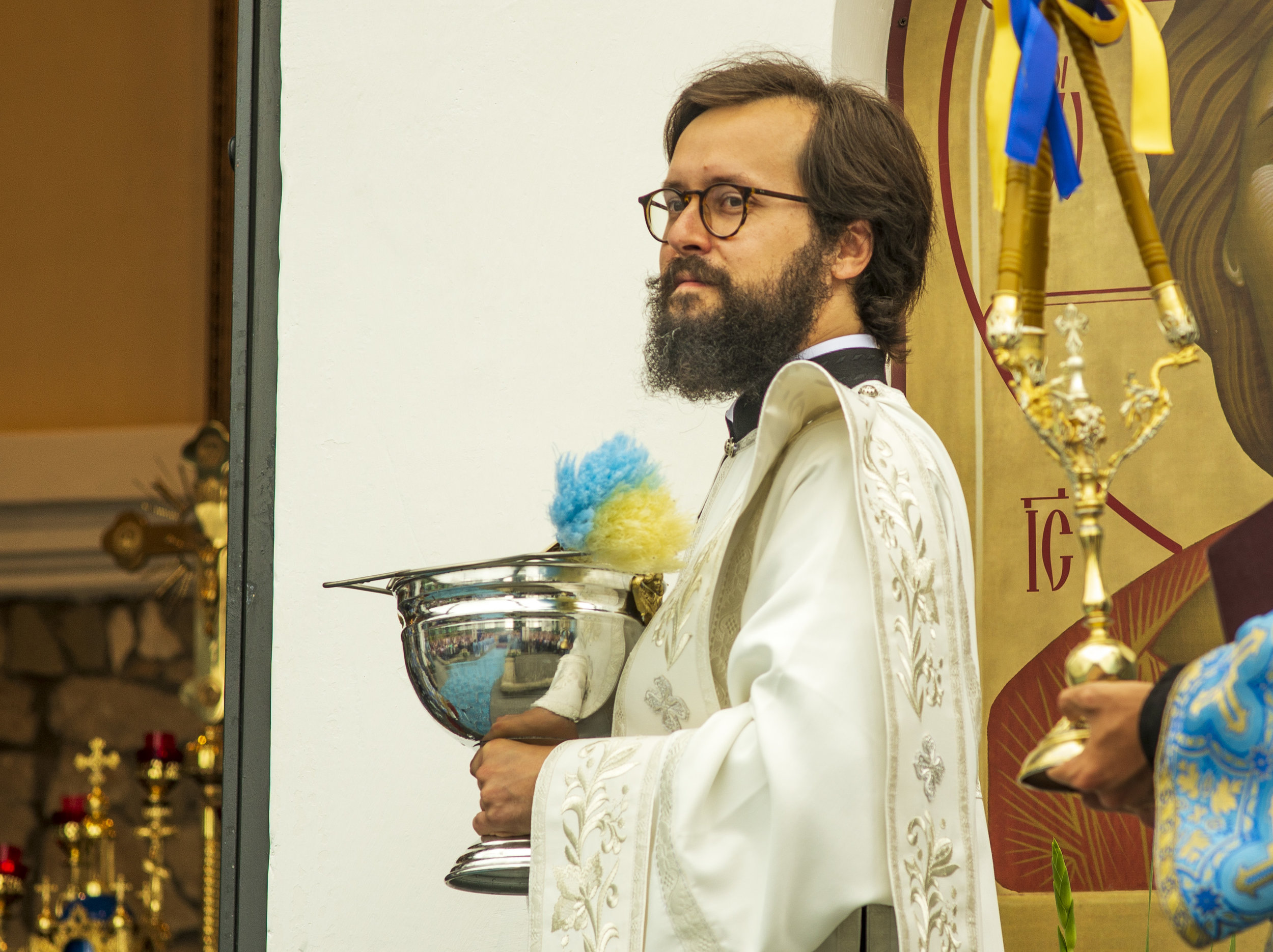
It is always a delight to interview scholars on here, but--in the interests of full disclosure--it is an especial delight with Daniel Galadza, whom I have known for the better part of two decades now. He is not just a friend, but also co-editor on a book we are finishing for Peeters about the pseudo-sobor of Lviv of 1946. (More on that soon.) In any event, he is the consummate gentleman and scholar who wears his vast learning very lightly on his diaconal riassa. Following my usual practice, I sent him some questions about his recent book, and here are his thoughts.

AD: Tell us about your background

DG: I am a deacon of the Ukrainian Greco-Catholic Church (UGCC), born in Chicago, raised in Toronto and Ottawa by my parents, Fr. Peter and Olenka Galadza. After studies at Trinity College in the University of Toronto and the Sheptytsky Institute, then at St. Paul University in Ottawa, I did a licentiate and a doctorate in Rome with Stefano Parenti, my doctoral supervisor, at the Oriental Institute, with a year as a junior fellow in Byzantine Studies at Dumbarton Oaks in 2011–2012.

In Rome, I paid close attention to how the coffee was made at my college, the Russicum, assuming that as a layman with a doctoral in Byzantine liturgy I might end up working at Starbucks--if I were lucky. But God had a different plan and I ended up as an assistant professor in the Catholic Theology Faculty at the University of Vienna in 2013, with Prof. Hans-Jürgen Feulner as my boss and Sr. Vassa Larin as a colleague.

Vienna is known as a “Byzantinists paradise” (well, perhaps not in the guidebooks) and I got to know the scholars in Byzantine Studies at the University of Vienna and the Austrian Academy of Sciences. For the last few years, Prof. Claudia Rapp had led the team of the “Vienna Euchologia Project,” of which I am honoured to be a member (officially as an “international research partner” since I no longer live in Vienna).

Since 2018, I have been in Kyiv as a deacon of the Kyiv Archeparchy, a lecturer at the seminary, and a member of the liturgical commission, at the same time trying to keep up with scholarly work in Europe and North America.

During the fall semester 2018 I was a visiting lecturer at the Sheptytsky Institute, now at University of St. Michael’s College in the University of Toronto, and from 2019 I am a fellow of the Centre for Advanced Studies at the University of Regensburg, splitting up semesters between Bavaria and Ukraine.

AD: What led you to write Liturgy and Byzantinization in Jerusalem?

In May 2008, I had finished my Bacherlor of Theology degree and had applied to study at the Pontifical Oriental Institute (PIO) in Rome. I wasn’t really sure about how things worked at the universities in Rome, so I made a trip to investigate and made an appointment with Fr. Robert Taft, SJ, whom I had known through my parents since childhood. He immediately sat me down and gave me a list of four different doctoral thesis topics. One of them was about the Basilians and the decline of the UGCC’s liturgical tradition, which is a fascinating topic, but I didn’t want to start my academic work immediately making enemies, so I chose the topic on the list about which I knew the least: the “liturgical Byzantinization” of the Orthodox Patriarchate of Jerusalem. That ended up being my thesis topic for the licentiate and doctorate.

Upon arrival in Rome in September 2008, I already knew my thesis topic and was fortunate enough to live in a college next door to the PIO library, so I was able to take advantage of the amazing resources there and read all about a whole other, fascinating world of Eastern Christianity I knew of only generally through my studies in Canada. The thesis then turned into the book, which was published in 2018 by Oxford University Press and came out as paperback in 2019.

AD: Among Eastern Catholics, the notion of “Latinization” is fairly common, and since at least Vatican II, almost always reprobated. Is “Byzantinization” a similar process, and if so, of what and of whom? Does it carry the same negative connotations today as “Latinization” does for many?

In a way, the two phenomena are similar. Byzantinization, like Latinization, is, generally speaking, the adoption of foreign customs and practices, potentially including also theology, culture, and even language, to the detriment of the local, “authentic” tradition. More specifically, the liturgical Byzantinization of Jerusalem involved the supplanting of liturgical tradition of Jerusalem by the rite of Constantinople. The process was complex, due to the natural evolution of the Byzantine liturgical tradition, which was a synthesis of elements from Constantinople, Jerusalem, and elsewhere.

Like Latinization, Byzantinization was never officially imposed on the other Eastern Patriarchates of Alexandria, Antioch, and Jerusalem, although due to the cultural climate of the post-Iconoclast Eastern Mediterranean, the factions within these Eastern Patriarchates that were faithful to the decisions of the Council of Chalcedon (451) willingly adopted most of the synthesized Byzantine practices. This was partly due to a desire to show unity with Constantinople and partly due to the declining material situation of each of the Eastern Patriarchates as a result of invasions and non-Byzantine rule from the seventh century onward. In such a context, the prestige of Constantinople was felt even more strongly among the Chalcedonians outside the constantly shrinking borders of the Byzantine Empire.

Latinization for the Eastern Catholics is similar. It was rarely imposed officially by the Holy See and usually adopted willingly by Eastern Catholics because of Rome’s prestige as a center of authority and education. (A notable exception might be the 1720 Synod of Zamosc, which officially imposed numerous Latin practices based on Tridentine scholastic theology, in an attempt to bring order to the chaos of the Uniate Church in the century following the Union of Brest. Because Rome has since the Second Vatican Council officially encouraged the Eastern Catholic Churches to return to their ancestral traditions, it will be interesting to see how the UGCC will commemorate the 300th anniversary of the Synod of Zamosc in 2020.)

Around the time of the Second Vatican Council, the Melkite Greco-Catholic Church was also eager to rediscover its ancestral traditions and a group of scholars and clergy, known as the Cairo Circle, began discussing ideas about the restoration of an authentic Melkite liturgy, since for them Byzantinization was their version of Latinization. However, as far as I am aware, not much came of it, because the authentic practices from Jerusalem had not yet been sufficiently researched and there was no continuity with the liturgical tradition of Jerusalem because it had been completely lost. Thus, it was almost impossible to restore and implement in a practical manner.

Although they are similar as phenomena, the histories of Latinization and Byzantinization are, however, quite different, of course, but so are the histories of the Byzantinization of each of the three Eastern Patriarchates, due to their specific linguistic and political contexts.

AD: In an era when much of the academy has been drawing critical attention to the phenomena of colonialism and imperialism, you seem to suggest that the Byzantinization of Jerusalem does not constitute a straightforward case of imperial subjugation and transformation at the hands of Constantinople—that, as your introduction nicely puts it, “the periphery of one centre can become the centre of yet another periphery.” Tell us a bit more about these dynamics.

The phenomenon in question here is certainly not straightforward. Liturgical Byzantinization in Jerusalem—which is not the same as political, literary, cultural, etc. forms of Byzantinization—began only after Jerusalem was no longer under Byzantine imperial and political control. The same is the case for Alexandria, although Antioch’s history is somewhat different, due to the Byzantine reconquest of Syria in the tenth century.

Previous theories about Byzantinization in Jerusalem suggested it was imposed and happened suddenly. A common narrative used to go like this: after the destruction of the Holy Sepulcher, also known as the Anastasis Church, in 1009, the rite of Jerusalem was lost and its patriarchs were exiled to Constantinople in the eleventh and twelfth centuries, where they learned the Byzantine Rite and brought it back with them to Jerusalem along with ready-made books.

However, the sources suggest otherwise, painting a picture of a gradual change to the liturgical tradition that was carried out locally, often times by scribes copying liturgical books and attempting to reconcile differences in liturgical practice.

AD: Part of your argument seems to be that Byzantinization was less about imperial imposition of liturgical trends and traditions, and more about local alterations, based partly on the changing geopolitical and topographical realities of the city. Give us, if you would, an example or two of these changes.

If I haven’t mentioned it already, perhaps this is the time to do so: there are no historical or legal documents from Constantinople, Jerusalem, or elsewhere that explicitly prescribe how liturgical Byzantinization was to be carried out, such as a conciliar document or the decree of a patriarch or emperor, nor do any sources, such as chronicles or other historical accounts, describe exactly how it happened.

The main sources for information are liturgical manuscripts, the books used for prayer during the liturgy, dating from the eighth century onwards. The most important collection for the study of the Byzantinization of Jerusalem is the library of the Monastery of St. Catherine on Mount Sinai, which houses hundreds of manuscripts in a variety of ancient languages and is also the place some of these manuscripts were copied and used.

At Mount Sinai, the Georgian collection of manuscripts is of particular importance, not just because of the local Georgian monastic community there in the Byzantine period, but also because of the migration of the Georgian monks of the Lavra of St. Sabas in Palestine near Jerusalem to Sinai in the tenth century. Among them was Iovane Zosime, a Georgian monk and scribe who copied numerous and diverse manuscripts, many of them liturgical. What is significant about Iovane Zosime is that he is aware of his sources and gives information about them. What is more, he often dates and signs his work, which isn’t always the case with scribes.

The calendar he copied in codex Sinai Georgian Old Collection 34—one needs to distinguish between the old and new collection, because a whole trove of manuscripts was rediscovered at the monastery in 1975—presents a liturgical calendar for the whole year based on several sources, including ones from Constantinople, Jerusalem, and the Lavra of St. Sabas. Thus, Iovane Zosime was, in a way, one of the first scholars of “comparative liturgy” and his work confirms that already in the tenth century, monks and scribes at the Sabas Lavra and Mount Sinai knew of multiple liturgical traditions, these traditions were in contact with one another in Jerusalem, and they were also changing. Specifically in the calendar, the feast of St. James the Brother of the Lord is mentioned on multiple days—both on the days his feast was celebrated in Jerusalem (December 1, December 26, May 25) and in Constantinople (October 23)—showing the gradual nature of the change.

Two centuries later, we know of the work of another scribe, Basil the Hagiopolite, a reader and scribe at the Church of the Anastasis in Jerusalem, from an important manuscript copied in 1122 and known in liturgical scholarship as the “Typikon of the Anastasis.” The manuscript contains all the hymns, readings, and prayers necessary for Holy Week and Easter at the Anastasis, mentioning local practices native to Jerusalem, like the Liturgy of St. James, but also a loss of other local elements and revealing an influx of general Byzantine practices. Basil the Hagiopolite himself shows an awareness of two different traditions and tries to make sense of them in his manuscript. Most notably, the processions on Palm Sunday that Basil describes have been lost and the gospel readings for Holy Week have changed.

AD: You note that much of the Byzantinization comes after the three conquests—the Persian, the Arab, and the Crusaders, in a period leading up to the thirteenth century. A contemporary reader might wonder if there is any kind of causal link between events here? In other words, is it conceivable to think that Jerusalem Christians, feeling under siege and perhaps worried about loss of their “identity” (as we might call it today), would seek to buttress and solidify that identity by conforming their external appearances and practices to be more like other Christians, including those in the still unconquered imperial capital?

Most certainly! I would argue that there is very little change in theological content when examining Byzantinization and that it has much more to do with religious identity and affiliation. Once the Greek-praying Christians become the minority in Jerusalem and are no longer under Byzantine rule, they look to their coreligionists for moral—and sometimes financial—support. Although the Chalcedonian Christians of Jerusalem were unique because they had no homegrown non-Chalcedonian Church in Jerusalem and Palestine, unlike the case in with numerous non-Chalcedonians in Syria and Egypt, nevertheless they seemed eager to maintain strong links with Constantinople. It appears that the strong Greek monastic presence in the Holy Land also played a role in buttressing the Greek, Chalcedonian identity in Jerusalem.

AD: For those unfamiliar with Jerusalem’s liturgical calendar (ch.4), and lectionary (ch.5), what are some of the most notable and distinctive features in your eyes?

In a nutshell, here are some of the most noteworthy elements:

The calendar, from the sixth century onward at least, begins with Christmas rather than September 1, suggesting a theological emphasis on the Incarnation that is understood in the liturgical year as well. The day on which a saint is commemorated depends on the local tradition of Jerusalem. If we take the example of St. James again, December 26 was an ancient day of commemorating James in Jerusalem connected, at least according to Anton Baumstark, with the Jewish celebration of the dedication of the Temple. The October 23 commemoration depended on the transfer of the relics of James to Constantinople. The calendar of Jerusalem also had multiple days of certain saints and sometimes celebrated groups of saints together, often dependent upon the dedication of a church in Jerusalem where their relics were deposed. Octaves, or eight day celebrations of major feasts, were also a significant feature and the most important ones involved stational liturgy during the eight days at some of the more important churches of Jerusalem.

The lectionary is intimately related to the calendar and in some cases lectionary manuscripts give us the most information about the calendar. Unlike the Byzantine lectionary—where the order of the Gospels from Easter to Lent is John, Matthew, Luke, and Mark—the Jerusalem lectionary reads them in the following order: John, Matthew, Mark, and Luke. Even when the same Gospel is read during the same liturgical season, the pericopes (or individual excerpts) for a given commemoration are not necessarily the same. For example, the readings from the Gospel of John on the Sundays after Easter have completely different episodes when comparing the Jerusalem and Constantinople lectionaries.

Perhaps the most important and interesting aspect of the Jerusalem lectionary for Orthodox liturgy is that it has an Old Testament reading at the Divine Liturgy. The ancient Armenian and Georgian translations of the Jerusalem lectionary have quite an extensive series of Old Testament readings, but Greek manuscripts with Old Testament readings for the Divine Liturgy are quite rare.

AD: If, in a sense, Jerusalem is the “mother-city” for all Christians, do we find elements of her lectionary and calendar anywhere today in other traditions—a kind of “Jerusalemization” of, say, Coptic or Syriac or Latin or Byzantine traditions? Is her tradition of “stational” liturgies borrowed or copied by other traditions?

The Liturgy of St. James—the local Divine Liturgy of Jerusalem—does in fact refer to Jerusalem, or rather to Sion, as the “Mother of all the Church.” With regard to liturgical practice, Jerusalem certainly did function as a centre of influence over all of Christendom, in effect the “Jerusalemization” of many other Christian traditions. This was particularly felt in Constantinople, where there really wasn’t a sacred topography and much of its liturgy was imported from elsewhere. In Constantinople, one can see strong the influence of Jerusalem during Holy Week, with its structure based on biblical narratives imported from Jerusalem. Constantinople also adopted Jerusalem’s Bright Week Gospel readings, but with a twist: instead of reading them on every day of Bright Week at Divine Liturgy, as was done in Jerusalem, Constantinople took them and turned them into the eleven resurrectional Gospels read at Orthros, or Matins, every Sunday morning.

With regard to “stational” liturgies, processions led by the bishop that went through the city with hymns and stopped at various points, these were imitated in Constantinople, Rome, and elsewhere.

But these aren’t discoveries that are new to my book or research. Many of these insights into “Jerusalemization” and “stational” liturgies come from the works of Janeras, Taft, Baldovin, and several Russian scholars writing before the October Revolution. My goal in the book was to present a summary of this scholarship, often times scattered in diverse studies in various languages, and to bring it into dialogue with information found in additional manuscripts, many of them among the “new finds” of Sinai from 1975 in order to examine the interaction of the liturgical traditions of Jerusalem and Constantinople, and the question of Byzantinization in Jerusalem.

AD: Much of your work proceeds comparatively, and by drawing on the methods of Baumstark and Taft. But you also note the limitations of this method. Tell us about some of those limitations and then tell us more generally about your methods of research for this book, including especially looking at liturgy “from the bottom up.” Why is that important and what are its benefits?

In this study, I did indeed rely on comparative methods, primarily due to the comparative nature of examining the liturgies of Jerusalem and Constantinople and seeing the influence of one on the other and vice versa. From a purely technical point of view, the comparative method, with its emphasis on a textual and philological approach that respects the importance of the historical context, fit best to begin this investigation. Because the topic of Byzantinization is precisely a question of top-down, “official” liturgy, liturgical books are the main source for study.

Comparative liturgy is often criticized because it can at times overemphasize liturgical structures over the meaning of texts and does not say much about the experience of the people during the liturgical services. The problem of the authority, use, and reliability of texts is also one that must be grappled with, especially if adopting the “splitter” approach (in the dichotomy of Paul Bradshaw).

The “from the bottom up” approach is something that I am attempting to read about more and integrate into my work, but in other areas, for example in work dealing with the Vienna Euchologia Project.

AD: I recall meeting you for lunch in Washington DC some years back, when you were a fellow at Dumbarton Oaks, and you casually told me, as we stood waiting for the traffic light to change, that you were studying Georgian. Why are Georgian sources important to your study?

I don’t think it could have been casually, Adam, since ancient Georgian is far from “casual”: they say you can learn the Georgian noun in a day and spent the rest of your life learning the Georgian verb. Studying Georgian in Rome was quite the experience!

The importance of Georgian sources in Jerusalem is primarily due to the presence of Georgian pilgrims and monks who stayed in Jerusalem, made translations and copies of its liturgical manuscripts, and then either used them in Jerusalem and its environs in their own Georgian-praying communities or brought them back to Georgia. Because many of the Greek originals were lost, Georgian manuscripts are sometimes the only surviving witnesses to this ancient and lost liturgical tradition.

AD: You note that in some ways even today the periphery-centre tension still holds, but with different focus today: must the Jerusalem patriarchate remain, as it were, an outpost of the Greek Orthodox Church, resisting any attempts at change in, say, a more “Arabized” direction? But you also note that in the early 20th century there was less defensiveness and more openness to studying the authentic tradition and perhaps removing non-native elements. How far did such a movement get, and is there anything comparable today?

The current state of the affairs in the Church of Jerusalem is not an easy one and balancing internal and external ecclesiastical relations are in addition to some of the difficulties of daily life in Israel and Palestine today. Christians find it difficult to stay and without a local population, the Church depends on pilgrims and non-Palestinian Christians to keep life going.

Some of the activity of the Greek Orthodox Patriarchate of Jerusalem, such as the retention of the Julian calendar, seems to depend on the status quo agreement from previous centuries that codified liturgical life at the Church of the Holy Sepulcher. Today, one can observe frequent use of Arabic, and sometimes other languages, at the Divine Liturgy, for example the Gospel reading. However, this multilingualism in the liturgy is nothing new, since Egeria describes it in the fourth century and Basil the Hagiopolite mentions it in the twelfth.

Any tendency to differentiate the Jerusalem Patriarchate too much from other Orthodox would isolate it from the rest of the Church—which is precisely one of the reasons why Byzantinization occurred, to strengthen ties and establish a common identity with Christians beyond Jerusalem.

Nevertheless, the late nineteenth and early twentieth century did witness a great interest in the local liturgical tradition of Jerusalem from scholars who were also ecclesiastical authorities. This meant the Liturgy of St. James was revived, although not always with the right motives. Because the manuscripts of the Liturgy of St. James are often missing rubrics and the tradition ceased to be celebrated, Archbishop Dionysios Latas of Zakynthos supplied his own rubrics based on his studies of biblical archaeology. His Greek edition was then adapted to Church Slavonic by Ivan Gardner (at that time Hieromonk Philip). The resulting liturgy that is often celebrated today is effectively a nineteenth-century scholarly invention. Prof. Heinzgerd Brakmann has written several articles about this.

It is curious that in some circles where any change or reform in the Liturgies of St. John Chrysostom or St. Basil the Great would be frowned upon, the nineteenth-century revived version of the Liturgy of St. James is welcomed and celebrated frequently. Prof. Vitaly Permiakov, who has studied these questions for some years, has recently published a Church Slavonic-English edition where he attempts to address some of these problems.

AD: Sum up your hopes for the book, and who in particular would benefit from reading it?

My main hope is that it will inspire other scholars to look more closely at the question of Byzantinization, whether in Jerusalem or one of the other Eastern Patriarchates, and provide more definitive answers than I have. The history of the Byzantinization of Antioch and Alexandria remains to be written. I believe Antioch holds the answers to many of the remaining questions about Byzantinization, precisely because it was reconquered by the Byzantines in the tenth century and because it is geographically between Constantinople and Jerusalem.

I also hope that Syriac scholars will find the book to be a useful reference in their examination of the abundance of Syriac Melkite manuscripts, most of them in the library of the Monastery of St. Catherine on Sinai and lamentably ignored in Byzantine liturgical studies. The importance of Georgian for Byzantine and theological studies is now being appreciated in Western academia (I should mention here the work of Stephen Shoemaker and his English translation of the Georgian Iadgari hymnal from Jerusalem, which I was not able to mention in my book because they appeared at around the same time), but I hope that better resources for studying ancient Georgian will be made available in the West.

Having expressed all these wishes, I do not want to give the impression that the book is intended only for specialists. (Certainly, certain sections will be too technical for some readers. For others, the book might be effective against insomnia.) I hope that anyone familiar with the Byzantine liturgical tradition, particularly its faithful practitioners, might find something of interest in the book—whether in the general introduction to Jerusalem’s liturgy before its Byzantinization or the discussion of the Liturgy of St. James, the calendar, or the lectionary.

AD: Having finished the book, what projects are you at work on now?

Perhaps too many to keep track of myself... At the moment, I am a fellow at the Centre for Advanced Studies of the University of Regensburg, where there are quite a few conferences and workshops on liturgical topics, organized by Prof. Harald Buchinger, an expert on the early liturgy of Jerusalem. My own work at the Centre involves a translation and commentary of the twelfth-century Greek manuscript from Jerusalem I mentioned earlier: Hagios Stavros gr. 43, known as the “Typikon of the Anastasis,” a hymnal for Holy Week and Easter whose services, readings, and hymns would be recognizable to any Byzantine Rite Christian, whether Orthodox or Greco-Catholic, who has attended their local parish during that most solemn time of the year. My goal with this project is to investigate the question of liturgical theology through the prism of hymnography in order to understand how the hymns serve as scriptural exegesis and also liturgical hermeneutic.

Last year, Prof. Jos Verheyden and I organized a conference on liturgy and literature in the various multilingual communities of the Lavra of St. Sabas at Catholic University of Leuven, so I am now slowly working on publishing the proceedings, which I hope will appear in the not too distant future.

Apart from those main projects, I am also interested in early printed Church Slavonic liturgical books from Ukraine. Some are housed in various libraries in Kyiv, Lviv, and elsewhere (while some can still be purchased online for very reasonable prices!). In the coming years I hope to more beyond Jerusalem and the first Christian millennium and delve deeper into the Slavonic and Kyivan liturgical tradition. Perhaps after Byzantinization, I’ll move on to Latinization. We’ll see.

Monday, August 6, 2018

Liturgy and the New Testament

Prof. Gregory Paulson of the Institut für Neutestamentliche Textforschung in Münster very kindly drew my attention to a new collection just published by Gorgias Press (which I'm always happy to mention given their vast and unrivaled attention to Eastern, and especially Syriac, Christian realities): Liturgy and the Living Text of the New Testament: Papers from the Tenth Birmingham Colloquium on the Textual Criticism of the New Testament, ed. H. A. G. Houghton (2018), 319pp. As you'll see from the table of contents below, considerable attention is paid to Greek, Byzantine, and Coptic realities.

About this collection the publisher tells us the following:
The textual history of the New Testament is a dynamic tradition, reflecting differing readings, interpretations and uses of its canonical writings. Twenty years after the publication of D.C. Parker’s celebrated volume The Living Text of the Gospels, the papers in this collection (first presented at the Tenth Birmingham Colloquium on the Textual Criticism of the New Testament) provide further insight into the lives of the New Testament text. One especially important focus for the New Testament as “living text” is its use in Christian worship: individual chapters examine the importance of liturgical manuscripts in Coptic and Greek traditions, alongside consideration of broader themes related to the lectionary text. Several famous biblical passages are the subject of extended treatment, including the Pericope Adulterae, Jesus’ teaching on the Temple in Mark, and the Lukan genealogy. The contributions represent original research by an international range of scholars, first presented at the Tenth Birmingham Colloquium on the Textual Criticism of the New Testament.
The table of contents:
List of Contributors (vii)
List of Abbreviations (xi)
Introduction (xiii)

1. Was There an Alexandrian Recension of the Living Text? TOMMY WASSERMAN (1)

2. The Living Text of Mark 13:2: Western Witnesses and the Book of Daniel. JEFF CATE (25)

3. One or Two Cups? The Text of Luke 22:17–20 Again. THOMAS O’LOUGHLIN (51)

4. The Lukan Genealogy (Luke 3:23–38) as a Living Text: The Genealogy of Jesus in the Traditions of Codex Bezae and Aphrahat. PETER E. LORENZ (71)

5. A Proposal For a Critical Edition of the Greek New Testament Lectionary. GREGORY S. PAULSON (121)

6. Some Notes on the Pericope Adulterae in Byzantine Liturgy. TEUNIS VAN LOPIK (151)

7. ‘Full of the Holy Spirit and Wisdom’: Variation in Theological Titles in the Greek Lectionary of Acts. SAMUEL GIBSON (177)

8. Is There Evidence For a Lectionary Text in Sahidic Coptic? MATTHIAS H.O. SCHULZ (197)

9. The Influence of the Catenae on the Most Recent Modern Greek New Testament Translation of the Hellenic Bible Society. THEODORA PANELLA (225)

10. From Inner-Jewish Debate to Anti-Jewish Polemic? The Transformation of the Gospel of John within its Textual Transmission. HANS FÖRSTER (245)

11. Inventing New Testaments. D.C. PARKER (269)

Index (287)

Friday, August 3, 2018

A Brief Introduction to Byzantine Christianity

The well-known British scholar Averil Cameron, a Byzantinist of long-standing distinction and many publications, has recently published Byzantine Christianity: A Very Brief History (SPCK/IVP, 2018), 138pp.

About this book the publisher tells us the following:
From the foundation of Constantinople in 330 to its fall in 1453, this brief history explores the key components of Byzantine Christianity, including the development of monasticism, icons and iconoclasm, the role of the emperor in relation to church councils and beliefs, the difficult relationship with the papacy, and the impact of the Crusades.
The book also considers Byzantine Christianity as a living force today: the variety and vitality of Orthodox churches, the role of the Church in Russia, and the enduring relevance of a spirituality derived from the church fathers.

Friday, July 27, 2018

Liturgical Subjects and the Byzantine Self

It was acclaimed several years ago upon its publication in hardback, and now this noteworthy book is available this year in a more affordable paperback edition: Liturgical Subjects: Christian Ritual, Biblical Narrative, and the Formation of the Self in Byzantium by Derek Krueger (University of Pennsylvania Press, 2018), 328 pages.

About this book we are told by the publisher:
Liturgical Subjects examines the history of the self in the Byzantine Empire, challenging narratives of Christian subjectivity that focus only on classical antiquity and the Western Middle Ages. As Derek Krueger demonstrates, Orthodox Christian interior life was profoundly shaped by patterns of worship introduced and disseminated by Byzantine clergy. Hymns, prayers, and sermons transmitted complex emotional responses to biblical stories, particularly during Lent. Religious services and religious art taught congregants who they were in relation to God and each other.
Focusing on Christian practice in Constantinople from the sixth to eleventh centuries, Krueger charts the impact of the liturgical calendar, the eucharistic rite, hymns for vigils and festivals, and scenes from the life of Christ on the making of Christian selves. Exploring the verse of great Byzantine liturgical poets, including Romanos the Melodist, Andrew of Crete, Theodore the Stoudite, and Symeon the New Theologian, he demonstrates how their compositions offered templates for Christian self-regard and self-criticism, defining the Christian "I." Cantors, choirs, and congregations sang in the first person singular expressing guilt and repentence, while prayers and sermons defined the collective identity of the Christian community as sinners in need of salvation. By examining the way models of selfhood were formed, performed, and transmitted in the Byzantine Empire, Liturgical Subjects adds a vital dimension to the history of the self in Western culture.
The well-known Orthodox scholar Susan Ashbrook Harvey blurbs this book thus:
 "A thrilling tour of Byzantine culture through wholly unexpected routes. With beautifully crafted prose, Krueger presents a trajectory lucidly drawn, filled with arresting insight and searing, poignant imagery; yet the account is concrete and concise, moving deftly through its chapters with impressive economy and formidable command of a wide array of textual and material evidence."—Susan Ashbrook Harvey, Brown University

Monday, December 18, 2017

After Dying in Byzantium, Where Does Your Soul Go?

If you hang around any Orthodox blogs or apologetics sites, you'll soon come across heated discussion about "toll-houses" and related matters trying to figure out the soul's fate post-mortem. The scholar Stephen Shoemaker, whom I have interviewed on here in the past in connection with his other works, has an excellent essay here.

Shoemaker's essay references, inter alia, recent works on the topic, including a book released just this spring:  Death and the Afterlife in Byzantium: The Fate of the Soul in Theology, Literature, and Art 
by Vasileios Marinis (Cambridge UP, 2017), 214pp.

About this book the publisher tells us:
For all their reputed and professed preoccupation with the afterlife, the Byzantines had no systematic conception of the fate of the soul between death and the Last Judgement. Death and the Afterlife in Byzantium marries for the first time liturgical, theological, literary, and material evidence to investigate a fundamental question: what did the Byzantines believe happened after death? This interdisciplinary study provides an in-depth analysis and synthesis of hagiography, theological treatises, apocryphal texts, liturgical services, as well as images of the fate of the soul in manuscript and monumental decoration. It also places the imagery of the afterlife, both literary and artistic, within the context of Byzantine culture, spirituality, and soteriology. The book intends to be the definitive study on concepts of the afterlife in Byzantium, and its interdisciplinary structure will appeal to students and specialists from a variety of areas in medieval studies.

Friday, September 1, 2017

Byzantine Canopies

Study of all things Byzantine remains steady, and that is no less true for the Byzantine liturgical tradition as well, which certainly commands far more scholarly attention in North America today than, say, the Armenian, Alexandrian, or various Syriac traditions.

Released this summer is another study that adds to other works highly focused on very particular parts and details of the Byzantine liturgical tradition: The Framing of Sacred Space: The Canopy and the Byzantine Church by Jelena Bogdanovic (Oxford UP, 2017), 456 Pages + 141 color and 44 black-and-white illustrations.

About this book we are told:
The Framing of Sacred Space offers the first topical study of canopies as essential spatial and symbolic units in Byzantine-rite churches. Centrally planned columnar structures--typically comprised of four columns and a roof--canopies had a critical role in the modular processes of church design, from actual church furnishings in the shape of a canopy to the church's structural core. As architectonic objects of basic structural and design integrity, canopies integrate an archetypical image of architecture and provide means for an innovative understanding of the materialization of the idea of the Byzantine church and its multi-focal spatial presence.
The Framing of Sacred Space considers both the material and conceptual framing of sacred space and explains how the canopy bridges the physical and transcendental realms. As a crucial element of church design in the Byzantine world, a world that gradually abandoned the basilica as a typical building of Roman imperial secular architecture, the canopy carried tectonic and theological meanings and, through vaulted, canopied bays and recognizable Byzantine domed churches, established organic architectural, symbolic, and sacred ties between the Old and New Covenants. In such an overarching context, the canopy becomes an architectural parti, a vital concept and dynamic design principle that carries the essence of the Byzantine church. The Framing of Sacred Space highlights significant factors in understanding canopies through specific architectural settings and the Byzantine concepts of space, thus also contributing to larger debates about the creation of sacred space and related architectural taxonomy.

Friday, August 11, 2017

Liturgy and Byzantinization in Jerusalem

It is one of the undeserved gifts of my life that I can count Daniel Galadza as a friend as well as co-worker (we are editing a collection of papers on the 1946 pseudo-sobor of Lviv based on a conference at the University of Vienna in June of 2016, which I discussed a bit here). He is a scholar's scholar without any of the pretenses such men sometimes have, combining great erudition with great humility. I've never forgotten our conversation about six or seven years ago now when I was in Washington giving a paper at a conference, and he was a junior fellow at the most prestigious centre for Byzantine studies in North America, Dumbarton Oaks. As we were standing in the rain waiting to cross some street or other en route to lunch, I asked him what he'd been up to lately, and he very off-handedly remarked that he was teaching himself Georgian (to add to his fluent Ukrainian, English, German, French, Italian, and, as I saw this past June in San Felice del Benaco, not impassable Russian!), at which I doffed my cap yet again in amazement.

He has been teaching at the University of Vienna since completing his doctoral studies in Rome. That dissertation will be published next year in the very prestigious series, Oxford Early Christian Studies, from the publisher of the same name: Liturgy and Byzantinization in Jerusalem (OUP, 2018), 432pp.

About this forthcoming study, we are told:
The Church of Jerusalem, the "mother of the churches of God," influenced all of Christendom before it underwent multiple captivities between the eighth and thirteenth centuries: first, political subjugation to Arab Islamic forces, then displacement of Greek-praying Christians by Crusaders, and finally ritual assimilation to fellow Orthodox Byzantines in Constantinople. All three contributed to the phenomenon of the Byzantinization of Jerusalem's liturgy, but only the last explains how it was completely lost and replaced by the liturgy of the imperial capital, Constantinople. The sources for this study are rediscovered manuscripts of Jerusalem's liturgical calendar and lectionary. When examined in context, they reveal that the devastating events of the Arab conquest in 638 and the destruction of the Holy Sepulchre in 1009 did not have as detrimental an effect on liturgy as previously held. Instead, they confirm that the process of Byzantinization was gradual and locally-effected, rather than an imposed element of Byzantine imperial policy or ideology of the Church of Constantinople. Originally, the city's worship consisted of reading scripture and singing hymns at places connected with the life of Christ, so that the link between holy sites and liturgy became a hallmark of Jerusalem's worship, but the changing sacred topography led to changes in the local liturgical tradition. Liturgy and Byzantinization in Jerusalem is the first study dedicated to the question of the Byzantinization of Jerusalem's liturgy, providing English translations of many liturgical texts and hymns here for the first time and offering a glimpse of Jerusalem's lost liturgical and theological tradition.
Upon its publication next year, you can be sure I'll arrange an interview with the author to discuss his work in more detail.

Friday, August 4, 2017

Byzantine Architecture and Aurality

I hope soon to run an interview with Nicholas Denysenko about his new book, Theology and Form: Contemporary Orthodox Architecture in America.

But this is a rich summer for those with an interest in such topics, as Bissera Pentcheva has just edited and published Aural Architecture in Byzantium: Music, Acoustics, and Ritual (Routledge, 2017), 272pp.

About this collection the publisher tells us:
Emerging from the challenge to reconstruct sonic and spatial experiences of the deep past, this multidisciplinary collection of ten essays explores the intersection of liturgy, acoustics, and art in the churches of Constantinople, Jerusalem, Rome and Armenia, and reflects on the role digital technology can play in re-creating aspects of the sensually rich performance of the divine word. Engaging the material fabric of the buildings in relationship to the liturgical ritual, the book studies the structure of the rite, revealing the important role chant plays in it, and confronts both the acoustics of the physical spaces and the hermeneutic system of reception of the religious services. By then drawing on audio software modelling tools in order to reproduce some of the visual and aural aspects of these multi-sensory public rituals, it inaugurates a synthetic approach to the study of the premodern sacred space, which bridges humanities with exact sciences. The result is a rich contribution to the growing discipline of sound studies and an innovative convergence of the medieval and the digital.
Pentcheva also has a monograph coming out in September under her own hand, clearly related this topic: Hagia Sophia: Sound, Space, and Spirit in Byzantium (Penn State, 2017), 304pp.

About this forthcoming book, the publisher tells us:
Experiencing the resonant acoustics of the church of Hagia Sophia allowed the Byzantine participants in its liturgical rituals to be filled with the Spirit of God, and even to become his image on earth. Bissera Pentcheva’s vibrant analysis examines how these sung rites combined with the church’s architectural space to make Hagia Sophia a performative place of worship representative of Byzantine religious culture in all its sensory richness.
Coupling digital acoustic models and video with a close examination of liturgical texts and melodic structures, Pentcheva applies art-historical, philosophical, archeoacoustical, and anthropological methodologies to provide insight into the complementary ways liturgy and location worked to animate worshippers in Byzantium. Rather than focus on the architectural form of the building, the technology of its construction, or the political ideology of its decoration, Pentcheva delves into the performativity of Hagia Sophia and explains how the “icons of sound” created by the sung liturgy and architectural reverberation formed an aural experience that led to mystical transcendence for worshippers, opening access to the imagined celestial sound of the angelic choirs.
Immersive, deeply researched, and beautifully illustrated, this exploration of Hagia Sophia sheds new light on sacred space, iconicity, and religious devotion in Byzantium. Scholars of art and architectural history, religious studies, music and acoustics, and the medieval period will especially appreciate Pentcheva’s field-advancing work.
Pentcheva is the author of two earlier studies in iconography, both of which were very positively reviewed in Logos: A Journal of Eastern Christian Studies. In 2006 she published Icons and Power: The Mother of God in Byzantium.

In 2010 she published The Sensual Icon: Space, Ritual, and the Senses in Byzantium (Penn State, 320pp).

Both books deserve a prominent place in any library serious about iconography.

Monday, February 20, 2017

The Liturgy of Death

Two years ago this month I was invited to the Wilken Colloquium at Baylor University, where I gave a lecture on contemporary eschatological heresies in light of Byzantine liturgical tradition. I have, before and since, remained very interested in how our culture treats death, and how Christians should respond to that, noting over the years some of the problems with contemporary funeral practices and the strange, curious new practices that are supplanting some older ones.

It was, then, with great interest that I received notice from St. Vladimir's Seminary Press of a new publication of recently discovered lectures by the great Orthodox liturgical theologian Alexander Schmemann, on whom I have often commented on here over the years: The Liturgy of Death (SVS Press, 2017), 234pp.

About this book the publisher tells us:
In these previously unpublished talks, Fr Alexander Schmemann critiques contemporary culture s distorted understanding of death. He then examines the Church s rites for burial and her prayers for the dead. Though they are often misunderstood, at the heart of the services Fr Alexander finds the paschal proclamation: Christ is risen from the dead, trampling down death by death, and upon those in the tombs bestowing life.
For the Orthodox Church, the time has arrived not to reform the liturgy of death, nor to modernize it (God forbid!), but simply to rediscover it. To rediscover it in its truth and glory means in its connection with the faith of the Church, with the meaning for the dead, for us, for the whole world and the entire creation of Christ s deathless death, and in connection with baptism and Eucharist, with Lent and Pascha, with the whole life of the Church and each one of us, her members. This rediscovery is needed first of all by the Church, but also by our secular culture, for which, whether we know it or not, we are responsible. How are we to rediscover it?
Contents:
Introduction by Alexis Vinogradov
Chapter 1 The Development of Christian Funeral Rites
Chapter 2 The Funeral Rites and Practices
Chapter 3 Prayers for the Dead
Chapter 4 The Liturgy of Death and Contemporary Culture
Appendix
The Order for the Burial of the Dead

Tuesday, July 12, 2016

A Byzantine Monastic Office

Of all the Eastern liturgical traditions, the Byzantine of course continues to command the greatest scholarly attention in part because it has the greatest number of faithful today--to say nothing of its historical-political prominence as the ritual tradition of empire. Scholarly attention has long focused heavily on the history of the Byzantine eucharistic liturgies, though more recent scholarship has been focusing on funerals, baptismal, and other rites, including monastic offices as in this book set for release later this month: Jeffrey C. Anderson, A Byzantine Monastic Office, A.D. 1105 (Catholic University of America Press, 2016), 368pp.

About this book we are told:
This book centers on a Greek text that was likely compiled in Constantinople, in 1105, for use in one of the monasteries located there. The book consists of a liturgical psalter, containing the fixed structure (the ordinary) in both the Greek original and in English translation, as well as a description of the hours themselves. The extensive commentary explains the development of the divine office, and the particular history of the translated manuscript, while brief notes clarify and explain, in a way suitable for non-liturgists, the more-technical aspects of the divine office.
Based on a single dated manuscript, the book presents the first, full example of the daily structure of monastic hours as they were celebrated at a time when services had reached a degree of maturity. The book, by presenting the ordinary of the office, compliments recent work on the propers of the office, and thus helps to complete our picture of the medieval monastic office in Byzantium.

Wednesday, March 16, 2016

The Therapeutic Power of Byzantine (and other) Rituals

Well do I remember seeing first hand, more than a decade ago, the healing power of ritual--in this case the Byzantine "rite of forgiveness" served on the eve of the Great Fast each year. Two people who had been bitterly estranged for years prostrated themselves before each other--as they and we all did--and it served at last to overcome their anger and misunderstanding. One of them reported to me right afterwards--with an enormous sigh of visible relief--that even after decades of knowing intellectually the power of liturgy, it still amazed him emotionally to experience so powerfully the real healing and reconciliation the rite had just enacted between him and his erstwhile brother in the faith.

I myself have explored this possibility of ritual healing in several articles over the years, wondering in particular whether the "healing of memories" of divided Christians can be effected, in part, through liturgy. As I have written about that over the years, it has long remained unclear to me exactly how a vague psychological phrase can be enacted among millions of people in a collective like the Church. Most of the exploration of "healing of memories" has taken place from the theology side, with little contribution from psychological, liturgical, or ritual studies--until now. Set for release later this month is a work from the psychiatrist Erik D. Goodwyn, Healing Symbols in Psychotherapy (Routledge, 2016), 240pp.

About this book we are told:
Ritual scholars note that rituals have powerful psychological, social and even biological effects, but these findings have not yet been integrated into the practice of psychotherapy and psychiatry. In Healing Symbols in Psychotherapy Erik D. Goodwyn attempts to rectify this by reviewing the most pertinent work done in the area of ritual study and applying it to the practice of psychotherapy and psychiatry, providing a new framework with which to approach therapy. The book combines ritual study with depth psychology, placebo study, biogenetic structuralism and cognitive anthropology to create a model of interdisciplinary psychology.
Goodwyn uses examples of rituals from history, folklore and cross-cultural study and uncovers the universal themes embedded within them as well as their psychological functions. As ritual scholars show time and again how Western culture and medicine is ‘ritually impoverished’ the application of ritual themes to therapy yields many new avenues for healing. The interdisciplinary model used here suggests new ways to approach problems with basic identity, complicated grief, anxiety, depression meaninglessness and a host of other problems encountered in clinical work.
The interdisciplinary approach of this accessibly-written book will appeal to psychotherapists, psychiatrists and Jungian analysts as well as those in training and readers with an interest in the science behind ritual.
The publisher also gives us the table of contents:
Part 1: Foundations. The Study of Ritual – Depth Psychology and Symbolic Anthropology. The Interdisciplinary Approach to Ritual. Part 2: The Dynamic Interdisciplinary Approach. Biological—Mind/Body Interactions. Cognitive—Cognitive Anthropology and Psychological Resonance. Psychodynamic—Projection, Narrative, Meaningful Coincidence and Dissociation. Cultural – Structures and Functions. Part 3: Applications. Magical Inscriptions. Healing Rituals. Transitional Rituals. Death. Part 4: Conclusions. The Technology of Ritual and the Ritual Expert. Summary. Afterword.

Tuesday, March 15, 2016

"A Bible Study Followed by a Meal": Ephrem Lash on the Eucharist

More than a decade ago now, in a graduate class on Byzantine liturgical translations, I was first introduced to the Orthodox liturgical scholar and translator Archimandrite Ephrem Lash. Most of his work has been freely available on his very useful website, which I check regularly. Some of his other printed translations are linked here on the right and left.

I've watched a number of his videos more recently, and he has long struck me as embodying a unique kind of English Orthodoxy seemingly without pretense (which cannot always be said): English because marked by dry wit (calling the Divine Liturgy structurally "a Bible study followed by a meal") and unromantic reflection on human nature; Orthodox because of a commitment to beauty and truth.

He died yesterday in London. We pray that his memory be eternal, and that his soul be placed where all the righteous dwell in (to use his translation) "a place of light, a place of green pasture, a place of refreshment, whence pain, grief and sighing have fled away."


Friday, March 4, 2016

Italo-Albanian Chant

There are certain groups, even within the often maddeningly confused world of Eastern Christianity, that are especially small and therefore acutely prone to being overlooked. The Italo-Albanians are arguably in this category. But at least one part of their heritage will no longer be so obscure, thanks to the publication next month of Bartolomeo di Salvo, Girolamo Garofalo, and Christian Troelsgård, eds., Chants of the Byzantine Rite: The Italo-Albanian Tradition in Sicily: Canti Ecclesiastici della Tradizione Italo-Albanese in Sicilia (Monumenta Musicae Byzantinae, Subsidia) (Museum Tusculanum Press 2016), 288pp.

About this book we are told:
This book presents for the first time the complete chant repertory of an orally transmitted collection of church hymns for the celebration of the Byzantine Rite in Sicily. Cultivated by Albanian-speaking minorities since their ancestors arrived in Sicily in the late fifteenth century, this repertory was transcribed by Bartolomeo di Salvo, a Basilian monk from the monastery of Grottaferrata, and is presented here in English, Italian, and Greek.

Monday, February 29, 2016

Beyond Boswell's Tendentious Pamphleteering

Well do I remember the controversy in the mid-90s when a handsome young historian at some school or other started putting it about that Christians, especially in the East, had been hiding for centuries some ritual that he claimed was a proto-marriage liturgy for same-sex couples. The "mainstream" media, with their usual dreary lack of imagination and empty-headed cheerleading, pounced on this, of course, and spread this nonsense far and wide, tarting it up with pity because this "revolutionary" finding was authored by a man who would not enjoy the results, dying of AIDS in the same year as his book appeared. I read first the book and then, with great relish, one take-down after another in scholarly journals by serious historians and theologians (Robin Darling Young among them) who showed  that John Boswell's Same-Sex Unions in Premodern Europe had tendentiously ginned up a case for pre-determined conclusions, and made the evidence fit those conclusions because today's politics seemed to demand doing so. It was my first awareness of the uses and abuses of history by Christians.

Now we have a serious Byzantinist examining this evidence anew in her just-released book: Claudia Rapp, Brother-Making in Late Antiquity and Byzantium: Monks, Laymen, and Christian Ritual (Oxford UP, 2016), 368pp. 

About this book we are told:
Among medieval Christian societies, Byzantium is unique in preserving an ecclesiastical ritual of adelphopoiesis, which pronounces two men, not related by birth, as brothers for life. It has its origin as a spiritual blessing in the monastic world of late antiquity, and it becomes a popular social networking strategy among lay people from the ninth century onwards, even finding application in recent times. Located at the intersection of religion and society, brother-making exemplifies how social practice can become ritualized and subsequently subjected to attempts of ecclesiastical and legal control.

Controversially, adelphopoiesis was at the center of a modern debate about the existence of same-sex unions in medieval Europe. This book, the first ever comprehensive history of this unique feature of Byzantine life, argues persuasively that the ecclesiastical ritual to bless a relationship between two men bears no resemblance to marriage. Wide-ranging in its use of sources, from a complete census of the manuscripts containing the ritual of adelphopoiesis to the literature and archaeology of early monasticism, and from the works of hagiographers, historiographers, and legal experts in Byzantium to comparative material in the Latin West and the Slavic world, Brother-Making in Late Antiquity and Byzantium examines the fascinating religious and social features of the ritual, shedding light on little known aspects of Byzantine society.

Friday, December 11, 2015

Saint-Serge Series in Eastern Christian Liturgics

I recently received in the mail two books from Aschendorff Verlag out of Münster, the 58th and 59th volumes in their series "Semaines d'études liturgiques Saint-Serge." The Saint-Serge Institute, of course, needs no introduction as the leading centre of French Orthodox intellectual culture for most of the last century. These are fascinating collections of scholarly articles.

The 58th volume, edited by two Orthodox scholars André Lossky and Goran Sekulovski, is entitled Jeûne et pratiques de repentance : dimensions communautaires et liturgiques (2015), 332pp.

About this collection the publisher tell us:

La question des jeûnes et autres restrictions est fréquemment objet d’annonces médiatiques; elle suscite des débats et des commentaires, parfois sans beaucoup de discernement sur le sens de ces pratiques, qu’il s’agisse d’actes religieux ou par exemple d’une grève de la faim. Les organisateurs des Semaines d’études liturgiques Saint Serge de Paris ont choisi de consacrer en 2011 un colloque ayant proposé plusieurs approches, principalement mais non exclusivement chrétiennes. Les lecteurs trouveront dans ces pages un éventail d’exposés soit introductifs, soit voulant présenter des réflexions et recherches plus spécifiques, ainsi que les riches échanges ayant suivi les communications. Par-delà les diversités, les pratiques religieuses de restriction, alimentaire ou autre, demeurent l’expression d’une attente et d’une soif de Dieu.
Depuis 1953, les Semaines d’études liturgiques organisées à l’Institut de Théologie orthodoxe Saint Serge à Paris réunissent des chercheurs principalement chrétiens invités à examiner ensemble des pratiques liturgiques observées hier ou aujourd’hui par diverses traditions, dans un but de découverte réciproque et de dépassement des incompréhensions.
This collection features articles on Lutheran and RC liturgical issues, but the majority of the chapters are devoted to Orthodox liturgical questions, with several on Lenten liturgical practices in both Byzantine usage as well as in the Coptic church; there are also numerous chapters on monastic practice, along with several on fasting customs. About 90% of the collection is in French, but the chapters on fasting in the Ethiopian Church, and in the Eparchy of Mukachevo, are both in English.

The 59th volume, under the same editorship, is entitled Liturges et liturgistes: fructification de leurs apports dans l'aujourd'hui des églises (2015), 371pp.

About this collection the publisher this time gives us an English blurb:
The 59th Semaine d’études liturgiques (Week of Liturgical Studies) offered its participants an opportunity to reflect on the issue of reception of the work of several known liturgists in various communities. These pages contain basic introductory presentations, followed by other studies of examples addressing liturgists and reputed liturgiologists, and the examination of some specific aspects concerning the concrete reception of the results of scholarly studies in liturgy. Since 1953, the Semaines d’études liturgiques organized at the Orthodox Theological Institute of Saint Serge in Paris bring together mainly Christian researchers. Participants are invited to examine together liturgical documents and observed practices, yesterday or today, by Christian communities, from an ecumenical perspective and with a scholarly approach. The purpose of these meetings, animated by a fervent hope of overcoming misunderstandings, is a mutual discovery of the various liturgical traditions and their possible convergences
As with the above collection, the majority of articles are in la plus belle langue, though three are in English. Many of the articles engage well-known liturgists, liturgical scholars, or historians of the 20th century including Dom Odo Casel, Dom Gregory Dix, Cipriano Vagaggini, Dom Bernard Capelle, and Anton Baumstark. There are chapters on Mt. Athos, and Slovakia, this latter focusing on prostop'enie chant among Greco-Catholics.

Both collections clearly merit a place in every serious liturgical library.

Thursday, July 23, 2015

Performing Orthodox Ritual in Byzantium

Just when I've about despaired of any further point in remaining on Facebook, with its capacity to hoover up huge amounts of time for little to no substantial purpose, along comes someone posting of a new book that had escaped my attention: Andrew Walker White, Performing Orthodox Ritual in Byzantium (Cambridge University Press, 2015), 284pp.

About this book the publisher tells us:
In this groundbreaking, interdisciplinary study, Andrew Walker White explores the origins of Byzantine ritual - the rites of the early Greek Orthodox Church - and its unique relationship with traditional theatre. Tracing the secularization of pagan theatre, the rise of rhetoric as an alternative to acting, as well as the transmission of ancient methods of musical composition into the Byzantine era, White demonstrates how Christian ritual was in effect a post-theatrical performing art, created by intellectuals who were fully aware of traditional theatre but who endeavoured to avoid it. The book explores how Orthodox rites avoid the aesthetic appreciation associated with secular art, and conducts an in-depth study (and reconstruction) of the late Byzantine Service of the Furnace. Often treated as a liturgical drama, White translates and delineates the features of five extant versions, to show how and why it generated widely diverse audience reactions in both medieval times and our own.

Monday, April 20, 2015

Liturgical Subjects

Among both students and scholars of early Christianity, especially in the East, Derek Kruger's name and work will be well known. Editor, e.g., of the 2006 book Byzantine Christianity, he has more recently written a book that focuses on the liturgical and spiritual worlds of the Eastern Empire: Liturgical Subjects: Christian Ritual, Biblical Narrative, and the Formation of the Self in Byzantium (University of Pennsylvania Press, 2014), 328pp.

About this book we are told:
Liturgical Subjects examines the history of the self in the Byzantine Empire, challenging narratives of Christian subjectivity that focus only on classical antiquity and the Western Middle Ages. As Derek Krueger demonstrates, Orthodox Christian interior life was profoundly shaped by patterns of worship introduced and disseminated by Byzantine clergy. Hymns, prayers, and sermons transmitted complex emotional responses to biblical stories, particularly during Lent. Religious services and religious art taught congregants who they were in relation to God and each other.
Focusing on Christian practice in Constantinople from the sixth to eleventh centuries, Krueger charts the impact of the liturgical calendar, the eucharistic rite, hymns for vigils and festivals, and scenes from the life of Christ on the making of Christian selves. Exploring the verse of great Byzantine liturgical poets, including Romanos the Melodist, Andrew of Crete, Theodore the Stoudite, and Symeon the New Theologian, he demonstrates how their compositions offered templates for Christian self-regard and self-criticism, defining the Christian "I." Cantors, choirs, and congregations sang in the first person singular expressing guilt and repentence, while prayers and sermons defined the collective identity of the Christian community as sinners in need of salvation. By examining the way models of selfhood were formed, performed, and transmitted in the Byzantine Empire, Liturgical Subjects adds a vital dimension to the history of the self in Western culture.
Related Posts Plugin for WordPress, Blogger...