"Let books be your dining table, / And you shall be full of delights. / Let them be your
mattress,/
And you shall sleep restful nights" (St. Ephraim the Syrian).


Showing posts with label Susan Ashbrook Harvey. Show all posts

Friday, May 15, 2020

Byzantine Liturgical Emotions

It seems to me that it may have been Susan Ashbrook Harvey's 2006 book Scenting Salvation: Ancient Christianity and the Olfactory Imagination that started this century's ongoing interest in the role of the senses, the corporeal, and the emotional within Eastern Christian studies. Along comes a new book expanding this ever-growing picture for us of embodied life in the Christian, especially Byzantine, East: Andrew Mellas, Liturgy and the Emotions in Byzantium: Compunction and Hymnody (Cambridge University Press, Aug. 2020), 222pp.

About this book the publisher tells us this:
This book explores the liturgical experience of emotions in Byzantium through the hymns of Romanos the Melodist, Andrew of Crete and Kassia. It reimagines the performance of their hymns during Great Lent and Holy Week in Constantinople. In doing so, it understands compunction as a liturgical emotion, intertwined with paradisal nostalgia, a desire for repentance and a wellspring of tears. For the faithful, liturgical emotions were embodied experiences that were enacted through sacred song and mystagogy. The three hymnographers chosen for this study span a period of nearly four centuries and had an important connection to Constantinople, which forms the topographical and liturgical nexus of the study. Their work also covers three distinct genres of hymnography: kontakion, kanon and sticheron idiomelon. Through these lenses of period, place and genre this study examines the affective performativity hymns and the Byzantine experience of compunction.

Friday, March 2, 2018

Byzantine Bodily Perceptions

It seems somewhere in the 1980s Christians all over the world woke up one morning and began to theologize about the body. The trend took off in the West, with rather questionable premises and dubious results, often issuing in a lot of very cheap psychologizing by people who found the "theology of the body" a nifty trick to making money marketing bad books.

Here, as in all things, the East lags behind, but more recently we have seen an upswing in serious scholarly books devoted to the role of the body, the place of the senses, and even studies of one sense in particular--the olfactory, for example, or the auditory.

Now two more books join this increasing number. The first is set for an official release date of today: a collection, Perceptions of the Body and Sacred Space in Late Antiquity and Byzantium, edited by Jelena Bogdanovic (Routledge, 2018), 304 pages + 65 B/W illustrations. I drew attention here to another new work by Bogdanovic.

About this collection we are told:
Perceptions of the Body and Sacred Space in Late Antiquity and Byzantium seeks to reveal Christian understanding of the body and sacred space in the medieval Mediterranean. Case studies examine encounters with the holy through the perspective of the human body and sensory dimensions of sacred space, and discuss the dynamics of perception when experiencing what was constructed, represented, and understood as sacred. The comparative analysis investigates viewers’ recognitions of the sacred in specific locations or segments of space with an emphasis on the experiential and conceptual relationships between sacred spaces and human bodies. This volume thus reassesses the empowering aspects of space, time, and human agency in religious contexts. By focusing on investigations of human endeavors towards experiential and visual expressions that shape perceptions of holiness, this study ultimately aims to present a better understanding of the corporeality of sacred art and architecture. The research points to how early Christians and Byzantines teleologically viewed the divine source of the sacred in terms of its ability to bring together – but never fully dissolve – the distinctions between the human and divine realms. The revealed mechanisms of iconic perception and noetic contemplation have the potential to shape knowledge of the meanings of the sacred as well as to improve our understanding of the liminality of the profane and the sacred.
The second is also an edited collection in the prestigious Dumbarton Oaks series, and edited by Susan Ashbrook Harvey (author of one of the above-linked books on smell) and Margaret Mullett: Knowing Bodies, Passionate Souls: Sense Perceptions in Byzantium (DOP, 2017), 342pp.

About this book we are told:
How does sense perception contribute to human cognition? How did the Byzantines understand that contribution? Byzantine culture in all its domains showed deep appreciation for sensory awareness and sensory experience. The senses were reckoned as modes of knowledge―intersecting realms both human and divine, bodily and spiritual, physical and intellectual.
Scholars have attended to aspects of sight and sound in Byzantine culture, but have generally left smell, taste, and touch undervalued and understudied. Through collected essays that redress the imbalance, the contributors explore how the Byzantines viewed the senses; how they envisaged sensory interactions within their world; and how they described, narrated, and represented the senses at work. The result is a fresh charting of the Byzantine sensorium as a whole.

Monday, July 27, 2015

Does Heaven Smell Better than Hell?

I remember once attending a very spikey (did only Canadian Anglicans use that odd term to describe the highest of high-church Anglo-Catholic liturgics?) Evensong and Benediction presided over by the local bishop who said of St. Barnabas in Ottawa and its lavish use of incense "At least here you know you are in a church thanks to the smell," a reference, I thought, to the often indistinguishable modern, purpose-built churches of cinder block that look like some hideous hybrid between an office block and a Soviet hydro station, lacking any distinguishing signs or smells of divine worship. (Speaking of which, as a would-be collector of incense, I found this website has fantastically fast service and a wonderfully wide collection of some really delightful and outstanding incense.)

The role of smell has fascinated me for a long time. In the 1990s I did extensive traveling (five of seven continents, as it turned out) and I remember being on an ecumenical trip thousands of miles from home and going for an evening stroll with some of my colleagues. Some smell or other in the wind instantly transported me back home and evoked still-sore memories of a girl I had then been dating until recently.

Why does the olfactory sense have such power? That question came up in a book whose hardback version has been out for nearly a decade, and was very favorably reviewed in Logos: A Journal of Eastern Christian Studies. Now the University of California Press tells me a more affordable paperback version is forthcoming this September of a fascinating book from the Orthodox scholar Susan Ashbrook Harvey, Scenting Salvation: Ancient Christianity and the Olfactory Imagination (U Cal Press, 2015), 448pp.

About this book we are told:

This book explores the role of bodily, sensory experience in early Christianity (first – seventh centuries AD) by focusing on the importance of smell in ancient Mediterranean culture. Following its legalization in the fourth century Roman Empire, Christianity cultivated a dramatically flourishing devotional piety, in which the bodily senses were utilized as crucial instruments of human-divine interaction. Rich olfactory practices developed as part of this shift, with lavish uses of incense, holy oils, and other sacred scents. At the same time, Christians showed profound interest in what smells could mean. How could the experience of smell be construed in revelatory terms? What specifically could it convey? How and what could be known through smell? Scenting Salvation argues that ancient Christians used olfactory experience for purposes of a distinctive religious epistemology: formulating knowledge of the divine in order to yield, in turn, a particular human identity.

Using a wide array of Pagan, Jewish, and Christian sources, Susan Ashbrook Harvey examines the ancient understanding of smell through religious rituals, liturgical practices, mystagogical commentaries, literary imagery, homiletic conventions; scientific, medical, and cosmological models; ascetic disciplines, theological discourse, and eschatological expectations. In the process, she argues for a richer appreciation of ancient notions of embodiment, and of the roles the body might serve in religion.

Thursday, May 21, 2015

Missionary Stories and Syriac Churches

We are living in boom times for the study of Syriac Christianity--relative, of course, to the previous neglect. A pioneering generation of scholars--Sidney Griffith, Sebastian Brock, Susan Ashbrook Harvey and others--is still around, but as they age they have fortunately have been training a younger generation, several of whom I have met, including the author of this forthcoming study, Jeanne-Nicole Mellon Saint-Laurent, who finished her doctorate under Harvey at Brown University and for the last few years has been teaching at Marquette. I met Saint-Laurent at a conference in Washington, DC in 2011 and she was very lovely and gracious. Her scholarly acumen is matched by a deep faith from what I could tell, and Marquette is thus very lucky to have her.

Set for release in the middle of next month is her Missionary Stories and the Formation of the Syriac Churches (U California Press, 2015, 232pp).
 
About this book the publisher tells us:
Missionary Stories and the Formation of the Syriac Churches analyzes the hagiographic traditions of seven missionary saints in the Syriac heritage during late antiquity: Thomas, Addai, Mari, John of Ephesus, Simeon of Beth Arsham, Jacob Baradaeus, and Ahudemmeh. Jeanne-Nicole Mellon Saint-Laurent studies a body of legends about the missionaries’ voyages in the Syrian Orient to illustrate their shared symbols and motifs. Revealing how these texts encapsulated the concerns of the communities that produced them, she draws attention to the role of hagiography as a malleable genre that was well-suited for the idealized presentation of the beginnings of Christian communities. Hagiographers, through their reworking of missionary themes, asserted autonomy, orthodoxy, and apostolicity for their individual civic and monastic communities, positioning themselves in relationship to the rulers of their empires and to competing forms of Christianity. Saint-Laurent argues that missionary hagiography is an important and neglected source for understanding the development of the East and West Syriac ecclesiastical bodies: the Syrian Orthodox Church and the Church of the East. Given that many of these Syriac-speaking churches remain today in the Middle East and India, with diaspora communities in Europe and North America, this work opens the door for further study of the role of saints and stories as symbolic links between ancient and modern traditions.
I'm hoping to arrange an author interview with this book once the publisher sends me a copy.

Thursday, February 19, 2015

Early Christian Listening

We have been seeing more attention paid in the scholarly world to the role of the senses in particular, and the body in general, in Eastern and early Christianity. Moreover, we have been discovering, especially in Evagrian and other early monastic literature, certain practices of spiritual insight and guidance that would not again be "discovered" and popularized until the advent of Sigmund Freud and the birth of modern psychology. One example of this from nearly a decade ago now is the work of the Orthodox historian and theologian Susan Ashbrook Harvey in her fascinating book, Scenting Salvation: Ancient Christianity and the Olfactory Imagination.

Then in 2013 Carol Harrison published a book whose paperback edition is forthcoming later this spring: The Art of Listening in the Early Church (Oxford UP, 2015), 320pp. Christianity, of course, places great emphasis on message, good news, teaching, and preaching: but to whom? What of those who hear this message? How do they listen? What is involved in the process of listening?

The virtues of this book, according to the publisher, include:
  • The first book to consider hearing in the early Church: Rhetoric, or the art of speaking, in the ancient world, has received a great deal of attention; the art of listening has been almost totally ignored.
  • Demonstrates how the art of listening influenced early Christian practice (catechesis, preaching, prayer) as well as theological reflection.
  • Uses cognitive science, contemporary philosophy, cultural anthropology, and musicology, in addition to theological reflection, to demonstrate that listening is best understood as an art rather than a matter of the rational capture of information.
  • Opens up a new approach to early Christian thought and practice which gives a place to the role of the silent listener (human and divine) and examines their role in influencing what is said/written.
About this book the publisher says:
How did people think about listening in the ancient world, and what evidence do we have of it in practice? The Christian faith came to the illiterate majority in the early Church through their ears. This proved problematic: the senses and the body had long been held in suspicion as all too temporal, mutable and distracting. Carol Harrison argues that despite profound ambivalence on these matters, in practice, the senses, and in particular the sense of hearing, were ultimately regarded as necessary - indeed salvific -constraints for fallen human beings. By examining early catechesis, preaching and prayer, she demonstrates that what illiterate early Christians heard both formed their minds and souls and, above all, enabled them to become 'literate' listeners; able not only to grasp the rule of faith but also tacitly to follow the infinite variations on it which were played out in early Christian teaching, exegesis and worship. It becomes clear that listening to the faith was less a matter of rationally appropriating facts and more an art which needed to be constantly practiced: for what was heard could not be definitively fixed and pinned down, but was ultimately the Word of the unknowable, transcendent God. This word demanded of early Christian listeners a response - to attend to its echoes, recollect and represent it, stretch out towards it source, and in the process, be transformed by it.
The Table of Contents:
Preface
Introduction: Voices of the Page
First Impromptu: The Other Side of Language or listening to the voice of Being
I: An Auditory Culture
1: Listening in Cultural Context
2: Rhetoric and the Art of Listening
3: Images and Echoes
II: Theme and Variations
4: Catechesis: Sounding the Theme
Second Impromptu : Playing ball: the art of reception
5: Preaching: Variations on the Theme
Third Impromptu: Singing the blues
III: From Listening to Hearing
6: The Polyphony of Prayer
7: From the bottom to the bottomless
Bibliography

Wednesday, May 23, 2012

Theodoret of Cyrrhus

Happily today we are seeing an expanding interest in Christianity in Syria in the first millennium. A recent publication continues this development: Adam M. Schor, Theodoret's People: Social Networks and Religious Conflict in Late Roman Syria (Transformation of the Classical Heritage) (University of California Press, 2011), 360pp.

About this book the publisher tells us:
Theodoret's People sheds new light on religious clashes of the mid-fifth century regarding the nature (or natures) of Christ. Adam M. Schor focuses on Theodoret, bishop of Cyrrhus, his Syrian allies, and his opponents, led by Alexandrian bishops Cyril and Dioscorus. Although both sets of clerics adhered to the Nicene creed, their contrasting theological statements led to hostilities, violence, and the permanent fracturing of the Christian community. Schor closely examines council transcripts, correspondence, and other records of communication. Using social network theory, he argues that Theodoret's doctrinal coalition was actually a meaningful community, bound by symbolic words and traditions, riven with internal rivalries, and embedded in a wider world of elite friendship and patronage.
One of the world's leading scholars of Syriac Christianity, Susan Ashbrook Harvey of Brown University, says of this book:
Adam Schor has written a lively and incisive study of a notoriously difficult era. Mining the substantial (but greatly understudied) letter collections of the times, applying the insights of network theory, and boldly taking on the entire corpus of Theodoret's writings--an ambitious project in itself--Schor has produced strikingly fresh material throughout. With rich insight and rigorous attention to detail, Schor opens new vistas on the late antique landscape. Thought-provoking at every turn!

Tuesday, November 16, 2010

Syriac Women

Almost alone in the world today, Brown University's Susan Ashbrook Harvey, an Orthodox Christian, has been focused on Syriac Christianity in general and women in particular. Her latest book continues this scholarship:

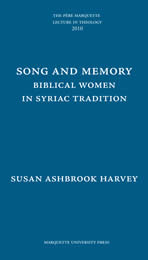
Susan Ashbrook Harvey, Song and Memory: Biblical Women in Syriac Tradition (Marquette UP, 2010), 96pp. 

This short book is based on the author's 2010 Père Marquette Lecture at the university of the same name. It will be reviewed in 2011 in Logos: A Journal of Eastern Christian Studies.
Related Posts Plugin for WordPress, Blogger...