"Let books be your dining table, / And you shall be full of delights. / Let them be your
mattress,/
And you shall sleep restful nights" (St. Ephraim the Syrian).


Showing posts with label Byzantine history. Show all posts

Wednesday, May 4, 2022

Narrating Martyrdom

The hardback having been out for nearly two years, a more affordable paperback version is coming later this year of Anne P. Alwis, Narrating Martyrdom: Rewriting Late-Antique Virgin Martyrs in Byzantium (Liverpool University Press, Sept. 2022), 224pp. 

Part of that excellent series, Translated Texts for Byzantinists, this book, the publisher tells us, 

reconceives the rewriting of Byzantine hagiography between the eighth and fourteenth centuries as a skilful initiative in communication and creative freedom, and as a form of authorship. Three men - Makarios (late C13th-C14th), a monk; Constantine Akropolites (d.c.1324), a statesman; and an Anonymous educated wordsmith (c. C9th - each opted to rewrite the martyrdom of a female virgin saint who suffered and died centuries earlier. Their adaptations, respectively, were of St. Ia of Persia (modern-day Iran), St. Horaiozele of Constantinople, and St. Tatiana of Rome. Ia is described as a victim of the persecutions of the Persian Shahanshah, Shapur II (309-79 C.E), Horaiozele was allegedly a disciple of St Andrew and killed anachronistically under the emperor Decius (249-51 C.E), and Tatiana, we are told, was a deaconess, martyred during the reign of emperor Alexander Severus (222-35 C.E). Makarios, Akropolites, and the Anonymous knowingly tailored their compositions to influence an audience and to foster their individual interests. The implications arising from these studies are far-reaching: this monograph considers the agency of the hagiographer, the instrumental use of the authorial persona and its impact on the audience, and hagiography as a layered discourse. The book also provides the first translations and commentaries of the martyrdoms of these virgin martyrs.

Friday, March 18, 2022

Byzantine Christian Philanthropy

The University of California Press remains one of the few public academic presses I know of to take such longstanding and in-depth interest in early Christian history, including Syriac Christianity. They have recently published a new book, The Rich and the Pure: Philanthropy and the Making of Christian Society in Early Byzantium by Daniel Caner (University of California Press, 2021), 440pp. About this book the publisher tells us this:

A portrait of history’s first complex Christian society as seen through the lens of Christian philanthropy and gift giving

As the Roman Empire broke down in western Europe, its prosperity moved decisively eastward, to what is now known as the Byzantine Empire. Here was born history’s first truly affluent, multifaceted Christian society. One of the ideals used to unite the diverse millions of people living in this vast realm was the Christianized ideal of philanthrōpia. In this sweeping cultural and social history, Daniel Caner shows how philanthropy required living up to Jesus’s injunction to “Give to all who ask of you,” by offering mercy and/or material aid to every human being, regardless of their origin or status.

Caner shows how Christian philanthropy became articulated through distinct religious ideals of giving that helped define proper social relations among the rich, the poor, and “the pure” (Christian holy people), resulting in new and enduring social expectations. In tracking the evolution of Christian giving over three centuries, he brings to the fore the concerns of the peoples of Early Byzantium, from the countryside to the lower levels of urban society to the imperial elites, as well as the hierarchical relationships that arose among them. The Rich and the Pure offers nothing less than a portrait of the whole of early Byzantine society.

Friday, February 4, 2022

Byzantine Identity

I mentioned a few weeks back the problem of trendy verbs and nouns dominating scholarly publications for a while. There is arguably no greater example of this than the much-invoked concept of 'identity' which must surely be approaching the end of its useful shelf life. But before it does, we have coming out next month The Routledge Handbook on Identity in Byzantium, eds. Michael Stewart, David Parnell, Conor Whately (Routledge, March 2022), 450pp. 

About this collection the publisher tells us this:

This volume is the first to focus solely on how specific individuals and groups in Byzantium and its borderlands were defined and distinguished from other individuals and groups from the mid-fourth to the close of the fifteenth century. It gathers chapters from both established and emerging scholars from a wide range of disciplines across history, art, archaeology, and religion to provide an accurate representation of the state of the field both now and in its immediate future. The handbook is divided into four subtopics that examine concepts of group and specific individual identity which have been chosen to provide methodologically sophisticated and multidisciplinary perspectives on specific categories of group and individual identity. The topics are Imperial Identities; Romanitas in the late antique Mediterranean; Macro and Micro Identities: Religious, Regional, and Ethnic Identities, and Internal Others; and Gendered Identities: Literature, Memory, and Self in Early and Middle Byzantium. While no single volume could ever provide a comprehensive vision of identities on the vast variety of peoples within Byzantium over nearly a millennium of its history, this handbook represents a milestone in offering a survey of the vibrant surge of scholarship examining the numerous and oft-times fluctuating codes of identity that shaped and transformed Byzantium and its neighbours during the empire's long life.

Wednesday, January 19, 2022

On the Patriarchate of Constantinople

The office of the Roman papacy, of course, attracts huge attention, including from scholars. But the patriarchate of New Rome attracts considerably less attention. A new book, however, will help remind us of its venerable nature and complex history: A Companion to the Patriarchate of Constantinople, eds. Christian Gastgeber, Ekaterini Mitsiou, Johannes Preiser-Kapeller, and Vratislav Zervan (Brill, 2021), 322pp.

Part of the series Brill's Companions to the Byzantine World, Volume: 9, this book, the publisher tells us,

provides an overview of the development of the Patriarchate of Constantinople from Late Antiquity to the Early Ottoman period (4th to 15th c.). It highlights continuities and changes in the organizational, dogmatic, and intellectual framework of the central ecclesiastical institution of the Byzantine Empire in the face of political and religious upheavals. The volume pays attention to the relations of the Patriarchate with other churches in the West and in the East. Across the disciplinary divide between Byzantine and Ottoman studies, the volume explains the longevity of the Patriarchate beyond the fall of Byzantium in 1453 up to modern times. A particular focus is laid on an original register book of the 14th century. 

You will note on the list of contributors some of the leading scholars of Byzantium today: 

Contributors are: Claudia Rapp, Frederick Lauritzen, Tia M. Kolbaba, Johannes Preiser-Kapeller, Marie-Hélène Blanchet, Dimitrios G. Apostolopoulos, Machi Païzi-Apostolopoulou, Klaus-Peter Todt, Mihailo S. Popović, Konstantinos Vetochnikov, Ekaterini Mitsiou, Vratislav Zervan, and Christian Gastgeber.

Monday, December 13, 2021

Byzance après Byzance Indeed!

Forthcoming in January next year from (appropriately enough) the premier centre in North America for Byzantine studies is The Invention of Byzantium in Early Modern Europe (Dumbarton Oaks Press, 11 January 2022), 400pp. edited by Nathanael Aschenbrenner and Jake Ransohoff. About this book the publisher tells us this: 

A gulf of centuries separates the Byzantine Empire from the academic field of Byzantine studies. This book offers a new approach to the history of Byzantine scholarship, focusing on the attraction that Byzantium held for Early Modern Europeans and challenging the stereotype that they dismissed the Byzantine Empire as an object of contempt.

The authors in this book focus on how and why the Byzantine past was used in Early Modern Europe: to diagnose cultural decline, to excavate the beliefs and practices of early Christians, to defend absolutism or denounce tyranny, and to write strategic ethnography against the Ottomans. By tracing Byzantium’s profound impact on everything from politics to painting, this book shows that the empire and its legacy remained relevant to generations of Western writers, artists, statesmen, and intellectuals as they grappled with the most pressing issues of their day.

Refuting reductive narratives of absence or progress, this book shows how “Byzantium” underwent multiple overlapping and often discordant reinventions before the institutionalization of “Byzantine studies” as an academic discipline. As this book suggests, it was precisely Byzantium’s ambiguity―as both Greek and Roman, ancient and medieval, familiar and foreign―that made it such a vibrant and vital part of the Early Modern European imagination.

Wednesday, August 18, 2021

Performing Byzantium

It is always interesting to watch what verbs and nouns become prevalent in academic discussion, and in my short lifetime, "performing" and cognates has become very common, not least when it comes to Byzantine history. A recently published book by an art historian at the University of California continues this trend: Performing the Gospels in Byzantium: Sight, Sound, and Space in the Divine Liturgy by Roland Betancourt  (Cambridge University Press, 2021), 320pp. 

Betancourt is a recently prolific fellow, as you can see from his other recent book which I noted here; and still others here

About this book the publisher tells us this:

Tracing the Gospel text from script to illustration to recitation, this study looks at how illuminated manuscripts operated within ritual and architecture. Focusing on a group of richly illuminated lectionaries from the late eleventh century, the book articulates how the process of textual recitation produced marginalia and miniatures that reflected and subverted the manner in which the Gospel was read and simultaneously imagined by readers and listeners alike. This unique approach to manuscript illumination points to images that slowly unfolded in the mind of its listeners as they imagined the text being recited, as meaning carefully changed and built as the text proceeded. By examining this process within specific acoustic architectural spaces and the sonic conditions of medieval chant, the volume brings together the concerns of sound studies, liturgical studies, and art history to demonstrate how images, texts, and recitations played with the environment of the Middle Byzantine church.

Wednesday, April 21, 2021

Byzantine and Balkan Historiographies

I have made no secret of my view that much of the problem of Christian (and other cultural and theological) division, especially between Orthodoxy and Catholicism, is historiographical in nature: how the doleful tales of our division are told, and retold, with tendentiousness formed in the present moment. A new book looks at these issues in a wide context: Byzantium after the Nation: The Problem of Continuity in Balkan Historiographies by Dimitris Stamatopoulos (Central European University Press, June 2021), 330pp. About this book the publisher tells us this: 

Dimitris Stamatopoulos undertakes the first systematic comparison of the dominant ethnic historiographic models and divergences elaborated by Greek, Bulgarian, Serbian, Albanian, Romanian, Turkish, and Russian intellectuals with reference to the ambiguous inheritance of Byzantium. The title alludes to the seminal work of Nicolae Iorga in the 1930s, Byzantium after Byzantium, that argued for the continuity between the Byzantine and the Ottoman empires. The idea of the continuity of empires became a kind of touchstone for national historiographies. Rival Balkan nationalisms engaged in a "war of interpretation" as to the nature of Byzantium, assuming different positions of adoption or rejection of its imperial model and leading to various schemes of continuity in each national historiographic canon.

Stamatopoulos discusses what Byzantium represented for nineteenth- and twentieth-century scholars and how their perceptions related to their treatment of the imperial model: whether a different perception of the medieval Byzantine period prevailed in the Greek national center as opposed to Constantinople; how nineteenth-century Balkan nationalists and Russian scholars used Byzantium to invent their own medieval period (and, by extension, their own antiquity); and finally, whether there exist continuities or discontinuities in these modes of making ideological use of the past.

Monday, April 5, 2021

Virgin Martyrs in Late Antique Byzantium

The ways in which we narrate the past almost always say as much about us in the present--and sometimes the future we wish to have--as they purport to do about the past. That seems no less true even in martyrology and hagiography as a new book once more reminds us:Narrating Martyrdom: Rewriting Late-Antique Virgin Martyrs in Byzantium by Anne P. Alwis (Liverpool University Press, 2020), 240pp. 

About this book the publisher tells us this:

This book reconceives the rewriting of Byzantine hagiography between the eighth and fourteenth centuries as a skilful initiative in communication and creative freedom, and as a form of authorship. Three men - Makarios (late C13th-C14th), a monk; Constantine Akropolites (d.c.1324), a statesman; and an Anonymous educated wordsmith (c. C9th - each opted to rewrite the martyrdom of a female virgin saint who suffered and died centuries earlier. Their adaptations, respectively, were of St. Ia of Persia (modern-day Iran), St. Horaiozele of Constantinople, and St. Tatiana of Rome. Ia is described as a victim of the persecutions of the Persian Shahanshah, Shapur II (309-79 C.E), Horaiozele was allegedly a disciple of St Andrew and killed anachronistically under the emperor Decius (249-51 C.E), and Tatiana, we are told, was a deaconess, martyred during the reign of emperor Alexander Severus (222-35 C.E). Makarios, Akropolites, and the Anonymous knowingly tailored their compositions to influence an audience and to foster their individual interests. The implications arising from these studies are far-reaching: this monograph considers the agency of the hagiographer, the instrumental use of the authorial persona and its impact on the audience, and hagiography as a layered discourse. The book also provides the first translations and commentaries of the martyrdoms of these virgin martyrs.

Friday, March 26, 2021

Byzantine Religious Law in Southern Italy

Coming out in May of this year is a book that focuses on those fascinating proto-ecumenical encounters of Eastern Christians with their Western counterparts in the latter's territories when the former were cut off from their own hierarchs: James Morton, Byzantine Religious Law in Medieval Italy (Oxford University Press, 2021), 336pp. 

About this book the publisher tells us this:

Southern Italy was conquered by the Norman Hauteville dynasty in the late eleventh century after over five hundred years of continuous Byzantine rule. At a stroke, the region's Greek Christian inhabitants were cut off from their Orthodox compatriots in Byzantium and became subject to the spiritual and legal jurisdiction of the Roman Catholic popes. Nonetheless, they continued to follow the religious laws of the Byzantine church; out of thirty-six surviving manuscripts of Byzantine canon law produced between the tenth and fourteenth centuries, the majority date to the centuries after the Norman conquest.

Byzantine Religious Law in Medieval Italy is a historical study of these manuscripts, exploring how and why the Greek Christians of medieval southern Italy persisted in using them so long after the end of Byzantine rule. The first part of the book provides an overview of the source material and the history of Italo-Greek Christianity. The second part examines the development of Italo-Greek canon law manuscripts from the last century of Byzantine rule to the late twelfth century, arguing that the Normans' opposition to papal authority created a laissez faire atmosphere in which Greek Christians could continue to follow Byzantine religious law unchallenged. Finally, the third part analyses the papacy's successful efforts to assert its jurisdiction over southern Italy in the later Middle Ages. While this brought about the end of Byzantine canon law as an effective legal system in the region, the Italo-Greeks still drew on their legal heritage to explain and justify their distinctive religious rites to their Latin neighbours.

Friday, February 5, 2021

Church of the Holy Apostles

Edited by two major scholars in the field, published in perhaps the most prestigious series for Byzantine scholarship in the anglophone world, and covering one of the most hallowed churches of Byzantium, The Holy Apostles: A Lost Monument, a Forgotten Project, and the Presentness of the Past, eds. Margaret Mullett and Robert G. Ousterhout (Dumbarton Oaks Papers/Harvard University Press, 2020, 320pp.) is a book about a building that no longer exists physically. As the publisher tells us:

Founded by Constantine the Great, rebuilt by Justinian, and redecorated in the ninth, tenth, and twelfth centuries, the Church of the Holy Apostles in Constantinople was the mausoleum of emperors, patriarchs, and saints. It was also a key station in the ceremonies of the city, the site of an important school, a major inspiration for apostolic literature, and briefly the home of the patriarch. Despite its significance, the church no longer exists, replaced by the mosque of Mehmet II after the fall of the city to the Ottomans. Today the church is remembered primarily from two important middle Byzantine ekphraseis, which celebrate its beauty and prominence, as well as from architectural copies and manuscript illustrations.

Scholars have long puzzled over the appearance of the church, as well as its importance to the Byzantines. Anxious to reconstruct the building and its place in the empire, an early collaborative project of Dumbarton Oaks brought together a philologist, an art historian, and an architectural historian in the 1940s and 1950s to reconstruct their own version of the Holy Apostles. Never fully realized, their efforts remained unpublished. The essays in this volume reconsider their project from a variety of vantage points, while illuminating differences of approach seventy years later, to arrive at a twenty-first-century synthesis.

Monday, December 14, 2020

Clerical Continence in England and Byzantium

Western apologists for celibacy, desperate to cover over the well-documented holes in their bogus and increasingly desperate apologias for that discipline, like tendentiously to play around with certain bits of canonical legislation to make the claim that continence is required of all clerics, and always has been, and the East gets it wrong, etc. This tedious clap-trap, subject to a royal rubbishing in my forthcoming Married Priests in the Catholic Church, by top-drawer historians without axes to grind, is given further scrutiny in this new book: Clerical Continence in Twelfth-Century England and Byzantium: Property, Family, and Purity Maroula Perisanidi (Routledge, 2020), 204pp. 

About this book the publisher tells us this:

Why did the medieval West condemn clerical marriage as an abomination while the Byzantine Church affirmed its sanctifying nature? This book brings together ecclesiastical, legal, social, and cultural history in order to examine how Byzantine and Western medieval ecclesiastics made sense of their different rules of clerical continence. Western ecclesiastics condemned clerical marriage for three key reasons: married clerics could alienate ecclesiastical property for the sake of their families; they could secure careers in the Church for their sons, restricting ecclesiastical positions and lands to specific families; and they could pollute the sacred by officiating after having had sex with their wives. A comparative study shows that these offending risk factors were absent in twelfth-century Byzantium: clerics below the episcopate did not have enough access to ecclesiastical resources to put the Church at financial risk; clerical dynasties were understood within a wider frame of valued friendship networks; and sex within clerical marriage was never called impure in canon law, as there was little drive to use pollution discourses to separate clergy and laity. These facts are symptomatic of a much wider difference between West and East, impinging on ideas about social order, moral authority, and reform.

Friday, December 11, 2020

Problems in Balkan Historiographies after Byzantium

The long-lasting, if conflicted, imprint left by "Byzantium"--both real and imagined--is itself a topic worthy of further consideration in any number of ways. In September of this year, we had one such way from the hand of Dimitris Stamatopoulos, Byzantium after the Nation: The Problem of Continuity in Balkan Historiographies (Central European University Press, 2020), 330pp.  

About this book the publisher tells us this:

Dimitris Stamatopoulos undertakes the first systematic comparison of the dominant ethnic historiographic models and divergences elaborated by Greek, Bulgarian, Serbian, Albanian, Romanian, Turkish, and Russian intellectuals with reference to the ambiguous inheritance of Byzantium. The title alludes to the seminal work of Nicolae Iorga in the 1930s, Byzantium after Byzantium, that argued for the continuity between the Byzantine and the Ottoman empires. The idea of the continuity of empires became a kind of touchstone for national historiographies. Rival Balkan nationalisms engaged in a "war of interpretation" as to the nature of Byzantium, assuming different positions of adoption or rejection of its imperial model and leading to various schemes of continuity in each national historiographic canon.

Stamatopoulos discusses what Byzantium represented for nineteenth- and twentieth-century scholars and how their perceptions related to their treatment of the imperial model: whether a different perception of the medieval Byzantine period prevailed in the Greek national center as opposed to Constantinople; how nineteenth-century Balkan nationalists and Russian scholars used Byzantium to invent their own medieval period (and, by extension, their own antiquity); and finally, whether there exist continuities or discontinuities in these modes of making ideological use of the past.

Wednesday, June 24, 2020

Byzantine Sex, Gender, and Race

The world "intersectionality" evokes anxious sneers from some people who rarely give evidence of any serious thought, much less any thought informed by history or psychology. But the term, however much it may appear a species of contemporary jargon, simply refers to what good scholars have always done: examine connections between multiple phenomena.

Forthcoming in October is a book that does this for some of the most explosive issues of our time and indeed of all time: Roland Betancourt, Byzantine Intersectionality: Sexuality, Gender, and Race in the Middle Ages  (Princeton University Press, October 2020), 288pp.

About this book the publisher tells us this:
While the term “intersectionality” was coined in 1989, the existence of marginalized identities extends back over millennia. Byzantine Intersectionality reveals the fascinating, little-examined conversations in medieval thought and visual culture around matters of sexual and reproductive consent, bullying and slut-shaming, homosocial and homoerotic relationships, trans and nonbinary gender identities, and the depiction of racialized minorities. Roland Betancourt explores these issues in the context of the Byzantine Empire, using sources from late antiquity and early Christianity up to the early modern period. Highlighting nuanced and strikingly modern approaches by medieval writers, philosophers, theologians, and doctors, Betancourt offers a new history of gender, sexuality, and race.
Betancourt weaves together art, literature, and an impressive array of texts to investigate depictions of sexual consent in images of the Virgin Mary, tactics of sexual shaming in the story of Empress Theodora, narratives of transgender monks, portrayals of same-gender desire in images of the Doubting Thomas, and stereotypes of gender and ethnicity in representations of the Ethiopian Eunuch. He also gathers evidence from medical manuals detailing everything from surgical practices for late terminations of pregnancy to save a mother’s life to a host of procedures used to affirm a person’s gender. Showing how understandings of gender, sexuality, and race have long been enmeshed, Byzantine Intersectionality offers a groundbreaking look at the culture of the medieval world.

Wednesday, May 27, 2020

In the Shadow of Constantine

Interest in Byzantine history always seems to remain relatively high, and will be further fed in July with the publication of a book in the publisher's New Approaches to Byzantine History and Culture series: The Sons of Constantine, AD 337-361:In the Shadows of Constantine and Julian, eds., Nicholas Baker-Brian, and Shaun J. Tougher (Palgrave Macmillan, 2020), 466pp.

About this book the publisher tells us this:
This edited collection focuses on the Roman empire during the period from AD 337 to 361. During this period the empire was ruled by three brothers: Constantine II (337-340), Constans I (337-350) and Constantius II (337-361). These emperors tend to be cast into shadow by their famous father Constantine, the first Christian Roman emperor (306-337), and their famous cousin Julian, the last pagan Roman emperor (361-363). The traditional concentration on the historically renowned figures of Constantine and Julian is understandable but comes at a significant price: the neglect of the period between the death of Constantine and the reign of Julian and of the rulers who governed the empire in this period. The reigns of the sons of Constantine, especially that of the longest-lived Constantius II, mark a moment of great historical significance. As the heirs of Constantine they became the guardians of his legacy, and they oversaw the nature of the world in which Julian was to grow up. The thirteen contributors to this volume assess their influence on imperial, administrative, cultural, and religious facets of the empire in the fourth century.

Wednesday, January 29, 2020

John McGuckin's New History of Orthodoxy

I recently received the Yale University Press's catalogue of forthcoming publications, and in there spied a name very well known, whom I have sometimes in the past interviewed on here about previous books: John McGuckin, The Eastern Orthodox Church: A New History (Yale UP, 2020), 376pp.

About this book the publisher tells us this:
In this short, accessible account of the Eastern Orthodox Church, John McGuckin begins by tackling the question “What is the Church?” His answer is a clear, historically and theologically rooted portrait of what the Church is for Orthodox Christianity and how it differs from Western Christians’ expectations.
McGuckin explores the lived faith of generations, including sketches of some of the most important theological themes and individual personalities of the ancient and modern Church. He interweaves a personal approach throughout, offering to readers the experience of what it is like to enter an Orthodox church and witness its liturgy. In this astute and insightful book, he grapples with the reasons why many Western historians and societies have overlooked Orthodox Christianity and provides an important introduction to the Orthodox Church and the Eastern Christian World.

Monday, December 30, 2019

Daniel Galadza Interviewed on Jerusalem's Liturgy: Byzance après Byzance

It is always a delight to interview scholars on here, but--in the interests of full disclosure--it is an especial delight with Daniel Galadza, whom I have known for the better part of two decades now. He is not just a friend, but also co-editor on a book we are finishing for Peeters about the pseudo-sobor of Lviv of 1946. (More on that soon.) In any event, he is the consummate gentleman and scholar who wears his vast learning very lightly on his diaconal riassa. Following my usual practice, I sent him some questions about his recent book, and here are his thoughts.

AD: Tell us about your background

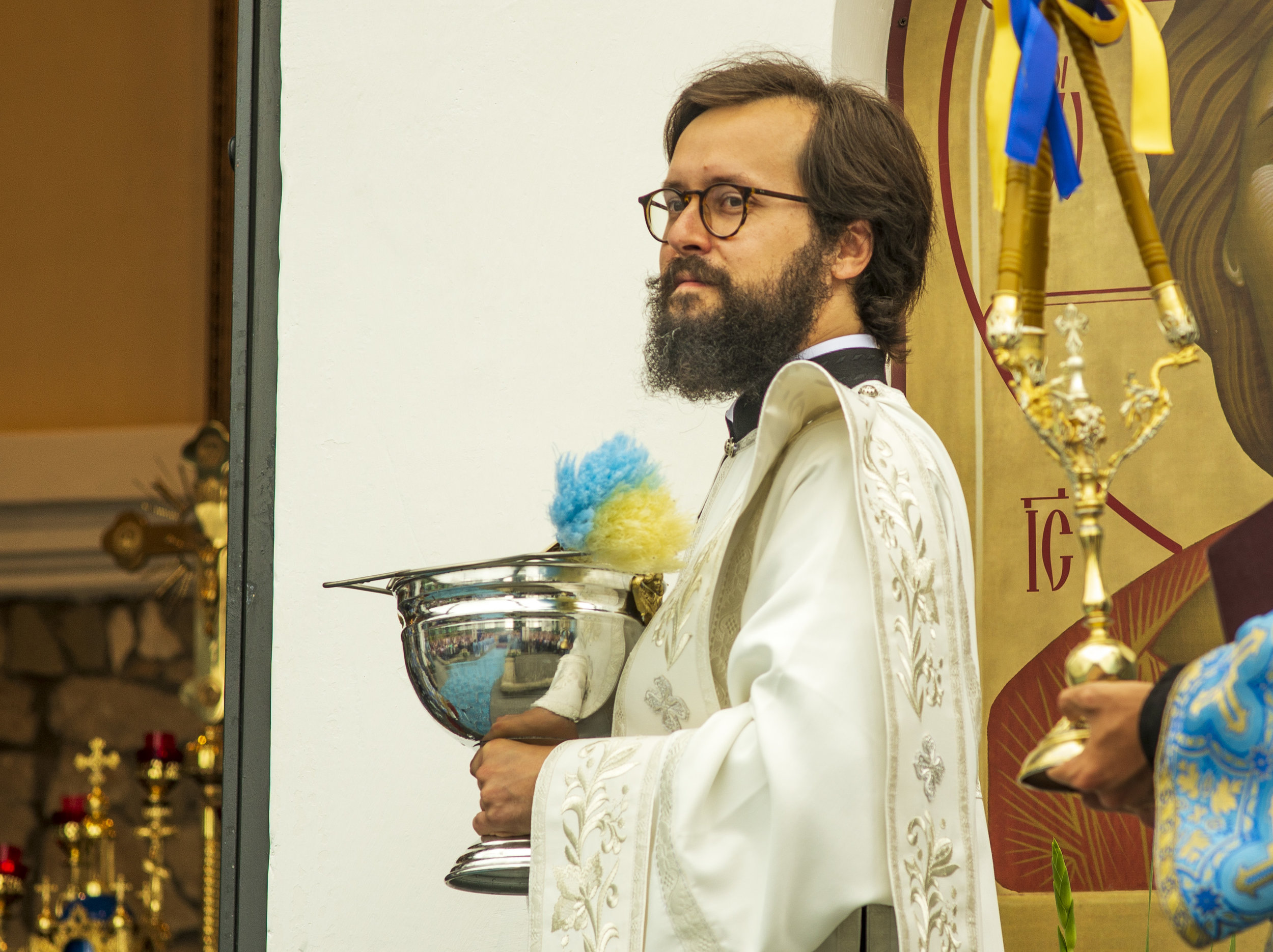
DG: I am a deacon of the Ukrainian Greco-Catholic Church (UGCC), born in Chicago, raised in Toronto and Ottawa by my parents, Fr. Peter and Olenka Galadza. After studies at Trinity College in the University of Toronto and the Sheptytsky Institute, then at St. Paul University in Ottawa, I did a licentiate and a doctorate in Rome with Stefano Parenti, my doctoral supervisor, at the Oriental Institute, with a year as a junior fellow in Byzantine Studies at Dumbarton Oaks in 2011–2012.

In Rome, I paid close attention to how the coffee was made at my college, the Russicum, assuming that as a layman with a doctoral in Byzantine liturgy I might end up working at Starbucks--if I were lucky. But God had a different plan and I ended up as an assistant professor in the Catholic Theology Faculty at the University of Vienna in 2013, with Prof. Hans-Jürgen Feulner as my boss and Sr. Vassa Larin as a colleague.

Vienna is known as a “Byzantinists paradise” (well, perhaps not in the guidebooks) and I got to know the scholars in Byzantine Studies at the University of Vienna and the Austrian Academy of Sciences. For the last few years, Prof. Claudia Rapp had led the team of the “Vienna Euchologia Project,” of which I am honoured to be a member (officially as an “international research partner” since I no longer live in Vienna).

Since 2018, I have been in Kyiv as a deacon of the Kyiv Archeparchy, a lecturer at the seminary, and a member of the liturgical commission, at the same time trying to keep up with scholarly work in Europe and North America.

During the fall semester 2018 I was a visiting lecturer at the Sheptytsky Institute, now at University of St. Michael’s College in the University of Toronto, and from 2019 I am a fellow of the Centre for Advanced Studies at the University of Regensburg, splitting up semesters between Bavaria and Ukraine.

AD: What led you to write Liturgy and Byzantinization in Jerusalem?

In May 2008, I had finished my Bacherlor of Theology degree and had applied to study at the Pontifical Oriental Institute (PIO) in Rome. I wasn’t really sure about how things worked at the universities in Rome, so I made a trip to investigate and made an appointment with Fr. Robert Taft, SJ, whom I had known through my parents since childhood. He immediately sat me down and gave me a list of four different doctoral thesis topics. One of them was about the Basilians and the decline of the UGCC’s liturgical tradition, which is a fascinating topic, but I didn’t want to start my academic work immediately making enemies, so I chose the topic on the list about which I knew the least: the “liturgical Byzantinization” of the Orthodox Patriarchate of Jerusalem. That ended up being my thesis topic for the licentiate and doctorate.

Upon arrival in Rome in September 2008, I already knew my thesis topic and was fortunate enough to live in a college next door to the PIO library, so I was able to take advantage of the amazing resources there and read all about a whole other, fascinating world of Eastern Christianity I knew of only generally through my studies in Canada. The thesis then turned into the book, which was published in 2018 by Oxford University Press and came out as paperback in 2019.

AD: Among Eastern Catholics, the notion of “Latinization” is fairly common, and since at least Vatican II, almost always reprobated. Is “Byzantinization” a similar process, and if so, of what and of whom? Does it carry the same negative connotations today as “Latinization” does for many?

In a way, the two phenomena are similar. Byzantinization, like Latinization, is, generally speaking, the adoption of foreign customs and practices, potentially including also theology, culture, and even language, to the detriment of the local, “authentic” tradition. More specifically, the liturgical Byzantinization of Jerusalem involved the supplanting of liturgical tradition of Jerusalem by the rite of Constantinople. The process was complex, due to the natural evolution of the Byzantine liturgical tradition, which was a synthesis of elements from Constantinople, Jerusalem, and elsewhere.

Like Latinization, Byzantinization was never officially imposed on the other Eastern Patriarchates of Alexandria, Antioch, and Jerusalem, although due to the cultural climate of the post-Iconoclast Eastern Mediterranean, the factions within these Eastern Patriarchates that were faithful to the decisions of the Council of Chalcedon (451) willingly adopted most of the synthesized Byzantine practices. This was partly due to a desire to show unity with Constantinople and partly due to the declining material situation of each of the Eastern Patriarchates as a result of invasions and non-Byzantine rule from the seventh century onward. In such a context, the prestige of Constantinople was felt even more strongly among the Chalcedonians outside the constantly shrinking borders of the Byzantine Empire.

Latinization for the Eastern Catholics is similar. It was rarely imposed officially by the Holy See and usually adopted willingly by Eastern Catholics because of Rome’s prestige as a center of authority and education. (A notable exception might be the 1720 Synod of Zamosc, which officially imposed numerous Latin practices based on Tridentine scholastic theology, in an attempt to bring order to the chaos of the Uniate Church in the century following the Union of Brest. Because Rome has since the Second Vatican Council officially encouraged the Eastern Catholic Churches to return to their ancestral traditions, it will be interesting to see how the UGCC will commemorate the 300th anniversary of the Synod of Zamosc in 2020.)

Around the time of the Second Vatican Council, the Melkite Greco-Catholic Church was also eager to rediscover its ancestral traditions and a group of scholars and clergy, known as the Cairo Circle, began discussing ideas about the restoration of an authentic Melkite liturgy, since for them Byzantinization was their version of Latinization. However, as far as I am aware, not much came of it, because the authentic practices from Jerusalem had not yet been sufficiently researched and there was no continuity with the liturgical tradition of Jerusalem because it had been completely lost. Thus, it was almost impossible to restore and implement in a practical manner.

Although they are similar as phenomena, the histories of Latinization and Byzantinization are, however, quite different, of course, but so are the histories of the Byzantinization of each of the three Eastern Patriarchates, due to their specific linguistic and political contexts.

AD: In an era when much of the academy has been drawing critical attention to the phenomena of colonialism and imperialism, you seem to suggest that the Byzantinization of Jerusalem does not constitute a straightforward case of imperial subjugation and transformation at the hands of Constantinople—that, as your introduction nicely puts it, “the periphery of one centre can become the centre of yet another periphery.” Tell us a bit more about these dynamics.

The phenomenon in question here is certainly not straightforward. Liturgical Byzantinization in Jerusalem—which is not the same as political, literary, cultural, etc. forms of Byzantinization—began only after Jerusalem was no longer under Byzantine imperial and political control. The same is the case for Alexandria, although Antioch’s history is somewhat different, due to the Byzantine reconquest of Syria in the tenth century.

Previous theories about Byzantinization in Jerusalem suggested it was imposed and happened suddenly. A common narrative used to go like this: after the destruction of the Holy Sepulcher, also known as the Anastasis Church, in 1009, the rite of Jerusalem was lost and its patriarchs were exiled to Constantinople in the eleventh and twelfth centuries, where they learned the Byzantine Rite and brought it back with them to Jerusalem along with ready-made books.

However, the sources suggest otherwise, painting a picture of a gradual change to the liturgical tradition that was carried out locally, often times by scribes copying liturgical books and attempting to reconcile differences in liturgical practice.

AD: Part of your argument seems to be that Byzantinization was less about imperial imposition of liturgical trends and traditions, and more about local alterations, based partly on the changing geopolitical and topographical realities of the city. Give us, if you would, an example or two of these changes.

If I haven’t mentioned it already, perhaps this is the time to do so: there are no historical or legal documents from Constantinople, Jerusalem, or elsewhere that explicitly prescribe how liturgical Byzantinization was to be carried out, such as a conciliar document or the decree of a patriarch or emperor, nor do any sources, such as chronicles or other historical accounts, describe exactly how it happened.

The main sources for information are liturgical manuscripts, the books used for prayer during the liturgy, dating from the eighth century onwards. The most important collection for the study of the Byzantinization of Jerusalem is the library of the Monastery of St. Catherine on Mount Sinai, which houses hundreds of manuscripts in a variety of ancient languages and is also the place some of these manuscripts were copied and used.

At Mount Sinai, the Georgian collection of manuscripts is of particular importance, not just because of the local Georgian monastic community there in the Byzantine period, but also because of the migration of the Georgian monks of the Lavra of St. Sabas in Palestine near Jerusalem to Sinai in the tenth century. Among them was Iovane Zosime, a Georgian monk and scribe who copied numerous and diverse manuscripts, many of them liturgical. What is significant about Iovane Zosime is that he is aware of his sources and gives information about them. What is more, he often dates and signs his work, which isn’t always the case with scribes.

The calendar he copied in codex Sinai Georgian Old Collection 34—one needs to distinguish between the old and new collection, because a whole trove of manuscripts was rediscovered at the monastery in 1975—presents a liturgical calendar for the whole year based on several sources, including ones from Constantinople, Jerusalem, and the Lavra of St. Sabas. Thus, Iovane Zosime was, in a way, one of the first scholars of “comparative liturgy” and his work confirms that already in the tenth century, monks and scribes at the Sabas Lavra and Mount Sinai knew of multiple liturgical traditions, these traditions were in contact with one another in Jerusalem, and they were also changing. Specifically in the calendar, the feast of St. James the Brother of the Lord is mentioned on multiple days—both on the days his feast was celebrated in Jerusalem (December 1, December 26, May 25) and in Constantinople (October 23)—showing the gradual nature of the change.

Two centuries later, we know of the work of another scribe, Basil the Hagiopolite, a reader and scribe at the Church of the Anastasis in Jerusalem, from an important manuscript copied in 1122 and known in liturgical scholarship as the “Typikon of the Anastasis.” The manuscript contains all the hymns, readings, and prayers necessary for Holy Week and Easter at the Anastasis, mentioning local practices native to Jerusalem, like the Liturgy of St. James, but also a loss of other local elements and revealing an influx of general Byzantine practices. Basil the Hagiopolite himself shows an awareness of two different traditions and tries to make sense of them in his manuscript. Most notably, the processions on Palm Sunday that Basil describes have been lost and the gospel readings for Holy Week have changed.

AD: You note that much of the Byzantinization comes after the three conquests—the Persian, the Arab, and the Crusaders, in a period leading up to the thirteenth century. A contemporary reader might wonder if there is any kind of causal link between events here? In other words, is it conceivable to think that Jerusalem Christians, feeling under siege and perhaps worried about loss of their “identity” (as we might call it today), would seek to buttress and solidify that identity by conforming their external appearances and practices to be more like other Christians, including those in the still unconquered imperial capital?

Most certainly! I would argue that there is very little change in theological content when examining Byzantinization and that it has much more to do with religious identity and affiliation. Once the Greek-praying Christians become the minority in Jerusalem and are no longer under Byzantine rule, they look to their coreligionists for moral—and sometimes financial—support. Although the Chalcedonian Christians of Jerusalem were unique because they had no homegrown non-Chalcedonian Church in Jerusalem and Palestine, unlike the case in with numerous non-Chalcedonians in Syria and Egypt, nevertheless they seemed eager to maintain strong links with Constantinople. It appears that the strong Greek monastic presence in the Holy Land also played a role in buttressing the Greek, Chalcedonian identity in Jerusalem.

AD: For those unfamiliar with Jerusalem’s liturgical calendar (ch.4), and lectionary (ch.5), what are some of the most notable and distinctive features in your eyes?

In a nutshell, here are some of the most noteworthy elements:

The calendar, from the sixth century onward at least, begins with Christmas rather than September 1, suggesting a theological emphasis on the Incarnation that is understood in the liturgical year as well. The day on which a saint is commemorated depends on the local tradition of Jerusalem. If we take the example of St. James again, December 26 was an ancient day of commemorating James in Jerusalem connected, at least according to Anton Baumstark, with the Jewish celebration of the dedication of the Temple. The October 23 commemoration depended on the transfer of the relics of James to Constantinople. The calendar of Jerusalem also had multiple days of certain saints and sometimes celebrated groups of saints together, often dependent upon the dedication of a church in Jerusalem where their relics were deposed. Octaves, or eight day celebrations of major feasts, were also a significant feature and the most important ones involved stational liturgy during the eight days at some of the more important churches of Jerusalem.

The lectionary is intimately related to the calendar and in some cases lectionary manuscripts give us the most information about the calendar. Unlike the Byzantine lectionary—where the order of the Gospels from Easter to Lent is John, Matthew, Luke, and Mark—the Jerusalem lectionary reads them in the following order: John, Matthew, Mark, and Luke. Even when the same Gospel is read during the same liturgical season, the pericopes (or individual excerpts) for a given commemoration are not necessarily the same. For example, the readings from the Gospel of John on the Sundays after Easter have completely different episodes when comparing the Jerusalem and Constantinople lectionaries.

Perhaps the most important and interesting aspect of the Jerusalem lectionary for Orthodox liturgy is that it has an Old Testament reading at the Divine Liturgy. The ancient Armenian and Georgian translations of the Jerusalem lectionary have quite an extensive series of Old Testament readings, but Greek manuscripts with Old Testament readings for the Divine Liturgy are quite rare.

AD: If, in a sense, Jerusalem is the “mother-city” for all Christians, do we find elements of her lectionary and calendar anywhere today in other traditions—a kind of “Jerusalemization” of, say, Coptic or Syriac or Latin or Byzantine traditions? Is her tradition of “stational” liturgies borrowed or copied by other traditions?

The Liturgy of St. James—the local Divine Liturgy of Jerusalem—does in fact refer to Jerusalem, or rather to Sion, as the “Mother of all the Church.” With regard to liturgical practice, Jerusalem certainly did function as a centre of influence over all of Christendom, in effect the “Jerusalemization” of many other Christian traditions. This was particularly felt in Constantinople, where there really wasn’t a sacred topography and much of its liturgy was imported from elsewhere. In Constantinople, one can see strong the influence of Jerusalem during Holy Week, with its structure based on biblical narratives imported from Jerusalem. Constantinople also adopted Jerusalem’s Bright Week Gospel readings, but with a twist: instead of reading them on every day of Bright Week at Divine Liturgy, as was done in Jerusalem, Constantinople took them and turned them into the eleven resurrectional Gospels read at Orthros, or Matins, every Sunday morning.

With regard to “stational” liturgies, processions led by the bishop that went through the city with hymns and stopped at various points, these were imitated in Constantinople, Rome, and elsewhere.

But these aren’t discoveries that are new to my book or research. Many of these insights into “Jerusalemization” and “stational” liturgies come from the works of Janeras, Taft, Baldovin, and several Russian scholars writing before the October Revolution. My goal in the book was to present a summary of this scholarship, often times scattered in diverse studies in various languages, and to bring it into dialogue with information found in additional manuscripts, many of them among the “new finds” of Sinai from 1975 in order to examine the interaction of the liturgical traditions of Jerusalem and Constantinople, and the question of Byzantinization in Jerusalem.

AD: Much of your work proceeds comparatively, and by drawing on the methods of Baumstark and Taft. But you also note the limitations of this method. Tell us about some of those limitations and then tell us more generally about your methods of research for this book, including especially looking at liturgy “from the bottom up.” Why is that important and what are its benefits?

In this study, I did indeed rely on comparative methods, primarily due to the comparative nature of examining the liturgies of Jerusalem and Constantinople and seeing the influence of one on the other and vice versa. From a purely technical point of view, the comparative method, with its emphasis on a textual and philological approach that respects the importance of the historical context, fit best to begin this investigation. Because the topic of Byzantinization is precisely a question of top-down, “official” liturgy, liturgical books are the main source for study.

Comparative liturgy is often criticized because it can at times overemphasize liturgical structures over the meaning of texts and does not say much about the experience of the people during the liturgical services. The problem of the authority, use, and reliability of texts is also one that must be grappled with, especially if adopting the “splitter” approach (in the dichotomy of Paul Bradshaw).

The “from the bottom up” approach is something that I am attempting to read about more and integrate into my work, but in other areas, for example in work dealing with the Vienna Euchologia Project.

AD: I recall meeting you for lunch in Washington DC some years back, when you were a fellow at Dumbarton Oaks, and you casually told me, as we stood waiting for the traffic light to change, that you were studying Georgian. Why are Georgian sources important to your study?

I don’t think it could have been casually, Adam, since ancient Georgian is far from “casual”: they say you can learn the Georgian noun in a day and spent the rest of your life learning the Georgian verb. Studying Georgian in Rome was quite the experience!

The importance of Georgian sources in Jerusalem is primarily due to the presence of Georgian pilgrims and monks who stayed in Jerusalem, made translations and copies of its liturgical manuscripts, and then either used them in Jerusalem and its environs in their own Georgian-praying communities or brought them back to Georgia. Because many of the Greek originals were lost, Georgian manuscripts are sometimes the only surviving witnesses to this ancient and lost liturgical tradition.

AD: You note that in some ways even today the periphery-centre tension still holds, but with different focus today: must the Jerusalem patriarchate remain, as it were, an outpost of the Greek Orthodox Church, resisting any attempts at change in, say, a more “Arabized” direction? But you also note that in the early 20th century there was less defensiveness and more openness to studying the authentic tradition and perhaps removing non-native elements. How far did such a movement get, and is there anything comparable today?

The current state of the affairs in the Church of Jerusalem is not an easy one and balancing internal and external ecclesiastical relations are in addition to some of the difficulties of daily life in Israel and Palestine today. Christians find it difficult to stay and without a local population, the Church depends on pilgrims and non-Palestinian Christians to keep life going.

Some of the activity of the Greek Orthodox Patriarchate of Jerusalem, such as the retention of the Julian calendar, seems to depend on the status quo agreement from previous centuries that codified liturgical life at the Church of the Holy Sepulcher. Today, one can observe frequent use of Arabic, and sometimes other languages, at the Divine Liturgy, for example the Gospel reading. However, this multilingualism in the liturgy is nothing new, since Egeria describes it in the fourth century and Basil the Hagiopolite mentions it in the twelfth.

Any tendency to differentiate the Jerusalem Patriarchate too much from other Orthodox would isolate it from the rest of the Church—which is precisely one of the reasons why Byzantinization occurred, to strengthen ties and establish a common identity with Christians beyond Jerusalem.

Nevertheless, the late nineteenth and early twentieth century did witness a great interest in the local liturgical tradition of Jerusalem from scholars who were also ecclesiastical authorities. This meant the Liturgy of St. James was revived, although not always with the right motives. Because the manuscripts of the Liturgy of St. James are often missing rubrics and the tradition ceased to be celebrated, Archbishop Dionysios Latas of Zakynthos supplied his own rubrics based on his studies of biblical archaeology. His Greek edition was then adapted to Church Slavonic by Ivan Gardner (at that time Hieromonk Philip). The resulting liturgy that is often celebrated today is effectively a nineteenth-century scholarly invention. Prof. Heinzgerd Brakmann has written several articles about this.

It is curious that in some circles where any change or reform in the Liturgies of St. John Chrysostom or St. Basil the Great would be frowned upon, the nineteenth-century revived version of the Liturgy of St. James is welcomed and celebrated frequently. Prof. Vitaly Permiakov, who has studied these questions for some years, has recently published a Church Slavonic-English edition where he attempts to address some of these problems.

AD: Sum up your hopes for the book, and who in particular would benefit from reading it?

My main hope is that it will inspire other scholars to look more closely at the question of Byzantinization, whether in Jerusalem or one of the other Eastern Patriarchates, and provide more definitive answers than I have. The history of the Byzantinization of Antioch and Alexandria remains to be written. I believe Antioch holds the answers to many of the remaining questions about Byzantinization, precisely because it was reconquered by the Byzantines in the tenth century and because it is geographically between Constantinople and Jerusalem.

I also hope that Syriac scholars will find the book to be a useful reference in their examination of the abundance of Syriac Melkite manuscripts, most of them in the library of the Monastery of St. Catherine on Sinai and lamentably ignored in Byzantine liturgical studies. The importance of Georgian for Byzantine and theological studies is now being appreciated in Western academia (I should mention here the work of Stephen Shoemaker and his English translation of the Georgian Iadgari hymnal from Jerusalem, which I was not able to mention in my book because they appeared at around the same time), but I hope that better resources for studying ancient Georgian will be made available in the West.

Having expressed all these wishes, I do not want to give the impression that the book is intended only for specialists. (Certainly, certain sections will be too technical for some readers. For others, the book might be effective against insomnia.) I hope that anyone familiar with the Byzantine liturgical tradition, particularly its faithful practitioners, might find something of interest in the book—whether in the general introduction to Jerusalem’s liturgy before its Byzantinization or the discussion of the Liturgy of St. James, the calendar, or the lectionary.

AD: Having finished the book, what projects are you at work on now?

Perhaps too many to keep track of myself... At the moment, I am a fellow at the Centre for Advanced Studies of the University of Regensburg, where there are quite a few conferences and workshops on liturgical topics, organized by Prof. Harald Buchinger, an expert on the early liturgy of Jerusalem. My own work at the Centre involves a translation and commentary of the twelfth-century Greek manuscript from Jerusalem I mentioned earlier: Hagios Stavros gr. 43, known as the “Typikon of the Anastasis,” a hymnal for Holy Week and Easter whose services, readings, and hymns would be recognizable to any Byzantine Rite Christian, whether Orthodox or Greco-Catholic, who has attended their local parish during that most solemn time of the year. My goal with this project is to investigate the question of liturgical theology through the prism of hymnography in order to understand how the hymns serve as scriptural exegesis and also liturgical hermeneutic.

Last year, Prof. Jos Verheyden and I organized a conference on liturgy and literature in the various multilingual communities of the Lavra of St. Sabas at Catholic University of Leuven, so I am now slowly working on publishing the proceedings, which I hope will appear in the not too distant future.

Apart from those main projects, I am also interested in early printed Church Slavonic liturgical books from Ukraine. Some are housed in various libraries in Kyiv, Lviv, and elsewhere (while some can still be purchased online for very reasonable prices!). In the coming years I hope to more beyond Jerusalem and the first Christian millennium and delve deeper into the Slavonic and Kyivan liturgical tradition. Perhaps after Byzantinization, I’ll move on to Latinization. We’ll see.

Wednesday, August 28, 2019

Streams of Bloody Gold

Oxford University Press, the publisher of  Streams of Gold, Rivers of Blood:The Rise and Fall of Byzantine, 955 A.D. to the First Crusade by Anthony Kaldellis (2019, 440pp.) tells me that it is bringing out a paperback edition of this book on, suitably, the start of the Byzantine new year, September 1st.

About this book we are told the following:
In the second half of the tenth century, Byzantium embarked on a series of spectacular conquests: first in the southeast against the Arabs, then in Bulgaria, and finally in the Georgian and Armenian lands. By the early eleventh century, the empire was the most powerful state in the Mediterranean. It was also expanding economically, demographically, and, in time, intellectually as well. Yet this imperial project came to a crashing collapse fifty years later, when political disunity, fiscal mismanagement, and defeat at the hands of the Seljuks in the east and the Normans in the west brought an end to Byzantine hegemony. By 1081, not only was its dominance of southern Italy, the Balkans, Caucasus, and northern Mesopotamia over but Byzantium's very existence was threatened.
How did this dramatic transformation happen? Based on a close examination of the relevant sources, this history-the first of its kind in over a century-offers a new reconstruction of the key events and crucial reigns as well as a different model for understanding imperial politics and wars, both civil and foreign. In addition to providing a badly needed narrative of this critical period of Byzantine history, Streams of Gold, Rivers of Blood offers new interpretations of key topics relevant to the medieval era. The narrative unfolds in three parts: the first covers the years 955-1025, a period of imperial conquest and consolidation of authority under the great emperor Basil "the Bulgar-Slayer." The second (1025-1059) examines the dispersal of centralized authority in Constantinople as well as the emergence of new foreign enemies (Pechenegs, Seljuks, and Normans). The last section chronicles the spectacular collapse of the empire during the second half of the eleventh century, concluding with a look at the First Crusade and its consequences for Byzantine relations with the powers of Western Europe. This briskly paced and thoroughly investigated narrative vividly brings to life one of the most exciting and transformative eras of medieval history.

Monday, January 7, 2019

Byzantine Constructions of the West

More than five years ago now, I lavished rather a lot of attention on an important and fascinating collection, Orthodox Constructions of the West. It seems that next month we are to have a similar collection albeit one with a tighter focus on a particular period: Byzantium and the West: Perception and Reality (11th-15th c.), eds. Nikolaos Chrissis, Athina Kolia-Dermitzaki, and Angeliki Papageorgiou (Routledge, 2019), 334pp.

About this collection the publisher tells us the following:
The interaction between Byzantium and the Latin West was intimately connected to practically all the major events and developments which shaped the medieval world in the High and Late Middle Ages – for example, the rise of the ‘papal monarchy’, the launch of the Crusades, the expansion of international and longdistance commerce, or the flowering of the Renaissance. This volume explores not only the actual avenues of interaction between the two sides (trade, political and diplomatic contacts, ecclesiastical dialogue, intellectual exchange, armed conflict), but also the image each side had of the other and the way perceptions evolved over this long period in the context of their manifold contact.
Twenty-one stimulating papers offer new insights and original research on numerous aspects of this relationship, pooling the expertise of an international group of scholars working on both sides of the Byzantine-Western ‘divide’, on topics as diverse as identity formation, ideology, court ritual, literary history, military technology and the economy, among others. The particular contribution of the research presented here is the exploration of how cross-cultural relations were shaped by the interplay of the thought-world of the various historical agents and the material circumstances which circumscribed their actions. The volume is primarily aimed at scholars and students interested in the history of Byzantium, the Mediterranean world, and, more widely, intercultural contacts in the Middle Ages.

Wednesday, December 5, 2018

Orthodox Cyprus Under the Latins

Well do I recall, in October 1993, being jolted out of my ignorance and naivete as a young Canadian unaccustomed to the scars of political violence when I visited Nicosia on Cyprus and saw the militarized border between Cypriot and Turkish claims to the island. I was there for a World Council of Churches conference of which I remember little now except for how hot it was relative to Ottawa, and how I almost didn't make it by developing acute appendicitis six days before I was supposed to leave. Oh, and the food. The food, of course, was wonderful. 

But back to matters at hand: a new book looking at the pivotal role Cyprus plays in the Mediterranean, not least with Crusaders coming from Western Europe to the Middle East and stopping off in various places, and sometimes never leaving, as happened in Cyprus, newly examined by Chrysovalantis Kyriacou, Orthodox Cyprus under the Latins, 1191–1571: Society, Spirituality, and Identities (Lexington Books, 2018), 354pp.
,
About this book the publisher tells us this:
Medieval and Renaissance Cyprus was a fascinating place of ethnic, cultural, and religious encounters. Following almost nine centuries of Byzantine rule, Cyprus was conquered by the Crusaders in 1191, becoming (until 1571) the most important stronghold of Latin Christianity in the Eastern Mediterranean—first under the Frankish dynasty of the Lusignans, and later under the Venetians. Modern historiographical readings of Cypriot identity in medieval and early modern times have been colored by British colonialism, Greek nationalism, and Cyprocentric revisionism. Although these perspectives have offered valuable insights into the historical experience of Latin-ruled Cypriots, they have partially failed to capture the dynamics of noncoercive resistance to domination, and of identity preservation and adaptation. Orthodox Cyprus under the Latins, 1191–1571 readdresses the question of Cypriot identity by focusing on the Greek Cypriots, the island’s largest community during the medieval and early modern period. By bringing together theories from the fields of psychology, social anthropology, and sociology, this study explores continuities and discontinuities in the Byzantine culture and religious tradition of Cyprus, proposing a new methodological framework for a more comprehensive understanding of Cypriot Orthodoxy under Crusader and Venetian rule. A discussion of fresh evidence from hitherto unpublished primary sources enriches this examination, stressing the role of medieval and Renaissance Cyprus as cultural and religious province of the Byzantine and post-Byzantine Orthodox world.

Friday, November 23, 2018

Monastic Experiences in Byzantium

The University of Notre Dame Press catalogue for spring 2019 has just been released, and in it we spy such forthcoming gems as Alice-Mary Talbot, Varieties of Monastic Experience in Byzantium, 800-1453 (April, 2019), 292pp. For those who follow the academic study of Byzantium in North America, Talbot's name is very familiar as the director emerita of Byzantine Studies at Dumbarton Oaks and editor of the Byzantine Greek series of the Dumbarton Oaks Medieval Library in which she has published such works as Byzantine Defenders of Images: Eight Saints' Lives in English Translation as well as Holy Men of Mt. Athos, inter alia.

About this book the publisher tells us this:

In this unprecedented introduction to Byzantine monasticism, based on the Conway Lectures she delivered at the University of Notre Dame in 2014, Alice-Mary Talbot surveys the various forms of monastic life in the Byzantine Empire between the ninth and fifteenth centuries. It includes chapters on male monastic communities (mostly cenobitic, but some idiorrhythmic in late Byzantium), nuns and nunneries, hermits and holy mountains, and a final chapter on alternative forms of monasticism, including recluses, stylites, wandering monks, holy fools, nuns disguised as monks, and unaffiliated monks and nuns.
This original monograph does not attempt to be a history of Byzantine monasticism but rather emphasizes the multiplicity of ways in which Byzantine men and women could devote their lives to service to God, with an emphasis on the tension between the two basic modes of monastic life, cenobitic and eremitic. It stresses the individual character of each Byzantine monastic community in contrast to the monastic orders of the Western medieval world, and yet at the same time demonstrates that there were more connections between certain groups of monasteries than previously realized. The most original sections include an in-depth analysis of the challenges facing hermits in the wilderness, and special attention to enclosed monks (recluses) and urban monks and nuns who lived independently outside of monastic complexes. Throughout, Talbot highlights some of the distinctions between the monastic life of men and women, and makes comparisons of Byzantine monasticism with its Western medieval counterpart.
Related Posts Plugin for WordPress, Blogger...