"Let books be your dining table, / And you shall be full of delights. / Let them be your
mattress,/
And you shall sleep restful nights" (St. Ephraim the Syrian).


Showing posts with label Church history. Show all posts

Monday, July 29, 2019

Catholics: Heretics and Schismatics?

I've just learned of the recent publication of a new book that looks to be most interesting, and will continue the exploration, now increasingly well advanced, of the process of constructing late-medieval and early modern "identities" and images of and between Eastern and Western Christians: Savvas Neocleous, Heretics, Schismatics, or Catholics?: Latin Attitudes to the Greeks in the Long Twelfth Century (PIMS Press, 2019), 308pp.

About this book the publisher tells us this:
The political division of the Roman world into Western and Eastern Roman Empires at the end of the fourth century spurred the divergence of the Latinised Western and the Hellenised Eastern halves. According to a pervasive and deeply ingrained belief in modern academic, educational and popular literature, the ensuing antagonism on religious and cultural grounds between the two parts of medieval Christendom eventually led to the "schism of 1054." Less than fifty years after the schism, Greeks and Latins came into closer contact as a result of the crusades and the encounter was catastrophic, leading to the capture and sack of Constantinople in 1204 by the armies of the Fourth Crusade. This study, the first to deal exclusively with Latin perceptions of and attitudes toward the Greeks in terms of religion, aims to revisit and challenge the view that the so-called schism between the Latin and Greek Churches led to the isolation of the Byzantine Empire by the Latin states and eventually to the events of 1204.
Heretics, Schismatics, or Catholics? investigates a wide range of often neglected historiographical, theological, and literary sources as well as letters, and covers the period from the last quarter of the eleventh century, when Pope Gregory VII (1073-1085) first conceived the idea of the union of Christendom under papal leadership for the liberation of Eastern Christians, to the decades that followed 1204, when the crusading enterprise went out of papal control and ended up destroying the very empire which it had initially set out to defend. It brings rigorous analysis and a fresh perspective to bear on these antagonisms and divergences: it demonstrates persuasively the persistence of a paradigm of shared unity between Latins and Greeks and their polities within an integral Christendom over the course of the long twelfth century.

Friday, September 14, 2018

Handbook of Ecclesiology

My 2011 book Orthodoxy and the Roman Papacy was steeped in the ecclesiological insights of both East and West of the 20th century, a century that some have called the century of the Church. By that is commonly meant that other "branches" of theology--Christology, say, or Triadology--have had hundreds of years of reflection, going back deep into the first millennium, but systematic reflection on the Church was not common until the twentieth century. Since then we have of course seen an explosion of books in ecclesiology. My chapter on The Church, in the forthcoming Oxford Handbook of Ecumenical Studies gives a good overview of these ecclesiological developments ecumenically understood.

For those who really want to get into the details here, then I direct your attention to the hefty and impressive Oxford Handbook of Ecclesiologyed. Paul Avis (Oxford UP, 2018), 672pp.

About this handbook the publisher tells us the following:
The Oxford Handbook of Ecclesiology is a unique scholarly resource for the study of the Christian Church as we find it in the Bible, in history and today. As the scholarly study of how we understand the Christian Church's identity and mission, ecclesiology is at the centre of today's theological research, reflection, and debate. Ecclesiology is the theological driver of the ecumenical movement. The main focus of the intense ecumenical engagement and dialogue of the past half-century has been ecclesiological and this is the area where the most intractable differences remain to be tackled Ecclesiology investigates the Church's manifold self-understanding in relation to a number of areas: the origins, structures, authority, doctrine, ministry, sacraments, unity, diversity, and mission of the Church, including its relation to the state and to society and culture. The sources of ecclesiological reflection are the Bible (interpreted in the light of scholarly research), Church history and the wealth of the Christian theological tradition, together with the information and insights that emerge from other relevant academic disciplines. This Handbook considers the biblical resources, historical development, and contemporary initiatives in ecclesiology. It offers invaluable and comprehensive guide to understanding the Church.
We also have a detailed table of contents:

List of contributors
1. Introduction to Ecclesiology, Paul Avis

Part I: Biblical Foundations
2. The Ecclesiology of Israel's Scriptures, R. W. L. Moberly
3. The Church in the Synoptic Gospels and the Acts of the Apostles, Loveday Alexander
4. The Johannine vision of the Church, Andrew T. Lincoln
5. The Shape of the Pauline Churches, Edward Adams
6. The Church in the General Epistles, Gerald O'Collins, SJ

Part II: Resources from the Tradition
7. Early Ecclesiology in the West, Mark Edwards
8. The Eastern Orthodox Tradition, Andrew Louth
9. Medieval Ecclesiology and the Conciliar Movement, Norman Tanner, SJ
10. The Church in the Magisterial Reformers, Dorothea Wendebourg
11. Anglican Ecclesiology, Paul Avis
12. Roman Catholic Ecclesiology from the Council of Trent to Vatican II and Beyond, Ormond Rush
13. Baptist Concepts of the Church and their Antecedents, Paul S. Fiddes
14. Methodism and the Church, David M. Chapman
15. Pentecostal Ecclesiologies, Amos Yong

Part III: Major Modern Ecclesiologists
16. Karl Barth, Kimlyn J. Bender
17. Yves Congar, Gabriel Flynn
18. Henri de Lubac, Gabriel Flynn
19. Karl Rahner, Richard Lennan
20. Joseph Ratzinger, Theodor Dieter
21. John Zizioulas, Paul McPartlan
22. Wolfhart Pannenberg, Friedericke Nussel
23. Rowan Williams, Mike Higton

Part IV: Contemporary Movements in Ecclesiology
24. Feminist Critiques, Visions, and Models of the Church, Elaine Graham
5. Social Science and Ideological Critiques of Ecclesiology, Neil Ormerod
26. Liberationist Ecclesiologies with Special Reference to Latin America, Michelle A. Gonzalez
27. Asian Ecclesiologies, Simon Chan
27. African Ecclesiologies, Stan Chu Ilo

Monday, July 2, 2018

Why Study the Past?

To my horror, my students have often complained in my courses on the history of interactions between Eastern Christians and Muslims that "there's too much history" in the books we read. That, however, is, I'm relieved to note, a complaint that usually comes about one-third, or no more than one-half, of the way through the semester. By the time we get to the end of the semester, they note, with a charming mixture of relief and chagrin, that the history has been well worth it to understand the whole picture we are looking at in 2018.

I do not know what history they are learning, or what they are learning about historiography, if anything, in their prior schooling. But it seems universally to be appallingly thin stuff if my posing random questions of them, and being met with utterly blank stares, is any indication. I mean by this what I regard as the basic understanding of any moderately schooled and sensate person: e.g., when was the First World War? If such general history escapes them, Christian history does so a fortiori. But here ignorance is combined with disbelief and disdain: whadday mean they punched each other up at Nicaea over doctrine, or the churches divided bitterly after Chalcedon? Nobody understands that stuff and nobody cares! 

This is just a preface to say that I'm glad to see, from the fall 2018 catalogue Eerdmans sent me last week, that they are bringing out a new edition of Rowan Williams' welcome book, Why Study the Past: the Quest for the Historical Church. Williams, of course, is not just the retired archbishop of Canterbury, but one of the United Kingdom's leading scholars of the Christian East (and much else), and has been for decades, author of, inter alia, books on icons, Dostoevsky, and much else besides.

You can, for the time being, find inexpensive copies of the 2005 edition of Why Study the Past here. The description has not changed:

The well-worn saying about being condemned to repeat the history we do not know applies to church history as much as to any other kind. But how are Christians supposed to discern what lessons from history need to be learned?
In this small but thoughtful volume, respected theologian and churchman Rowan Williams opens up a theological approach to history, an approach that is both nonpartisan and relevant to the church's present needs. As he reflects on how we consider the past in general, Williams suggests that how we consider church history in particular remains important not so much for winning arguments as for clarifying who we are as time-bound human beings. Good history is a moral affair, he advises, because it opens up a point of reference that is distinct from us yet not wholly alien. The past can then enable us to think with more varied and resourceful analogies about our identity in the often confusing present.

Friday, November 3, 2017

Against Marcellus

Set for release early in the new year, Against Marcellus and On Ecclesiastical Theology, trans. Kelly McCarthy Spoerl and Markus Vinzent (Catholic University of America Press, 2018) will appear in the ongoing and prestigious Fathers of the Church series from CUA Press.

About this collection we are told:
This is the first English translation of the last two theological works of Eusebius of Caesarea, Against Marcellus and On Ecclesiastical Theology. The first text was composed after the deposition of Marcellus of Ancyra in 336 to justify the action of the council fathers in ordering the deposition on the grounds of heresy, contending that Marcellus was "Sabellian" (or modalist) on the Trinity and a follower of Paul of Samosata (hence adoptionist) in Christology. Relying heavily upon extensive quotations from a treatise Marcellus wrote against Asterius the Sophist, this text provides important information about ecclesiastical politics in the period before and just after the Council of Nicea, and endeavors to demonstrate Marcellus's erroneous interpretation of several key biblical passages that had been under discussion since before the council. In doing so, Eusebius criticizes Marcellus's inadequate account of the distinction between the persons of the Trinity, eschatology, and the Church's teaching about the divine and human identities of Christ.
On Ecclesiastical Theology, composed circa 338/339 just before Eusebius's death, and perhaps in response to the amnesty for deposed bishops enacted by Constantius after the death of Constantine in 377 and the possibility of Marcellus's return to his see, continues to lay out the criticisms initially put forward in Against Marcellus, again utilizing quotations from Marcellus's book against Asterius. However, we see in this text a much more systematic explanation of Eusebius's objections to the various elements of Marcellus's theology and what he sees as the proper orthodox articulation of those elements.
Long overlooked for statements at odds with later orthodoxy, even written off as heretical because allegedly "semi-Arian," recent scholarship has demonstrated the tremendous influence these texts had on the Greek theological tradition in the fourth century, especially on the orthodox understanding of the Trinity. In addition to their influence, they are some of the few complete texts that we have from Greek theologians in the immediate period following the Council of Nicea in 325, thus filling a gap in the materials available for research and teaching in this critical phase of theological development.

Tuesday, May 23, 2017

We Have Here No Lasting City.....or Church (I)

I'm about half-way through Cyril Hovorun's welcome new book, Scaffolds of the Church: Towards Poststructural Ecclesiology (Cascade, 2017), 276pp. I will post more thoughts when I have finished it. It shows vast reading and reflection, but all of it is worn lightly. The author suggests but never bludgeons.

For now I can say that it is a fascinating book that sheds a great deal of important historical light on the changing nature of ecclesial structures, showing up all their pretenses to permanence (usually disguised by a lot of gas about the Church's "divine nature") and instead asking anew the question: what is this structure for? And if it has ceased to serve that purpose, can we change the structure so that it will again serve the purpose for which it was designed?

While coming from, and primarily directed at, the structures of the Christian East, the book cannot, of course, fail to deal with comparable situations in the West with the development of the papacy and the mono-episcopacy and all the questions about primacy thereby entailed.

This new book clearly continues work begun in his earlier book, Meta-Ecclesiology: Chronicles on Church Awareness about which I interviewed him here.

Both books, I have no hesitation in saying, deserve a place in every course on ecclesiology. Both books offer much to those interested not just in ecclesiology but also church history as well as the sociology of institutions.

I'm told that I may be seeing Fr. Cyril at a conference we are both likely attending next month in Bergamo (having met up almost a year ago now in Vienna at another conference). If so, I shall see about interviewing him about this new book also.

Continues. 

Saturday, January 14, 2017

The Path of Christianity

I just received the 2017 catalogue for InterVarsity Academic Press, and among its many offerings is a massive book set for release in late spring by a prolific and respected Orthodox priest and academic, John McGuckin, The Path of Christianity: the First Thousand Years (IVP, 2017), 1280pp. Many of McGuckin's previous books and chapters have been noted on here, and I interviewed him in 2012 about some of them.

About this book the publisher tells us:
John Anthony McGuckin, one of the world's leading scholars of ancient Christianity, has synthesized a lifetime of work to produce the most comprehensive and accessible history of the Christian movement during its first thousand years. The Path of Christianity takes readers on a journey from the period immediately after the composition of the Gospels, through the building of the earliest Christian structures in polity and doctrine, to the dawning of the medieval Christian establishment. McGuckin explores Eastern and Western developments simultaneously, covering grand intellectual movements and local affairs in both epic scope and fine detail.
The Path of Christianity is divided into two parts of twelve chapters each. Part one treats the first millennium of Christianity in linear sequence, from the second to the eleventh centuries. In addition to covering key theologians and conciliar decisions, McGuckin surveys topics like Christian persecution, early monasticism, the global scope of ancient Christianity, and the formation of Christian liturgy. Part two examines key themes and ideas, including biblical interpretation, war and violence, hymnography, the role of women, attitudes to wealth, and early Christian views about slavery and sexuality. McGuckin gives the reader a sense of the real condition of early Christian life, not simply what the literate few had to say. Written for student and scholar alike, The Path of Christianity is a lively, readable, and masterful account of ancient Christian history, destined to be the standard for years to come.

Wednesday, October 12, 2016

Henry Chadwick: Unpublished Writings

Last year, when the second of two dynamo brothers died, I paid tribute to the great Anglican historians Owen and Henry Chadwick, several of whose books are absolute landmarks and utterly invaluable. It was Owen who died in the summer of 2015, his brother Henry having predeceased him in 2008. But it is Henry's unpublished writings that we will soon be able to enjoy thanks to an unexpected but welcome collection set to emerge this month: Henry Chadwick, Henry Chadwick: Selected Writings, ed. W.G. Rusch (Eerdmans, 2016), 416pp.

This collection, the publisher says, offers
Rare scholarly insight into the early church — still relevant for the church today

This anthology offers a choice selection of writings by one of the twentieth century’s premier church historians, Sir Henry Chadwick. Many of Chadwick’s considerable contributions to a fuller understanding of the early church were unpublished or not circulated widely during his lifetime, but here they are compiled in a convenient, accessible form.
Reflecting Chadwick’s wide-ranging expertise, this volume contains his essays on a variety of themes pertaining to the early church, including the emerging faith’s relationship to classical culture; the interaction between piety, politics, and theology; councils in the early church; the power of music in the church; and more. As relevant for the study of early Christianity today as when they were first written, Chadwick’s essays remain a valuable resource for better understanding the church both past and present, shedding light on ecumenical problems that still keep Christians visibly divided.

Monday, August 29, 2016

Passion and Compassion in Early Christianity

When it first appeared in 2008, I read with great interest Susan Wessel's fascinating and important study, Leo the Great and the Spiritual Rebuilding of a Universal Rome. Among other things, it sheds important light on Leo's role in the Council of Chalcedon, including its famous controverted 28th canon about patriarchal jurisdictions and so-called Roman pre-eminence. Wessel's considerable achievement was to show that Leo--pace later Eastern fears--was not engaged in a campaign of self-aggrandizement at the expense of the East. In fact, both Rome and Constantinople misunderstood the motives and actions of each other when, in fact, it seems they were both concerned about maintaining ecclesial affairs in their own spheres "decently and in good order," without trying to one-up each other.

Now we have another book from Wessel, published just this summer: Passion and Compassion in Early Christianity (Cambridge University Press, 2016), 290pp.

The publisher, who has made this book available both in print and in a Kindle format, tells us the following about the book:
This book examines how the early Christian elite articulated and cultivated the affective dimensions of compassion in a Roman world that promoted emotional tranquillity as the path to human flourishing. Drawing upon a wide range of early Christians from both east and west, Wessel situates each author in the broader cultural and intellectual context. The reader is introduced to the diverse conditions in which Christians felt and were urged to feel compassion in exemplary ways, and in which warnings were sounded against the possibilities for distortion and exploitation. Wessel argues that the early Christians developed literary methods and rhetorical techniques to bring about appropriate emotional responses to human suffering. Their success in this regard marks the beginning of affective compassion as a Christian virtue. Comparison with early modern and contemporary philosophers and ethicists further demonstrates the intrinsic worth of the early Christian understanding of compassion.
We are also given the table of contents here and an excerpt here.

Tuesday, December 29, 2015

An Interview with George Demacopoulos on Gregory the Great

As I noted last June, when notice of this book's publication was posted, we have been living in a time of increasing scholarship focusing on the diverse figures occupying, diverse theological understandings of, and diverse practices emanating from, the bishopric of Rome in the first millennium, a focus which was called for in part by the modern Orthodox-Catholic dialogue and the recent popes of Rome themselves, including John Paul II, on whose request I have had a few things to say. The more we learn of this period the more we find that it fits easily and neatly into nobody's imagined reconstructions of the past, especially hardcore triumphalistic apologists in both Catholicism and Orthodoxy.

One of those prominent figures contributing to this scholarship is the Orthodox George Demacopoulos of Fordham University, author of several recent studies, including The Invention of Peter: Apostolic Discourse and Papal Authority in Late Antiquity, which I favorably reviewed elsewhere.

Along with Aristotle Papanikalaou, also of Fordham's theology department and its Orthodox Christian Studies Centre, Demacopoulos is editor of the invaluable scholarly collection Orthodox Constructions of the West (Orthodox Christianity and Contemporary Thought, which I discussed on here in three parts.

His new book returns to some earlier work he did on St. Gregory the Great, including a translation, The Book of Pastoral Rule: St. Gregory the Great, part of the Popular Patristics Series of St. Vladimir's Seminary Press.

Demacopoulos's first book, Five Models of Spiritual Direction in the Early Church, also featured a chapter on Gregory the Great, to whom he returns in his newest book, published this year: Gregory the Great: Ascetic, Pastor, and First Man of Rome (UND Press, 2015), 240pp. I sent him some questions to interview him about this newest book, and here are his thoughts:

AD: Tell us about your background, and what led you to this book:

George E. Demacopoulos: 15 years ago, I wrote my dissertation at UNC-CH on Gregory the Great's approach to spiritual direction, arguing that he attempted to bring to the broader Christian world the technologies of pastoral care then operative in ascetic communities.  At the time, Robert Markus has recently published his excellent biography of Gregory and my dissertation advisor wisely recommended that I look in a different direction when turning the dissertation into a book. So, for my first monograph, I put the questions about spiritual direction that I had for Gregory to a broader set of early Christian authors.

My second book continued to work in Gregory's world (the late-ancient papacy) but, again, examined one facet of his thought (the link between St. Peter and the papacy) that also captivated other late ancient authors.

So, in some sense, I have been thinking about this current book for nearly fifteen years, but it was only recently that I felt ready to attempt what I believe is a new approach to the so-called "two Gregorys"--the ascetic contemplative and the shrewd administrator.

AD: As you may know, the popes of Rome for 20 years now have been calling for more scholarship on the papacy in the first millennium--and the official international Orthodox-Catholic dialogue hsa done likewise. Do you see both your recent book, The Invention of Peter, and now this one on Gregory the Great as part of this trajectory of 'ecumenical scholarship' as it were?

GED: With regard to ecumenical engagement via historical study--Yes, I do see this as part of that broader project.  Not so much because I expect to strike the perfect cord between Orthodox and Roman Catholics but because I believe that the Orthodox have great deal to learn from figures like St. Gregory and because the Orthodox desperately need a little more nuance and sophistication in their understanding of the development of the papacy and the ways in which the papacy was understood by early Christians east of the Adriatic.

AD: Your introduction (p.5) speaks of a topic I've recently become preoccupied with: the role of 'editorial erasure...in the shaping of ecclesiastical memory.' Is that a significant factor in assessing Gregory's pontificate?

GED: In some sense, it is hard to know how much editorial erasure took place--we don't have much evidence of things that once existed and no longer do.  But it is really important for historians to be ever conscious of the fact that we have limited access to the figures of pre-modernity and that we are very much beholden to the editors and copyists, whatever theological or ideological biases, who preserved our records.

AD: A key theme throughout your work is the influence of Gregory's ascetic theology on the rest of his life and work. Tell us a bit more about that theology and its importance.

GED: What I find so intriguing about Gregory's ascetic theology was that it was somewhat unique of major late-ancient thinkers.  Whereas most ascetic theologians understood the summit of the Christian experience to be a kind of mystical encounter or union with the divine (one that typically required renunciation), Gregory speaks of the summit of the Christian life being achieved only when the ascetic forsakes the spiritual joys of contemplation for the benefit of others.  In Gregory, we find someone who genuinely sees perfection in service, rather than in ascetic isolation. But this perfection is always an asceticism of a particular kind.

AD: As you know, sometimes polemical treatments (whether Protestant or Orthodox) of the papacy view it as one long campaign of self-aggrandizement motivated by what Augustine famously called "libido dominandi." Yet you note (p.43) that in Gregory there is little evidence of one seeking gratuitously to expand Roman claims. Moreover, in the famous dispute with John the Faster over the title "ecumenical" and elsewhere, Gregory, as you note, is at pains to stress Peter's faults and flaws, which strikes me as a singular and rather odd strategy, at least in the eyes of modern papal apologetics. Why would Gregory have done that--rather than, say, play up Peter as "prince of the apostles"?

Yes, Gregory is the only late-ancient pope who even addresses with any significance Peter's flaws. And, for Gregory, these are the keys to Peter (pardon the pun).  Unlike Leo or Gelasius, Gregory has very little interest in asserting papal privilege on the basis of Peter (though he will of course defend Roman claims, but he doesn't attempt to extend those in any way). Gregory is deeply committed to a theology of spiritual direction, of spiritual reform, and of emphasizing the importance of humility in the Christian leader.  For all of these reasons, Peter, in Gregory's hands, is a model of repentance, of humility, and of spiritual growth after failure. That's why he emphasizes the flaws.

AD: Looking at him in the eyes of contemporary scholarship and churchmanship, as well as ecumenically, what do you see as Gregory's legacy today?

GED: Gregory is clear bridge between east and west and between late-antiquity and the middle ages. He was a man who longed for retreat and contemplation but felt moved to action for the benefit of others.

AD: Having finished Gregory the Great: Ascetic, Pastor, and First Man of Rome, what are you at work on now? What's the next project?

GED: I recently received a Carpenter Foundation Grant, which allows for a year-long sabbatical beginning next month.  The first book project will apply the resources of post-colonial critique to the study of Orthodox identity narratives in the wake of the Crusades.  I don't think I will get to a second project in that time frame, but the next one (which I've started to write a few articles about) explores the theology of violence in early Byzantine hymnography.

Tuesday, December 22, 2015

The History of Eastern Christian Historical Writing

I'm looking forward to teaching a course next year on the uses and abuses of history, focusing on Christian-Muslim relations and the ever-misunderstood Crusades, which the lovely inhabitants of ISIS keep banging on about in their propaganda. So historiographical questions have come to preoccupy my attention and thinking more and more over the last few months. I am therefore especially interested in this recently released volume in multi-part series: Sarah Foot and Chase F. Robinson, eds., The Oxford History of Historical Writing: Volume 2: 400-1400 (Oxford UP, 2015), 672pp.

The volume has chapters on, inter alia, Coptic, Ethiopian, Syro-Arab, Syriac, Arab, and Byzantine histories. About this book the publisher further tells us:
How was history written in Europe and Asia between 400-1400? How was the past understood in religious, social and political terms? And in what ways does the diversity of historical writing in this period mask underlying commonalities in narrating the past? The volume, which assembles 28 contributions from leading historians, tackles these and other questions. Part I provides comprehensive overviews of the development of historical writing in societies that range from the Korean Peninsula to north-west Europe, which together highlight regional and cultural distinctiveness. Part II complements the first part by taking a thematic and comparative approach; it includes essays on genre, warfare, and religion (amongst others) which address common concerns of historians working in this liminal period before the globalizing forces of the early modern world.

Monday, July 20, 2015

A Good Hill to Die On

I taught a mini-class on ecclesiology last week, and we spent a great deal of time on papal history and the papacy in general. My students asked me for references to general works in Church history, including the history of Orthodox-Catholic divisions and relations, and also papal history in particular. Unhesitatingly I recommended to them, inter alia, various works of the Chadwick brothers, including Henry Chadwick's invaluable and magisterial East and West: The Making of a Rift in the Church: From Apostolic Times until the Council of Florence (Oxford, 2005).

It's not for the faint of heart, or those without solid background. But for those who have the background, Chadwick's book lays out, in prose so taut and spare as almost to be painful, the disintegration of East-West relations and the long process of estrangement, all of which is treated with great care and even-handedness, offering few rationalizations or comforting places to hide from the painful facts. Though the Guardian obituary for Henry's brother Owen Chadwick says of the latter that he wrote in "short sentences: no modern writer employed so few subordinate clauses. He had a penchant for one-sentence paragraphs. His writing was always crisp and vivid," that could equally be said of Henry in East and West: The Making of a Rift in the Church, a book which seems to have been written (or at least edited) by someone with an almost sadistic desire to prune out everything but the most essential points, with no digressions or detail beyond what was judged strictly necessary. I think only a senior scholar could have pulled it off. As I tell my students, especially those fresh out of highschool, it is much harder to write a short essay or book than a long one, and they rarely believe me. But discipline--askesis--if you will is necessary in writing as in life. 

Henry wrote as an Anglican, so in some important ways had no dog in any Catholic-Orthodox fights and could rise above polemics in East and West. He once said of ecumenical scholarship, and the ecumenical movement, that it was a "good cause to die for," and I agree. Henry died in 2008 at the age of 87, after a long and prolific life.

His brother Owen, also a Church of England cleric, theologian, dialogue partner with Orthodoxy on behalf of the Anglican Communion, and historian, lived to be 99, and died last Friday after an equally if not more prolific life as a scholar at the top of his class. He was rightly lauded by his country. Her Majesty made him a member of the Order of Merit, which is within the sole gift of the Sovereign, limited to 24 members, and is thus unique and rare in the British honours system as being free from grubby control by government ministers. (Having said that, I've never understood why the queen sullied so rare a guild by inducting the former Canadian prime minister Jean Chrétien, as sordid, dimwitted, and oleaginous a mediocrity as ever emerged from her senior dominion.)

I have not read many of Chadwick's books, but have scholarly friends who have and they recommend various of them, including his study of the important patristic figure John Cassian.

I can say something more about two that I have read. More than ten years ago now, when I was grappling with the East-West divide over whether in any significant sense one can say that doctrine "develops," as the West, above all in the person of Cardinal Newman, says it can (and as the East sometimes denies), I found Chadwick's book From Bossuet to Newman a very useful history and chronology, studying figures who are sometimes lost in the massive shadow that Newman casts here, as in so much else.

But it is Owen Chadwick's A History of the Popes 1830-1914 (Oxford, 2003) that I have found utterly invaluable over the years. I think he and others--including the other Cambridge historians John Pollard and Eamon Duffy--are right in seeing this period as crucial for the creation of the modern papacy, with all its centralized power, global prominence--and ecumenical difficulty. Chadwick got in first with his study and it remains a landmark work of papal history, not least for Eastern Christians trying to understand how Vatican I came about with its twin problematic definitions of papal infallibility and jurisdiction (about which I have had a thing or two to say).

For such a crucial period of nearly a century, Chadwick's taut and spare style was on display again: the book, though 614pp. long, could easily have been twice that in lesser hands. Moreover, this is not dry-as-dust prose, either. He had, here as elsewhere, a keen eye for an illuminating tale, an amusing anecdote (as the typically winsome obituarist at the Daily Telegraph recognizes), or a juicy bit of gossip that was relevant but not salacious or vicious.

That latter point seems to come out in something lighter, which I only discovered upon reading the obits: I have just ordered his Victorian Miniature, about which the publisher tells us:
Nancy Mitford once observed that some of the most bitter personal clashes of all time have been 'between the Manor and the Vicarage'. Owen Chadwick's Victorian Miniature paints a detailed cameo of nineteenth-century English rural life, in the extraordinary battle of wills between squire and parson in a Norfolk village. Both the evangelical clergyman and the squire, proudly conscious of his Huguenot ancestry, were passionate diarists, and their two journals open up a fascinating double perspective on the events which exposed their clash of personalities. The result is a narrative that is at once deeply informative about Victorian class distinctions, rural customs and festivities, and richly entertaining in a manner worthy of Trollope.
As a fan of Nancy Mitford, and even more of Trollope's Barchester Towers, which I thoroughly enjoyed more than twenty years ago, Chadwick's book sounds like pleasurably diverting reading now.

Monday, May 18, 2015

The Messiness of Synodality

It always astonishes me that my students are astonished at the development of Christian doctrine. These innocents, knowing very little even recent American history, know absolutely nothing about ancient Christian history. They seem fondly to have imagined—if they have thought about the matter at all—that, e.g., the Nicene Creed “had fallen from heaven quite unexpectedly during Good Friday luncheon some years back” (to use one of the lines from Evelyn Waugh’s uproariously politically incorrect novel Black Mischief). When they discover that it did not—that the creed was a lengthy process of synodal or conciliar debate going on for decades—they are not only amazed but some of them even a little disgusted. The raw humanity of the Church--which, I must remind them, has two natures, as Christ did: divine and human--seems to be rather disdainful to some. (Others, of course, can see only the human side, and therefore reductionistically and simplistically assume that every decision was the result always and only of political machinations of the most sordid and self-interested variety, with no possible room for the Holy Spirit to drop His ready-made creeds into the diners' laps.)

When we cover the era of The First Seven Ecumenical Councils (325-787): Their History and Theology, starting at Nicaea I in 325 and ending with Nicaea II in 787, and spending the most time on Chalcedon in 451, every one of them in classes going back nearly a decade has professed to be amazed at how messy, protracted, polemical, and confrontational the process was by which Christological doctrine was shaped and defined, not least in the creed. In the passive-aggressive argot of today, they ask: Why was everyone so “divisive”? Wasn’t the reaction to Arius rather “extreme”? Couldn’t they have just tolerated a diversity of opinions? After all, who cares how many natures Christ has, or what the relationship, if any, between them is. This is all irrelevant nonsense--isn't it? We can still be nice persons whether Christ has one nature, two, or 391,704.

Eventually, of course, the Church was guided to understand the dyophysite nature of Christ, and to settle other related and controverted matters. But it took time and effort lasting centuries. There was, then, no neat, tidy, simple, quick process for the formation of doctrinal claims that most of us take for granted today and have seemed settled for ages if not forever. It was a process taking decades and centuries, and in the meantime there was a lot of unsettled opinion and a great deal of vigorous, and occasionally violent, fighting. A very good, if dense, book for the formation of Christological doctrine remains that of Khaled Anatolios (whom I interviewed here), Retrieving Nicaea: The Development and Meaning of Trinitarian Doctrine.

Such is the way of synods and councils, East and West, ancient and modern. As we finish the seemingly endless commemorations of Vatican II this year, Catholics of a certain age--now fewer and fewer with each passing year--will remember the tumult in the post-conciliar period. Those with longer historical memories will know that whether it is Nicaea I, Chalcedon, Lateran IV, Trent, or some other synod, it takes decades for things to settle down, and in the meantime the process remains often painfully messy. Indeed, in not a few cases, things get worse after a synod/council, and the question is often raised: was the "cure" not worse than whatever the precipitating "disease" was? Such is the way synodality down through the ages.

I mention all this in anticipation of what I fully expect to be a shambolic synod in Rome in October, picking up where last year's session left off. I've talked to many people who have been disconcerted by the messiness and controversy last fall, but such concern is, in part, likely a function of just how unfamiliar the West is with synodality, though there is a long history of the same going back to the earliest centuries, as I documented in my book, Orthodoxy and the Roman Papacy: Ut Unum Sint and the Prospects of East-West Unity.

For those wishing more depth and detail on the topic, see the hefty scholarly collection (of uneven quality, and with articles in French and other European languages), Synod and Synodality: Theology, History, Canon Law and Ecumenism in New Contact.

Other works, most of them mentioned or reviewed on here over the years, that may be of interest would include Paul Valliere's rather uneven but still insightful Conciliarism: A History of Decision-Making in the Church.

Valliere's title does not really treat what one expects under the heading of "conciliarism," on whose history, in the West, Francis Oakley is the doyen. As I have noted before, Oakley's book on the topic, The Conciliarist Tradition: Constitutionalism in the Catholic Church 1300-1870, discussed in depth here, is a deeply disturbing one raising age-old questions that nobody has bothered to answer--preferring instead to ignore them or "forget" them. I am using part of it in a lecture I am giving at Fordham next month at the OTSA meeting.

Finally, I would recommend a rich collection discussing ecclesiological and ecumenical issues, including synodality: Receptive Ecumenism and the Call to Catholic Learning: Exploring a Way for Contemporary Ecumenism.

Tuesday, August 26, 2014

The Problem of Bishops

It has been well known among scholars since at least 1970 that the office Catholic, Orthodox, Anglican, and some Lutheran Christians call "bishop" is a relatively late development, that is, the idea that there is one figure with exclusive "jurisdiction" (to use a notoriously slippery term) over a discrete and delimited territory is probably a late second-century development, if not later. Such a phenomenon--the so-called monepiscopate--is, as far as we can see, something that predates our more customary understanding of the episcopacy--one man to one city. But a new book, released this summer, looks like it will challenge some of these understandings: Alistair C. Stewart, Original Bishops, The: Office and Order in the First Christian Communities (Baker Academic, 2014), 416pp. 

About this book we are told:
A leading authority on early Christianity provides a new starting point for studying the origins of church offices, offering careful readings of the ancient evidence. This work provides a new starting point for studying the origins of church offices. Alistair Stewart, a leading authority on early Christianity and a meticulous scholar, provides essential groundwork for historical and theological discussions. Stewart refutes a long-held consensus that church offices emerged from collective leadership at the end of the first century. He argues that governance by elders was unknown in the first centuries and that bishops emerged at the beginning of the church; however, they were nothing like bishops of a later period. The church offices as presently known emerged in the late second century. Stewart debunks widespread assumptions and misunderstandings, offers carefully nuanced readings of the ancient evidence, and fully interacts with pertinent secondary scholarship.

Monday, July 21, 2014

Theology in History, Theology of History, or History of Theology?

It has been said that too much of what passes for theology today, especially among those dealing in patristics, is in fact just history or intellectual geneology: God is an afterthought or, in some cases, an embarrassment to be set aside while we look for the "hidden" world of Christians, or what they "really" believed, only to be found in the "gnostic gospels," etc. What is really sought is to show how, say, Gregory of Nyssa influenced Aquinas and Palamas, and how those two, through a convoluted development, ultimately played a role in shaping the intellectual worldview of, say, a Florovsky or a Bulgakov or a Barth.

A recently released book appears to buck this trend, trying to keep history and theology together: Frances Young, God's Presence: A Contemporary Recapitulation of Early Christianity (Cambridge UP, 2013), 472pp. 

About this book we are told:
In 2011, Frances Young delivered the Bampton Lectures in Oxford to great acclaim. She offered a systematic theology with contemporary coherence, by engaging in conversation with the fathers of the church - those who laid down the parameters of Christian theology and enshrined key concepts in the creeds - and exploring how their teachings can be applied today, despite the differences in our intellectual and ecclesial environments. This book results from a thorough rewriting of those lectures in which Young explores the key topics of Christian doctrine in a way that is neither simply dogmatic nor simply historical. She addresses the congruence of head and heart, through academic and spiritual engagement with God's gracious accommodation to human limitations. Christianity and biblical interpretation are discussed in depth, and the book covers key topics including Creation, anthropology, Christology, soteriology, spirituality, ecclesiology and Mariology, making it invaluable to those studying historical and constructive theology.
Young, as you may recall, is the author of the recently updated and acclaimed handbook From Nicaea to Chalcedon: A Guide to the Literature and Its Background, which helps put much of the conciliar and patristic literature in the fourth and fifth centuries into a helpful and wide-ranging context.

Monday, June 23, 2014

A Short History of the Byzantine Empire

As I have often noted on here, interest in all things "Byzantine" (whatever the problems with that term) remains high, and new books are constantly appearing in English especially. Just released at the end of May is another book by Dionysios Stathakopoulos, A Short History of the Byzantine Empire (I.B. Tauris, 2014), 192pp.

About this book the publisher tells us:

The Byzantine Empire was one of the most impressive imperial adventures in history. It ruled much of Europe and Anatolia for a remarkable eleven hundred years. From Constantine I's establishment of Byzantium (renamed Constantinople) as his capital in 324 CE, until the fall of the city to the Ottomans in 1453, the Byzantine domain became a powerhouse of literature, art, theology, law and learning. Dionysios Stathakopoulos here tells a compelling story of military conquest, alliance and reversal, including the terrifying secret of Greek fire: of a state constantly at war, but not warlike, resorting wherever possible to a sophisticated diplomacy with its neighbours and enemies. Breaking with outdated notions of Byzantium as an unchanging, theocratic state, Stathakopoulos uses the most recent research to explore its political, economic, social and cultural history. He evokes the dynamism of a people whose story is one of astonishing resilience and adaptability; and whose legacy, whether it be the bronze horses of the Hippodrome, or the very term 'Byzantine', everywhere endures.
His new short history embraces individuals like Justinian I, the powerful ruler who defeated the Ostrogoths in Italy and oversaw construction of Hagia Sofia (completed in 537); his notorious queen Theodora, a courtesan who rose improbably to the highest office of imperial first lady; the charismatic but cuckolded general Belisarios; and the religious leaders Arius and Athanasios, whose conflicting ideas about Christ and doctrine shook the Empire to its core.

Monday, April 21, 2014

What is Patristic? What Apostolic?

Augustine Casiday is a busy and prolific fellow. I interviewed him last September about his massive, and massively impressive, The Orthodox Christian World.

Since then, he has also published a book on Evagrius and the taint of "heresy" that surrounds him. And now he has another volume just out: Remember the Days of Old: Orthodox Thinking on the Patristic Heritage (SVS Press, 2014),198pp.
 
About this book we are told:
The faith of the Orthodox Christian is “apostolic,” in that it is continuous with the faith of the first century apostles. But to be truly apostolic it must be sent into the world, speaking to each new age. In this fresh and innovative work, Augustine Casiday shows us what it means to re-appropriate the wisdom of the Fathers and to give their words new life in a new age.
Beginning with the basic inquiry of what it means to accord the ancient writers’ authority—as it were affiliating them, or adopting them as fathers—the reader is invited to join on a journey to many new places, as well as to ones we thought we knew, but didn’t really. This book will inform anyone who wants to grapple with how we treat the past and its authoritative voices. Beginners will encounter a first-rate thinker writing comprehensibly and accessibly. Advanced patristic scholars will be guaranteed to come away from this book with new insights and challenging arguments.
I look forward to reading this book and seeing about an interview with the author. 

Friday, February 7, 2014

Oliver Herbel on Turning to Tradition

Last week I posted a review of Fr. Oliver's splendid new book. I had previously sent him some questions for an interview, and here are his replies. 

AD: When we last talked on here, it was about your book on Serapion of Thmuis. How, in the last two years, have you moved from ancient Egyptian patristics to Turning to Tradition: Converts and the Making of an American Orthodox Church? Was this a planned development or an unexpected move? What, if anything, links the progress from the first book to the second?

OH: I admit that is a jump!  Would it surprise you to know I published an article on Anselm and one on Bonaventure during the interim (in addition to articles on American Orthodoxy)?  The move was both planned and unplanned.  Dr. Lois Malcolm at Luther Seminary told our systematics class (and presumably she tells each class this) that it is wise and helpful to have two periods of church history from which to draw when developing one’s theology.  That stuck with me and so I have always felt it to be important to have a handle on some geographical and temporal location in the early church together with a later period.  I privately decided to one-up Lois’ class challenge and committed to finding three periods, to triangulate my theology. It’s been a slow go to develop the third (Byzantine theology of the eighth, ninth, and tenth centuries, which is slowly coming to the fore and lies behind the Anselm and Bonaventure articles and guides a current project in collaboration with Brian Matz of Carroll College on the filioque dispute of the ninth century—may we see that through!). 

In my case, I wanted to be grounded in patristic thought and at St. Vladimir’s, I encountered Sarapion, who intrigued me, as he was a desert father, but also clearly an astute, philosophical intellectual.  I also admitted that I had sympathy for him as a little known saint—there’s something about a “dark horse.”  Anyhow, when I went to SLU, I fully intended to write a dissertation on Sarapion.  About a year-and-a-half into my studies, though, I found American historical theology to be not only the second area in which to ground my theology, but the area that interested me more.  I didn’t expect that.  So, finding a second, modern period was planned (because of that class at Luther) but finding it to be “American” and finding that to be more interesting to me than fourth century Egypt was unplanned.  Up to that time, I had a relatively generic view of Orthodox history in America.  As I researched and wrote my paper-turned-article on Nicholas Bjerring, the first convert priest in 1870, however, I realized just how much Orthodox overlapped with theological movements in America.  I also realized that many of the generalizations of that generic history needed to be questioned.  It was all downhill after that.  By that time, I had done so much translation work on Sarapion (with encouragement from Fr. McLeod) that I decided to finish that up and complete a manuscript, which I did.  It took a little while for it to go through the publication process, but it did.  So, I published a book on what would have become a dissertation and then completed a dissertation and have now published that book. 

I should note that Cornelia Horn gave as good a pitch as any to get me to re-prioritize my areas of research, and I’m thankful for working with her as well, but American Orthodoxy is too fascinating to me.  There is also the fact that Fr. John Erickson, who was on my dissertation committee, and my advisor, Michael McClymond, have an interest in American Christianity that is contagious.

So, in the last few years I have found myself writing articles on American Orthodoxy and completing this book.  I’m quite thankful to be where I’m at in terms of research and publications.

AD: In your introduction you use several striking and revealing terms such as "ecclesiastical restorationism" Could you elaborate a bit on that term for us?

OH: Sure.  By using the phrase ecclesiastical restorationism, I meant to highlight two things.  First, that what is going on here is something more than merely switching denominations on the one hand (say, going from Lutheranism to Presbyterianism).  The converts were doing more than denominational hopping.  They were operating within a restoration paradigm, seeking to restore, or reconstitute, something. 
             
The second (and most important) thing I hope this phrase highlights is that the converts in question were not simply looking for a past historical standard but a past historical ecclesiastical standard—a past church that set Christian norms.  This is why tradition was such a concern.  They were concerned not merely with a tradition of ideas, but a tradition of a kind of religious existence.  In fairness, of course, any restorationist Christian movement will seek to reestablish the early church but in the case of these converts, it went beyond that, with them looking for a “church” that could be found to have existed early on and to have set the standards to which, they believed, we are all to adhere.  That is to say, “church” was not a secondary or derivative concern, but a primary one.

AD: You speak of the role of theology in conversion. Is there one consistent role for theology? At risk of generalization, could one inquire as to whether theology plays a major role positively--coming to embrace Orthodox theology for its own sake as the fullness of truth--or is the role of theology largely "negative" for converts insofar as Orthodoxy represents what my former tradition is not (liberal, pro-gay, etc)? Or perhaps it's a mixture of both?
 
OH: This is an interesting question.  When I began looking at theology as a factor, I had primarily the work of Lewis Rambo and Amy Slagle in mind.  For Rambo (and for Scot McKnight who has adopted Rambo’s system), theology sets patterns of behavior.  I didn’t think that was really the primary role of theology in these conversion narratives, at least not initially.  Additionally, Slagle’s study had noted theological factors but it wasn’t her task to assess them.  I decided to investigate what theological conclusions were driving  the conversion process and whether those conclusions fit within any larger trend(s) within American Christianity.  Interestingly, what I found could be argued to have brought me back full circle, inasmuch as three of the four converts studied pioneered theological norms for intra-Christian conversion to Orthodoxy.  That is to say, they promoted their way of looking at things and it guided many into the Orthodox Church. 
             
I say all this by way of preface, because what I found was that theology was, indeed, a “mix.”  It could operate both positively or negatively, in the ways you describe.  I think the primary way in which it functioned as “positive” was that the converts were making legitimate conclusions to the best of their ability.  If we deny that, then I think we end up down-playing what was motivating them at their core.  That said, this positive use was very much wedded to a negative use at times.  You see that in Toth with his polemics, which could be quite vehement.  You see this in Morgan and Berry on the issue of race and in Berry’s case in seeking something that isn’t too tied to “this world.”  You see it in Gillquist in his disgust with “parachurch.”  Others within the EOC who converted with Gillquist and are mentioned likewise had some negative motivations.  These negative motivations were important, but the motivations in and of themselves did not create the conclusions, for the converts could have chosen any other number of possible solutions than Orthodox Christianity.

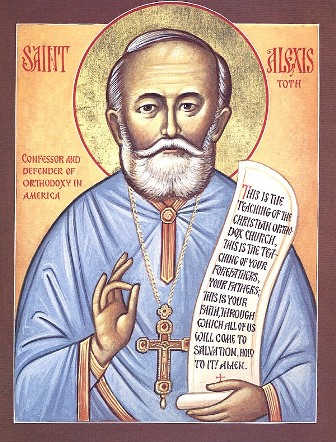
AD: Your chapter on Alexis Toth also discusses Josaphat Kuntsevych, and it has long been a question of mine as to how each side should regard the other's saints, especially as one works towards unity. To put it crudely, one church's heretic is another church's hero. Toth, of course, was a former Eastern Catholic who became Orthodox and was canonized by the OCA while Kuntsevych went the opposite route, ending up a canonized martyr in the Ukrainian and Roman Catholic Churches. What are your thoughts on these competing martyrologies? How should we regard them today--as embarrassing emblems of nasty practices from the past we think we would never do again today? Or should their holiness be considered primarily on its own more individual and personal terms without regard to the ecclesial politics? (This issue came up in the Byzantine-Oriental dialogues where both liturgical traditions have canonized saints and anathematized heretics that are the direct opposite of each other, and neither side seems to know what to do about that since they do not want to simply abandon liturgical texts that have been prayed for centuries.)

OH: Oh, wow.  This is a tough one and one I will admit not having thought about nearly as much as I probably should, even though I first encountered this in a real way at seminary, when Dr. Bouteneff asked us the same question in a class looking at Orthodox and Oriental Orthodox relations.  So, I can only tell you where I’m at currently, which may not be my mature thought as I give this more time. 

I would say that what makes this question seem difficult is our sinful desire to hold grudges and identify with an imagined past.  It seems to be easy to identify with our own church brothers and sisters who were wronged in the past and then to retain the accusation of abuse against the contemporary expression of the opposing religious body.  One might claim this is a “sacramental” aspect to “church.”  This could be especially so in the case of Orthodox and Catholics.  Something like:  “My church is the body of Christ and therefore I am mystically present with the past abused persons when I go to liturgy/mass and therefore those past abuses are still meaningful and real.”  At other times, it’s much less profound and is simply a way of attacking the church you do not belong to simply because it doesn’t agree with your church.

However it is expressed, it seems to me that what is needed a reconfiguration based on the fact that the Church is, indeed, the Body of Christ.  If I believe my church is the Church (or at least part of it) then I should see the past martyrs as being able to exist at a level in which they can say “Father forgive them, for they know not what they do.”  This perspective should then be combined with humility, such that we no longer think it pertains to us to continue the violence (even if by way of rhetoric).  If these are combined, we can then become open to the fact that each church has canonized people who helped people against abuse from the other side.  That is, we will realize our side sinned too.  Our side also helped create tensions and violence. 

So, to return to your examples: a faithful Roman Catholic should be able to say that Toth was right to oppose the prejudice he encountered from Western Catholics and a faithful Orthodox Christian should be able to say Josef Kuntsevych’s murder was wrong, as were the subsequent exaggerations later told to “justify” his murder.  At the same time, each side should hope that in a reunited church, a former Roman Catholic could say Toth’s faith is now dogmatically acceptable (even if he himself was mistaken at times) and a former Eastern Orthodox could say Kuntsevych’s faith is dogmatically acceptable (even if he was mistaken at times).  Their faiths would be seen as reunited.  So, in that context, I really don’t see the problem for canonizing both men.  In fact, I think reunion would require that both remain canonized.  For a real, lasting peace never ignores the difficulties, but reconciles them.

AD: I'm struck by the very different ways in with Catholic and Orthodox immigrants in the last century adjusted to the American context. Archbishop Ireland seems to be a paragon of the Catholic attempt to prove, as strenuously as possible, that Catholics were just like Americans--they spoke English, they were patriotic, they worked hard, they tried to blend in; but Orthodox seem more content to have retained indigenous languages and practices and more comfortable, perhaps, appearing as "exotic." And yet, the main burden of your book is in showing just how very much Orthodox did strive to become American through, as you aptly put it, the very American "anti-traditional tradition." Tell us a bit more about what you mean by that phrase.

OH: Yes, well, that gets at the central irony running through this book.  Here you have this faith that many Americans would still categorize as “exotic,” that has received many converts who have operated according to a very American pattern, and on the basis of that American pattern have, in turn, sought to evangelize other Americans.  That American pattern is one of anti-tradition (which could be called an anti-traditional tradition).  America has a long history of religious mavericks who emphasize a part of their previously received tradition in order to create something new.  This has led to an increasingly diversified and complex religious scene.  Restorationist movements embody this anti-traditional tradition by emphasizing aspects of what they had received in order to recreate what had once allegedly existed prior to that tradition that was given to them.  So, it is “anti-tradition” in trying to by-pass the received tradition but a “tradition” nonetheless by virtue of being an ongoing way of doing religion in America.  One restoration bequeaths another.  What has happened in the case of many American Orthodox converts, especially those I examined in my study, was that their very desire to find tradition was undertaken in a manner that represented the anti-tradition tradition. 
       
What is more, these converts then used this approach to lead and/or attract other converts.  This is important to note because some have taken such actions by new converts as simply perpetuating Orthodoxy’s “defensiveness” in the face of American culture when, in fact, it is evidence of engaging American pluralism.  One sees this in the case of Gillquist, for instance when he went on to encourage other Christians to join the Orthodox Church by arguing the Orthodox Church exists not merely as a non-denominational church but as a pre-denominational church.  It also becomes a way of trying to present the Orthodox Church to America in a way that Americans could appreciate it.
 
AD: In your discussion about the reception of many former Evangelical Orthodox into the Antiochian Archdiocese, it occurred to me that in some clear ways Met. Philip is precisely an embodiment of your 'anti-traditional tradition," yes? I'm thinking here of his handling of the Joseph Allen affair as well as his performing a "mass" ordination for the EO clergy in one liturgy. Is that a fair assessment of him?
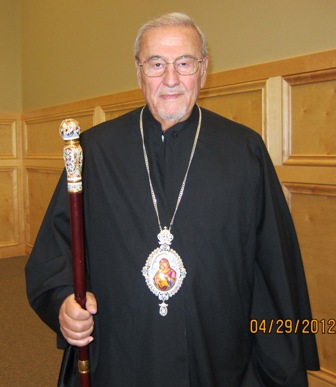
OH:  Hmmm.  Interesting that you should ask this.  Not long after the book came out, a colleague and friend emailed me and wrote that Metropolitan Philip came off looking more like a lone ranger than this friend had previously thought.  I should point out that Metropolitan Philip was not a focus of my study.  He did, however, play significant roles in the conversions of Gillquist and the most of the former Evangelical Orthodox Church and so he appeared with some frequency in the last two chapters of this work.  He was connected to controversial decisions that affected that group of converts, including that of their ordinations and the remarriage of Fr. Joseph Allen, which you mention.  And, to be fair, he performed other actions surrounding those decisions that were (and are) controversial in themselves and this doesn’t even touch on Ben Lomond and fallout from that.  So, I can see how one might wonder if Metropolitan Philip doesn’t represent the anti-traditional tradition, but I would argue he does not fit the anti-traditional tradition as I set it out in my narrative.  Whatever one might think of his actions at times, he has not, from the sources I consulted, sought to recover and reestablish a previous norm.  He may be a religious maverick, but he did not exhibit the intention to reestablish a previous norm by establishing a new church or some larger church reform.  Indeed, the only common denominator I saw was himself.  I suppose if one were to broaden anti-traditional tradition far enough, he would fit, but then the phrase would merely be a synonym for a religious maverick of any kind whereas I wanted to highlight the founding of new denominations, religions, or reform efforts.  Perhaps someday someone will study his legacy, for all its complexities.  When that day arrives, I would encourage that scholar to consult the sources I did in addition to other sources that are relevant and to seek to be as unpartisan as possible, allowing the sources to speak for themselves.

AD: Your work shows, as you sum up at the end (p.156) that many converts "prioritized an earlier expression of Christianity and have identified the Orthodox Churches as continuations of that earlier church." This gets at something I've been thinking about more and more over the past year--and have discussed in my reviews of the new collection, Orthodox Constructions of the West: how many Eastern Christians (and in a different direction, but with similar methods, many "traditionalist" Roman Catholics also) appropriate history. I've heard it said that few of us read history on its own terms. Instead we "plunder it for present political purposes." Do you think that's generally true?
 
OH: That’s a great question because suspect there will be Orthodox who are not yet prepared to allow the historical evidence to be what it is but will believe that somehow I must have slanted it so that things did not look as neat and tidy (and triumphalistic) as might be found in books such as Orthodox America, 1794-1776 or Becoming Orthodox. What I would counter with is that we need to distinguish between plundering for our own purposes and investigating to address current concerns.  One can cherry pick any period of history to “prove” nearly anything but that is different from saying, “here is a topic that is important to us today—what is its history, its back story and what can we learn from this”?

AD: Following this, have you set out, or have other especially Orthodox historians set out, any basic hermeneutical and historiographical guidelines on reading and writing about church history? It's often seemed to me that some guidelines or ground-rules like that would be useful in trying to talk about (and defuse the tensions surrounding) controverted issues like, say, the Fourth Crusade or the Union of Brest and similar issues.

OH:  You’re determined to turn this interview into a book project of its own!  I actually think that what is eventually needed is an Orthodox philosophy/theology of history.  I actually have that as a long range goal, sometime later in my career.  I’m not even close to that yet, but I suppose there are a few things I could say.  I have outlined what I think historical theology means (see attached PDF).  I think the most important element is the ascetic—the effort to remain dispassionate as one researches and studies.  This is not easy, for any number of reasons.  One might already have a predetermined outcome one wants.  For instance, I suspect this happens at times when we want to canonize a particular person or particular kind of person.  One might also be cherry picking in order to defend a particular point of view.  This is an extreme version of the predetermined outcome.  Alternatively, one might simply be too colored by one’s political or ecclesiastical allegiance.  Here, the historian may be looking at all the evidence but the way in which it is weighed might seem questionable.  We all have perspective and that shouldn’t be denied but I think the biggest lesson we need to learn is to go into historical inquiry as an act of disciplining the soul and achieving dispassion.  It may be a never ending goal, but must be our goal nonetheless, especially those of us who would ground dispassion in theosis, which comes through Christ. 

AD: Sum up your hopes for this book:

OH: I have several hopes for this book.  First, I hope it provides scholars a way to assess many Orthodox conversions, if not the majority of them.  As a by-product, I think my thesis could be applied to analogous situations within the church, as you suggested by asking about Metropolitan Philip.  It didn’t work in his case, but maybe it could still apply in others.  Second, I hope this provides scholars, Orthodox clergy, and Orthodox laity with a more realistic view of some important converts and convert movements.  Orthodox have developed a fair amount of mythology surrounding Orthodox converts, a mythology that has often been wedded to triumphalism (talk about a lack of dispassion!).  This work clearly breaks through that and in that way, I hope it can serve as an example of the kind of historical inquiry Orthodoxy in America needs (whether internally, from Orthodox such as myself, or externally).

AD: What projects do you have on the go now? What will the next book likely be?

OH: In  true fashion for one who could simultaneously work on Sarapion and American Orthodox converts, I have three projects in progress. 

First, I am collaborating with my friend and colleague Brian Matz on translations of texts from the ninth century filioque dispute.  We hope to have a manuscript that we could submit a year from now.  Ed Sciecienski mentioned our work in his book, but Brian and I got distracted by our other projects, so it will be nice to return to this and publish it. 

Second, I am also working on a project that develops a virtue ethic from iconography.  This work is intended not simply as an academic piece, but as something that will be easily accessible to clergy and interested laity.  I am not sure how soon I will have something to a publisher with this project.  It will depend on what this spring and summer bring. 

A third project I am working on is more in-depth than the first two.  It builds from my convert book, taking up the idea of engaging American pluralism.  This project will be an exploration of American Orthodox engagement with religious freedom.  I believe this is a much needed area of exploration and in the conclusion I will directly engage some Orthodox political theology, and argue for an Orthodox-informed “Christian secularism.”  So, if I hope the first two will be to publishers within a year or so, this one will likely take a couple of years just to get into (rough) manuscript form.  This one might take a little while but I hope it will be worth it.
Related Posts Plugin for WordPress, Blogger...