"Let books be your dining table, / And you shall be full of delights. / Let them be your
mattress,/
And you shall sleep restful nights" (St. Ephraim the Syrian).


Showing posts with label Marcus Plested. Show all posts

Friday, April 29, 2022

Plested on Sophiology

If you don't know the works of Marcus Plested, you need to remedy that immediately. I've interviewed him on here and discussed some of his other landmark works. 

Coming out the end of June is his latest book, Wisdom in Christian Tradition:The Patristic Roots of Modern Russian Sophiology (Oxford University Press, 2022), 288pp.

About this book the publisher tells us this:

Following a survey of the biblical and classical background, Wisdom in Christian Tradition offers a detailed exploration of the theme of wisdom in patristic, Byzantine, and medieval theology, up to and including Gregory Palamas and Thomas Aquinas in Greek East and Latin West, respectively. Three principal levels of Christian wisdom discourse are distinguished: wisdom as human attainment, wisdom as divine gift, and wisdom as an attribute or quality of God. This journey through Wisdom in Christian Tradition is undertaken in conversation with modern Russian Sophiology, one of the most popular and widely discussed theological movements of our time. Sophiology is characterized by the idea of a primal pre-principle of divineâhuman unity (âSophiaâ) manifest in both uncreated and created forms and constituting the very foundation of all that is. Sophiology is a complex phenomenon with multiple sources and inspirations, very much including the Church Fathers. Indeed, fidelity to patristic tradition was to become an ever-increasing feature of its self-understanding and self-articulation, above all in the work of its greatest exponent, Fr Sergius Bulgakov (1871-1944). This âunmodern turnâ (as it is here christened) to patristic sources has, however, long been fiercely contested. This book is the first to evaluate thoroughly the nature and substance of Sophiologyâs claim to patristic continuity. The final chapter offers a radical re-thinking of Sophiology in line with patristic tradition. This constructive proposal maintains Sophiologyâs most distinctive insights and most pertinent applications while divesting it of some its more problematic elements.

Wednesday, November 11, 2020

On Receiving--or Not--the Great Schoolman Thomas Aquinas

One of the most fascinating books I read in the last decade was and remains Marcus Plested's Orthodox Readings of Aquinas, about which I interviewed him on this blog. It must surely be counted as a key piece of scholarship in dismantling the bogus and tendentious tales told by Orthodox apologists about the Big Bad Schoolmen, and in that way serving as "ecumenical scholarship" of the most precious sort. 

Plested now teams up with the indefatigable Matthew Levering to bring us, early next year, The Oxford Handbook of the Reception of Aquinas. The book contains several chapters on Eastern, Byzantine, and Orthodox responses to Aquinas in a variety of different historical contexts--along with many other riches. About this book the publisher further tells us this: 

The Oxford Handbook of the Reception of Aquinas provides a comprehensive survey of Catholic, Orthodox, and Protestant philosophical and theological reception of Thomas Aquinas over the past 750 years.This Handbook will serve as a necessary primer for everyone who wishes to study Aquinas's thought and/or the history of theology and philosophy since Aquinas's day. Part I considers the late-medieval receptions of Aquinas among Catholics and Orthodox. Part II examines sixteenth-century Western receptions of Aquinas (Protestant and Catholic), followed by a chapter on sixteenth- and seventeenth-century Orthodox reception. Part III discusses seventeenth-century Protestant and Catholic receptions, and Part IV surveys eighteenth- and nineteenth-century receptions (Protestant, Orthodox, and Catholic). Part V focuses on the twentieth century and takes into account the diversity of theological movements in the past century as well as extensive philosophical treatment. The final section unpicks contemporary systematic approaches to Aquinas, covering the main philosophical and theological themes for which he is best known. With chapters written by a wide range of experts in their respective fields, this volume provides a valuable touchstone regarding the developments that have marked the past seven centuries of Christian theology.

Friday, August 17, 2018

Aquinas and the Greek Fathers

I spy many good things in the catalogue just sent to me by the Catholic University of America Press.The one that lept out at me in a particular way will be published this November: Thomas Aquinas and the Greek Fatherseds. Michael Dauphinais, Andrew Hoffer, and Roger Nutt (CUAP, 2018), 384pp.

About this collection the publisher tells us the following:
Scholars have often been quick to acknowledge Thomas Aquinas's distinctive retrieval of Aristotle's Greek philosophical heritage. Often lagging, however, has been a proper appreciation of both his originality and indebtedness in appropriating the great theological insights of the Greek Fathers of the Church. In a similar way to his integration of the Aristotelian philosophical corpus, Aquinas successfully interwove the often newly received and translated Greek patristic sources into a thirteenth-century theological framework, one dominated by the Latin Fathers. His use of the Greek Fathers definitively shaped his exposition of sacra doctrina in the fundamental areas of God and creation, Trinitarian theology, the moral life, and Christ and the Sacraments.
Aquinas is one of the three great A-Team Bogey Men (the others being Augustine and Anselm, none of whom are ever read in the originals of course) of the tiresome and puerile Orthodox apologetics one finds on line and in various tawdry books written by people who couldn't conjugate a Latin verb if their life depended on it. But for people who've read him, it's long been obvious that he is deeply immersed in Greek patristic, especially Cappadocian, literature. This was superlatively documented and discussed in Marcus Plested's invaluable book Orthodox Readings of Aquinas, about which I interviewed him here. That book would make a suitable accompaniment for this new collection.

Thursday, June 28, 2018

Inventing Gregory Palamas

I just received in the mail Oxford University Press's catalogue of forthcoming works. As always, there are lots of interesting books in the works, but none more so, it seems to me, than this book, not due out for nearly a year, but well worth the wait both because of the author (who is a widely respected translator and author of many books) and especially the timeliness of the topic: Gregory Palamas and the Making of Palamism in the Modern Age by Norman Russell (OUP, 2019).

For those who have followed Orthodox constructions of identity in the West in the last three decades, as well as Orthodox apologetics, the figure of Gregory Palamas looms large, almost always as a cipher and a rock against whom the horrors of (inter alia) Thomism, rationalism, and scholasticism can be dashed to pieces in triumphalist fashion. But that narrative construction, always shaky at best as far as real scholars were concerned, really began to fall apart when Christiaan Kappes (interviewed here) published his book on the Immaculate Conception; and when, a few months later, Marcus Plested published his book on Orthodox Readings of Aquinas. Both showed that Palamas was far from the anti-Western figure he had been made out to be; both showed that he engaged, often quite positively, with Thomism and other Western schools of thought. (For an interview with, engagement of, and lecture by Plested, go here and follow the links.)

To be fair, it is not only Orthodox apologists who got into this act. As Russell's forthcoming book notes, a key figure in Western distortions of Eastern thought, a key figure in Western polemics and triumphalism of an equally repellent variety, is Martin Jugie, who had an obvious hatred of Palamas and did everything he could to poison Western Catholicism against him. As Jaroslav Pelikan once archly said of Jugie, his tragedy was that he knew so much but understood so little.

Jugie and others figure prominently in Russell's forthcoming book, for which the publisher has given us this table of contents:

List of Abbreviations
Introduction
Part I THE HISTORICAL RECEPTION OF PALAMITE THEOLOGY
1. The Orthodox Struggle to Assimilate Palamite Thinking
2. Martin Jugie and the invention of Palamism
3. John Meyendorff's Response to Jugie
4. New Directions since Meyendorff
Part II RAISING THE LARGER QUESTIONS
5. What Does Doctrinal Development Mean?
6. How is a Participatory Understanding of the Divine Mystery to be Attained?
7. What is the Reality of Divine-Human Communion?
8. Could Palamas Become 'the Inheritance of all Christians'?
Bibliography

And this description:
The fourteenth-century Greek hesychast and controversialist, Gregory Palamas, has been so successfully cast as 'the other' in Western theological discourse that it can be difficult to gain a sympathetic hearing for him. In the first part of this book, Norman Russell traces the historical reception of Palamite thought in Orthodoxy and in the West, and investigates how 'Palamism' was constructed in the early twentieth century by both Western and Eastern theologians (principally Martin Jugie and John Meyendorff) for polemical or apologetic purposes. Russell argues that we need to go behind these ideological constructions in order to gain a true perception of the teaching of Gregory Palamas. In his recent survey of Palamite scholarship, Robert Sinkewicz noted that it is now time to raise the larger questions. The second part of the book attempts to do this, following the contours of Palamas' thinking in three areas: his relationship to tradition, his philosophy, and his theology. Russell shows that Palamite thought, when freed of misunderstanding and misrepresentation, has the potential to enrich our understanding of divine-human communion. This study contributes to the changing paradigm of scholarship on Palamas, nudging it towards the point at which Palamite thought can be used fruitfully by contemporary Western and Eastern theologians without the need to subscribe to what has been regarded as 'Palamism'.
When the book is published next year, I will have more to say about it then. 

Thursday, July 21, 2016

Marcus Plested on East-West Estrangement

Marcus Plested's splendid study, Orthodox Readings of Aquinas, which I discussed here, and whom I interviewed here, came back to mind tonight as a friend sent me a link to a lecture that Plested gave on East-West estrangement, and the role of Aquinas and Palamas, this May in Moscow:

Friday, February 13, 2015

Orthodox Readings of Aquinas

Oxford University Press yesterday sent me a flyer in the mail alerting me to the fact that they have just released a paperback version of Marcus Plested's Orthodox Readings of Aquinas

When this superlative and wholly welcome study first emerged two years ago in hardback, I reviewed it here, and interviewed Plested here.This is precisely the sort of careful, discerning scholarship that we need, and all the reviews I have seen have been extremely laudatory, and rightly so. Never again should anyone from the East be allowed to slag Aquinas or "the scholastics" until and unless they have read this book from an important Orthodox scholar.

Friday, December 6, 2013

Orthodox Constructions of the West: II

When we last met, we heard from one of the contributors to the collection Orthodox Constructions of the West on the question of primacy in Orthodox ecclesiology. Let us now proceed back to the beginning of the book and the introduction and opening historical essays, all of which are, alone, worth the price of the book. As I noted in my first comments, this is an invaluable book that deserves the widest possible audience.

The editors provide the introduction, noting that it is not designed to be a comprehensive re-telling of the history of relations between East and West. Nevertheless, they do set forth an expansive and carefully considered narrative which goes some considerable distance toward "clearing the swamp" (Stanley Hauerwas) of received notions. (Many of the shibboleths people repeat in the dolorous narrative of East-West division are manifestly of recent vintage, and many issues we today commonly insist are paramount were of little concern to our forebears.) But more than that, the editors set forth the vision of this volume, and of the conference that preceded it, noting that "the categories of East and West are always fluid, always multiform, and almost always projections of an imagined difference" (2; my emphasis). This emphasis on an imagined difference is a leitmotif in many of the essays that follow.

Robert Taft's essay is vintage Taft. Much of it will, of course, be very familiar to those who read Taft. Parts of this paper, in fact, were used in another paper of his at the Orientale Lumen conference in 2011 when I was on a panel with him and others, including Sr. Vassa Larin of ROCOR; and Met. Kallistos Ware, the retired Greek Orthodox theologian from Oxford. Taft's opening is worth quoting in extenso because it sums up perfectly my own views of, approach towards, and love for the Orthodox Christian East:
I consider the Orthodox Churches the historic apostolic Christianity of the East and sister churches of the Catholic Church;...I recognize and rejoice in the fact that Orthodox peoples remain Orthodox; the Catholic Church should support and collaborate with the Orthodox Churches in every way, foster the most cordial relations with them, earnestly work to restore communion with them, recognize their legitimate interests especially on their home ground, avoid all proselytism among their flocks there or elsewhere, not seek in any way to undercut them, nor rejoice in or exploit their weaknesses, nor fish in their pond, nor seek to convert their faithful to the Catholic Church.
After this, Taft notes that it's important to begin with self-criticism, and so he goes into some detail about how his own Jesuit predecessors badly mangled relations with the Christian East in places such as India, Ethiopia, and Eastern Europe, especially, of course, what is today known as Ukraine. This latter brings to mind the controverted history of "Uniatism," about which Taft is as blunt and detailed here as in the rest of the essay.

Having criticized the Catholic Church in unsparing terms, Taft then lists a number of areas where we are still waiting for more honest self-criticism and -assessment from the Orthodox. By laying out the facts, Taft shows how, e.g., the idea that no Orthodox country ever used the power of the state to compel non-Orthodox to believe is revealed to be without foundation--both in the early Byzantine period (cf. the fate of the Copts or Armenians) and later as under, e.g., the Russian tsars. The idea that the residents of Constantinople in 1204 were as pure and innocent as the driven snow, and thus complete victims of the Fourth Crusade, conveniently overlooks the fact of a pogrom against the Latins in the city organized and murderously carried out by the Greeks in 1182. Orthodox treatment of Greek Catholics in Romania and Ukraine in the immediate post-war period of the 1940s is another area where frank admission is still wanting. The point of this list (and other many examples Taft provides) is not to engage in a tit-for-tat--what Taft memorably in 2011 called the "my hands are cleaner than yours" approach to history; but simply to show that all have sinned and fallen short of the glory of our romanticized pasts.

Taft's essay is followed by two others, equally historically impressive in different ways though less widely focused. The historian Tia Kolbaba, author of such important studies (which I had expertly reviewed in Logos: A Journal of Eastern Christian Studies) as Inventing Latin Heretics: Byzantines and the Filioque in the Ninth Century and The Byzantine Lists: ERRORS OF THE LATINS, draws on her historical expertise to treat relations between Byzantines, Armenians, and Latins on the question of whether to use yeast in the eucharistic bread, a controversy she traces to the tenth century. This is a fascinating essay in which she reveals that the common problem of the time was an inability to conceive of difference that was not seen as "heretical," a term which, she notes, still needs further historical elaboration and differentiation  in the Byzantine period.

Kolbaba's essay is followed by "Light from the West: Byzantine Readings of Aquinas" by Marcus Plested, who has, of course, recently published an entire book on Orthodoxy and Aquinas, which I discussed here while interviewing the author here. In the next installment, we'll look at what Plested unearths here, and a few of the other essays that follow. To be continued. 

Monday, February 4, 2013

Marcus Plested on Orthodoxy and Aquinas

Earlier I reviewed Marcus Plested's splendid new book, Orthodox Readings of Aquinas (Oxford UP, 2012). I've since had a chance to interview the author, and here are his thoughts.

AD: Tell us a bit about your background.

MP: I am an Orthodox layman from London educated at Oxford. I wrote my doctorate on the Macarian writings under the supervision of Metropolitan Kallistos Ware. Since 2000 I have been at the Institute for Orthodox Christian Studies in Cambridge, latterly as Academic Director.
AD: What led you to write this book in particular?

MP: It was a book I felt had to be written - not only because it was a vastly important subject area that hadn't been tackled before, but also as an attempt to dispel some of the negative and oppositional (i.e. anti-Western) accounts of Orthodoxy that have tended to prevail in recent years. Such accounts, to my mind, are not properly faithful to Orthodox tradition and tend to undermine Orthodox witness in the world today. The fact that so many Orthodox saints and scholars over the centuries have admired and made good critical use of Aquinas warns us that any blanket rejection of him and all he stands for is a relatively recent development within Orthodoxy.

AD: Tell us a little bit about your method of 'reverse perspective' or 'multiple perspectives' and how that helped in writing this book.

MP: As you appreciate, this method came through thinking about the artistic principles of the Orthodox icon. Approaching the Fathers more as one would an icon than as a mere object of enquiry helps us to be more receptive and less hubristic in our approach to the tradition. I have also expanded the principle of multiple perspectives to underpin some of the more unusual things I do in the book - e.g. the presentation of a 'Byzantine Aquinas', or Palamas' sympathies with Latin theology and theological methodology, or the Barlaamite character of Byzantine anti-Thomism. All this, I hope, will encourage many people to look with a rather different perspective on some of the supposed certainties of Orthodox anti-Westernism.

AD: Your first chapter on Aquinas and the Greek East makes mention several times of multiple forms of Thomism depending on period, 'school,' etc. Was it a difficult task trying to sort through all the different expressions of Thomism extant?
MP: Yes.

AD:  Am I correct in thinking that Palamas seems to be coming in for something of a re-consideration lately by Orthodox thinkers who realize he has often been put forth--as you note several times in your book--less for his own merits, and more as a supposed counterpoint to Aquinas, both almost equally 'mythologized'?

MP: There are indeed encouraging signs of a sea-change.

AD: The extent of Thomas' appreciation for the East ('Greeks'), which you detail in your first chapter, was astonishing to me. He really seems much more generous and gracious than I would have expected. Were you also surprised by these findings?

MP: Yes, while I knew of his fascination with Dionysius and admiration for St John of Damascus, I was stunned by the extent of his engagement with patristic, conciliar, and Byzantine sources.

AD: Your next chapter notes a similar openness to the Latin West in Gregory Palamas--more so than in those who come after him or claim to be his followers or interpreters. Was that also surprising to you?
Less so - this is something I knew something of as a graduate student, but even here I found much more than I had anticipated.

AD: Tell us a bit about the role the Kievan Academy plays, especially under Petro Mohyla, in shaping East-Slavic understandings and interpretations of Thomism, scholasticism, and 'the West' generally.
MP: The Kievan school has some claim to being treated as a species of Occidental Orthodoxy - i.e. a consciously Western expression of Orthodox tradition. While not all achievements of that school are equally admirable (or equally Orthodox), this school cannot be written off as a corruption of Orthodoxy.
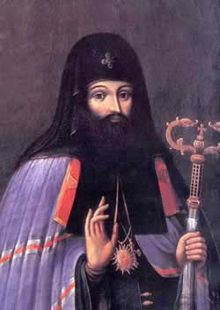
Petro Mohyla
AD: What changes in modern Orthodoxy such that its perceptions of, and reactions to, 'Thomism' and 'scholasticism' almost seem to suggest an allergic reaction to both, in distinction to the earlier openness and often deep and gracious consideration you so skillfully document?

MP: A very good question. I trace much of this allergic reaction back to the anti-Westernism of the Russian Slavophiles (itself, ironically, conditioned by German Idealism and Romanticism). Aggressive expansionism on the part of both Catholicism and Protestantism in the early modern and modern periods will not have helped matters. But it seems to me that an uncompromising defence of Orthodoxy has no need for a global rejection of the West and all its works. Dositheos of Jerusalem is a fine case in point - a fierce defender of Orthodoxy (known as the 'scourge of the Latins') but deeply sympathetic, in practice, to Latin theology.
AD: Am I right in seeing your book as part of a larger and long-term project (in which you and numerous others seem at work today) of reconsidering Orthodox-Catholic history in order to clear away what we would now regard as baseless misunderstandings that needlessly divide us?
MP: This is a fair comment. It seems to me that if if ecumenism has a future, it is one in which the Churches plunge ever deeper into their respective traditions rather than seeking some sort of artificial commonality. There remains some serious differences between Orthodox and Catholics but there is also a great deal of misunderstanding that can be swept away.
 AD: What projects are you working on currently?

A project on Wisdom in the Church Fathers that has been on hold while I completed the project on Aquinas.
 
AD: Sum up for us what you hopes or expectations you have for this book

I hope some people will read it!

Wednesday, December 12, 2012

Orthodox Readings of Aquinas

Recently I drew attention to a just-released book from Oxford University Press authored by Marcus Plested: Orthodox Readings of Aquinas (Changing Paradigms in Historical and Systematic Theology).

I had a chance to read it before sending it out to an expert Thomist for review. It is a splendid book, and I very warmly encourage all who are interested in these matters to get a copy and appreciate the many riches of this detailed, well researched, and very cogently written study which overturns so much rubbish about "Thomism" and "scholasticism" that ignorant apologists for the East have often proffered without bestirring themselves to inquire into such tiresome matters as actual texts or historical facts. Equally, though, it overturns a lot of other rubbish about the glories of Palamism, and how Palamas is the counterpoint to that very bad man Aquinas. Both perspectives, as Plested shows, are uniquely creations of late modernity and not at all reflective of either figure or their near-contemporaries. Thomas was far more gracious towards, far more open to, and far more deeply immersed in, Greek thought, than he is usually given credit for, and much the same could be said about Palamas's immersion in Latin theology.

This is, then, a wholly welcome book if for no other reason than it clears away a lot of the tiresome and tendentious detritus blocking the way towards a discussion of real and serious issues (e.g., the papacy) in the search for East-West rapprochement. We need to get past the bad, and often deliberate, historical distortions of each other in order to deal with reality. We are greatly indebted to Plested for helping us to do this with the one figure who (as I noted earlier), arguably more than any other (though Augustine and Anselm are close contenders), is often held up as being somehow the perfect exemplar of everything that is wrong with the West and everything that blocks unity with the East. What a weary roadshow that has become, and its complete demolition in Plested's hands is a greatly cheering development.

Wednesday, November 28, 2012

Orthodox Readings of Aquinas

As the Orthodox theologian David Bentley Hart acerbically put it, most Orthodox never bother to read Roman Catholic sources, but that does not prevent them from criticizing them, often in truly fatuous terms. And among those sources, it is a matter of some competition as to whether Augustine (as I noted before) or Aquinas is the more criticized and misunderstood because ignored. Along comes a new book that looks set to remedy this as least as far as the "angelic doctor" is concerned:  Marcus Plested, Orthodox Readings of Aquinas (Changing Paradigms in Historical and Systematic Theology, OUP, 2013).

About this book the publisher tells us:
This book is the first exploration of the remarkable odyssey of Thomas Aquinas in the Orthodox Christian world, from the Byzantine to the modern era. Aquinas was received with astonishing enthusiasm across the Byzantine theological spectrum. By contrast, modern Orthodox readings of Aquinas have been resoundingly negative, routinely presenting Aquinas as the archetype of as a specifically Western form of theology against which the Orthodox East must set its face. Basing itself primarily on a close study of the Byzantine reception of Thomas, this study rejects such hackneyed dichotomies, arguing instead for a properly catholic or universal construal of Orthodoxy - one in which Thomas might once again find a place. In its probing of the East-West dichotomy, this book questions the widespread juxtaposition of Gregory Palamas and Thomas Aquinas as archetypes of opposing Greek and Latin theological traditions. The long period between the Fall of Constantinople and the Russian Revolution, conventionally written off as an era of sterility and malformation for Orthodox theology, is also viewed with a fresh perspective. Study of the reception of Thomas in this period reveals a theological sophistication and a generosity of vision that is rarely accounted for. In short, this is a book which radically re-thinks the history of Orthodox theology through the prism of the fascinating and largely untold story of Orthodox engagement with Aquinas.
Related Posts Plugin for WordPress, Blogger...