I sent questions to the author back in September, but Pia Sophia Chaudhari was able to get her answers to me only this week. But like fine wine, these were worth waiting for, not least as the intervening time allowed me to read her book again in a much closer way as a result of which I can say with even greater conviction that Dynamis of Healing: Patristic Theology and the Psyche is an extraordinary and welcome book for all sorts of reasons. If you have any interest in psychology of whatever school (object relations, self-psychology, Jungian, and even Freudian), of Orthodox theology, and of patristics, you will want to read this book. So will those of clinical background interested in understanding spiritual dynamics more deeply.
It is not only the most singular and important engagement of Orthodox theology and depth psychology I have seen. It is also full of the sorts of insights into the psychic and spiritual life, into both theology and psychology, that cause one to write such exclamatory notes in the margins as "At last!" when you come across an author giving welcome voice to what Christopher Bollas so memorably called the "unthought known." This is the sort of book that pays re-reading, and I will certainly be recommending it to students in the years to come.
Following my usual practice, I e-mailed some questions to Pia, and here are her answers.
AD:Tell us about your background, both as a scholar as a Jungian analyst in training.
PSC: My doctoral work was in the department of Psychiatry and Religion at Union Theological seminary, where I entered with an interest in theology, early church history and psychology, and eventually focused on Orthodox Christian theology, anthropology, and psychoanalytic theory. Since receiving my PhD I have taught, continued my research and writing, and started training as a Jungian analyst (I am currently on leave of absence from the program). In 2016 I also co-founded an initiative called APOCC—Analytical Psychology and Orthodox Christianity Consultation to further the conversation between the two fields of study.
AD: Tell us what led you to write this book, Dynamis of Healing: Patristic Theology and the Psyche.
PSC: My first serious engagement with Christianity came about 20 years ago, in a charismatic free church. Everyone there spoke of God’s power to heal, and I found myself drawn by both the hope of healing and a wondering as to how God actually does heal. It’s been a long and winding journey since then, and this book was an attempt to put down some of what I have seen. I don’t claim to have definitive answers, only observations and a continued hope that God does indeed heal, though not always (often!) in the way we expect.
AD: I have found that the very mention of Freud and Jung among some Orthodox and Catholic Christians awakens strong suspicion if not outright condemnation. Has that been your experience, and if so, how have you handled it?
Yes, there’s been some of that. I understand it, and sometimes even agree with it. I think we always have to be careful—and this is a trope that arises over and over again when talking with both these fields—to be curious about the ‘resistance’ (to use a Freudian term) to psychoanalytic insights, while also respectful of the major differences. Sometimes the resistance is a fear of the psyche, a fear of the unknown, a fear of the body, desire, emotions, vulnerability, anger etc…a fear of oneself in the fullest sense. Such a resistance can do a disservice to the possibility of healing contained within the psychological work. And these are fears all people have in some form, and which can be couched in any language.
But sometimes the resistance is also either to the overt dismantling of the religious beliefs, as you see in Freud, or to the re-interpretation of them as you see in Jung. As an Orthodox Christian I am firmly against the psychologization of the sacramental, as though it can be reduced to the psychological, even as, of course, it speaks to the psyche and has an impact on it. I think it important not to read either Freud or Jung, but perhaps especially Jung who writes about God, as theologians. They were doctors and their focus was clinical. Lastly, I would say that we always have to keep in mind the difference between the created order and the uncreated order. Psychology belongs to the former (as do psychoanalysts as well as theologians) but God and His uncreated energies to the latter. They should never be conflated.
AD: Ann Belford Ulanov comes up by p.2 and is a regular interlocutor throughout your book. Tell us a bit about how and why you have found her helpful and insightful
PSC: Ann’s work became very meaningful to me early on in my own work, as her writing managed to convey both rigorous scholarship and deeply embodied application. There is very little that is abstract in her work. It speaks from and to the gut level of existence.
So much theology and psychology can be intellectually stimulating and gratifying, and yet leave you wondering how it applies to your immediate concerns, your underlying pain or emptiness, or even your most mundane joys. But Ann's work speaks to those issues with all the earthy wisdom of a clinician of many decades, and yet, it also manages to hold within it a deep joy and expectation of the transcendent. Of course, her focus on Christian theology and psychoanalytic theory also deeply formed my focus. Her work on the ‘feminine mode of being’ helped me find a toehold into a way of exploring these issues, which I sometimes joke is feminine-ist, rather than feminist.
AD: You seem (p.5) to be at pains to set out both Orthodox theology and depth psychology alongside one another, without conflating the two. Why is it important to maintain that distinction?
For two reasons. The one is that—and perhaps this comes from my early work in peace-building and conflict resolution!—that when inviting two parties to the table to talk I think it only respectful to allow each one to self-define. In other words, let psychology tell us what it is about, and Orthodox theology tell us what it in turn is about. If one party begins to define the other using its own unique terms and language, you’ve already collapsed the space between the two. (I’m sure I do this occasionally anyway even though I try not to.)
The second reason is the same that I gave earlier—particularly because I am Orthodox I am keenly aware of the sacramental side of faith, and I do not think, believe, or experience that you can psychologize the uncreated energies of God. To the degree Orthodoxy talks about anthropology (in the sense of what it is to be human), and to the degree psychology also talks about anthropology, we have a great deal to talk about. But-as above—when Orthodox talk about God as revealed in Holy Tradition and Scripture, I want to be careful not to psychologize this energy or experience or reduce it to its symbolic aspects.
AD: At the same time, you talk about the “meeting places” where the two may be encountered. Tell us a bit about what you mean by that phrase, and give us an example or two.
Well this is what I set out to explore in my work. And what I postulated was that if Orthodox ontological claims, in particular regarding the person, were true, then they ought to show up in our clinical insights and experience of how people heal. That’s what I mean by meeting places. The two main examples I look at in the book is the instinctual urge towards healing out of a kind of innate ‘blueprint’ we contain within ourselves, and then the incredible importance of the energy of eros in healing and flourishing.
AD: I confess that my own work in psychoanalytic thought has much more strongly gravitated towards Freud and the Middle/Independent school in Britain, including Klein, Coltart, Winnicott, Fairbairn, Guntrip, Adam Phillips, and Christopher Bollas. You cite some of these—Klein, Fairbairn, Winnicott—while having been obviously indebted to and influenced by Jung and the traditions developing after him. Tell us how you came to be drawn to Jung and what you think he in particular offers Eastern Christians among others. In your view is he a more congenial interlocutor to Orthodox Christianity than most other analytic and depth psychologists?
Actually, I love many of the British school analysts you mention, and draw heavily on Winnicott, Fairbairn and Guntrip in my own thinking, in particular because of their relational emphasis. It makes for such interesting conversation with theologies of communion (or desire), as in Zizioulas, Loudovikos, and Yannaras. But my own experience has been more Jungian and many of my mentors have been Jungian as well, so in some ways I speak more from what I know in this realm.
Jung actually studied the Fathers a great deal, and you often will see him quoting St. Irenaeus and others, though I always wish he had managed to find and read the works of St. Maximus. I think there is a great deal to be said between them, and others (e.g Tympas) have explored this directly. Personally, I was drawn to a certain natural wisdom in Jung, as well as his sense of the psyche and Self as guiding and orienting us from within. I love his theory of dreams and the objective psyche and find that it imbues creation with an innate wisdom that is breathtaking and also un-nerving at times. To some degree his theory of the archetypes could work well with Orthodox anthropology as well.
But I also think Jung can be more dangerous to people of faith because he does talk about God and Spirit in ways that are compelling but not always Christian. He was fascinated with Gnosticism for a period, seeing it as an inner path that compensated for—what he experience to be—the more externally oriented and moralistic Christian traditions.
And then of course he found alchemy, which is richly bound up in Christian mysticism, but I am not an expert on that so I should leave it there. There is always the danger of narcissism or solipsism in any ‘theory of the world’ and Jung is no exception. I think only Holy Communion saves us from that.
AD: I know some Christians who find Jung’s theologizing rather dubious, alleging that he confuses issues in unorthodox ways—e.g., his views on the “problematic fourth” with reference to the feminine and the Trinity. Were there areas where, as an Orthodox Christian scholar, you felt that parts of Jung’s project did indeed go too far outside the bounds of what the Church could accept?
Yes, of course. And it may sound surprising, but I never overly focused on those readings. My project was never to put Jung’s ‘theology’ in conversation with Orthodox theology. I think there would be little to say. My project was to put his ‘boots on the ground’ clinical insights in conversation with Orthodox theology and anthropology, all in the service of healing. I think he had a right, of course, to investigate and postulate what he wanted to about grand theological themes which formed part of his cultural background and of which he tried to make sense, but that is not the same as clinical insights accrued over decades of working with people. I give him far more credence in the latter than the former. I don’t mean that disrespectfully but as I said above, he was a doctor not a theologian and said as much himself.
AD: There are also, of course, clear patristic influences in your work, including especially Maximus the Confessor, Athanasius, Irenaeus, and the Cappadocians. Tell us how you came to work with them, and why you found some of them congenial interlocutors in a book concerned also with depth psychology.
One of my first classes at Union was about the early Church, taught by Fr. John McGuckin (who later became my priest). I was fascinated by the history, and then increasingly by the theology. In fact, it became increasingly difficult for me to read the ‘moderns’, as Fr. John called them (by which he probably meant Aquinas!). I also benefitted from their focus on anthropology, and between Fr. John McGuckin and later Fr. John Behr, was privileged and delighted to enter in to a whole new world of learning.
I felt that the Fathers wrote out of an experience, with all the power of their formidable intellects and education, but still correlated to something experiential. You could feel an energy coursing through their writings, even as it was slightly different for each one, but there is a spiritual power there that I was drawn to. And this emphasis on experience is what made them congenial interlocutors for a book that tried to hold experience as valuable to the questions at hand.
Amazingly enough, by the way, I never intended to use St. Maximus’ work but as I was conducting my original research, I somehow kept being ‘nudged’ towards his work and I finally gave in and started reading him. Within days I knew I would have to redo my entire framework in order to include his work, as the ‘meeting places’ I had been trying to intuit seemed to closely align with his theory of modes of being and tropes of being. Obviously he then became a pillar of my work and thinking.
AD: Some of my recent work with Freud has been in overlapping areas as yours, especially the questions of fantasy, desire, and illusion, and how our images of God are often distorted by various ways, some of them unconscious. Tell us a bit about your clinical pastoral experience in this regard, working in chaplaincy and seeing some of these issues in patients. This book is not just an academic exercise, but also born out of such experience you have had and your patients have also had, yes?
Yes absolutely. I think the basic notions of project and transference are so useful in the clinical pastoral world. I’ve worked with people, for example, who had no contact with their own feelings of anger, but were convinced God was going to rain down hellfire on the people who had hurt them. And of course, people who felt God was punishing them with whatever issue they were struggling with. I think in particular, with my focus on psychology, I was upset at hearing from people of faith that they believed they were simply given this or that painful diagnosis as a cross to bear, when from a psychological standpoint, it seemed like something that could be worked with.
But our projections onto God are fierce and tenacious, because God draws our projections of what is ultimately true—even if at the end of the day we must come to see that it is only ultimately true in our psyche. But that work of recalling such projections is painful and earth-shaking. And then, as Orthodox, I also want to hold open the space for what IS ultimately true to come in, however God chooses to meet each person, but that of course is the work of a spiritual mother or father and not something I can do.
AD: In your experience do you find that Orthodox Christians, in general, are open to talking about these issues more freely today, or are questions of desire, of psychological and mental health, and of our struggles still rather shrouded in shame or embarrassment, as though being people of faith we should somehow be “immune” to, say, depression or disordered fantasizing?
I do find people of faith are easily taken aback when I talk about desire, and even more so when I say that some of what I learned I learned from a very wise spiritual father! There is a kind of Puritanical aspect to religion that pervades our thinking and makes us prone to Freudian super-ego driven religion at times.
I don’t know how many people are aware of the riches of the Fathers and the tradition we have of the interior life. I know what you mean about feeling that one ought not to be prone to depression or fantasy if one has the ‘correct’ faith, but this is also why I wanted to write this book. As much as Orthodoxy has centuries of wisdom about the person, I think the conversation between Orthodox Christianity and the best of the mental health field is imperative—and not just contemporary cognitive/neuroscientific but these analysts we are discussing who plumbed the depths of the person. To the degree a depression or what you term disordered fantasizing can be found to have a meaning (and I do not dismiss chemical imbalances here either), which Jung postulated they often did, they may open up a goldmine of new life for the person. Surely to go in search of that lost or hidden life is a work of faith as well?
AD: I found your discussion of the schizoid type, and of Guntrip’s work, which I have also read with great interest, a very helpful reminder that when it comes to being or feeling split between, as it were, our heads and our hearts, that we all can experience this at different points in time and along different spots of a spectrum. Christopher Bollas has also argued something similar about notions of “madness” and how it’s not an all-or-nothing experience but we dip into and out of it in milder and stronger versions from time to time. Is this a helpful reminder that Christians need to hear—that we can slip into, or out of, various states of health and disease, and that both Orthodox Christianity and therapy can be helpful here, offering us both discernment and ways of healing?
PSC: Such an interesting question! I think we do need to be reminded that we are human and prone to slipping into all kinds of things! And also, I think we need to be reminded of the importance of community in all aspects of our lives. Ann used to say that a ‘complex’ (Jungian term) comes up behind you and just throws a bag over your head, and suddenly you are acting completely unreasonably and don’t even know why. We can do the work, and hopefully get some ‘elbow room’ as she also used to say, between us and our patterns/complexes, but the big ones are rarely fully gone—we are just better able to see them coming and hopefully dodge their onslaught. It helps having people who know you and love you, both pastoral and therapeutic, as well as of course your Church community. And as a wise priest reminded me, for some things, and maybe the most painful and traumatic things we experience, the only answer ultimately is the Cross.
AD: Tell us a bit about your hopes for the book, and who would benefit from reading it
As you mentioned above, it is both academic and, I hope, clinically and pastorally oriented. I hope that anyone with an interest in these two fields might find that there is something helpful in it. Again I think the closer I’ve drawn to the questions, the bigger the answers have become, so I don’t claim to have corralled any final or complete answers into my pages but just to bear witness to an exploration which I undertook and which hopefully others will also undertake in their own ways and we can keep sharing our findings. The goal is to contribute maximally to the field of healing with the best of what we know.
AD: Having finished such a book as this, what is next for you? What are you working on now?
I ended this book with a nod towards the importance of beauty. I have since started working more in this area, both professionally and also in my research. I find the aesthetic emphasis to be so important, especially these days when we are being daily conditioned by an aesthetic (all the computer and phone and tablet screens everywhere) which humans have never before experienced. I worry it is shaping our way of thinking and interacting and that we need to be thinking and writing about this, and naming the effects---especially on young people—from both theological and psychological perspectives.
I did an exploratory paper last year on the archetype of Aphrodite, and the philosophy of Byung Chul-Han (Saving Beauty, and The Agony of Eros) and attempted to connect it with St Maximus. It was just a nascent foray, but I hope to continue in this direction!
Showing posts with label Christopher Bollas. Show all posts
Showing posts with label Christopher Bollas. Show all posts
Friday, December 6, 2019

Tuesday, October 22, 2019
Hysteria Lives--in the Catholic Church
The carryings-on around this pseudo-synod in Rome (so called not because of its content but because, as I argued almost a year ago, nothing in Rome called a "synod" since 1965 has really been such properly so called) are really a sight to behold. The reaction to this synod is merely a more advanced case of the reaction to Pope Francis, which has been growing worse over the last three years especially. But in the last day or so things really seem to have crossed a line with the adolescent antics around some of the Amazonian art which was pitched into the Tiber and has caused rejoicing among a certain sector of Catholics (largely white, North American and Western European, upper middle class at least, and right-wing) on social media.
This sector, I'm convinced, is astonishingly well described by the Anglo-American psychoanalyst Christopher Bollas in his book Hysteria. Bollas defines hysterics as those who are
This sector, I'm convinced, is astonishingly well described by the Anglo-American psychoanalyst Christopher Bollas in his book Hysteria. Bollas defines hysterics as those who are
“indifferent to conversion, who are over-identified with the other, who express themselves in a theatrical manner; who daydream existence rather than engage it; and who prefer the illusion of childlike innocence to the worldliness of the adult. They also suffer from suggestion, either easily influenced by the other or in turn passing on ideas to fellow hysterics.”Elsewhere in this book he notes that "there are as many male as there are female hysterics" and the especially advanced cases are "malignant hysterics" prone to, inter alia, being "transference junkies."
Wednesday, June 5, 2019
The Aphoristic Flirt Adam Phillips
If you randomly started reading Adam Phillips and knew nothing of his background, I have to think it would soon become apparent that he is a psychoanalyst, which conclusion you would arrive at--tentatively, of course--after seeing how his style is circuitous, diffuse, self-questioning, suggestive and assertive in about equal measure, and very reminiscent of the wide-ranging meanderings of the mind. If--apart from, perhaps, his study of D.W. Winnicott--you read virtually any of his many books, you will find that one way to characterize them is as collections of aphorisms surrounded by acres of prose. Because they bear remembering and quoting, I wanted to write some of them down here in no particular order. I gravitate towards the ones I think rich with theological promise as well as those of what seems to me acute clinical insight and applicability.
From On Flirtation: Psychoanalytic Essays on the Uncommitted Life, a book written in part to offer "psychoanalysis with a light touch," to allow analyst and analysand--and general readers--to realize that analysis should be about pleasure and enjoying ourselves (with a reference to Nina Coltart's singular and splendid book Slouching Towards Bethlehem).
On Idolatry:
"It is one of the advantages of flirtation that it can protect us from idolatry....Flirtation keeps things in play."
"Psychoanalysis has always been a religion in which you are not allowed to believe in God."
"We have made a fetish of sexual difference....Our categories are themselves ghosts or ghost-writers and not the reassuring commodities which we...pretend they are."
"Thinking of the sexes as making each other whole is grounds for murder."
Quoting Sandor Ferenczi, "'The patient is not cured by free-associating: he is cured when he can free associate'."
"The radical nature of Freud's project is clear if one imagines what it would be like to live in a world in which everyone was able--had the capacity--to free-associate, to say whatever happened to come into their mind at any given moment."
"Psychoanalysis has always been about what it means to get bogged down in traditions."
"Guilt...is a fundamental obstacle to psychoanalytic cure; the patient desperately needs his symptoms as a punishment."
"In psychoanalytic treatment it takes two to make a life-story."
"In our repetitions we seem to be staying away from the future, keeping it at bay."
"The best and worst of psychoanalytic theory always verges on the mystical."
"A good life entails the tolerance and enjoyment of inner complexity....There is no final resolution here" (commenting on Christopher Bollas' Being a Character).
"Psychoanalysis does not have to be an omnivorous interpreting machine, or another colonial adventure. At its best, it is a way of keeping the questions of childhood alive."
From On Flirtation: Psychoanalytic Essays on the Uncommitted Life, a book written in part to offer "psychoanalysis with a light touch," to allow analyst and analysand--and general readers--to realize that analysis should be about pleasure and enjoying ourselves (with a reference to Nina Coltart's singular and splendid book Slouching Towards Bethlehem).
On Idolatry:
"It is one of the advantages of flirtation that it can protect us from idolatry....Flirtation keeps things in play."
"All idols, by disarming pertinent forms of criticism, distracted their worshippers from more problematic but interesting desires."
"Psychoanalysis has always been a religion in which you are not allowed to believe in God."
"Dreams are accidents of desire."
For the "Theology of the Body" Crowd:
"It is a fundamentally useful Freudian insight that we are never coincident with--the same as--the images we have of ourselves."
"We have made a fetish of sexual difference....Our categories are themselves ghosts or ghost-writers and not the reassuring commodities which we...pretend they are."
"There is an erotics of uncertainty so the fear of relinquishing the idea of difference may be the fear of the death of desire."
"Thinking of the sexes as making each other whole is grounds for murder."
"Our theoretical habits, like our erotic habits, are the revenge of the past upon the future."
On the Virtues and Nature of Forgetting:
"People come for psychoanalytic treatment because they are remembering in a way that does not free them to forget."
"It has been the value of forgetting that psychoanalysis after Freud has most often repressed."
"It is only when two people forget themselves in each other's presence that they can recognize each other."
On D.W. Winnicott, British Psychoanalysis, and Narrative Theology/Philosophy:
"In Winnicott's work, it could be argued, psychoanalysis was incorporated into a Christian empiricist tradition.....Psychoanalysis becomes a new theology of mothering."
On Psychoanalytic Methods and Results:
"Freud...put the implied narratives of a life, sanctioned by a Christian cosmology, in question."
"A successful psychoanalysis...makes memory possible but with a specific end in view--the patient's recovery."
"The patient has to refuse himself the conventional satisfactions of narrative....Psychoanalysis enables the patient to tolerate anti-narrative."
"Psychoanalysis as a theory and a therapy unavoidably promotes and institutionalizes the idea of an exemplary life."
"Psychoanalysis is a professionalized social practice." (Would Alasdair MacIntyre agree?)
"Psychoanalytic practice is always hearsay."
"Free association itself is the psychic act of relinquishing, as far as possible, one's slavish devotion to internal censors."
Quoting Sandor Ferenczi, "'The patient is not cured by free-associating: he is cured when he can free associate'."
"The radical nature of Freud's project is clear if one imagines what it would be like to live in a world in which everyone was able--had the capacity--to free-associate, to say whatever happened to come into their mind at any given moment."
"If a person ends up speaking psychoanalysis then the treatment has failed and must be called indoctrination."
"Psychoanalysis has always been about what it means to get bogged down in traditions."
"Psychoanalysis has, fortunately, had all its boundaries blurred...and it has now spilled into all sorts of other areas--religion, history, philosophy, politics, anthropology among others--with which it has much in common."
"Guilt...is a fundamental obstacle to psychoanalytic cure; the patient desperately needs his symptoms as a punishment."
"In psychoanalytic treatment it takes two to make a life-story."
"It would be particularly interesting for those who love psychoanalysis to tell us their misgivings about it all." (This is something I shall certainly do at some point!)
"It is not clear why so many of our notions of accountability--and often intelligibility--depend so exclusively on a capacity for blame."
"The best and worst of psychoanalytic theory always verges on the mystical."
"A good life entails the tolerance and enjoyment of inner complexity....There is no final resolution here" (commenting on Christopher Bollas' Being a Character).
"Psychoanalysis does not have to be an omnivorous interpreting machine, or another colonial adventure. At its best, it is a way of keeping the questions of childhood alive."
Monday, August 20, 2018
Mourning and Melancholia, Sex and Capitalism: Two New Books
I have, on here and elsewhere, been testing out certain psychoanalytic ideas over the past few years in the context of considering both Eastern Christian and Islamic historiographical abuses. What I am increasingly coming to wonder in both cases--but especially the latter--is how much unacknowledged romanticized nostalgia is mixed up with a strange sort of unrecognized mourning for past glories.
Moreover, I have been returning to the whole category of "lament" to see how and where it has largely disappeared from contemporary Christian experience--e.g., the bowdlerizing or outright censorship, in contemporary lectionaries, of the psalms of lament, of Job, etc. And within a contemporary Islamic context, I am wondering if their developing of a literature of lament would not be useful in grappling with Western imperialism and its century of damage in the region, beginning with the dismantling of the Ottoman Empire after 1918 and continuing through the Gulf War of 1991 and, above all, the utter disaster of the 2003 Iraq war which has destroyed so many lives, Muslim and Christian alike, across the entire region.
Finally, I have been watching with fascination as several recent critical theorists--starting with Todd McGowan--have begun the process of bringing Freud's theory of the death drive back in from the cold where it has been consigned by analysts and others alike for almost a century now.
All of these themes--mourning, lament, and the death drive--are on prominent display in two news books I've just finished, starting with Madelon Sprengnether's Mourning Freud (Bloomsbury, 2018), 288pp. (For a third book along these lines, see my discussion of Christopher Bollas's new Meaning and Melancholia: Life in an Age of Bewilderment here. For a fourth, see Freud, Psychoanalysis, and Death, which makes some good if at times over-obvious points about the neglect, both clinical and theoretical, on death as such in the Freudian tradition.)
Hers is a very insightful and important book, movingly written in places and offering important additions to and new directions for psychoanalytic thinking after Freud, with whom she is rightly not afraid to differ on certain points. I have never once understood the refusal of certain people--most of them now dead, I should think--to differ from Freud, or to treat such differences as some kind of treason. No human figure deserves unquestioned loyalty; but it seems especially ironic to treat Freud in such terms given the insights and tools he bequeathed to us precisely to see through both the demand for such loyalty and the urge to give it.
Moreover, the idea that psychoanalysis is somehow fixed for all time in Freudian theory has also never made sense to me. The developments after Freud--especially in the British middle or independent tradition--have been invaluable. There is, rightly, a variety of approaches and theories; and as Sprengnether later puts it in her book, "psychoanalysis as Freud conceived it does not come down to us as a fixed and internally consistent body of theory. Freud's texts interact with one another in myriad ways, repeating, revising, and commenting on one another as if to represent an ongoing internal conversation rather than a logically ordered set of ideas" (164).
In addition, she is further right in moving past that silly and protracted distraction of scientism which has been too conveniently used by both Freudians and his haters for too long to distract us from some of his key insights. Claims to psychoanalysis (and much else) being a "science" have never made sense for those with a modicum of understanding of the philosophy of science and its history. What the average person means by "science" (and even, alas, what too many so-called scientists mean) is a fantastical ideological construct used to ward off politically inconvenient questions. In this light, Freud was himself too hung up on some late-Enlightenment "scientific" claims as a way of securing for his "Jewish science" a certain kind of stability and respectability that minorities in Habsburg Europe needed to find for their own security. As Sprengnether puts it, "what Freud invented, in my view, is not an objective science of mind but rather a new form of subjective self-inquiry. The power of his discovery is in no way diminished by its lack of 'scientific' status" (183).
I found the most useful part of her book to be the one that might make strict orthodox Freudians (are there any left?) unhappy: her argument that Freud unhelpfully side-tracked himself (beginning in the self-analysis of his own life) down an Oedipal alley and in so doing missed the role of mourning, thinking instead that the "trauma" of childhood was about sex rather than loss. (Another point I've never understood: those who want to make, as Freud himself seems to do, the tale of Oedipus into something to be taken literally. That we have complicated libidinal-erotic-sexual feelings, understood very broadly, towards others, including family, seems unremarkable. But to go beyond that and posit anything further seems de trop.) As she puts it bluntly right at the outset, "the subject that Freud most clearly failed to confront in his life and his work, I maintain, is mourning" (1). As she later elaborates on this point, "oedipal theory performs the function of acknowledging anger toward the deceased (murderous wishes directed towards the father) while enshrining an idealized memory of maternal love" (55). He does this, she continues, because "he chose to theorize from a text that offered him more consoling images. Out of the tragic material of Oedipus Rex, Freud forged a hopeful, if sober, psychic construct" (85).
She goes on to show how this is not only the case in his own incomplete mourning for childhood figures, but is then projected onto the famous story he recounts--in Beyond the Pleasure Principle--of his own grandson's reactions to the death of his mother, Freud's daughter Sophie, who died of the Spanish flu. Freud's own reaction, and what he records of his grandson, both point to a man steeped in a kind of stiff-upper-lip stoicism that would not allow for open grieving--and this he projects onto his grandson.
A few final critical thoughts to end with: Sprengnether: to my enormous surprise she seems not to have read, or at least never cites anywhere, three contemporary theorists whose work overlaps considerably with her own, and who, in at least one case, would have strengthened her own case considerably. I speak here, firstly, of Adam Phillips (especially his discussions on the links between psychoanalysis and literature as seen in, e.g., Promises, Promises: Essays on Psychoanalysis and Literature). Also nowhere to be found is Christopher Bollas. But finally Ana-Maria Rizzuto, whose work on Freud's mourning of his father in Why Did Freud Reject God
Moreover, I have been returning to the whole category of "lament" to see how and where it has largely disappeared from contemporary Christian experience--e.g., the bowdlerizing or outright censorship, in contemporary lectionaries, of the psalms of lament, of Job, etc. And within a contemporary Islamic context, I am wondering if their developing of a literature of lament would not be useful in grappling with Western imperialism and its century of damage in the region, beginning with the dismantling of the Ottoman Empire after 1918 and continuing through the Gulf War of 1991 and, above all, the utter disaster of the 2003 Iraq war which has destroyed so many lives, Muslim and Christian alike, across the entire region.
Finally, I have been watching with fascination as several recent critical theorists--starting with Todd McGowan--have begun the process of bringing Freud's theory of the death drive back in from the cold where it has been consigned by analysts and others alike for almost a century now.
All of these themes--mourning, lament, and the death drive--are on prominent display in two news books I've just finished, starting with Madelon Sprengnether's Mourning Freud (Bloomsbury, 2018), 288pp. (For a third book along these lines, see my discussion of Christopher Bollas's new Meaning and Melancholia: Life in an Age of Bewilderment here. For a fourth, see Freud, Psychoanalysis, and Death, which makes some good if at times over-obvious points about the neglect, both clinical and theoretical, on death as such in the Freudian tradition.)
Hers is a very insightful and important book, movingly written in places and offering important additions to and new directions for psychoanalytic thinking after Freud, with whom she is rightly not afraid to differ on certain points. I have never once understood the refusal of certain people--most of them now dead, I should think--to differ from Freud, or to treat such differences as some kind of treason. No human figure deserves unquestioned loyalty; but it seems especially ironic to treat Freud in such terms given the insights and tools he bequeathed to us precisely to see through both the demand for such loyalty and the urge to give it.
Moreover, the idea that psychoanalysis is somehow fixed for all time in Freudian theory has also never made sense to me. The developments after Freud--especially in the British middle or independent tradition--have been invaluable. There is, rightly, a variety of approaches and theories; and as Sprengnether later puts it in her book, "psychoanalysis as Freud conceived it does not come down to us as a fixed and internally consistent body of theory. Freud's texts interact with one another in myriad ways, repeating, revising, and commenting on one another as if to represent an ongoing internal conversation rather than a logically ordered set of ideas" (164).
In addition, she is further right in moving past that silly and protracted distraction of scientism which has been too conveniently used by both Freudians and his haters for too long to distract us from some of his key insights. Claims to psychoanalysis (and much else) being a "science" have never made sense for those with a modicum of understanding of the philosophy of science and its history. What the average person means by "science" (and even, alas, what too many so-called scientists mean) is a fantastical ideological construct used to ward off politically inconvenient questions. In this light, Freud was himself too hung up on some late-Enlightenment "scientific" claims as a way of securing for his "Jewish science" a certain kind of stability and respectability that minorities in Habsburg Europe needed to find for their own security. As Sprengnether puts it, "what Freud invented, in my view, is not an objective science of mind but rather a new form of subjective self-inquiry. The power of his discovery is in no way diminished by its lack of 'scientific' status" (183).
I found the most useful part of her book to be the one that might make strict orthodox Freudians (are there any left?) unhappy: her argument that Freud unhelpfully side-tracked himself (beginning in the self-analysis of his own life) down an Oedipal alley and in so doing missed the role of mourning, thinking instead that the "trauma" of childhood was about sex rather than loss. (Another point I've never understood: those who want to make, as Freud himself seems to do, the tale of Oedipus into something to be taken literally. That we have complicated libidinal-erotic-sexual feelings, understood very broadly, towards others, including family, seems unremarkable. But to go beyond that and posit anything further seems de trop.) As she puts it bluntly right at the outset, "the subject that Freud most clearly failed to confront in his life and his work, I maintain, is mourning" (1). As she later elaborates on this point, "oedipal theory performs the function of acknowledging anger toward the deceased (murderous wishes directed towards the father) while enshrining an idealized memory of maternal love" (55). He does this, she continues, because "he chose to theorize from a text that offered him more consoling images. Out of the tragic material of Oedipus Rex, Freud forged a hopeful, if sober, psychic construct" (85).
She goes on to show how this is not only the case in his own incomplete mourning for childhood figures, but is then projected onto the famous story he recounts--in Beyond the Pleasure Principle--of his own grandson's reactions to the death of his mother, Freud's daughter Sophie, who died of the Spanish flu. Freud's own reaction, and what he records of his grandson, both point to a man steeped in a kind of stiff-upper-lip stoicism that would not allow for open grieving--and this he projects onto his grandson.
A few final critical thoughts to end with: Sprengnether: to my enormous surprise she seems not to have read, or at least never cites anywhere, three contemporary theorists whose work overlaps considerably with her own, and who, in at least one case, would have strengthened her own case considerably. I speak here, firstly, of Adam Phillips (especially his discussions on the links between psychoanalysis and literature as seen in, e.g., Promises, Promises: Essays on Psychoanalysis and Literature). Also nowhere to be found is Christopher Bollas. But finally Ana-Maria Rizzuto, whose work on Freud's mourning of his father in Why Did Freud Reject God
+++++++++++++++++++++++
Now on to Benjamin Fong's fascinating book, Death and Mastery: Psychoanalytic Drive Theory and the Subject of Late Capitalism (Columbia UP, 2018). There is a lot of wisdom here, but I'm not sure how well this holds together as a book. Nevertheless, there are many great insights scattered throughout this book.
Fong begins not unlike Sprengnether: wanting to think with Freud, but also to develop certain of his ideas, to see how others after him (especially Lacan) have grappled with these problems, and in some cases to go beyond Freud.
After Freud, the other major interlocutors in this book are those of the Frankfurt school, above all Theodor Adorno, whose work on The Culture Industry is discussed with great intelligence and insight.
Marx plays a role, but very much in the background. Max Horkeimer is also featured prominently. Herbert Marcuse comes in for considerable, and highly critical, discussion. (I've never been able to take Marcuse seriously since MacIntyre so thoroughly trashed him decades ago.)
Hans Loewald comes in for extensive discussion. René Girard is also discussed here, and rather critically in such works as Things Hidden Since the Foundation of the World. Fong is especially hard on John Milbank and others who have picked up ideas about violence and rivalry to trumpet a supposed Christian offer of peace.
Fong begins by noting that the death drive, to the extent that it is considered at all, often overshadows what he sees as a co-relative drive, viz., to mastery. Indeed, as he puts it early on, "the death drive becomes its own counter-drive, a drive to mastery" (18). This can manifest itself in many ways, and no drive is ever going to be totally contained; but, he says, they can at least be understood. One key example of this process, he says, is that of the drive to intellectual mastery, which is often a drive to overcome the destructive death-dealing effects of past trauma.
So too is the compulsion to repeat, as McGowan so abundantly illustrated in his book, as I showed in my discussion of it. We often repeat things that are very clearly destructive and death-dealing because in doing so we are seeking some lost or misplaced or inaccessible good. There is a logic here, though on the surface it may look perverse and self-defeating--thereby illustrating, of course, the importance of Freud's hermeneutic in The Interpretation of Dreams of looking not just at manifest but especially at latent content and meaning.
Fong's book is worth it if only for this central insight, which comes almost exactly half-way through: "there is perhaps no more confused assertion, for a critical theorist, than that capitalist society is becoming increasingly 'secular'." Why churchmen and others insist on using this term or its even more fatuous variants ("secular humanism") has never made sense to me--except, of course, to flog their hideous books.
Rather, capitalism is itself not just an ideology and substitute "religion." More to the point, as the final parts of Fong's book argue, it is "a committed psychic investment" and an "insidious....internalized social structure" whose "comfortable obviousness" makes it all the harder to distance oneself from and to think about with "self-reflective reason." As a result, "late capitalism is defined not only by a reorganization of production, radically heightened capacities of distribution, and a new ideology of consumption but also by a sea change in what Judith Butler calls 'the psychic life of power'" (86).
After Freud, the other major interlocutors in this book are those of the Frankfurt school, above all Theodor Adorno, whose work on The Culture Industry is discussed with great intelligence and insight.
Marx plays a role, but very much in the background. Max Horkeimer is also featured prominently. Herbert Marcuse comes in for considerable, and highly critical, discussion. (I've never been able to take Marcuse seriously since MacIntyre so thoroughly trashed him decades ago.)
Hans Loewald comes in for extensive discussion. René Girard is also discussed here, and rather critically in such works as Things Hidden Since the Foundation of the World. Fong is especially hard on John Milbank and others who have picked up ideas about violence and rivalry to trumpet a supposed Christian offer of peace.
Fong begins by noting that the death drive, to the extent that it is considered at all, often overshadows what he sees as a co-relative drive, viz., to mastery. Indeed, as he puts it early on, "the death drive becomes its own counter-drive, a drive to mastery" (18). This can manifest itself in many ways, and no drive is ever going to be totally contained; but, he says, they can at least be understood. One key example of this process, he says, is that of the drive to intellectual mastery, which is often a drive to overcome the destructive death-dealing effects of past trauma.
So too is the compulsion to repeat, as McGowan so abundantly illustrated in his book, as I showed in my discussion of it. We often repeat things that are very clearly destructive and death-dealing because in doing so we are seeking some lost or misplaced or inaccessible good. There is a logic here, though on the surface it may look perverse and self-defeating--thereby illustrating, of course, the importance of Freud's hermeneutic in The Interpretation of Dreams of looking not just at manifest but especially at latent content and meaning.
Fong's book is worth it if only for this central insight, which comes almost exactly half-way through: "there is perhaps no more confused assertion, for a critical theorist, than that capitalist society is becoming increasingly 'secular'." Why churchmen and others insist on using this term or its even more fatuous variants ("secular humanism") has never made sense to me--except, of course, to flog their hideous books.
Rather, capitalism is itself not just an ideology and substitute "religion." More to the point, as the final parts of Fong's book argue, it is "a committed psychic investment" and an "insidious....internalized social structure" whose "comfortable obviousness" makes it all the harder to distance oneself from and to think about with "self-reflective reason." As a result, "late capitalism is defined not only by a reorganization of production, radically heightened capacities of distribution, and a new ideology of consumption but also by a sea change in what Judith Butler calls 'the psychic life of power'" (86).
Such psychic effects, to be clear, have not totally robbed most people of the capacity for some critical thought. But too much of that capacity in too many people has been anesthetized by capitalism, and most recently and most especially by the technology that so consumes our life today. As a result Fong is quite right to say, as others recently have, that any dreams of any sort of "revolution" are never going to come to pass; for capitalism is extremely adept at using all its commodities to inculcate in people a "remarkably stubborn adherence to the status quo" (98). Such technology gains its power, he asserts, from first gratifying "a psychic need before it does material ones" (110).
Using classic Freudian terminology, Fong explains how this works: the culture industry works both sides of the ego, giving satisfaction to the id in various ways (that is, satisfying many basic material desires and wants) so as to blunt the force of the superego's critical capacities. If you doubt this, just think how often, in conversation with a defender of capitalism, you have immediately been met with the tedious rejoinder "Yes, but think how many people today own their own home" or "How many more have joined the middle class from poverty."
Nobody doubts that moving from poverty is a good thing, but that is not why such utterances are made. They are made to close down discussion because the apologists for capitalism know what a weak case they have in the face of massive psychic and spiritual costs--to say nothing of real, material costs, too, to lives devastated by its myriad social pathologies. As MacIntyre memorably put it in his most recent book, advanced capitalism today has “destroyed…traditional ways of life, created gross and sometimes grotesque inequalities of income and wealth, lurched through crisis after crisis, creating recurrent mass unemployment and left those areas and those communities that it was not profitable to develop permanently impoverished and deprived.”
In the end, Fong's very insightful book does not give us a lot of detailed directives on how to overcome these problems--which is, of course, a classical instance of Freudian "abstinence." Freud himself made it clear that an analyst should usually hold him/herself abstinent from the analysand insofar as the latter wanted the former to tell him what to do, how to live, and how to decide certain matters. It is up to us to begin to think much more critically about all this, and then to figure out what is to be done. We are in Fong's debt insofar as he has helped us to see all this more clearly and to realize the nature of the challenges we face.
Using classic Freudian terminology, Fong explains how this works: the culture industry works both sides of the ego, giving satisfaction to the id in various ways (that is, satisfying many basic material desires and wants) so as to blunt the force of the superego's critical capacities. If you doubt this, just think how often, in conversation with a defender of capitalism, you have immediately been met with the tedious rejoinder "Yes, but think how many people today own their own home" or "How many more have joined the middle class from poverty."
Nobody doubts that moving from poverty is a good thing, but that is not why such utterances are made. They are made to close down discussion because the apologists for capitalism know what a weak case they have in the face of massive psychic and spiritual costs--to say nothing of real, material costs, too, to lives devastated by its myriad social pathologies. As MacIntyre memorably put it in his most recent book, advanced capitalism today has “destroyed…traditional ways of life, created gross and sometimes grotesque inequalities of income and wealth, lurched through crisis after crisis, creating recurrent mass unemployment and left those areas and those communities that it was not profitable to develop permanently impoverished and deprived.”
In the end, Fong's very insightful book does not give us a lot of detailed directives on how to overcome these problems--which is, of course, a classical instance of Freudian "abstinence." Freud himself made it clear that an analyst should usually hold him/herself abstinent from the analysand insofar as the latter wanted the former to tell him what to do, how to live, and how to decide certain matters. It is up to us to begin to think much more critically about all this, and then to figure out what is to be done. We are in Fong's debt insofar as he has helped us to see all this more clearly and to realize the nature of the challenges we face.
Friday, May 4, 2018
Meaning and Melancholia
Christopher Bollas is a prolific writer and one of the most important psychoanalytic theorists alive today. I have previously mentioned a number of his books, and recently received and read his newest: Meaning and Melancholia: Life in an Age of Bewilderment (Routledge, 2018), 174pp. I had high hopes for this book, but they were only partially met.
The title, of course, instantly calls to mind one of Freud's wartime essays, "Mourning and Melancholia" (The Standard Edition of the Complete Psychological Works of Sigmund Freud, Volume XIV: 237-258). (This Penguin edition gives you that essay and a number of related works.)
I have been thinking about that essay and drawing on its important insights for some time in a number of lectures I gave on the underlying psychology of ISIS propaganda about Eastern Christianity and the Crusades.
Like many of Bollas' books, and not unlike the analytic process itself, Meaning and Melancholia is written in a diffuse style loosely stitching together a number of themes under an overarching narrative. As the publisher tells us:
In this short book, Bollas imitates Freud in some ways insofar as he engages in broad cultural analysis of many themes of our time, especially certain developments in both technology and politics. But this is no mere restating or updating of Freud but instead clearly a book of our time. The impetus for it, he tells us, comes largely from the election of Trump in the US, the rise of Marie Le Pen in France, and the Brexit vote and ongoing discontent in the United Kingdom. But this is not a partisan book that discusses policies so much as it looks at the history of the past century to detect certain underlying psychological themes, including, he begins by claiming, unfinished mourning from the Great War, which introduced a massive splitting into the Western psyche from which it has not recovered.
The book spends more time than I wanted on the causes and effects of current American politics, and not enough time on the changes wrought by technology. But what links the two, Bollas says in a number of ways, is a preference for simplicity, homogeneity, and the deliberate destruction of complexity: "in the age of bewilderment, there was peace to be found in ridding the mind of unwanted complexity" (77). Such eliminations are widespread: today's politics preys on that anti-complexity; today's globalized capitalism demands it; and even today's therapists and psychologists go along with it, offering almost instant ready-made courses of action to "fix" one's life rather than (as a psychoanalyst would) encouraging one to reflect on it at length in all its messiness, perhaps coming later to a new course of action--or perhaps not bothering to do so but instead, as Adam Phillips might say, coming to be content not to know without being thereby frustrated.
When he does focus on technological change--especially what it means to live our life tethered to phones and tablets, and broadcasting bits and pieces of that fragmented, homogenized life on social media--Bollas provides this very apt summary of the problems of social media, as anyone who ever bothers to read the comments on any website about any topic soon realizes: "Aspects of the way we communicate and think in the twenty-first century can be seen as forms of psychic flight from the overwhelming weight of inheriting a world shattered by dumb thoughtlessness."
In the end, Bollas says that the chaos and unmourned losses unleashed by the Great War have fed into an age of bewilderment which is only getting worse, and we have not recognized or admitted this--to our peril:
The title, of course, instantly calls to mind one of Freud's wartime essays, "Mourning and Melancholia" (The Standard Edition of the Complete Psychological Works of Sigmund Freud, Volume XIV: 237-258). (This Penguin edition gives you that essay and a number of related works.)
I have been thinking about that essay and drawing on its important insights for some time in a number of lectures I gave on the underlying psychology of ISIS propaganda about Eastern Christianity and the Crusades.
Like many of Bollas' books, and not unlike the analytic process itself, Meaning and Melancholia is written in a diffuse style loosely stitching together a number of themes under an overarching narrative. As the publisher tells us:
Meaning and Melancholia: Life in the Age of Bewilderment sees Christopher Bollas apply his creative and innovative psychoanalytic thinking to various contemporary social, cultural and political themes.
This book offers an incisive exploration of powerful trends within, and between, nations in the West over the past two hundred years. The author traces shifts in psychological forces and ‘frames of mind’, that have resulted in a crucial ‘intellectual climate change’. He contends that recent decades have seen rapid and significant transformations in how we define our ‘selves’, as a new emphasis on instant connectedness has come to replace reflectiveness and introspection.
Bollas argues that this trend has culminated in the current rise of psychophobia; a fear of the mind and a rejection of depth psychologies that has paved the way for what he sees as hate based solutions to world problems, such as the victory of Trump in America and Brexit in the United Kingdom. He maintains that, if we are to counter the threat to democracy posed by these changes and refind a more balanced concept of the self within society, we must put psychological insight at the heart of a new kind of analysis of culture and society.
This remarkable, thought-provoking book will appeal to anyone interested in politics, social policy and cultural studies, and in the gaining of insight into the ongoing challenges faced by the Western democracies and the global community.
The book spends more time than I wanted on the causes and effects of current American politics, and not enough time on the changes wrought by technology. But what links the two, Bollas says in a number of ways, is a preference for simplicity, homogeneity, and the deliberate destruction of complexity: "in the age of bewilderment, there was peace to be found in ridding the mind of unwanted complexity" (77). Such eliminations are widespread: today's politics preys on that anti-complexity; today's globalized capitalism demands it; and even today's therapists and psychologists go along with it, offering almost instant ready-made courses of action to "fix" one's life rather than (as a psychoanalyst would) encouraging one to reflect on it at length in all its messiness, perhaps coming later to a new course of action--or perhaps not bothering to do so but instead, as Adam Phillips might say, coming to be content not to know without being thereby frustrated.
When he does focus on technological change--especially what it means to live our life tethered to phones and tablets, and broadcasting bits and pieces of that fragmented, homogenized life on social media--Bollas provides this very apt summary of the problems of social media, as anyone who ever bothers to read the comments on any website about any topic soon realizes: "Aspects of the way we communicate and think in the twenty-first century can be seen as forms of psychic flight from the overwhelming weight of inheriting a world shattered by dumb thoughtlessness."
In the end, Bollas says that the chaos and unmourned losses unleashed by the Great War have fed into an age of bewilderment which is only getting worse, and we have not recognized or admitted this--to our peril:
With the loss of a sense of meaning--the feeling that our lives can make a contribution--mourning has turned into melancholia. When we are melancholic we are angry over the losses we have suffered, and we unconsciously blame that which has apparently left us. We now feel abandoned by the humanist predicates of Western culture and the network of belief systems that seemed to offer a progressive vision of humanity, and we have turned our rage against social efficacy itself (127).
Monday, February 26, 2018
On Fasting from Noise or Against Asceticism and Spirituality (II)
When we were last met to discuss Maggie Ross's wonderfully cool diagnosis of much that ails us, Silence: A User's Guide, I sketched out some of the background influences and concerns to this book, and to my reading of it. I also noted one or two places in the first part of the book where we get some hints of what is to come as we move now into the third chapter, "The Language of Silence," where Ross really lets fly, inveighing against many common, but even more commonly misunderstood and misapplied terms, concepts, and practices.
This entire third chapter, as I commented previously, really could bear the title "Glossary of Nonsense Terms Fatuously Flung About by Careless Christians." In the book it functions very much as an excursus between the background she lays out in chs.1-2, and the objections to silence in the rest of the book. I will only give you a taste, but the entire chapter is very much worth your time.
One of the biggest misunderstandings--as I have long thought myself--comes down to the primacy people give to the notion of "experience," which Ross says is "perhaps the most significant of the frequently misused words in this list." Experience, Ross says, is solipsistic in today's usage, running totally contrary to "ancient, patristic, and medieval" wariness of the term; it invites narcissism and notions of control.
Faith is another misused word--and here Ross agrees very much with Fr. Paul Tarazi, as his interview on here last week showed--because it refers, wrongly, to a set of abstract doctrines rather than the practice of trust.
Mystical/Mystic/Mysticism: All these terms "have become useless and misleading" and function to justify "weirdness," "exoticism," "voyeurism (a kind of spiritual pornography" (90). See below for more on the problems with "mysticism."
Spiritual Direction: I was moving from studying psychology to theology in the late 1990s when all of a sudden it seemed (as I noted in part I) that the study of something called "spirituality" exploded in revolting fashion, and along with it, very predictably, came the attempts to make money off that by people setting themselves up as "spiritual directors" everywhere, offering expensive courses in how you, too, could become a director, or at least benefit from on-going direction. A couple of these people to whom I spoke, including one woman in charge of just such a brand-new centre for spiritual direction and formation, were so dim and tedious, so incurious and uninformed about everything, that I felt myself falling rapidly into a coma after about two sentences.
But what these newly minted "spiritual directors" lacked in intellectual substance was more than made up for by the aggressively preening self-importance of their tone. All this is to say I greatly cheered Ross's denunciation of "spiritual direction, so-called" as having "little to no relationship to the desert practice of manifestation of thoughts. It evolved as a form of mind control." As she continues, "modern so-called spiritual direction is counter-productive and a distraction: it tends to make the 'directee' become increasingly preoccupied with his or her self-construct and imagined 'spiritual life' instead of moving towards self-forgetfulness in beholding the divine other."
After this swamp-clearing excursus, the rest of the book is a more extended critical analysis of how to practice silence and of the obstacles towards doing so. She begins chapter 4 by briefly surveying how few modern thinkers are interested in silence because they operate under a Cartesian method. Of the few who, she says, escape this influence to some extent, she cites the Canadians Charles Taylor and Bernard Lonergan; and the Greek Orthodox scholar John Panteleimon Manoussakis, whom I interviewed here.
One of the points Ross makes clear here, and elsewhere in the book, is that most of us have lost the capacity for observing how our minds work. Indeed, as Christopher Bollas (inter alia) has also recently noted, we live in a time that scorns the idea of thinking about our minds and the unconscious influences on them. But this loss, this refusal, this scorn, makes us incapable of enduring silence and so living in the wellsprings of the deep mind. Without this, we are bereft of what we need for any serious transfiguration in our life. (In this regard I would say that Ross's critique echoes those who suggest our reliance on overly hasty "cures" approved by modern "therapists" and pharmaceutical companies, and especially the insurance companies who pay the bills of both, are, as I suggested here, far less effective than the slower work of often silently lying on the couch of unknowing.)
It is that lack of control over "unknowing" that makes silence so suspect. Much of this and later chapters in her book are spent by Ross discussing problems with the many translations of the famous work The Cloud of Unknowing, almost all versions of which use the word "experience and other anachronisms" the effect of which is to "have obscured behold, so that it rarely appears." Beholding something, as she is at pains to show at length, is different from thinking we "experience" (and thus presumably, at least partially, control) it. It is the Gallacher edition of the Cloud (linked above and at left) that she says almost alone avoids this problem.
Later on she also decries the elimination of "behold" and cognates from modern biblical translations. This term, she says, is "arguably the most important word in the Bible..., which occurs more than 1300 times in the Hebrew and Greek" (179).
Lots of churchmen, she says, have been quite content to eliminate ideas of beholding and the silence which it requires, in part because both are suspect and hard to control. Of those very few not guilty of this, Ross cites some of the Desert Fathers and Mothers, including our old friend Evagrius, whom I have often cited on here and whom I taught to my students last semester. According to Ross, the writings of Evagrius "speak to human beings in every age....His advice is just as applicable today in an urban culture."
In the final part of the book Ross presents something of an apologia for the fruits of silence, noting that there is a reciprocal relationship: the more one enters into the silence of the deep mind, the more mind is released from tightly held ideas and hostile emotions, especially avarice, anger, and judgment. Instead of these, one emerges more compassionate, detached, and willing to forgive. At the same time, she notes, one's powers of discernment are heightened as silence encourages a ruthless honesty.
For those worried about the "political" implications of all this, Ross is clear in several places that emergence into silence does not give rise to a crabbed "me and my cell and the rest of you go to hell" Christianity. Rather, she says the ethics and politics of silence are "green" in caring for creation. Silence, she says, makes one simultaneously more liberal and more conservative: liberal in wanting to share the riches with everyone, and conservative in wanting to hang onto the experience of silence and protect it via a sort of "custody of the ears." Those who are immersed in silence come quickly to have a pronounced intolerance for reading about violence, for going to loud parties and pointless meetings, etc.
Finally, those who live in silence find there a refuge but not an escape. The silent are never at home in our culture again, but are able nonetheless to live because the richness of silence enables a life-sustaining transfiguration, which this book, Silence: A User's Guide, itself goes some very considerable distance to advancing in surprising and welcome ways.
Concluded.
This entire third chapter, as I commented previously, really could bear the title "Glossary of Nonsense Terms Fatuously Flung About by Careless Christians." In the book it functions very much as an excursus between the background she lays out in chs.1-2, and the objections to silence in the rest of the book. I will only give you a taste, but the entire chapter is very much worth your time.
One of the biggest misunderstandings--as I have long thought myself--comes down to the primacy people give to the notion of "experience," which Ross says is "perhaps the most significant of the frequently misused words in this list." Experience, Ross says, is solipsistic in today's usage, running totally contrary to "ancient, patristic, and medieval" wariness of the term; it invites narcissism and notions of control.
Faith is another misused word--and here Ross agrees very much with Fr. Paul Tarazi, as his interview on here last week showed--because it refers, wrongly, to a set of abstract doctrines rather than the practice of trust.
Mystical/Mystic/Mysticism: All these terms "have become useless and misleading" and function to justify "weirdness," "exoticism," "voyeurism (a kind of spiritual pornography" (90). See below for more on the problems with "mysticism."
Spiritual Direction: I was moving from studying psychology to theology in the late 1990s when all of a sudden it seemed (as I noted in part I) that the study of something called "spirituality" exploded in revolting fashion, and along with it, very predictably, came the attempts to make money off that by people setting themselves up as "spiritual directors" everywhere, offering expensive courses in how you, too, could become a director, or at least benefit from on-going direction. A couple of these people to whom I spoke, including one woman in charge of just such a brand-new centre for spiritual direction and formation, were so dim and tedious, so incurious and uninformed about everything, that I felt myself falling rapidly into a coma after about two sentences.
But what these newly minted "spiritual directors" lacked in intellectual substance was more than made up for by the aggressively preening self-importance of their tone. All this is to say I greatly cheered Ross's denunciation of "spiritual direction, so-called" as having "little to no relationship to the desert practice of manifestation of thoughts. It evolved as a form of mind control." As she continues, "modern so-called spiritual direction is counter-productive and a distraction: it tends to make the 'directee' become increasingly preoccupied with his or her self-construct and imagined 'spiritual life' instead of moving towards self-forgetfulness in beholding the divine other."
After this swamp-clearing excursus, the rest of the book is a more extended critical analysis of how to practice silence and of the obstacles towards doing so. She begins chapter 4 by briefly surveying how few modern thinkers are interested in silence because they operate under a Cartesian method. Of the few who, she says, escape this influence to some extent, she cites the Canadians Charles Taylor and Bernard Lonergan; and the Greek Orthodox scholar John Panteleimon Manoussakis, whom I interviewed here.
One of the points Ross makes clear here, and elsewhere in the book, is that most of us have lost the capacity for observing how our minds work. Indeed, as Christopher Bollas (inter alia) has also recently noted, we live in a time that scorns the idea of thinking about our minds and the unconscious influences on them. But this loss, this refusal, this scorn, makes us incapable of enduring silence and so living in the wellsprings of the deep mind. Without this, we are bereft of what we need for any serious transfiguration in our life. (In this regard I would say that Ross's critique echoes those who suggest our reliance on overly hasty "cures" approved by modern "therapists" and pharmaceutical companies, and especially the insurance companies who pay the bills of both, are, as I suggested here, far less effective than the slower work of often silently lying on the couch of unknowing.)
It is that lack of control over "unknowing" that makes silence so suspect. Much of this and later chapters in her book are spent by Ross discussing problems with the many translations of the famous work The Cloud of Unknowing, almost all versions of which use the word "experience and other anachronisms" the effect of which is to "have obscured behold, so that it rarely appears." Beholding something, as she is at pains to show at length, is different from thinking we "experience" (and thus presumably, at least partially, control) it. It is the Gallacher edition of the Cloud (linked above and at left) that she says almost alone avoids this problem.
Later on she also decries the elimination of "behold" and cognates from modern biblical translations. This term, she says, is "arguably the most important word in the Bible..., which occurs more than 1300 times in the Hebrew and Greek" (179).
Lots of churchmen, she says, have been quite content to eliminate ideas of beholding and the silence which it requires, in part because both are suspect and hard to control. Of those very few not guilty of this, Ross cites some of the Desert Fathers and Mothers, including our old friend Evagrius, whom I have often cited on here and whom I taught to my students last semester. According to Ross, the writings of Evagrius "speak to human beings in every age....His advice is just as applicable today in an urban culture."
In the final part of the book Ross presents something of an apologia for the fruits of silence, noting that there is a reciprocal relationship: the more one enters into the silence of the deep mind, the more mind is released from tightly held ideas and hostile emotions, especially avarice, anger, and judgment. Instead of these, one emerges more compassionate, detached, and willing to forgive. At the same time, she notes, one's powers of discernment are heightened as silence encourages a ruthless honesty.
For those worried about the "political" implications of all this, Ross is clear in several places that emergence into silence does not give rise to a crabbed "me and my cell and the rest of you go to hell" Christianity. Rather, she says the ethics and politics of silence are "green" in caring for creation. Silence, she says, makes one simultaneously more liberal and more conservative: liberal in wanting to share the riches with everyone, and conservative in wanting to hang onto the experience of silence and protect it via a sort of "custody of the ears." Those who are immersed in silence come quickly to have a pronounced intolerance for reading about violence, for going to loud parties and pointless meetings, etc.
Finally, those who live in silence find there a refuge but not an escape. The silent are never at home in our culture again, but are able nonetheless to live because the richness of silence enables a life-sustaining transfiguration, which this book, Silence: A User's Guide, itself goes some very considerable distance to advancing in surprising and welcome ways.
Concluded.
Friday, February 2, 2018
The Fundamental Rule of Prayer: Free Association?
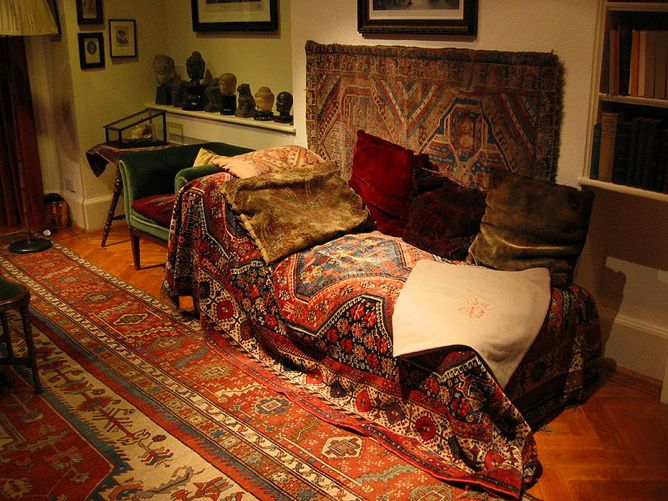
 Today's lovely feast, which of course brings the 40-day Christmas cycle to an end, is that of the Presentation of Christ in the Temple, often known as Candlemas. And in the Catholic world it's kept as a day to remember consecrated religious who devote their lives to prayer and contemplation. But what is prayer, and what of our difficulties with it? Here are some thoughts on that question aided by two books I read back to back last weekend--quite unintentionally, I might add, or at least without conscious (!) intent.
But hear me out when I suggest that there are connections to be discovered between late Anglo-Irish Dominican theologian Herbert McCabe's God, Christ, and Us, and the contemporary Anglo-American psychoanalyst Christopher Bollas in The Evocative Object World.
I started with McCabe's lovely short book of sermons, God, Christ, and Us. If you are casting about for suitable Lenten reading material this year, permit me very warmly to recommend it. No chapter is very long, and none suffers from that kind of revolting treacle one sometimes associates with pious utterances such a sermons. McCabe was not pious in that sense at all, but very earthy and practical in a refreshingly straight-forward kind of way. The God preached by this member of the Order of Preachers is a God you actually want to meet, indeed might actually look forward to meeting, and quite probably over a drink or meal à deux.
I first encountered McCabe's name in the 1990s when Stanley Hauerwas made an off-hand reference to him in connection to Alasdair MacIntyre. I paid no heed as Hauerwas didn't say much and I wasn't interested enough to pursue the matter. Later I would see MacIntyre himself in several places confess debts to McCabe, but without much detail to spur on an investigation on my part.
But the person who really convinced me I must read McCabe was and is Eugene McCarraher, whom I first stumbled across in articles like this (discussing Terry Eagleton's Culture and the Death of God) and then this deeply fascinating three-part interview, the third of which avers "I swear that reading McCabe has often kept me a Christian." In my more despairing moments recently, I know exactly what McCarraher means by that, and I suspect very strongly he had lines like this from McCabe in mind:
"Like Peter and the 12 we remain Christians because there is nowhere else to go: if Christianity is not the revolution, nothing else is" (Law, Love and Language, 1968).McCarraher has also written a lovely overview of McCabe's life in this Commonweal article which notes, inter alia, that McCabe's "radicalism" was precisely and only possibly because of its deep orthodoxy. Rooted in the tradition, he could see its deeply subversive potential--even if, alas, that potential is almost always domesticated, tamed, thwarted by the powers and principalities of the present age. His orthodoxy, then, allowed him freely to explore socialism and Marxism.
Though my reading is still early yet, I have not see in him so far much exploration of Freud. But the language is clearly there. Repeatedly McCabe uses classical Freudian language in unmistakable ways, especially speaking of our tendency towards "projection" and our wallowing in "illusion" about both ourselves and God. In, e.g., Faith Within Reason, reflecting on the prodigal son, McCabe writes:
Sin is something that changes God into a projection of our guilt, so that we don’t see the real God at all; all we see is some kind of judge. God (the whole meaning and purpose and point of our existence) has become a condemnation of us. God has been turned into Satan, the accuser of man, the paymaster, the one who weighs our deeds and condemns us…For damnation must be just being fixed in this illusion, stuck forever with the God of the Law, stuck forever with the God provided by our sin (155-56; my emphasis).A little later on, McCabe uses language that very much echos the difficulties of psychoanalysis as Freud saw them for it confronts people with hidden, and often infelicitous, desires, images, and actions. But both Freud and McCabe argue that it is much better to face up to ourselves, sinful and infantile as we are:
We damn ourselves because we would rather justify and excuse ourselves, and look on our self-flattering images of ourselves, than be taken out of ourselves by the infinite love of God…Contrition, or forgiveness, is self-knowledge, the terribly painful business of seeing ourselves as what and who we are: how mean, selfish, cruel and indifferent and infantile we are (Faith Within Reason, 157).But it is in McCabe's sermons on prayer, two of which are found in God, Christ, and Us that most put me in mind of what Bollas says in the first chapter of The Evocative Object World, and, come to think of it, what Adam Phillips has also said, as I noted here in discussing his ideas about distractions and frustrations; see also his book Side Effects. The link between the two of them seems to be an unapologetic advocacy of free association, leading to my question: are prayer and psychoanalysis the only activities today where one's mind can range freely without being hectored and controlled by ideologues and capitalists (the two often being the same thing)? Are the pew and the couch the only places left to us today as places that do not demand anything of us but give us silence, space, freedom?
Bollas thinks that today's "attacks on psychoanalysis are thinly disguised attacks on unconscious life itself" because "there is a widespread contempt for unconcious life in modern culture." He doesn't say why this is, but it's not hard to figure out: both analysis and prayer, as activities in which our mind ranges freely in search of some outlet for our deepest desires and hurts, are precisely the vague, free-flowing, unproductive, dreamy, gimmick-free kinds of activity that cannot be monetized or commodified or turned into an app promoting "mindfulness" or some other bit of money-making chicanery.
Bollas's first chapter treats free association, noting that it's a mutual process of analyst-analysand freely associating together, creating the analysis together. As he nicely put it, this is an experience in which one can rightly and proudly say "You don't know what you're talking about!" But still you talk, and listen, and associate, and eventually certain things become clear. Other things may not become clear, but this is not necessarily a failure, for the value of analysis is not just the "what" or the content: it is also the process--as Bollas has said elsewhere, echoing D.W. Winnicott--of being held and contained, of developing a deep connection to another human being that in itself is worthwhile, not least in its transferential (and thereafter transformational) power. Furthermore, an analysis is worthwhile not just for the clarity of content that sometimes comes about, but also for the "psychoanalytic mind" it creates, as Fred Busch has so winsomely described.
The beauty of this, as I have long appreciated it, is that "psychoanalysis does not provide ready answers to patients symptoms or lives," as Bollas admits. This, he recognizes, is "disconcerting" for those who think that clinicians are supposed to be experts. In fact, Bollas--and here his thought closely tracks that of Phillips, as I have repeatedly shown on here--says that the free associating of the unconscious of both analyst and analysand "subverts the analyst's natural authoritarian tendencies as well as the patient's wish to be dominated."
In this regard, Bollas puts me in mind of how Maggie Ross describes the mistaken notions behind modern concepts and practices of "spiritual direction," much of which consists of attempts at "mind control" as she puts it, and the result of which is to reinforce one's narcissism. Silence, for Ross, whose book shows considerable familiarity with psychoanalytic ideas, is the goal, and is hugely valuable in itself--a point that also becomes abundantly clear in reading the psychoanalytic literature about silent patients who nonetheless get better--start with another fascinating English Anglican, the analyst Nina Coltart, for examples of this; see her Slouching Towards Bethlehem.
McCabe doesn't come right out and advocate freely associating during prayer, but he very much leans in that direction. This is something I'll have to think about some more, but it does seem to me a helpful way to conceive of prayer and the problems of being distracted during or bored by prayer, or restlessly wondering about the futility of it all.
Rather than fighting that, McCabe advocates letting your mind wander until you find what you really want to pray about, and then praying about it. Here, again without using the words per se, McCabe seems to me to establish the "fundamental rule" (cf. Freud's "On Beginning the Treatment") of prayer outside the shackles of whatever spiritual superegos may be trying to tell us otherwise. If we let ourselves pray for what we are really concerned about, McCabe says, those prayers not only will almost always be, but in fact should be "the vulgar and rather infantile things you really do want," instead of all the pious and high-minded things we think we should pray about.
If we're distracted during prayer, it's because we're not praying for the right things (he notes those on sinking ships never report distractions during their prayers!), and constraining ourselves to pray for the things our superego tells us to--the "proper and respectable and 'religious'" things. Instead of that, as he drolly puts it, "you could let world peace rest for a while."And while you're at it, let your mind run to those distractions because they "are nearly always your real wants breaking in on your prayer." (Lest we worry that this is an excuse for descending into infantile selfishness, McCabe says that if we are honest in prayer about our desires, the Holy Spirit will invariably lead us deeper, for prayer involves change and growing up.) If psychoanalysis involves, as Bollas argued in his first major book The Shadow of the Object, a certain "ordinary regression to dependence" for a time, does this not also describe how we are in prayer with our Father in heaven as we pray for the things closest to us that matter most to us?
Subscribe to:
Posts (Atom)
