"Let books be your dining table, / And you shall be full of delights. / Let them be your
mattress,/
And you shall sleep restful nights" (St. Ephraim the Syrian).


Showing posts with label Anton Baumstark. Show all posts

Monday, December 30, 2019

Daniel Galadza Interviewed on Jerusalem's Liturgy: Byzance après Byzance

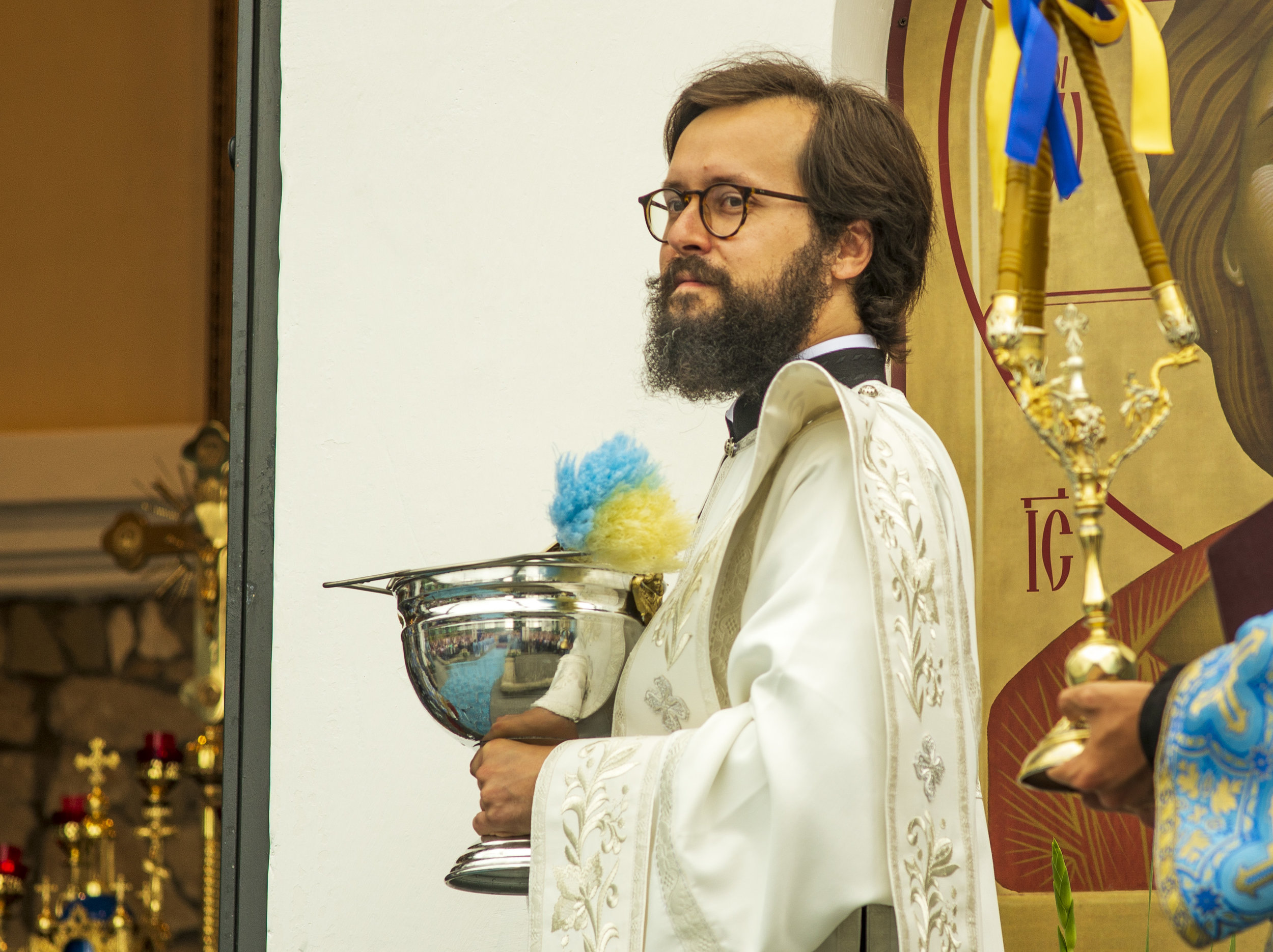
It is always a delight to interview scholars on here, but--in the interests of full disclosure--it is an especial delight with Daniel Galadza, whom I have known for the better part of two decades now. He is not just a friend, but also co-editor on a book we are finishing for Peeters about the pseudo-sobor of Lviv of 1946. (More on that soon.) In any event, he is the consummate gentleman and scholar who wears his vast learning very lightly on his diaconal riassa. Following my usual practice, I sent him some questions about his recent book, and here are his thoughts.

AD: Tell us about your background

DG: I am a deacon of the Ukrainian Greco-Catholic Church (UGCC), born in Chicago, raised in Toronto and Ottawa by my parents, Fr. Peter and Olenka Galadza. After studies at Trinity College in the University of Toronto and the Sheptytsky Institute, then at St. Paul University in Ottawa, I did a licentiate and a doctorate in Rome with Stefano Parenti, my doctoral supervisor, at the Oriental Institute, with a year as a junior fellow in Byzantine Studies at Dumbarton Oaks in 2011–2012.

In Rome, I paid close attention to how the coffee was made at my college, the Russicum, assuming that as a layman with a doctoral in Byzantine liturgy I might end up working at Starbucks--if I were lucky. But God had a different plan and I ended up as an assistant professor in the Catholic Theology Faculty at the University of Vienna in 2013, with Prof. Hans-Jürgen Feulner as my boss and Sr. Vassa Larin as a colleague.

Vienna is known as a “Byzantinists paradise” (well, perhaps not in the guidebooks) and I got to know the scholars in Byzantine Studies at the University of Vienna and the Austrian Academy of Sciences. For the last few years, Prof. Claudia Rapp had led the team of the “Vienna Euchologia Project,” of which I am honoured to be a member (officially as an “international research partner” since I no longer live in Vienna).

Since 2018, I have been in Kyiv as a deacon of the Kyiv Archeparchy, a lecturer at the seminary, and a member of the liturgical commission, at the same time trying to keep up with scholarly work in Europe and North America.

During the fall semester 2018 I was a visiting lecturer at the Sheptytsky Institute, now at University of St. Michael’s College in the University of Toronto, and from 2019 I am a fellow of the Centre for Advanced Studies at the University of Regensburg, splitting up semesters between Bavaria and Ukraine.

AD: What led you to write Liturgy and Byzantinization in Jerusalem?

In May 2008, I had finished my Bacherlor of Theology degree and had applied to study at the Pontifical Oriental Institute (PIO) in Rome. I wasn’t really sure about how things worked at the universities in Rome, so I made a trip to investigate and made an appointment with Fr. Robert Taft, SJ, whom I had known through my parents since childhood. He immediately sat me down and gave me a list of four different doctoral thesis topics. One of them was about the Basilians and the decline of the UGCC’s liturgical tradition, which is a fascinating topic, but I didn’t want to start my academic work immediately making enemies, so I chose the topic on the list about which I knew the least: the “liturgical Byzantinization” of the Orthodox Patriarchate of Jerusalem. That ended up being my thesis topic for the licentiate and doctorate.

Upon arrival in Rome in September 2008, I already knew my thesis topic and was fortunate enough to live in a college next door to the PIO library, so I was able to take advantage of the amazing resources there and read all about a whole other, fascinating world of Eastern Christianity I knew of only generally through my studies in Canada. The thesis then turned into the book, which was published in 2018 by Oxford University Press and came out as paperback in 2019.

AD: Among Eastern Catholics, the notion of “Latinization” is fairly common, and since at least Vatican II, almost always reprobated. Is “Byzantinization” a similar process, and if so, of what and of whom? Does it carry the same negative connotations today as “Latinization” does for many?

In a way, the two phenomena are similar. Byzantinization, like Latinization, is, generally speaking, the adoption of foreign customs and practices, potentially including also theology, culture, and even language, to the detriment of the local, “authentic” tradition. More specifically, the liturgical Byzantinization of Jerusalem involved the supplanting of liturgical tradition of Jerusalem by the rite of Constantinople. The process was complex, due to the natural evolution of the Byzantine liturgical tradition, which was a synthesis of elements from Constantinople, Jerusalem, and elsewhere.

Like Latinization, Byzantinization was never officially imposed on the other Eastern Patriarchates of Alexandria, Antioch, and Jerusalem, although due to the cultural climate of the post-Iconoclast Eastern Mediterranean, the factions within these Eastern Patriarchates that were faithful to the decisions of the Council of Chalcedon (451) willingly adopted most of the synthesized Byzantine practices. This was partly due to a desire to show unity with Constantinople and partly due to the declining material situation of each of the Eastern Patriarchates as a result of invasions and non-Byzantine rule from the seventh century onward. In such a context, the prestige of Constantinople was felt even more strongly among the Chalcedonians outside the constantly shrinking borders of the Byzantine Empire.

Latinization for the Eastern Catholics is similar. It was rarely imposed officially by the Holy See and usually adopted willingly by Eastern Catholics because of Rome’s prestige as a center of authority and education. (A notable exception might be the 1720 Synod of Zamosc, which officially imposed numerous Latin practices based on Tridentine scholastic theology, in an attempt to bring order to the chaos of the Uniate Church in the century following the Union of Brest. Because Rome has since the Second Vatican Council officially encouraged the Eastern Catholic Churches to return to their ancestral traditions, it will be interesting to see how the UGCC will commemorate the 300th anniversary of the Synod of Zamosc in 2020.)

Around the time of the Second Vatican Council, the Melkite Greco-Catholic Church was also eager to rediscover its ancestral traditions and a group of scholars and clergy, known as the Cairo Circle, began discussing ideas about the restoration of an authentic Melkite liturgy, since for them Byzantinization was their version of Latinization. However, as far as I am aware, not much came of it, because the authentic practices from Jerusalem had not yet been sufficiently researched and there was no continuity with the liturgical tradition of Jerusalem because it had been completely lost. Thus, it was almost impossible to restore and implement in a practical manner.

Although they are similar as phenomena, the histories of Latinization and Byzantinization are, however, quite different, of course, but so are the histories of the Byzantinization of each of the three Eastern Patriarchates, due to their specific linguistic and political contexts.

AD: In an era when much of the academy has been drawing critical attention to the phenomena of colonialism and imperialism, you seem to suggest that the Byzantinization of Jerusalem does not constitute a straightforward case of imperial subjugation and transformation at the hands of Constantinople—that, as your introduction nicely puts it, “the periphery of one centre can become the centre of yet another periphery.” Tell us a bit more about these dynamics.

The phenomenon in question here is certainly not straightforward. Liturgical Byzantinization in Jerusalem—which is not the same as political, literary, cultural, etc. forms of Byzantinization—began only after Jerusalem was no longer under Byzantine imperial and political control. The same is the case for Alexandria, although Antioch’s history is somewhat different, due to the Byzantine reconquest of Syria in the tenth century.

Previous theories about Byzantinization in Jerusalem suggested it was imposed and happened suddenly. A common narrative used to go like this: after the destruction of the Holy Sepulcher, also known as the Anastasis Church, in 1009, the rite of Jerusalem was lost and its patriarchs were exiled to Constantinople in the eleventh and twelfth centuries, where they learned the Byzantine Rite and brought it back with them to Jerusalem along with ready-made books.

However, the sources suggest otherwise, painting a picture of a gradual change to the liturgical tradition that was carried out locally, often times by scribes copying liturgical books and attempting to reconcile differences in liturgical practice.

AD: Part of your argument seems to be that Byzantinization was less about imperial imposition of liturgical trends and traditions, and more about local alterations, based partly on the changing geopolitical and topographical realities of the city. Give us, if you would, an example or two of these changes.

If I haven’t mentioned it already, perhaps this is the time to do so: there are no historical or legal documents from Constantinople, Jerusalem, or elsewhere that explicitly prescribe how liturgical Byzantinization was to be carried out, such as a conciliar document or the decree of a patriarch or emperor, nor do any sources, such as chronicles or other historical accounts, describe exactly how it happened.

The main sources for information are liturgical manuscripts, the books used for prayer during the liturgy, dating from the eighth century onwards. The most important collection for the study of the Byzantinization of Jerusalem is the library of the Monastery of St. Catherine on Mount Sinai, which houses hundreds of manuscripts in a variety of ancient languages and is also the place some of these manuscripts were copied and used.

At Mount Sinai, the Georgian collection of manuscripts is of particular importance, not just because of the local Georgian monastic community there in the Byzantine period, but also because of the migration of the Georgian monks of the Lavra of St. Sabas in Palestine near Jerusalem to Sinai in the tenth century. Among them was Iovane Zosime, a Georgian monk and scribe who copied numerous and diverse manuscripts, many of them liturgical. What is significant about Iovane Zosime is that he is aware of his sources and gives information about them. What is more, he often dates and signs his work, which isn’t always the case with scribes.

The calendar he copied in codex Sinai Georgian Old Collection 34—one needs to distinguish between the old and new collection, because a whole trove of manuscripts was rediscovered at the monastery in 1975—presents a liturgical calendar for the whole year based on several sources, including ones from Constantinople, Jerusalem, and the Lavra of St. Sabas. Thus, Iovane Zosime was, in a way, one of the first scholars of “comparative liturgy” and his work confirms that already in the tenth century, monks and scribes at the Sabas Lavra and Mount Sinai knew of multiple liturgical traditions, these traditions were in contact with one another in Jerusalem, and they were also changing. Specifically in the calendar, the feast of St. James the Brother of the Lord is mentioned on multiple days—both on the days his feast was celebrated in Jerusalem (December 1, December 26, May 25) and in Constantinople (October 23)—showing the gradual nature of the change.

Two centuries later, we know of the work of another scribe, Basil the Hagiopolite, a reader and scribe at the Church of the Anastasis in Jerusalem, from an important manuscript copied in 1122 and known in liturgical scholarship as the “Typikon of the Anastasis.” The manuscript contains all the hymns, readings, and prayers necessary for Holy Week and Easter at the Anastasis, mentioning local practices native to Jerusalem, like the Liturgy of St. James, but also a loss of other local elements and revealing an influx of general Byzantine practices. Basil the Hagiopolite himself shows an awareness of two different traditions and tries to make sense of them in his manuscript. Most notably, the processions on Palm Sunday that Basil describes have been lost and the gospel readings for Holy Week have changed.

AD: You note that much of the Byzantinization comes after the three conquests—the Persian, the Arab, and the Crusaders, in a period leading up to the thirteenth century. A contemporary reader might wonder if there is any kind of causal link between events here? In other words, is it conceivable to think that Jerusalem Christians, feeling under siege and perhaps worried about loss of their “identity” (as we might call it today), would seek to buttress and solidify that identity by conforming their external appearances and practices to be more like other Christians, including those in the still unconquered imperial capital?

Most certainly! I would argue that there is very little change in theological content when examining Byzantinization and that it has much more to do with religious identity and affiliation. Once the Greek-praying Christians become the minority in Jerusalem and are no longer under Byzantine rule, they look to their coreligionists for moral—and sometimes financial—support. Although the Chalcedonian Christians of Jerusalem were unique because they had no homegrown non-Chalcedonian Church in Jerusalem and Palestine, unlike the case in with numerous non-Chalcedonians in Syria and Egypt, nevertheless they seemed eager to maintain strong links with Constantinople. It appears that the strong Greek monastic presence in the Holy Land also played a role in buttressing the Greek, Chalcedonian identity in Jerusalem.

AD: For those unfamiliar with Jerusalem’s liturgical calendar (ch.4), and lectionary (ch.5), what are some of the most notable and distinctive features in your eyes?

In a nutshell, here are some of the most noteworthy elements:

The calendar, from the sixth century onward at least, begins with Christmas rather than September 1, suggesting a theological emphasis on the Incarnation that is understood in the liturgical year as well. The day on which a saint is commemorated depends on the local tradition of Jerusalem. If we take the example of St. James again, December 26 was an ancient day of commemorating James in Jerusalem connected, at least according to Anton Baumstark, with the Jewish celebration of the dedication of the Temple. The October 23 commemoration depended on the transfer of the relics of James to Constantinople. The calendar of Jerusalem also had multiple days of certain saints and sometimes celebrated groups of saints together, often dependent upon the dedication of a church in Jerusalem where their relics were deposed. Octaves, or eight day celebrations of major feasts, were also a significant feature and the most important ones involved stational liturgy during the eight days at some of the more important churches of Jerusalem.

The lectionary is intimately related to the calendar and in some cases lectionary manuscripts give us the most information about the calendar. Unlike the Byzantine lectionary—where the order of the Gospels from Easter to Lent is John, Matthew, Luke, and Mark—the Jerusalem lectionary reads them in the following order: John, Matthew, Mark, and Luke. Even when the same Gospel is read during the same liturgical season, the pericopes (or individual excerpts) for a given commemoration are not necessarily the same. For example, the readings from the Gospel of John on the Sundays after Easter have completely different episodes when comparing the Jerusalem and Constantinople lectionaries.

Perhaps the most important and interesting aspect of the Jerusalem lectionary for Orthodox liturgy is that it has an Old Testament reading at the Divine Liturgy. The ancient Armenian and Georgian translations of the Jerusalem lectionary have quite an extensive series of Old Testament readings, but Greek manuscripts with Old Testament readings for the Divine Liturgy are quite rare.

AD: If, in a sense, Jerusalem is the “mother-city” for all Christians, do we find elements of her lectionary and calendar anywhere today in other traditions—a kind of “Jerusalemization” of, say, Coptic or Syriac or Latin or Byzantine traditions? Is her tradition of “stational” liturgies borrowed or copied by other traditions?

The Liturgy of St. James—the local Divine Liturgy of Jerusalem—does in fact refer to Jerusalem, or rather to Sion, as the “Mother of all the Church.” With regard to liturgical practice, Jerusalem certainly did function as a centre of influence over all of Christendom, in effect the “Jerusalemization” of many other Christian traditions. This was particularly felt in Constantinople, where there really wasn’t a sacred topography and much of its liturgy was imported from elsewhere. In Constantinople, one can see strong the influence of Jerusalem during Holy Week, with its structure based on biblical narratives imported from Jerusalem. Constantinople also adopted Jerusalem’s Bright Week Gospel readings, but with a twist: instead of reading them on every day of Bright Week at Divine Liturgy, as was done in Jerusalem, Constantinople took them and turned them into the eleven resurrectional Gospels read at Orthros, or Matins, every Sunday morning.

With regard to “stational” liturgies, processions led by the bishop that went through the city with hymns and stopped at various points, these were imitated in Constantinople, Rome, and elsewhere.

But these aren’t discoveries that are new to my book or research. Many of these insights into “Jerusalemization” and “stational” liturgies come from the works of Janeras, Taft, Baldovin, and several Russian scholars writing before the October Revolution. My goal in the book was to present a summary of this scholarship, often times scattered in diverse studies in various languages, and to bring it into dialogue with information found in additional manuscripts, many of them among the “new finds” of Sinai from 1975 in order to examine the interaction of the liturgical traditions of Jerusalem and Constantinople, and the question of Byzantinization in Jerusalem.

AD: Much of your work proceeds comparatively, and by drawing on the methods of Baumstark and Taft. But you also note the limitations of this method. Tell us about some of those limitations and then tell us more generally about your methods of research for this book, including especially looking at liturgy “from the bottom up.” Why is that important and what are its benefits?

In this study, I did indeed rely on comparative methods, primarily due to the comparative nature of examining the liturgies of Jerusalem and Constantinople and seeing the influence of one on the other and vice versa. From a purely technical point of view, the comparative method, with its emphasis on a textual and philological approach that respects the importance of the historical context, fit best to begin this investigation. Because the topic of Byzantinization is precisely a question of top-down, “official” liturgy, liturgical books are the main source for study.

Comparative liturgy is often criticized because it can at times overemphasize liturgical structures over the meaning of texts and does not say much about the experience of the people during the liturgical services. The problem of the authority, use, and reliability of texts is also one that must be grappled with, especially if adopting the “splitter” approach (in the dichotomy of Paul Bradshaw).

The “from the bottom up” approach is something that I am attempting to read about more and integrate into my work, but in other areas, for example in work dealing with the Vienna Euchologia Project.

AD: I recall meeting you for lunch in Washington DC some years back, when you were a fellow at Dumbarton Oaks, and you casually told me, as we stood waiting for the traffic light to change, that you were studying Georgian. Why are Georgian sources important to your study?

I don’t think it could have been casually, Adam, since ancient Georgian is far from “casual”: they say you can learn the Georgian noun in a day and spent the rest of your life learning the Georgian verb. Studying Georgian in Rome was quite the experience!

The importance of Georgian sources in Jerusalem is primarily due to the presence of Georgian pilgrims and monks who stayed in Jerusalem, made translations and copies of its liturgical manuscripts, and then either used them in Jerusalem and its environs in their own Georgian-praying communities or brought them back to Georgia. Because many of the Greek originals were lost, Georgian manuscripts are sometimes the only surviving witnesses to this ancient and lost liturgical tradition.

AD: You note that in some ways even today the periphery-centre tension still holds, but with different focus today: must the Jerusalem patriarchate remain, as it were, an outpost of the Greek Orthodox Church, resisting any attempts at change in, say, a more “Arabized” direction? But you also note that in the early 20th century there was less defensiveness and more openness to studying the authentic tradition and perhaps removing non-native elements. How far did such a movement get, and is there anything comparable today?

The current state of the affairs in the Church of Jerusalem is not an easy one and balancing internal and external ecclesiastical relations are in addition to some of the difficulties of daily life in Israel and Palestine today. Christians find it difficult to stay and without a local population, the Church depends on pilgrims and non-Palestinian Christians to keep life going.

Some of the activity of the Greek Orthodox Patriarchate of Jerusalem, such as the retention of the Julian calendar, seems to depend on the status quo agreement from previous centuries that codified liturgical life at the Church of the Holy Sepulcher. Today, one can observe frequent use of Arabic, and sometimes other languages, at the Divine Liturgy, for example the Gospel reading. However, this multilingualism in the liturgy is nothing new, since Egeria describes it in the fourth century and Basil the Hagiopolite mentions it in the twelfth.

Any tendency to differentiate the Jerusalem Patriarchate too much from other Orthodox would isolate it from the rest of the Church—which is precisely one of the reasons why Byzantinization occurred, to strengthen ties and establish a common identity with Christians beyond Jerusalem.

Nevertheless, the late nineteenth and early twentieth century did witness a great interest in the local liturgical tradition of Jerusalem from scholars who were also ecclesiastical authorities. This meant the Liturgy of St. James was revived, although not always with the right motives. Because the manuscripts of the Liturgy of St. James are often missing rubrics and the tradition ceased to be celebrated, Archbishop Dionysios Latas of Zakynthos supplied his own rubrics based on his studies of biblical archaeology. His Greek edition was then adapted to Church Slavonic by Ivan Gardner (at that time Hieromonk Philip). The resulting liturgy that is often celebrated today is effectively a nineteenth-century scholarly invention. Prof. Heinzgerd Brakmann has written several articles about this.

It is curious that in some circles where any change or reform in the Liturgies of St. John Chrysostom or St. Basil the Great would be frowned upon, the nineteenth-century revived version of the Liturgy of St. James is welcomed and celebrated frequently. Prof. Vitaly Permiakov, who has studied these questions for some years, has recently published a Church Slavonic-English edition where he attempts to address some of these problems.

AD: Sum up your hopes for the book, and who in particular would benefit from reading it?

My main hope is that it will inspire other scholars to look more closely at the question of Byzantinization, whether in Jerusalem or one of the other Eastern Patriarchates, and provide more definitive answers than I have. The history of the Byzantinization of Antioch and Alexandria remains to be written. I believe Antioch holds the answers to many of the remaining questions about Byzantinization, precisely because it was reconquered by the Byzantines in the tenth century and because it is geographically between Constantinople and Jerusalem.

I also hope that Syriac scholars will find the book to be a useful reference in their examination of the abundance of Syriac Melkite manuscripts, most of them in the library of the Monastery of St. Catherine on Sinai and lamentably ignored in Byzantine liturgical studies. The importance of Georgian for Byzantine and theological studies is now being appreciated in Western academia (I should mention here the work of Stephen Shoemaker and his English translation of the Georgian Iadgari hymnal from Jerusalem, which I was not able to mention in my book because they appeared at around the same time), but I hope that better resources for studying ancient Georgian will be made available in the West.

Having expressed all these wishes, I do not want to give the impression that the book is intended only for specialists. (Certainly, certain sections will be too technical for some readers. For others, the book might be effective against insomnia.) I hope that anyone familiar with the Byzantine liturgical tradition, particularly its faithful practitioners, might find something of interest in the book—whether in the general introduction to Jerusalem’s liturgy before its Byzantinization or the discussion of the Liturgy of St. James, the calendar, or the lectionary.

AD: Having finished the book, what projects are you at work on now?

Perhaps too many to keep track of myself... At the moment, I am a fellow at the Centre for Advanced Studies of the University of Regensburg, where there are quite a few conferences and workshops on liturgical topics, organized by Prof. Harald Buchinger, an expert on the early liturgy of Jerusalem. My own work at the Centre involves a translation and commentary of the twelfth-century Greek manuscript from Jerusalem I mentioned earlier: Hagios Stavros gr. 43, known as the “Typikon of the Anastasis,” a hymnal for Holy Week and Easter whose services, readings, and hymns would be recognizable to any Byzantine Rite Christian, whether Orthodox or Greco-Catholic, who has attended their local parish during that most solemn time of the year. My goal with this project is to investigate the question of liturgical theology through the prism of hymnography in order to understand how the hymns serve as scriptural exegesis and also liturgical hermeneutic.

Last year, Prof. Jos Verheyden and I organized a conference on liturgy and literature in the various multilingual communities of the Lavra of St. Sabas at Catholic University of Leuven, so I am now slowly working on publishing the proceedings, which I hope will appear in the not too distant future.

Apart from those main projects, I am also interested in early printed Church Slavonic liturgical books from Ukraine. Some are housed in various libraries in Kyiv, Lviv, and elsewhere (while some can still be purchased online for very reasonable prices!). In the coming years I hope to more beyond Jerusalem and the first Christian millennium and delve deeper into the Slavonic and Kyivan liturgical tradition. Perhaps after Byzantinization, I’ll move on to Latinization. We’ll see.

Monday, October 15, 2012

Nicholas Denysenko on Theophanic Water Blessings

A new book from Ashgate written by Nicholas Denysenko was just published in both a Kindle edition and a hardback: The Blessing of Waters and Epiphany: The Eastern Liturgical Tradition (Ashgate, 2012, 237pp.). The author, a deacon in the Orthodox Church of America (OCA) and professor at Loyola Marymount University in Los Angeles and director of the very important Huffington Ecumenical Institute, has previously published critically acclaimed articles in (inter alia) Logos: A Journal of Eastern Christian Studies. I asked him for an interview about his new book, and here are his thoughts.

AD: Tell us a bit about your background.

ND: I am a first-generation American, the son of post-World War II immigrants from Ukraine and grandson of an Orthodox priest. While not a stereotypical "PK," I essentially grew up in and around a rectory and took great pleasure in singing with the church choir. After graduating from the University of Minnesota with a BS in Business in 1994, I took my first job with St. Mary's Orthodox Cathedral in Minneapolis as their music director. I received my M.Div. from St. Vladimir's Seminary in 2000, worked as a product manager at Augsburg Fortress Publishers until 2003, graduated from The Catholic University of America with a Ph.D. in liturgical studies and sacramental theology in 2008 (with a short stint as marketing manager at the USCCB from 2007-9), and accepted an appointment as assistant professor of theological studies at Loyola Marymount University in Los Angeles, where I also direct the Huffington Ecumenical Institute.

AD: What led you to work in the areas of liturgical theology, and in particular on the question of Theophany and water blessing? 

Well, when I turned 18, after a lifetime of praying in my non-native language (Ukrainian), I honestly began the process of "faith seeking understanding." A friend gave me a copy of Alexander Schmemann's book Liturgy and Life
which I eagerly read. I continued to read Schmemann in my quest to understand liturgy, which I had actively engaged as a choir director. One motivation was my own need to teach liturgical music and to demonstrate to singer how music is a servant of the liturgy; the only way to accomplish this was to learn liturgical structures, history, and theology. My interest in the Theophany water blessing began in a seminar on the Holy Spirit I took with my Doktorvater, Dominic Serra, in 2004. My desire was to unpack the mystery of the so-called "double epiclesis" of the "Great are You" prayer, and my entrance into the project became something much more significant and definitive.


AD: Among several outstanding things about your study I found two especially commendable. First is your ecumenical focus in which you don't just confine yourself to the Byzantine tradition but also examine other Eastern traditions as well as Roman Catholic and Anglican liturgical treatments of Epiphany and blessings. Is there evidence of Eastern traditions influencing the Western, or vice versa?

ND: There is no doubt that the Anglican water blessing draws upon elements of the Byzantine and perhaps Armenian traditions, which are then synthesized in a beautiful blend of Theophany and Western Epiphany themes of "greeting," an anticipation (as it were) of the second coming. In other words, it's as if the Baptism of Jesus at the Jordan has a powerful eschatological flavor in anticipating his revelation as Lord and God at the end of days. More work needs to be done in this area. A Hungarian scholar is about to publish a critical edition of the blessing of waters in Latin which appears to draw heavily upon Greek euchological sources, so there is some evidence of East influencing West, in both medieval and contemporary sources.

AD: You draw on a wonderful array of people in your work, including some very prominent names in Roman Catholic, Byzantine Catholic, Anglican, and Orthodox circles, inter alia. Is it possible today (in the shadow of Baumstark as it were) to do liturgical theology using anything other than such a comparative method?

ND: Employing the comparative method is essential for writing liturgical history, and I humbly consider myself to be an adherent of the Baumstark-Mateos-Taft school of comparative liturgy, with special thanks to Mark Morozowich (Dean of the School of Theology and Religious Studies at The Catholic University of America), who carefully taught me the method. My work is also one of sacramental theology, and here, I employed Monsignor Kevin Irwin's method of Context and Text, an enormously valuable method for gleaning liturgical theology. Liturgical Studies is gradually becoming interdisciplinary, and I think we will see these methods evolve, develop, and grow, especially now, since the liturgical movement and its fruits are increasingly scrutinized and criticized in Catholic and Orthodox circles.

AD: The second thing I greatly cheered was your chapter "Pastoral Considerations." Some liturgical scholars see their task as largely confined to narrating history, which is said to be "instructive but not normative." But you don't confine yourself only to history: you put forward some very interesting practical-pastoral proposals. Tell us what led you to do that.

ND: The task of liturgical history is to inform, and not reform. Two of the best liturgical historians of our time, Taft and Maxwell Johnson, have been quoted accordingly. In the case of the blessing of waters, we are speaking of a living tradition, a real practice in which people participate. In the case of the blessing of waters, history can inform contemporary practice, especially since the Theophany feast occurs right after the New Year, when most people have returned to work (even academics!). This feast is beloved to Eastern Christians: why not maximize and optimize participation? The models I propose are really not attempts to reform, but instead a fine-tuning--pastoral adjustments that are designed to provide people with greater access to the blessings of the feast. My proposals concerning Catholic and Reformed churches draw upon the Roman tradition of adaptation and are offered in the spirit of ecumenical gift-exchange.

AD: The current Ecumenical Patriarch, as I'm sure you're aware, is often called the "green patriarch" for his concern about ecological issues. Do you see the theology of water blessing as connected to current concerns for the environment?

ND: Yes, absolutely. The blessing of waters reveals all of creation as holy, and water, symbolized by the Jordan, is the locus for salvation. All of creation participates in the praise of God as holy, of Christ as Lord, in this feast. Water is God's preferred instrument of salvation, a gift to humanity of restoration to the community of the Trinity. The ecumenical patriarch often referred to the blessing of waters in his many speeches and homilies as a demonstration of Orthodoxy's prioritization of ecological stewardship. I contend in this study that the blessing of waters essentially demands that the Church contribute to the global task of developing a new ethos of water; we have much to contribute from our lived tradition.

AD: Your introduction notes that there is a question, in the Theophany prayers, as to the identity of the one to whom the prayers are addressed. You then note the possibility that perhaps not all prayers are addressed to the Father through Christ, but to Christ directly, and this may pose a challenge to traditional Trinitarian theology from John of Damascus onward and its resolute insistence on "protecting" the "monarchia" of the Father. Say a bit more about this if you would, including some of the ecumenical implications.

ND: The euchology and hymnography of the blessing of waters is distinctly Christological. The texts, together with the ritual action of submerging the cross into the waters, tell the story. The Church invokes her head, Christ, to sanctify the waters by entering them; the Spirit bears witness to this entrance. Comparative liturgy not only confirms, but strengthens this thesis, as the Christological trajectory of the rite is even more prevalent in the Oriental tradition. I contend that the blessing of waters should be consulted as a source in Trinitarian theology, because the rite clearly contradicts the longstanding and fatuous claim that all prayer must be addressed to the Father. My invitation to theologians is to consider the ecclesiological framework of prayer when the Church as the body calls upon the head, Christ, to act. Some might say that this framework only concerns the economy of the Trinity, and that the monarchy of the Father as the source of divinity for the three persons of the Trinity is not threatened by the framework. My hope is that this framework might be useful in an ecumenical context to advance the notion that the filioque clause can no longer be cited as a Church-dividing issue, and that theologians might recognize the dynamics of Trinitarian prayer and activity in the Theophany blessing of waters as a demonstration of fluidity in the divine economy. 

AD: Why is it that Theophany ("Jordan") in the East retains, it seems to me (at least among the East-Slavs, with whom I am most familiar), such a place of popularity in the yearly liturgical cycle? Is there something unique about this blessing that people, even without perhaps articulating the whole theology of the feast, grasp in their piety?

ND: Among many people of the Byzantine tradition, the Theophany feast carries a strong popular parallel to Christmas, with carols, and traditional foods, not to mention a similar liturgical structure. There are many potential reasons for the popularity of the Theophany feast, but if I were asked to focus on one, it's the simple human need for water. Somtimes, in a hyperacademic drive to unveil an original theological idea, we overanalyze texts and contexts and overlook the obvious. On Theophany, the people take the blessed water home and use it throughout the year. The churches are packed on similar occasions when food and drink are blessed: on Transfiguration, we bless fruits, and take them home, and of course on Pascha, pastors have to schedule multiple basket blessings. In the moment, we tend to complain about the apparently trite attitude of the people, who don't recognize receiving the Eucharist as the authentic meaning of feast. But it's erroneous to dismiss the people's recognition that the sacred is welcome in their domiciles. Whatever we bring to Church, whether it's water for the Theophany feast, bread and wine for communion, eggs and other savory foods for Pascha baskets, fruit for Transfiguration, or flowers for Dormition, the act of bringing such items to Church is authentic offering and thanksgiving, a recognition that these domestic foods and elements are holy gifts from God freely given to us for our enjoyment. These traditions so dear to the people also serve as stark reminders that the domestic setting, the family (small or extended), is sacred, and that there is no real separation between the holy space of the Church and that of the home. The time has arrived for pastors to recognize these instances as opportunities to build upon what people themselves already recognize, that God is always with us, everywhere we go, and especially in the gifts of creation He has entrusted to our stewardship. These examples represent strong liturgical episodes (to paraphrase Monsignor Kevin Irwin), and not only should we be thankful for them, but we should also recognize the divine philanthropy they convey to us.    

AD: Sum up for us what you hope the The Blessing of Waters and Epiphany: The Eastern Liturgical Tradition accomplishes.

ND: I hope the book will be informative for broad audiences. There used to be a saying about Eastern Christianity in North America that it's a well-kept secret. Scholarship on the Eastern Church and her traditions has begun the process of demythologizing Eastern Christianity. Today, almost everyone knows about icons, and among theologians, terms such as hesychasm and theosis are well-known. That said, there are many other Eastern secrets that could be unveiled and have the capacity to tell a more comprehensive narrative story that complements what most people already know about Eastern Christianity. My hope is that this book will provide insights into Eastern Christian liturgical theology that demonstrate its diversity within the tradition, its theological fluidity, and its incredibly beautiful Christology, still experienced in a lived tradition.

AD: Finally, tell us what projects you are working on now. 

ND: I'm writing a book on Chrismation for Western Christians. The premise of my book is that within the Byzantine tradition, Chrismation, like its Western sibling (Confirmation), is also a mystery in search of a theology. My book (under contract with Liturgical Press) endeavors to unpack the liturgical theology of Chrismation in dialogue with the Catholic and Reformed traditions, to take a step towards retrieving the theology of Chrismation. I'm also steadily working on an architecture project profiling select Orthodox parishes in America. My project endeavors to recast the theology of architecture as multifaceted, and no longer an instance of form following function. My thesis contends that contemporary architecture conveys the narrative story of ecclesial communities with the local Church's mission now the primary shaper of architectural form.

Friday, September 28, 2012

Fritz West on Anton Baumstark

Anton Baumstark (1872-1948)
Anybody who knows anything about the study of liturgy in the last sixty years and more knows the name of Anton Baumstark, who died in 1948. He was one of those brilliant polyglot Germans whose erudition and range of publication make the rest of us look like jejune slackers by comparison. He has exercised an enormous influence over all subsequent scholarship, especially in the Christian East through Baumstark's most influential and prolific "disciple," the great Robert Taft, now retired (but still, thankfully, publishing) from the Oriental Institute in Rome.

Baumstark's great work, On the Historical Development of the Liturgy (Liturgical Press, 2011), 256pp. was recently translated by Fritz West, who has previously published on Baumstark. Here is the publisher's blurb about the book:
Anton Baumstark's On the Historical Development of the Liturgy (1923) complements his classic work, Comparative Liturgy. Together they lay out his liturgical methodology. Comparative Liturgy presents his method; On the Historical Development of the Liturgy offers his model. This book was written for one audience and valued by another. Written to lead adherents of the nascent German liturgical movement to a deeper religious appreciation of Catholic worship, its methodology and scope have won the appreciation of liturgical specialists for nearly a century. In describing the organic growth of the liturgy, its shaping and distortion, Baumstark s reach extends from India to Ireland, Moscow to Axum, Carthage to Xi an. He discusses the influences of language, literature, doctrine, piety, politics, and culture. While his audacity can be breathtaking and his hypotheses grandiose, his approach is nevertheless stimulating. In this annotated edition, Fritz West provides the first English translation of this work by Anton Baumstark.
I asked West for an interview about his work, and here are his thoughts:

AD: Tell us about your own background.   

FW: I am a Protestant minister (now retired), ordained in the United Church of Christ, with a doctorate in liturgical studies from the University of Notre Dame.  My dissertation was entitled The Methodological Thought of Anton Baumstark in its Intellectual Milieu. I summarized the findings of my dissertation in The Comparative Liturgy of Anton Baumstark.

I have contributed to the study and practice of worship in the church through seminary teaching and organizational work as well as writing.  My published work generally falls into three categories: liturgical methodology, lectionary studies, and worship in the Reformed tradition.

AD: Tell us, if you would, a bit about the background of Anton Baumstark and why he remains so important today.  

FW: Anton Baumstark was a lay Roman Catholic scholar of Christian art, literature, and liturgy, who came from an intellectual German family with roots in Baden and strong political interests. As a young man, Baumstark entertained thoughts of entering the priesthood and/or a religious order.  Apart from specific findings, his major contribution to the field of liturgical studies lies in the area of methodology. Even as a university student of philology in the 1890’s, he showed an interest in method. Early in the twentieth century, under the influence and example of the art historian Josef Strzygowski (1862-1941), Baumstark conceived comparative liturgy, a method for the study of the liturgies of the Church, particularly focused on the East.  His method became more widely known twenty years later, when the liturgical apostolate of the Abbey of Maria Laach sought to shape an approach to the study of the liturgy appropriate to its nature.  Along with other methods the Abbey enthusiastically embraced comparative liturgy, which afforded Baumstark opportunities to publish both comparative liturgical studies and reflections on methodology, including Vom Geschichtlichen Werden der Liturgie, translated under the title On the Historical Development of the Liturgy.  Comparative liturgy is important yet today for being the first attempt to articulate a coherent methodology for the study of liturgical history and an inspiration for the Mateos School of Oriental Liturgiology.

One aspect of Baumstark’s biography continues to generate particular interest: his politics. From the defeat of Germany at end of World War I, he was involved in conservative nationalist German politics and in 1932 became active as a member of the National Socialist Party. This is of relevance to his intellectual biography in that both his methodology and his political thinking reflect an organic understanding of culture.  This line of thinking was widespread in the Germany of Baumstark’s day, found among both liberals and conservatives, in both scholarly and political circles.  In this framework  the identity of the individual was thought to derive from an organic relationship to the community.  While on the one hand this was used analytically as a sociological insight (e.g. Ferdinand Tönnies), it was also embraced by conservative Germans (völkisch thought) to further nationalistic and political ends. The former finds resonance in Baumstark’s understanding of the church at prayer, the latter in his treatment of the influence upon the liturgy of language and nation. While one despairs of finding a causal relationship between Baumstark’s political and methodological thought, they both stem from an organic understanding of culture with roots in nineteenth-century German romanticism.

AD: Your introduction notes that On the Historical Development of the Liturgy was "written for a segment of the German Roman Catholic reading public of the early twentieth century, those supportive of the German liturgical movement." How were you, a member of the United Church of Christ in twenty-first century America, first drawn to him? 

FW: I first became interested in the comparative liturgy of Anton Baumstark when exploring the broader question of the use of linguistic models for the study of the liturgy.  Specifically, I wanted to explore the possibility of using structural linguistics to define and analyze the “liturgical tradition” underlying (my own) Free Church worship.  By studying similar transfers of method from the study of language to that of liturgy, that of comparative liturgy from comparative grammar and semiological analyses from structural linguistics, I hoped to better understand this move theoretically.

AD: Baumstark, of course, has been greatly influential in Orthodox and Catholic liturgical studies, but I am less familiar with his influence on your own tradition in particular, and on Protestant liturgical scholarship more widely. Tell us a bit about that if you would. 

FW: The comparative liturgy of Anton Baumstark is of use in studying liturgical traditions marked by the continuous use of liturgical texts.  This is not the case for Protestant worship of the Free Church in which structure is central, while text is occasional and variable.  For this reason, scholars of these traditions, including my own, have disregarded comparative liturgy almost entirely. On the other hand, Baumstark’s method has had appeal and application in the Anglican tradition. See David H. Tripp, "Comparative Method in Liturgical Study," Modern Churchman, n.s. 13(1970): 188-197 and more recently Hans-Jürgen Feulner, “The Anglican Use Within the Western Liturgical Tradition: Importance and Ecumenical Relevance from the Perspective of Comparative Liturgy.” 

AD: Robert Taft's foreword notes that Baumstark's German was "not always pellucid." How onerous was your task as translator? 

Prof. Dr. Gabriele Winkler once joked that Germans would welcome my translation, for they could then finally understand what Baumstark was trying to say.  Baumstark’s “akademisches Deutsch,” prolix and turgid, can be daunting.  He uses long sentences, containing elaborate participial clauses, nestling semantic units within semantic units in a linguistic version of a Russian doll. His Latinate style, favoring nouns and nominal phrases, including neologisms such as “das Sichauswirken,” is laborious to unpack. Some passages, such as the final paragraph of the book, are simply opaque. After producing a rough translation, I went through the German and English four more times, twice with readers fluent in German, working with me sentence by sentence.  At the point when I had not only translated the work but largely internalized it, I was able to massage it into readable English, referring to the German original only on occasion.  The process of translation stretched over twelve years, eight while serving as pastor of a congregation.

AD: Taft's foreword notes, as he has done in many places over the years, that Baumstark was a pioneer in comparative liturgiology, a method that has solved problems in liturgical history better than other methods. Explain, if you would, the significance of that approach as a scholarly method. 

FW: As a scholarly method comparative liturgy is significant for studying liturgies or aspects of them in terms of the liturgy, the parts in terms of the whole. For this move he used the organic model, asserting that the liturgy is an organism and that in two ways: ontologically and structurally.  For Baumstark the liturgy was ontologically an organism that grows.  He also thought it to be structurally organic in that it contains structurally analogous units, notably liturgical and heortological.  The significance of the move that regards the parts in light of the whole becomes clear when contrasted to standard historiography.  That is a method that builds a synthesis of what is known directly upon two kinds of sources, primary and secondary.  Here one works not with a whole containing parts, but with pieces of evidence that are material in so far as they pertain to the historical phenomenon under study, be it the French Revolution or Andrew Jackson. These two approaches are distinguished by the warrants they use to reach conclusions.  Standard historiography uses purely referential warrants; its conclusions refer directly to the available evidence and go no further. If there is no evidence, there can be no reference; gaps in the evidence necessarily result in gaps of knowledge.  By contrast the warrants used in the organological approach are  inferential.  Understanding the parts in terms of the whole, it ventures to infer what the whole implies when direct evidence is scant or lacking.  In actual practice, Baumstark used both referential and inferential reasoning, supplementing the former with the latter.
           
Paleontology offered the model for this latter approach.  Here the whole is animal life, an organic realm, whose genetic regularity is visibly evident in the structure of animals, shaped to insure survival. Georges Curvier (1769-1832), the father of comparative anatomy and paleontology, thought himself able to construct the whole of the animal from but a part or evidence thereof (e.g., a fossil). If the various systems of every organism function together for survival, then physical evidence from any single system within it would imply the whole. This kind of inferential reasoning captivated scholars of culture increasingly over the course of the nineteenth century. The comparative sciences of culture applied it to realms of culture, most successfully that of language.  A language family is a structurally organic whole. Comparative grammar also held that language families were ontologically organic, that is, that they grew like organisms according to laws. Emulating paleontology, comparative grammar set reconstruction as a goal, notably that of Proto-Indo-European (PIE) by comparing immediate linguistic descendants: Sanskrit, Latin, and Classical Greek.
           
Baumstark makes the same move in regards to the liturgy.  He saw it as a unity, both as an organism that grew and as a whole containing analogous structures.  He held it was governed by laws, as evident in the regularity of liturgical development.  In this framework, he dared to venture reconstruction. He thought it possible to fill in gaps in the evidence for the liturgy by supplementing the referential reasoning of standard historiography with the inferential reasoning of the organological approach. Notably he thought the comparative method could be used to infer (no longer extant) earlier liturgical forms from (still extant) later ones. With Baumstark, however, one must handle the move from theory to practice with care.  In his historical writings Baumstark was renowned for drawing conclusions that overreached his evidence and his laws point to this extravagance. While Baumstark does articulate laws, one is hard put to find instances where he applies them directly to solve a problem in liturgical history. Their force is as much metaphorical as descriptive.  They express his conviction that the liturgy—as a whole exhibiting regular development in stable structures—is amenable to inferential reasoning. All this notwithstanding, the central contribution of comparative liturgy remains: it assigned a methodological role to the whole of the liturgy.

AD: Taft takes some pains to insist that even if not all of Baumstark's factual conclusions are today accepted, nonetheless that does not impair the validity of his comparative methods and the "laws" derived therefrom. If Baumstark were writing today, what do you think he would write differently?

FW: It is impossible to know how Baumstark would write differently if he were alive today. A “what if” question such as this lies beyond the scope of history.  We can, however, relate Baumstark’s method to the “climate of opinion” found in his day and that in play today.  How did the comparative method and his “laws” look then?  How do contemporary scholars handle similar issues today?

First, the comparison. Baumstark was shaped by the positivist climate of opinion that prevailed around the turn of the twentieth century, which transferred models and understandings of the natural sciences whole hog into the social sciences.  In the study of cultural phenomena this approach claimed the certainty (understood to be) within the epistemological grasp of the physical and life sciences.  Notably these sciences were thought to employ laws with predictive powers equal to those at work in the physical world.  Things lie differently today. No longer do natural and social scientists think that they are studying the “Ding an sich (thing-in-itself).” Rather they construct models to organize what they know and help them explore what they don’t.  Furthermore, both natural and social scientists handle models with circumspection, regarding them as heuristic devices to organize data into coherent patterns. Every model is true only insofar as and so long as it stands the test. Just as the necessity to subject models to testing is a tacit recognition of their conditional status, the same holds true for laws. Rather than being regarded as ironclad predictors, laws are now understood to describe behavior with a high degree of probability.  This probability may be so high as to appear to be without exception, as the Law of Gravity once did … until the work of Albert Einstein demonstrated that it pertains only under certain conditions.

Practitioners of the Mateos School of Oriental Liturgiology, who self-consciously trace their method to Baumstark’s comparative liturgy, subsist in today’s climate of opinion.  Robert F. Taft, SJ, its leading practitioner, speaks of models, hypotheses, and heuristic devices.  For this reason, he rejects Baumstark’s ontological claim that the liturgy is an organism, while affirming the methodological claim that it is structurally organic.  He further observes that these structures exhibit regular development; sometimes this regularity is apparent in—or between—the structures (“the soft points in the liturgy”), sometimes in developmental patterns (variety to uniformity). Taft wrestles with the term “law,” not in the positivist sense found in Baumstark, but rather as observable developmental regularities found repeatedly (although not without exception) in the history of the liturgy. With his understanding of the liturgy as a structural unity, along with his recognition of developmental regularity, he allows for the use of inferential reasoning in the analysis of historical data.   However—once again—he does so only heuristically, to venture hypotheses of what might have been.  To determine whether the hypothesis stands—whether it is the case in fact—can only be done through referential reasoning.

The difference, then, between Baumstark’s day and our own lies in “the climate of opinion,” notably in regard to the use of models and the understanding of “laws.”   Whereas Baumstark claimed the liturgy to be an organism ontologically, scholars of the Matos School of Oriental Liturgiology use it as a model for understanding the liturgy. Whereas for Baumstark laws inexorably led to conclusions he claimed to be sure, members of the Mateos School use them to describe tendencies and likelihoods apparent in the history of the liturgy.

AD: Taft also defends Baumstark's use of the metaphor of "laws" against many modern academics who remain suspicious of such terms. In general do you think that modern historiography has gone too far in its suspicions of "meta" theories and generalizable observations?  

FW: It has become commonplace to observe that the writing of history is now oriented to the particular and away from the general.  Historians focus on narrower and narrower questions; they are loath to write general histories, much less project “meta” theories.  Several factors contribute to this.  The post-modernist tenor of the times is suspicious of generalizations and theory. Beyond that the sheer quantity of historical data now available makes it daunting for an historian to move with confidence from the particular to the general.  Finally, the multiplication of methods allows the same data to be seen in various ways, rendering quaint the surety once gained by a single-minded approach.

Robert F. Taft, SJ.
Paul Bradshaw
According to Baumstark and Taft, however, the character of liturgical history mitigates this orientation toward the particular. For them both the liturgy is an internally coherent whole, similar to the way that a language is marked by analogous structures and generated by grammar.  The difference in the organic models used by Baumstark and Taft notwithstanding, this move to conceptualize the liturgy as a coherent whole allows them both to dare higher levels of generality. The ongoing (cordial) difference between Robert F. Taft and Paul Bradshaw turns in part on their historiographical orientation.  Taft works with the liturgy as an historical unity; Bradshaw works from liturgical data toward a historical synthesis.  Bradshaw reflects the post-modern temper of our times; Taft paints with a broader stroke.

AD: Baumstark's first law of liturgical development, of course, is that liturgies go from diversity to uniformity. But could it be said, do you think, that perhaps the reforms to the Latin liturgy following Vatican II reversed that law--that the Roman Church went from increasing uniformity following Trent to an explosion of diversity, at least in practical terms, following Vatican II and the reformed Missale Romanum of 1970?  

FW: The conciliar reforms of the Second Vatican Council are analogous to those of Trent: a conscious attempt to conserve the Roman tradition.  Like Trent, Vatican II produced liturgical books (each with its Latin editio typica) to be used throughout the Roman Church and interpreted by a central authority.  True, editio typica are now translated into various languages, for use in the liturgy and to be inculturated in various settings, but that does not modify the uniformity of the Roman Rite.  It simply becomes more nearly analogous to its eastern sister.  Although the Byzantine Rite is celebrated in different cultures and languages, it is—as Baumstark himself observed—no less uniform as a rite.

AD: If Baumstark were alive today, what do you think he would make of the attempt, since the 2007 motu proprio Summorum Pontificum, to have the so-called ordinary and extraordinary forms of the Roman Rite exist alongside one another? Would he see it as a violation of his understanding of "organic" development, an artificial wrenching of the process of liturgical development first one way and then another? 

FW: The organic development of the liturgy—“quietly and stealthily”—was interrupted in the 16th century, when the conscious exercise of will interrupted (in the case of the Protestants) and curbed (in the case of the Roman Catholics) the organic growth of the liturgy.  In terms of organic development, there is no difference between the liturgies produced by Trent and Vatican II.  Both are conscious attempts (which are, by definition, antithetical to organic growth) to conserve the Roman liturgical tradition, subsequently maintained by a centralized liturgical administrative authority.  Neither stands fully in organic continuity with that which preceded it.

One might see an analogy between the celebration of the Tridentine Missal and the persistence of various older liturgies in a limited orbit: the Mozarabic Rite in Toledo, Spain; the Ambrosian Rite in Milan, Italy, and a few surrounding dioceses; the Liturgy of St. James on the island of Zakynthos, Greece and Jerusalem, Israel.  Each of these liturgies, however, is the direct product of organic development and their celebration, the preservation of an ancient form.  The Tridentine Missal on the other hand is a conscious product and discontinuous with ancient practice.  Only the Mass of the Roman Church prior to Trent, the Mass of the late Middle Ages, could make such a claim.

AD: Taft recently retired to Boston at the age of 80, though he is still actively publishing. In addition to your own work, who today is continuing to draw on and be influenced by Baumstark? Are there up and coming younger liturgists or theologians we should watch out for? 

Hans-Jürgen Feulner
Sr. Vassa
Robert F. Taft represents the Mateos School of Oriental Liturgiology, which consciously traces its method back to Anton Baumstark and Juan Mateos. Gabriele Winkler, who had Taft for her Doktorvater, is a well-known representative of this school. Though now retired from the University of Tübingen, she continues to pursue her scholarly interest in the Armenian liturgy.  A student of Winkler’s, Hans-Jürgen Feulner is Professor for Liturgical Studies and Theology of the Sacraments at the Catholic Faculty of the University of Vienna and the Director of the Institute for Liturgical Studies at the University of Vienna. Having worked comparatively with liturgies of the East, Feulner is now turning those insights to modern liturgical forms, in particular those of the Anglican Communion. His assistant in Vienna, Sister Vassa (Barbara) Larin, also trained by Taft, has undertaken a study of the Byzantine Liturgy of the Word, building on the work of Juan Mateos. In this way the Mateos School of Oriental Liturgiology (and through it the legacy of Anton Baumstark) continues to exercise its influence.

AD: Sum up for us the significance of this book and its lasting relevance for us today. 
FW: Baumstark’s work challenges us to think about the methodology of the liturgy.  Specifically, it moves us to consider 1) whether the liturgy is a coherent entity, and, if so, 2) whether one can ascribe methodological import to that entity. Colloquially we use “the liturgy” as a substantive noun (sometimes written as “the Liturgy” or even “The Liturgy”); we speak of the worship of the church (or certain strains of it) as a whole.  Is this merely a manner of speech?  Or does it refer to something real or essential?  And, if so, does it provide a context for studying liturgy? Baumstark and the Mateos School share this methodological move; others reject it.  Let the reader judge.
Related Posts Plugin for WordPress, Blogger...