"Let books be your dining table, / And you shall be full of delights. / Let them be your
mattress,/
And you shall sleep restful nights" (St. Ephraim the Syrian).


Showing posts with label Healing of Memories. Show all posts

Wednesday, September 2, 2020

Stolen Churches? Borrowed Bridges?

I was invited to give a lecture at this "Stolen Churches" conference in Germany last summer, but was unable to take up the invitation. Nonetheless, I look forward to reading, upon their publication early next year, the proceedings, forthcoming as Stolen Churches or Bridges to Orthodoxy?: Volume 1: Historical and Theological Perspectives on the Orthodox and Eastern-Catholic Dialogue (Palgrave Macmillan, 2021, 409pp.), eds.Vladimir Latinovic and Anastacia Wooden.

About this volume the publisher tells us this:
Throughout their shared history, Orthodox and Eastern Catholic Churches have lived through a very complex and sometimes tense relationship – not only theologically, but also politically. In most cases such relationships remain to this day; indeed, in some cases the tension has increased. In July 2019, scholars of both traditions gathered in Stuttgart, Germany, for an unprecedented conference devoted to exploring and overcoming the division between these churches. This book, the first in a two-volume set of the essays presented at the conference, explores historical and theological themes with the goal of healing memories and inspiring a direct dialogue between Orthodox and Eastern Catholic Churches. Like the conference, the volume brings together representatives of these Churches, as well as theologians from different geographical contexts where tensions are the greatest. The published essays represent the great achievements of the conference: willingness to engage in dialogue, general openness to new ideas, and opportunities to address difficult questions and heal inherited wounds.

Thursday, April 16, 2020

Memoirs and History of the Armenian Genocide

For a lecture I was to give in Europe in June (now postponed until next year for obvious reasons), I was asked to focus on the role of traumatic memory in the life of Eastern Christians, individually and ecclesially. As I had a chance to explore some of the clinical research, it fast became apparent, based on dozens of studies with diverse populations around the world, that trans-generational transmission of trauma is real, often affecting at least the third generation (ie., grandchildren of the original victims).

In this light, it is striking to read that the scholar Roderic Ai Camp, the grandson of an Armenian genocide survivor named John Minassian, has written a foreword to his grandfather's Surviving the Forgotten Genocide: An Armenian Memoir (Rowman and Littlefield, 2020), 288pp.

This book, published at the end of March is, the publisher tells us,
A rare and poignant testimony of a survivor of the Armenian genocide.
The twentieth century was an era of genocide, which started with the Turkish destruction of more than one million Armenian men, women, and children—a modern process of total, violent erasure that began in 1895 and exploded under the cover of the First World War. John Minassian lived through this as a young man, witnessing the murder of his kin, concealing his identity as an orphan and laborer in Syria, and eventually immigrating to the United States to start his life anew. A rare testimony of a survivor of the Armenian genocide, one of just a handful of accounts in English, Minassian’s memoir is breathtaking in its vivid portraits of Armenian life and culture and poignant in its sensitive recollections of the many people who harmed and helped him. As well as a searing testimony, his memoir documents the wartime policies and behavior of Ottoman officials and their collaborators; the roles played by foreign armies and American missionaries; and the ultimate collapse of the empire. The author’s journey, and his powerful story of perseverance, despair, and survival, will resonate with readers today.

Last month also saw the publication of another book on this topic: Marc Baer, Sultanic Saviors and Tolerant Turks: Writing Ottoman Jewish History, Denying the Armenian Genocide (Indiana University Press, 2020), 360pp.

About this new study the publisher tells us this:
What compels Jews in the Ottoman Empire, Turkey, and abroad to promote a positive image of Ottomans and Turks while they deny the Armenian genocide and the existence of antisemitism in Turkey? Based on historical narrative, the Jews expelled from Spain in 1492 were embraced by the Ottoman Empire and then, later, protected from the Nazis during WWII. If we believe that Turks and Jews have lived in harmony for so long, then how can we believe that the Turks could have committed genocide against the Armenians? Marc David Baer confronts these convictions and circumstances to reflect on what moral responsibility the descendants of the victims of one genocide have to the descendants of victims of another. Baer delves into the history of Muslim-Jewish relations in the Ottoman Empire and Turkey to find the origin of these many tangled truths. He aims to bring about reconciliation between Jews, Muslims, and Christians, not only to face inconvenient historical facts but to confront it and come to terms. By looking at the complexities of interreligious relations, Holocaust denial, genocide and ethnic cleansing, and confronting some long-standing historical stereotypes, Baer sets out to tell a new history that goes against Turkish antisemitism and admits to the Armenian genocide.

Monday, December 23, 2019

Religious, Ritual, and Spiritual Responses to Trauma

This is a new international collection of scholarly articles that is rich on promise and offers encouraging evidence of theology moving into new areas: Trauma and Lived Religion: Transcending the Ordinary, eds., R.R. Ganzevoort and s. Sremac (Palgrave Macmillan, 2019), 258pp.

About this book the publisher tells us this:
This book focuses on the power of the ‘ordinary’, ‘everydayness’ and ‘embodiment’ as keys to exploring the intersection of trauma and the everyday reality of religion. It critically investigates traumatic experiences from a perspective of lived religion, and therefore, examines how trauma is articulated and lived in the foreground of people’s concrete, material actualities. 
Trauma and Lived Religion seeks to demonstrate the vital relevance between the concept of lived religion and the study of trauma, and the reciprocal relationship between the two. A central question in this volume therefore focuses on the key dimensions of body, language, memory, testimony, and ritual. It will be of interest to academics in the fields of sociology, psychology, and religious studies with a focus on lived religion and trauma studies, across various religions and cultural contexts. 
The execution of the book, however, rather falls down in several places. Collections have inherent weaknesses, but this one really could have done with editors tightening the focus of the articles somewhat, or in lieu of that providing some sort of epilogue or conclusion that drew out some common themes, which are present but under-developed and undertheorized in the chapters.

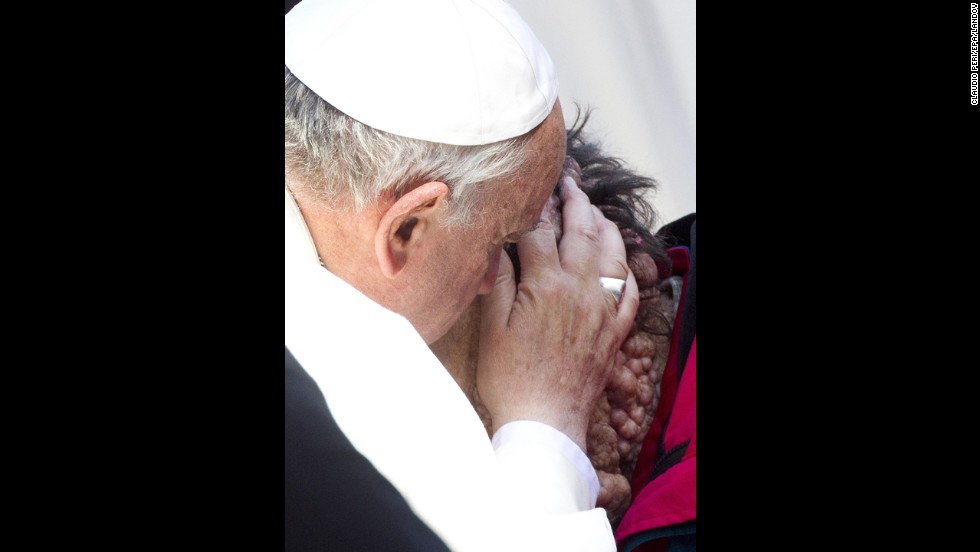
Chapters that stand out include Stephanie Arel's work on the role of pastoral (and especially papal) touch in overcoming shame, stigma, and their traumatic effects. She focuses on the number of people Pope Francis has touched and draws out some powerful lessons. Arel has herself contributed to an earlier collection, Post-Traumatic Public Theology.

The last section is especially useful, focusing on the ways in which Christian rituals can both help and harm those trying to overcome trauma.

The last chapter, by Hillary Jerome Scarsella, raises important but distressing questions from a Mennonite context: what message are victims of violence and abuse hearing when they come to church only to be told by Christians to imitate Christ, who stood silent before his accusers and abusers and protested nothing? Such a counsel can be retraumatizing for people who have suffered in silence and isolation for too long, powerless and voiceless. Such a counsel can leave powerful abusers in place, which is a gross injustice and potential danger to new victims.

Equally, what message are people hearing when told to forgive their abusers without any attempt at acknowledgement, let alone healing and reconciliation? Liturgies that too glibly promote these ideas and apparent virtues can do more damage than good. How can victims and victimizers equally partake from the same table and drink from the one chalice in the absence of any kind of reconciliation?

Finally I would note that the chapter on sexual abuse in the Catholic Church in Peru is very powerful, and Mariéle Wulf's chapter on trauma and healing is worthwhile. She draws on the insights of Margaret Crastnopol's recent book Micro-Trauma: A Psychoanalytic Understanding of Cumulative Psychic Injury (Routledge, 2015). 

Monday, September 16, 2019

Healing of African Memories

One of the issues that has haunted me for a long time, especially in Orthodox-Catholic relations, is what to do with the memories of our divisions and denunciations of each other--"heretics," "schismatic," etc. Given the climate in the Church today I'm of the view that such terms should be locked away in a specialized laboratory, the way the Centres for Disease Control keeps copies of deadly viruses under guard for exceedingly rare occasions where their resurrection might occasion some social good. Otherwise, lacking such a secure and controlled setting, you have the chaos of social media where every half-wit gong-show operator flings about accusations of "heretic" every few seconds based on a reading of Church history one can only regard, at best, as jejune. These kinds of antics can be damaging to the Church and her unity.

But there are other, much more sinister, forces doing real damage to individual lives as well as the life of the Church, and Christians continue to grapple with how to respond to such traumatic incidents and their pathological sequelae. It is not at all clear how to begin healing from some of these challenges, and too often notions of the "healing of memories" remain unhelpfully vague. A recent book I'm greatly looking forward to reading examines some of these problems and proposes some concrete ways forward: The Healing of Memories: African Christian Responses to Politically Induced Trauma, ed. Mohammed Girma (Lexington Books, 2018), 208pp.

About this book the publisher tells us this:
Africa has seen many political crises ranging from violent political ideologies, to meticulous articulated racist governance system, to ethnic clashes resulting in genocide and religious conflicts that have planted the seed of mutual suspicion.The masses impacted by such crises live with the past that has not passed. The Healing of Memories: African Christian Responses to Politically Induced Trauma examines Christian responses to the damaging impact of conflict on the collective memory. Troubled memory is a recipe for another cycle of conflict. While most academic works tend to stress forgiving and forgetting, they did not offer much as to how to deal with the unforgettable past. This book aims to fill this gap by charting an interdisciplinary approach to healing the corrosive memories of painful pasts. Taking a cue from the empirical expositions of post-apartheid South Africa, post-genocide Rwanda, the Congo Wars, and post-Red Terror Ethiopia, this volume brings together coherent healing approaches to deal with traumatic memory.

Friday, August 2, 2019

Forgetful Remembrance of Ireland's Troubles

Back in 2016 I began exploring several new works treating the theme of forgetting as an unexplored category for how we treat controversial, divisive pasts, particularly between Eastern and Western Christians. I continue to read in the area for an article I'm working on.

Two weeks ago, on a tiny lake in northern Indiana while my kids spent the day swimming and playing, I sat on the deck and began reading a very dense but fascinating new work by Guy Beiner, Forgetful Remembrance: Social Forgetting and Vernacular Historiography of a Rebellion in Ulster (Oxford University Press, 2018), 736pp. If you have any interest in Irish history, or the history of religio-political conflict, of British imperialism, and of historiography, this book will give you depth and detail in abundance. It is the very impressive fruit of serious and wide-ranging research into all kinds of out-of-the-way places and sources.

Being no expert in Irish history, I will not essay comments on the book's treatment of it. Let me, rather, note that the book's introduction alone is worth the price and effort of slogging through the whole thing. The author has given a wonderful summary of a large body of literature in memory studies, cognitive psychology and neurology, and historiography. Much of this he picks up again in his concluding chapter, "Rites of Oblivion."

The book breaks new and important ground between the heavy emphasis found in much of Western culture since at least 1945 on social remembering (of, e.g., the Holocaust), and the more recent, and still developing, awareness of the importance of forgetting both as an important phenomenon in its own right, but also as part and parcel of how human remembering works. Its use of the category of "social forgetting" shows how, in situations of longstanding and complex conflict such as that of Northern Ireland, politically mandated forgetting of, say, "The Troubles" does not always or even usually result in total obliteration of any and all memories of those events. Instead, what one finds is that officially or publicly "forgotten" events may not be discussed openly by those in power, but unofficially, in, say, families, or cultural societies or historical associations, they may be kept alive in varying forms. Thus socially and politically one may pretend to "forget" while, sotto voce as it were, one does not. The relationship between these two phenomena has not been well studied, and so, as the author says in his preface, that is what he seeks to do: "Studies of cultural and social memory have too often made sweeping claims that have not been fully substantiated. It is therefore necessary to lay out the nuts and bolts of remembrance in order to closely examine the mechanics of how social forgetting actually works" (xvii). Thus his book is situated somewhere between les lieux d'oubli and les lieux de mémoire.

The irony of any requests or still more demands--especially those enforced by the power of the state--for forgetting is, of course, that it makes remembering more likely. But curiously, Beiner notes, "the request to disregard does not" have the same effect. As he puts it, reviewing a number of recent studies, including those of juries in courtrooms, a "conscious effort to forget produces an altered form of memory, and this 'forgetful memory' needs to be better understood" (18).

Forgetting of all kinds, Beiner notes, is still given short shrift in many places, and it is often badly understood, too. Later in the book Beiner distinguishes, based on what he has observed in Ulster historiography since 1798, different kinds of forgetting: troubled forgetting, partial forgetting, nonconformist remembering that forgets differently from others around it, and a kind of "restored forgetting" brought to bear once the prevailing politics shifts again and something that was for a time officially remembered must now be suppressed in the interests of, say, an "amnesty" after a long period of political violence and a fragile social peace that feels victims must "forgive and forget." These and other types of forgetting are similar to what Mary Douglas (in an essay in Shifting Contexts) called "selective remembering, misremembering, and disremembering."

Many people assume that forgetting is bad, remembering good, and there is a straightforward connection between them. But in some ways, at least as far as human memory is concerned, remembering is the problem or, better, the aberration: we spend most of our time forgetting most things. Think, e.g., just over the last 12 hours of your life: can you give an hour-by-hour, or even more minute-by-minute recounting of everything you saw, thought, smelled, heard, and did? Would not most of us recollect only in broad outline: "Well, I was in a meeting this morning until 11:30, and then I had lunch, and then I did some paperwork at my desk for a couple hours, took tea about 3pm, and knocked off around 5 to drive home?" In other words, we forget much more of the details of a given day than we remember, and this is not only normal but necessary for if we remembered every detail out memory would soon approach saturation and exhaustion.

If attempts to enforce forgetting are problematic, so too are those demanding remembrance of an event, for it is becoming clear in the literature that "constructions of memory are not uniform and cannot be simply imposed from above and passively adopted by subservient communities" (23). Practices of social forgetting are similarly complex and incompletely successful. They may and often do come at some cost: "Practices of disremembering bury secrets" (30), with all the well-known psychic sequelae that follow from keeping traumatic secrets.

This is perhaps especially clear in the partition of states, the formation of new states, or civil war between factions within a state (see, e.g., the el pacto del olvido decreed in the 1977 Amnesty Law after Franco left office in Spain). Much of that violence is forcibly buried, resulting in disremembering in the very peculiar ways we see--what Vamik Volkan, to whom I have so often returned, calls narratives of "chosen trauma" and "chosen glory." Here ostensibly (or even genuinely) traumatic pasts get traduced for present felt purposes. Much of these dynamics and developments are still only just now being understood, and so as Beiner comes to the end of his very long and dense book, he notes that "the history of these dynamics of generating, repressing, and regenerating social forgetting has been mostly missed by conventional historiography."

There is much in Forgetful Remembrance that needs to be brought to bear on Christian ideas of forgetting, especially of major conflicts in ecclesial history--e.g., the aftermath of the Council of Chalcedon in 451, or the Union of Brest, or the pseudo-sobor of 1946. It is clear that exhortations to remember such events as these have left Christians unable to move towards that "healing of memories" so often called for by the late Pope John Paul II. But it is equally clear that simply calling for all such events to be forgotten will not work either. Instead, I think we need to explore that "thin line between an inner duty to remember and a right to be outwardly forgotten" which Beiner calls "social forgetting," for it "offers another way to approach this dilemma" by seeing that "the desire for willful forgetting produces rites of oblivion, which are in effect forms of unofficial remembrance that are discreetly performed alongside social memory in defiance of state prohibitions and social taboos" (626).

Wednesday, December 19, 2018

Collective Remembering, Forgetting, and Forgiving

I have for many years been fascinated with, and written numerous articles about, the questions of remembering and forgetting among Christians, especially between and among Orthodox and Catholic Christians. Too much of what still divides us is bad history badly "remembered." The remembering has very little to do with the past, and much to do with present politics, as Adam Phillips (also explored extensively on here) has so helpfully and rightly reminded us: "memories always have a future in mind."

The on-going problem is how we can overcome these dodgy so-called memories and find true healing. Some have suggested we need to engage in deliberate forgetting, an idea I explored in detail here, by discussing David Rieff's useful little book.

Since it remains an on-going problem, I remain on-goingly interested in books exploring these questions. Oxford University Press recently sent me some such books in exchange for reviewing manuscripts for them. Among the books I asked for were J.K. Olick et al, eds., The Collective Memory Reader (OUP, 2011), 528pp.

As you might imagine, it features very short (most are c. 3-4pp.) excerpts from a huge range of people, some well known--Freud, Burke, Marx, Durkheim, Benjamin, Blondel, Foucault, Ricoeur--alongside many others who were knew to me. The editors argue in their introduction that the study of collective memory really goes back to Maurice Halbwachs, whom I had not read previously, and who was first translated by the anthropologist Mary Douglas, whom I have read to great profit (see, inter alia, her Natural Symbols as well as Purity and Danger).

One of the other authors excerpted in this collection is Roger Bastide, whose The African Religions of Brazil argues that we need to be careful about assuming that we either remember or forget (for whatever motives) in anything like a straightforward manner. Instead, both the remembering and forgetting can be subject to individualized and idiosyncratic mutations that may or may not bleed into the supposedly collective memory.

The other book OUP sent me is Jeffrey Blustein's Forgiveness and Remembrance: Remembering Wrongdoing in Personal and Public Life (OUP, 2014). Blustein is a philosopher who teaches bioethics at the City University of New York.

About this book the publisher tells us the following:
Forgiveness and Remembrance examines the complex moral psychology of forgiving, remembering, and forgetting in personal and political contexts. It challenges a number of entrenched ideas that pervade standard philosophical approaches to interpersonal forgiveness and offers an original account of its moral psychology and the emotions involved in it. The volume also uses this account to illuminate the relationship of forgiveness to political reconciliation and restorative political practices in post-conflict societies.
Memory is another central concern that flows from this, since forgiveness is tied to memory and to emotions associated with the memory of injury and injustice. In its political function, memory of wrongdoing -- and of its victims -- is embodied in processes of memorialization, such as the creation of monuments, commemorative ceremonies, and museums. The book casts light on the underexplored relationship of memorialization to transitional justice and politically consequential interpersonal forgiveness. It examines the symbolism and the symbolic moral significance of memorialization as a political practice, reflects on its relationship to forgiveness, and, finally, argues that there are moral responsibilities associated with memorialization that belong to international actors as well as to states.

I'm only a little ways into the book, and hope to report more later. But for the time being, I wanted to draw it to your attention as one of the most philosophically rigorous and carefully argued books I have yet found in this whole complex of topics. Other works, including Rieff's, have only glanced at some of the serious challenges we face if we talk about learning to forget and forgive. Blustein faces these challenges head-on, and his book is much the richer for it, as I hope to show in a future note about it.

Wednesday, August 8, 2018

Against Collective Memory

I'm finishing revisions to a lecture I gave just over a year ago now at the University of St. Thomas in Minnesota on salutary oubliance, that is on the uses of forgetting as a deliberate means of advancing Christian unity in certain cases, including the absurdly stalled Byzantine-Oriental Orthodox dialogue.

In doing so, I am returning to works I discovered and noted on here a couple of years ago now, including those of David Rieff (whose fascinating book I discussed in three parts) and Bradford Vivian, one of the earliest authors to raise the question of why we insist on so much remembering when forgetting might be more useful.

We in the East have, as I argued here, far too much history--more than we can bear--on any number of topics, including the Council of Chalcedon, the Crusades, the Council of Florence, and the Union of Brest. The refusal to let go of some of these bogus historical narratives and grievances blocks the way towards any kind of reconciliation and unity--which is the whole point of hanging on to such pathologies in the first place, making them, in the very apt phrase of Vamik Volkan, a "chosen trauma."

Vivian has a new book out, and it is one I think Eastern Christians should pay attention before we continue, too glibly, to mouth that most tiresome of clichés about being condemned to repeat the past if we do not remember and bear witness to its horrors: Commonplace Witnessing: Rhetorical Invention, Historical Remembrance, and Public Culture (Oxford UP, 2017), 248pp.

About Vivian's book we are told:
Commonplace Witnessing examines how citizens, politicians, and civic institutions have adopted idioms of witnessing in recent decades to serve a variety of social, political, and moral ends. The book encourages us to continue expanding and diversifying our normative assumptions about which historical subjects bear witness and how they do so. Commonplace Witnessing presupposes that witnessing in modern public culture is a broad and inclusive rhetorical act; that many different types of historical subjects now think and speak of themselves as witnesses; and that the rhetoric of witnessing can be mundane, formulaic, or popular instead of rare and refined. This study builds upon previous literary, philosophical, psychoanalytic, and theological studies of its subject matter in order to analyze witnessing, instead, as a commonplace form of communication and as a prevalent mode of influence regarding the putative realities and lessons of historical injustice or tragedy. It thus weighs both the uses and disadvantages of witnessing as an ordinary feature of modern public life.

Friday, July 13, 2018

Sins of the Turkish Fathers

I recently noted yet another publication devoted to the long-term psychological effects of the Armenian Genocide. And then Herder and Herder, now published by Crossroad, sent me their newest catalogue in which we find a book released this year: The Sins of the Fathers: Turkish Denialism and the Armenian Genocide by Siobhan Nash-Marshall  (Crossroad, 2018), 256pp.

About this book the publisher tells us the following:
We hear much talk today about post-truth. Journalists and intellectuals describe it as a shocking new phenomenon caused by recent electoral campaigns. They point to contemporary political statements as horrendous post-truths. Nothing is more misleading. ‘Historical engineering’ is not a new phenomenon. Nor are the events to which journalists point as exemplary instances of ‘post-truth’ particularly poignant. ‘Historical engineering’ is the intellectual twin of ‘social engineering’ and has been taking place on increasingly large scales since the dawn of the modern world. It is a consequence of the premises, methods, and ambitions of modern philosophy. This book is the first part of a trilogy – The Betrayal of Philosophy – that concerns the roots of the post-truth phenomenon. Its intent is to provide the philosophical world with a phantasm in which it can see not just the what of ‘historical engineering,’ but the why: to show the flaws of modern philosophy itself. The phantasm regards the most successful modern project of historical and social engineering: the Armenian Genocide. It includes both Turkey’s ‘historical engineering’ – its official policy of genocide negation – and the massive late Ottoman project of social and territorial engineering which led to the murder of the first Christian nation: Armenia.

Friday, July 6, 2018

Transgenerational Trauma: The Armenian Genocide Considered

To my mind one of the most important and far-reaching insights Freud first helped us to understand, and many analysts--as well as other psychologists, sociologists, historians, and churchmen--have deepened in the years after Freud (and in particular after the Holocaust) is the long-lasting nature of major trauma, and the very real ways in which something of those traumatic memories will shape later generations who did not experience the trauma directly.

In this instance, Eastern Christians have first-hand experience, starting in 1915 (though, of course, actually much earlier, given a centuries-long trail of blood and tears among Armenian Christians, subject to periodic mass slaughters under the Ottomans) with the Armenian, Assyrian, and Greek genocides. The first of these was the largest, and has attracted a good deal of attention in the last two decades. Now that a century and more has passed, and all survivors are dead, the memories and effects of the genocide are not, as a new book reminds us: Anthonie Holslag, The Transgenerational Consequences of the Armenian Genocide: Near the Foot of Mount Ararat (Palgrave Macmillan, 2018), 291pp.

About this book the publisher tells us:
This book brings together the Armenian Genocide process and its transgenerational outcome, which are often juxtaposed in existing scholarship, to ask how the Armenian Genocide is conceptualized and placed within diasporic communities. Taking a dual approach to answer this question, Anthonie Holslag studies the cultural expression of violence during the genocidal process itself, and in the aftermath for the victims. By using this approach, this book allows us to see comparatively how genocide in diasporic communities in the Netherlands, London and the US is encapsulated in an historic narrative. It paints a picture of the complexity of genocidal violence itself, but also in its transgenerational and non-spatial consequences, raising new questions of how violence can be perpetuated or interlocked with the discourse and narratives of the victims, and how the violence can be relived.

Friday, May 25, 2018

Justice and Redress in Romania

For two years and more now, here and elsewhere, I have been examining questions of historical memory and reconciliation in a variety of contexts using a variety of methods. In this I've returned to some themes that have long interested me in my ecumenical involvements over the last twenty-five years.

A recent publication, from two of the leading scholars of contemporary Romania, explores these questions anew: Justice, Memory and Redress in Romania: New Insights, eds. Lavinia Stan, Lucian Turcescu (Cambridge Scholars, 2017), 360pp.

About this book the publisher tells us:
Are there any lessons Romania can teach transitional justice scholars and practitioners? This book argues that important insights emerge when analyzing a country with a moderate record of coming to terms with its communist past. Taking a broad definition of transitional justice as their starting point, contributors provide fresh assessments of the history commission, court trials, public identifications of former communist perpetrators, commemorations, and unofficial artistic projects that seek to address and redress the legacies of communist human rights violations. Theoretical and practical questions regarding the continuity of state agencies, the sequencing of initiatives, their advantages and limitations, the reasons why some reckoning programs are enacted and others are not, and these measures’ efficacy in promoting truth and justice are answered throughout the volume. Contributors include seasoned scholars from Romania, Canada, the United States, and the United Kingdom, and current and former leaders of key Romanian transitional justice institutions.

Monday, July 11, 2016

David Rieff on the Duty to Forget (II)

As I noted previously, among its several virtues, David Rieff's new and important book, In Praise of Forgetting: Historical Memory and Its Ironies, forces us to overcome any romantic or idealistic claims that enforced historical remembrance of certain, especially traumatic, events, in itself makes the world a better place.

The notion of collective memory comes in for unrelenting criticism from Rieff, and in my view this is wholly justified. He disputes flatly the idea that there is such a thing as collective memory as genuine memory of actual events which the collective itself experienced directly. (This is a problem I have long wondered about in all the papal calls for the "healing of memories," especially among and between Christians. How can the "memories" of, say, the entire Greek Orthodox Church be healed apart from healing each person one at a time if, that is, they have such "memories" in the first place--rather than having "acquired" them as part of their national identity kits?) This is indeed Rieff's point also: collective "memory" is an instrumentalist notion packaged into national identities and political ideologies; as such it is tendentious, narcissistic, unambiguous, unequivocal, and one-dimensional. It privileges power over truth; it does not scruple over historical accuracy, or acknowledge any ambiguity. This is what makes collective memory so useful to politicians and convincing in the hands of nationalist ideologues, and precisely what makes it so dangerous also.

Instead of an almost unquestioning insistence on remembrance, whose utility is assumed but almost never demonstrated, Rieff spends considerable time arguing that certain memories for a time may be useful in trying to prod people to repentance and reconciliation, but these cases will likely be short-lived and can only be determined on a case-by-base basis. There is, then, no room for blanket insistence on wide-spread collective remembrance by everyone forever.

Equally Rieff is not a one-sided polemicist in the other direction, insisting on blanket and widespread forgetting. He recognizes that remembering may have its place, and may be of limited use to some people.

Its utility, however, is in fact likely to be highly limited, and time-bound. Wide-spread insistence on collective remembrance has little if any demonstrable track record in making the world a better place. Collective remembrance in and of itself gives us no clues, no tools, no guidelines, as to how to prevent a future recurrence of, say, a genocide or other traumatic or violent event.

What might work better, then? Here Rieff turns to both forgiveness and especially forgetting. According to Rieff, both have considerable virtues and both have advantages that collective remembrance does not.

Forgetting, says Rieff:
  • is more mature
  • is more likely to bring peace
  • is no more likely to ensure repetition of a traumatic, violence event than enforced remembrance is to prevent it

We insist (and legally so in some cases--e.g., France's Gayssot Act and later legislation mandating memory and criminalizing denial of, e.g., the Holocaust) on a "duty to remember," notes Rieff before asking: Why not a duty to forget? Would that not be socially useful also?

Related to a duty to forget is the question of forgiveness. Rieff does not give this as much attention, and in our final installment we will look at this in more detail before teasing out some of the implications of all this for both Christian and Muslim "memories" of such as, e.g, the Fourth Crusade.

Continues. 

Tuesday, July 5, 2016

David Rieff on the Duty to Forget (I)

As it happened, I was sitting out toward dusk on perhaps the loveliest summer evening so far, finishing the reading of David Rieff's powerful and important book In Praise of Forgetting: Historical Memory and Its Ironies before coming in to the news of the death of Elie Wiesel, whose efforts to ensure perpetual remembrance of the Holocaust come in for critical scrutiny in Rieff's book.

Rieff's book is one of several to have emerged stressing the importance of forgetting--indeed, the moral imperative and duty to forget, at least some conflicts at least some of the time--as I have noted on here in drawing attention to Manuel Cruz's book, inter alia. Though this work--as I noted here--does not deal much with Christian approaches to history and memory, nor to conflicts involving Christians, I have been engaged for some time in thinking with authors such as Rieff to see how useful their work could be to the on-going project of Catholic-Orthodox healing of memories as well as to Christian-Muslim relations in the context of (entirely bogus) "memories" of the "Crusades."

Rieff's book is a subtle, careful work that does indeed make the case for forgetting, but not in a simplistic manner. He recognizes the importance of memory and remembering, but severely puts to the question any notion that collective memory is a coherent and tangible reality instead of a political cipher, a metaphor, and, on balance, a rather dangerous tool of identity always in service of some agenda or other.

Moreover, he asks--as Cruz did--whether and where all this emphasis on remembering has made the world a better place. Did insistence on not forgetting the Armenian genocide of 1915 prevent the Ukrainian terror-famine of 1932-33, the Holocaust of 1939-45, or more recent genocides in Rwanda, Cambodia, the Balkans in the 1990s, and elsewhere? Has insistence on remembering the Holocaust solved the problem of anti-Semitism? Have no Jews anywhere been killed since 1945, or at least 1948 and the creation of the state of Israel in part as a way of saying "Never forget!" and "Never again!" to the Holocaust?

Continues. 

Saturday, March 5, 2016

On Learning to Forget

As I noted last summer, I have become more and more fascinated not just with the uses and abuses of memory--in the context of, e.g., the "Crusades," which have become an all-purpose stick with which certain Orthodox Christians and certain Muslims try to beat the Catholic Church--but also with the question of forgetting. Our last century has, for justifiable reasons, been concerned to say "Never again!" by saying "Never forget!" And that is noble, commendable, important if we wish to guard against a repeat of, say, the Holocaust, Armenian Genocide, or Holodomor.

But sometimes it seems the only way forward is by not remembering. That is, the way forward is precisely through forgetting. The problem here, of course, is that most of us have been conditioned to think of forgetting as a morally reprobated activity, as a deplorable oversight, as a sin of omission--forgetting the dog in the car on a hot day, say, or failing to remember the dental appointment that morning at 9, or not remembering to buy a card for my spouse's birthday.

But as we ought to have learned by now from Freud, not all forms of remembering are healthful and helpful; and not all forms of forgetting are evidence of unhealthy repression or unconscious frustration. Certain forms of remembering are necessary, while certain others are not. Certain remembrances can help with healing with others can hinder it. This is as true for individuals as it is for Christians and their churches. Indeed, on this latter score, I think there are certain things that Christians can and must come to forget if we are ever to live together again as one body.

I've been thinking about these things for a while now, and continue to work on them for a lecture I'm to give in 2017. These thoughts have also been recently addressed in this fascinating article, which in turn put me in mind of Bradford Vivian's welcome and important book, Public Forgetting: The Rhetoric and Politics of Beginning Again

The author of the article, David Rieff, has a book coming out in May: In Praise of Forgetting: Historical Memory and Its Ironies (Yale UP, 2016), 160pp.

About this book we are told:
The conventional wisdom about historical memory is summed up in George Santayana’s celebrated phrase, “Those who cannot remember the past are condemned to repeat it.” Today, the consensus that it is moral to remember, immoral to forget, is nearly absolute. And yet is this right?
David Rieff, an independent writer who has reported on bloody conflicts in Africa, the Balkans, and Central Asia, insists that things are not so simple. He poses hard questions about whether remembrance ever truly has, or indeed ever could, “inoculate” the present against repeating the crimes of the past. He argues that rubbing raw historical wounds—whether self-inflicted or imposed by outside forces—neither remedies injustice nor confers reconciliation. If he is right, then historical memory is not a moral imperative but rather a moral option—sometimes called for, sometimes not. Collective remembrance can be toxic. Sometimes, Rieff concludes, it may be more moral to forget.

Ranging widely across some of the defining conflicts of modern times—the Irish Troubles and the Easter Uprising of 1916, the white settlement of Australia, the American Civil War, the Balkan wars, the Holocaust, and 9/11—Rieff presents a pellucid examination of the uses and abuses of historical memory. His contentious, brilliant, and elegant essay is an indispensable work of moral philosophy.

Wednesday, September 2, 2015

Imagining Byzantium

I have for some time been ever more fascinated with the uses and abuses of the past, with questions of memory and forgetting, particularly in the context of East-West relations. We seem to be living in a time where such questions are coming more and more to the fore, as I have noted on here several times. A new book continues the exploration of these historiographical and hermeneutical questions: Elena Boeck, Imagining the Byzantine Past: The Perception of History in the Illustrated Manuscripts of Skylitzes and Manasses (Cambridge UP, 2015), 300pp.

About this book the publisher tells us:
Two lavish, illustrated histories confronted and contested the Byzantine model of empire. The Madrid Skylitzes was created at the court of Roger II of Sicily in the mid-twelfth century. The Vatican Manasses was produced for Ivan Alexander of Bulgaria in the mid-fourteenth century. Through close analysis of how each chronicle was methodically manipulated, this study argues that Byzantine history was selectively re-imagined to suit the interests of outsiders. The Madrid Skylitzes foregrounds regicides, rebellions, and palace intrigue in order to subvert the divinely ordained image of order that Byzantine rulers preferred to project. The Vatican Manasses presents Byzantium as a platform for the accession of Ivan Alexander to the throne of the Third Rome, the last and final world-empire. Imagining the Byzantine Past demonstrates how distinct visions of empire generated diverging versions of Byzantium's past in the aftermath of the Crusades.

Wednesday, August 12, 2015

"Do This in Memory of Me"

As I noted on here a few weeks ago, my attention has lately been riveted on the question of memory and forgetting, especially in the context of Christian disputes and traumas such as the Fourth Crusade. More than a decade ago now I published several articles on the concept of the "healing of memories" that the late Pope John Paul II talked about so often in the context of Christian relations, especially between East and West.

But I did not then attend to the issue of how those memories were formed in the first place, or how we come to forget things, or to other broader questions raised by the category of memory, which is of course such a central part of the central ritual of Christianity: the Eucharist. What does it mean to say "Do this in memory of me?" How are we to translate the Greek ἀνάμνησιν or the Latin commemorationem in Luke 19:22? Christians have not, of course, always agreed on these terms, nor do we today.

Even if we did agree on the liturgical meaning of these terms, it would leave other important questions unresolved. In my days as a psychology major, the then-recent research of people like Elizabeth Loftus was emerging to demonstrate just how fungible and unreliable memory can be. Her research on what even so-called eye-witnesses thought they remembered was and remains startling and disconcerting. Memory, it seems, is an enormously complex phenomenon and ever so much more than a mere "photograph" in our mind of a past event. I look forward to continuing to explore these questions in the coming years.

Oxford University Press sent me an e-mail this week alerting me to a book to be published at month's end that treats some of these questions: Dmitri Nikulin, ed., Memory: A History (Oxford UP, 2015),416pp.

About this book we are told:
In recent decades, memory has become one of the major concepts and a dominant topic in philosophy, sociology, politics, history, science, cultural studies, literary theory, and the discussions of trauma and the Holocaust. In contemporary debates, the concept of memory is often used rather broadly and thus not always unambiguously. For this reason, the clarification of the range of the historical meaning of the concept of memory is a very important and urgent task. This volume shows how the concept of memory has been used and appropriated in different historical circumstances and how it has changed throughout the history of philosophy. In ancient philosophy, memory was considered a repository of sensible and mental impressions and was complemented by recollection-the process of recovering the content of past thoughts and perceptions. Such an understanding of memory led to the development both of mnemotechnics and the attempts to locate memory within the structure of cognitive faculties. In contemporary philosophical and historical debates, memory frequently substitutes for reason by becoming a predominant capacity to which one refers when one wants to explain not only the personal identity but also a historical, political, or social phenomenon. In contemporary interpretation, it is memory, and not reason, that acts in and through human actions and history, which is a critical reaction to the overly rationalized and simplified concept of reason in the Enlightenment. Moreover, in modernity memory has taken on one of the most distinctive features of reason: it is thought of as capable not only of recollecting past events and meanings, but also itself. In this respect, the volume can be also taken as a reflective philosophical attempt by memory to recall itself, its functioning and transformations throughout its own history.
We are also given the table of contents:

Introduction. Memory in Recollection of Itself. Dmitri Nikulin

Ch.1. Memory in Ancient Philosophy. Dmitri Nikulin

Reflection: Roman Art and the Visual Memory of Greece. Francesco de Angelis
Ch.2. Memory in Medieval Philosophy. Jörn Müller
Reflection: Visual Memory and a Drawing by Villard de Honnecourt. Ludovico Geymonat
Ch. 3. Memory in the Renaissance and Early Modern Period. Stephen Clucas
Reflection: Memory and Forgetfulness in Daoism. Xia Chen
Ch. 4. Forms of Memory in Classical German Philosophy. Angelica Nuzzo
Reflection: Memory and Story-Telling in Proust. Mieke Bal
Ch. 5. Memory in Continental Philosophy: Metaphor, Concept, Thinking. Nicolas de Warren
Reflection: Freud and Memory. Eli Zaretsky
Ch. 6. Trauma, Memory, Holocaust. Michael Rothberg

Reflection: Memory: An Adaptive Constructive Process. Daniel Schacter

Ch. 7. Memory in Analytic Philosophy. Sven Bernecker

Reflection: The Recognitional Structure of Collective Memory. Axel Honneth

Ch. 8. Memory and Culture. Jan Assmann

Monday, June 1, 2015

Orthodoxy and Catholicism in Asian Perspective

More than a decade ago now I wrote several articles on the concept of the "healing of memories," a phrase that Pope John Paul II picked up and began using from the earliest months of his pontificate. As the years of his papacy wore on, he began using that phrase (and variations of it--e.g., "purification of memory") with greater urgency and with greater focus on East-West divisions. The phrase itself is a curious mix of psychology and theology and it's never been entirely clear to me how practicable such an approach is beyond the individual-clinical context: that is to say, I may be able, lying on my analyst's couch, to talk through painful memories of some trauma or other from my childhood ("remembering, repeating, and working through," to use Freud's phrase for the analytic process), and so find some measure of healing of those memories, allowing me to move on with my life. But how do entire churches or whole ecclesial communities do that? To put this in concrete terms, how do Greek Orthodox Christians (inter alia) who still harbor (one knows not how) bad memories of, say, the Fourth Crusade, experience healing of those memories as a Church?

Anyway that is a question to continue to ponder for another time. In the meantime, and along these lines, we have a new book that looks promising and interesting: Ambrose Mong, Purification of Memory: A Study of Orthodox Theologians from a Catholic Perspective (James Clark and Co., 2015), 232pp.

About this book the publisher tells us:

Among the major Christian denominations, the Orthodox Church is the least known and widely misunderstood. This is more serious in Asia where the Orthodox Church is a minority and is perceived as an exotic branch of Christianity. But in fact, the Eastern Church has been in China since the seventeenth century. The purpose of this work is to acquaint lay people, theological students and seminarians with the teaching of Orthodoxy through a study of important modern Orthodox theologians. Mong argues that in spite of the differences and painful clashes between the Eastern and Western Churches, there is a lot that they share in common. Key topics like ecclesiology, ecumenism, catholicity, traditions and liberation theology are explored in the works of Jaroslav Pelikan, Nicolas Berdyaev, Nicolas Afanasiev, Georges Florovsky, Sergei Bulgakov, John Meyendorff, John Zizioulas and Vladimir Lossky, together with their Catholic counterparts like Joseph Ratzinger, Yves Congar, Henri de Lubac, Karl Rahner and Hans Urs von Balthasar. This study highlights their striking similarities and suggests, that from an ecumenical point of view, their common heritage and concerns in the world can be a basis for dialogue and the healing of memory.

Sunday, August 28, 2011

Ecclesial Repentance

I have written several articles on the whole concept of the "healing of memories" and the necessary exchange of forgiveness and repentance between Christians that is presupposed by the healing of memories--particularly, as I proposed, between Eastern and Latin hierarchs on the first Sunday of Great Lent during Forgiveness Vespers. In so doing, I was echoing a familiar request and practice of the late Pope John Paul II, who proposed just such a request on many times, but perhaps most centrally on the first Sunday of Lent in 2000, which he celebrated liturgically in the Vatican basilica as a "Day of Repentance."  More dramatically still, he made such a request for forgiveness in Athens in 2001 in the face of some Orthodox Christians demanding he apologize for the Fourth Crusade as though it happened last week. (As the great historian Robert Taft has said, some Eastern Christians have an unhelpful tendency to collapse history and act as though the events of, e.g., 1204 in Constantinople happened yesterday.)

When, in the late 1990s, the late pope proposed doing what he did in March 2000, some Catholics (particularly the Italians in the Roman Curia concerned about preserving la bella figura) objected that asking for forgiveness would confuse people into thinking that the Church, as the spotless bride of Christ, was asking forgiveness, which would be superfluous, if not sacrilegious. Au contraire, the pope patiently replied many times: the Church, like Christ, is dyophisite. In her divine nature, she is perfect as the Body of Christ; but in her human nature she is full of sinners, and we, as humans and sinners, need always to be asking forgiveness of the Lord.

This notion, only rarely analyzed before, is a concept at the heart of a new book: Jeremy M. Bergen, Ecclesial Repentance: The Churches Confront Their Sinful Past (T&T Clark, 2011), 352pp.
About this book, the publisher tells us:
Churches have been repenting, apologizing, and asking forgiveness for beliefs and practices they once justified. These often high-profile statements raise questions such as: Can a church repent for things that happened centuries ago? Is it possible for a church to sin or to be forgiven? What difference will repenting make? Is this just more church hypocrisy? In this book Jeremy Bergen tells the story of ecclesial repentance in recent decades and explores the theological issues its raises. He argues that because it is grounded in the doctrines of Christ and the Holy Spirit, ecclesial repentance requires the church to articulate in new ways its own nature and mission.
This book, alas, seems to pay scant attention to the East, and so I hope someone will write a companion volume for Eastern Christians lest the absence of such a reckoning merely reinforce the idea among some in the East that they have nothing to apologize for: the Western Church is entirely at fault for everything from 1054--and even from before that often wildly misunderstood and rather mythological date. But Eastern Christians thinking that they are always the victim, never the perpetrator, are merely continuing in their own delusions, recently and rightly denounced by Robert Taft, who noted, e.g., the appalling persecution of the Armenians and Copts by the Orthodox Church of the Byzantine Empire or the Greek pogrom against Latin Christians in Constantinople in 1182. Inter alia, Eastern Christians in our day have egregious sins to deal with, not least, as the Russian Orthodox theologian Antoine Arjakovsky has very recently shown in his En attendant le Concile de l'Eglise Orthodoxe, the collaboration, on the part of the Russian Church, in the violent suppression, in 1946, of the Ukrainian Greco-Catholic Church--a sin repeated two years later by the Orthodox Church in Romania against the Greco-Catholics there.

None of this should be taken as a vulgar tit-for-tat. As Taft has repeatedly shown, we have all sinned against one another, and we all have much to repent for. Bergen's book reminds of that, and therefore deserves attention for that reason.  

Sunday, May 1, 2011

The Healing of Memories


NPR's blog "Being" (formerly "Speaking of Faith") here publishes some of my further thoughts on Pope John Paul II and the healing of Orthodox-Catholic memories.

Saturday, April 30, 2011

On Pope John Paul II and Eastern Christianity

In thinking about Pope John Paul's pontificate on the occasion of his beatification this weekend I am reminded of many things he accomplished but I want to focus on only three of especial relevance to Eastern Christians.

First, he made it his priority, in line with the express wishes of the Second Vatican Council in its decree Unitatis Redintegratio and Orientalium Ecclesiarum to continue seeking Christian unity. He first visited Constantinople and the Ecumenical Patriarch in 1979. In the next quarter-century he would visit with many heads of Orthodox Churches.

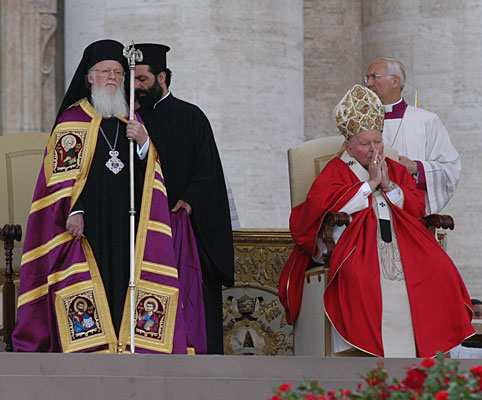
Second, he realized that part of the task of seeking unity with the East depended on something he advocated from the beginning of his papacy: the healing of memories. He himself put this into practice with Eastern Christians most memorably and movingly in 2001 when he visited Greece and in a dramatic gesture asked forgiveness for those Latin Catholics who had sacked Constantinople in the Fourth Crusade of 1204 and prayed that the memory of this would finally be healed.

I have elsewhere in several places analysed this notion of the healing of memories, but it remains as important today as when he first began to talk about it. Indeed, the newly elected patriarchal head of the Ukrainian Greco-Catholic Church has recently spoken eloquently about how important such healing remains for more than a few Eastern Christians who seem, perversely, to be unwilling to let go of those memories of hurts, whether real or imagined, but hang on to them as an excuse not to have to be united with the still-hated Catholic Church.  I have seen proof of that only this week in a few fanatics elsewhere attacking my book, Orthodoxy and the Roman Papacy: Ut Unum Sint and the Prospects of East-West Unity

which they proudly--perversely--claim not to have read because it is a work of "ecumenism," that supposed "pan-heresy." O la fatigue du Nord! Such an attitude is--more than being predictable, tedious, and silly--really very sad because it evidences no desire to do what the Lord wants by seeking unity. Such people are perversely content not merely to hang on to their hurts but to lash out at anyone who suggests we have no choice but to press for unity.

But what type of unity? That is the real question. As those who will actually bestir themselves to read the book will discover, I am not at all one of those who sees unity as being a process of trade-off, of dogmatic compromise or doctrinal relativizing. No Catholic or Orthodox hierarch involved in the process today sees unity in these terms. Quite to the contrary. My entire project is about finding a way for Catholicism to be true to itself, Orthodoxy true to itself, but both to be converted anew to the truth Himself and His express wish that all might be one so that the world might believe (John 17:21). The notion of watering down the truth to reach unity is as much anathema to me as it is to the most fervent Athonite parading about with his "Orthodoxy or Death" banner.

How could such unity ever come to pass? Some assert--even the more hopeful--that while we may have resolved the filioque, and can conceivably overcome any other issue that might remain, the papacy remains the unbridgeable chasm.

But that notion fails to grapple with the third part of the legacy of Pope John Paul II: his genuine request for helpful responses to his real and acute question in Ut Unum Sint:
I insistently pray the Holy Spirit to shine his light upon us, enlightening all the Pastors and theologians of our Churches, that we may seek—together, of course—the forms in which this ministry may accomplish a service of love recognized by all concerned." This is an immense task, which we cannot refuse and which I cannot carry out by myself. Could not the real but imperfect communion existing between us persuade Church leaders and their theologians to engage with me in a patient and fraternal dialogue on this subject, a dialogue in which, leaving useless controversies behind, we could listen to one another, keeping before us only the will of Christ for his Church and allowing ourselves to be deeply moved by his plea "that they may all be one ... so that the world may believe that you have sent me" (Jn 17:21)?
My Orthodoxy and the Roman Papacy: Ut Unum Sint and the Prospects of East-West Unity was one attempt to respond to that request in the name of, and reflecting faithfully the mindset of, Eastern Orthodoxy. You might not like my response or disagree with it (though I note with gratitude that several Orthodox clerics and theologians have read it and lauded it), in which case: where is yours?
Related Posts Plugin for WordPress, Blogger...