The book is co-authored by a Ukrainian Catholic priest-academic and his wife, also an academic, about their life with their three daughters. As such, they are immersed in the world of Eastern Christianity. Fr. Myroslaw, in fact, is author of other works, including How to Pray with Icons as well as an early and still-important study on the role and reception of Augustine of Hippo: Augustine and Russian Orthodoxy.
I asked Fr. Myroslaw and Pres. Maria for an interview, and here are their thoughts:
AD: Tell us about your backgrounds
Myroslaw is a Ukrainian Catholic priest and Doctor of Theology. He has served as pastor in Ontario and Saskatchewan (currently in Kitchener) and a professor at the University of Saskatchewan, Toronto, and, presently, Waterloo, where he has also been Dean and Acting President at St Jerome’s University.
He is married to Maria whose doctorate is in English, with a specialization in Literary Disability Studies. She has been the primary caregiver for their 3 daughters and an advocate for disability rights.
AD: What led to the writing of this book?
Although we had been entirely conscious of how our daily lives are permeated with the intersecting issues of disability, theology, culture, and justice, the real impetus for this collaborative project simply came from the publisher’s request. Without the outside proposal, daily life forever obstructed our desire to write together. Everything else seemed to take priority.
AD: Through much of this book, but especially in Maria's "Why We Wrote This Book," you've both put yourselves out there more than most "normal" academics would in writing, where we often treat issues in a dry, detached, clinical manner. The more personal side of our life has, in some ways, been bred out of us through graduate programs. Did you find it a struggle or a liberation (or both?) to be more directly personal about your own struggles and those of your family?
I, Maria, found it intensely difficult to include our personal life in this writing. In any academic work, I believe it is critical to disclose our ideological standpoint, or as much as possible to reflect on how our thinking is fueled by our personal experiences. My life with disability had compelled my work in disability studies, but for me, using family examples was uncomfortable and even invasive. However, we were instructed to write for an audience that was not strictly academic; our editors felt the personal was important. Unlike for me, Myroslaw, did find writing the personal experience somehow liberating. He included the excerpts from our life at the end of chapters and I, reluctantly, conceded.
AD: Also in that section, Maria, you note your entirely understandable frustration, which I share completely, with the usual shower of treacly pious cliches that rained down on you as a child when your father died. Has that changed at all in the intervening years--do you think Christians today are any better at resisting the usual tropes ("it's for the best" or "he's in a better place" or "don't be said--he's with Jesus in heaven!") that surround death in our culture today?
What an interesting question! Unfortunately, I think not. Understandably, because our mainstream culture still promulgates myths of control both in and of life (especially now promoting choice over when to die) death, grief, pain is strangely medicalized, sterilized, so that it is, as an event, removed from the normal. When faced with death, people, Christians or not, are simply not enculturated with responses beyond the reigning clichés. We want and need to feel helpful, comforting, and, in the moment, the tired tropes invariably revive.
AD: That section ends almost cryptically by declaring "We searched our faith tradition for signs of disability and, indeed, we found the Divine Trinity" (p.7). Tell us more what you meant by that.
 Simply, we set out to find and
analyze images of disability in the Bible and in theology. Foundational texts
of disability studies in the humanities regularly indicted the Christian
tradition for much of the oppression suffered by people with disabilities and
indeed, voices of disabled people persistently spoke of exclusion and pain
suffered in their churches. In popular understanding, the Judeo-Christian
tradition viewed disability either as a mark of sin, divine disfavour, or
testing: a Job-like trial to see if you’ll go to the devil! God has singled you
out...
Simply, we set out to find and
analyze images of disability in the Bible and in theology. Foundational texts
of disability studies in the humanities regularly indicted the Christian
tradition for much of the oppression suffered by people with disabilities and
indeed, voices of disabled people persistently spoke of exclusion and pain
suffered in their churches. In popular understanding, the Judeo-Christian
tradition viewed disability either as a mark of sin, divine disfavour, or
testing: a Job-like trial to see if you’ll go to the devil! God has singled you
out...So we wanted to examine some of the classic biblical passages used to devalue people with physical and/or mental impairments to determine if popular conceptions concurred with text and exegesis. This is why “we searched our faith tradition for signs of disability.” Of course, this search could constitute a life’s work with volumes of material. We delved into an example or two from a theological period and then jumped over centuries into another one. Nevertheless, we had not expected what we found. I, for one, grew up knowing that the doctrine of the Trinity was a mystery impossible to fathom. The shamrock provided a visual, but honestly—that symbol linked too quickly to leprechauns and beer drinking!
Investigating images of disability in our theological tradition illuminated the understanding of God as Trinity. Through our Judaic history, our record of Christ’s life and the development of the church, tracing the response to human vulnerability and difference reveals the inevitability of a Trinitarian God. Tracing the Christian reflection of Christ’s response to difference, impairment, alienation, erases the mystery of Trinity; disability seen with Christ makes the Trinity make sense. God is community: interdependent, inclusive, inviting, and embracing. God cannot be one: independent, solitary, autonomous (traits we North Americans value). God is love and love must go beyond self. It was a revelation, to look for disability and to find Trinity.
AD: Your introduction notes the work of Jean Vanier in bringing to the world's attention the plight of disabled people and how they are often appallingly treated. How influential was Vanier in your writing this book?
Vanier’s work did not directly inform ours. However, Jean Vanier, as a Christian, echoes Christ’s example of resisting mainstream norms to illuminate and value our shared and endlessly variable humanity. Vanier’s life reinforces the Christian tradition we highlight in our work.
AD: Your introduction notes that Christian communities may be good at rallying after an initial crisis or tragedy, but fade away quickly as people assume governments and social-service agencies will take their role. What can Christian communities do today to be more involved in helping people in need over the long haul?
If we believe that community necessitates relationship amongst members, then the answer to this question is alarmingly simple: we maintain a relationship with the disabled individual, even if they have ceased to run bake sales or attend services. Every person’s circumstance will be specific. A church community may not be able to provide specialized medical care, if it should be needed, but a community may always ensure that its members feel wanted and relevant, no matter the state they may be in. A community can ensure that members are not isolated, forgotten, lonely. Medicalized treatments and services play an important role in our lives, but they do not supplant the vital need for genuine caring relationship that a church community can and must provide if we aim to follow Christ. When a community cares for its members, no one person can feel burdened by giving or receiving care. Shared actions of love and care energize and motivate the Trinitarian dynamic represented in the icon that we describe in our book.
AD: You argue that "there is no one (definitive) definition of disability....Disability affects every person in society" (p.18) and yet I don't think we really realize this because, as you note, they are hidden away, or labeled as "special" or otherwise treated from a distance as "different" or "other." How can churches help avoid this ostracization, this distanciation, this "othering," and instead come to see everyone as fully part of God's commonwealth?
How can churches help avoid this “othering”? How can churches mirror Christ’s love, generosity, and courage to oppose mainstream norms? This is the truly daunting challenge. To see the fullness of Christ in the incommensureable breadth of humanity entails a profound transformation of perspective that demands conscious determination and work. To live as Trinity, we must necessarily unlearn enculturated prejudice. To unlearn means that we must recognise the prejudice in us and our role in the oppression of those who are seen as different. This acknowledgement is much easier said than done. Our view of disabled lives as less valuable than non-disabled lives seems self evident, far from a constructed societal policy that derived from a historical period of expansionist power politics. Church communities, it seems to me, thrive on opportunities for growth and conversion to deeper spirituality. To unlearn disability as deviancy and to dispel our fear of difference can be propelled by church leadership, who can create the attitude and language of welcome and familiarity. It is contagious! It is possible and it is beautiful.
AD: You make a strong point (pp.94-95) about how labeling people as "special" is in some ways the equivalent of the old label of "leper." Tell us what you meant by that.
 There is power and privilege in
belonging to a dominant “norm.” Cultural studies has demonstrated the unspoken
privilege of whiteness, for example. Why
was whiteness not “coloured” and subject to study? Similarly, when civil rights
movements developed into disability rights movements, the insulting language
surrounding people with disabilities began to change into what appeared as more
“positive” terms. But these were euphemisms for the same debilitating and
dehumanizing attitudes that existed before and generally remain today. Retarded
kids became special kids, but no one wants to be special any more than they
want to be retarded! “Special”, in the 1990’s, became the accepted term for
segregated, excluded, bullied, too costly. Even as parents, we’d be called
“special” in a way we could tell meant, thank God YOU are the special ones and
we are normal! One could feel good about distancing oneself from the disabled
person, by praising them as special (and turning away). One wouldn’t feel as
decent if one spat in the face of a disabled person and turned away. Hence, the special label
helped the labellers, not the labelled.
There is power and privilege in
belonging to a dominant “norm.” Cultural studies has demonstrated the unspoken
privilege of whiteness, for example. Why
was whiteness not “coloured” and subject to study? Similarly, when civil rights
movements developed into disability rights movements, the insulting language
surrounding people with disabilities began to change into what appeared as more
“positive” terms. But these were euphemisms for the same debilitating and
dehumanizing attitudes that existed before and generally remain today. Retarded
kids became special kids, but no one wants to be special any more than they
want to be retarded! “Special”, in the 1990’s, became the accepted term for
segregated, excluded, bullied, too costly. Even as parents, we’d be called
“special” in a way we could tell meant, thank God YOU are the special ones and
we are normal! One could feel good about distancing oneself from the disabled
person, by praising them as special (and turning away). One wouldn’t feel as
decent if one spat in the face of a disabled person and turned away. Hence, the special label
helped the labellers, not the labelled.AD: You refer several times to how Jesus debunks ideas of "normalcy." Tell us more about that.
Jesus hung out with women, prostitutes, children, lepers, tax collectors, foreigners and pointed out the hypocrisy of spiritual leaders. Jesus was crucified for defying norms. Need I say more?
AD: You make various references throughout the book to Eastern Christians persons and practices--sacraments, Maximus the Confessor, Athanasius of Alexandria, etc. But in chapter 11 you talk in particular about the role of icons. Tell us how their portrayal of transfigured bodies is important to your arguments about embracing difference.
Icons do not try to present human bodies in anyone’s ideal form. There is no “normal” body. Humanity, all creation, is transfigured through Christ and as Christians we see material reality, each other as divine vessels. Only through creation can we come to know God. Physical variation in any form participates in the breadth and depth of divine revelation.
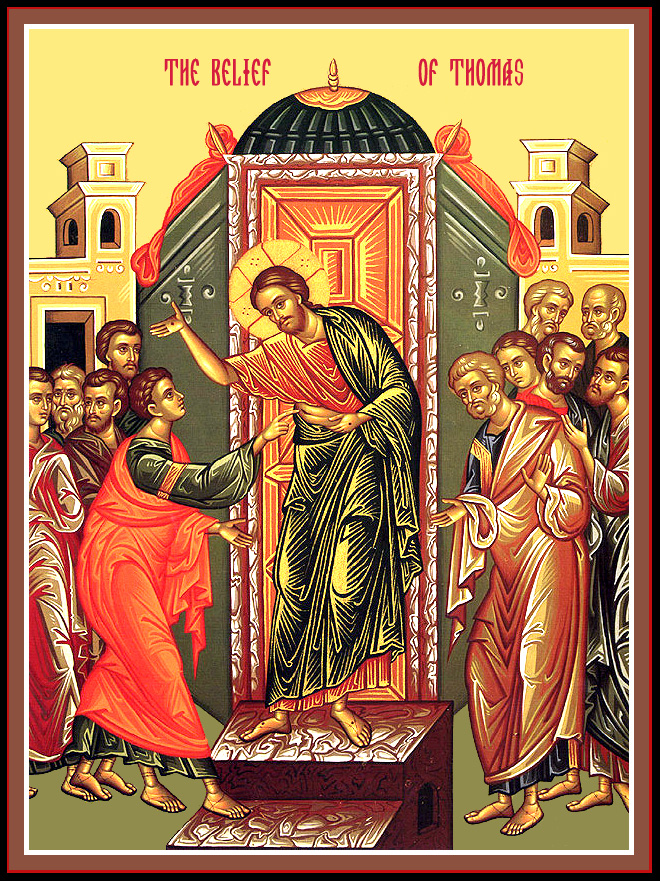 AD: One thing I've always been cheered by is that in the icons of the risen
Jesus, His "disability" as it were is transfigured but not hidden or
disappeared. In other words, His wounds are still visible, and I think
that's tremendously important to illustrating how God works--not by
covering up, hiding, pretending something didn't happen, or finding a
clumsy "work-around" but instead working through His disabling wounds.
AD: One thing I've always been cheered by is that in the icons of the risen
Jesus, His "disability" as it were is transfigured but not hidden or
disappeared. In other words, His wounds are still visible, and I think
that's tremendously important to illustrating how God works--not by
covering up, hiding, pretending something didn't happen, or finding a
clumsy "work-around" but instead working through His disabling wounds.Yes. Our vulnerabilities/impairments bring us in touch with our physical reality, our humanness, and through our humanness we can come to know God.
AD: Sum up your hopes for this book, and who should read it.
We hope that believers and non-believers find value in the book. Believers who, by deepening their understanding of the Holy Trinity, become more radical in their willingness to see how we are all interdependent and so all, in our own unique manner, reflective of the Divine Life. Unbelievers who come to recognize that to be human is to be interdependent and that the idea of a human being as a solitary, unconnected entity is a myth that needs to be discarded. We hope that rather than seeing others as different, dangerous, or frightening we come to see each other as another face of the Divine Trinity.

