"Let books be your dining table, / And you shall be full of delights. / Let them be your
mattress,/
And you shall sleep restful nights" (St. Ephraim the Syrian).


Showing posts with label suffering. Show all posts

Wednesday, September 5, 2018

Theology and Trauma

I've been doing a lot of reading over the past three years in the study of trauma widely understood. Part of this has been motivated by trying to understand how Eastern Christians have reacted to and suffered the effects of such things as, inter alia, the Armenian genocide and other massacres by Ottoman Muslims, Ukrainian Greek-Catholic repression at the hands of Stalin from 1946 onwards--to say nothing of earlier divisions and events in the Church often thought to require some "healing of memories."

The study of trauma has really exploded in the last several years, and I have previously noted on here some of the scholars I have found especially useful--Jeffrey Prager, Charles Strozier, Vamik Volkan, and others.  But books linking reflections on trauma to Christianity are rather rare. Notably there is Marcus Pound's book from 2008, Theology, Psychoanalysis, and Trauma, which is useful though rather narrowly focused on Lacan.

Now, however, released just a couple of weeks ago, we have a new collection, wide-ranging in scope, but with several essays devoted to theology and trauma: Trauma and Transcendence: Suffering and the Limits of Theory, eds. Eric Boynton and Peter Capretto (Fordham UP, 2018), 344pp.

About this book the publisher tells us the following:
Trauma theory has become a burgeoning site of research in recent decades, often demanding interdisciplinary reflections on trauma as a phenomenon that defies disciplinary ownership. While this research has always been challenged by the temporal, affective, and corporeal dimensions of trauma itself, trauma theory now faces theoretical and methodological obstacles given its growing interdisciplinarity. Trauma and Transcendence gathers scholars in philosophy, theology, psychoanalysis, and social theory to engage the limits and prospects of trauma’s transcendence. This volume draws attention to the increasing challenge of deciding whether trauma’s unassimilable quality can be wielded as a defense of traumatic experience against reductionism, or whether it succumbs to a form of obscurantism.
Contributors: Eric Boynton, Peter Capretto, Tina Chanter, Vincenzo Di Nicola, Ronald Eyerman, Donna Orange, Shelly Rambo, Mary-Jane Rubenstein, Hilary Jerome Scarsella, Eric Severson, Marcia Mount Shoop, Robert D. Stolorow, George Yancy.

Monday, March 20, 2017

Did Early Martyrs Feel or Deny Their Pain?

The University of California Press, which has a number of series publishing works about early and Eastern Christian history, inter alia, has just sent me an intriguing new study by L.S. Cobb, Divine Deliverance: Pain and Painlessness in Early Christian Martyr Texts (UC Press, 2016), 264pp.

Amidst much chatter recently about the dim future of the Church in the West, and the various forms of "persecution" that are coming, this book raises an important question about how to respond to any form of "persecution," violent and otherwise, and where power ultimately lies.

The key question, in the words of the publisher's blurb, is this:
Does martyrdom hurt? The obvious answer to this question is “yes.” L. Stephanie Cobb, asserts, however, that early Christian martyr texts respond to this question with an emphatic “no!” Divine Deliverance examines the original martyr texts of the second through fifth centuries, concluding that these narratives in fact seek to demonstrate the Christian martyrs’ imperviousness to pain. For these martyrs, God was present with, and within, the martyrs, delivering them from pain. These martyrs’ claims not to feel pain define and redefine Christianity in the ancient world: whereas Christians did not deny the reality of their subjection to state violence, they argued that they were not ultimately vulnerable to its painful effects.

Monday, October 24, 2016

He Who Suffers Shall Be Saved

The Orthodox and Catholic scholars, Nonna Verna Harrison and David Hunter, respectively, have edited what looks to be a very rich collection treating the perennially difficult problem of suffering in the world: part of the Holy Cross Studies in Patristic Theology and History, this collection, Suffering and Evil in Early Christian Thought (Baker Academic, 2016), 288pp. is set to be published next month.

About it the publisher provides these details:
What did the early church teach about the problem of suffering and evil in the world? In this volume, distinguished historians and theologians explore a range of ancient Christian responses to this perennial problem. The ecumenical team of contributors includes John Behr, Gary Anderson, Brian Daley, and Bishop Kallistos Ware, among others. This is the fourth volume in Holy Cross Studies in Patristic Theology and History, a partnership between Baker Academic and the Pappas Patristic Institute of Holy Cross Greek Orthodox School of Theology. The series is a deliberate outreach by the Orthodox community to Protestant and Catholic seminarians, pastors, and theologians.

Monday, August 29, 2016

Passion and Compassion in Early Christianity

When it first appeared in 2008, I read with great interest Susan Wessel's fascinating and important study, Leo the Great and the Spiritual Rebuilding of a Universal Rome. Among other things, it sheds important light on Leo's role in the Council of Chalcedon, including its famous controverted 28th canon about patriarchal jurisdictions and so-called Roman pre-eminence. Wessel's considerable achievement was to show that Leo--pace later Eastern fears--was not engaged in a campaign of self-aggrandizement at the expense of the East. In fact, both Rome and Constantinople misunderstood the motives and actions of each other when, in fact, it seems they were both concerned about maintaining ecclesial affairs in their own spheres "decently and in good order," without trying to one-up each other.

Now we have another book from Wessel, published just this summer: Passion and Compassion in Early Christianity (Cambridge University Press, 2016), 290pp.

The publisher, who has made this book available both in print and in a Kindle format, tells us the following about the book:
This book examines how the early Christian elite articulated and cultivated the affective dimensions of compassion in a Roman world that promoted emotional tranquillity as the path to human flourishing. Drawing upon a wide range of early Christians from both east and west, Wessel situates each author in the broader cultural and intellectual context. The reader is introduced to the diverse conditions in which Christians felt and were urged to feel compassion in exemplary ways, and in which warnings were sounded against the possibilities for distortion and exploitation. Wessel argues that the early Christians developed literary methods and rhetorical techniques to bring about appropriate emotional responses to human suffering. Their success in this regard marks the beginning of affective compassion as a Christian virtue. Comparison with early modern and contemporary philosophers and ethicists further demonstrates the intrinsic worth of the early Christian understanding of compassion.
We are also given the table of contents here and an excerpt here.

Friday, March 27, 2015

Trinitarian Theology and Disability: an Interview with the Tataryns

At the end of February, I was at Baylor University at the Wilken Colloquium, devoted this year to the theme of eschatology. One of the speakers was the Reformed theologian J. Todd Billings, who gave a memorably moving presentation based on his new book, which is itself based on his life as a young man given a diagnosis of incurable cancer: Rejoicing in Lament: Wrestling with Incurable Cancer and Life in Christ (Brazos, 2015). In the discussion afterwards he noted that we still have not seen enough theological reflection on what it is like, and what it means, to live with a chronic condition, a major handicap, or a terminal diagnosis. I thought at the time of a recently published book, Discovering Trinity in Disability: A Theology for Embracing Difference (Orbis 2013), 144pp.

The book is co-authored by a Ukrainian Catholic priest-academic and his wife, also an academic, about their life with their three daughters. As such, they are immersed in the world of Eastern Christianity. Fr. Myroslaw, in fact, is author of other works, including How to Pray with Icons as well as an early and still-important study on the role and reception of Augustine of Hippo: Augustine and Russian Orthodoxy.

I asked Fr. Myroslaw and Pres. Maria for an interview, and here are their thoughts:

AD: Tell us about your backgrounds

Myroslaw is a Ukrainian Catholic priest and Doctor of Theology. He has served as pastor in Ontario and Saskatchewan (currently in Kitchener) and a professor at the University of Saskatchewan, Toronto, and, presently, Waterloo, where he has also been Dean and Acting President at St Jerome’s University.

He is married to Maria whose doctorate is in English, with a specialization in Literary Disability Studies. She has been the primary caregiver for their 3 daughters and an advocate for disability rights.

AD: What led to the writing of this book?
 
Although we had been entirely conscious of how our daily lives are permeated with the intersecting issues of disability, theology, culture, and justice, the real impetus for this collaborative project simply came from the publisher’s request. Without the outside proposal, daily life forever obstructed our desire to write together. Everything else seemed to take priority.

AD: Through much of this book, but especially in Maria's "Why We Wrote This Book," you've both put yourselves out there more than most "normal" academics would in writing, where we often treat issues in a dry, detached, clinical manner. The more personal side of our life has, in some ways, been bred out of us through graduate programs. Did you find it a struggle or a liberation (or both?) to be more directly personal about your own struggles and those of your family?

I, Maria, found it intensely difficult to include our personal life in this writing. In any academic work, I believe it is critical to disclose our ideological standpoint, or as much as possible to reflect on how our thinking is fueled by our personal experiences. My life with disability had compelled my work in disability studies, but for me, using family examples was uncomfortable and even invasive. However, we were instructed to write for an audience that was not strictly academic; our editors felt the personal was important. Unlike for me, Myroslaw, did find writing the personal experience somehow liberating. He included the excerpts from our life at the end of chapters and I, reluctantly, conceded.

AD: Also in that section, Maria, you note your entirely understandable frustration, which I share completely, with the usual shower of treacly pious cliches that rained down on you as a child when your father died. Has that changed at all in the intervening years--do you think Christians today are any better at resisting the usual tropes ("it's for the best" or "he's in a better place" or "don't be said--he's with Jesus in heaven!") that surround death in our culture today?

What an interesting question! Unfortunately, I think not. Understandably, because our mainstream culture still promulgates myths of control both in and of life (especially now promoting choice over when to die) death, grief, pain is strangely medicalized, sterilized, so that it is, as an event, removed from the normal. When faced with death, people, Christians or not, are simply not enculturated with responses beyond the reigning clichés. We want and need to feel helpful, comforting, and, in the moment, the tired tropes invariably revive.

AD: That section ends almost cryptically by declaring "We searched our faith tradition for signs of disability and, indeed, we found the Divine Trinity" (p.7). Tell us more what you meant by that.

Simply, we set out to find and analyze images of disability in the Bible and in theology. Foundational texts of disability studies in the humanities regularly indicted the Christian tradition for much of the oppression suffered by people with disabilities and indeed, voices of disabled people persistently spoke of exclusion and pain suffered in their churches. In popular understanding, the Judeo-Christian tradition viewed disability either as a mark of sin, divine disfavour, or testing: a Job-like trial to see if you’ll go to the devil! God has singled you out...

So we wanted to examine some of the classic biblical passages used to devalue people with physical and/or mental impairments to determine if popular conceptions concurred with text and exegesis. This is why “we searched our faith tradition for signs of disability.” Of course, this search could constitute a life’s work with volumes of material. We delved into an example or two from a theological period and then jumped over centuries into another one. Nevertheless, we had not expected what we found. I, for one, grew up knowing that the doctrine of the Trinity was a mystery impossible to fathom. The shamrock provided a visual, but honestly—that symbol linked too quickly to leprechauns and beer drinking!

Investigating images of disability in our theological tradition illuminated the understanding of God as Trinity. Through our Judaic history, our record of Christ’s life and the development of the church, tracing the response to human vulnerability and difference reveals the inevitability of a Trinitarian God. Tracing the Christian reflection of Christ’s response to difference, impairment, alienation, erases the mystery of Trinity; disability seen with Christ makes the Trinity make sense.  God is community: interdependent, inclusive, inviting, and embracing. God cannot be one: independent, solitary, autonomous (traits we North Americans value). God is love and love must go beyond self. It was a revelation, to look for disability and to find Trinity.

AD: Your introduction notes the work of Jean Vanier in bringing to the world's attention the plight of disabled people and how they are often appallingly treated. How influential was Vanier in your writing this book?

Vanier’s work did not directly inform ours. However, Jean Vanier, as a Christian, echoes Christ’s example of resisting mainstream norms to illuminate and value our shared and endlessly variable humanity.  Vanier’s life reinforces the Christian tradition we highlight in our work.

AD: Your introduction notes that Christian communities may be good at rallying after an initial crisis or tragedy, but fade away quickly as people assume governments and social-service agencies will take their role. What can Christian communities do today to be more involved in helping people in need over the long haul?
 
If we believe that community necessitates relationship amongst members, then the answer to this question is alarmingly simple: we maintain a relationship with the disabled individual, even if they have ceased to run bake sales or attend services. Every person’s circumstance will be specific. A church community may not be able to provide specialized medical care, if it should be needed, but a community may always ensure that its members feel wanted and relevant, no matter the state they may be in. A community can ensure that members are not isolated, forgotten, lonely. Medicalized treatments and services play an important role in our lives, but they do not supplant the vital need for genuine caring relationship that a church community can and must provide if we aim to follow Christ. When a community cares for its members, no one person can feel burdened by giving or receiving care. Shared actions of love and care energize and motivate the Trinitarian dynamic represented in the icon that we describe in our book.

AD: You argue that "there is no one (definitive) definition of disability....Disability affects every person in society" (p.18) and yet I don't think we really realize this because, as you note, they are hidden away, or labeled as "special" or otherwise treated from a distance as "different" or "other." How can churches help avoid this ostracization, this distanciation, this "othering," and instead come to see everyone as fully part of God's commonwealth? 

How can churches help avoid this “othering”? How can churches mirror Christ’s love, generosity, and courage to oppose mainstream norms? This is the truly daunting challenge. To see the fullness of Christ in the incommensureable breadth of humanity entails a profound transformation of perspective that demands conscious determination and work. To live as Trinity, we must necessarily unlearn enculturated prejudice. To unlearn means that we must recognise the prejudice in us and our role in the oppression of those who are seen as different.  This acknowledgement is much easier said than done. Our view of disabled lives as less valuable than non-disabled lives seems self evident, far from a constructed societal policy that derived from a historical period of expansionist power politics. Church communities, it seems to me, thrive on opportunities  for growth and conversion to deeper spirituality. To unlearn disability as deviancy and to dispel our fear of difference can be propelled by church leadership, who can create the attitude and language of welcome and familiarity. It is contagious! It is possible and it is beautiful.

AD: You make a strong point (pp.94-95) about how labeling people as "special" is in some ways the equivalent of the old label of "leper." Tell us what you meant by that. 

There is power and privilege in belonging to a dominant “norm.” Cultural studies has demonstrated the unspoken privilege of whiteness, for example.  Why was whiteness not “coloured” and subject to study? Similarly, when civil rights movements developed into disability rights movements, the insulting language surrounding people with disabilities began to change into what appeared as more “positive” terms. But these were euphemisms for the same debilitating and dehumanizing attitudes that existed before and generally remain today. Retarded kids became special kids, but no one wants to be special any more than they want to be retarded! “Special”, in the 1990’s, became the accepted term for segregated, excluded, bullied, too costly. Even as parents, we’d be called “special” in a way we could tell meant, thank God YOU are the special ones and we are normal! One could feel good about distancing oneself from the disabled person, by praising them as special (and turning away). One wouldn’t feel as decent if one spat in the face of a disabled person and turned away. Hence, the special label helped the labellers, not the labelled.
 
AD: You refer several times to how Jesus debunks ideas of "normalcy." Tell us more about that. 

Jesus hung out with women, prostitutes, children, lepers, tax collectors, foreigners and pointed out the hypocrisy of spiritual leaders. Jesus was crucified for defying norms. Need I say more?
 
AD: You make various references throughout the book to Eastern Christians persons and practices--sacraments, Maximus the Confessor, Athanasius of Alexandria, etc. But in chapter 11 you talk in particular about the role of icons. Tell us how their portrayal of transfigured bodies is important to your arguments about embracing difference.  

Icons do not try to present human bodies in anyone’s ideal form. There is no “normal” body. Humanity, all creation, is transfigured through Christ and as Christians we see material reality, each other as divine vessels. Only through creation can we come to know God.  Physical variation in any form participates in the breadth and depth of divine revelation.

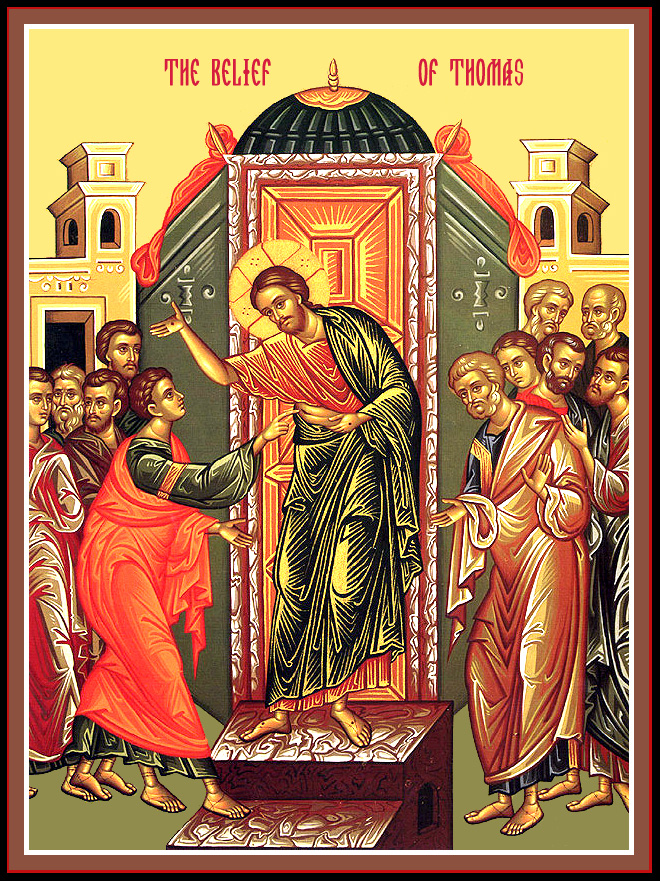
AD: One thing I've always been cheered by is that in the icons of the risen Jesus, His "disability" as it were is transfigured but not hidden or disappeared. In other words, His wounds are still visible, and I think that's tremendously important to illustrating how God works--not by covering up, hiding, pretending something didn't happen, or finding a clumsy "work-around" but instead working through His disabling wounds.

Yes. Our vulnerabilities/impairments bring us in touch with our physical reality, our humanness, and through our humanness we can come to know God.
 
AD: Sum up your hopes for this book, and who should read it.
 
We hope that believers and non-believers find value in the book. Believers who, by deepening their understanding of the Holy Trinity, become more radical in their willingness to see how we are all interdependent and so all, in our own unique manner, reflective of the Divine Life. Unbelievers who come to recognize that to be human is to be interdependent and that the idea of a human being as a solitary, unconnected entity is a myth that needs to be discarded. We hope that rather than seeing others as different, dangerous, or frightening we come to see each other as another face of the Divine Trinity.

Monday, July 14, 2014

Brenda Llewellyn Ihssen on John Moschos and his Meadow

Brenda Llewellyn Ihssen has been doing some very interesting research and writing in the past few years. When I last interviewed her at the very beginning of 2013, it was about her then-new publication, They Who Give from Evil: The Response of the Eastern Church to Moneylending in the Early Christian Era. It is a fascinating and welcome contribution to the field of patristic moral and socio-political theology. Now this year she has come out with a study of an early and important monastic figure: John Moschos' Spiritual Meadow: Authority and Autonomy at the End of the Antique World (Ashgate, 2014), 181pp. I recently had a chance to interview her about this latest publication. Here are her thoughts:

AD: Tell us how you’ve moved from a recent book on money-lending to a book on John Moschos.

BLI: It is hard to believe that they are related, but there is a link! I had always wanted to write on Moschos’ Meadow, and in the Preface of the book I write of how I first encountered the text as a graduate student. For whatever reason, it just kept getting sidetracked as a scholarship project. But one of the tales in the collection always stuck with me, and that is the account of a woman who, when her pagan husband suggests that they loan their money and live off the interest, convinces him to loan fifty coins to the “God of the Christians” because that God will return the money and double it. To make a short story even shorter, the couple ends up profiting at an interest rate of five hundred percent, and this, Moschos writes, persuades the man to immediately become a Christian. It is easy to dismiss this as a fable, but there is so much to learn from this beneficial tale about Byzantine social history: Christians are engaged in lending with interest, a practice forbidden by the Councils; women are financial managers in some households; there is a prevailing belief that those who invest in God will be rewarded, with interest; and, finally, sometimes people are converted when they profit, and this highlights for us the occasional financial advantages of a particular religion and the way in which economic advantage can encourage conversion. So as I was finishing my monograph on moneylending, I decided that it might be a good time to start exploring accounts of “miraculous wealth” in Byzantine Beneficial Tales. The study of those texts led me to discover that I had perhaps more than just an article here, that there were some interesting themes worth exploring in the collection as a whole, even those not addressing money!

AD: Your subtitle speaks of “Authority and Autonomy at the End of the Antique World.” There seems to have been a number of books on authority, power, and social roles in the Christian East of late. What are we learning today about those issues in this time-period?

BLI: Patristic and other scholars of eastern Christianity and antiquity have done a great deal of magnificent work in the last decades of unpacking types of critical expression—one might even suggest subversion—present in the texts of the Christian East. Popularity of theorists like Foucault and Butler has also changed how we read now, and they assist us in understanding how language and ritual contributes to the subjugation of people, or specific groups, genders or castes. I believe that this is particularly important work, too, because I think that what we are finding—or, at least, what I am finding—is a variety of creative approaches to oppressive systems. I am heartened by little expressions, quiet moments of self-sufficiency that are demonstrated in the texts, and most especially when there is next to no comment because that speaks to the importance of the subversive method.

AD: You begin your preface with a winsome story about how you first encountered Moschos’ Spiritual Meadow, and the amusing story of the dead monk. Do we too often miss the humour in the literature of the desert and of the monastery? Are there others writing about the lighter side of monastic pursuits?

Yes, I think that we are so eager to ascribe serious, spiritual meaning to texts within religious history that we fail to see moments of levity. The The Sayings of the Desert Fathers are replete with humorous moments, such as the two monks who attempt but are unable to argue over a brick, or John the Dwarf being shut out of his cell without his cloak. Anyone who has spent time in a monastery knows that there are often subtle—or even not so subtle—glances, phrases or movements that carry with them deep significance, and that significance can be hilarious easily as well as spiritually transcendent. And if, in a monastery, that glance occurs when the observation of something funny is not appropriate, or when noise is not allowed, that can quickly reduce everyone at the table to silent tears of laughter. Such laughter is important, if for no other reason than the slightly naughty feeling one enjoys when one is laughing when one is supposed to be silent or serious. The British anthropologist Mary Douglas writes about precisely this in Implicit Meanings, in which she notes that the essence of a joke is the undermining of something formal by something informal, which affirms that tense and shifting relationship between authority figures and those over whom they claim authority. 

AD: You begin your introduction by admitting how little we know of John Moschos. Give us a quick sketch of what we do know about him with some certainty. 

Well, we do not know where or when he was born and there are scholarly arguments about when he died, but in between we do have a few details of which we can be fairly certain! He was a sixth-century, Chalcedonian Christian, possibly from Damascus. He began his monastic career at the large, well-organized monastery of St. Theodosius. Located about five miles from Bethlehem, this monastery housed hundreds of monks and was known as a site of hospitality for the physically and mentally ill, the elderly and the poor. At some point in his early monastic life he was joined by his companion—and future Patriarch of Jerusalem—Sophronios, who with John practiced two types of ascetic activity: a voluntary, rootless existence in which the monastic figure would be dependent entirely on the hospitality of others, and the collecting and writing of spiritually beneficial tales. For approximately forty years these two wandered through Palestine, Syria, Mount Sinai, Egypt and Rome. The debate about the time and place of John’s death is lively; what is more interesting to me is that after John’s death Sophronios, during a time of great unrest and instability in Palestine, endeavored to return his companion’s body to the monastery where they met; quite a poignant detail, in my opinion.

AD: You speak (pp. 10-11) of some difficulty in classifying Moschos’ writing, which has been seen as a series of “beneficial tales.” How should 21st-century readers approach him, and what should we expect in reading him?

I think that a twenty-first century reader might want to think of Moschos as a sixth-century “John Jacob Niles.” He was an American composer who believed that it was his duty and task to preserve early American music, in addition to writing and recording it. While many people recognize the popular Christmas folk hymn “I Wonder as I Wander,” we might not have had that hymn had Niles not heard strains of that Appalachian tune sung by a rag-tag girl with a beautiful voice. And while many people recognize the important account of St. Mary of Egypt attributed to Sophronios, we might not have had that vita had Moschos’ not heard strains of it and included it in his Meadow. In this way, I think that Moschos collected for spiritual posterity the snippets of beneficial tales of monks who found their way to one monastery or another, just as John Jacob Niles collected for cultural posterity the snippets of the music of British, Irish, Welsh and Scots who—in the nineteenth century—found their way from one country to another.

I make this comparison also because of your question about what to expect; I believe that because Moschos is a collector as much as a composer, and that because he is collecting tales of which only portions existed, that we should expect that much of what we are reading might be lost on us. That is not to say that we cannot derive either pleasure or joy from reading “spiritually beneficial tales,” for the name alone suggests several good things, but the casual reader must know going in that there are layers and elements of social, cultural or political history that are not obvious parts of the tale.


AD: Tell us about the influence of Moschos on monasticism in his own day, and does he remain influential today on monastic life in any way?
 
I am hesitant to suggest that Moschos was influential for monasticism in his day, much less for ours. This is not usually the claim that a scholar wants to make, really, for part of our job is to point out ways in which previously unexamined—or ‘under-examined’—people, ideas, events or artifacts are ‘oh so important.’ Sophronios’ was certainly influential for several reasons, but Moschos was, in many ways, more of a silent partner, even if the Spiritual Meadow is credited to him. As I reflect on the question, I think that the ways in which Moschos ‘matters’ is that aside from the text itself, his activity in the world affirms the variety of ascetic practices of the late sixth and early seventh centuries. Byzantine and patristic scholarship has demonstrated so well the ways in which monastic and ascetic figures interacted with lay persons in the Eastern Empire, a good reminder that not all monks are living behind walls or dying unseen in caves. Moschos also matters because his ascetic practices—walking around and writing—do not fit the traditional model of monastic discipline, and so this is an affirmation of the creativity of eastern monastic practices. Derek Krueger has written some important and insightful articles on this topic, and his work has been helpful for me in understanding the possibilities that exist beyond standard ascetic practices.

AD: Your third and fourth chapters treat medical issues and those of mortality. Are there spiritual or practical insights here that have perhaps been lost but should be recovered?

I was astounded to uncover so many accounts in the Meadow about medical issues, healing, suffering, dying, infertility, and so forth. It should not have surprised me, but it did, how many of the tales dealt with the frailty of our existence and an acute awareness of this. I was writing these two chapters on curing, enduring, death and dying while a friend of mine was dying of cancer. Naturally this had an impact on the way I read and the way I wrote, and that—as much as the texts—has refined my thinking on this theme. My reading of monastic texts, martyr accounts and theoretical approaches to suffering and pain has led me to conclude that an individual in pain forms a relationship with that pain. We cannot just treat pain as something independent of the body and mind of one in pain: we must also treat the relationship with that pain, and, further, we must consider why one forms that relationship to begin with. This manifests itself in monastic texts as “spiritual sickness” or the “ascetic sick role.” This relationship might have at its core a physical reason, or it might be emotional, cultural or spiritual. Either way, illness is used in monastic and ascetic environments for a purpose, and we can assume that this is true of laity as well. We would be wise to think about how illness is used and what it means to people as we seek treatment for their bodies or seek to force treatment upon them. We should also consider if treatment is even what is needed. I suppose if there is a spiritual or practical insight that has been lost but should be recovered, as you ask, it might be to remember that death is also a form of treatment, and illness might also be a cure.

AD: Sum up the book for us and who should read it.
This book is an attempt to uncover some of the social history of late sixth-century life among monastics, desert ascetics, and the laity they encountered and lived among. I make no claims that we can know this period perfectly, but I think that these spiritually beneficial tales can provide us with glimpses of how individuals on the fringes lived and how they might have thought about basic life issues such as Christian discipline, getting, giving or losing money, ill or good health and dying. As for who should read it? I think that it is appropriate for those studying asceticism, Palestinian monasticism, early Byzantine or late Antique social history.

AD: What projects are you at work on now?

It seems that each of these chapters had prompted thinking for me, and each has—in its own way—pushed me towards some future project. The chapter on interaction between laity and ascetics has challenged me to think more about the development of Christian asceticism independent of organized communities; the chapter on death has challenged me to think about how soteriology is understood and defined among monks and the chapter on healthcare has challenged me to think about the use of suffering and pain. As for the chapter on economics? I think I am done thinking about that for some time! My most current work is on the martyr Stephen the Younger. I was invited to think the use of pain imagery in Byzantine martyr vitae at a conference last year with Dr. Vasiliki Limberis and Dr. James Skedros, and this has led me—quite possibly—to my next large project.

Wednesday, August 28, 2013

Why Do We Suffer?

If you've ever been sick yourself for an extended period, or watched others with chronic illness, the question inevitably arises: why is this happening? One may generate all sorts of "medical" ideas as to etiology of the illness, which may go some distance towards providing something of an answer to that question; but the spiritual and theological question remains: what, if anything, is the purpose of this experience? What, if any, meaning can be discerned in my suffering?

A new book from St. Vladimir's Seminary Press treats of these questions: Daniel Hinshaw, Suffering and the Nature of Healing (SVS Press, 2013), 262pp.

About this book we are told:
Author Dr. Daniel Hinshaw explores the central relationship between the Incarnation of the Word of God as Jesus Christ and the nature of healing within the understanding of traditional Christianity. This understanding and teaching regarding sin, suffering, and death have had tremendous impact on the care of the sick. With increased secularization, the unique perspective of traditional Christianity is largely being lost from health care. There is much in modern health care that is very good and could be recognized and blessed as consistent with traditional Christian teaching and practice; there is much that is not.
Related Posts Plugin for WordPress, Blogger...