"Let books be your dining table, / And you shall be full of delights. / Let them be your
mattress,/
And you shall sleep restful nights" (St. Ephraim the Syrian).


Showing posts with label Cross. Show all posts

Friday, October 18, 2019

Eastern Christian Soteriology

I've previously read, and cautiously recommended, at least one of James Peyton's previous books introducing parts and figures of the Christian East to evangelical Christians in North America. He has a new one just released a couple of weeks ago: The Victory of the Cross: Salvation in Eastern Orthodoxy (IVP Academic, 2019), 244pp.

About this book the publisher tells us this:
How can Christians claim that the death of Jesus Christ on the cross is a victory? Yet the doctrine of salvation affirms precisely that: in his death and his resurrection, Christ is victorious over the power of sin and death. The articulation of this tenet of faith has taken different shapes throughout the church's life and history. Eastern Orthodoxy has made its own contributions to the belief in salvation through Christ, but its expressions sometimes sound unfamiliar to Western branches of the church. Here James Payton, a Western Christian with a sympathetic ear for Eastern Orthodoxy, explores the Orthodox doctrine of salvation. Payton helps Christians of all traditions listen to Orthodox brothers and sisters so that together we might rejoice, "Where, O death, is your victory?"
For Eastern Christians a little bit nervous at reading a book by a non-Orthodox, two of the blurbers are well-known Orthodox scholars:
 "James Payton is a theologian skilled in patristic and contemporary thought. He is also a careful and sympathetic reader in all things to do with Eastern Christianity, an area in which he has immersed himself in a deeply insightful manner. In this present study he has surveyed Orthodox thought on salvation in Christ, and the result is an elegant and masterful survey of a major theme at the very heart of the Christian message. His approachable style is unfailingly clear, and this important study will surely be a new standard on the reading lists." (John A. McGuckin, Oxford University faculty of theology)
"Professor Payton belongs to a charmed circle of bridge builders working between the Orthodox and evangelical worlds today. This book brings together a wide range of topics related to the doctrine of salvation in the Eastern Church from creation to consummation and compares it with classical Protestant thought. The author's dependence on original biblical, patristic, liturgical, and monastic texts has produced a masterful synthesis of the Orthodox vision of salvation. Free of artificial contrasts between Eastern and Western theology that are too often made today, this book is carefully nuanced and critically reliable. Readers, both East and West, will find it to be an ideal textbook for theology classes as well as a handy resource for understanding selected topics in Eastern Orthodox doctrine." (Bradley Nassif, professor of biblical and theological studies, North Park University).

Saturday, January 6, 2018

Veneration of the Cross in the Medieval Islamic World

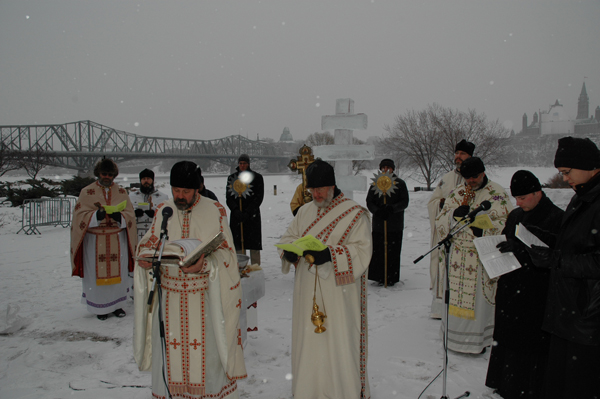
Today, the ancient and wonderful feast of the Theophany (about which see Nick Denysenko's book here), will often see many Eastern Christians carving crosses out of ice near newly blessed bodies of water, and then hurling wooden hand crosses into those waters to make of them an offering back to their Creator. This seems a quintessentially Christian ritual, but how was it handled in the Muslim world, where so many Eastern Christians lived and live?

I count it a success in my courses on Eastern Christian encounters with Islam when my students come to appreciate how often the boundaries were more blurred than they realize, or are often thought to be today. I tell them that they should leave the course recognizing that questions of identity, historically situated, are far messier than many thought, and that borrowings of, or at least attendance at, ritual practices of the "other's" community, happened more than we might realize.

Examples of this include some Muslims venerating Christian relics and praying in Christian shrines, and Christians attending Muslim village festivals, some evidence of which is to be found in such fascinating works as I noted here.

Now a new book further complicates and expounds the picture for us: Cross Veneration in the Medieval Islamic World: Christian Identity and Practice Under Muslim Rule by Charles Tieszen (I.B. Tauris, 2017), 244pp.

About this book the publisher tells us:
One of the most common religious practices among medieval Eastern Christian communities was their devotion to venerating crosses and crucifixes. Yet many of these communities existed in predominantly Islamic contexts, where the practice was subject to much criticism and often resulted in accusations of idolatry. How did Christians respond to these allegations? Why did they advocate the preservation of a practice that was often met with confusion or even contempt? To shed light onto these questions, Charles Tieszen looks at every known apologetic or polemical text written between the eighth and fourteenth centuries to include a relevant discussion. With sources taken from across the Mediterranean basin, Egypt, Syria and Palestine, the result is the first in-depth look at a key theological debate which lay at the heart of these communities' religious identities. By considering the perspectives of both Muslim and Christian authors, Cross Veneration in the Medieval Islamic World also raises important questions concerning cross-cultural debate and exchange, and the development of Christianity and Islam in the medieval period. This is an important book that will shine much needed light onto Christian-Muslim relations, the nature of inter-faith debates and the wider issues facing the communities living across the Middle East during the medieval period

Thursday, September 14, 2017

On the Invention of the True Cross and its Universal Exaltation*

"It is reported (and I, for one, believe it) that some few years ago a lady prominent for her hostility to the Church returned from a visit to Palestine in a state of exultation. 'I got the real low-down at last,' she told her friends. 'The whole story of the crucifixion was made up by a British woman named Ellen. Why, the guide showed me the very place where it happened. Even the priests admit it. They call their chapel "the Invention of the Cross".'"
Attentive readers will recognize this as the uproarious Preface to the hilarious historical novel by Evelyn Waugh, Helena. As a treat--and to avoid tedious editorial work--I decided to re-read it last Saturday knowing that today's feast was coming up. In so doing, I realized I'd forgotten just how much of the novel is given over to ruthless mocking of the pieties and politics of empire.

In Waugh's hands Helena is the key figure who "invents" the true cross and so allows Christians, from her day to our own, to mark September 14th as a festival of the cross's exaltation and triumph. Waugh, a master craftsman of English prose who would have been educated in Latin and who loved using deliberate archaisms, is of course using the verb "invent" here in an older sense of "to come upon, to find"--while also slyly playing on the more common connotation of "creating or producing with the imagination," which of course his novel was itself doing. (The word itself is derived from the Latin verb invenire, to come upon or find.)

Helena was published in 1950 by Waugh as an historical novel and roman à clef devoted to exploring the notion of vocation through the life of the Dowager Empress of Rome, St. Helena, mother of Constantine the great. Her vocation, in Waugh's eyes, was to 'invent' (=find) the true cross that had been thought to be lost forever.

This novel is full of archaic language, buried puns, double entendres, and jokes at the expense of just about everybody--socialist politicians in 1950s Britain, heretical churchmen, tendentious historians (e.g., Gibbon), sclerotic bureaucracies of both church and state, youth "culture" and much else besides, including Eastern Christians. Such mockery holds up strikingly well today--plus ça change....

Waugh's exposure to the Christian East was extremely limited, and he never missed an opportunity to trumpet the supposed superiority of Latin Christianity, rather provincially portraying the East in the worst light possible (cf. his description of Alexandrian liturgies of coronation in Scoop) but I have never held that against him.

Here in this scene Waugh clearly seems to have in his sights the Eastern exaltation of Constantine, whom the Byzantine tradition calls "co-equal to the apostles," a notion Waugh ridicules mercilessly. After a long exile from court, Helena is back in Rome to see her son Constantine, whose court is portrayed as nothing so much as an opéra bouffe, with the emperor himself perhaps the most absurd figure:
From the neck down he was all upholstery. A surcoat of imperial purple, laced with floriations of gold wire and studded with amorphous pearls, hung stiff as a carpet to the carpeted floor. It was sleeveless, and at the arms an undergarment billowed out, peacock-hued, ending in lace ruffles and a pair of coarse, much-jewelled hands. Above the surcoat was a wide collar of gold and enamel, a massive thing suited to the bull-neck; its miniatures told indifferently the stories of the gospel and of Mount Olympus. Above the collar rose the face, pale now as his father's; he was rouged but purely for ornament
But none of this much interests Helena. Instead, she cannot take her eyes off her son's imperial head:
'My dear boy, what on earth have you got on your head?'
The face above the collar assumed an expression of alarm. 'On my head?' He put up a hand as though to dislodge some bird which might inadvertently have perched there. 'Is there anything on my head?'
Two courtiers danced forward. They were shorter than Constantine and made little jumps to see what was amiss.
Without excess of ceremony Constantine inclined to them. 'Well, what is it? Take it off at once, whatever it is.'
The courtiers craned and peered; one raised a finger and touched. They looked at one another. They looked at the Empress Dowager in abject consternation.
"That green wig,' said Helena.
After telling his mother he has a whole collection of such wigs ("some are very pretty") he attempts to rescue his image by barking at his courtiers:
'To work, to work,' said the Thirteenth Apostle.
For those who are interested in more on Waugh: Earlier this year I noted some thoughts on Waugh here, and elaborated on them here at greater length. But for a fun and funny read, a quick read, to celebrate today's feast, read Helena

____________________
* In honour of today's feast, this post is a reprint from 2016. 

Monday, January 2, 2017

The Cross

The well-respected art historian Robin Jensen has a book coming out in April looking at that most central and recognizable of Christian symbols: The Cross: History, Art, and Controversy (Harvard UP, 2017), 280pp.

About this book the publisher tells us:
The cross stirs intense feelings among Christians as well as non-Christians. Robin Jensen takes readers on an intellectual and spiritual journey through the two-thousand-year evolution of the cross as an idea and an artifact, illuminating the controversies—along with the forms of devotion—this central symbol of Christianity inspires.
Jesus’s death on the cross posed a dilemma for Saint Paul and the early Church fathers. Crucifixion was a humiliating form of execution reserved for slaves and criminals. How could their messiah and savior have been subjected to such an ignominious death? Wrestling with this paradox, they reimagined the cross as a triumphant expression of Christ’s sacrificial love and miraculous resurrection. Over time, the symbol’s transformation raised myriad doctrinal questions, particularly about the crucifix—the cross with the figure of Christ—and whether it should emphasize Jesus’s suffering or his glorification. How should Jesus’s body be depicted: alive or dead, naked or dressed? Should it be shown at all?
Jensen’s wide-ranging study focuses on the cross in painting and literature, the quest for the “true cross” in Jerusalem, and the symbol’s role in conflicts from the Crusades to wars of colonial conquest. The Cross also reveals how Jews and Muslims viewed the most sacred of all Christian emblems and explains its role in public life in the West today.
We are also given the table of contents:
Preface
1. Scandalum Crucis: The Curse of the Cross
2. Signum Crucis: The Sign of the Son of Man
3. Inventio Crucis: Discovery, Dispersion, and Commemoration of the Cross
4. Crux Abscondita: The Late-emerging Crucifix
5. Adoratio Crucis: Monumental Gemmed Crosses and Feasts of the Cross
6. Carmina Crucis: The Cross in Poetry, Legend, and Liturgical Drama
7. Crux Patiens: Medieval Devotion to the Dying Christ
8. Crux Invicta: The Cross and Crucifix in the Reformation Period
9. Crux Perdurans: The Cross in the New World, Islam, and the Modern Era
Notes
Further Reading
Credits
Index

Wednesday, September 30, 2015

The Cross Before Constantine

You sometimes hear it put about, especially by those wishing to accuse Christians of being inconsistent on the question of the legitimacy of images, that early Christianity was largely iconoclastic before smuggling in various images and then trying to justify them. But a newly published revisionist history is forcing a re-think of some of these and related allegations: Bruce Longenecker, The Cross Before Constantine: The Early Life of a Christian Symbol (Fortress, 2015), 244pp.

About this book we are told:
This book brings together, for the first time, the relevant material evidence demonstrating Christian use of the cross prior to Constantine. Bruce W. Longenecker upends a longstanding consensus that the cross was not a Christian symbol until Constantine appropriated it to consolidate his power in the fourth century. Longenecker presents a wide variety of artifacts from across the Mediterranean basin that testify to the use of the cross as a visual symbol by some pre-Constantinian Christians. Those artifacts interlock with literary witnesses from the same period to provide a consistent and robust portrait of the cross as a pre-Constantinian symbol of Christian devotion. The material record of the pre-Constantinian period illustrates that Constantine did not invent the cross as a symbol of Christian faith; for an impressive number of Christians before Constantine's reign, the cross served as a visual symbol of commitment to a living deity in a dangerous world.

Wednesday, September 14, 2011

The Universal Exaltation of the Life-Giving Cross

Today's feast, observed in East and West, celebrates the central paradox at the heart of Christianity: an instrument of torture and death is the instrument of everlasting life. As we commemorate this feast, I think especially of the role of the dowager empress Helena, who has been much on my mind after I have been re-reading (in preparation for a public lecture later this month) that absolutely wonderful
eponymous historical novel about her by Evelyn Waugh.

We are fortunate this year to have a new book about the sign of the cross from the hand of the young scholar Andreas Andreopoulos, author of previous works on iconography and art, who, his publisher tells us,
was born in Greece in 1966 and is recognized throughout the world as one of the most eloquent young scholars of Christianity. He earned his Ph.D. in theology at the University of Durham under Fr. Andrew Louth and has taught in Toronto, Montreal, and Philadelphia. He is currently Lecturer of Christian Theology at the University of Wales.

About this book, the publisher tells us:

Millions of Christians around the world use the sign of the Cross—and have done so for centuries—as a gesture of blessing. It is practiced when alone, during worship, before sleep, upon waking, before eating, before travel, and many other times throughout the day. But, what does it mean? Where did it originate? What did the sign of the Cross mean to the first Christians, and how has this simple movement of the hand evolved over the centuries?
The sign of the Cross is literally a tracing of the Cross of Christ onto the body. By so doing, Christians invite the mystery of the Cross into their everyday lives. Now and for the first time, young Greek scholar Andreas Andreopoulos explains the tremendous meaning, mystery, and history of this dramatic gesture shared by Christians worldwide. This readable account will fascinate and inspire all who desire to know more about the inherited spiritual practices of everyday life.

Related Posts Plugin for WordPress, Blogger...