AD: Tell us about your background
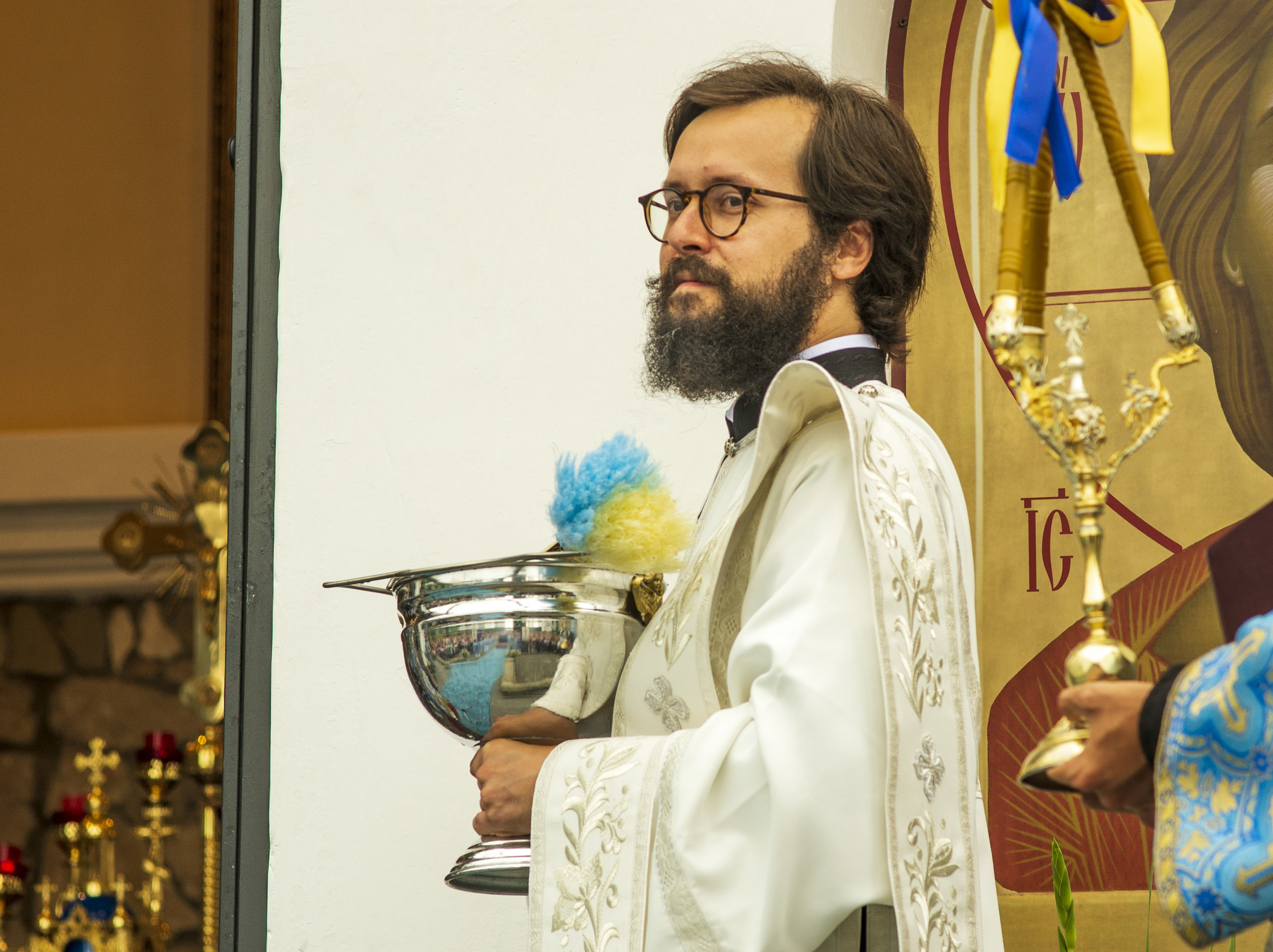
DG: I am a deacon of the Ukrainian Greco-Catholic Church (UGCC), born in Chicago, raised in Toronto and Ottawa by my parents, Fr. Peter and Olenka Galadza. After studies at Trinity College in the University of Toronto and the Sheptytsky Institute, then at St. Paul University in Ottawa, I did a licentiate and a doctorate in Rome with Stefano Parenti, my doctoral supervisor, at the Oriental Institute, with a year as a junior fellow in Byzantine Studies at Dumbarton Oaks in 2011–2012.
In Rome, I paid close attention to how the coffee was made at my college, the Russicum, assuming that as a layman with a doctoral in Byzantine liturgy I might end up working at Starbucks--if I were lucky. But God had a different plan and I ended up as an assistant professor in the Catholic Theology Faculty at the University of Vienna in 2013, with Prof. Hans-Jürgen Feulner as my boss and Sr. Vassa Larin as a colleague.
Vienna is known as a “Byzantinists paradise” (well, perhaps not in the guidebooks) and I got to know the scholars in Byzantine Studies at the University of Vienna and the Austrian Academy of Sciences. For the last few years, Prof. Claudia Rapp had led the team of the “Vienna Euchologia Project,” of which I am honoured to be a member (officially as an “international research partner” since I no longer live in Vienna).
Since 2018, I have been in Kyiv as a deacon of the Kyiv Archeparchy, a lecturer at the seminary, and a member of the liturgical commission, at the same time trying to keep up with scholarly work in Europe and North America.
During the fall semester 2018 I was a visiting lecturer at the Sheptytsky Institute, now at University of St. Michael’s College in the University of Toronto, and from 2019 I am a fellow of the Centre for Advanced Studies at the University of Regensburg, splitting up semesters between Bavaria and Ukraine.
AD: What led you to write Liturgy and Byzantinization in Jerusalem?
In May 2008, I had finished my Bacherlor of Theology degree and had applied to study at the Pontifical Oriental Institute (PIO) in Rome. I wasn’t really sure about how things worked at the universities in Rome, so I made a trip to investigate and made an appointment with Fr. Robert Taft, SJ, whom I had known through my parents since childhood. He immediately sat me down and gave me a list of four different doctoral thesis topics. One of them was about the Basilians and the decline of the UGCC’s liturgical tradition, which is a fascinating topic, but I didn’t want to start my academic work immediately making enemies, so I chose the topic on the list about which I knew the least: the “liturgical Byzantinization” of the Orthodox Patriarchate of Jerusalem. That ended up being my thesis topic for the licentiate and doctorate.
Upon arrival in Rome in September 2008, I already knew my thesis topic and was fortunate enough to live in a college next door to the PIO library, so I was able to take advantage of the amazing resources there and read all about a whole other, fascinating world of Eastern Christianity I knew of only generally through my studies in Canada. The thesis then turned into the book, which was published in 2018 by Oxford University Press and came out as paperback in 2019.
AD: Among Eastern Catholics, the notion of “Latinization” is fairly common, and since at least Vatican II, almost always reprobated. Is “Byzantinization” a similar process, and if so, of what and of whom? Does it carry the same negative connotations today as “Latinization” does for many?
In a way, the two phenomena are similar. Byzantinization, like Latinization, is, generally speaking, the adoption of foreign customs and practices, potentially including also theology, culture, and even language, to the detriment of the local, “authentic” tradition. More specifically, the liturgical Byzantinization of Jerusalem involved the supplanting of liturgical tradition of Jerusalem by the rite of Constantinople. The process was complex, due to the natural evolution of the Byzantine liturgical tradition, which was a synthesis of elements from Constantinople, Jerusalem, and elsewhere.
Like Latinization, Byzantinization was never officially imposed on the other Eastern Patriarchates of Alexandria, Antioch, and Jerusalem, although due to the cultural climate of the post-Iconoclast Eastern Mediterranean, the factions within these Eastern Patriarchates that were faithful to the decisions of the Council of Chalcedon (451) willingly adopted most of the synthesized Byzantine practices. This was partly due to a desire to show unity with Constantinople and partly due to the declining material situation of each of the Eastern Patriarchates as a result of invasions and non-Byzantine rule from the seventh century onward. In such a context, the prestige of Constantinople was felt even more strongly among the Chalcedonians outside the constantly shrinking borders of the Byzantine Empire.
Latinization for the Eastern Catholics is similar. It was rarely imposed officially by the Holy See and usually adopted willingly by Eastern Catholics because of Rome’s prestige as a center of authority and education. (A notable exception might be the 1720 Synod of Zamosc, which officially imposed numerous Latin practices based on Tridentine scholastic theology, in an attempt to bring order to the chaos of the Uniate Church in the century following the Union of Brest. Because Rome has since the Second Vatican Council officially encouraged the Eastern Catholic Churches to return to their ancestral traditions, it will be interesting to see how the UGCC will commemorate the 300th anniversary of the Synod of Zamosc in 2020.)
Around the time of the Second Vatican Council, the Melkite Greco-Catholic Church was also eager to rediscover its ancestral traditions and a group of scholars and clergy, known as the Cairo Circle, began discussing ideas about the restoration of an authentic Melkite liturgy, since for them Byzantinization was their version of Latinization. However, as far as I am aware, not much came of it, because the authentic practices from Jerusalem had not yet been sufficiently researched and there was no continuity with the liturgical tradition of Jerusalem because it had been completely lost. Thus, it was almost impossible to restore and implement in a practical manner.
Although they are similar as phenomena, the histories of Latinization and Byzantinization are, however, quite different, of course, but so are the histories of the Byzantinization of each of the three Eastern Patriarchates, due to their specific linguistic and political contexts.
AD: In an era when much of the academy has been drawing critical attention to the phenomena of colonialism and imperialism, you seem to suggest that the Byzantinization of Jerusalem does not constitute a straightforward case of imperial subjugation and transformation at the hands of Constantinople—that, as your introduction nicely puts it, “the periphery of one centre can become the centre of yet another periphery.” Tell us a bit more about these dynamics.
The phenomenon in question here is certainly not straightforward. Liturgical Byzantinization in Jerusalem—which is not the same as political, literary, cultural, etc. forms of Byzantinization—began only after Jerusalem was no longer under Byzantine imperial and political control. The same is the case for Alexandria, although Antioch’s history is somewhat different, due to the Byzantine reconquest of Syria in the tenth century.
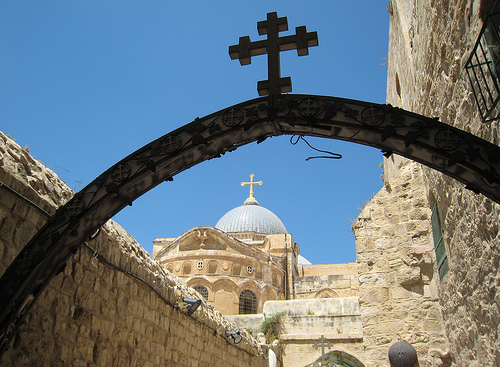
Previous theories about Byzantinization in Jerusalem suggested it was imposed and happened suddenly. A common narrative used to go like this: after the destruction of the Holy Sepulcher, also known as the Anastasis Church, in 1009, the rite of Jerusalem was lost and its patriarchs were exiled to Constantinople in the eleventh and twelfth centuries, where they learned the Byzantine Rite and brought it back with them to Jerusalem along with ready-made books.
However, the sources suggest otherwise, painting a picture of a gradual change to the liturgical tradition that was carried out locally, often times by scribes copying liturgical books and attempting to reconcile differences in liturgical practice.
AD: Part of your argument seems to be that Byzantinization was less about imperial imposition of liturgical trends and traditions, and more about local alterations, based partly on the changing geopolitical and topographical realities of the city. Give us, if you would, an example or two of these changes.
If I haven’t mentioned it already, perhaps this is the time to do so: there are no historical or legal documents from Constantinople, Jerusalem, or elsewhere that explicitly prescribe how liturgical Byzantinization was to be carried out, such as a conciliar document or the decree of a patriarch or emperor, nor do any sources, such as chronicles or other historical accounts, describe exactly how it happened.
The main sources for information are liturgical manuscripts, the books used for prayer during the liturgy, dating from the eighth century onwards. The most important collection for the study of the Byzantinization of Jerusalem is the library of the Monastery of St. Catherine on Mount Sinai, which houses hundreds of manuscripts in a variety of ancient languages and is also the place some of these manuscripts were copied and used.
At Mount Sinai, the Georgian collection of manuscripts is of particular importance, not just because of the local Georgian monastic community there in the Byzantine period, but also because of the migration of the Georgian monks of the Lavra of St. Sabas in Palestine near Jerusalem to Sinai in the tenth century. Among them was Iovane Zosime, a Georgian monk and scribe who copied numerous and diverse manuscripts, many of them liturgical. What is significant about Iovane Zosime is that he is aware of his sources and gives information about them. What is more, he often dates and signs his work, which isn’t always the case with scribes.
The calendar he copied in codex Sinai Georgian Old Collection 34—one needs to distinguish between the old and new collection, because a whole trove of manuscripts was rediscovered at the monastery in 1975—presents a liturgical calendar for the whole year based on several sources, including ones from Constantinople, Jerusalem, and the Lavra of St. Sabas. Thus, Iovane Zosime was, in a way, one of the first scholars of “comparative liturgy” and his work confirms that already in the tenth century, monks and scribes at the Sabas Lavra and Mount Sinai knew of multiple liturgical traditions, these traditions were in contact with one another in Jerusalem, and they were also changing. Specifically in the calendar, the feast of St. James the Brother of the Lord is mentioned on multiple days—both on the days his feast was celebrated in Jerusalem (December 1, December 26, May 25) and in Constantinople (October 23)—showing the gradual nature of the change.
Two centuries later, we know of the work of another scribe, Basil the Hagiopolite, a reader and scribe at the Church of the Anastasis in Jerusalem, from an important manuscript copied in 1122 and known in liturgical scholarship as the “Typikon of the Anastasis.” The manuscript contains all the hymns, readings, and prayers necessary for Holy Week and Easter at the Anastasis, mentioning local practices native to Jerusalem, like the Liturgy of St. James, but also a loss of other local elements and revealing an influx of general Byzantine practices. Basil the Hagiopolite himself shows an awareness of two different traditions and tries to make sense of them in his manuscript. Most notably, the processions on Palm Sunday that Basil describes have been lost and the gospel readings for Holy Week have changed.
AD: You note that much of the Byzantinization comes after the three conquests—the Persian, the Arab, and the Crusaders, in a period leading up to the thirteenth century. A contemporary reader might wonder if there is any kind of causal link between events here? In other words, is it conceivable to think that Jerusalem Christians, feeling under siege and perhaps worried about loss of their “identity” (as we might call it today), would seek to buttress and solidify that identity by conforming their external appearances and practices to be more like other Christians, including those in the still unconquered imperial capital?
Most certainly! I would argue that there is very little change in theological content when examining Byzantinization and that it has much more to do with religious identity and affiliation. Once the Greek-praying Christians become the minority in Jerusalem and are no longer under Byzantine rule, they look to their coreligionists for moral—and sometimes financial—support. Although the Chalcedonian Christians of Jerusalem were unique because they had no homegrown non-Chalcedonian Church in Jerusalem and Palestine, unlike the case in with numerous non-Chalcedonians in Syria and Egypt, nevertheless they seemed eager to maintain strong links with Constantinople. It appears that the strong Greek monastic presence in the Holy Land also played a role in buttressing the Greek, Chalcedonian identity in Jerusalem.
AD: For those unfamiliar with Jerusalem’s liturgical calendar (ch.4), and lectionary (ch.5), what are some of the most notable and distinctive features in your eyes?
In a nutshell, here are some of the most noteworthy elements:
The calendar, from the sixth century onward at least, begins with Christmas rather than September 1, suggesting a theological emphasis on the Incarnation that is understood in the liturgical year as well. The day on which a saint is commemorated depends on the local tradition of Jerusalem. If we take the example of St. James again, December 26 was an ancient day of commemorating James in Jerusalem connected, at least according to Anton Baumstark, with the Jewish celebration of the dedication of the Temple. The October 23 commemoration depended on the transfer of the relics of James to Constantinople. The calendar of Jerusalem also had multiple days of certain saints and sometimes celebrated groups of saints together, often dependent upon the dedication of a church in Jerusalem where their relics were deposed. Octaves, or eight day celebrations of major feasts, were also a significant feature and the most important ones involved stational liturgy during the eight days at some of the more important churches of Jerusalem.
The lectionary is intimately related to the calendar and in some cases lectionary manuscripts give us the most information about the calendar. Unlike the Byzantine lectionary—where the order of the Gospels from Easter to Lent is John, Matthew, Luke, and Mark—the Jerusalem lectionary reads them in the following order: John, Matthew, Mark, and Luke. Even when the same Gospel is read during the same liturgical season, the pericopes (or individual excerpts) for a given commemoration are not necessarily the same. For example, the readings from the Gospel of John on the Sundays after Easter have completely different episodes when comparing the Jerusalem and Constantinople lectionaries.
Perhaps the most important and interesting aspect of the Jerusalem lectionary for Orthodox liturgy is that it has an Old Testament reading at the Divine Liturgy. The ancient Armenian and Georgian translations of the Jerusalem lectionary have quite an extensive series of Old Testament readings, but Greek manuscripts with Old Testament readings for the Divine Liturgy are quite rare.
AD: If, in a sense, Jerusalem is the “mother-city” for all Christians, do we find elements of her lectionary and calendar anywhere today in other traditions—a kind of “Jerusalemization” of, say, Coptic or Syriac or Latin or Byzantine traditions? Is her tradition of “stational” liturgies borrowed or copied by other traditions?
The Liturgy of St. James—the local Divine Liturgy of Jerusalem—does in fact refer to Jerusalem, or rather to Sion, as the “Mother of all the Church.” With regard to liturgical practice, Jerusalem certainly did function as a centre of influence over all of Christendom, in effect the “Jerusalemization” of many other Christian traditions. This was particularly felt in Constantinople, where there really wasn’t a sacred topography and much of its liturgy was imported from elsewhere. In Constantinople, one can see strong the influence of Jerusalem during Holy Week, with its structure based on biblical narratives imported from Jerusalem. Constantinople also adopted Jerusalem’s Bright Week Gospel readings, but with a twist: instead of reading them on every day of Bright Week at Divine Liturgy, as was done in Jerusalem, Constantinople took them and turned them into the eleven resurrectional Gospels read at Orthros, or Matins, every Sunday morning.
With regard to “stational” liturgies, processions led by the bishop that went through the city with hymns and stopped at various points, these were imitated in Constantinople, Rome, and elsewhere.
But these aren’t discoveries that are new to my book or research. Many of these insights into “Jerusalemization” and “stational” liturgies come from the works of Janeras, Taft, Baldovin, and several Russian scholars writing before the October Revolution. My goal in the book was to present a summary of this scholarship, often times scattered in diverse studies in various languages, and to bring it into dialogue with information found in additional manuscripts, many of them among the “new finds” of Sinai from 1975 in order to examine the interaction of the liturgical traditions of Jerusalem and Constantinople, and the question of Byzantinization in Jerusalem.
AD: Much of your work proceeds comparatively, and by drawing on the methods of Baumstark and Taft. But you also note the limitations of this method. Tell us about some of those limitations and then tell us more generally about your methods of research for this book, including especially looking at liturgy “from the bottom up.” Why is that important and what are its benefits?
In this study, I did indeed rely on comparative methods, primarily due to the comparative nature of examining the liturgies of Jerusalem and Constantinople and seeing the influence of one on the other and vice versa. From a purely technical point of view, the comparative method, with its emphasis on a textual and philological approach that respects the importance of the historical context, fit best to begin this investigation. Because the topic of Byzantinization is precisely a question of top-down, “official” liturgy, liturgical books are the main source for study.
Comparative liturgy is often criticized because it can at times overemphasize liturgical structures over the meaning of texts and does not say much about the experience of the people during the liturgical services. The problem of the authority, use, and reliability of texts is also one that must be grappled with, especially if adopting the “splitter” approach (in the dichotomy of Paul Bradshaw).
The “from the bottom up” approach is something that I am attempting to read about more and integrate into my work, but in other areas, for example in work dealing with the Vienna Euchologia Project.
AD: I recall meeting you for lunch in Washington DC some years back, when you were a fellow at Dumbarton Oaks, and you casually told me, as we stood waiting for the traffic light to change, that you were studying Georgian. Why are Georgian sources important to your study?
I don’t think it could have been casually, Adam, since ancient Georgian is far from “casual”: they say you can learn the Georgian noun in a day and spent the rest of your life learning the Georgian verb. Studying Georgian in Rome was quite the experience!
The importance of Georgian sources in Jerusalem is primarily due to the presence of Georgian pilgrims and monks who stayed in Jerusalem, made translations and copies of its liturgical manuscripts, and then either used them in Jerusalem and its environs in their own Georgian-praying communities or brought them back to Georgia. Because many of the Greek originals were lost, Georgian manuscripts are sometimes the only surviving witnesses to this ancient and lost liturgical tradition.
AD: You note that in some ways even today the periphery-centre tension still holds, but with different focus today: must the Jerusalem patriarchate remain, as it were, an outpost of the Greek Orthodox Church, resisting any attempts at change in, say, a more “Arabized” direction? But you also note that in the early 20th century there was less defensiveness and more openness to studying the authentic tradition and perhaps removing non-native elements. How far did such a movement get, and is there anything comparable today?
The current state of the affairs in the Church of Jerusalem is not an easy one and balancing internal and external ecclesiastical relations are in addition to some of the difficulties of daily life in Israel and Palestine today. Christians find it difficult to stay and without a local population, the Church depends on pilgrims and non-Palestinian Christians to keep life going.
Some of the activity of the Greek Orthodox Patriarchate of Jerusalem, such as the retention of the Julian calendar, seems to depend on the status quo agreement from previous centuries that codified liturgical life at the Church of the Holy Sepulcher. Today, one can observe frequent use of Arabic, and sometimes other languages, at the Divine Liturgy, for example the Gospel reading. However, this multilingualism in the liturgy is nothing new, since Egeria describes it in the fourth century and Basil the Hagiopolite mentions it in the twelfth.
Any tendency to differentiate the Jerusalem Patriarchate too much from other Orthodox would isolate it from the rest of the Church—which is precisely one of the reasons why Byzantinization occurred, to strengthen ties and establish a common identity with Christians beyond Jerusalem.
Nevertheless, the late nineteenth and early twentieth century did witness a great interest in the local liturgical tradition of Jerusalem from scholars who were also ecclesiastical authorities. This meant the Liturgy of St. James was revived, although not always with the right motives. Because the manuscripts of the Liturgy of St. James are often missing rubrics and the tradition ceased to be celebrated, Archbishop Dionysios Latas of Zakynthos supplied his own rubrics based on his studies of biblical archaeology. His Greek edition was then adapted to Church Slavonic by Ivan Gardner (at that time Hieromonk Philip). The resulting liturgy that is often celebrated today is effectively a nineteenth-century scholarly invention. Prof. Heinzgerd Brakmann has written several articles about this.
It is curious that in some circles where any change or reform in the Liturgies of St. John Chrysostom or St. Basil the Great would be frowned upon, the nineteenth-century revived version of the Liturgy of St. James is welcomed and celebrated frequently. Prof. Vitaly Permiakov, who has studied these questions for some years, has recently published a Church Slavonic-English edition where he attempts to address some of these problems.
AD: Sum up your hopes for the book, and who in particular would benefit from reading it?
My main hope is that it will inspire other scholars to look more closely at the question of Byzantinization, whether in Jerusalem or one of the other Eastern Patriarchates, and provide more definitive answers than I have. The history of the Byzantinization of Antioch and Alexandria remains to be written. I believe Antioch holds the answers to many of the remaining questions about Byzantinization, precisely because it was reconquered by the Byzantines in the tenth century and because it is geographically between Constantinople and Jerusalem.
I also hope that Syriac scholars will find the book to be a useful reference in their examination of the abundance of Syriac Melkite manuscripts, most of them in the library of the Monastery of St. Catherine on Sinai and lamentably ignored in Byzantine liturgical studies. The importance of Georgian for Byzantine and theological studies is now being appreciated in Western academia (I should mention here the work of Stephen Shoemaker and his English translation of the Georgian Iadgari hymnal from Jerusalem, which I was not able to mention in my book because they appeared at around the same time), but I hope that better resources for studying ancient Georgian will be made available in the West.
Having expressed all these wishes, I do not want to give the impression that the book is intended only for specialists. (Certainly, certain sections will be too technical for some readers. For others, the book might be effective against insomnia.) I hope that anyone familiar with the Byzantine liturgical tradition, particularly its faithful practitioners, might find something of interest in the book—whether in the general introduction to Jerusalem’s liturgy before its Byzantinization or the discussion of the Liturgy of St. James, the calendar, or the lectionary.
AD: Having finished the book, what projects are you at work on now?
Perhaps too many to keep track of myself... At the moment, I am a fellow at the Centre for Advanced Studies of the University of Regensburg, where there are quite a few conferences and workshops on liturgical topics, organized by Prof. Harald Buchinger, an expert on the early liturgy of Jerusalem. My own work at the Centre involves a translation and commentary of the twelfth-century Greek manuscript from Jerusalem I mentioned earlier: Hagios Stavros gr. 43, known as the “Typikon of the Anastasis,” a hymnal for Holy Week and Easter whose services, readings, and hymns would be recognizable to any Byzantine Rite Christian, whether Orthodox or Greco-Catholic, who has attended their local parish during that most solemn time of the year. My goal with this project is to investigate the question of liturgical theology through the prism of hymnography in order to understand how the hymns serve as scriptural exegesis and also liturgical hermeneutic.
Last year, Prof. Jos Verheyden and I organized a conference on liturgy and literature in the various multilingual communities of the Lavra of St. Sabas at Catholic University of Leuven, so I am now slowly working on publishing the proceedings, which I hope will appear in the not too distant future.
Apart from those main projects, I am also interested in early printed Church Slavonic liturgical books from Ukraine. Some are housed in various libraries in Kyiv, Lviv, and elsewhere (while some can still be purchased online for very reasonable prices!). In the coming years I hope to more beyond Jerusalem and the first Christian millennium and delve deeper into the Slavonic and Kyivan liturgical tradition. Perhaps after Byzantinization, I’ll move on to Latinization. We’ll see.


 (Melisende, 2010), 368pp.