"Let books be your dining table, / And you shall be full of delights. / Let them be your
mattress,/
And you shall sleep restful nights" (St. Ephraim the Syrian).


Showing posts with label Martyrs. Show all posts

Wednesday, May 4, 2022

Narrating Martyrdom

The hardback having been out for nearly two years, a more affordable paperback version is coming later this year of Anne P. Alwis, Narrating Martyrdom: Rewriting Late-Antique Virgin Martyrs in Byzantium (Liverpool University Press, Sept. 2022), 224pp. 

Part of that excellent series, Translated Texts for Byzantinists, this book, the publisher tells us, 

reconceives the rewriting of Byzantine hagiography between the eighth and fourteenth centuries as a skilful initiative in communication and creative freedom, and as a form of authorship. Three men - Makarios (late C13th-C14th), a monk; Constantine Akropolites (d.c.1324), a statesman; and an Anonymous educated wordsmith (c. C9th - each opted to rewrite the martyrdom of a female virgin saint who suffered and died centuries earlier. Their adaptations, respectively, were of St. Ia of Persia (modern-day Iran), St. Horaiozele of Constantinople, and St. Tatiana of Rome. Ia is described as a victim of the persecutions of the Persian Shahanshah, Shapur II (309-79 C.E), Horaiozele was allegedly a disciple of St Andrew and killed anachronistically under the emperor Decius (249-51 C.E), and Tatiana, we are told, was a deaconess, martyred during the reign of emperor Alexander Severus (222-35 C.E). Makarios, Akropolites, and the Anonymous knowingly tailored their compositions to influence an audience and to foster their individual interests. The implications arising from these studies are far-reaching: this monograph considers the agency of the hagiographer, the instrumental use of the authorial persona and its impact on the audience, and hagiography as a layered discourse. The book also provides the first translations and commentaries of the martyrdoms of these virgin martyrs.

Monday, April 5, 2021

Virgin Martyrs in Late Antique Byzantium

The ways in which we narrate the past almost always say as much about us in the present--and sometimes the future we wish to have--as they purport to do about the past. That seems no less true even in martyrology and hagiography as a new book once more reminds us:Narrating Martyrdom: Rewriting Late-Antique Virgin Martyrs in Byzantium by Anne P. Alwis (Liverpool University Press, 2020), 240pp. 

About this book the publisher tells us this:

This book reconceives the rewriting of Byzantine hagiography between the eighth and fourteenth centuries as a skilful initiative in communication and creative freedom, and as a form of authorship. Three men - Makarios (late C13th-C14th), a monk; Constantine Akropolites (d.c.1324), a statesman; and an Anonymous educated wordsmith (c. C9th - each opted to rewrite the martyrdom of a female virgin saint who suffered and died centuries earlier. Their adaptations, respectively, were of St. Ia of Persia (modern-day Iran), St. Horaiozele of Constantinople, and St. Tatiana of Rome. Ia is described as a victim of the persecutions of the Persian Shahanshah, Shapur II (309-79 C.E), Horaiozele was allegedly a disciple of St Andrew and killed anachronistically under the emperor Decius (249-51 C.E), and Tatiana, we are told, was a deaconess, martyred during the reign of emperor Alexander Severus (222-35 C.E). Makarios, Akropolites, and the Anonymous knowingly tailored their compositions to influence an audience and to foster their individual interests. The implications arising from these studies are far-reaching: this monograph considers the agency of the hagiographer, the instrumental use of the authorial persona and its impact on the audience, and hagiography as a layered discourse. The book also provides the first translations and commentaries of the martyrdoms of these virgin martyrs.

Monday, January 20, 2020

Christian Martyrs Under Islam

First published in the summer of 2018, a new paperback version is to be released in just a few short weeks. Unlike some apologetic and hagiographic texts, which would have us believe this history is unidirectional and entirely bloody and violent for Christians, this author recognizes the complexities: Christian Sahner, Christian Martyrs Under Islam: Religious Violence and the Making of the Muslim World (Princeton University Press, 2020), 360pp.

About this book the publisher tells us this:
How did the medieval Middle East transform from a majority-Christian world to a majority-Muslim world, and what role did violence play in this process? Christian Martyrs under Islam explains how Christians across the early Islamic caliphate slowly converted to the faith of the Arab conquerors and how small groups of individuals rejected this faith through dramatic acts of resistance, including apostasy and blasphemy.
Using previously untapped sources in a range of Middle Eastern languages, Christian Sahner introduces an unknown group of martyrs who were executed at the hands of Muslim officials between the seventh and ninth centuries CE. Found in places as diverse as Syria, Spain, Egypt, and Armenia, they include an alleged descendant of Muhammad who converted to Christianity, high-ranking Christian secretaries of the Muslim state who viciously insulted the Prophet, and the children of mixed marriages between Muslims and Christians. Sahner argues that Christians never experienced systematic persecution under the early caliphs, and indeed, they remained the largest portion of the population in the greater Middle East for centuries after the Arab conquest. Still, episodes of ferocious violence contributed to the spread of Islam within Christian societies, and memories of this bloodshed played a key role in shaping Christian identity in the new Islamic empire.
Christian Martyrs under Islam examines how violence against Christians ended the age of porous religious boundaries and laid the foundations for more antagonistic Muslim-Christian relations in the centuries to come.

Thursday, March 21, 2019

Christian Martyrs Under Islam

There is still much to be learned about early Muslim-Christian encounters in the first generations of Islam and its gradual conquest of the Middle East. In the wrong hands, this history can be portrayed tendentiously, as either relentless bloodshed and suffering or impeccable peace and amity. A book released last summer tries to recognize the complexity of decisions facing Christians living under Islam: Christian Martyrs under Islam: Religious Violence and the Making of the Muslim World by Christian C. Sahner (Princeton University Press, 2018), 360pp.

About this book the publisher tells us the following:
How did the medieval Middle East transform from a majority-Christian world to a majority-Muslim world, and what role did violence play in this process? Christian Martyrs under Islam explains how Christians across the early Islamic caliphate slowly converted to the faith of the Arab conquerors and how small groups of individuals rejected this faith through dramatic acts of resistance, including apostasy and blasphemy.
Using previously untapped sources in a range of Middle Eastern languages, Christian Sahner introduces an unknown group of martyrs who were executed at the hands of Muslim officials between the seventh and ninth centuries CE. Found in places as diverse as Syria, Spain, Egypt, and Armenia, they include an alleged descendant of Muhammad who converted to Christianity, high-ranking Christian secretaries of the Muslim state who viciously insulted the Prophet, and the children of mixed marriages between Muslims and Christians. Sahner argues that Christians never experienced systematic persecution under the early caliphs, and indeed, they remained the largest portion of the population in the greater Middle East for centuries after the Arab conquest. Still, episodes of ferocious violence contributed to the spread of Islam within Christian societies, and memories of this bloodshed played a key role in shaping Christian identity in the new Islamic empire.
Christian Martyrs under Islam examines how violence against Christians ended the age of porous religious boundaries and laid the foundations for more antagonistic Muslim-Christian relations in the centuries to come.

Wednesday, January 23, 2019

Coptic Martyrs

I reviewed here a recent book on the theology of martyrdom and some of its ecclesiological and ecumenical questions. Now another book, set for release next month, treats the same Coptic martyrs in Egypt, but in a very different way: Moses Mosebach, The 21: A Journey into the Land of Coptic Martyrs (Plough Publishing, 2019), 272pp.

About this book the publisher tells us this:
Behind a gruesome ISIS beheading video lies the untold story of the men in orange and the faith community that formed these unlikely modern-day saints and heroes. In a carefully choreographed propaganda video released in February 2015, ISIS militants behead twenty-one orange-clad Christian men on a Libyan beach.
In the West, daily reports of new atrocities may have displaced the memory of this particularly vile event. But not in the world from which the murdered came. All but one were young Coptic Christian migrant workers from Egypt. Acclaimed literary writer Martin Mosebach traveled to the Egyptian village of El-Aour to meet their families and better understand the faith and culture that shaped such conviction.
He finds himself welcomed into simple concrete homes through which swallows dart. Portraits of Jesus and Mary hang on the walls along with roughhewn shrines to now-famous loved ones. Mosebach is amazed time and again as, surrounded by children and goats, the bereaved replay the cruel propaganda video on an iPad. There is never any talk of revenge, but only the pride of having a martyr in the family, a saint in heaven. “The 21” appear on icons crowned like kings, celebrated even as their community grieves. A skeptical Westerner, Mosebach finds himself a stranger in this world in which everything is the reflection or fulfillment of biblical events, and facing persecution with courage is part of daily life.
In twenty-one symbolic chapters, each preceded by a picture, Mosebach offers a travelogue of his encounter with a foreign culture and a church that has preserved the faith and liturgy of early Christianity – the “Church of the Martyrs.” As a religious minority in Muslim Egypt, the Copts find themselves caught in a clash of civilizations. This book, then, is also an account of the spiritual life of an Arab country stretched between extremism and pluralism, between a rich biblical past and the shopping centers of New Cairo.

Monday, January 14, 2019

The Beginning of Relics

Christians from the very beginning, being celebrants of an incarnate God, treasured (sometimes controversially) material embodiments of God's salvific activity in the world, including relics of their beloved dead. As one later commentator, St John Damascene, would famously put it,
I do not worship matter. I worship the Creator of matter who became matter for my sake, who willed to take His abode in matter, who worked out my salvation through matter. Never will I cease honoring the matter which wrought my salvation! I honor it, but not as God…. Because of this I salute all remaining matter with reverence, because God has filled it with his grace and power. Through it my salvation has come to me.
How did the cults around various sets of relics begin? Of what practices did they consist? Were they everywhere practiced? These and other questions will find some answer in a forthcoming book, The Beginnings of the Cult of Relics by Robert Wiśniewski (Oxford University Press, 2019), 272pp.

About this book the publisher tells us this:
Christians have often admired and venerated martyrs who died for their faith, but for long time thought that the bodies of martyrs should remain undisturbed in their graves. Initially, Christian attitude toward the bones of the dead, saint or not, was that of respectful distance. The Beginnings of the Cult of Relics examines how this changed in the mid-fourth century. Robert Wiśniewski investigates how Christians began to believe in power of relics, first, over demons, then over physical diseases and enemies. He considers how they sought to reveal hidden knowledge at the tombs of saints and why they buried the death close to them. An essential element of this new belief was a string conviction that the power of relics was transferred in a physical way and so the following chapters study relics as material objects. Wiśniewski analyses what the contact with relics looked like and how close it was. Did people touch, kiss, or look at the very bones, or just at reliquaries which contained them? When did the custom of dividing relics appear? Finally, the book the book deals with discussions and polemics concerning relics and tries to find out how strong was the opposition which this new phenomenon had to face, both within and outside Christianity on its way relics to become an essential element of the medieval religiosity.

Monday, July 30, 2018

The Martyrs of Iraq Ancient and Modern

It's been out for just over a year now, but I only just stumbled upon a book that reminds us, once again, of the horrific plight that has befallen so many Christians in Iraq in the last 15 years since the disastrous neoimperial war launched by the United States (the second of its kind in the region in just over a decade): Doves in Crimson Fields: Iraqi Christian Martyrs by Robert Ewan (Gracewing, 2017), 232pp.

About this book the publisher tells us the following:
Christianity has been firmly established in Iraq for nearly two thousand years, but from the fourth century to the present day Christians in Iraq have faced periods of terrible persecution. This book brings together their stories, from the witness of martyrs sixteen hundred years ago, across the centuries, to our own time. In the twenty-first century Iraqi Christians have been confronted by relentless terrorist attack, by genocide and exile from their homeland. Alongside accounts of martyrdom and massacre under the Persian and Ottoman Empires and, in the twentieth century, the newly independent Kingdom of Iraq, Robert Ewan records the heart-rending stories of just some of the myriad of contemporary martyrs: Sister Cecilia Moshi Hanna, Archbishop Paulos Faraj Rahho, Father Ragheed Aziz Ganni and of the massacre at Sayidat al-Najat Church in Baghdad.

Monday, March 20, 2017

Did Early Martyrs Feel or Deny Their Pain?

The University of California Press, which has a number of series publishing works about early and Eastern Christian history, inter alia, has just sent me an intriguing new study by L.S. Cobb, Divine Deliverance: Pain and Painlessness in Early Christian Martyr Texts (UC Press, 2016), 264pp.

Amidst much chatter recently about the dim future of the Church in the West, and the various forms of "persecution" that are coming, this book raises an important question about how to respond to any form of "persecution," violent and otherwise, and where power ultimately lies.

The key question, in the words of the publisher's blurb, is this:
Does martyrdom hurt? The obvious answer to this question is “yes.” L. Stephanie Cobb, asserts, however, that early Christian martyr texts respond to this question with an emphatic “no!” Divine Deliverance examines the original martyr texts of the second through fifth centuries, concluding that these narratives in fact seek to demonstrate the Christian martyrs’ imperviousness to pain. For these martyrs, God was present with, and within, the martyrs, delivering them from pain. These martyrs’ claims not to feel pain define and redefine Christianity in the ancient world: whereas Christians did not deny the reality of their subjection to state violence, they argued that they were not ultimately vulnerable to its painful effects.

Monday, January 18, 2016

The Bishop of Rome in Late Antiquity (II): the Fourth Century

When we were last met to discuss the very informative and important collection of essays recently published as The Bishop of Rome in Late Antiquity, I noted some of the historiographical problems which the editor, Geoffrey Dunn, treats in his introduction.

There he also notes that the book is designed to look at papal relations with: (i) his own church; (ii) other bishops; and (iii) civil authorities.

Today, let us cast a glance at some of the insights of the first section, devoted to the fourth century and consisting of three chapters.

In the first chapter, "The Pax Constantiniana and the Roman Episcopate," Glen Thompson reviews the data--which is conflicted in some cases--over the move from private worship in the pre-toleration period to more public worship and the concomitant construction of basilicas and other churches for such worship. Not surprisingly he notes that the rate of attendance and zeal for participation both decline after the legalization of Christianity. Additionally, he notes that while there is some evidence for monarchic episcopate in and for Rome in the fourth century, one should not assume that it was a highly developed, consolidated, centralized structure governing all Christian life in the city--that would assume far too many facts not in evidence.

In Marianne Saghy's "The Bishop of Rome and the Martyrs," we find documentation of the relationship that was forged, especially by Damasus, between Roman martyrs and Roman bishops. The most powerful example of this is of course the cult of devotion to Peter and Paul, who form the only church that could claim a dual apostolic foundation.

Though Saghy confines herself to the fourth century, it must be noted that in time, of course, the memory of this dual apostolic foundation would fade considerably in the Roman ecclesial imaginary--so much so that more than a quarter-century ago now, William R. Farmer and Roch Kereszty would publish an important aide-mémoire, Peter and Paul in the Church of Rome: The Ecumenical Potential of a Forgotten Perspective.

Christian Hornung's chapter, "Siricius and the Rise of the Papacy" rounds out this first section of The Bishop of Rome in Late Antiquity. She makes a convincing case, by means of analyzing the decretals and letters of Siricius (384-98), that his marks the first papal episcopate, the first papacy insofar as he clearly sees his office as one with the power to legislate for the whole Church. Responding to a letter from a Spanish bishop, Siricius uses the occasion to assert that he is heir to St. Peter; that his response is not just a pastoral letter from a brother bishop but a legal text in the mode of Roman imperial legislation; and that his response is not confined merely to the one Spanish case, but is to be taken as having universal authority in the whole Church.

Siricius comes up again in the next chapter, Alberto Ferreiro's "Pope Siricius and Himerius of Tarragona (385): Provincial Papal Intervention in the Fourth Century." This chapter looks at the same decretal and papacy as Hornung's chapter did, but widens the context and introduces important additional considerations, not least by noting that Siricius's intervention in the Spanish case was part of a series of interventions outside of the Italian peninsula. Siricius had, before the Spanish case, already been intervening in the affairs of the North African church.

Next up: the fifth century.

To be continued. 

Friday, November 13, 2015

Those Tricky Corpses

A graduate student of mine working on the great St. Irenaeus of Lyons has been researching the persecution of Christians in southern Gaul in the late second century when Irenaeus was briefly--Providentially?--out of town and thus escaped being killed. He returned to find much of the Christian community devastated and the persecutors disposing of the bodies in such a way that the relics could never be found and used to pray over.

Closer to our own day, Scott Kenworthy's magnificent study The Heart of Russia: Trinity-Sergius, Monasticism, and Society after 1825 revealed, inter alia, that the Bolshevik destruction of the Trinity-Sergius Lavra also entailed the destruction of relics and saints' bodies there in the hateful but mistaken belief that in destroying the relics of their faith, the supposedly superstitious and stupid peasants would in fact have that faith itself destroyed.

Christianity's despisers thus often know of the power of the dead even if Christians themselves have forgotten or refuse to acknowledge that power. A new book brings this phenomenon squarely into focus: Robert Bartlett, Why Can the Dead Do Such Great Things?: Saints and Worshippers from the Martyrs to the Reformation (Princeton UP, 2015),

The publisher gives a detailed table of contents here, where you will note ample attention paid to the Christian East.

About this book the publisher tells us:
From its earliest centuries, one of the most notable features of Christianity has been the veneration of the saints—the holy dead. This ambitious history tells the fascinating story of the cult of the saints from its origins in the second-century days of the Christian martyrs to the Protestant Reformation. Robert Bartlett examines all of the most important aspects of the saints—including miracles, relics, pilgrimages, shrines, and the saints’ role in the calendar, literature, and art.
The book explores the central role played by the bodies and body parts of saints, and the special treatment these relics received. From the routes, dangers, and rewards of pilgrimage, to the saints’ impact on everyday life, Bartlett’s account is an unmatched examination of an important and intriguing part of the religious life of the past—as well as the present.

Friday, November 8, 2013

Prayers from the East

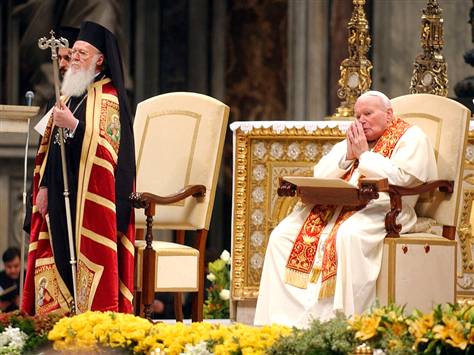
1995 was a significant year for Orthodox-Catholic rapprochement. The late Pope John Paul II wrote an encyclical on Christian unity (about which I then wrote a book that the current pope commented on, if this post is to be believed) and almost simultaneously published another letter, Orientale Lumen, urging Catholics to get to know the treasures of Eastern Christianity in order that the Church would again (to use a favourite, if somewhat tiresome, metaphor of the late pope, which was not original to him but, if memory serves, came from Congar and was not unproblematic insofar as it seemed to overlook the Syriac tradition, as Sebastian Brock suggested) "breathe with both lungs, East and West." Frankly acknowledging that most Latin Catholics are entirely ignorant about the Christian East--and not merely Orthodoxy, but the millions of Eastern Catholics in their own communion--the pope asked the former to get to know those latter two in some detail. Nearly two decades after that request, I am regularly staggered by how little progress has been made notwithstanding a great, even ardent, interest in the East when some Latins do discover it. All of my Roman Catholic graduate students, e.g., are deeply drawn to the East and have been for some time, and when we read Eastern sources they cannot get enough of them and constantly hunger for more. But they are, it seems, a rare exception.

When Catholics and other Western Christians do look East, one of the first things they are often drawn toward is Eastern liturgy, about which not a little romanticism and myth-making has long endured. (This Robert Taft article should begin the process of disabusing one of those romanticized myths.)

Liturgy, thus, has loomed large in Eastern consciousness, and in Western consciousness of the East (recall Taft's frequent temptation to write a book "Inventing Eastern Orthodoxy," one chapter of which, he has often said, would be "Inventing Eastern Liturgy"). And so it is appropriate, as the West continues to learn about the East, that it begins with liturgy and prayer. It is, then, a welcome development to have, just in time for Christmas, a short and charming little book that I hope many Roman Catholics (and many other Christians, East and West, who will doubtless benefit)  find under their trees this December: J. Michael Thompson, Lights From the East: Pray for Us (Ligouri, 2013), 144pp. This book will not only be educational about important figures of the East, but--more important--it will help people to pray.

About this book the publisher tells us: 
Catholics worldwide are increasingly heeding the call of the late Pope John Paul II to breathe spiritually "with both lungs"-to be inspired by both Western and Eastern Christianity. Yet many Catholics are unaware that the Roman Catholic Church is in communion with twenty-two other Churches, which together comprise the Eastern Catholic Churches. Focused on Eastern holy ones Lights From the East presents incredible riches to English speakers worldwide, including icons, biographies, Scripture, reflections, translated quotations from the service that honors the saint, prayers, and original hymns set to Rusyn or Galician melodies.
This is the kind of book, I think, that one dives into from time to time rather than reading systematically straight through. It is like several other collections I have seen--a kind of "breviary" of a sort, with scriptural, liturgical, and iconographical texts and plates tied to the liturgical year commemorating saints in five categories: those of the Old and New Testaments; the Fathers and Mothers of the Church; monastics; saints common to East and West; and martyrs of the twentieth century. As such, this book would be ideal for those asked to lead a reflection at the start of a parish Bible study, say, or before a class, or for family reading at home to inspire the imaginations of children, particularly on the feast days of those feted herein.  

Unlike other similar collections, the outstanding feature of this book is its inclusion of liturgical music. The author is a well-known and highly accomplished liturgical and pastoral musician, and virtually all of the hymn texts and translations here are his own work, often a rendering into elegant English of Slavonic or Ukrainian or other Trans-Carpathian sources. (Last year the author graciously sent me a very lovely CD of prostopinije music for the Great Fast which I have listened to repeatedly since then.) As one who deeply loves Galician and Kievan chant, but who cannot (as my late grandmother used to say, of herself and many of her relations) "carry a tune in a bucket," this book is handy to have, and to give to those more musically talented than I, in the hopes that they will learn something of the beauties of East-Slavic chant in its various forms, and begin to make them more widely known--as well as the stories of some of those East-Slavic saints killed by the Nazis and Communists in that century of tears to which we recently bade farewell but from whose clutches we are not yet free.

I warmly commend this spiritually edifying little book and its author, whom I hope to interview in the coming days. 

Tuesday, July 2, 2013

Global War on Christians

Given what has been going on in Egypt for more than two years, as well as Syria and too many other places to count, it is not apologetical propaganda or polemical pamphleteering to speak, as John Allen does in a book to be published in October, of The Global War on Christians: Dispatches from the Front Lines of Anti-Christian Persecution (Image Books, 2013), 356pp.

About this book we are told:
John Allen Jr. uses his unparalleled knowledge and insight to investigate the troubling worldwide persecution of Christians. A detailed and statistical look at the ways Christians are persecuted around the world and a challenge to American Christians to take notice of the persecution of others.The bestselling author of The Future Church uses his unparalled knowledge and insight to investigate the troubling worldwide persecution of Christians. From Iraq and Egypt to Sudan and Nigeria, from Indonesia to the Indian subcontinent, Christians in the early 21st century are the world's most persecuted religious group. According to the secular International Society for Human Rights, 80 percent of violations of religious freedom in the world today are directed against Christians. In effect, our era is witnessing the rise of a new generation of martyrs. Underlying the global war on Christians is the demographic reality that more than two-thirds of the world's 2.3 billion Christians now live outside the West, often as a beleaguered minority up against a hostile majority-whether it's Islamic fundamentalism in the Middle East and parts of Africa and Asia, Hindu radicalism in India, or state-imposed atheism in China and North Korea. In Europe and North America, Christians face political and legal challenges to religious freedom. Allen exposes the deadly threats and offers investigative insight into what is, and can be, done to stop these atrocities.

Friday, June 29, 2012

The Martyrdom of Alexander Men

From the pen of Michel Evdokimov, theologian-son of a theologian-father Paul Evdokimov, comes a new book: Father Alexander Men: Martyr of Atheism (Gracewing, 2011), 104pp.

About this book the publisher tells us:
Father Alexander Men (1935-1990), a priest assassinated after the fall of communism, is a highly regarded figure in Russian Orthodoxy. He was brought up during the War and marked by the Stalinist era. Following the completion of his theological studies in Moscow, he was appointed to various parishes around the capital, in particular Alabino and Novaïa Dérévnia. But his personality and influence soon brought him into conflict with the authorities and he was persistently hounded by the police and subjected to interrogations and searches of his home. Father Men was not an agitator but the embodiment of an ideal of spiritual resistance to communism effected through prayer, the liturgical and sacramental life, and the valuing of the human person

Thursday, March 29, 2012

The Persecuted Church Past and Present

With the recent news of a demented and demonic Saudi fatwa demanding the destruction of all churches in the Arab peninsula, one is confronted yet again with the ugly intolerance of Islam and its willingness to countenance violence towards those it deems its enemies. Eastern Christians have, for more than a thousand years, been on the front-lines of such barbaric treatment. As the old saying has it: plus ça change, la plus c'est la même chose. 

When it comes to the question of Christian persecution, there has never been a period in history when it has not been going on, often on a vast scale; but the last one hundred years saw more persecution and suffering than many other centuries combined. World Watch's 2011 report on the 50 worst countries for persecution of Christians makes for very grim reading. Much of that suffering befalls Eastern Christians, often in Islamic territories. E.g., how many people are aware that almost a million Christians have been forced to flee Iraq since the war started in 2003? How many people realize that the so-called Arab Spring has brought not life but death to many Coptic Christians, forcing well over 100,000 of them to flee? Where is the outrage?

A new book examines cases of persecution in our time: Baroness Cox and Benedict Rogers, Very Stones Cry Out: The Persecuted Church: Pain, Passion and Praise (Continuum, 2011), 168pp.

About this book, the publisher tells us:
According to the World Evangelical Alliance, over 200 million Christians in at least 60 countries are denied fundamental human rights solely because of their faith. Many face widespread and systematic persecution. The Very Stones Cry Out is a passionate challenge to the rest of the Church, and all advocates of religious freedom, to break their silence on this issue. Baroness Cox presents graphic photographs and survivors' accounts as testimony to widespread destruction, and provides powerful documentary evidence of contemporary persecution. Featuring contributions from those with on the ground experience of the nations concerned, this book details the impact that sustained persecution has on individuals, families and communities. In doing so, it provides a moving account of resilience in the face of destruction, and joy in spite of trials, making this a book that is as much about celebration as it is about challenge.
While taking a global perspective, the book focuses on countries with large Eastern Christian populations, including Egypt (ch. 5), India (6), Iran (8), and Iraq (9).

Tuesday, December 20, 2011

Memorials and Martyrs in Modern Lebanon

Lebanon continues to be a fascinating place especially for those of us who study relations between Eastern Christians and Muslims. Indiana University Press last fall released a study looking at both groups: Lucia Volk, Memorials and Martyrs in Modern Lebanon (Public Cultures of the Middle East and North Africa) (IU Press, 272pp.).

About this book, the publisher tells us:
Lebanese history is often associated with sectarianism and hostility between religious communities, but by examining public memorials and historical accounts, Lucia Volk finds evidence for a sustained politics of Muslim and Christian co-existence. Lebanese Muslim and Christian civilians were jointly commemorated as martyrs for the nation after various episodes of violence in Lebanese history. Sites of memory sponsored by Maronite, Sunni, Shiite, and Druze elites have shared the goal of creating cross-community solidarity by honoring the joint sacrifice of civilians of different religious communities. This compelling and lucid study enhances our understanding of culture and the politics of memory in situations of ongoing conflict. 

Thursday, June 9, 2011

Ottoman Conversions

Given the heated atmosphere (to put it mildly) which attends any discussion of Islam today, it is only too easy to fall into simplistic categories when treating religious minorities in Islamic territories, both historic and current. Emerging scholarship, some touched on previously, is helping us to get a better picture of the relations between Jews and Christians on the one hand, and Muslims on the other, in territories under the latter's jurisdiction. Two recent books, both from Stamford University Press, shed welcome light:

Tijana Krstic, Contested Conversions to Islam: Narratives of Religious Change in the Early Modern Ottoman Empire (Stamford University Press, 2011), 280pp.

About this book the publisher tells us:
This book explores how Ottoman Muslims and Christians understood the phenomenon of conversion to Islam from the 15th to the 17th centuries, when the Ottoman Empire was at the height of its power and conversions to Islam peaked. Because the Ottomans ruled over a large non-Muslim population and extended greater opportunities to converts than to native-born Muslims, conversion to Islam was a contentious subject for all communities, especially Muslims themselves. By producing narratives about conversion, Ottoman Muslim and Christian authors sought to define the boundaries and membership of their communities while promoting their own religious and political agendas. Krstic argues that the production and circulation of narratives about conversion to Islam was central to the articulation of Ottoman imperial identity and Sunni Muslim "orthodoxy" in the long 16th century.

Placing the evolution of Ottoman attitudes toward conversion and converts in the broader context of Mediterranean-wide religious trends and the Ottoman rivalry with the Habsburgs and Safavids, Contested Conversions to Islam also introduces new sources, such as first-person conversion narratives and Orthodox Christian neomartyologies, to reveal the interplay of individual, (inter)communal, local, and imperial initiatives that influenced the process of conversion.
Chapters 5 and 6 will be of especial interest, focused as they are on Orthodox martyrs and "neomartyrs." I look forward to seeing this reviewed in Logos: A Journal of Eastern Christian Studies.

The second book covering the area is

Amit Bein, Ottoman Ulema, Turkish Republic: Agents of Change and Guardians of Tradition (SUP, 2011), 224pp.

About this book the publisher says:

To better understand the diverse inheritance of Islamic movements in present-day Turkey, we must take a closer look at the religious establishment, the ulema, during the first half of the twentieth century. During the closing years of the Ottoman Empire and the early decades of the Republic of Turkey, the spread of secularist and anti-religious ideas had a major impact on the views and political leanings of the ulema. This book explores the intellectual debates and political movements of the religious establishment during this time.
Bein reveals how competing visions of development influenced debates about reforms in religious education and the modernization of the medreses. He also explores the reactions and changing attitudes of Islamic intellectuals to the religious policies of the secular republic, and provides a better understanding of the changes in the relationship between religion and state. Exposing division within the religious establishment, this book illuminates the ulema's long-lasting legacies still in evidence in Turkey today.
Related Posts Plugin for WordPress, Blogger...