In the summer of 2016 I was able to interview my friend Michael Plekon about his then-new book, Uncommon Prayer. You can read that interview here.
I am delighted to be able finally to use Uncommon Prayer: Prayer in Everyday Experience in a course I am teaching this semester. If you haven't read it yet, you will not want to miss it. Like all his books, it is marked by an uncommonly and un-apologetically large and gracious breadth of themes, sources, and personages rendered in very accessible and inviting style--never thou shalt believe this, but instead: here, have a look at this where God may be found. I think the chapter on prayers and pirogi making is perhaps my favourite--but then I always think, as it were, with my stomach!
Showing posts with label Prayer. Show all posts
Showing posts with label Prayer. Show all posts
Wednesday, January 15, 2020

Wednesday, January 8, 2020
Prayerful Distractions as Psychological Free-Associations
Almost two years ago I was speculating rather cautiously on the possibility of a kind of "psychoanalytic" reading of Herbert McCabe's ideas around prayer, drawing on his helpful notion about "distractions" which come from his short chapter in God, Christ, and Us.
Well last night I had a chance to read another of his works, God Still Matters, with additional chapters on prayer and the Trinity. It was in this work that he acknowledges that his thoughts on distractions--which he says reveal to us what we really want, and instead of fighting them we should encourage their surfacing, the more easily to pray about and for them--were not his own, but came from a fellow Dominican, Victor White.
Now it all makes sense and I feel vindicated in my speculation. For White was a long-time dialogue partner with Carl Jung, and in fact wrote works about Jungian psychoanalysis, including God and the Unconscious.
All this, of course, takes us back to the great Viennese master himself, whose reflections on free association were and are so profoundly revealing and revolutionary. (At Strands in New York over Christmas, I picked up a short book by Anton Kris, Free Association: Method and Practice, which you may find interesting. Christopher Bollas also has interesting things to say about this in a variety of places, including here.)
We think that freely associating on the analyst's couch is a spectacular waste of time. And, wouldn't you know it, that's precisely the argument most of us use against prayer. McCabe again:
Well last night I had a chance to read another of his works, God Still Matters, with additional chapters on prayer and the Trinity. It was in this work that he acknowledges that his thoughts on distractions--which he says reveal to us what we really want, and instead of fighting them we should encourage their surfacing, the more easily to pray about and for them--were not his own, but came from a fellow Dominican, Victor White.
Now it all makes sense and I feel vindicated in my speculation. For White was a long-time dialogue partner with Carl Jung, and in fact wrote works about Jungian psychoanalysis, including God and the Unconscious.
All this, of course, takes us back to the great Viennese master himself, whose reflections on free association were and are so profoundly revealing and revolutionary. (At Strands in New York over Christmas, I picked up a short book by Anton Kris, Free Association: Method and Practice, which you may find interesting. Christopher Bollas also has interesting things to say about this in a variety of places, including here.)
We think that freely associating on the analyst's couch is a spectacular waste of time. And, wouldn't you know it, that's precisely the argument most of us use against prayer. McCabe again:
For a real absolute waste of time you have to go to prayer. I reckon that more than 80% of our reluctance to pray consists precisely in our dim recognition of this and our neurotic fear of wasting time, of spending part of our life in something that in the end gets you nowhere, something that is not merely non-productive, non-money making, but is even non-creative. it doesn't even have the justification of art and poetry. It is an absolute waste of time, it is a sharing into the waste of time which is the interior life of the Godhead.Finally for my students this semester in addition to reading McCabe, Plekon, and others, we will be reading Romano Guardini's lovely little classic, The Spirit of the Liturgy, where he also winsomely writes about liturgy being utterly wasteful of time for it is simply children at play in the Father's playground.
Friday, June 15, 2018
Praying with the Senses
I've previously noted a new interest in the role of the senses within Christian experience, a trend that was begun in part by the Orthodox scholar Susan Ashbrook Harvey's well-received book on the olfactory, now some dozen years ago.
Now we have a new and wide-ranging collection to continue this exploration: Praying with the Senses: Contemporary Orthodox Christian Spirituality in Practice, ed. Sonja Luehrmann (Indiana University Press, 2017), 280pp.
About this book the publisher tells us:
Acknowledgments
Introduction: The Senses of Prayer in Eastern Orthodox Christianity / Sonja Luehrmann
Part I: Senses
1. Becoming Orthodox: The Mystery and Mastery of a Christian Tradition / Vlad Naumescu
A Missionary Primer / Ioann Veniaminov
2. Listening and the Sacramental Life: Degrees of Mediation in Greek Orthodox Christianity / Jeffers Engelhardt
Creating an Image for Prayer / Sonja Luehrmann
3. Imagining Holy Personhood: Anthropological Thresholds of the Icon / Angie Heo
Syriac as a lingua sacra: Speaking the Language of Christ in India / Vlad Naumescu
4. Authorizing: The Paradoxes of Praying by the Book / Sonja Luehrmann
Part II: Worlds
5. Inhabiting Orthodox Russia: Religious Nomadism and the Puzzle of Belonging / Jeanne Kormina
Baraka: Mixing Muslims, Christians, and Jews / Angie Heo
6. Sharing Space: On the Publicity of Prayer, between an Ethiopian Village and the World / Tom Boylston
Prayers for Cars, Weddings, and Well-Being: Orthodox Prayers en route in Syria / Andreas Bandak
7. Struggling Bodies at the Crossroads of Economy and Tradition: The Case of Contemporary Russian Convents / Daria Dubovka
Competing Prayers for Ukraine / Sonja Luehrmann
8. Orthodox Revivals: Prayer, Charisma, and Liturgical Religion / Simion Pop
Epilogue: Not-Orthodoxy/Orthodoxy's Others / William A. Christian Jr.
Glossary
Index
Now we have a new and wide-ranging collection to continue this exploration: Praying with the Senses: Contemporary Orthodox Christian Spirituality in Practice, ed. Sonja Luehrmann (Indiana University Press, 2017), 280pp.
About this book the publisher tells us:
How do people experience spirituality through what they see, hear, touch, and smell? Sonja Luehrmann and an international group of scholars assess how sensory experience shapes prayer and ritual practice among Eastern Orthodox Christians. Prayer, even when performed privately, is considered as a shared experience and act that links individuals and personal beliefs with a broader, institutional, or imagined faith community. It engages with material, visual, and aural culture including icons, relics, candles, pilgrimage, bells, and architectural spaces. Whether touching upon the use of icons in age of digital and electronic media, the impact of Facebook on prayer in Ethiopia, or the implications of praying using recordings, amplifiers, and loudspeakers, these timely essays present a sophisticated overview of the history of Eastern Orthodox Christianities. Taken as a whole they reveal prayer as a dynamic phenomenon in the devotional and ritual lives of Eastern Orthodox believers across Eastern Europe, the Middle East, North Africa, and South Asia.And we have a nicely detailed table of contents as well:
Acknowledgments
Introduction: The Senses of Prayer in Eastern Orthodox Christianity / Sonja Luehrmann
Part I: Senses
1. Becoming Orthodox: The Mystery and Mastery of a Christian Tradition / Vlad Naumescu
A Missionary Primer / Ioann Veniaminov
2. Listening and the Sacramental Life: Degrees of Mediation in Greek Orthodox Christianity / Jeffers Engelhardt
Creating an Image for Prayer / Sonja Luehrmann
3. Imagining Holy Personhood: Anthropological Thresholds of the Icon / Angie Heo
Syriac as a lingua sacra: Speaking the Language of Christ in India / Vlad Naumescu
4. Authorizing: The Paradoxes of Praying by the Book / Sonja Luehrmann
Part II: Worlds
5. Inhabiting Orthodox Russia: Religious Nomadism and the Puzzle of Belonging / Jeanne Kormina
Baraka: Mixing Muslims, Christians, and Jews / Angie Heo
6. Sharing Space: On the Publicity of Prayer, between an Ethiopian Village and the World / Tom Boylston
Prayers for Cars, Weddings, and Well-Being: Orthodox Prayers en route in Syria / Andreas Bandak
7. Struggling Bodies at the Crossroads of Economy and Tradition: The Case of Contemporary Russian Convents / Daria Dubovka
Competing Prayers for Ukraine / Sonja Luehrmann
8. Orthodox Revivals: Prayer, Charisma, and Liturgical Religion / Simion Pop
Epilogue: Not-Orthodoxy/Orthodoxy's Others / William A. Christian Jr.
Glossary
Index
Monday, February 12, 2018
On Fasting from Noise or Against Asceticism and Spirituality (I)
The paschal calculations are only out by a week this year (see here for some further thoughts on this absurd problem), so today begins Great Lent on the Gregorian Calendar, and next week it begins on the Julian.
Always around this time in the past, as here, I have listed some good books, especially Alexander Schmemann's Great Lent: Journey to Pascha, and I would not unsay what I have said there. But I am increasingly uneasy about much of this discussion and increasingly given to rethinking the categories of asceticism thanks to a book I mentioned at the beginning of the month in discussing the links between Freudian and Dominican notions of prayer: Maggie Ross, Silence: A User's Guide vol. I.
This builds on a longstanding dislike I have had of the whole notion of "spirituality." I remember very clearly in the early 1990s, as I moved from studying psychology to theology, taking my first undergraduate course in "spirituality" taught by a man who was bouncing across the stage with excitement that, at long last, "spirituality" was emerging as its own academic discipline, with new journals being founded every other week to prove its bona fides. The eagerness with which he raced to embrace all the trappings of middle-class North American academic respectability were then distasteful to me and have become all the more so over the passing years. I rapidly became deeply suspicious--before I had the language to express it--that "spirituality" was yet another triumph of the process of commodification that Western capitalism does with such seductive ease.
Thus I am increasingly inclined to the view that there is no such thing as spirituality, and that's a very good thing too. Some of this I got more recently from reading Robert Farrar Capon, as well as Schmemann's For the Life of the World. But the first two who really helped me to see this were, of course, John Milbank's Theology and Social Theory and John Bossy's underappreciated but delightful minor classic, Christianity in the West 1400-1700. Ross reinforces this suspicion early on in Silence: A User's Guide by quoting Meister Eckhart: if you think you are doing anything "spiritual" or "special," you're not seeking God!
But my few suspicious and criticisms are anodyne compared to the scathing, cold dissection in the hands of Maggie Ross. Her book seems increasingly to me to be a rare and welcome knife cutting through so much nonsense, some of it positively harmful. We'll start with the first two chapters before getting to the third chapter, which should really be called "A Glossary of Fatuous Terms of Destruction and Illusion Masquerading as Piety." In this third chapter she really takes the gloves off, though she drops a hint in ch. 1 when, e.g., she says that "mysticism (a dog's breakfast of a word that needs to be eliminated from the discussion) is tainted with voyeurism and self-aggrandizement and has become a consumer circus" (25). A little later on she will also scorn all language of having an "experience" of God, noting that "God" may be operative in the experience, but God is not the experience: that would be to hack Him down to our little self-conscious concepts.
The burden of the first two chapters is to sketch out her psychology, as it were, noting the tension between the self-conscious mind, which is always noisy, and the "deep mind," as she calls it. If the former, as she says, "makes us human, then its elision opens the door to...divinity" (1).
Too many of us are scared to open that door for several reasons. First, we may think that the deep mind is a morass of irrational instincts and urges, but, she says, it is itself also thinking. This deep mind, however, cannot be forcibly accessed: to get here you have to find ways to subvert self-consciousness. Perhaps, she says in a few places, the most common technique is to focus on a single word or exhalations until self-consciousness gradually falls away for a time.
However we do it, she makes the claim that putting on the mind of Christ is silence: to put on the mind of Christ is to relinquish projections and imagined stereotypes and to receive a transfigured mind back instead. This is impossible without the "work of silence," as she repeatedly calls it. The mind of Christ, then, is not an inhibited self-conscious mind, but the deep mind that avoids all notions of pious "imitation" because such ideas depend on our own suspect concepts and projections of Christ.
To become transfigured it is necessary to enter into solitude and silence: she notes the desert fathers and mothers (and modern commentators, as I have often noted--e.g., Thomas Merton) said that if you went and sat silently in your cell, your cell will teach you everything. This, she notes later, is surely why Pascal could claim that our unhappiness arises from only one thing: our inability to remain alone and silent in a room.
In reading her so far, I am put in mind of one French and two other British writers whom I read in the 1990s on these themes. The first would be the psychiatrist Anthony Storr's little book Solitude.
The second is the psychoanalyst Nina Coltart, the publication of whose Slouching Towards Bethlehem in 1992 was influential for me in deciding to enter full-time psychoanalysis in 1994. Among the many fascinating chapters in that book, I have often returned to her reflections on the silent patient, which she defines as the patient who speaks for less than 10% of the total analysis; and then her own experiences of solitude and meditation as an Anglican who later embraced Buddhism.
In the midst of reading these two, then somehow I discovered Simone Weil and her especially searing insights on solitude. One of these days I must go back to Weil, on whom an explosion of scholarship has developed in the two decades since I last read her.
For Ross, engaging deep silence requires no gimmicks, programs, gurus, or expensive memberships. It costs nothing. That, of course, makes it highly suspect to the powers and principalities of our present age, which can make no profits off it--but, as she shows, suspicion of silence goes back many centuries within a Christian context alone.
There is also another factor at work, one which, as I noted in previous discussions of Christopher Bollas, centres on the fact that many of us today dismiss and disdain any notion of an unconscious life not least because the unconscious, the hidden mind is a thinking mind and we don't want to entertain Freud's insight here about that. How dare our minds go on thinking without our self-conscious approval and, above all, control!
But Ross hastens here to insert a welcome reassurance, especially for those who are worried that--as she noted earlier--the deep mind, the hidden and unconscious mind, is an irrational mass of desires that will lead you astray and deceive you. On the contrary, she says, the silence of the deep mind is perhaps most objective of all insofar as it leads away from self-consciousness and its suspect motives to simply see what is real not just in ourselves but especially in the world around us. In doing the work of silence, we can see, but see differently: deep silence transfigures. We learn to figure things out differently.
And part of what we figure differently is the relationship between what is known and unknown--here echoing what Adam Phillips has written about in several places, as I've noted on here the past two years, and more recently in discussing Christopher Bollas's pivotal idea of the "unthought known."
And yet, in addition to fear of the hidden and unconscious, and to disdain for its simplicity, silence is also scorned by some who abandon the work because they think it should transform them into something unique, a new self--only to discover that it does not. It leads them into communion with the ordinary, and to seeing our life in the daily things.
Moreover, it is feared by some who think it will change them rather too much. But, she says, you have to abandon and change nothing at the outset! The silence will elicit changes organically. This is very much my own recollection of the analytic experience as well: the change comes quite as much as a result of the process itself as of (and perhaps more than) any individual insights developed or traumatic memories analyzed.
Silence, Ross argues, leads us out of our very narrow, repetitive, cramped, noisy self-conscious minds into what Weil called the absolute unmixed attention which is prayer. (Cf. Coltart's understanding of the analyst proffering "evenly hovering attention," as Freud called it, and as Coltart saw as a deeply spiritual, almost sacred, practice.) How can this happen?
For Ross, "the only requirement is to observe one's own mind at work, to discover its permutations, to engage, receive, and realize the effects that arise from learning to inhabit deepest silence" (32). From here, it may be useful for some people to try meditation as an entry-level way into silence but it is not the whole thing. It can also dangerously magnify existing beliefs. So context and intent become key.
Sometimes, she notes, the way into silence can be inadvertent and this is often a sign of authenticity. But the most common entry point is through focus on one thing only: e.g., a word. There is most likely not one universal way to do this, but much depends on the individual. The point is to find a way to defeat the self-conscious mind by turning towards liminality, where the self-conscious mind submits its knowledge to the deep mind and receives it back transfigured. In the end, she says, silence can effect such dramatic change that even the way a person looks is changed.
Continues.
Always around this time in the past, as here, I have listed some good books, especially Alexander Schmemann's Great Lent: Journey to Pascha, and I would not unsay what I have said there. But I am increasingly uneasy about much of this discussion and increasingly given to rethinking the categories of asceticism thanks to a book I mentioned at the beginning of the month in discussing the links between Freudian and Dominican notions of prayer: Maggie Ross, Silence: A User's Guide vol. I.
This builds on a longstanding dislike I have had of the whole notion of "spirituality." I remember very clearly in the early 1990s, as I moved from studying psychology to theology, taking my first undergraduate course in "spirituality" taught by a man who was bouncing across the stage with excitement that, at long last, "spirituality" was emerging as its own academic discipline, with new journals being founded every other week to prove its bona fides. The eagerness with which he raced to embrace all the trappings of middle-class North American academic respectability were then distasteful to me and have become all the more so over the passing years. I rapidly became deeply suspicious--before I had the language to express it--that "spirituality" was yet another triumph of the process of commodification that Western capitalism does with such seductive ease.
Thus I am increasingly inclined to the view that there is no such thing as spirituality, and that's a very good thing too. Some of this I got more recently from reading Robert Farrar Capon, as well as Schmemann's For the Life of the World. But the first two who really helped me to see this were, of course, John Milbank's Theology and Social Theory and John Bossy's underappreciated but delightful minor classic, Christianity in the West 1400-1700. Ross reinforces this suspicion early on in Silence: A User's Guide by quoting Meister Eckhart: if you think you are doing anything "spiritual" or "special," you're not seeking God!
But my few suspicious and criticisms are anodyne compared to the scathing, cold dissection in the hands of Maggie Ross. Her book seems increasingly to me to be a rare and welcome knife cutting through so much nonsense, some of it positively harmful. We'll start with the first two chapters before getting to the third chapter, which should really be called "A Glossary of Fatuous Terms of Destruction and Illusion Masquerading as Piety." In this third chapter she really takes the gloves off, though she drops a hint in ch. 1 when, e.g., she says that "mysticism (a dog's breakfast of a word that needs to be eliminated from the discussion) is tainted with voyeurism and self-aggrandizement and has become a consumer circus" (25). A little later on she will also scorn all language of having an "experience" of God, noting that "God" may be operative in the experience, but God is not the experience: that would be to hack Him down to our little self-conscious concepts.
The burden of the first two chapters is to sketch out her psychology, as it were, noting the tension between the self-conscious mind, which is always noisy, and the "deep mind," as she calls it. If the former, as she says, "makes us human, then its elision opens the door to...divinity" (1).
Too many of us are scared to open that door for several reasons. First, we may think that the deep mind is a morass of irrational instincts and urges, but, she says, it is itself also thinking. This deep mind, however, cannot be forcibly accessed: to get here you have to find ways to subvert self-consciousness. Perhaps, she says in a few places, the most common technique is to focus on a single word or exhalations until self-consciousness gradually falls away for a time.
However we do it, she makes the claim that putting on the mind of Christ is silence: to put on the mind of Christ is to relinquish projections and imagined stereotypes and to receive a transfigured mind back instead. This is impossible without the "work of silence," as she repeatedly calls it. The mind of Christ, then, is not an inhibited self-conscious mind, but the deep mind that avoids all notions of pious "imitation" because such ideas depend on our own suspect concepts and projections of Christ.
To become transfigured it is necessary to enter into solitude and silence: she notes the desert fathers and mothers (and modern commentators, as I have often noted--e.g., Thomas Merton) said that if you went and sat silently in your cell, your cell will teach you everything. This, she notes later, is surely why Pascal could claim that our unhappiness arises from only one thing: our inability to remain alone and silent in a room.
In reading her so far, I am put in mind of one French and two other British writers whom I read in the 1990s on these themes. The first would be the psychiatrist Anthony Storr's little book Solitude.
The second is the psychoanalyst Nina Coltart, the publication of whose Slouching Towards Bethlehem in 1992 was influential for me in deciding to enter full-time psychoanalysis in 1994. Among the many fascinating chapters in that book, I have often returned to her reflections on the silent patient, which she defines as the patient who speaks for less than 10% of the total analysis; and then her own experiences of solitude and meditation as an Anglican who later embraced Buddhism.
In the midst of reading these two, then somehow I discovered Simone Weil and her especially searing insights on solitude. One of these days I must go back to Weil, on whom an explosion of scholarship has developed in the two decades since I last read her.
For Ross, engaging deep silence requires no gimmicks, programs, gurus, or expensive memberships. It costs nothing. That, of course, makes it highly suspect to the powers and principalities of our present age, which can make no profits off it--but, as she shows, suspicion of silence goes back many centuries within a Christian context alone.
There is also another factor at work, one which, as I noted in previous discussions of Christopher Bollas, centres on the fact that many of us today dismiss and disdain any notion of an unconscious life not least because the unconscious, the hidden mind is a thinking mind and we don't want to entertain Freud's insight here about that. How dare our minds go on thinking without our self-conscious approval and, above all, control!
But Ross hastens here to insert a welcome reassurance, especially for those who are worried that--as she noted earlier--the deep mind, the hidden and unconscious mind, is an irrational mass of desires that will lead you astray and deceive you. On the contrary, she says, the silence of the deep mind is perhaps most objective of all insofar as it leads away from self-consciousness and its suspect motives to simply see what is real not just in ourselves but especially in the world around us. In doing the work of silence, we can see, but see differently: deep silence transfigures. We learn to figure things out differently.
And part of what we figure differently is the relationship between what is known and unknown--here echoing what Adam Phillips has written about in several places, as I've noted on here the past two years, and more recently in discussing Christopher Bollas's pivotal idea of the "unthought known."
And yet, in addition to fear of the hidden and unconscious, and to disdain for its simplicity, silence is also scorned by some who abandon the work because they think it should transform them into something unique, a new self--only to discover that it does not. It leads them into communion with the ordinary, and to seeing our life in the daily things.
Moreover, it is feared by some who think it will change them rather too much. But, she says, you have to abandon and change nothing at the outset! The silence will elicit changes organically. This is very much my own recollection of the analytic experience as well: the change comes quite as much as a result of the process itself as of (and perhaps more than) any individual insights developed or traumatic memories analyzed.
Silence, Ross argues, leads us out of our very narrow, repetitive, cramped, noisy self-conscious minds into what Weil called the absolute unmixed attention which is prayer. (Cf. Coltart's understanding of the analyst proffering "evenly hovering attention," as Freud called it, and as Coltart saw as a deeply spiritual, almost sacred, practice.) How can this happen?
For Ross, "the only requirement is to observe one's own mind at work, to discover its permutations, to engage, receive, and realize the effects that arise from learning to inhabit deepest silence" (32). From here, it may be useful for some people to try meditation as an entry-level way into silence but it is not the whole thing. It can also dangerously magnify existing beliefs. So context and intent become key.
Sometimes, she notes, the way into silence can be inadvertent and this is often a sign of authenticity. But the most common entry point is through focus on one thing only: e.g., a word. There is most likely not one universal way to do this, but much depends on the individual. The point is to find a way to defeat the self-conscious mind by turning towards liminality, where the self-conscious mind submits its knowledge to the deep mind and receives it back transfigured. In the end, she says, silence can effect such dramatic change that even the way a person looks is changed.
Continues.
Friday, February 2, 2018
The Fundamental Rule of Prayer: Free Association?
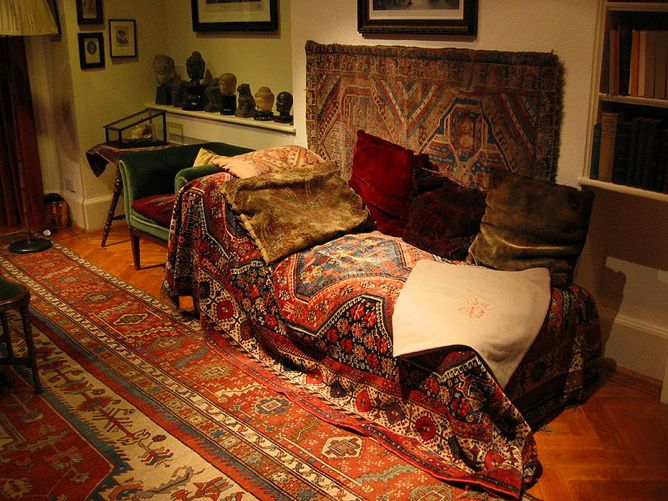
 Today's lovely feast, which of course brings the 40-day Christmas cycle to an end, is that of the Presentation of Christ in the Temple, often known as Candlemas. And in the Catholic world it's kept as a day to remember consecrated religious who devote their lives to prayer and contemplation. But what is prayer, and what of our difficulties with it? Here are some thoughts on that question aided by two books I read back to back last weekend--quite unintentionally, I might add, or at least without conscious (!) intent.
But hear me out when I suggest that there are connections to be discovered between late Anglo-Irish Dominican theologian Herbert McCabe's God, Christ, and Us, and the contemporary Anglo-American psychoanalyst Christopher Bollas in The Evocative Object World.
I started with McCabe's lovely short book of sermons, God, Christ, and Us. If you are casting about for suitable Lenten reading material this year, permit me very warmly to recommend it. No chapter is very long, and none suffers from that kind of revolting treacle one sometimes associates with pious utterances such a sermons. McCabe was not pious in that sense at all, but very earthy and practical in a refreshingly straight-forward kind of way. The God preached by this member of the Order of Preachers is a God you actually want to meet, indeed might actually look forward to meeting, and quite probably over a drink or meal à deux.
I first encountered McCabe's name in the 1990s when Stanley Hauerwas made an off-hand reference to him in connection to Alasdair MacIntyre. I paid no heed as Hauerwas didn't say much and I wasn't interested enough to pursue the matter. Later I would see MacIntyre himself in several places confess debts to McCabe, but without much detail to spur on an investigation on my part.
But the person who really convinced me I must read McCabe was and is Eugene McCarraher, whom I first stumbled across in articles like this (discussing Terry Eagleton's Culture and the Death of God) and then this deeply fascinating three-part interview, the third of which avers "I swear that reading McCabe has often kept me a Christian." In my more despairing moments recently, I know exactly what McCarraher means by that, and I suspect very strongly he had lines like this from McCabe in mind:
"Like Peter and the 12 we remain Christians because there is nowhere else to go: if Christianity is not the revolution, nothing else is" (Law, Love and Language, 1968).McCarraher has also written a lovely overview of McCabe's life in this Commonweal article which notes, inter alia, that McCabe's "radicalism" was precisely and only possibly because of its deep orthodoxy. Rooted in the tradition, he could see its deeply subversive potential--even if, alas, that potential is almost always domesticated, tamed, thwarted by the powers and principalities of the present age. His orthodoxy, then, allowed him freely to explore socialism and Marxism.
Though my reading is still early yet, I have not see in him so far much exploration of Freud. But the language is clearly there. Repeatedly McCabe uses classical Freudian language in unmistakable ways, especially speaking of our tendency towards "projection" and our wallowing in "illusion" about both ourselves and God. In, e.g., Faith Within Reason, reflecting on the prodigal son, McCabe writes:
Sin is something that changes God into a projection of our guilt, so that we don’t see the real God at all; all we see is some kind of judge. God (the whole meaning and purpose and point of our existence) has become a condemnation of us. God has been turned into Satan, the accuser of man, the paymaster, the one who weighs our deeds and condemns us…For damnation must be just being fixed in this illusion, stuck forever with the God of the Law, stuck forever with the God provided by our sin (155-56; my emphasis).A little later on, McCabe uses language that very much echos the difficulties of psychoanalysis as Freud saw them for it confronts people with hidden, and often infelicitous, desires, images, and actions. But both Freud and McCabe argue that it is much better to face up to ourselves, sinful and infantile as we are:
We damn ourselves because we would rather justify and excuse ourselves, and look on our self-flattering images of ourselves, than be taken out of ourselves by the infinite love of God…Contrition, or forgiveness, is self-knowledge, the terribly painful business of seeing ourselves as what and who we are: how mean, selfish, cruel and indifferent and infantile we are (Faith Within Reason, 157).But it is in McCabe's sermons on prayer, two of which are found in God, Christ, and Us that most put me in mind of what Bollas says in the first chapter of The Evocative Object World, and, come to think of it, what Adam Phillips has also said, as I noted here in discussing his ideas about distractions and frustrations; see also his book Side Effects. The link between the two of them seems to be an unapologetic advocacy of free association, leading to my question: are prayer and psychoanalysis the only activities today where one's mind can range freely without being hectored and controlled by ideologues and capitalists (the two often being the same thing)? Are the pew and the couch the only places left to us today as places that do not demand anything of us but give us silence, space, freedom?
Bollas thinks that today's "attacks on psychoanalysis are thinly disguised attacks on unconscious life itself" because "there is a widespread contempt for unconcious life in modern culture." He doesn't say why this is, but it's not hard to figure out: both analysis and prayer, as activities in which our mind ranges freely in search of some outlet for our deepest desires and hurts, are precisely the vague, free-flowing, unproductive, dreamy, gimmick-free kinds of activity that cannot be monetized or commodified or turned into an app promoting "mindfulness" or some other bit of money-making chicanery.
Bollas's first chapter treats free association, noting that it's a mutual process of analyst-analysand freely associating together, creating the analysis together. As he nicely put it, this is an experience in which one can rightly and proudly say "You don't know what you're talking about!" But still you talk, and listen, and associate, and eventually certain things become clear. Other things may not become clear, but this is not necessarily a failure, for the value of analysis is not just the "what" or the content: it is also the process--as Bollas has said elsewhere, echoing D.W. Winnicott--of being held and contained, of developing a deep connection to another human being that in itself is worthwhile, not least in its transferential (and thereafter transformational) power. Furthermore, an analysis is worthwhile not just for the clarity of content that sometimes comes about, but also for the "psychoanalytic mind" it creates, as Fred Busch has so winsomely described.
The beauty of this, as I have long appreciated it, is that "psychoanalysis does not provide ready answers to patients symptoms or lives," as Bollas admits. This, he recognizes, is "disconcerting" for those who think that clinicians are supposed to be experts. In fact, Bollas--and here his thought closely tracks that of Phillips, as I have repeatedly shown on here--says that the free associating of the unconscious of both analyst and analysand "subverts the analyst's natural authoritarian tendencies as well as the patient's wish to be dominated."
In this regard, Bollas puts me in mind of how Maggie Ross describes the mistaken notions behind modern concepts and practices of "spiritual direction," much of which consists of attempts at "mind control" as she puts it, and the result of which is to reinforce one's narcissism. Silence, for Ross, whose book shows considerable familiarity with psychoanalytic ideas, is the goal, and is hugely valuable in itself--a point that also becomes abundantly clear in reading the psychoanalytic literature about silent patients who nonetheless get better--start with another fascinating English Anglican, the analyst Nina Coltart, for examples of this; see her Slouching Towards Bethlehem.
McCabe doesn't come right out and advocate freely associating during prayer, but he very much leans in that direction. This is something I'll have to think about some more, but it does seem to me a helpful way to conceive of prayer and the problems of being distracted during or bored by prayer, or restlessly wondering about the futility of it all.
Rather than fighting that, McCabe advocates letting your mind wander until you find what you really want to pray about, and then praying about it. Here, again without using the words per se, McCabe seems to me to establish the "fundamental rule" (cf. Freud's "On Beginning the Treatment") of prayer outside the shackles of whatever spiritual superegos may be trying to tell us otherwise. If we let ourselves pray for what we are really concerned about, McCabe says, those prayers not only will almost always be, but in fact should be "the vulgar and rather infantile things you really do want," instead of all the pious and high-minded things we think we should pray about.
If we're distracted during prayer, it's because we're not praying for the right things (he notes those on sinking ships never report distractions during their prayers!), and constraining ourselves to pray for the things our superego tells us to--the "proper and respectable and 'religious'" things. Instead of that, as he drolly puts it, "you could let world peace rest for a while."And while you're at it, let your mind run to those distractions because they "are nearly always your real wants breaking in on your prayer." (Lest we worry that this is an excuse for descending into infantile selfishness, McCabe says that if we are honest in prayer about our desires, the Holy Spirit will invariably lead us deeper, for prayer involves change and growing up.) If psychoanalysis involves, as Bollas argued in his first major book The Shadow of the Object, a certain "ordinary regression to dependence" for a time, does this not also describe how we are in prayer with our Father in heaven as we pray for the things closest to us that matter most to us?
Tuesday, November 21, 2017
Wounded by Love
Earlier this month I drew attention to another book published by Denise Harvey Publishers, a book that came back to mind in a conversation with Fr John Jillions. We were together at the Eleanor Malburg Eastern Churches Seminar in Cleveland in October, and in the course of his presentation he mentioned--having lived in Greece for part of the time he was doing his doctorate at Thessaloniki--this book as being one of the most spiritually profound works he has read: Wounded by Love: The Life and Wisdom of Saint Porphyrios (2012), 268pp.
About this book the publisher (who gives some excerpts here) tells us:
About this book the publisher (who gives some excerpts here) tells us:
Saint Porphyrios, a Greek monk and priest who died in 1991, stands in the long tradition of charismatic spiritual guides in the Eastern Church which continues from the apostolic age down to figures such as Saint Seraphim of Sarov and Staretz Silouan in modern times. In this book he tells the story of his life and, in simple, deeply reflected and profoundly wise words, he expounds the Christian faith for today.
The vibrant personality of Saint Porphyrios at all times shines through his words with great transparency and charm. In his introduction to the Greek edition Bishop Irenaeus of Chania writes: 'The words of blessed Elder Porphyrios are the words of a holy Father, of a man with the gift of clear sight, who was ever retiring, humble, simple and ardent and whose life was a true and authentic witness to Christ, to His truth and to His joy. Through his presence, love, prayer, counsel and guidance he supported an untold number of people in the difficult hours of illness, mourning, pain, loss of faith and death. He is a god-bearing Father of our days, a true priest and teacher who in his ascetic way fell in love with Christ and faithfully served his fellow man.'
This book was compiled after Saint Porphyrios's death from an archive of notes and recordings of his reminiscences, conversations and words of guidance, and was first published in Greek in 2003. Since its publication in English in 2005 it has been reprinted seven times, most recently in 2015.
Monday, September 19, 2016
Michael Plekon's Uncommon Prayers--and Ours, Too
In July I interviewed Michael Plekon about his forthcoming book Uncommon Prayer: Prayer in Everyday Experience. You may read that here. I also noted that I would post a reminder when the book was finally published in September, as it now has been.
Consider yourself reminded to go and buy a copy! While you're at it, check out some of his other books (or books devoted to him), all of which will be well worth your time.
In particular, I interviewed him in 2012 about Saints As They Really Are: Voices of Holiness in Our Time.
In an interview from 2011, we discussed some of his other earlier books, including Hidden Holiness as well as Living Icons: Persons of Faith in the Eastern Church.
He is also the editor of numerous works, including those by Afanasiev, Evdokimov, and others--don't forget the splendid biography of Elisabeth Behr-Siegel!
Consider yourself reminded to go and buy a copy! While you're at it, check out some of his other books (or books devoted to him), all of which will be well worth your time.
In particular, I interviewed him in 2012 about Saints As They Really Are: Voices of Holiness in Our Time.
In an interview from 2011, we discussed some of his other earlier books, including Hidden Holiness as well as Living Icons: Persons of Faith in the Eastern Church.
He is also the editor of numerous works, including those by Afanasiev, Evdokimov, and others--don't forget the splendid biography of Elisabeth Behr-Siegel!
Friday, July 15, 2016
Michael Plekon on the Uncommon Prayers We Pray
It is one of the great delights of my life that I have known Michael Plekon for a decade now, and continue to benefit from his friendship and counsel, to say nothing of his books. I have in the past written in his honour and also interviewed him about previous books, any and all of which are more than worth your time--both the ones he has written himself, and the many others he has edited or translated.
Two weeks ago the publisher sent me advanced page proofs of his forthcoming book, set for release on 15 September 2016: Uncommon Prayer. Prayer in Everyday Experience (UND Press, 280pp.). Amazon will let you pre-order a copy now and ship it upon release; but in case you forget I'll try to post a reminder of the book's release two months hence.
I asked Fr. Michael for an interview about this book, and here are his thoughts:
AD: In the few years since our last interview on here, discussing your Saints as They Really Are, what have you been up to? How did you get from that book to the present one, Uncommon Prayer, and what if any threads link them?
MP: Saints as They Really Are was the last in a trilogy of books about holy women and men in our time, how they pursued a life in and with God. I started out with persons of faith from the Eastern Church in Living Icons, but wanted to expand horizons. Thus those profiled and listened to in Hidden Holiness and Saints are ecumenically diverse, some even at odds with the institutional church. Given the conflict at the recent Pentecost Pan-Orthodox gathering in Crete over whether non-Orthodox Christian communities could even be called "churches," whether they were in any way Christian, bearers of the Spirit, the commitment to authentic and ecclesial ecumenical perspectives is all the more necessary! There is no reason, within the church's tradition, to doubt the faith of, say, a Thomas Merton or Dorothy Day, a Rowan Williams or Michael Ramsay any more than a Mother Maria Skobtsova or Alexander Men, an Alexander Schmemann or Nicholas Afanasiev or Elisabeth Behr-Sigel.
I mention not only Western Christians here but some of those associated with the "Paris School" and the "religious Renaissance" among the Russians, as Nicholas Zernov called it in the early 20th century. I do so because even these faithful Eastern Church figures have been called into question as "innovationists" or even "heretics" by some Orthodox traditionalists. Listening to these "ecclesial beings" or "people of the church," as Paul Evdokimov called them, it is clear that in both East and West, such women and men were attending to the "signs of the times." They were trying to bring the church into encounter with political revolutions and those fleeing them into exile, a destructive economic Depression, the rise of fascism and two horrendous world wars, followed by a cold war and buildup of nuclear arms.
Contrary to what one might suspect, the processions of these persons of faith was anything but a march of fearful, introverted believers. Rather, those already passed into the kingdom, as well as those still with us, despite their marked differences in vision, nonetheless converged in many ways. They celebrated the life of Christ lived out in the details of everyday life. Rather than condemn secular institutions, they remembered the preaching and enacting of the Gospel in the church's earliest years. They also connected the Gospel with peacemaking, with the fight for human/civil rights and social justice more broadly.
So as it usually is, "one thing leads to another" for me. The books about persons of faith and their experiences of looking for God and trying to live with God in daily life led me to prayer, I supposed the language of faith, the heart of spirituality. I think many are turning away from making a hard distinction between being "religious" and being "spiritual." Jesuit Roger Haight's new book on this, Spiritual and Religious: Explorations for Seekers, (Orbis, 2016) goes a long way toward getting back to inherent connections, commonalities, a lot of shared space, thinking and action.
This is exactly where Uncommon Prayer came to be. I very much wanted to look at how prayer is lived out after services are ended, after the scriptures and prayerbooks are closed--there in our daily round of existence. So I went back to some persons of faith I had written about before, such as Evdokimov, who wrote specifically on "becoming what you pray," also Dorothy Day and Maria Skobtsova, who refused to pit love of God against that of the neighbor--rather seeing the two as inseparable.
I also consulted Sara Miles and Barbara Brown Taylor, really fine writers on the experience of living what you believe, and Richard Rohr, Sara Coakley and Rowan Williams, who were explicit in describing the very personal aspects of prayer. But I also went, for the first time, to poets Mary Oliver, Christian Wiman, Mary Karr, but also Heather Havrilesky, who has done memoirs, criticism, and advice-columns!
And, wanting to share some of the rich experience with which I have been gifted, I take the reader into the maybe surprising liturgical work of food prep--the “liturgies” and community built up in parish pirogi making, baking of Easter breads and other pastries and the food fairs, post-funeral repasts and weekly coffee hours. After so many years in parish ministry, I wanted to share how there really is a “liturgy after the liturgy,” not only that of the “8th sacrament,” the coffee hour, but all those other adventures in food prep and eating that are at the core of my parish’s strong sense of community.
AD: Yes, I remember only too well how stuffed I was after a BBQ and picnic at St. Gregory's one Sunday two or three summers ago! I was also amazed at the gracious hospitality extended to me, a stranger. What a parish you have!
MP: I also did some digging into my own prayer life, excavating what lies behind a now tattered, soiled prayerlist that is at least 30 years old. This list opened up both my learning to do pastoral ministry years ago, but more importantly how both forgetting and remembering are core elements of prayer and our lived prayer. I was also led to reflect on the experience of prayer in my “day job,” in the classrooms of a large, secular, public university of great ethnic and religious diversity. This is where I have worked for the past 40 years, and hopefully it can serve as a point of departure for readers to consider their own workplaces and homes and neighborhood as locations of prayer.
AD: As a former Anglican, I hear your title and immediately think of it as a riff on Cranmer's Book of Common Prayer. What was your intent in speaking of "uncommon" prayer?
I explain this title and yes, as you suspect, I did want to suggest that just as much as we need and depend on the “common prayer” of the church, of the community here and over time, that prayer of course is never restricted to the liturgical services and books, that is, to the formal contexts. If St Paul says we should pray always and everywhere, then let’s have a look at how this appears in practice. I also think what is implied here is that we all too often imprison ourselves in the “formal” language and forms of prayer, not knowing we are doing that. And often the consequence is that we are tormented by how little we pray outside the church building and the prayers we recite or read from the books. That, in my own personal experience and in my pastoral experience, is simply NOT true! We pray a lot, in many other circumstances and locations. But often do not think of what we are saying, feeling, and doing as prayer.
AD: Your introduction notes the tendency of moderns to see religious practices such as prayer as more or less private hobbies, undertaken outside of a communal context. Do you have any thoughts on what can be done to overcome this tendency towards splitting off, towards privatizing and individualizing the faith and its practices?
We all know the old line of Tertullian, is it, about “a Christian alone is no Christian.” But it is no longer the case that the community of the local church, the parish, doubles as the same community of the village, the same community of local industry, work, factories, mines, mills. We are so much more diverse in just about everything, from language to culture to political perspective.
Robert Putnam would say we have lost community. But Nancy Ammermann would say, no, just look more closely. There are all kinds of ways we bridge our individuality to others, so many ways in which connect beyond ourselves. I think it’s silly to dismiss how we do this electronically, through social media and email and all the resources online. That is an enormous marketplace, a very real public square. Think of the capacity we have to access books, images of paintings, pieces of music. But we also are drawn more to each other—concerts, sporting events, really an array of gatherings. And we continue to see urban areas growing in population.
All this said, our community life is NOT what it was even a generation or so ago. While some communities of faith and language and ethnicity continue as enclaves, the community of homogeneity and similarity has given way as we intermarry and move. As I see it, our faith and our prayer life is portable, adaptable. We are able, especially in America, to sing, pray, collect and distribute food and clothing with diverse others. We don’t need to question their faith; in practice we do not, but cooperate. This is the proverbial “other side” of what often appears to be an isolated, hyper-individualist culture. Putnam and Campbell in American Grace found this ability to work with others in the research they studied. I see that while there are more “religious nones,” who do not join a congregation, there are many people who try to live out what they believe, whether that takes identifiable religious/spiritual forms.
AD: I've been doing a lot of thinking lately about the importance of forgetting in Christian memory, and so I was struck by your introduction's noting the importance of "the experience of God's absence, God's silence" (p.7), when it often feels to people like they have been forgotten by God. Why is it important not to gloss over these experiences, these kinds of prayers? What can be learned from them?
First of all, the experiences of seeming to be forgotten by God, of God’s silence and absence are among the most frequent, the most common we have—and not just us in the 21st century but, I think, universally, and across time. The scriptures are replete with expression of just such forgetting, absence, silence, distance, especially the Hebrew Bible, and in particular, the Psalms.
Likely those who regularly pray the psalms, like monastics and others in religious communities, have been the most aware of the forgetting/absence/silence as only one side of the reality of life with God. Julian of Norwich, Mother Teresa of Calcutta, Dorothy Day, Thomas Merton, Alexander Men, and more recently, Christian Wiman, Richard Rohr, Barbara Brown Taylor—these are just a few who give powerful expression to the experience of this kind of alienation from God. So, yes, as you say, this experience of silence and absence, of being forgotten, should be essential to our prayer language. Paul Evdokimov’s essay on God’s “foolish” or absurd love for us is subtitled as being linked to the “mystery of God’s silence” in contemporary spiritual experience.
AD: You note you are drawing on a wide array of people from diverse traditions. Are there any links between the English Anglicans, American Roman Catholics, and Franco-Russian Orthodox (inter alia) you draw on? Did you find common experiences of prayer across these lines?
Yes, there are some direct, documentable connections, say between Rowan Williams and Thomas Merton and the “Paris School” figures of Bulgakov, Mother Maria Skobtsova, Paul Evdokimov and Vladimir Lossky, also between Richard Rohr and Merton, perhaps his primary inspiration, but also between him and Julian of Norwich from centuries back. But even when there were no traceable connections, there are nevertheless strong similarities in perception and vision. A few colleagues and friends have noticed that so many of the figures to whom I listen, writers but also activists, in this book and the two before it, are women. I have found a preponderance of women writers doing good memoirs. I also think that when you look at the ecclesial backgrounds, it is not surprising there are so many Anglicans, then Catholics, and finally Orthodox--not a lot of Baptists or Evangelicals. Somehow, I think it must be the importance of the historical liturgies and with them, the important places of Mary and the saints, as well as monastic practices that fire such fascinating writing.
AD: Several times you mention that for at least some of the authors you draw on, prayer may be conceived as mindfulness or attentiveness to what one is doing as one goes about the day. Is it just me, or has such a discipline of attentiveness become vastly more difficult in this age of constantly beeping, endlessly updating text messages, social media, and other technical distractions? Is prayer of any type fighting a losing battle with our cellphones and tablets?
Our “devices” can be disruptive, interferences with real conversation, preventing presence to each other, substitutes even for actual encounter. Now I am neither a technomaniac nor a technophobe. I am immensely grateful for what the internet, what social media can allow me to see, access, even store and come back to later on. But I recall that even the desert mothers and fathers of the 3rd-8th centuries, in the stark desert landscape, with few texts or other distractions, were well aware of minds drifting, of boredom, depression, anxiety, temptation of very powerful sorts and more.
But mindfulness is a goal at which we can always aim. In Thomas Merton’s journals and some of his letters, one can chart his struggle to acquire greater mindfulness, more awareness of the presence of God at every moment. Merton, probably more than anyone else, restored the contemplative spirit and life to not just monastic but more general, even universal practice. I would note, too, there was not much Buddhist or Sufi about his doing so—he still has critics who react badly to his openness to Asian and Eastern religious traditions.
AD: You include wonderful selections from the "prayers of the poets." But--unless I'm wrong--apart from Dante, Ephraim the Syrian, and St. Gregory Nazianzus, all long dead, modern Christians tend to pray in prose (and unless they have the genius of a Cranmer or Chrysostom, often rather banal and prolix prose!). What is it about poetry that may be unsettling for some? And yet what gifts does it offer?
Yes, much of our formal praying is in prose, though we surely sing a great deal and listen to a great deal of lyrical, poetic material from hymnwriters and the scriptures. Perhaps the poets I listen to in Uncommon Prayer, especially Mary Oliver, Christian Wiman and Mary Karr produce poetry that is more prosaic—simple, but precise, free verse and continuous form. What I find distinctive is the power of even short lines with only a few syllables—particularly true of Oliver and Wiman—that carry enormous weight in emotion and reflection. But in addition to these more technical points, what strikes me is the ability, especially of these here poets, but also of other writers I listen to, to sense so strongly the divine in most ordinary, inconsequential details of a field, a dog cavorting across a beach, a brief encounter with a neighbor or clerk. Again, the lesson here being the experience of God and of communion outside the accustomed confines of nave and prayerbook.
AD: I loved your chapter on the community and communion discovered when making perogies! For that made me feel far less crazy in reflecting back on an intense and memorable experience of communion and community I had at an Anglican parish in Ottawa washing dishes long into the night after a potluck one Maundy Thursday evening. Do we tend to gloss over such experiences too easily, seeing them as too ordinary, too banal, and thus inconceivable places for theophany?
Only because we compartmentalize our lives do we somehow think, this is “religious,” this is “secular.” The scriptures don’t know such segregation, nor does the liturgy. Things are of God or not. And most things are of God. Now as I say that, I can hear someone in my parish insist to me that, of course pirogi making, baking, and the big December Food Fair are fine, but what we’re really here for is what goes on upstairs, i.e. in the nave of the church, the liturgy. And I can also hear myself retorting that of course, the Eucharist is the center of everything, communion with Christ and each other, but it is only an hour and some minutes most weeks. What about all the rest of the days? Years ago when I was in formation in the Carmelites, the texts and the teachers made this point, the same as in Benedict’s Rule. The kitchen pots and pans are as sacred as the communion vessels. Cleaning a room was not inferior to chanting a psalm or reading a chapter of the gospels. But when I look at church and diocesan websites, it’s clear that vested clergy, services, and icons trump soup kitchens and clothing pantries.
AD: Having finished Uncommon Prayer, what are you at work on now?
Oh, as I said, one thing for me always leads to another. Going back to some familiar figures as well as on to ones I had not yet examined, in Uncommon Prayer, prompted me to do likewise in yet another book, The World as Sacrament: Ecumenical Paths towards a Worldly Spirituality that Liturgical Press will publish in spring 2017.
I was struck, as I returned to figures I had written about, even translated some years ago, how fresh and powerful they still sounded to me, though I found myself looking for different things from them. And I was struck by their unanimous stress that faith be put into action, that the world be “churched,” that is, become the arena for love, mercy, and forgiveness. With some this was obvious—Maria Skobtsova, Paul Evdokimov, Dorothy Day, and Elisabeth Behr-Sigel.
But it was less apparent though real with the likes of Alexander Men, Lev Gillet, and Nicholas Afanasiev. From review of the proposal and sample chapters, Liturgical Press staff suggested I create an ecumenical selection of writers to consult, adding to these Eastern Church authors a comparable number from the West. Thus joining the gathering were Merton, Barbara Brown Taylor, Richard Rohr, Kathleen Norris, Joan Chittister and Marilynne Robinson.
Robinson’s trilogy of Gilead, Home and Lila became a very beautiful way, through fiction, of looking at grace, suffering, hope and mercy at work in the lives of a number of Midwesterners back in the 1950s. These are really parables retold in not too distant American heartland settings, with characters that have become unforgettable to readers. It was particularly helpful to have Robinson’s voice, imbued with the Reformed tradition, Calvin in particular, to listen to. The Franciscan and Benedictine and Anglican streams also came through with the inclusion of Rohr, Chittister, Norris, and Taylor.
Somewhere in winter of 2017 Cascade Books should be publishing “The Church Has Left the Building”: Faith, Parish and Ministry in the 21st Century, to which I contributed an essay, a collection of reflections I gathered and edited from an ecumenical group of laity and clergy on pastoral ministry, the parish and faith today. There are particularly personal and powerful reflections in this collection, one I have been trying to bring to light for several years now and finally am, with a great sense of relief and hope. No matter the demographic changes that are shrinking, reshaping the local churches, the church as communion and community endures. And I have to say this is the focus of the book I am hoping to write in the next year or so.
After 31 August 2017, I will be retired from the City University of New York, almost to the day of my starting teaching there 40 years ago, on 1 September 1977. I intend to keep writing, and giving retreats and talks as invited, even teaching at the parish level and occasionally in college settings. But Jeanne and I would like to have more time for family and for writing, her painting and pottery and other crafts.
The last several of the book projects I have described here and my own almost 35 years of experience in parish ministry have brought me to think that the principal charism or gift the Spirit is giving to and through the churches now is that of community and communion. As we see ethnic belonging, the tribalism of language disappearing, along with multi-generational presence in a town, a congregation, we see shrinkage, many small parishes simply becoming redundant due to other neighboring duplicates of who they are.
Some clergy friends, working in the Hudson valley where I live, have shared their on-going efforts to sustain parish communities, but not without sometimes painful closings of individual congregations, mergers and rebirths, reinventions. For me, as at once a sociologist of religion, theologian and pastor, there is a lot to mine here. Another colleague, interviewed here, Nicholas Denysenko, had likewise been exploring how religious identity is fed, shaped by liturgy and prayer—this another example of trying to make sense of the profound changes the churches are undergoing now and in the foreseeable future.
Two weeks ago the publisher sent me advanced page proofs of his forthcoming book, set for release on 15 September 2016: Uncommon Prayer. Prayer in Everyday Experience (UND Press, 280pp.). Amazon will let you pre-order a copy now and ship it upon release; but in case you forget I'll try to post a reminder of the book's release two months hence.
I asked Fr. Michael for an interview about this book, and here are his thoughts:
AD: In the few years since our last interview on here, discussing your Saints as They Really Are, what have you been up to? How did you get from that book to the present one, Uncommon Prayer, and what if any threads link them?
MP: Saints as They Really Are was the last in a trilogy of books about holy women and men in our time, how they pursued a life in and with God. I started out with persons of faith from the Eastern Church in Living Icons, but wanted to expand horizons. Thus those profiled and listened to in Hidden Holiness and Saints are ecumenically diverse, some even at odds with the institutional church. Given the conflict at the recent Pentecost Pan-Orthodox gathering in Crete over whether non-Orthodox Christian communities could even be called "churches," whether they were in any way Christian, bearers of the Spirit, the commitment to authentic and ecclesial ecumenical perspectives is all the more necessary! There is no reason, within the church's tradition, to doubt the faith of, say, a Thomas Merton or Dorothy Day, a Rowan Williams or Michael Ramsay any more than a Mother Maria Skobtsova or Alexander Men, an Alexander Schmemann or Nicholas Afanasiev or Elisabeth Behr-Sigel.
I mention not only Western Christians here but some of those associated with the "Paris School" and the "religious Renaissance" among the Russians, as Nicholas Zernov called it in the early 20th century. I do so because even these faithful Eastern Church figures have been called into question as "innovationists" or even "heretics" by some Orthodox traditionalists. Listening to these "ecclesial beings" or "people of the church," as Paul Evdokimov called them, it is clear that in both East and West, such women and men were attending to the "signs of the times." They were trying to bring the church into encounter with political revolutions and those fleeing them into exile, a destructive economic Depression, the rise of fascism and two horrendous world wars, followed by a cold war and buildup of nuclear arms.
Contrary to what one might suspect, the processions of these persons of faith was anything but a march of fearful, introverted believers. Rather, those already passed into the kingdom, as well as those still with us, despite their marked differences in vision, nonetheless converged in many ways. They celebrated the life of Christ lived out in the details of everyday life. Rather than condemn secular institutions, they remembered the preaching and enacting of the Gospel in the church's earliest years. They also connected the Gospel with peacemaking, with the fight for human/civil rights and social justice more broadly.
So as it usually is, "one thing leads to another" for me. The books about persons of faith and their experiences of looking for God and trying to live with God in daily life led me to prayer, I supposed the language of faith, the heart of spirituality. I think many are turning away from making a hard distinction between being "religious" and being "spiritual." Jesuit Roger Haight's new book on this, Spiritual and Religious: Explorations for Seekers, (Orbis, 2016) goes a long way toward getting back to inherent connections, commonalities, a lot of shared space, thinking and action.
This is exactly where Uncommon Prayer came to be. I very much wanted to look at how prayer is lived out after services are ended, after the scriptures and prayerbooks are closed--there in our daily round of existence. So I went back to some persons of faith I had written about before, such as Evdokimov, who wrote specifically on "becoming what you pray," also Dorothy Day and Maria Skobtsova, who refused to pit love of God against that of the neighbor--rather seeing the two as inseparable.
I also consulted Sara Miles and Barbara Brown Taylor, really fine writers on the experience of living what you believe, and Richard Rohr, Sara Coakley and Rowan Williams, who were explicit in describing the very personal aspects of prayer. But I also went, for the first time, to poets Mary Oliver, Christian Wiman, Mary Karr, but also Heather Havrilesky, who has done memoirs, criticism, and advice-columns!
And, wanting to share some of the rich experience with which I have been gifted, I take the reader into the maybe surprising liturgical work of food prep--the “liturgies” and community built up in parish pirogi making, baking of Easter breads and other pastries and the food fairs, post-funeral repasts and weekly coffee hours. After so many years in parish ministry, I wanted to share how there really is a “liturgy after the liturgy,” not only that of the “8th sacrament,” the coffee hour, but all those other adventures in food prep and eating that are at the core of my parish’s strong sense of community.
AD: Yes, I remember only too well how stuffed I was after a BBQ and picnic at St. Gregory's one Sunday two or three summers ago! I was also amazed at the gracious hospitality extended to me, a stranger. What a parish you have!
MP: I also did some digging into my own prayer life, excavating what lies behind a now tattered, soiled prayerlist that is at least 30 years old. This list opened up both my learning to do pastoral ministry years ago, but more importantly how both forgetting and remembering are core elements of prayer and our lived prayer. I was also led to reflect on the experience of prayer in my “day job,” in the classrooms of a large, secular, public university of great ethnic and religious diversity. This is where I have worked for the past 40 years, and hopefully it can serve as a point of departure for readers to consider their own workplaces and homes and neighborhood as locations of prayer.
AD: As a former Anglican, I hear your title and immediately think of it as a riff on Cranmer's Book of Common Prayer. What was your intent in speaking of "uncommon" prayer?
I explain this title and yes, as you suspect, I did want to suggest that just as much as we need and depend on the “common prayer” of the church, of the community here and over time, that prayer of course is never restricted to the liturgical services and books, that is, to the formal contexts. If St Paul says we should pray always and everywhere, then let’s have a look at how this appears in practice. I also think what is implied here is that we all too often imprison ourselves in the “formal” language and forms of prayer, not knowing we are doing that. And often the consequence is that we are tormented by how little we pray outside the church building and the prayers we recite or read from the books. That, in my own personal experience and in my pastoral experience, is simply NOT true! We pray a lot, in many other circumstances and locations. But often do not think of what we are saying, feeling, and doing as prayer.
AD: Your introduction notes the tendency of moderns to see religious practices such as prayer as more or less private hobbies, undertaken outside of a communal context. Do you have any thoughts on what can be done to overcome this tendency towards splitting off, towards privatizing and individualizing the faith and its practices?
We all know the old line of Tertullian, is it, about “a Christian alone is no Christian.” But it is no longer the case that the community of the local church, the parish, doubles as the same community of the village, the same community of local industry, work, factories, mines, mills. We are so much more diverse in just about everything, from language to culture to political perspective.
Robert Putnam would say we have lost community. But Nancy Ammermann would say, no, just look more closely. There are all kinds of ways we bridge our individuality to others, so many ways in which connect beyond ourselves. I think it’s silly to dismiss how we do this electronically, through social media and email and all the resources online. That is an enormous marketplace, a very real public square. Think of the capacity we have to access books, images of paintings, pieces of music. But we also are drawn more to each other—concerts, sporting events, really an array of gatherings. And we continue to see urban areas growing in population.
All this said, our community life is NOT what it was even a generation or so ago. While some communities of faith and language and ethnicity continue as enclaves, the community of homogeneity and similarity has given way as we intermarry and move. As I see it, our faith and our prayer life is portable, adaptable. We are able, especially in America, to sing, pray, collect and distribute food and clothing with diverse others. We don’t need to question their faith; in practice we do not, but cooperate. This is the proverbial “other side” of what often appears to be an isolated, hyper-individualist culture. Putnam and Campbell in American Grace found this ability to work with others in the research they studied. I see that while there are more “religious nones,” who do not join a congregation, there are many people who try to live out what they believe, whether that takes identifiable religious/spiritual forms.
AD: I've been doing a lot of thinking lately about the importance of forgetting in Christian memory, and so I was struck by your introduction's noting the importance of "the experience of God's absence, God's silence" (p.7), when it often feels to people like they have been forgotten by God. Why is it important not to gloss over these experiences, these kinds of prayers? What can be learned from them?
First of all, the experiences of seeming to be forgotten by God, of God’s silence and absence are among the most frequent, the most common we have—and not just us in the 21st century but, I think, universally, and across time. The scriptures are replete with expression of just such forgetting, absence, silence, distance, especially the Hebrew Bible, and in particular, the Psalms.
Likely those who regularly pray the psalms, like monastics and others in religious communities, have been the most aware of the forgetting/absence/silence as only one side of the reality of life with God. Julian of Norwich, Mother Teresa of Calcutta, Dorothy Day, Thomas Merton, Alexander Men, and more recently, Christian Wiman, Richard Rohr, Barbara Brown Taylor—these are just a few who give powerful expression to the experience of this kind of alienation from God. So, yes, as you say, this experience of silence and absence, of being forgotten, should be essential to our prayer language. Paul Evdokimov’s essay on God’s “foolish” or absurd love for us is subtitled as being linked to the “mystery of God’s silence” in contemporary spiritual experience.
AD: You note you are drawing on a wide array of people from diverse traditions. Are there any links between the English Anglicans, American Roman Catholics, and Franco-Russian Orthodox (inter alia) you draw on? Did you find common experiences of prayer across these lines?
Yes, there are some direct, documentable connections, say between Rowan Williams and Thomas Merton and the “Paris School” figures of Bulgakov, Mother Maria Skobtsova, Paul Evdokimov and Vladimir Lossky, also between Richard Rohr and Merton, perhaps his primary inspiration, but also between him and Julian of Norwich from centuries back. But even when there were no traceable connections, there are nevertheless strong similarities in perception and vision. A few colleagues and friends have noticed that so many of the figures to whom I listen, writers but also activists, in this book and the two before it, are women. I have found a preponderance of women writers doing good memoirs. I also think that when you look at the ecclesial backgrounds, it is not surprising there are so many Anglicans, then Catholics, and finally Orthodox--not a lot of Baptists or Evangelicals. Somehow, I think it must be the importance of the historical liturgies and with them, the important places of Mary and the saints, as well as monastic practices that fire such fascinating writing.
AD: Several times you mention that for at least some of the authors you draw on, prayer may be conceived as mindfulness or attentiveness to what one is doing as one goes about the day. Is it just me, or has such a discipline of attentiveness become vastly more difficult in this age of constantly beeping, endlessly updating text messages, social media, and other technical distractions? Is prayer of any type fighting a losing battle with our cellphones and tablets?
Our “devices” can be disruptive, interferences with real conversation, preventing presence to each other, substitutes even for actual encounter. Now I am neither a technomaniac nor a technophobe. I am immensely grateful for what the internet, what social media can allow me to see, access, even store and come back to later on. But I recall that even the desert mothers and fathers of the 3rd-8th centuries, in the stark desert landscape, with few texts or other distractions, were well aware of minds drifting, of boredom, depression, anxiety, temptation of very powerful sorts and more.
But mindfulness is a goal at which we can always aim. In Thomas Merton’s journals and some of his letters, one can chart his struggle to acquire greater mindfulness, more awareness of the presence of God at every moment. Merton, probably more than anyone else, restored the contemplative spirit and life to not just monastic but more general, even universal practice. I would note, too, there was not much Buddhist or Sufi about his doing so—he still has critics who react badly to his openness to Asian and Eastern religious traditions.
AD: You include wonderful selections from the "prayers of the poets." But--unless I'm wrong--apart from Dante, Ephraim the Syrian, and St. Gregory Nazianzus, all long dead, modern Christians tend to pray in prose (and unless they have the genius of a Cranmer or Chrysostom, often rather banal and prolix prose!). What is it about poetry that may be unsettling for some? And yet what gifts does it offer?
Yes, much of our formal praying is in prose, though we surely sing a great deal and listen to a great deal of lyrical, poetic material from hymnwriters and the scriptures. Perhaps the poets I listen to in Uncommon Prayer, especially Mary Oliver, Christian Wiman and Mary Karr produce poetry that is more prosaic—simple, but precise, free verse and continuous form. What I find distinctive is the power of even short lines with only a few syllables—particularly true of Oliver and Wiman—that carry enormous weight in emotion and reflection. But in addition to these more technical points, what strikes me is the ability, especially of these here poets, but also of other writers I listen to, to sense so strongly the divine in most ordinary, inconsequential details of a field, a dog cavorting across a beach, a brief encounter with a neighbor or clerk. Again, the lesson here being the experience of God and of communion outside the accustomed confines of nave and prayerbook.
AD: I loved your chapter on the community and communion discovered when making perogies! For that made me feel far less crazy in reflecting back on an intense and memorable experience of communion and community I had at an Anglican parish in Ottawa washing dishes long into the night after a potluck one Maundy Thursday evening. Do we tend to gloss over such experiences too easily, seeing them as too ordinary, too banal, and thus inconceivable places for theophany?
Only because we compartmentalize our lives do we somehow think, this is “religious,” this is “secular.” The scriptures don’t know such segregation, nor does the liturgy. Things are of God or not. And most things are of God. Now as I say that, I can hear someone in my parish insist to me that, of course pirogi making, baking, and the big December Food Fair are fine, but what we’re really here for is what goes on upstairs, i.e. in the nave of the church, the liturgy. And I can also hear myself retorting that of course, the Eucharist is the center of everything, communion with Christ and each other, but it is only an hour and some minutes most weeks. What about all the rest of the days? Years ago when I was in formation in the Carmelites, the texts and the teachers made this point, the same as in Benedict’s Rule. The kitchen pots and pans are as sacred as the communion vessels. Cleaning a room was not inferior to chanting a psalm or reading a chapter of the gospels. But when I look at church and diocesan websites, it’s clear that vested clergy, services, and icons trump soup kitchens and clothing pantries.
AD: Having finished Uncommon Prayer, what are you at work on now?
Oh, as I said, one thing for me always leads to another. Going back to some familiar figures as well as on to ones I had not yet examined, in Uncommon Prayer, prompted me to do likewise in yet another book, The World as Sacrament: Ecumenical Paths towards a Worldly Spirituality that Liturgical Press will publish in spring 2017.
I was struck, as I returned to figures I had written about, even translated some years ago, how fresh and powerful they still sounded to me, though I found myself looking for different things from them. And I was struck by their unanimous stress that faith be put into action, that the world be “churched,” that is, become the arena for love, mercy, and forgiveness. With some this was obvious—Maria Skobtsova, Paul Evdokimov, Dorothy Day, and Elisabeth Behr-Sigel.
But it was less apparent though real with the likes of Alexander Men, Lev Gillet, and Nicholas Afanasiev. From review of the proposal and sample chapters, Liturgical Press staff suggested I create an ecumenical selection of writers to consult, adding to these Eastern Church authors a comparable number from the West. Thus joining the gathering were Merton, Barbara Brown Taylor, Richard Rohr, Kathleen Norris, Joan Chittister and Marilynne Robinson.
Robinson’s trilogy of Gilead, Home and Lila became a very beautiful way, through fiction, of looking at grace, suffering, hope and mercy at work in the lives of a number of Midwesterners back in the 1950s. These are really parables retold in not too distant American heartland settings, with characters that have become unforgettable to readers. It was particularly helpful to have Robinson’s voice, imbued with the Reformed tradition, Calvin in particular, to listen to. The Franciscan and Benedictine and Anglican streams also came through with the inclusion of Rohr, Chittister, Norris, and Taylor.
Somewhere in winter of 2017 Cascade Books should be publishing “The Church Has Left the Building”: Faith, Parish and Ministry in the 21st Century, to which I contributed an essay, a collection of reflections I gathered and edited from an ecumenical group of laity and clergy on pastoral ministry, the parish and faith today. There are particularly personal and powerful reflections in this collection, one I have been trying to bring to light for several years now and finally am, with a great sense of relief and hope. No matter the demographic changes that are shrinking, reshaping the local churches, the church as communion and community endures. And I have to say this is the focus of the book I am hoping to write in the next year or so.
After 31 August 2017, I will be retired from the City University of New York, almost to the day of my starting teaching there 40 years ago, on 1 September 1977. I intend to keep writing, and giving retreats and talks as invited, even teaching at the parish level and occasionally in college settings. But Jeanne and I would like to have more time for family and for writing, her painting and pottery and other crafts.
The last several of the book projects I have described here and my own almost 35 years of experience in parish ministry have brought me to think that the principal charism or gift the Spirit is giving to and through the churches now is that of community and communion. As we see ethnic belonging, the tribalism of language disappearing, along with multi-generational presence in a town, a congregation, we see shrinkage, many small parishes simply becoming redundant due to other neighboring duplicates of who they are.
Some clergy friends, working in the Hudson valley where I live, have shared their on-going efforts to sustain parish communities, but not without sometimes painful closings of individual congregations, mergers and rebirths, reinventions. For me, as at once a sociologist of religion, theologian and pastor, there is a lot to mine here. Another colleague, interviewed here, Nicholas Denysenko, had likewise been exploring how religious identity is fed, shaped by liturgy and prayer—this another example of trying to make sense of the profound changes the churches are undergoing now and in the foreseeable future.
Friday, November 8, 2013
Prayers from the East
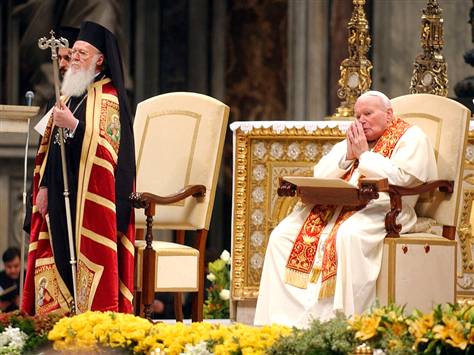 1995 was a significant year for Orthodox-Catholic rapprochement. The late Pope John Paul II wrote an encyclical on Christian unity (about which I then wrote a book that the current pope commented on, if this post is to be believed) and almost simultaneously published another letter, Orientale Lumen, urging Catholics to get to know the treasures of Eastern Christianity in order that the Church would again (to use a favourite, if somewhat tiresome, metaphor of the late pope, which was not original to him but, if memory serves, came from Congar and was not unproblematic insofar as it seemed to overlook the Syriac tradition, as Sebastian Brock suggested) "breathe with both lungs, East and West." Frankly acknowledging that most Latin Catholics are entirely ignorant about the Christian East--and not merely Orthodoxy, but the millions of Eastern Catholics in their own communion--the pope asked the former to get to know those latter two in some detail. Nearly two decades after that request, I am regularly staggered by how little progress has been made notwithstanding a great, even ardent, interest in the East when some Latins do discover it. All of my Roman Catholic graduate students, e.g., are deeply drawn to the East and have been for some time, and when we read Eastern sources they cannot get enough of them and constantly hunger for more. But they are, it seems, a rare exception.
When Catholics and other Western Christians do look East, one of the first things they are often drawn toward is Eastern liturgy, about which not a little romanticism and myth-making has long endured. (This Robert Taft article should begin the process of disabusing one of those romanticized myths.)
Liturgy, thus, has loomed large in Eastern consciousness, and in Western consciousness of the East (recall Taft's frequent temptation to write a book "Inventing Eastern Orthodoxy," one chapter of which, he has often said, would be "Inventing Eastern Liturgy"). And so it is appropriate, as the West continues to learn about the East, that it begins with liturgy and prayer. It is, then, a welcome development to have, just in time for Christmas, a short and charming little book that I hope many Roman Catholics (and many other Christians, East and West, who will doubtless benefit) find under their trees this December: J. Michael Thompson, Lights From the East: Pray for Us (Ligouri, 2013), 144pp. This book will not only be educational about important figures of the East, but--more important--it will help people to pray.
About this book the publisher tells us:
Catholics worldwide are increasingly heeding the call of the late Pope John Paul II to breathe spiritually "with both lungs"-to be inspired by both Western and Eastern Christianity. Yet many Catholics are unaware that the Roman Catholic Church is in communion with twenty-two other Churches, which together comprise the Eastern Catholic Churches. Focused on Eastern holy ones Lights From the East presents incredible riches to English speakers worldwide, including icons, biographies, Scripture, reflections, translated quotations from the service that honors the saint, prayers, and original hymns set to Rusyn or Galician melodies.This is the kind of book, I think, that one dives into from time to time rather than reading systematically straight through. It is like several other collections I have seen--a kind of "breviary" of a sort, with scriptural, liturgical, and iconographical texts and plates tied to the liturgical year commemorating saints in five categories: those of the Old and New Testaments; the Fathers and Mothers of the Church; monastics; saints common to East and West; and martyrs of the twentieth century. As such, this book would be ideal for those asked to lead a reflection at the start of a parish Bible study, say, or before a class, or for family reading at home to inspire the imaginations of children, particularly on the feast days of those feted herein.
Unlike other similar collections, the outstanding feature of this book is its inclusion of liturgical music. The author is a well-known and highly accomplished liturgical and pastoral musician, and virtually all of the hymn texts and translations here are his own work, often a rendering into elegant English of Slavonic or Ukrainian or other Trans-Carpathian sources. (Last year the author graciously sent me a very lovely CD of prostopinije music for the Great Fast which I have listened to repeatedly since then.) As one who deeply loves Galician and Kievan chant, but who cannot (as my late grandmother used to say, of herself and many of her relations) "carry a tune in a bucket," this book is handy to have, and to give to those more musically talented than I, in the hopes that they will learn something of the beauties of East-Slavic chant in its various forms, and begin to make them more widely known--as well as the stories of some of those East-Slavic saints killed by the Nazis and Communists in that century of tears to which we recently bade farewell but from whose clutches we are not yet free.
I warmly commend this spiritually edifying little book and its author, whom I hope to interview in the coming days.
Thursday, August 9, 2012
Praying as and with the Early Christians
When, earlier this year, I interviewed the incredibly prolific John McGuckin, he mentioned the release this year of the latest of his many books: Prayer Book of the Early Christians (Paraclete Press, 2012), 224pp.
I received a copy of this book from the publisher earlier this month. About this book the publisher tell us:
This is a handsome book, well laid out in a way that makes it suitable indeed for personal devotion. It contains a lovely sample of prayers and texts from a variety of Eastern liturgical families--primarily the Byzantine and Syriac but also the Coptic and Latin. It contains simplified versions of Byzantine vespers and orthros, as well as the so-called small hours--along with a large selection of prayers for all kinds of occasional uses and needs. With a deftly light hand, McGuckin has written a brief introductory essay, and occasional brief "rubrical" note before certain prayers or disciplines. Happily the book eschews the use of hieratic English--a silly affectation among modern Orthodox Christians--but is nonetheless written in clear, crisp, elegant English. Warmly recommended.
Designed for any 21st-century Christian, this prayer book gathers prayers and rituals from the ancient Church (especially early Greek Christianity), re-presenting them for the use of Christians at home, in small prayer groups, cohorts, and house churches. It offers a structure of prayer offices and blessing rituals for all times of day and year, and articulates many religious needs including bereavement, house blessing, praise, worry, gratitude, and thanksgiving.
This is a handsome book, well laid out in a way that makes it suitable indeed for personal devotion. It contains a lovely sample of prayers and texts from a variety of Eastern liturgical families--primarily the Byzantine and Syriac but also the Coptic and Latin. It contains simplified versions of Byzantine vespers and orthros, as well as the so-called small hours--along with a large selection of prayers for all kinds of occasional uses and needs. With a deftly light hand, McGuckin has written a brief introductory essay, and occasional brief "rubrical" note before certain prayers or disciplines. Happily the book eschews the use of hieratic English--a silly affectation among modern Orthodox Christians--but is nonetheless written in clear, crisp, elegant English. Warmly recommended.
Subscribe to:
Posts (Atom)
