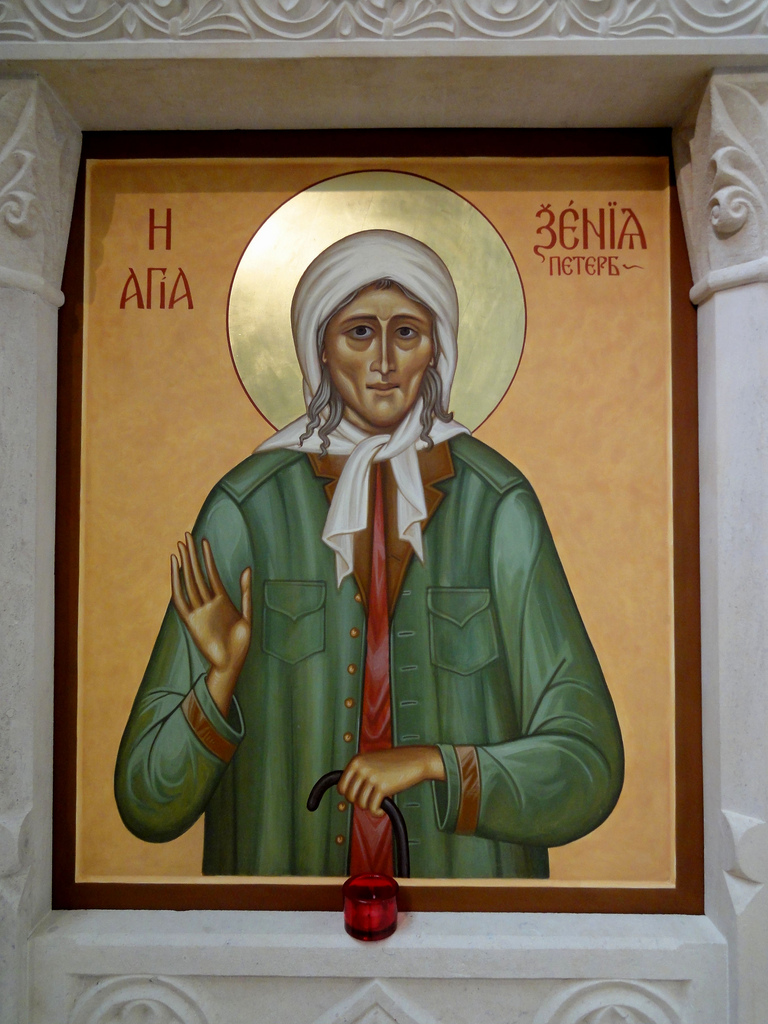
I've had a chance to interview Svitlana Kobets about this book and here are her thoughts:
AD: Tell us a bit about your background, research
interests, and other publications.
Both I and my colleague and co-editor
of the present volume, Priscilla Hunt, have a shared background in
Slavic and medieval studies and a long-standing
research interest in the phenomenology of holy foolishness.

Ever since my graduate studies at the University of Illinois at Urbana-Champaign, the
phenomenology of holy foolishness and its versatile adaptations in Russian literature and culture have been in the focus of my research. My doctoral
dissertation, entitled Genesis and
Development of Holy Foolishness as a Textual Topos in Early Russian Literature
(UIUC 2001), as well as my post-doctoral LMS thesis, The Prophetic Paradigms: the Fool for Christ and the Hebrew Prophet (PIMS 2009), place Russian foolishness in Christ within the context of medieval Russian literature, popular culture, and the socio-cultural history of Byzantium,
Kievan Rus', and Russia. As I continued my
research, I compared (in several articles) the Russian holy fool with his counterparts from other
cultures and discussed various
aspects of the paradigm of holy foolishness in several other articles. Holy foolishness, the Middle Ages, and Christian ascetic
traditions also provide the methodological edge for my literary critique and
the venue for an exploration of contemporary literature.
My recent article "Holy
Foolishness and its Hellenistic Models: Serapion the Sindonine or Serapion the
Cynic?" (forthcoming in a compilation Rewriting Holiness [KCLMS, UK]),
explores the impact of the Cynical movement on the Christian hagiographic
traditions about holy foolishness. My contribution to the present compilation
discusses the clash and the reconciliation of historical and textual realities
in the vita of the first Kievan—and later on Ukrainian and Russian—fool for
Christ, Isaakii of the Kiev Caves Monastery.
As for current projects, I am working on a monograph
entitled The Holy Fool in Russian
Literature and Culture, in which I explore cultural idiosyncrasies of
Russian foolishness for Christ, its relationship to the Byzantine prototype,
and its textual evolution in Russian religious and secular literature.

My colleague and
co-editor, Priscilla Hunt, has a wide range of
research interests (medieval Russian literature, theology, iconography)
including the phenomenology of holy
foolishness.
Hunt’s innovative study of Ivan the Terrible’s holy foolery
entitled, "Ivan IV’s Personal Mythology of Kingship," offers a versatile
and most comprehensive treatment of the issue of Ivan’s orientation toward the
behavioral paradigm of foolishness in Christ. Another subject of her research,
Archpriest Avvakum, is an important cultural figure who extensively relied on
the behavioral paradigm and theology of holy foolishness. In her scholarly work Hunt examines a variety of texts,
including hagiography and iconography to understand how poetic structure
embodies culturally specific models of the self, the state, history, and the
world. She wrote widely on the autobiography and other writings of the
Archpriest Avvakum in the 17th century; works from the age of Ivan IV and the
ritualized behavior and writings of Ivan IV himself; Wisdom icons from the
early 16th and 15th centuries as well as the Wisdom iconography of light as it
evolved from the fifth to the fourteenth century to reflect the symbolism of a
sphere of light in the works of Dionysius the Areopagite and the Neo-Platonic
tradition. She is currently working on a monograph entitled Wisdom Builds her House: A Study in the
Poetics of Russian Identity. In her contribution to this volume, an
article entitled "The Fool and the King: The Vita
of Andrew of Constantinople and Russian Urban Holy Foolishness," Hunt
examines the holy fool’s show vis-à-vis a liturgical spectacle, involving the
imperial ritual of the Elevation of the Cross, approaching the latter as the
key to the former.
Iurodstvo
o Khriste, or foolishness
in Christ, is a peculiar form of Eastern Orthodox asceticism whose practitioners
feign madness in order to provide the public with spiritual guidance but eschew
praise for their saintliness. It has been noted on several occasions that iurodstvo is seminal for the
understanding of Russian national self-perception, that implicitly and
explicitly it provided material for the country’s aesthetic self-expression,
and that it is momentous for Russia’s
religious and philosophical worldview. While religious thinkers regard holy
foolishness as a unique form of non-institutional asceticism, their secular counterparts
perceive this phenomenon as a defining characteristic of the Russian religious
tradition, the one which distinguishes it from the religious traditions of the
West.
Another seminal characteristic of the fool in Christ is that, as a
liminal figure, in the cultural as well as the social sense the holy fool is
simultaneously oriented towards sacred and profane values, norms, and models.
Moreover, through his appearance, discourse, and behavior he simultaneously
affirms and challenges the stability and the very reality of the existing
social order and its values. In the figure of the holy fool the central
antinomies of the old and medieval Russia (folk culture/Christian
culture, blasphemy/piety, the individual/the public, the irrational/the
rational) are brought together and dynamically reconciled. The claim that the
whole of Russian culture, as well as the Russian people’s collective sense of
self, had been markedly influenced by this phenomenon, has been advanced on
several occasions.
AD: What led you to work on a book about holy
fools?
This book is a collective effort of scholars who
share interest in the phenomenon of Russian holy foolishness. Most of the
articles found in this book were first presented as papers at thematic panels
dedicated to different aspects of holy foolishness, which took place at a
number of international conferences, including the Medieval Congress in Leeds,
UK (2007), the International Congress of Slavists in Ohrid, Macedonia (2008),
the annual meeting of the Association for Slavic, East European and Euroasian
Studies (2009) and the Conference of the Canadian Association of Slavists,
Ottawa (2009). These panel discussions not only brought together
colleagues from different spheres of Slavic studies but also brought to the
fore diverse and dynamic character of contemporary scholarship dedicated to
holy foolishness. Our volume brings their interdisciplinary and innovative
research to the broad reader.
AD: Your subtitle of course refers to "new
perspectives." What is new in the study of holy fools today?
In the last two decades the subject of holy foolishness, its phenomenology and history as well as
its adaptations in Russian literature and culture came to the scholarly focus
with renewed intensity. Sergei Ivanov’s ground-breaking monograph Byzantine Holy Foolery [Vizantiiskoe iurodstvo] (1994) (expanded
and translated edition Holy Fools in Byzantium and Beyond (Oxford Studies in Byzantium), became the first scholarly history of the
phenomenon of Byzantine iurodstvo,
making possible a more informed dialogue about its various cultural meanings.
At
the same time, there appeared works of literature and art that draw in a
variety of ways on the phenomenology of holy foolishness. A number of
dissertations, articles, and book-length studies on the subject followed.
Studies of holy foolishness and its literary/artistic adaptations go hand in
hand, delving into new aspects of the phenomenon and its different national
endorsements by Russian and Ukrainian cultures.
Our volume presents the most recent
scholarship on the subject of holy foolishness. Pioneering in several respects,
it offers the first and only English translation of the classic study of holy
foolish phenomenology, “Laughter as Spectacle,” by A. M.
Panchenko, who was the last century’s foremost Russian researcher of holy
foolishness; new discussions of miniatures accompanying the text of St.
Andrew’s vita; innovative explorations of hagiographical, historical, poetical, and liturgical aspects of writings about such seminal holy fools as Andrew of
Constantinople, Isaakii of the Kiev Caves Monastery, and Kseniia of St.
Petersburg; and new discussions of the adaptations of the holy fool’s
phenomenology by modern and post-modern literature and culture. Further, it
addresses foundational moments in the institutionalization of holy foolishness:
the Church-calendar commemorations of holy fools inherited from Byzantium; the
first Russian narrative describing holy foolishness as a form of asceticism;
the first Russian holy foolish vita with verifiable facts about the
protagonist’s life; the first Russian canonized female holy fool, Kseniia of
St. Petersburg; and comprehensive treatments of holy foolery’s cultural significance for Leningrad underground poets, Soviet and post-Soviet
performance art, and postmodern thinkers.
AD: Would you say that we have seen an evolution in
the "type" of holy fool over the last several centuries? In other
words, are there fools today, and are they different from historic fools like
St. Isaak of the Kievan Caves, St. Basil the Fool, or St. Kseniia of St.
Petersburg?
There are ‘yes’ and ‘no’ parts in the answer to
this question. On the one hand the great variety of holy foolish types
described in early Byzantine texts did not become outdated and accounts for the
contemporary holy foolish types just as well. On the other hand, as a live
phenomenon enduring in changing socio-historical circumstance, holy foolishness
cannot but change and assume new forms, both in liturgical and artistic spheres.
When we talk about the types of holy fools,
evolution of this cultural paradigm and the phenomenology of holy foolishness
in general, we have to keep in mind that fools for Christ of late antiquity, of the medieval period, and even of early modern times are available to us only through their
textualizations--mostly hagiographic portrayals. Hagiographies of such famous
holy fools as St. Andrew, St. Isaak, St. Basil, and St. Kseniia are hardly
dependable portrayals of historical individuals. As I argue in my article about
St. Isaakii, the tale about this holy fool, at least in part, was based on factual
materials, but foremost it is a textual construct. Isaakii’s hagiographer was
most likely dealing with a case of real mental derangement rather than with an
ascetic feat of feigned madness. However, he successfully dealt with this
problem as he interpreted Isaakii’s bizarre personality and aberrant behaviors
in terms of the intentional provocation of abuse and voluntary martyrdom of a
holy fool.
St. Basil (Vasilii) the Fool of Moscow can be found in the municipal
records of the early sixteenth-century Moscow
and there is evidence that Kseniia of St. Petersburg was a historical person as
well. Although, just like in the case of Isaakii of Kievan Caves Monastery,
there is no evidence that the latter two were iurodivye. At the same time, there are vitae, which reflect
verifiable records of holy fools’ lives. Such is the vita of Simon of Iurievets,
which Sergei Ivanov discusses in his article, "Simon of Iurievets and the Hagiography of Old Russian Holy Fools." Ivanov argues that the hagiographical account of Simon of Iurievets’ life was
tailored by his contemporaries to fit the literary paradigm of holy
foolishness.
Thus, we might as well be talking about two types
of accounts of holy foolishness, one that is represented by hagiography and
iconography and another one that bases itself on historical records and
verifiable facts. These two overlap, diverge, and rely on each other. Both of
them served as an inspiration for artistic creations, which represent yet
another side of the story about Russian holy foolishness. Therefore, when we
talk about the evolution of the “type” of the holy fool and the continuity of
the tradition of holy foolishness, we need to account for hagiographic,
historical, and literary aspects of the this tradition. All of them have their
idiosyncrasies and all of them had an impact on the contemporary Russian scene. Ivanov’s
article about Simon of Iur’evets, Shtyrkov’s article about Kseniia of St.
Petersburg, and my article about Isaakii of the Kievan Caves Monastery all
discuss interconnections between factual and literary components in these
saints’ canonized images and their differences vis-à-vis their Byzantine
models. Marco Sabbatini’s article offers an insight into the intricacies of the
interactions of the tradition of Russian holy foolishness as a consciously
adopted behavioral model. He explores its role as an inspiration for poetry as
well as quest for liberty and protest in the Leningrad underground of the 1970s. Laura
Piccolo discusses emulations of holy foolishness as well as its parody by
contemporary Russian performance artists. These articles show that the holy
fool endures in Russian culture both as an artistic derivation and a religious
type.
 Since we are talking about the holy fools today, I
would like to note that the iurodivy
is presented seemingly only in hagiographies whereas in real life it is always a
controversial, sordid, and even appalling figure, which does not make acceptance
of his message easy for the onlookers. This year’s performance of the Russian
punk feminist group Pussy Riot in the Cathedral of Christ the Savior in Moscow is the most recent
example of a holy foolish disturbance, an ugly yet called for spectacle.
Since we are talking about the holy fools today, I
would like to note that the iurodivy
is presented seemingly only in hagiographies whereas in real life it is always a
controversial, sordid, and even appalling figure, which does not make acceptance
of his message easy for the onlookers. This year’s performance of the Russian
punk feminist group Pussy Riot in the Cathedral of Christ the Savior in Moscow is the most recent
example of a holy foolish disturbance, an ugly yet called for spectacle.
 The show
of the young women, who sang a prayer “Mother of God, chase away Putin,” thus
protesting against Putin’s recent election to presidency, indeed brings to mind
the audacity of the holy fool vis-à-vis the tyranny of those in power. Pussy
Riot triggered an upsurge of heated discussions of holy foolishness and its
relevance for today’s Russia.
The fact that for their unorthodox performance the young women are facing
criminal charges and up to seven years of imprisonment tells us the harsh truth
about today’s Russia’s
rejection of their iurodivye.
The show
of the young women, who sang a prayer “Mother of God, chase away Putin,” thus
protesting against Putin’s recent election to presidency, indeed brings to mind
the audacity of the holy fool vis-à-vis the tyranny of those in power. Pussy
Riot triggered an upsurge of heated discussions of holy foolishness and its
relevance for today’s Russia.
The fact that for their unorthodox performance the young women are facing
criminal charges and up to seven years of imprisonment tells us the harsh truth
about today’s Russia’s
rejection of their iurodivye.
AD: After the collapse of the East-Roman or Byzantine Empire, the holy fool disappears among almost
all Eastern Christians except for the Russians and Ukrainians. Why has this
figure retained such a place among East-Slavs? Is there something unique about
East-Slavic culture that seems to allow for the on-going place of fools that
other cultures may have lost?
The intriguing question about reasons for Russia’s unique
predilection for holy foolishness has been ever popular and hypotheses are
many. The majority of them, however, are speculative. For example, an American
scholar, Ewa Thompson, finds the explanation in Russian “national character.” A
number of Russian and Western scholars are in agreement. Another hypothesis by
a historian of Russian culture, George Fedotov, holds that the holy fool
appeared on the Russian socio-historical arena to reinstate Russia’s
spiritual balance, which had been severed after the decline of saintly princes.
In my recent study of the role that the model of the Hebrew prophet played in
the formation of the paradigm of holy foolishness, I trace the connection
between these two cultural paradigms. I suggest that in Russia these
two cults went hand in hand and that the former informed the latter. I believe
that prominence of the Hebrew prophet in early Russian Christianity was an
important contributing factor to the emergence and escalation of the cult of
the iurodivyi. I also believe that there were a number of factors that brought about the holy fool’s prominence in Russian culture. At this time,
however, there is no comprehensive study that would account for a variety of
reasons for the holy fool’s importance to Russian culture and the question why
Russians and no other Christian nation have had a canonical category of fools
for Christ’s sake remains open.
AD: Are there major differences between Slavic
fools (such as St. Basil, after whom the famous Kremlin cathedral is named) and their Byzantine predecessors --people like St. Andrew of
Constantinople, or St. Simeon Salos?
Here again, we are talking about texts and
hagiographic types rather than real individuals. One of the differences between
the two traditions is the superior craftsmanship of Byzantine hagiographers.
The explicit description of the holy fool’s folly is an important distinct
feature of the Byzantine hagiography, which stands in sharp contrast to Russian
iurodivy’s down-played foolery.
Russian vitae almost never present the iurodivy
as a blasphemer (St. Basil’s destruction of an icon is a rare exception) nor
are there any colorful descriptions of the holy fool’s transgressions. Scenes
with prostitutes comparable to those found in vitae of Simeon of Emesa or
Andrew of Constantinople or instances of the fool’s defecation in the street
are unthinkable in Russian vitae. Another distinct mark of the Russian
tradition is that the holy fool’s madness often received an essentially new
interpretation: it would be seen as real, yet would be invested with divine
connotations. Hellenistic influences, which we discern in the
Byzantine vitae are important and prominent whereas Russian hagiography of holy foolishness mostly drew on the Hebrew
tradition.
AD: Some Orthodox theologians such as Kallistos
Ware have suggested that fools blur the boundary between
eccentricity and insanity, raising the question: are these people really mad or
not? Ware suggests we do not need to be too concerned about psychoanalyzing
fools so much as listening to their message. What are your thoughts on the use
of modern psychology in trying to understand iurodstvo?
Kallistos Ware points to the very core of holy
foolishness. The iurodivyi is indeed
a madman and a sage, a prophet and a pariah who always vacillates between
sacred and profane realms. I believe that the attempts to psychoanalyze the
holy fool would not bring us any closer to understanding of this phenomenon or
its cultural role. Practitioners of psychoanalysis usually chastise Russia for its
odd cult and condemn the holy fool as an aberration. For example, an American
Slavist, Rancour-Laferriere, considers both the holy fool and by extension the
Russian nation that worships him, practitioners of masochism. I think the
scholar’s goal should be to explore, describe, discover rather than condemn. I
totally agree with Ware that the holy fool’s insanity should not be of any
concern to his audiences. The paradigm of holy foolishness dictates that the
holy fool feigns madness and that the question is not whether he or she is
really insane but how the onlookers react to his alleged madness. By presenting
himself to the world as a feeble-minded, marginal individual, the holy fool
exposes himself to society, to its cruelty or mercy. The holy fool’s hagiography
and mythology posit that he is a sinner in the eyes of the sinners and a holy
man in the eyes of the righteous ones, yet the drama of recognition plays
itself out over and over again. The iurodivyi
has always been—and remains today—the benchmark of the society’s mores and each
individual’s personal ethos.
AD: Your introduction to this volume notes that
fools were especially common in 15-16th centuries. What was it about that time
that made fools so popular and prevalent? What was it that caused their
revival, as you later note, in the 19th and early 20th centuries?
The 15th and especially 16th centuries
yield the biggest number of holy fools’ canonizations and largely because of
that are considered centuries of the climax of the holy fool’s popularity as
Russia’s saint. I believe that there were several probable contributing
factors. Among them is the popular recognition of the holy fool’s messianic
role as a prophet. In the reign of Ivan the Terrible (1530-1584), which was the
time of unrelieved tyranny and oppression, the holy fool’s audacity vis-à-vis
the tyrant supposedly solicited him favor among common people. It is during the
16th century that the Russian mythology of the holy fool sees a new
development and his hagiography gains a new topos: the holy fool starts being
portrayed as the mouthpiece and protector of people. The canonization of St.
Basil the Fool of Moscow became yet another contributing factor to the
furthering of the holy fool’s popularity.
In the end of the 16th
century, the Russian Church pronounced St. Basil the Fool Russia’s
national saint in order to support Russia’s claim to the status of an independent patriarchate in the Orthodox world. (I discuss this issue in my upcoming monograph The Holy Fool in Russian Culture.) In the
nineteenth century, the revival of the cult of holy fools went hand in hand with
such socio-cultural developments as Russia’s search for national
identity and the revival of the Church. The same factors are at play today, in
the twenty-first century. In the present volume, Swedish scholar Per-Arne Bodin
addresses the question of the renewed popularity of the holy fool and holy
foolishness in post-modern culture. I would also like to observe that in
today’s Russia
the phenomenon and behavioral model of holy foolishness remain as urgent as
ever. An unfortunate yet telling trigger for the urgency of the solo protest
staged by the holy fool proceeds from a number of characteristics that
contemporary Russia shares
with medieval Muscovy. Just like in the Middle
Ages, there is today a deep gap between the government and the people—the corruption and
self-serving position of the former and the subdued status and suppressed
rights of the latter—that calls for the brash voice and intervention of the
holy fool.
AD: Until the recent canonization of St. Kseniia of
St. Petersburg,
holy foolishness seems to have been the almost exclusive province of men. Do
you have any thoughts on why that is?
It is true that St. Ksenia of St. Petersburg is the only Russian canonized
female holy fool and that male holy fools figure much more prominently in
Russian hagiography as well as in scholarly discussions. At the same time, the
first portrayal of the holy fool, the anonymous nun in Palladius’ Lausaic
History (nun by the name of Isidora in the rendition of Isaak Syrian) is that of
a female. We also have historical evidence about female holy fools from the
notes of foreign travelers (Massa,
XVII c.), sketches of Russian ethnographers (Pryzhov, XIX c.), and accounts of
contemporary church historians (Hieromonk Damaskin [Orlov], 1992), all of whom
describe a number of female fools for Christ. One of the most famous
nineteenth-century holy fools, Pelagiia Ivanovna Serebrennikova, spiritual
daughter and follower of Serapion Sarovskii, awaits canonization. As we learn
from her vita about hardships and hindrances, which she encountered on her way
to holy foolishness, we come to appreciate how difficult it was (if not next to
impossible) for a healthy, mentally normal woman of a child-bearing age (both
before and after her marriage) to undertake the ascetic exploit of holy foolishness.
Nonetheless, female holy fools have always been a part of the tradition of holy
foolishness. If they are fewer in numbers and less noticeable than male iurodivye, it was probably because they, just like the
Desert Mothers, have always been in the
shadow of their male counterparts. Nevertheless, the canonization of St. Kseniia of St. Petersburg in 1988 marked the importance of this cultural type for the post-Soviet era and the contemporary Russian world.
AD: Much of your introduction very helpfully
reviews the state of the literature about fools in various languages. Are we
seeing a revival in scholarly study today of holy fools?
Yes, we are certainly seeing a revival of scholarly
interest in the phenomenology, history and textual appropriations of holy
foolishness, which is evident from the sheer volume of publications of primary
and secondary texts on this topic. The articles included in the present volume are not only
representative of a wide thematic scope and multi-disciplinary nature of
contemporary approaches to holy foolishness but also provide commentary on its
enduring urgency for today’s Russia.
AD: You conclude by noting that this new volume
marks the "bicentenary of scholarship devoted to holy foolishness."
What areas do you think still need further exploration today and in the years
ahead?
Holy foolishness still has a lot in store for its
researchers, both historians (including comparative, church, and art
historians) and scholars of literature and culture. A major lacuna in the
studies of holy foolishness lies on the junction of Byzantine and Russian
traditions. It is yet to be explored through what venues and in what forms
(languages, redactions) Byzantine texts relevant to the tradition of holy
foolishness were transmitted to Eastern Slavdom. While researching texts, which
were instrumental to the formation of the Russian tradition of holy
foolishness, it will be also of great interest to see how the same texts had an impact on other Christian, especially Western European, cultures. Moreover, the venues of transmission to the
Slavic world and Russia
of the seminal for the tradition of holy foolishness text, The Vita of Simeon of Emesa, remains almost completely unknown.
Overall, Slavonic and Russian translations of Simeon’s vita, their availability
to and influences on the Russian tradition of holy foolishness remain
unstudied. Illuminated vitae of holy fools have received very scarce attention--as did Russian iconography of fools for Christ. Our compilation features two
pieces on the illuminations of the Vita of St. Andrew of Constantinople
(Bubnov, Kobets). Other important yet virtually unstudied issues include holy
foolishness in Ukraine;
the holy fool’s place within the tradition of Russian Old Believers;
ethnographic accounts of contemporary holy fools and the popular/folk dimension
of the tradition of holy foolishness. Meanwhile, the protean figure of the holy
fool and his diverse phenomenology continue to inspire artists of all genres,
creating new layers of the contemporary culture imbued with familiar spirit yet
always new imagery of holy foolery. In the light of this situation it will not
be an exaggeration to say that studies of holy foolishness have a lot in
store for scholars that will not be exhausted in the foreseeable
future.