"Let books be your dining table, / And you shall be full of delights. / Let them be your
mattress,/
And you shall sleep restful nights" (St. Ephraim the Syrian).


Showing posts with label Oliver Herbel. Show all posts

Friday, October 26, 2018

North American Churches and the Cold War

Eerdmans recently put into my hands a very impressive collection edited by Paul Mojzes, North American Churches and the Cold War (2018), 560pp.

It is a substantial collection of considerable size and range. I am especially cheered to see included two sections that one rarely finds in collections like this--or, if one finds them, then they are invariably tiny and begrudging: thus we have a hefty first section devoted entirely to Canadian church history in six chapters; and another section with five chapters devoted to Eastern Orthodox Churches. (Too many collections, if they include either section, usually have one token contribution in it.)

In the former, I recognize with fondness the name of Lois Wilson, author of the chapter "Canadian Churches and the Cold War 1975-90." Growing up in Canada in the 1980s and 1990s, you could hardly avoid the name of Lois Wilson if you paid any attention to both ecclesial and political affairs. She was elected moderator--the first woman to hold that position--of what was then the largest Protestant body in the country, the United Church of Canada. She came out of the social gospel tradition of Western Canada from which, in part, the inspiration for the Canadian universal healthcare system emerged. I met her in the fall of 1990 at a preparatory meeting in Quebec City for those us going to Canberra, Australia in February 1991 for the seventh general assembly of the WCC, of which Wilson was then one of the seven outgoing presidents. Her reputation as a dynamo did not disappoint, and I think I had a mild but instant crush on her.

The latter section, on the Orthodox Churches, contains chapters by names familiar to all, including those I am glad to call friends.

The section leads off with a chapter by Leonid Kishkovsky, "The Orthodox Church in America: Steering Through the Cold War."

This is followed by Nicholas Denysenko (see my recent interview with him here) authors the chapter "Sustaining the Fatherland in Exile: Commemoration and Ritual During the Cold War."

Andrei V. Psarev and Nadieszda Kizenko co-wrote "The Russian Orthodox Church Abroad, the Moscow Patriarchate, and Their Participation in Ecumenical Assemblies during the Cold War 1948-64."

Lucian Turcescu, who has written about Orthodox Churches and Cold War (as well as post-Cold War) politics in Romania itself, here authors "Fascists, Communists, Bishops, and Spies: Romanian Orthodox Churches during the Cold War."

D. Oliver Herbal (see my interview with him here about his splendid book Turning to Tradition) rounds out this section with his chapter, "Redressing Religious Freedom: Anti-Communism and the Rejection of Orthodox Christianity as the 'Fourth Major Faith'."

Before and after these two sections, there are chapters on "Evangelical Approaches," "Peace Activities," "Roman Catholic Approaches," "US Mainline Protestant Approaches" and a final section, "Lessons Learned."

All told, as the publisher tells us, this book fills a considerable gap:
History textbooks typically list 1945–1990 as the Cold War years, but it is clear that tensions from that period are still influencing world politics today. While much attention is given to political and social responses to those first nuclear threats, none has been given to the reactions of Christian churches. North American Churches and the Cold War offers the first systematic reflection on the diverse responses of Canadian and American churches to potential nuclear disaster.
A mix of scholars and church leaders, the contributors analyze the anxieties, dilemmas, and hopes that Christian churches felt as World War II gave way to the nuclear age. As they faced either nuclear annihilation or peaceful reconciliation, Christians were forced to take stands on such issues as war, communism, and their relationship to Christians in Eastern Europe. As we continue to navigate the nuclear era, this book provides insight into Chris-tian responses to future adversities and conflicts.

Saturday, March 25, 2017

Reading Dreher with Schmemann and MacIntyre (and thus Marx)

After having written something in 2015 about Rod Dreher's project of marketing MacIntyre's concluding (and regretted) peroration to After VirtueI decided to not bother with the "Benedict option" any more pending the release of the book, which is now upon us.

In the meantime I had hoped the nascent book might deal with serious issues in a way that Dreher's journalistic jottings up to 2015 had not manifested--not least in its relentlessly tendentious treatment of one paragraph of MacIntyre while neglecting many more important essays and books of his, not the least of which is Secularization and Moral Change.

Dreher did not read Secularization and Moral Change, and we know this from the potted history he gives us as when, e.g., he insouciantly claims that "the loss of the Christian religion is why the West has been fragmenting for some time now, a process that is accelerating" (22).  MacIntyre--who is as much an intellectual historian as he is moral philosopher--writing in 1967, having laid out in this book (as well as other places--e.g., A Short History of Ethics) abundant historical evidence for his thesis, argued forcefully that “the view that moral and social change is consequent upon the decline of religion is false, and the view therefore that such change could be arrested or could have been arrested by halting the decline of religion is also false. I have argued instead that the causes of moral and social change have lain in the same urbanization and industrialization that produce secularization” (p. 58; my emphasis). While Dreher nods his head towards the Industrial Revolution, he never really takes MacIntyre seriously and investigates the role of urbanization and industrialization. Nor, worse, does he do the only sensible thing and pursue a critical analysis of the role of economics beyond the dominant neoliberal paradigm. We shall return to this problem presently.

Though I have every sympathy with Dreher's evidently sincere desire to see Christianity flourish everywhere possible, I regret to say that Dreher's book offers little that is new and fresh to assist with such a task. It is, rather, wreathed about with the stale air of apocalypticism on the cheap. In reading Dreher I was ineluctably drawn back to a passage from the great Orthodox liturgical theologian Alexander Schmemann's Journals: "In the Bible, there is space and air.  In Byzantium the air is always stuffy, always heavy, static, petrified."

In fact, several passages from Schmemann came back to mind in reading Dreher, whose book fixates on same-sex marriage and gender issues to an unhealthy and unhelpful degree. None seems more acute or appropriate than this one: In March 1976 during Lent, Schmemann wrote: "Students' confessions. Always sex. I am beginning to think that this sin is useful; otherwise they would consider themselves saintly and plunge into guruism." Dreher's entire project reeks of guruism.

It is, of course, the nature of gurus that they must convince you of their epistemological superiority, as it were: they know things that you cannot possibly know, or know as fully as the guru. And one of the things the guru knows is just how bad things are, and how badly you need his advice, his counsel and wisdom, his program and, especially, his merchandise to get you out of the deplorable state of affairs you are otherwise condemned to inhabit.

That is the most objectionable feature of Dreher's book: its profiteering on the back of despondency and determinism as manifested in several such claims as "the wave cannot be stopped, only ridden." Or when he counsels Christians to build an "ark" instead of fighting "unwinnable political battles" (12). Or when he flatly insists that "the new order is not a problem to be solved but a reality to be lived with" (18).

These claims are theologically objectionable insofar as he presumes to know that nothing can be changed, and thus there is no room for the virtue of hope.

These claims are objectionable also on historical grounds, for while Christianity has dwindled and even died off in parts of the world at different points of history (see the history of the Assyrian Church of the East for the clearest example of this), such a process is by no means inevitable or, as Dreher suggests, entirely out of our control. Such a process, moreover, forgets the surprising ways in which the Church can rebound precisely when, in worldly eyes, she seems to be at her weakest.

Those who are more literate in Catholic history than Dreher is can tell you that as recently as 1978 the Catholic Church was increasingly being written off by journalists like Dreher as having suffered mortal blows coming out of the 1960s (with the Sexual Revolution that Dreher tediously bores on about: "History's Most Revolutionary Revolution" [201]) and in the aftermath of the chaotic Second Vatican Council, which sapped the Church's energy and focus from within at precisely the moment she was also beset from without by seemingly inexorable political forces--communism, consumerism, etc. But along came the whirlwind from Poland to upend all expectations of decline, and to sow seeds of dramatic new birth, not least in Eastern Europe, but also elsewhere in the Church through new programs, communities, and movements. Many problems remain, to be sure, but it is undeniable that John Paul II gave new dynamism to the Church at a moment when some pundits were pessimistically predicting inexorable decline and doom, as Dreher is now doing with a grandly (if very superficially) ecumenical sweep that includes Protestants and Orthodox (whose own resurgence in the post-Soviet period, after far worse, and much more genuine, "persecution" than anything faced by Christians in America today, is ignored by Dreher).

At the turn of the 19th century, similar prognostications of decline and demise were made by many as the Church in the West was being clobbered in the aftermath of the French Revolution, and the rise of modern nation-states, including Italy, whose formation would deprive the Church of the Papal States which were thought--wrongly, as we now see, and as Pope Leo XIII [r. 1878-1903] himself quickly came to see--as being essential to the mission of the Church. But it was under Leo especially that the Church--and especially the papacy--found a new focus and dynamism and emerged into the twentieth century on an upward trajectory, aided in no small part by money gained as compensation from Italy for loss of the Papal States and as part of the Lateran Treaty process.

In the middle of the 16th century, in the heat of the Reformation and Counter-Reformation, the plight of the Church again looked dire to many, and even what ultimately proved to be the great reforming Council of Trent was, for some of the time, a very close-run thing that nearly fell apart. But ultimately Trent proved to be a success, and the Church was again on the move with new orders like the Jesuits and new dynamism that recovered much of what she had lost, and opened up new avenues, taking on new nations and continuing to grow globally.

Going back further still to the rise of the mendicant orders, the Church in the age of Dominic and Francis was, as is well known, thought by those giants, and many others, to be in a massive state of disrepair and dissolution, perhaps fatally so. But responding, so he believed, to the Lord's call to "repair my Church," the poverello of Assisi launched a reformation that is still going on more than 800 years after his death, as the Sisters who sponsor and run my own University of Saint Francis daily, cheerfully attest.

Knowing even just a little bit of this history must surely give one pause and reason to question Dreher's firm determination that Christianity in North America and Western Europe is finished, a judgment from which he seemingly permits no dissent. Examining Christian history all the way back to the beginning helps one to see that the Church has always been in a cycle of decline and rebirth, rising in some places at some times while sinking in others.

There are other serious problems with Dreher's recounting of history, not least his retailing of the discredited notion of "wars of religion" and his indifference--which nobody who takes MacIntyre seriously could ever justify--around the founding of the modern nation-state.

But arguably the most egregious flaw with Dreher's historical section (ch.2) is its attempt to describe the history of the Enlightenment without even mentioning, let alone having read, MacIntyre's Whose Justice? Which Rationality?, a book MacIntyre himself said was necessitated by what After Virtue didn't accomplish, left out, or needed to be further developed or changed. The convenient neglect of such a crucial if dense book reveals once and for all that Dreher's read of MacIntyre is entirely selective and tendentious.

Dreher's lack of familiarity not just with Catholic and broader philosophical history, but also with Catholic life in this country (and others) in any serious detail is really telling--apart, that is, from his boutique examples in Italy, Oklahoma, Maryland, etc. For there are plenty of Catholics I know who have been doing the things he has packaged together, and been doing them without fanfare for decades. There are, moreover, many Catholics emerging today--especially among the much-feared and much-derided "millennials"--who have a deep grasp of the faith and a deeper desire to live it. I see them every semester in my classes, and they give me a modest degree of hope.

Dreher goes on and on about "moralistic therapeutic deism" (never taking seriously some of the criticism of that claim and its research, which I have myself heard from other Catholic sociologists), but the Catholics I see in my classes are, with each passing year, farther and farther removed from that. He also makes much of the previous pope's comments about the "dictatorship of relativism," but with all due respect to Ratzinger, and again following MacIntyre (see his essay "Plain Persons and Moral Philosophy: Rules, Virtues, and Goods," American Catholic Philosophical Quarterly 66 [1992]: 3-19), my classroom experience has made it clear to me that nobody is ever really a relativist. When I have taught ethics and moral theology to students, disabusing students of a lazy relativism is an easy job by asking them to tell me how they live their lives when faced with significant moral choices.

I have now taught for almost 20 years in three countries at a number of Catholic institutions at both the high-school and university level. With each passing year my students seem, quietly and imperfectly, but firmly and hopefully, to be growing in the strength and depth of their faith. I find, therefore, Dreher's narrative of unrelenting decline to be extremely selective in its evidence, and plainly to ignore plenty of evidence I have myself seen first-hand.

So are my examples correct, and Dreher's wrong? Do my anecdotes trump his? I would not for a moment claim that. In fact, for a moment, let us suppose, that Dreher is more right than wrong about our particular moment in North American and West-European Christian history. Let us suppose Christianity is largely on life support, and may soon die out almost entirely. What is to be done? The answer he proposes to this is of course the "Benedict option."

But what kind of solution is this? Here remedy and disease seem almost indistinguishable, and here a deeper appreciation of MacIntyre could, perhaps, have rescued Dreher's project at the moment of its conception. For Dreher's project seems ab initio to have fallen into the very pit MacIntyre predicted not in After Virtue but in a 1979 essay "Theology, Ethics, and the Ethics of Medicine and Health Care: Comments on Papers by Novak, Mouw, Roach, Cahill, and Hartt" in the Journal of Medicine and Philosophy 4 (4): 435-443. There MacIntyre recognized the dangers of "the peculiarly deep secularization of our pluralist culture," which
offers traps to the theologians into which they continually fall. A culture of systematic unbelief would provide a relatively unambiguous context for theological utterance, while a pluralist culture offers an atmosphere of tolerant absorption through which the theologian is diminished and patronized and in which the theologian too often responds either by an anxious accommodation to the culture or by an equally adaptive reaction against it.
Dreher is clearly in the latter category, offering a reactionary take on this moment in our history. Like too many reactionaries he is a member of the bourgeoisie, proof of which can be seen in the very notion of a Benedict option, which can be dismissed as both harmless and irrelevant precisely because it has failed to offer us--as MacIntyre continues later in the same essay--"a theological critique of secular morality and culture," including, of course, the economics of late capitalism.

The "Benedict option," then, seems to participate too much in the fatalistic neoliberal economics of the culture it claims to resist. Dreher's whole project seems an example of the "normal nihilism" Stanley Hauerwas, himself hugely influenced by MacIntyre of course (but here, instead, drawing on James Edwards) describes thus:
Laid out before one are whole lives that one can, if one has the necessary credit line, freely choose to inhabit: devout Christian; high-tech yuppie; Down East guide; great white hunter. This striking transformation of life into lifestyle, the way in which the tools, garments, and attitudes specific to particular times and places become commodities to be marketed to anonymous and rootless consumers.
The whole "Benedict option" smacks of just such a "transformation of life into lifestyle," and its uses and abuses of Benedict have turned that great saint into a commodity to be marketed to "anonymous and rootless [Christian] consumers," alas.

In this regard, all those commentators worried about the political implications and applications of Dreher's proposal have nothing to worry about: he is simply not radical enough, for his proposal--to borrow Pickstock's language about the dreamy reforms of Vatican II--manifests "an entirely more sinister conservatism" that fails "to challenge those structures of the modern secular world that are wholly inimical to liturgical purpose."

Far from challenging, let alone overthrowing, those structures, Dreher beats an unseemly and hasty retreat from them and says the idea of anybody challenging them is pointless. Worse, Dreher sneers that those who still want to challenge the structures of the modern secular world are deluded. Those who do not read the signs as he does are dismissed as "the most deluded of the old-school Religious Right" or as out of touch as "White Russians" after the Revolution (12). But assertions do not arguments make, and such derisive dismissals as these merely underscore Dreher's very flimsy and intellectually fragile plaidoyer for a particular program that will appeal to people most like Dreher--middle-class American Christians.

But gurus have no greater insight into the future than anyone else. Indeed, gurus are especially to be put rather severely to the question (to use a MacIntyrean formula) precisely insofar as they try to see and say how things are and how they are going to turn out. Let us invent a law here--call it Merited Commensurability: the more adamant someone is in saying that such and such is bound to happen, the more we ought to greet such claims with the strongest skepticism.

I rather wish Dreher had a deeper recognition of the contingencies of culture and unpredictability of human events. At one point he edges up to such a recognition, saying "History is a poem, not a syllogism" (23) but he has no sooner delivered himself of that single line then he races back to what the psychoanalyst Vamik Volkan has called a narrative of "chosen trauma" in which the West is in inexorable decline, and persecution of Christians is coming in fast and thick as far as the eye can see. (Dreher's treatment of Freud [pp. 42-43] turns the latter into the usual sort of grotesque one would expect from those who have never read primary sources. Dreher reads everything through Philip Rieff's The Triumph of the Therapeutic: Uses of Faith after Freud.)

Dreher's overheated narrative of trauma and decline could have benefited from a hefty dose of modesty and restraint at the urge to predict the future. Here I rather wish he had some of the modesty as manifested, e.g., in Churchill's eloquent eulogy for Neville Chamberlain delivered in the mother of Parliaments in late 1940 after his predecessor's death:
At the lychgate we may all pass our own conduct and our own judgments under a searching review. It is not given to human beings, happily for them, for otherwise life would be intolerable, to foresee or to predict to any large extent the unfolding course of events. In one phase men seem to have been right, in another they seem to have been wrong. Then again, a few years later, when the perspective of time has lengthened, all stands in a different setting. There is a new proportion. There is another scale of values.
Dreher's "scale of values" inclines toward recommending such things ("options" indeed!) as deeper prayer and more frequent fasting, these being unobjectionable--indeed noble--in themselves.

But when they are packaged together with still further options enjoined upon others, and when especially they are read, as they only can be read, in light of his regular gastronomic ejaculations on his blog about oysters and mustards, or, now, the bourbon cocktail invented by a friend and called the "Benedict option," I could not help but think of another work of MacIntyre's that Dreher seems never to have read, viz., Marxism and ChristianityThere MacIntyre says of the Tractarians and the "ascetic disciplines" (weekly communion, intense local community life, regular fasting, auricular confession, and other devotions practiced in ritually resplendent churches) which they commended to everyone that these disciplines "were of a kind possible only to a leisured class."

Like most members of the leisure class, Dreher evidences little interest in the social environment flourishing on a wide scale, preferring only that it do so for the small communities he advocates, and, of course, for himself. Though Dreher commendably says at one point, "love the community but don't idolize it" (137), the rest of his book is precisely such near-idolatry. Here again one can only note that a deeper, more sophisticated engagement with MacIntyre would have saved Dreher from such fatuities.

In dozens of places, MacIntyre has offered repeated demonstrations of, and arguments against, what he calls the "communitarian mistake" which is premised upon "a further mistake...that there is anything good about local community as such" because those "communities are always open to corruption by narrowness, by complacency, by prejudice against outsiders and by a whole range of other deformities, including those that arise from a cult of local community" (Dependent Rational Animals142; my emphasis). To avoid such problems and deformities, local communities must engage in many things, including "a rejection of the economic goals of advanced capitalism" (Ibid., 145). Dreher seems totally uninterested in any such rejection.

It is more than a little amazing that Dreher seems to lack self-awareness of how such advanced capitalism makes his peripatetic blogging life possible, but makes many of his proposals impossible for too many other people, who must pick up and move far from family and community merely to survive economically. Here we must include his praise of "stability" (65-67), his advocacy that one must "live close to other members of your community" (129-34), his insistence that public schools be abandoned and people should home-school their kids (165-66), and his impertinent demand that "church can't just be the place you go on Sundays--it must become the center of your life" (131). Try recommending any one of these things, never mind all of them (and still others he recommends) to the people working three jobs just to pay rent and forced to relocate every few years when jobs disappear.

Incidentally, those Tractarians recommending such ascetic disciplines as Dreher does, and those practicing them, did not always have an easy time of it in the Church of England of the late 19th century. There was considerable opposition to many of these proposals, as John Shelton Reid's fascinating book Glorious Battle: The Cultural Politics of Victorian Anglo-Catholicism showed. In the end, the "ritualists" and Tractarians, when they did not decamp for Rome, were reduced to a Dreher style of pleading merely for the right to be left alone pursuing their "option" for what Cardinal Manning came caustically to call "private judgment in gorgeous raiment, wrought about with divers colours."

Newman, of course, came to loathe private judgment. In his Apologia Pro Vita Sua and then especially in his famous Biglietto speech, he denounced private judgment as just another species of liberalism. Newman, acutely aware of the contingencies of history, especially Christian history, and loathe to make the sorts of facile prognostications that Dreher does, ended that speech in Rome after being given a red hat by Leo XIII with this apt reminder:

Christianity has been too often in what seemed deadly peril, that we should fear for it any new trial now. ... Commonly the Church has nothing more to do than to go on in her own proper duties, in confidence and peace; to stand still and to see the salvation of God.

Dreher is not content to stand still and see the salvation of God. His busybody guruism seeking to safeguard "orthodox Christianity" is, as MacIntyre suggested decades ago, a typical reaction of the leisure class that often has the greatest tendency to fixate (as Kate Daloz has recently shown in fascinating detail) on simplicity, intentional community, and various forms of voluntary self-denial--whether in monasteries or pseudo-monastic communities. It is the leisure class especially among converts to Orthodoxy (in what Amy Slagle has aptly called the The Eastern Church in the Spiritual Marketplace: American Conversions to Orthodox Christianity) who most often seem to fetishize monasteries, who have the time and money to obsess over "monasticism" and "tradition" in psychologically suspect ways, running after their "spiritual fathers" for permission to pee or clip their toenails on Fridays in Lent.

Dreher, of course, is not made of such stern fanaticism, and, curiously but revealingly, his gaze falls primarily upon Catholic and Protestant communities in preference to, e.g., Mt. Athos (which is to his credit given some of the hysterical nonsense that sometimes issues from the so-called holy mountain). Nevertheless, one must challenge this desire to play at being a monk or a quasi-monastic, and one must regard any and all calls for "new forms of community" with a great deal of skepticism until and unless they engage in--as MacIntyre says--“rethinking even further some well-established notions of freedom of expression and of toleration. But about how to do this constructively in defence of the rational politics of local community no one has yet known what to say. Nor do I.”

Absent such serious rational thought, and attendant safeguards, one can only be cautious and reluctant to pursue such a life, much as would-be monks rightly were before their tonsure. I am told by a liturgist of impeccable scholarship that some recensions of the Byzantine rite of monastic tonsure saw the hegumen or abbot toss the scissors away three times when presented with them by the would-be monk, who would then have to scramble across the floor to retrieve them repeatedly, each time being reminded of the seriousness of the state of life he was about to enter and the real risks he would run thereby.

Because of those risks, it is imperative, then, that one must repeatedly and ruthlessly interrogate any romanticism about monastic or community life in any form, for they are fraught with conflicts and problems, not the least of which is a tendency toward escapism and subtle forms of self-promotion--and not-so-subtle forms of control and manipulation or outright sexual abuse. Returning once again to Dreher's fellow Orthodox Alexander Schmemann (the relative neglect of serious engagement with Orthodox sources in this book must be read as a marketing strategy to appeal to the vastly more numerous Catholics and Protestants in this country), we see that Schmemann has already offered us severe warnings about these temptations in a bracing and acid passage from January 1981:

More and more often it seems to me that revising the monasticism that everybody so ecstatically talks about–or at least trying to revive it–can be done only by liquidating first of all the monastic institution itself, i.e. the whole vaudeville of klobuks, cowls, stylization, etc. If I were a staretz–an elder–I would tell a candidate for monasticism roughly the following:
–get a job, if possible the simplest one, without creativity (for example as a cashier in a bank);
–while working, pray and seek inner peace; do not get angry; do not think of yourself (rights, fairness, etc.). Accept everyone (coworkers, clients) as someone sent to you; pray for them;
–after paying for a modest apartment and groceries, give your money to the poor; to individuals rather than foundations;
–always go to the same church and there try to be a real helper, not by lecturing about spiritual life or icons, not by teaching but with a “dust rag” (cf. St Seraphim of Sarov)....
–do not thrust yourself and your service on anyone; do not be sad that your talents are not being used; be helpful; serve where needed and not where you think you are needed;
–read and learn as much as you can; do not read only monastic literature, but broadly...;
–be always simple, light, joyous. Do not teach. Avoid like the plague any “spiritual” conversations and any religious or churchly idle talk. 
Real monastics, whether Benedictine or otherwise, know that the course of wisdom is to be found not in talking "church talk" or promoting "options" but in listening and serving everyone without drawing attention to oneself. Real monastics who have done that include another of Dreher's fellow Orthodox nowhere in evidence in his book: Mother Maria Skobtsova, who made wartime Paris her "monastery" without walls, serving the suffering she encountered there, including the Jews service to whom and protection of whom cost Maria her life in the gas chamber of Ravensbrück. She would later be canonized by the Orthodox church not just for this sacrifice of her life but also for her monastic service in and for the city of Paris--not atop some mountain somewhere or in an inaccessible cloister.

What Skobtsova was living was something later described by another Franco-Russian Orthodox theologian, Paul Evdokimov, as "interiorized monasticism" which is lived anywhere and everywhere for the life of the world.

Precisely insofar as it is interiorized, such a monastic spirit it is silent, reflecting, as Thomas Merton once said succinctly, the entire wisdom of the desert fathers and mothers, thus: "Shut up, and go to your cell!"

May we all do so.

Wednesday, August 17, 2016

On the Ecumenism of Exploding Heads

I shall let you in on three secrets:

1) In the 1990s, numerous evangelicals entered Orthodoxy, details of which are to be found in several studies, including the superlative one of D.O. Herbel, Turning to Tradition: Converts and the Making of an American Orthodox Church. (I interviewed the author here.)

2) Some of those converts turned around and scorned their Protestant heritage, and indeed all non-Orthodox Christians of whatever tradition, loudly and virulently denouncing them as heretics and any efforts at working with them as guilty of the "pan-heresy" of "ecumenism," all phrases that nobody uses except tendentiously and as weaponry.

3) Some evangelicals repay the favour, as it were, if they even know anything at all about Orthodoxy, which they often regard as being in essence a version of Roman Catholicism: icon-worshipping, Mary-devoted, priest-confessing, works-righteous folks with too many statues in their churches and too much formality in that weird biscuit ceremony they call 'Mass' or 'liturgy.'

What, then, will past and present evangelicals and Orthodox alike make of the co-operative efforts of a new book that brings both together in missionary efforts? Will we see an ecumenical explosion of heads?

Edited by Mark Oxbrow and Tim Grass, The Mission of God: Studies in Orthodox and Evangelical Mission (Wipf and Stock, 2016), 270pp. is a collection of essays which has garnered a variety of positive blurbs from evangelical and Orthodox folks:

This is a 'must read' collection of essays that are rooted in prayer, in the Scriptures and in the rich histories of two very different traditions. The variety of topics and perspectives are presented by senior scholars and leaders, giving the reader an excellent glimpse into the ways in which Orthodox and Evangelical Christians around the globe have come together to participate in God's transforming mission. I highly recommend it for all pastors, seminary and Bible college students and staff. (Dr. C. Rosalee Velloso Ewell, PhD, Executive Director, Theological Commission, World Evangelical Alliance.)
The wealth of material in this extraordinary symposium is indicated by the widely dispersed backgrounds - geographical, cultural, and theological - of its contributors. I cannot think of a comparable example in which the evangelical mission of the Church is placed so firmly in the varying contexts of theology, ethics, exegesis, ecumenism, and spiritual transformation. Fr. Patrick Henry Reardon, Orthodox Pastor in Chicago and Senior Editor of Touchstone: A Journal of Mere Christianity 
Can Evangelical and Orthodox Christians move from exclusion and competition of the past to mutuality and complementarity in the present? Can the depth of a powerful spiritual tradition be (re)discovered and in some ways appropriated by modern activistic evangelizers and can they both be enriched by each other's strengths? The amazing recent dialogues in the spirit and under the umbrella of the Lausanne Movement for world evangelization - as documented by this extraordinary book - provide us with promising answers to these questions. Diversity, quality and experience of the contributors assure the reader that this compendium points the way toward a future of greater understanding and desirable partnerships in the mission of the Triune God in our complex world. Ecumenism at its best! (Dr. Peter Kuzmic Eva B. and Paul E. Toms Distinguished Professor of World Missions and European Studies, Gordon Conwell Theological Seminary.)

Friday, February 7, 2014

Oliver Herbel on Turning to Tradition

Last week I posted a review of Fr. Oliver's splendid new book. I had previously sent him some questions for an interview, and here are his replies. 

AD: When we last talked on here, it was about your book on Serapion of Thmuis. How, in the last two years, have you moved from ancient Egyptian patristics to Turning to Tradition: Converts and the Making of an American Orthodox Church? Was this a planned development or an unexpected move? What, if anything, links the progress from the first book to the second?

OH: I admit that is a jump!  Would it surprise you to know I published an article on Anselm and one on Bonaventure during the interim (in addition to articles on American Orthodoxy)?  The move was both planned and unplanned.  Dr. Lois Malcolm at Luther Seminary told our systematics class (and presumably she tells each class this) that it is wise and helpful to have two periods of church history from which to draw when developing one’s theology.  That stuck with me and so I have always felt it to be important to have a handle on some geographical and temporal location in the early church together with a later period.  I privately decided to one-up Lois’ class challenge and committed to finding three periods, to triangulate my theology. It’s been a slow go to develop the third (Byzantine theology of the eighth, ninth, and tenth centuries, which is slowly coming to the fore and lies behind the Anselm and Bonaventure articles and guides a current project in collaboration with Brian Matz of Carroll College on the filioque dispute of the ninth century—may we see that through!). 

In my case, I wanted to be grounded in patristic thought and at St. Vladimir’s, I encountered Sarapion, who intrigued me, as he was a desert father, but also clearly an astute, philosophical intellectual.  I also admitted that I had sympathy for him as a little known saint—there’s something about a “dark horse.”  Anyhow, when I went to SLU, I fully intended to write a dissertation on Sarapion.  About a year-and-a-half into my studies, though, I found American historical theology to be not only the second area in which to ground my theology, but the area that interested me more.  I didn’t expect that.  So, finding a second, modern period was planned (because of that class at Luther) but finding it to be “American” and finding that to be more interesting to me than fourth century Egypt was unplanned.  Up to that time, I had a relatively generic view of Orthodox history in America.  As I researched and wrote my paper-turned-article on Nicholas Bjerring, the first convert priest in 1870, however, I realized just how much Orthodox overlapped with theological movements in America.  I also realized that many of the generalizations of that generic history needed to be questioned.  It was all downhill after that.  By that time, I had done so much translation work on Sarapion (with encouragement from Fr. McLeod) that I decided to finish that up and complete a manuscript, which I did.  It took a little while for it to go through the publication process, but it did.  So, I published a book on what would have become a dissertation and then completed a dissertation and have now published that book. 

I should note that Cornelia Horn gave as good a pitch as any to get me to re-prioritize my areas of research, and I’m thankful for working with her as well, but American Orthodoxy is too fascinating to me.  There is also the fact that Fr. John Erickson, who was on my dissertation committee, and my advisor, Michael McClymond, have an interest in American Christianity that is contagious.

So, in the last few years I have found myself writing articles on American Orthodoxy and completing this book.  I’m quite thankful to be where I’m at in terms of research and publications.

AD: In your introduction you use several striking and revealing terms such as "ecclesiastical restorationism" Could you elaborate a bit on that term for us?

OH: Sure.  By using the phrase ecclesiastical restorationism, I meant to highlight two things.  First, that what is going on here is something more than merely switching denominations on the one hand (say, going from Lutheranism to Presbyterianism).  The converts were doing more than denominational hopping.  They were operating within a restoration paradigm, seeking to restore, or reconstitute, something. 
             
The second (and most important) thing I hope this phrase highlights is that the converts in question were not simply looking for a past historical standard but a past historical ecclesiastical standard—a past church that set Christian norms.  This is why tradition was such a concern.  They were concerned not merely with a tradition of ideas, but a tradition of a kind of religious existence.  In fairness, of course, any restorationist Christian movement will seek to reestablish the early church but in the case of these converts, it went beyond that, with them looking for a “church” that could be found to have existed early on and to have set the standards to which, they believed, we are all to adhere.  That is to say, “church” was not a secondary or derivative concern, but a primary one.

AD: You speak of the role of theology in conversion. Is there one consistent role for theology? At risk of generalization, could one inquire as to whether theology plays a major role positively--coming to embrace Orthodox theology for its own sake as the fullness of truth--or is the role of theology largely "negative" for converts insofar as Orthodoxy represents what my former tradition is not (liberal, pro-gay, etc)? Or perhaps it's a mixture of both?
 
OH: This is an interesting question.  When I began looking at theology as a factor, I had primarily the work of Lewis Rambo and Amy Slagle in mind.  For Rambo (and for Scot McKnight who has adopted Rambo’s system), theology sets patterns of behavior.  I didn’t think that was really the primary role of theology in these conversion narratives, at least not initially.  Additionally, Slagle’s study had noted theological factors but it wasn’t her task to assess them.  I decided to investigate what theological conclusions were driving  the conversion process and whether those conclusions fit within any larger trend(s) within American Christianity.  Interestingly, what I found could be argued to have brought me back full circle, inasmuch as three of the four converts studied pioneered theological norms for intra-Christian conversion to Orthodoxy.  That is to say, they promoted their way of looking at things and it guided many into the Orthodox Church. 
             
I say all this by way of preface, because what I found was that theology was, indeed, a “mix.”  It could operate both positively or negatively, in the ways you describe.  I think the primary way in which it functioned as “positive” was that the converts were making legitimate conclusions to the best of their ability.  If we deny that, then I think we end up down-playing what was motivating them at their core.  That said, this positive use was very much wedded to a negative use at times.  You see that in Toth with his polemics, which could be quite vehement.  You see this in Morgan and Berry on the issue of race and in Berry’s case in seeking something that isn’t too tied to “this world.”  You see it in Gillquist in his disgust with “parachurch.”  Others within the EOC who converted with Gillquist and are mentioned likewise had some negative motivations.  These negative motivations were important, but the motivations in and of themselves did not create the conclusions, for the converts could have chosen any other number of possible solutions than Orthodox Christianity.

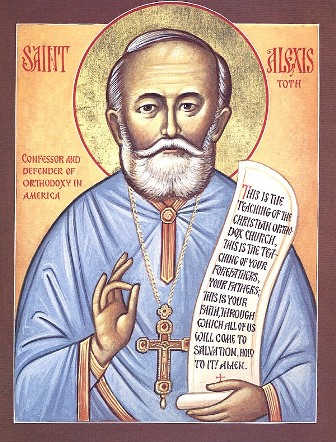
AD: Your chapter on Alexis Toth also discusses Josaphat Kuntsevych, and it has long been a question of mine as to how each side should regard the other's saints, especially as one works towards unity. To put it crudely, one church's heretic is another church's hero. Toth, of course, was a former Eastern Catholic who became Orthodox and was canonized by the OCA while Kuntsevych went the opposite route, ending up a canonized martyr in the Ukrainian and Roman Catholic Churches. What are your thoughts on these competing martyrologies? How should we regard them today--as embarrassing emblems of nasty practices from the past we think we would never do again today? Or should their holiness be considered primarily on its own more individual and personal terms without regard to the ecclesial politics? (This issue came up in the Byzantine-Oriental dialogues where both liturgical traditions have canonized saints and anathematized heretics that are the direct opposite of each other, and neither side seems to know what to do about that since they do not want to simply abandon liturgical texts that have been prayed for centuries.)

OH: Oh, wow.  This is a tough one and one I will admit not having thought about nearly as much as I probably should, even though I first encountered this in a real way at seminary, when Dr. Bouteneff asked us the same question in a class looking at Orthodox and Oriental Orthodox relations.  So, I can only tell you where I’m at currently, which may not be my mature thought as I give this more time. 

I would say that what makes this question seem difficult is our sinful desire to hold grudges and identify with an imagined past.  It seems to be easy to identify with our own church brothers and sisters who were wronged in the past and then to retain the accusation of abuse against the contemporary expression of the opposing religious body.  One might claim this is a “sacramental” aspect to “church.”  This could be especially so in the case of Orthodox and Catholics.  Something like:  “My church is the body of Christ and therefore I am mystically present with the past abused persons when I go to liturgy/mass and therefore those past abuses are still meaningful and real.”  At other times, it’s much less profound and is simply a way of attacking the church you do not belong to simply because it doesn’t agree with your church.

However it is expressed, it seems to me that what is needed a reconfiguration based on the fact that the Church is, indeed, the Body of Christ.  If I believe my church is the Church (or at least part of it) then I should see the past martyrs as being able to exist at a level in which they can say “Father forgive them, for they know not what they do.”  This perspective should then be combined with humility, such that we no longer think it pertains to us to continue the violence (even if by way of rhetoric).  If these are combined, we can then become open to the fact that each church has canonized people who helped people against abuse from the other side.  That is, we will realize our side sinned too.  Our side also helped create tensions and violence. 

So, to return to your examples: a faithful Roman Catholic should be able to say that Toth was right to oppose the prejudice he encountered from Western Catholics and a faithful Orthodox Christian should be able to say Josef Kuntsevych’s murder was wrong, as were the subsequent exaggerations later told to “justify” his murder.  At the same time, each side should hope that in a reunited church, a former Roman Catholic could say Toth’s faith is now dogmatically acceptable (even if he himself was mistaken at times) and a former Eastern Orthodox could say Kuntsevych’s faith is dogmatically acceptable (even if he was mistaken at times).  Their faiths would be seen as reunited.  So, in that context, I really don’t see the problem for canonizing both men.  In fact, I think reunion would require that both remain canonized.  For a real, lasting peace never ignores the difficulties, but reconciles them.

AD: I'm struck by the very different ways in with Catholic and Orthodox immigrants in the last century adjusted to the American context. Archbishop Ireland seems to be a paragon of the Catholic attempt to prove, as strenuously as possible, that Catholics were just like Americans--they spoke English, they were patriotic, they worked hard, they tried to blend in; but Orthodox seem more content to have retained indigenous languages and practices and more comfortable, perhaps, appearing as "exotic." And yet, the main burden of your book is in showing just how very much Orthodox did strive to become American through, as you aptly put it, the very American "anti-traditional tradition." Tell us a bit more about what you mean by that phrase.

OH: Yes, well, that gets at the central irony running through this book.  Here you have this faith that many Americans would still categorize as “exotic,” that has received many converts who have operated according to a very American pattern, and on the basis of that American pattern have, in turn, sought to evangelize other Americans.  That American pattern is one of anti-tradition (which could be called an anti-traditional tradition).  America has a long history of religious mavericks who emphasize a part of their previously received tradition in order to create something new.  This has led to an increasingly diversified and complex religious scene.  Restorationist movements embody this anti-traditional tradition by emphasizing aspects of what they had received in order to recreate what had once allegedly existed prior to that tradition that was given to them.  So, it is “anti-tradition” in trying to by-pass the received tradition but a “tradition” nonetheless by virtue of being an ongoing way of doing religion in America.  One restoration bequeaths another.  What has happened in the case of many American Orthodox converts, especially those I examined in my study, was that their very desire to find tradition was undertaken in a manner that represented the anti-tradition tradition. 
       
What is more, these converts then used this approach to lead and/or attract other converts.  This is important to note because some have taken such actions by new converts as simply perpetuating Orthodoxy’s “defensiveness” in the face of American culture when, in fact, it is evidence of engaging American pluralism.  One sees this in the case of Gillquist, for instance when he went on to encourage other Christians to join the Orthodox Church by arguing the Orthodox Church exists not merely as a non-denominational church but as a pre-denominational church.  It also becomes a way of trying to present the Orthodox Church to America in a way that Americans could appreciate it.
 
AD: In your discussion about the reception of many former Evangelical Orthodox into the Antiochian Archdiocese, it occurred to me that in some clear ways Met. Philip is precisely an embodiment of your 'anti-traditional tradition," yes? I'm thinking here of his handling of the Joseph Allen affair as well as his performing a "mass" ordination for the EO clergy in one liturgy. Is that a fair assessment of him?

OH:  Hmmm.  Interesting that you should ask this.  Not long after the book came out, a colleague and friend emailed me and wrote that Metropolitan Philip came off looking more like a lone ranger than this friend had previously thought.  I should point out that Metropolitan Philip was not a focus of my study.  He did, however, play significant roles in the conversions of Gillquist and the most of the former Evangelical Orthodox Church and so he appeared with some frequency in the last two chapters of this work.  He was connected to controversial decisions that affected that group of converts, including that of their ordinations and the remarriage of Fr. Joseph Allen, which you mention.  And, to be fair, he performed other actions surrounding those decisions that were (and are) controversial in themselves and this doesn’t even touch on Ben Lomond and fallout from that.  So, I can see how one might wonder if Metropolitan Philip doesn’t represent the anti-traditional tradition, but I would argue he does not fit the anti-traditional tradition as I set it out in my narrative.  Whatever one might think of his actions at times, he has not, from the sources I consulted, sought to recover and reestablish a previous norm.  He may be a religious maverick, but he did not exhibit the intention to reestablish a previous norm by establishing a new church or some larger church reform.  Indeed, the only common denominator I saw was himself.  I suppose if one were to broaden anti-traditional tradition far enough, he would fit, but then the phrase would merely be a synonym for a religious maverick of any kind whereas I wanted to highlight the founding of new denominations, religions, or reform efforts.  Perhaps someday someone will study his legacy, for all its complexities.  When that day arrives, I would encourage that scholar to consult the sources I did in addition to other sources that are relevant and to seek to be as unpartisan as possible, allowing the sources to speak for themselves.

AD: Your work shows, as you sum up at the end (p.156) that many converts "prioritized an earlier expression of Christianity and have identified the Orthodox Churches as continuations of that earlier church." This gets at something I've been thinking about more and more over the past year--and have discussed in my reviews of the new collection, Orthodox Constructions of the West: how many Eastern Christians (and in a different direction, but with similar methods, many "traditionalist" Roman Catholics also) appropriate history. I've heard it said that few of us read history on its own terms. Instead we "plunder it for present political purposes." Do you think that's generally true?
 
OH: That’s a great question because suspect there will be Orthodox who are not yet prepared to allow the historical evidence to be what it is but will believe that somehow I must have slanted it so that things did not look as neat and tidy (and triumphalistic) as might be found in books such as Orthodox America, 1794-1776 or Becoming Orthodox. What I would counter with is that we need to distinguish between plundering for our own purposes and investigating to address current concerns.  One can cherry pick any period of history to “prove” nearly anything but that is different from saying, “here is a topic that is important to us today—what is its history, its back story and what can we learn from this”?

AD: Following this, have you set out, or have other especially Orthodox historians set out, any basic hermeneutical and historiographical guidelines on reading and writing about church history? It's often seemed to me that some guidelines or ground-rules like that would be useful in trying to talk about (and defuse the tensions surrounding) controverted issues like, say, the Fourth Crusade or the Union of Brest and similar issues.

OH:  You’re determined to turn this interview into a book project of its own!  I actually think that what is eventually needed is an Orthodox philosophy/theology of history.  I actually have that as a long range goal, sometime later in my career.  I’m not even close to that yet, but I suppose there are a few things I could say.  I have outlined what I think historical theology means (see attached PDF).  I think the most important element is the ascetic—the effort to remain dispassionate as one researches and studies.  This is not easy, for any number of reasons.  One might already have a predetermined outcome one wants.  For instance, I suspect this happens at times when we want to canonize a particular person or particular kind of person.  One might also be cherry picking in order to defend a particular point of view.  This is an extreme version of the predetermined outcome.  Alternatively, one might simply be too colored by one’s political or ecclesiastical allegiance.  Here, the historian may be looking at all the evidence but the way in which it is weighed might seem questionable.  We all have perspective and that shouldn’t be denied but I think the biggest lesson we need to learn is to go into historical inquiry as an act of disciplining the soul and achieving dispassion.  It may be a never ending goal, but must be our goal nonetheless, especially those of us who would ground dispassion in theosis, which comes through Christ. 

AD: Sum up your hopes for this book:

OH: I have several hopes for this book.  First, I hope it provides scholars a way to assess many Orthodox conversions, if not the majority of them.  As a by-product, I think my thesis could be applied to analogous situations within the church, as you suggested by asking about Metropolitan Philip.  It didn’t work in his case, but maybe it could still apply in others.  Second, I hope this provides scholars, Orthodox clergy, and Orthodox laity with a more realistic view of some important converts and convert movements.  Orthodox have developed a fair amount of mythology surrounding Orthodox converts, a mythology that has often been wedded to triumphalism (talk about a lack of dispassion!).  This work clearly breaks through that and in that way, I hope it can serve as an example of the kind of historical inquiry Orthodoxy in America needs (whether internally, from Orthodox such as myself, or externally).

AD: What projects do you have on the go now? What will the next book likely be?

OH: In  true fashion for one who could simultaneously work on Sarapion and American Orthodox converts, I have three projects in progress. 

First, I am collaborating with my friend and colleague Brian Matz on translations of texts from the ninth century filioque dispute.  We hope to have a manuscript that we could submit a year from now.  Ed Sciecienski mentioned our work in his book, but Brian and I got distracted by our other projects, so it will be nice to return to this and publish it. 

Second, I am also working on a project that develops a virtue ethic from iconography.  This work is intended not simply as an academic piece, but as something that will be easily accessible to clergy and interested laity.  I am not sure how soon I will have something to a publisher with this project.  It will depend on what this spring and summer bring. 

A third project I am working on is more in-depth than the first two.  It builds from my convert book, taking up the idea of engaging American pluralism.  This project will be an exploration of American Orthodox engagement with religious freedom.  I believe this is a much needed area of exploration and in the conclusion I will directly engage some Orthodox political theology, and argue for an Orthodox-informed “Christian secularism.”  So, if I hope the first two will be to publishers within a year or so, this one will likely take a couple of years just to get into (rough) manuscript form.  This one might take a little while but I hope it will be worth it.
Related Posts Plugin for WordPress, Blogger...