"Let books be your dining table, / And you shall be full of delights. / Let them be your
mattress,/
And you shall sleep restful nights" (St. Ephraim the Syrian).


Showing posts with label Robert Slesinski. Show all posts

Friday, October 1, 2021

In Praise of Robert Slesinski (III): Ecclesiology

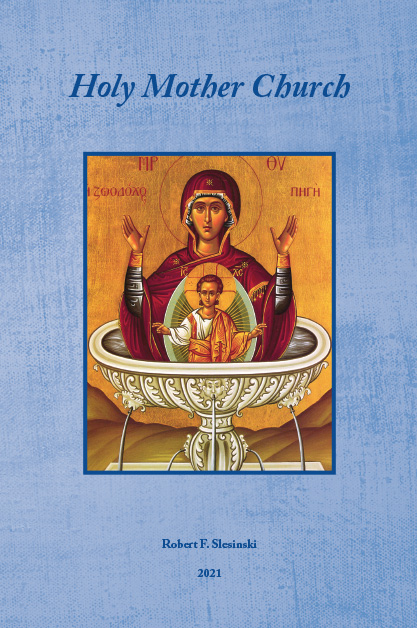
In this category of Slesinski's works we place not only Holy Mother Church, but several other works as well. But to begin with this one, here is the publisher's blurb:

Holy Mother Church is the latest of Fr. Slesinski’s contributions in mystagogical catechesis, which already include ten other books, all published by Eastern Christian Publications. The Christian Faithful throughout the world at every Divine Liturgy or Holy Mass profess a creedal belief “in one, holy, catholic, and apostolic Church.” This catechetical study directly examines the full meaning of these constitutive marks of the Church–the Church in her oneness, holiness, catholicity, and apostolicity. It covers the universal aspects of the Church at the opposite end of the spectrum from ECP’s recent book The Home Church which examines mixed marriage of Catholics and Orthodox. Color icons enhance the meaning of the book throughout.  

We also have A Primer on Church and Eucharist: Eastern Perspectives, from 2007, which is also available in Spanish.

I would also put in this category some of his other books that look at crucial parts of the Church's life, starting with Holy Tradition: An Essay in Reparation from 2018. About this book we are given a short blurb befitting a short (50pp.) book: An Eastern examination of the meaning of Tradition in the context of today’s problems for the Church.  

The Church lives in, from, and with her tradition, including sacramental and liturgical traditions, which are not meant to be exclusively inward focused, but to take Christians out to The Holy Apostolate: The Liturgy After the Liturgy (2013). 


The liturgy is of course intimately connected to the sacraments, treated in The Holy Mysteries: Celebrating Christ's Sacramental Presence (2018). 

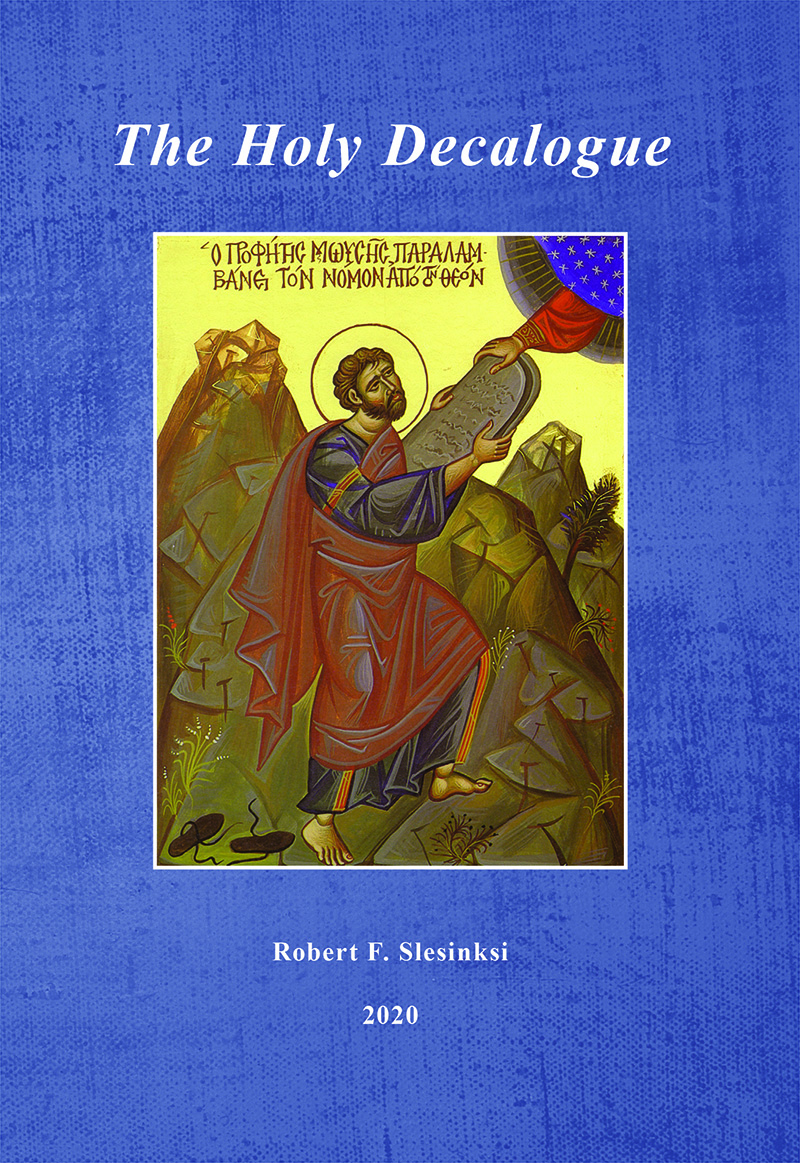
But liturgy must also give rise to new and different ways of living, well treated in this introduction to moral theology: The Holy Decalogue

Moral and liturgical life both are led in the power of the Holy Spirit and in the light of the resurrection, both well treated in The Holy Pentekostarion: Catechesis on Holy Week, Pascha, and Pentecost from 2010. 

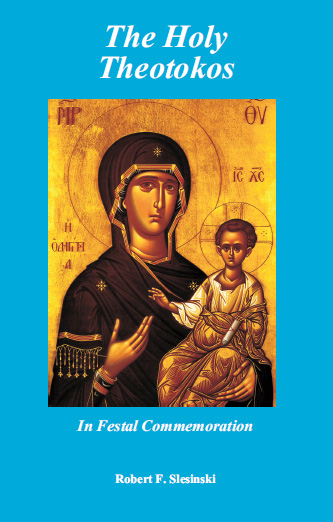
Finally, to speak 'patristically,' we can say that all sacraments, all liturgy, all ecclesial life culminate in the one who is the Ark and Temple of the Most High, The Holy Theotokos: In Festal Commemoration, published in 2012 and one of Slesinski's longest books in this category. 


About this book the publisher tells us this: 

This book continues the series of adult education on the feast days of the Byzantine Churches, their theology and liturgical texts. 200 pages with icons.


Series ended.

Wednesday, September 29, 2021

In Praise of Robert Slesinski (II): The Liturgical Feasts

Continuing on in our series, begun Monday of this week, with the focus on the many books of Robert Slesinski published by Eastern Christian Publications, let us turn next to his liturgical and festal commentaries. I count at least three.

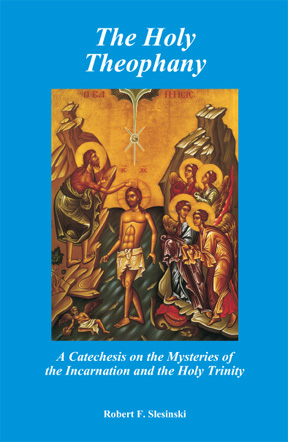
In the first place, if we start at the beginning of the civil calendar, we have The Holy Theophany: A Catechesis on the Mysteries of the Incarnation and the Holy Trinity (ECP, 2011). The publisher's description of this is brief:

This book continues the series of adult education on the feast days of the Byzantine Churches, their theology and liturgical texts. 200 pages with icons. 

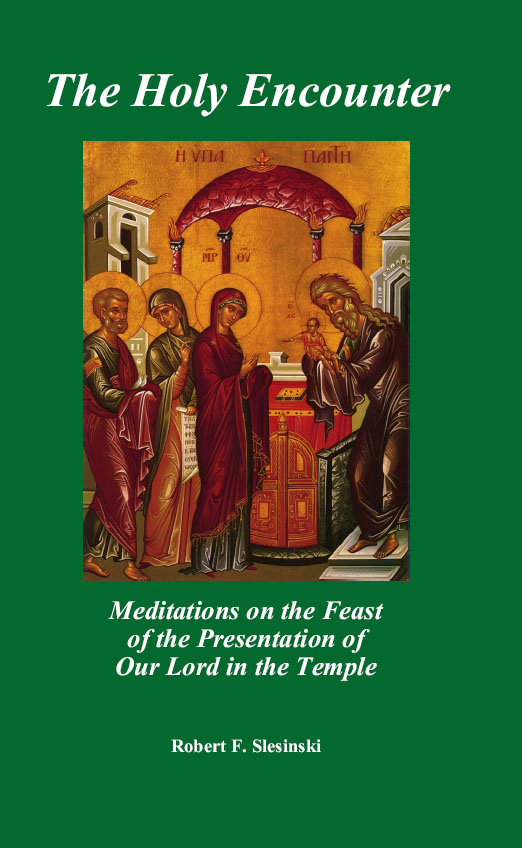
Next up is the feast that all right-thinking people know closes out the Christmas season: the Encounter/Purification/Candlemas. Fr Robert has turned his hand to this great feast in The Holy Encounter: Meditations on the Feast of the Presentation of the Lord in the Temple (ECP, 2008), 116pp. About this book we are told this:


This book of reflections investigates the feast of the Encounter of Christ with Simeon in the Temple, celebrated on February 2nd, from several theological perspectives.

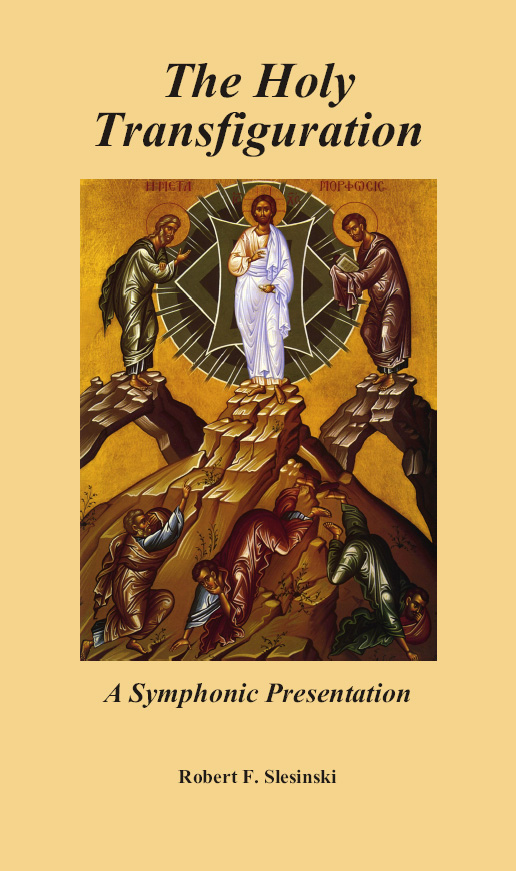
Finally we come to my favourite feast of the year: The Holy Transfiguration: A Symphonic Presentation (ECP, 2009). 120pp. About this book the publisher tells us this:

The in-depth educational book reflects on the feast of the Transfiguration of Our Lord from a scriptural perspective, comparing the Gospel accounts and writings of Luke, Matthew, Mark, John, Peter and Paul. 


Monday, September 27, 2021

In Praise of Robert Slesinski (I)

The indefatigable Jack Figel, who seems to run Eastern Christian Publications single-handedly, is owed many debts by Eastern Christians, and those others interested in the liturgical and theological works of the Christian East. I met him over a decade ago at the Orientale Lumen Conferences he has hosted for decades in Washington, DC, and again in 2019 at the last one I attended in those far-off days we now fondly recall as the Before Times. 

In any event, he recently kindly sent me a box full of all the books ECP has published by Robert Slesinski. Slesinski, for those who do not know him, is an independent scholar and pastor, and author of many works, including most recently his The Theology of Sergius Bulgakov. Most of Slesinski's work focuses on Russian philosophical and theological thought, especially in the so-called Silver Age. 

As I mentioned, he is not only a scholar but also a pastor, and combines these two roles to great effect in nearly a dozen books published from ECP over the years. As a tribute to the unsung labours of both men, I want this week to draw your attention to those books. They are, broadly, grouped into three categories: those that focus on liturgical feasts and texts; those that focus on people; and those that are "ecclesiological" in nature, examining not just the nature of the Church but the place of law and Tradition within the Church and the sacramental nature of the Church as well. 

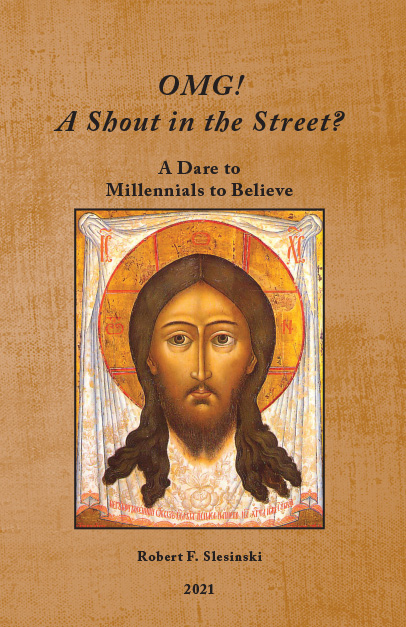
But let us begin with his newest book, which seems in some ways to be in a category of its own, not least by its title: OMG! A Shout in the Street? A Dare to Millennials to Believe (ECP, 2011). 

Here is the publisher's blurb about the book: 

Digressing from his usual catechetical and theological works, Father Robert Slesinski targets this book on philosophy at millennials and those who might be searching to find true meaning in their lives.  Mostly marked by secularism, the author of this book, a philosopher himself as well as a Byzantine Catholic priest, strives to awaken the “inner philosopher” in all people by plumbing the depths of human interiority.  This inevitably draws the person out of his or herself, ultimately enabling the person to soar beyond themselves toward worship of the One, True God.  164 page.  Color illustrations.  $20.00.

In the coming days I will draw some attention to some of his other books, few of which are available on Amazon, so you will have to do the meet, right, and just thing by ordering them directly from ECP

Continues. 

Friday, December 15, 2017

Robert Slesinski on Sergius Bulgakov

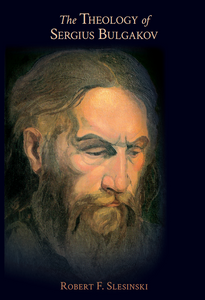
Robert Slesinski is always worth reading, and has established himself as a leading and wide-ranging scholar of several of the noteworthy figures of the Russian Silver Age and of her theological renaissance from the end of the 19th through the middle of the 20th centuries. He has published a number of articles and reviews in Logos: A Journal of Eastern Christian Studies over the years. And now, I'm delighted to tell you, St. Vladimir's Seminary Press has just published his newest study, The Theology of Sergius Bulgakov (2017), 280pp

Following my usual practice, I e-mailed some questions to Fr. Bob about the book, and here are his thoughts.

AD: Tell us about your background

RS: I am a Ruthenian Byzantine Catholic priest (Eparchy of Passaic, NJ) of over 40 years, but my surname gives me away as something else.  On my paternal side, I am Polish, but not insignificantly on my maternal side I am German-French-English.  In sum, I'm a hybrid.  But growing up in Worcester, Massachusetts, there was never a time when I did not have to pronounce and spell my last name!

Going on to college I would have liked to have taken Polish as a "foreign language" requirement course, but few colleges offer Polish as a subject of study.  But Russian was offered--and that was the beginning of my interest in all things "Russian."

Having discerned a possible vocation to the priesthood, I was accepted as a candidate by the RC Diocese of Worcester--my pastor at the time, by the way, was a Melkite turned RC and I was his first vocation to the priesthood. I was sent to the North American College in Rome with the understanding I could frequent the Russian College. Well, after a year at NAC I transferred to the Russicum and subsequently was accepted by the Eparchy of Passaic...the beginning of a life's journey.

AD: Your 1984 book was a real scholarly landmark, devoted to Pavel Florensky. Are there connections you see from him to Bulgakov?

RS: My first book, Pavel Florensky: A Metaphysics of Love, my doctoral dissertation was, indeed, published by SVS Press, and now they are publishing my fourteenth book, The Theology of Sergius Bulgakov.  The two figures are intimately connected, the former serving as a "spiritual father" to his "spiritual son."


There is a famous painting of the two, "The Philosophers," by M. Nestervov in the Saint Petersburg, Russia, Art Museum of the two walking in Florensky's garden at Sergiev Posad.  The whole composition has Florensky as a "Plato," as it were, and Bulgakov as an Aristotle. (AD: the photo is on the cover of the book at left.)

AD: There's been a huge upswing in studies devoted to Bulgakov over the last couple of decades. Why do you think he continues to command such a wide interest?

RS: Bulgakov has surprisingly been neglected in Orthodox circles--after all, he was "convicted" of "heresy."  Westerners--like Hans Urs von Balthasar--who were interested in possible insights from the Christian East rediscovered him.

AD: Your introduction seems to suggest that Orthodoxy did not pay much attention to Bulgakov until and after Western Christians began doing so. What led the West--among whom you single out such luminaries as Rowan Williams, Aidan Nichols, and John Milbank inter alia--to Bulgakov? Was it a perceived gap in the Western tradition that he somehow filled, or was it something else?

RS: This continues your next question: people like myself--Westerners--are, indeed, interested in gaining insights into our common Christian tradition from the East.

AD: Your first chapter notes "some truly eye-opening statements" about Bulgakov's openness to the Catholic Church, not least about the papacy and the filioque, about which he said "I am a 'filioquist'." What do you think he meant by that?

RS: Bulgakov as a person was deeply, indelibly, steeped in Orthodox tradition, but was devastated by the Bolshevik Revolution. Just as at the time of the Council of Florence as the Turks were overwhelming Constantinople, Bulgakov flirted with a possible help from Rome.  Now he remained a confirmed Orthodox, but still affirmed certain "Catholic" beliefs like the filioque, embracing Augustine's paradigm of love to explain the Holy Trinity.

AD: My perception of Bulgakov (admittedly it's been a few years since I read T.A. Smith's translation of The Burning Bush) is that he often finds a way to accept or even agree, broadly speaking, with the substance of Catholic doctrine, but finds ways to disagree methodologically--either the categories of definition, or the papal mechanisms of definition of the modern Marian dogmas. Is that a fair distinction?

RS: To continue the discussion...the esteemed late Alexander Schmemann, an actual student of Bulgakov, made the observation that however "Orthodox" Bulgakov was, he always wanted to put his original stamp of "things"--novelty being his mode of action.  Catholic doctrine/dogma he was wont to characterize in his own terms--not necessarily of those of Catholics themselves.  Curiously, as "opposed" as he was to the dogma of the Immaculate Conception (he was a partisan of Aquinas in this matter), he fervidly argued in favor of the Theotokos being a "Co-Redemptrix."

AD: You note at the beginning of ch.7 that Bulgakov's understanding of the Catholic dogma of the Immaculate Conception "is found to be wanting" but the rest of his Mariology is not. Tell us more about that.

RS: My answer to this question is to repeat what I say in response to the last question--only to add that Bulgakov was utterly convinced in his sophiological understanding of May, she truly was the Pneumatophore--the Bearer of the Holy Spirit!


AD: In ch.8 you note Florovsky's influence on modern Orthodoxy's turn to history and patrology at the expense of more systematic theology such as Bulgakov's. Why is that? What is behind the focus on history and the fathers--and also behind the fear of Bulgakov's more speculative and systematic work?

RS: Florovsky's influence, to my mind, became paramount after the indictment of heresy.  He was an historian--hence patristics.  And we all know of the centrality of the Divine Liturgy for the Christian experience of God, hence liturgical theology.  Speculative theology/philosophy of the likes of Bulgakov did not, alas--to my mind--find a resonant ear in the Orthodox.

AD: Having done some work in both Orthodox and Catholic ecclesiology, I naturally read your 14th chapter, "Ecclesiological Musings in Bulgakov," with great interest. The word 'musings' is especially noteworthy, as you go on to suggest that Bulgakov may have been a bit sloppy with the scriptural texts, claiming they give no "'indications concerning the Church as an organization'" (p.209).  Later on you speak of his rather 'cloudy' approach to the Church's sacramental character. And once again his love-hate relationship to Catholicism returns in his discussion of papal infallibility. What lies behind these rather conflicted views?

RS: There is no doubt in my mind that the weakest theology of Bulgakov is in the area of ecclesiology.  I would surmise he was reading too much of German Protestant theology.  Catholics and Orthodox are truly one in this area.

AD: Tell us what your hopes were for this book, The Theology of Sergius Bulgakovand who should read it.

RS: Well, my book is intended to inspire any philosopher-theologian to consider Bulgakov as an area for insight in coming to terms with understanding God and the cosmos.  Now that ALL the major works of Bulgakov are in English translation, I would hope that my "modest" monograph may assist in appreciating the theological genius of Bulgakov.

AD: Having finished this, what projects are you at work on now?

RS: Over the ten years I worked on my Bulgakov book I have written seven other books in "mystagogical catechesis;" I am now working on another one The Holy Mysteries: Celebrating Christ's Sacramental Presence.
Tuesday, March 12, 2013

Russian-Jewish Encounters

I just received a long review-essay that will run in a forthcoming issue of Logos: A Journal of Eastern Christian Studies. Authored by Robert Slesinski, the essay very carefully discusses a recent and very important, if difficult and controversial, collection by Dominic Rubin treating the explosive questions of Judaism, anti-Semitism, and Russian Orthodox theology: Holy Russia, Sacred Israel: Jewish-Christian Encounters in Russian Religious Thought (Academic Studies Press, 2010, 400pp.).

About this book the publisher tells us:
Holy Russia, Sacred Israel examines how Russian religious thinkers, both Jewish and Christian, conceived of Judaism, Jewry and the 'Old Testament' philosophically, theologically and personally at a time when the Messianic element in Russian consciousness was being stimulated by events ranging from the pogroms of the 1880s, through two Revolutions and World Wars, to exile in Western Europe. An attempt is made to locate the boundaries between the Jewish and Christian, Russian and Western, Gnostic-pagan and Orthodox elements in Russian thought in this period. The author reflects personally on how the heritage of these thinkers little analyzed or translated in the West can help Orthodox (and other) Christians respond to Judaism (including 'Messianic Judaism'), Zionism, and Christian anti-Semitism today.

Thursday, November 11, 2010

"When You Were Transfigured, O Christ..."


The Transfiguration has long been my favourite feast of the year. I was therefore delighted when Eastern Christian Publications sent me a review copy of Robert Slesinski's new book:


This lovely little book is suitable for slow, rich meditation on the Transfiguration, which I have often thought the most felicitous feast of the year after Pascha, to which it is closely linked chronologically in the life of Christ, and liturgically in some traditions, such as the Latin, where the gospel pericope is read during Lent. (The Latins never celebrated the Transfiguration widely until, Slesinski tells us, 1457, but even today for them it is only a second-class feast and has “never carried the same importance and gravitas as in the Christian East.” Why this should be so is an interesting question not pursued by the author.)

Slesinski examines the feast through numerous biblical texts as well as a close reading of the Byzantine liturgical texts, ending with a brief “mystagogical catechesis” of the feast. His edifying efforts are the latest in a series of recent books on the Transfiguration, including—to cite only the most recent, and only from Eastern authors—Solrunn Nes (The Uncreated Light: an Iconographic Study of the Transfiguration in the Eastern Church) and Andreas Andreopoulos (Metamorphosis: The Transfiguration in Byzantine Theology and Iconography and his forthcoming work, This is My Beloved Son: the Transfiguration of Christ, about which more later). Now we have Slesinski’s book, offering us great spiritual insights into a feast whose glory comes to us “as far as we can bear it.”
Related Posts Plugin for WordPress, Blogger...