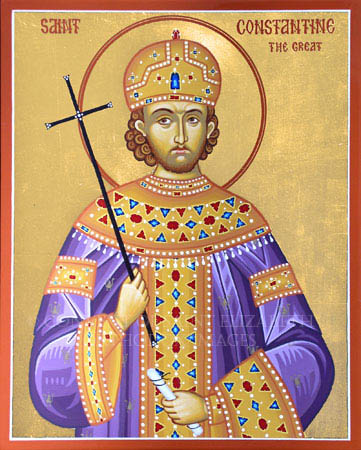
Two decades ago when I began to read
Stanley Hauerwas, I found him frequently railing against the baleful influence of "Constantinianism," by which he meant (at the time) the interference in, and thus taming of, the Church by the empire--notions Hauerwas borrowed, if memory serves, from John Howard Yoder. I was not entirely convinced of this line of argumentation at the time, and over the years have become less so; I think Hauerwas has himself moderated his views somewhat.
In the last two decades, and especially in the last five years, this legacy of Constantine (whom the Byzantine tradition calls "equal to the apostles") continues to be debated, as I have
noted repeatedly before. But much of what people today seem to be "rediscovering" or reconsidering about Constantine was, at least in inchoate fashion, discussed more than half a century ago by the Jesuit historian Francis Dvornik, as I mentioned
before.
Further studies about Constantine coming out this year, on top of a book recently published by Oxford University Press: David Potter,
Constantine the Emperor (OUP, 2012), 368pp.
About this book the publisher tells us:
This year Christians worldwide will celebrate the 1700th anniversary of
Constantine's conversion and victory at the Battle of the Milvian
Bridge. No Roman emperor had a greater impact on the modern world than
did Constantine. The reason is not simply that he converted to
Christianity but that he did so in a way that brought his subjects along
after him. Indeed, this major new biography argues that Constantine's
conversion is but one feature of a unique administrative style that
enabled him to take control of an empire beset by internal rebellions
and external threats by Persians and Goths. The vast record of
Constantine's administration reveals a government careful in its
exercise of power but capable of ruthless, even savage actions.
Constantine executed (or drove
to suicide) his father-in-law, two brothers-in-law, his eldest son, and
his once beloved wife. An unparalleled general throughout his life, even
on his deathbed he was planning a major assault on the Sassanian Empire
in Persia. Alongside the visionary who believed that his success came
from the direct intervention of his God resided an aggressive warrior, a
sometimes cruel partner, and an immensely shrewd ruler. These
characteristics combined together in a long and remarkable career, which
restored the Roman Empire to its former glory.
Beginning with
his first biographer Eusebius, Constantine's image has been subject to
distortion. More recent revisions include John Carroll's view of him as
the intellectual ancestor of the Holocaust (Constantine's Sword) and Dan Brown's
presentation of him as the man who oversaw the reshaping of Christian history (The Da Vinci Code). In Constantine the Emperor,
David Potter confronts each of these skewed and partial accounts to
provide the most comprehensive, authoritative, and readable account of
Constantine's extraordinary life.
The other study, apparently published at the end of June, is a critical scholarly engagement of Peter Leithart's 2010 book (which we had expertly reviewed in
Logos: A Journal of Eastern Christian Studies)
Defending Constantine: The Twilight of an Empire and the Dawn of Christendom. Leithart's work engendered a good deal of criticism, some collected in John Roth, ed.,
Constantine Revisited: Leithart, Yoder, and the Constantinian Debate (Pickwick, 2013), 216pp.
About this collection we are told:
This collection of essays continues a long and venerable debate in the
history of the Christian church regarding the legacy of the Roman
emperor Constantine the Great. For some, Constantine's conversion to
Christianity early in the fourth century set in motion a process that
made the church subservient to the civil authority of the state, brought
a definitive end to pacifism as a central teaching of the early church,
and redefined the character of Christian catechesis and missions.
In
2010, Peter J. Leithart published a widely read polemic, Defending
Constantine, that vigorously refuted this interpretation. In its place,
Leithart offered a thoroughgoing rehabilitation of Constantine and his
legacy, while directing a rhetorical fusillade against the pacifist
theology and ethics of the Mennonite theologian John Howard Yoder.
The
essays gathered here in response to Leithart reflect the insights of
eleven leading theologians, historians, and ethicists from a wide range
of theological traditions. They engage one of the most contentious
issues in Christian church history in irenic fashion and at the highest
level of scholarship. In so doing, they help ensure that the
"Constantinian Debate" will continue to be lively, substantive, and
consequential.