"Let books be your dining table, / And you shall be full of delights. / Let them be your
mattress,/
And you shall sleep restful nights" (St. Ephraim the Syrian).


Showing posts with label Herbert McCabe. Show all posts

Wednesday, July 8, 2020

Herbert McCabe's Legacy

I have previously on here, and elsewhere, talked about what I have learned from the English Dominican Herbert McCabe, who died nearly two decades ago now. In a time when, in this country, too much of Catholic Christianity has veered rightward and in some instances become little more than a capitalistic cult around that vile figure in the White House, McCabe keeps alive hope for some of us that it is possible to be perfectly orthodox in theology and perfectly radical in working for justice, peace, and the integrity of creation. (Dorothy Day, of course, is the other hopeful and helpful model here.)

So I am very cheered indeed to report the recent publication of Franco Manni's new book, Herbert McCabe: Recollecting a Fragmented Legacy (Cascade, 2020), 300pp.

About this welcome new work the publisher tells us this:
Herbert McCabe struck those who met him (Alasdair MacIntyre, Anthony Kenny, Terry Eagleton, Denys Turner) or those who read his writings (David Burrell, Stanley Hauerwas) for his high intelligence. He was the most intelligent philosopher after the death of Karl Popper. His philosophical inquiries on God and the Human Being have yet to be properly understood, not because they were abstruse (clarity was McCabe’s inexorable sword!) but because of their dizzying depth, for which many are not yet prepared.
This is the first comprehensive study of McCabe, a person who preferred speaking to writing and left only the short—fragmented and dispersed—texts of his lectures and sermons. But in this book, to use David Burrell’s words, Manni has “managed to get inside McCabe’s mind” and assemble together for the first time the disiecta membra of a powerful system of thought.

Wednesday, January 8, 2020

Prayerful Distractions as Psychological Free-Associations

Almost two years ago I was speculating rather cautiously on the possibility of a kind of "psychoanalytic" reading of Herbert McCabe's ideas around prayer, drawing on his helpful notion about "distractions" which come from his short chapter in God, Christ, and Us.

Well last night I had a chance to read another of his works, God Still Matters, with additional chapters on prayer and the Trinity. It was in this work that he acknowledges that his thoughts on distractions--which he says reveal to us what we really want, and instead of fighting them we should encourage their surfacing, the more easily to pray about and for them--were not his own, but came from a fellow Dominican, Victor White.

Now it all makes sense and I feel vindicated in my speculation. For White was a long-time dialogue partner with Carl Jung, and in fact wrote works about Jungian psychoanalysis, including God and the Unconscious.

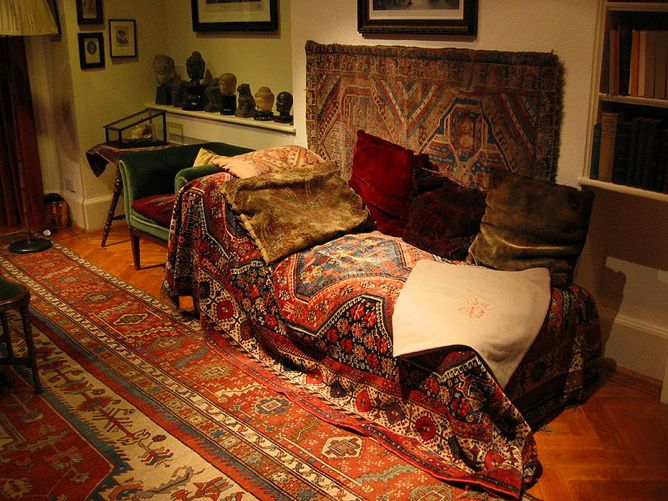
All this, of course, takes us back to the great Viennese master himself, whose reflections on free association were and are so profoundly revealing and revolutionary. (At Strands in New York over Christmas, I picked up a short book by Anton Kris, Free Association: Method and Practice, which you may find interesting. Christopher Bollas also has interesting things to say about this in a variety of places, including here.)

We think that freely associating on the analyst's couch is a spectacular waste of time. And, wouldn't you know it, that's precisely the argument most of us use against prayer. McCabe again:
For a real absolute waste of time you have to go to prayer. I reckon that more than 80% of our reluctance to pray consists precisely in our dim recognition of this and our neurotic fear of wasting time, of spending part of our life in something that in the end gets you nowhere, something that is not merely non-productive, non-money making, but is even non-creative. it doesn't even have the justification of art and poetry. It is an absolute waste of time, it is a sharing into the waste of time which is the interior life of the Godhead. 
Finally for my students this semester in addition to reading McCabe, Plekon, and others, we will be reading Romano Guardini's lovely little classic, The Spirit of the Liturgy, where he also winsomely writes about liturgy being utterly wasteful of time for it is simply children at play in the Father's playground.

Wednesday, July 11, 2018

On Misunderstanding Sacrifice

I have just finished reading and being edified by Terry Eagleton's newest book, Radical Sacrifice (Yale UP, 2018), 204pp.

Eagleton, for those who don't know him, is a wide-ranging and prolific theorist, literary scholar, and cultural critic who comes out of that always-fascinating world of the post-war British left. But unlike others whom one might mention here--the late Christopher Hitchens, say, or the tiresome pamphleteer Richard Dawkins--Eagleton has a Catholic background which shows up in some of his many books, including this one, where his grasp of both Scripture and theology is impressive and far outstrips many other academics who try to write about these matters.

In this regard, he is part of the world shaped by the late Herbert McCabe, and still populated by the great Alasdair MacIntyre. All three of these men, in ways that seem depressingly rare, understand the radical nature of the gospels and the fact that, properly understood and lived, Christianity is revolutionary in overturning so much of the neoliberal capitalism and violence of our world today. All three have sought to show (as, discussing McCabe and MacIntyre, I also did a bit here and here; and as Dorothy Day also did--for more on her see the book that Lance Richey and I edited for the splendidly named Solidarity Hall Press) that the relationship between Christianity and Marxism is far less antagonistic than has often been portrayed.

Christianity, as Eagleton, McCabe, MacIntyre, and Day have helped us to see, is also far more critical of the capitalistic world than most Christians realize. Every Christian, instead of making placards with John 3:16 on them to wave at sports events, should instead write this to chasten and harrow players (and their corporate sponsors) making millions for whacking balls and pucks around: "Capitalism is bad for those who succeed by its standards as well as for those who fail by them." If they have especially big placards, they can put the whole quote from MacIntyre:
Capitalism is bad for those who succeed by its standards as well as for those who fail by them, something that many preachers and theologians have failed to recognize. And those Christians who have recognized it have often enough been at odds with ecclesiastical as well as political and economic authorities.
Getting back to Eagleton's new book, I would note that among its several virtues, it makes some necessary and, it seems to me, overdue criticisms of parts of Girard's theories about sacrifice, mimesis, and the scapegoat. Eagleton, greatly respecting Girard's insights and achievements, nonetheless rightly says that, inter alia, Girard often greatly exaggerates, provides too few concrete historical examples, and ignores questions of class.

Eagleton begins by noting that the notion of sacrifice is too little understood today and too often derided based on narrow, incomplete, or outright faulty notions. So the first part of the book is an exercise in clearing the ground to help us move beyond the idea that sacrifice means nothing more than "the voluntary relinquishing of what one finds valuable. But renunciation is only one feature of sacrifice, and not always the most prominent" (3). As he goes on to say, "sacrifice cannot be reduced to self-denial" (4). It is, rather, a "polythetic term, encompassing a range of activities that have no single feature in common." If this is true in general, a fortiori it is so in Christianity where it "spans a number of activities (praise, thanksgiving, prayer, witness, peacemaking, dedication to God and the like)" (6).

What makes Christian notions and practices of sacrifice even more unique, as Eagleton notes later in the book, is their lavish, superabundant, extravagant, and promiscuous nature: turning the other cheek, returning good for evil, blessing those who curse us, forgiving seventy times seven, etc. In doing all these things, Christians are engaged in "eschatological forms of excess--absurdist, avant-gardist, over-the-top gestures foreshadowing a future in which exchange-value will have been surpassed for what Paul Ricoeur terms 'an economy of superabundance'" (104).

Incidentally, this theme of superabundance puts me in mind of Hans Urs von Balthasar's winsome sermon for Trinity Sunday that I have often read to my students over the years where he says:
God is not a sealed fortress, to be attacked and seized by our engines of war (ascetic practices, meditative techniques, and the like) but a house full of open doors, through which we are invited to walk. In the Castle of the Three-in-One, the plan has always been that we, those who are entirely "other," shall participate in the superabundant communion of life. 
With an eye on anthropological work, especially that of another fascinating British Catholic and highly regarded scholar, Mary Douglas (whose book, Natural Symbols, should be required reading for liturgists, inter alia), Eagleton looks at sacrifice in a number of cultures, ancient and modern, and finds there common themes of power and the exchange of powers, especially with a divine figure or figures. There is, here and elsewhere, a paradox at work: to sacrifice something is in some instances to be able to go on to possess it more deeply later and in different ways. So what looks like a loss initially is often but the gateway to a much deeper and more powerful grasp of it, or by it, later on.

With a second eye on the Old Testament in particular, Eagleton notes that it generally takes a dim if not hostile view of sacrifice at least insofar as it is thought to be a means of averting God's gaze from injustice or a cheap trinket thought to appease divine wrath in the face of unchanged and unjust behavior. (See, e.g., much of Jeremiah or Micah.) This leads Eagleton on, in the next chapter, to argue that sacrifice-as-suffering cannot be blithely endorsed for others to endure, let alone forced to volunteer for: "Jesus never once counsels the diseased and disabled who flock around him to reconcile themselves to their misfortune" (38).

This is an especially important thing for Catholics to hear who may be inclined, as the Church often is, towards a passive siding with reactionary regimes whose injustices are downplayed while people are told to "offer up" various sacrifices of poverty, human rights, and injustice. In doing so, Christianity, whether inadvertently or not, presses its ascetical tradition into the service of profit and the violence that so often attends profiteers and capitalists: "Asceticism, Marx considers, is an integral part of a profit-driven social order" (180, referring to the Economic and Philosophical Manuscripts). (For more on this, see my notion of an "ascetical politics" which I discussed in three parts here by drawing on the fascinating and valuable work of Todd McGowan, Enjoying What We Don't Have: The Political Project of Psychoanalysis.)

But that is not to say that voluntary acceptance of injustice and suffering is without merit. Indeed, in the example of Christ Himself voluntarily accepting the horrors of arrest, torture, and crucifixion, we come once again to the notion of sacrifice as an exchange of powers enabling one to go far deeper and far beyond what one otherwise could have done. Here Mary Douglas is pressed into service, when she notes (in Purity and Danger) that "when someone freely embraces the symbols of death, or death itself,...a great release of power for good should be expected to follow." Nowhere is that more true than in the case of Christ.

In addition to his work on Marx, Eagleton has also read Freud (and Lacan, inter alia) very perceptively, which most people today seem incapable of doing. This allows him to say--without, alas, developing it to the extent I wished--that the silence of the Father faced with His Son on the Cross "may be compared to the silence of the psychoanalyst who refuses the role of Big Other or transcendental guarantor" (41). (One thing it took me a long time on the couch to realize was that such silence was not neglect or lack of interest on the part of the remarkable woman who was my analyst. It was, rather, the very condition of freedom, and a very necessary reminder that the responsibility for the authorship of our lives must not mindlessly be handed over to others, tempting though that often is for many of us--cf. both Fromm and Winnicott on this point--as well as Adam Phillips.)

Here as elsewhere, Eagleton, discussing notions of sin, puts these Christian theological claims into dialogue with Freud and his notion of the death drive. Picking up a theme--that of desire--that one finds increasingly today in a good deal of work in philosophy, theology, and psychology, Eagleton notes that "desire itself can become ritualized and automated, assuming all the coercive, anonymous force of a law. If Freud names this condition neurosis, Paul gives it the title of sin, which he regards as a matter of the unconscious. When I sin, he writes in Romans, 'I do not understand my own actions'" (47). In this light, sin is a fake floor or false consciousness that prevents us from having access to and "being aware of our true desire" (48).

Eagleton, however, later turns the death drive around in a way that perhaps only a Christian could to argue that "there is a sense in which the death drive, striving to defeat the flow of temporality with its compulsive repetitions, represents a way of being undead, and so lies on the side of the living" (95).


Tuesday, May 1, 2018

Christians and Class Warfare

If you listened, in the aftermath of the Florida school massacre, to that moral cretin heading up the NRA, he fatuously claimed that there was a "God-given" right to bear arms. Even a cursory review of Catholic social teaching, which has reflected in very considerable detail on human rights since 1948, would show that there is no such right theologically understood. And if you listen to the great moral philosopher and intellectual historian Alasdair MacIntyre, you would know from his historical review that the very concept of rights is an entirely human invention dating no earlier than the year 1400. As a result, people like LaPierre resort to uttering rubbish fit only for the splendid riposte of MacIntyre: “there are no such rights, and belief in them is one with belief in witches and in unicorns” (After Virtue).

One of MacIntyre's great influences was the late Dominican theologian Herbert McCabe. Indeed, in the acknowledgements to Whose Justice? Which Rationality, the successor book to After Virtue (and part of the so-called trilogy along with Three Rival Versions of Moral Enquiry), MacIntyre pointedly and rather fulsomely acknowledges how much he owes McCabe more than anyone for the latter's critical responses to After Virtue.

I have previously reflected on some of McCabe's writings on here in conversation with other thinkers who come out of and are shaped by the post-war British left, including Adam Phillips and Christopher Bollas.

But the work of McCabe's that bears on this debate in some ways, and which is perhaps the most challenging thing he wrote, is his 1980 essay "The Class Struggle and Christian Love," reprinted in God Matters.

The language of "class struggle" is of course more familiar to Eastern, especially Slavic, Christians than to anyone else due to the Russian Revolution. Some, especially Americans, may be inclined smugly to dismiss this language as a relic of losers in the Cold War. But as others have argued very recently, that language cannot be abandoned quite so facilely if one hopes to bring about any real political and economic change.

McCabe was writing when the Cold War was at its height, having been deeply influenced by Marxism, as was his close friend Terry Eagleton, a man of the British Catholic left whose books Why Marx Was Right and The Gatekeeper: A Memoir are rollicking good reads. 

In his essay "The Class Struggle and Christian Love," McCabe begins by stating that "the class struggle is the revolution--not just a means toward it, but the thing itself"(182).  He immediately notes that many, perhaps most, Christians will reject this notion of class struggle as incompatible with the gospel--and in doing so find themselves in bed with those who agree with them, viz., Joseph Stalin, Margaret Thatcher, and the International Marxist Group.

But, later in the essay, McCabe will more stoutly insist that Christian participation in the class struggle is in fact required by the dominical call to love our neighbor, and that such struggle and such love may sometimes be found in "circumstances in which even violence itself--by which I mean killing people--is not only compatible with Christian love but demanded by it" (185). 

Later still, he wants to unpack, just a little bit, what this notion of "class struggle" entails. It is not, he begins, just a variant on English class snobbery; it is not about simple conflict between haves and have-nots; and it is not differences of wealth that cause class conflict, but "class differences that cause differences of wealth" (188).

In mentioning all this, McCabe along the way notes that the gospels say nothing of course about these issues, though they say plenty about the dire perils posed by riches and the neglect of the poor. But the gospels are silent on any notion "that everyone has to have equal shares of wealth" (189). And if we think class conflict is about envious maneuvering to establish total equality with everyone having the same share, we are mistaken. Equally mistaken are we if we think we are not somehow already involved in a struggle, and have been for a very long time. Finally, we delude ourselves if we think there is a position of neutrality somewhere here: those who are neutral, he says, are inevitably on the side of "the class in power" (192). Christians cannot be neutral, he insists, but must fight against the class conflict and war.

What is that conflict and war based upon? Here, McCabe's Marxism is most clearly on display: in capitalism the fundamental divide, and so the fundamental factor in class conflict, is over surplus value created by workers (beyond what they need strictly for subsistence) which is appropriated by capitalists to enrich themselves and extend their own power in defense of their interests against others. The system of capitalism has at its heart an "intrinsic" need for class conflict (190).

There is, then, "human antagonism" at the heart of capitalism (192). That antagonism sometimes breaks out in open shooting wars in which the state goes to battle on behalf of the ruling classes to preserve them in power. Can Christians join in? Can Christians be involved in a class struggle up to and including the use of violence? Or is it the case that this antagonism at the heart of capitalist-driven class conflict means that it will forever be opposed to and by Christianity properly lived and understood?

Is Christianity, in other words, always going to be opposed to capitalism insofar as the former claims against the latter the possibility (however poorly embodied) that conflict can be overcome, that conflict is not inevitable, that we can live together in love? McCabe certainly thinks so: "Christianity is deeply subversive of capitalism precisely because it announces the improbable possibility that men might live together without war; neither by domination nor by antagonism but by unity in love" (193).

Christianity must therefore fight the class war because it is ipso facto fighting capitalism and its antagonism which is most precisely opposed to the universal call to love. But does the Christian fighting that war have to use violence or have the right to do so--or must it be forsworn? McCabe, as is his wont, calmly and carefully considers the arguments of his opponents while advancing his own. And so he picks up the Christian concern that any idea of a class struggle somehow requires violence, which no Christian can support. But does it? Does the idea of a class struggle inevitably mean a violent or armed struggle? McCabe says no: "It is perfectly possible to believe passionately in the importance of the class struggle and to renounce all political violence" (183).

He goes on to argue that there is no incompatibility in working, as a Christian, for the just overthrow of the ruling class while forswearing the killing of that class.

But leave aside such principles: there are much more pragmatic considerations to forswearing killing. McCabe notes that any time you go up against the modern state, it is bound to win. You can recruit a few starry-eyed idealists to your cause--the IRA, say, or ISIS--but the other side will always have more men under arms and better arms, and thus will always defeat you. The ruling class, then, is much better at killing on a much larger scale than any of its opponents can ever hope to do.

Here McCabe quotes General Patton's aphorism that you don't win wars by getting young men to die for your country, but by convincing the other men to die for their country--a neat twist to this having been pulled off by the Americans and British in the Second World War, where the Soviet Union lost far more men than their erstwhile allies, and they all knew it but tried to avoid talking about it. In reading The Maisky Diaries: Red Ambassador to the Court of St. James 1932-1943 last year, I came across the suspicion expressed again and again by the Soviet ambassador, Ivan Maisky, along with his boss Molotov, and his boss Stalin, that the refusal of a second front in Europe until mid-1944, while not without certain technical considerations, was also secretly motivated by a desire to bleed Russia white. The British of course denied this at all times, and not totally insincerely, it seems to me; but at the same time we cannot forget that a scant 20 years before the British regarded the Bolsheviks as terrible enemies to be wiped off the earth.

And, in fact, much of this is born out later on. As David Reynolds' deeply fascinating book In Command of History: Churchill Fighting and Writing the Second World War showed, the British premier was certainly aware of the fact that the Russian losses were on a scale never seen or matched in the West, which is why Churchill's chapters on the war in Russia are among the shortest, least attentive, and poorly researched of his entire six-volume memoirs of the war. E.g., lavish attention is given to British battles in North Africa while Stalingrad gets only the barest treatment; Churchill also withheld certain criticisms of Eisenhower as the latter was elected when the former was finishing his last volume in the early 1950s. Seldom has the writing of "history" been so transparently tendentious and subordinate to the political moment.

But back to McCabe. who continues to note that there are other pragmatic but in fact powerful reasons to forswear violence: it takes you away from spending time and energy on the one thing that might dislodge the ruling class from power, that is, exposing its carefully concealed lie that preservation of its power is necessary for the preservation of the peace and prosperity of those further down the social hierarchy. For the moment, McCabe says, Christians doing this are doing the best they can, and are not mistaken in seeing what they see and doing what they do. Conditions are not yet in place for them to be called upon to do more. Capitalism, he says, has not yet reached that stage of crisis where Christians might be called on to undertake violent actions.

And here's where the essay starts to raise difficulties at least for me when he says that "I think...that the pacifist is mistaken in supposing that violence is always incompatible with the Christian demand that we love our neighbor" (185). I suppose my difficulty comes in part from having first read Stanley Hauerwas in the early 1990s when I was beginning to take theology seriously. His repeated arguments in favour of pacifism have never really left me. On this score, see, inter alia, his early The Peaceable Kingdom; see also his memorable essay "The Non-Violent Terrorist: In Defense of Christian Fanaticism" in Sanctify Them in the Truth; and then see some of his more recent works after September 11th, including War and the American Difference: Theological Reflections on Violence and National Identity.

Though I don't know how pacifism works out in practice, it seems to me in theory, that is, in theology, to be true that Christians should forswear violence, for the use of violence seems to me to be a theological mistake in the strict sense: that is, God in Christ has kenotically abandoned the path of violence when, as the gospels make plain, He easily could have summoned legions of angels to destroy His enemies....but did not.

My difficulty with McCabe's claim is lessened, briefly, towards the end of his essay. For he turns to the practical question of how a Christian must fight the class war, and here he issues some strong counsels: "In the first place be meek" because nobody likes a loud-mouthed, ungracious bully-boy advancing a cause; such behavior is counter-productive. Second and further, be "loving, kind, gentle, calm, unprovoked to anger." Real revolutionaries, he says, are all these things and just to that extent "they are extremely dangerous" to the lies and liars of capitalism who view conflict as inevitable, as something one must be well armed against and willing to kill over. In addition, "we should not lose our sense of humour" and become tedious and unpleasant scolds.

But just when you think McCabe might left you off easy, he comes back to say "We still need though to face the question of revolutionary violence" (196). Here he notes with his usual self-critical bluntness that no churchmen have the right to demand nonviolence when "their cathedrals are stuffed with the regimental flags and monuments to colonial wars. The Christian Church, with minor exceptions, has been solidly on the side of violence for centuries" as long as it has supported the status quo and the right class. The Church's opposition to violence begins "only when the poor catch on to violence."

Nevertheless, it is not the case, he concedes, that the Church has always and everywhere been only on the side of violence in promotion of selected interests. The Church has not quite lost total credibility insofar as it has tried to maintain a call for justice, however poorly realized. And that call sometimes requires the use of violence. In doing so, we may not think it terribly loving to kill certain people--the love may not, he says, be very "perspicuous"--but we cannot conclude that such actions, sinful though they are, are totally lacking in love. They are motivated by love for the innocent who are suffering injustice. To that extent, then, we may describe violence not as intrinsically wrong but as at least partially loving.

Here McCabe knows his Christian history in ways that almost all of us today have forgotten. Here I was reminded of something Phillip Jenkins documents in hair-raising detail from just a century ago, and Jonathan-Riley Smith documents for at least ten centuries before that: the Christian tradition, until the aftermath of the First and then Second World Wars, never saw violence as intrinsically wrong and always to be avoided. That perspective, it seems to me, is a purely post-1945 development aided, in part, by popes going to the UN in New York to pound the podium and (ahem) pontificate "War no more!" Until those developments, the Christian tradition for the overwhelming part of its history did not presuppose that violence was ruled out of course with prejudice. Rather, it evaluated the use of violence based on broader moral considerations, including righting injustice and protecting the innocent.Thus it gave us the just war tradition, which tradition McCabe invokes here by saying that "the only just war is the class war, the struggle of the working class against the exploiters. No war is just except insofar as it is part of this struggle" (197).

Having said that, however, he immediately returns to his earlier point to reiterate that "violence can have very little part in the class struggle as such" right now given current conditions (197), not least the overwhelming preponderance of force on the side of the ruling class.

Finally, in his closing paragraphs, McCabe almost anticipates what I said above about it being a theological mistake to condone violence because Christ forswore its use: "we cannot imagine Jesus taking part in such violence; he was wholly and entirely a perspicuous example of what love means; he was and is the presence of the Kingdom itself; we, however, are only on the road towards it" (197).

That road is rooted in the present but already concluded in the future. As a result, we can see with two sets of eyes: the injustice of the present, but its destruction and forgiveness in the future. As a result, Christians cannot hate anybody, even those who exploit the poor or inflict other injustices. The Christian engaged in class warfare can only do so once he understands that "hatred is impossible" and that even one's class enemies are those for whom Christ also died.

Monday, February 19, 2018

God's Poverty....and Ours

I noted here how I came to read Herbert McCabe, and some of the connections I spied in some of his writings to our father among the saints, Sigmund of Vienna.

Now in this Lenten season, when our focus should be less on our efforts towards fasting and other sometimes suspect "ascetical" works, and more on serving others, the poor above all, I want to draw your attention to a short but compelling sermon in McCabe's God, Christ, and Us.

By the end of my first year teaching here in Indiana, I heard loud and clear from my Catholic students that they had had the what drilled into them rather well by twelve years of Catholic schooling, but nobody had ever explained to them the who. So ever after one of the challenges I set for every class I teach, at least if it bears a THEO prefix, is to help students to understand not just a teaching or even its underlying logic, history, or rationale; but to see how and where God is, how and where, sometimes obscurely or partially, a given "doctrine" points beyond itself, reveals more than itself by revealing God. We are commanded to shun murder and adultery not merely because it makes for more felicitous social relations; we shun them because it is not God's nature to kill or betray those whom he loves.

In this case, then, to the Lenten question of "Why should we help the poor" we must reply not just by way of moral exhortation ("Scripture commands you so to do"), or psychological appeal ("How can we not feel compassion for their plight?"). Scripture, as the venerable scholar Raymond Collins has made clear in a recent study, Wealth, Wages, and the Wealthy: New Testament Insight for Preachers and Teachers, does demand that we help, and does issue dozens of dire warnings about wealth, but why? Is God just the biggest social justice warrior (to use today's infelicitous argot) of all?

Perhaps we can understand why God wants us to help the poor, for we presume that God must be compassionate; but why does He also have to bore on with His condemnations of the wealthy (Matt. 13:22; 19:16ff; Mark 10:23; Luke 16:19ff; etc.)? Why can't God just let us enjoy our wealth and possessions? Even if we recognize the often subtle ways in which possessions and wealth corrupt us, surely that's a risk worth running?

McCabe is helpful here in showing us that, as with all sound teaching, the Christian teaching on poverty and its beatitude, and the Christian condemnation of wealth and possessions, are so because both are an icon of God. In this short reflection, "Poverty and God," McCabe begins by claiming that "the movement from riches to poverty, from having to not having, can be a movement not only to being more human but to being divine." Why is that? It is so because God is poor and has no possessions: "We cannot speak literally of the riches of God. But I think we can speak literally of the poverty of God....He is literally poor because he simply and literally has no possessions. He takes nothing for his own use."

As McCabe continues, "God's creative act is an act of God's poverty, for God gains nothing by it. God makes without becoming richer." To which I would add: God makes and gives without becoming poorer, either. In reflecting on this, my mind freely associated to McCabe's other chapters on prayer, and the rather freeing realization came that, as McCabe counsels, in praying for very real and practical things, we should feel no guilt as though we are somehow depriving God of something, or short-changing others if He gives it to us first. God, in other words, is not sitting on a gigantic but finite bank account from which our prayers function as so many withdrawals, depleting His capital. If that were so, would He have counseled us to pray for our daily bread--rather than asking for bread once in a while or once in a lifetime?

Friday, February 2, 2018

The Fundamental Rule of Prayer: Free Association?

Today's lovely feast, which of course brings the 40-day Christmas cycle to an end, is that of the Presentation of Christ in the Temple, often known as Candlemas. And in the Catholic world it's kept as a day to remember consecrated religious who devote their lives to prayer and contemplation. But what is prayer, and what of our difficulties with it? Here are some thoughts on that question aided by two books I read back to back last weekend--quite unintentionally, I might add, or at least without conscious (!) intent.

But hear me out when I suggest that there are connections to be discovered between late Anglo-Irish Dominican theologian Herbert McCabe's God, Christ, and Us, and the contemporary Anglo-American psychoanalyst Christopher Bollas in The Evocative Object World.

I started with McCabe's lovely short book of sermons, God, Christ, and Us. If you are casting about for suitable Lenten reading material this year, permit me very warmly to recommend it. No chapter is very long, and none suffers from that kind of revolting treacle one sometimes associates with pious utterances such a sermons. McCabe was not pious in that sense at all, but very earthy and practical in a refreshingly straight-forward kind of way. The God preached by this member of the Order of Preachers is a God you actually want to meet, indeed might actually look forward to meeting, and quite probably over a drink or meal à deux. 

I first encountered McCabe's name in the 1990s when Stanley Hauerwas made an off-hand reference to him in connection to Alasdair MacIntyre. I paid no heed as Hauerwas didn't say much and I wasn't interested enough to pursue the matter. Later I would see MacIntyre himself in several places confess debts to McCabe, but without much detail to spur on an investigation on my part.

But the person who really convinced me I must read McCabe was and is Eugene McCarraher, whom I first stumbled across in articles like this (discussing Terry Eagleton's Culture and the Death of God) and then this deeply fascinating three-part interview, the third of which avers "I swear that reading McCabe has often kept me a Christian." In my more despairing moments recently, I know exactly what McCarraher means by that, and I suspect very strongly he had lines like this from McCabe in mind:
"Like Peter and the 12 we remain Christians because there is nowhere else to go: if Christianity is not the revolution, nothing else is" (Law, Love and Language1968).
McCarraher has also written a lovely overview of McCabe's life in this Commonweal article which notes, inter alia, that McCabe's "radicalism" was precisely and only possibly because of its deep orthodoxy. Rooted in the tradition, he could see its deeply subversive potential--even if, alas, that potential is almost always domesticated, tamed, thwarted by the powers and principalities of the present age. His orthodoxy, then, allowed him freely to explore socialism and Marxism.

Though my reading is still early yet, I have not see in him so far much exploration of Freud. But the language is clearly there. Repeatedly McCabe uses classical Freudian language in unmistakable ways, especially speaking of our tendency towards "projection" and our wallowing in "illusion" about both ourselves and God. In, e.g., Faith Within Reason, reflecting on the prodigal son, McCabe writes:
Sin is something that changes God into a projection of our guilt, so that we don’t see the real God at all; all we see is some kind of judge. God (the whole meaning and purpose and point of our existence) has become a condemnation of us. God has been turned into Satan, the accuser of man, the paymaster, the one who weighs our deeds and condemns us…For damnation must be just being fixed in this illusion, stuck forever with the God of the Law, stuck forever with the God provided by our sin (155-56; my emphasis).
A little later on, McCabe uses language that very much echos the difficulties of psychoanalysis as Freud saw them for it confronts people with hidden, and often infelicitous, desires, images, and actions. But both Freud and McCabe argue that it is much better to face up to ourselves, sinful and infantile as we are:
We damn ourselves because we would rather justify and excuse ourselves, and look on our self-flattering images of ourselves, than be taken out of ourselves by the infinite love of God…Contrition, or forgiveness, is self-knowledge, the terribly painful business of seeing ourselves as what and who we are: how mean, selfish, cruel and indifferent and infantile we are (Faith Within Reason, 157).
But it is in McCabe's sermons on prayer, two of which are found in God, Christ, and Us that most put me in mind of what Bollas says in the first chapter of The Evocative Object World, and, come to think of it, what Adam Phillips has also said, as I noted here in discussing his ideas about distractions and frustrations; see also his book Side EffectsThe link between the two of them seems to be an unapologetic advocacy of free association, leading to my question: are prayer and psychoanalysis the only activities today where one's mind can range freely without being hectored and controlled by ideologues and capitalists (the two often being the same thing)? Are the pew and the couch the only places left to us today as places that do not demand anything of us but give us silence, space, freedom?

Bollas thinks that today's "attacks on psychoanalysis are thinly disguised attacks on unconscious life itself" because "there is a widespread contempt for unconcious life in modern culture." He doesn't say why this is, but it's not hard to figure out: both analysis and prayer, as activities in which our mind ranges freely in search of some outlet for our deepest desires and hurts, are precisely the vague, free-flowing, unproductive, dreamy, gimmick-free kinds of activity that cannot be monetized or commodified or turned into an app promoting "mindfulness" or some other bit of money-making chicanery.

Bollas's first chapter treats free association, noting that it's a mutual process of analyst-analysand freely associating together, creating the analysis together. As he nicely put it, this is an experience in which one can rightly and proudly say "You don't know what you're talking about!" But still you talk, and listen, and associate, and eventually certain things become clear. Other things may not become clear, but this is not necessarily a failure, for the value of analysis is not just the "what" or the content: it is also the process--as Bollas has said elsewhere, echoing D.W. Winnicott--of being held and contained, of developing a deep connection to another human being that in itself is worthwhile, not least in its transferential (and thereafter transformational) power. Furthermore, an analysis is worthwhile not just for the clarity of content that sometimes comes about, but also for the "psychoanalytic mind" it creates, as Fred Busch has so winsomely described.

The beauty of this, as I have long appreciated it, is that "psychoanalysis does not provide ready answers to patients symptoms or lives," as Bollas admits. This, he recognizes, is "disconcerting" for those who think that clinicians are supposed to be experts. In fact, Bollas--and here his thought closely tracks that of Phillips, as I have repeatedly shown on here--says that the free associating of the unconscious of both analyst and analysand "subverts the analyst's natural authoritarian tendencies as well as the patient's wish to be dominated."

In this regard, Bollas puts me in mind of how Maggie Ross describes the mistaken notions behind modern concepts and practices of "spiritual direction," much of which consists of attempts at "mind control" as she puts it, and the result of which is to reinforce one's narcissism. Silence, for Ross, whose book shows considerable familiarity with psychoanalytic ideas, is the goal, and is hugely valuable in itself--a point that also becomes abundantly clear in reading the psychoanalytic literature about silent patients who nonetheless get better--start with another fascinating English Anglican, the analyst Nina Coltart, for examples of this; see her Slouching Towards Bethlehem.

McCabe doesn't come right out and advocate freely associating during prayer, but he very much leans in that direction. This is something I'll have to think about some more, but it does seem to me a helpful way to conceive of prayer and the problems of being distracted during or bored by prayer, or restlessly wondering about the futility of it all.

Rather than fighting that, McCabe advocates letting your mind wander until you find what you really want to pray about, and then praying about it. Here, again without using the words per se, McCabe seems to me to establish the "fundamental rule" (cf. Freud's "On Beginning the Treatment") of prayer outside the shackles of whatever spiritual superegos may be trying to tell us otherwise. If we let ourselves pray for what we are really concerned about, McCabe says, those prayers not only will almost always be, but in fact should be "the vulgar and rather infantile things you really do want," instead of all the pious and high-minded things we think we should pray about.

If we're distracted during prayer, it's because we're not praying for the right things (he notes those on sinking ships never report distractions during their prayers!), and constraining ourselves to pray for the things our superego tells us to--the "proper and respectable and 'religious'" things. Instead of that, as he drolly puts it, "you could let world peace rest for a while."And while you're at it, let your mind run to those distractions because they "are nearly always your real wants breaking in on your prayer." (Lest we worry that this is an excuse for descending into infantile selfishness, McCabe says that if we are honest in prayer about our desires, the Holy Spirit will invariably lead us deeper, for prayer involves change and growing up.) If psychoanalysis involves, as Bollas argued in his first major book The Shadow of the Object, a certain "ordinary regression to dependence" for a time, does this not also describe how we are in prayer with our Father in heaven as we pray for the things closest to us that matter most to us?
Related Posts Plugin for WordPress, Blogger...