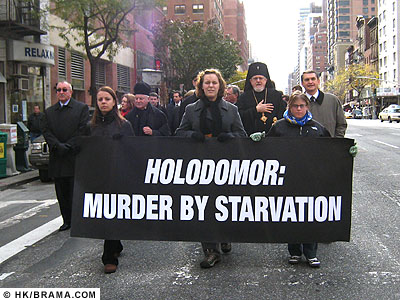
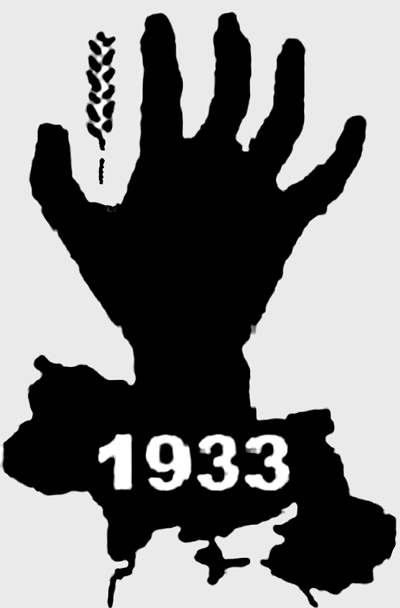
The famous diabolical sneer attributed to Hitler on the eve of the Holocaust, "Who remembers the Armenians?", uttered a scant quarter-century after the genocide in that country, could equally apply,
mutatis mutandis, to Ukrainians under Stalin who, only a half-dozen years before the Final Solution, suffered through what Robert Conquest first called
The Harvest of Sorrow: Soviet Collectivization and the Terror-Famine. That horrendous event has only recently begun to attract scholarly attention.
Recently I
noted the launch of a new scholarly work treating the Holodomor or terror-famine as seen in the documents of the archives of the Holy See: Athanasius McVay and Lubomyr Luciuk,
The Holy See and the Holodomor: Documents from the Vatican Secret Archives on the Great Famine of 1932-1933 in Soviet Ukraine. (This topic is also the subject of a symposium at the
Huffington Ecumenical Institute in Los Angeles under the capable direction of Nicholas Denysenko.) I asked one of the co-authors of that study, the priest and historian Athanasius McVay (who blogs about some of his scholarship at
Annales Ecclesiae Ucrainae), to discuss his work for us.
AD: Tell us a bit about your background:
I was born in Winnipeg, Canada to a mother of Ukrainian ancestry. I studied at the Angelicum and Church History at the Gregorian University in Rome, and completed a doctoral dissertation on the relations between the papal diplomats and the Ukrainian Greco-Catholic hierarchy during the struggle for Ukrainian independence (1918-1923). Currently I am completing an historical biography of the first Ukrainian bishop for Canada, Blessed Nykyta Budka (1877-1949), the centenary of whose appointment we will be celebrating in 2012.
In addition to being a church historian and scholar, I am a Ukrainian Greco-Catholic priest who has, among other assignments, spent the last twelve years transcribing various documents in the Vatican Archives relating to Ukrainian history. At first this research was aimed at the preparation of my doctoral dissertation. Later, I discovered that there was very little research being done on Ukrainian subjects in these archives.
AD: You note some of this research and its findings on your blog, yes?
Yes, and I publish some of it in scholarly journals including, as you know, Logos: A Journal of Eastern Christian Studies.
AD: What happened after you finished your doctoral program?
After finishing my doctorate in 2008, both Bishop David Motiuk of the Edmonton Eparchy of the Ukrainian Greco-Catholic Church and the Bishop Budka Society of Edmonton commissioned me to write an historical biography of Blessed Nykyta Budka in preparation for the centenary of his nomimnation (1912-2012).
 While searching the archives for information on Budka, I accidentally discovered documents concerning the Holodomor. I’ve known about the Holodomor since the early 1980’s when Ukrainians across Canada organized various conferences and demonstrations to have this humanitarian tragedy officially recognized by the Canadian Government. In 1984 my hometown erected a monument to the Holodomor directly in front of our City Hall.
AD: "Holodomor" is still not a generally well-known term. What does it describe?
After the 1917 Russian Revolution and creation of the USSR, the Soviet economy was a disaster, especially due to the ideological economic schemes such as the collective farms. Widespread famine was occurring in Russia and Ukraine at the end of the 1920’s. This made the Soviet Union politically weak and fueled the Ukrainian independence movement. Stalin decided to kill two birds with one stone by weakening the Ukrainian ethnic population and also eliminating the prosperous farmer-class known as kulaks. Grain was confiscated at gunpoint and shipped to Russian parts of the Soviet Union that were also experiencing food shortages. The politically motivated famine was directed specifically against Ukrainian ethnics. Estimates range from three to ten million starved to death as a result. The exact number of victims is a matter of lively debate.
The Soviet Union and its successor the Russian Federation have denied that the famine was directed against Ukraine. Political and diplomatic pressure has been exerted on other countries not to disseminate information about the Holodomor and especially not to give it any kind of official recognition. As to the labeling of genocide, the question is complicated. Whatever you want to call the Holodomor, it is vital that it be recognized as a deliberate act directed mainly against the ethnically Ukrainian population of Soviet Ukraine and Russia. Films about the Holodomor have been released. At the time journalists such as Malcolm Muggeridge and Gareth Jones broke the story after visiting Soviet Ukraine.
After the publication of government documents proving the existence of the Holodomor, the publication of our documents, and contemporary news reports by Muggeridge and Jones, it is obvious that the late Walter Duranty’s reports were inaccurate. I don’t know the motivation behind such reports. I understand that some scholars have asked for Duranty’s Pulitzer prize to be posthumously revoked.
For my doctoral dissertation, I sifted through well over ten-thousand folios, mainly from two collections: the Archives of the Sacred Congregation for Extraordinary Ecclesiastical Affairs (AES) and those of the Apostolic Nunciature of Warsaw. For this particular project, virtually all of the documents are found in the Pro Russia section of the AES. Pro Russia was a Pontifical Commission created by Pius XI to handle all Catholic affairs in the Soviet Union and among Russian émigréés.
AD: I have heard from other scholars that doing research in Rome, and especially the Vatican, is sometimes difficult and that accessing materials is not always easy. What was your experience?
The Archivium Secretum Vaticanum was opened for research to scholars by Pope Leo XIII in 1881. It has been the custom for the Roman Pontiffs to de-classify documents dating from not less than eighty years after the end of a pontificate of one or more of their predecessors. In 1985 John Paul II declassified documents from the pontificates of Pius X and Benedict XV (1903-1922). In 2006 Benedict XVI de-classified those from the pontificate of Pius XI (1922-1939).

It is a great privilege to be permitted to perform research in such an important collection of archival
fonds known collectively as the Vatican Secret Archives. The official name is a bit of a misnomer. Secretum here would be the equivalent to Privy in English. They are the Pope’s archives and, as at any state archives, are private but not secret.
The staff of the Vatican archives is made up of highly competent historians. Researchers have to be recommended by competent academic institutions and even by ecclesiastical authorities in order to gain permission to consult the archival collections. They do not have direct access to the archives themselves but may consult the indices provided and request portions of archival fonds, boxes, envelopes and sometimes even single folios. Consultation of the documents is carefully monitored by the staff in order that no harm comes to them.
AD: It is often assumed that all communications in the Vatican are in Latin, still the "official" language of the Roman Catholic Church. What languages did you encounter in the documentation?
The lingua franca used in Vatican diplomatic correspondence is Italian. Documents to and from secular diplomatic representatives are invariably in French. Only a very few documents are in Latin, often to or from churchmen who did not speak Italian or French. The letters coming from Ukraine were written in Russian. The AES index lists the themes of all the documents contained in that archive, including famine in Russia. "Holodomor" is a Ukrainian term coined later. I spent about two months on-and-off translating the documents as I had other work do on my biography of Bishop Budka.
AD: Were there any surprises as you did your research?
The basic details about the Holodomor were known to me; but many of the details of the famine were new to me, especially how the Apostolic See sought to intervene to make the tragedy know to the world and to alleviate the people's suffering. The Pope learned about the Holodomor from the French Jesuit, Bishop Michel d'Herbigny, who was the president of the Pro Russia Commission. D'Herbigny was receiving letters from the Soviet Union as well as reports from foreign diplomats who had witnessed the situation first hand. D'Herbigny attempted to move mountains in order to convince Pius XI to launch an aid-mission to the Soviet Union, just as he and his predecessor Benedict XV had done in 1921-1923. The emotional Pius XI wept when he received one report and insisted that something must be done. Unfortunately churchmen and diplomats all concurred that no aid would ever reach the people because Soviet authorities were officially denying the existence of a famine that Stalin had deliberately orchestrated. In the end, the Pope was only able to authorize a gift of ten-thousand Italian lire to be forwarded to starving Catholics via German charitable organizations that had contacts in Ukraine.
AD: Sum up the book for us:
The book, currently only in English, is simply one more testimony of the Holodomor from primary and international diplomatic sources.

It is also a contribution to scholarship on the inner workings of the Roman Curia during the pontificate of Pius XI. The book is available from Kashtan Press, Abe Books, and, in Rome, at the Centro Russo Ecumenica (Messaggio dell’Icona) on Borgo Pio.
________________________
* Updated at request of the interviewee