"Let books be your dining table, / And you shall be full of delights. / Let them be your
mattress,/
And you shall sleep restful nights" (St. Ephraim the Syrian).


Showing posts with label Pope John Paul II. Show all posts

Wednesday, November 13, 2019

Killing the Inconvenient and Inefficient

In the mid- and late-1990s, I was a volunteer in the pastoral care department of a large nursing home and was saddened by the neglect of many people there who were simply warehoused away pending their expiration date, which their families certainly found inconveniently far off into the future. And several of the residents themselves, bored, lonely, and often in declining health, felt the pressure to do the decent thing by hurrying along to their graves. The experience of visiting the residents, and sometimes bringing them the Eucharist, bestowed on my far more gifts than anything my poor efforts might have given them in return.

It was during this time that debates in Canada over euthanasia began to emerge, and it was smack in the middle of all that that Pope John Paul II rightly raised his finger in his powerful and still entirely relevant encyclical Evangelium Vitae. Some wrote that off as the "abortion letter" but its critique of the idol and ideology of "efficiency," developed at some length in several parts of the letter, admits of very wide application today, including how we handle the questions of human disease, decline, and death.

As I was reading the late pope's letter, I was also smack in the middle of my Hauerwas period, where I read every one of his books then extant, and even had whole sections memorized. He was hugely influential for my development, and became, unexpectedly, a friend when I wrote to him about my difficulties defending my MA thesis, which was heavily indebted to him and Alasdair MacIntyre. Hauerwas has written a powerful foreword to the new book Euthanasia and the Patristic Tradition by Ioannis Bekos (James Clarke & Co., 2019), 284pp.

About this book the publisher tells us this:
Euthanasia and Patristic Tradition presents secular and Christian bioethics as opposing forces in dialogue, highlights the importance of the Christian Patristic tradition in revealing disguised characteristics of bioethics in our era, and challenges the idea of individualism in modern societies through the development of a Christian individualism. While the book is focused on euthanasia, it also offers important perspectives on other ethical dilemmas. Ioannis Bekos applies Panagiotis Kondyliss theory for the emergence of worldviews as a function of power where all ethical theories have been proved to be subjective. Bringing together bioethical theories and just war theory, he exposes the disguised power claims of modern bioethics over human existence. Then, through an account of the history of thought, society, and politics of the twentieth and twenty-first centuries, Bekos delivers a profound critique of the idea of common morality, popular theories such as principlism and contractualism, ethicists like Peter Singer, and philosophers like Habermas. Using the works of St John Damascene and St Symeon the New Theologian, Bekos shows the fundamental elements of a Christian anthropology regarding the constitution of man, the character of pain and death, and the importance of the free will in man, offering a critique of modern bioethics.

Friday, November 8, 2013

Prayers from the East

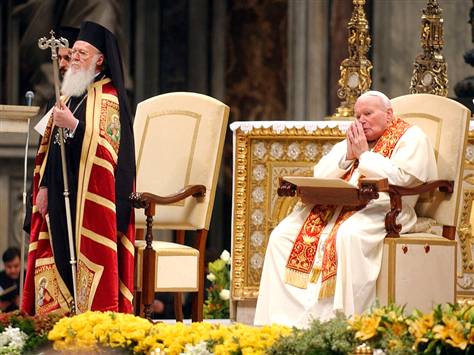
1995 was a significant year for Orthodox-Catholic rapprochement. The late Pope John Paul II wrote an encyclical on Christian unity (about which I then wrote a book that the current pope commented on, if this post is to be believed) and almost simultaneously published another letter, Orientale Lumen, urging Catholics to get to know the treasures of Eastern Christianity in order that the Church would again (to use a favourite, if somewhat tiresome, metaphor of the late pope, which was not original to him but, if memory serves, came from Congar and was not unproblematic insofar as it seemed to overlook the Syriac tradition, as Sebastian Brock suggested) "breathe with both lungs, East and West." Frankly acknowledging that most Latin Catholics are entirely ignorant about the Christian East--and not merely Orthodoxy, but the millions of Eastern Catholics in their own communion--the pope asked the former to get to know those latter two in some detail. Nearly two decades after that request, I am regularly staggered by how little progress has been made notwithstanding a great, even ardent, interest in the East when some Latins do discover it. All of my Roman Catholic graduate students, e.g., are deeply drawn to the East and have been for some time, and when we read Eastern sources they cannot get enough of them and constantly hunger for more. But they are, it seems, a rare exception.

When Catholics and other Western Christians do look East, one of the first things they are often drawn toward is Eastern liturgy, about which not a little romanticism and myth-making has long endured. (This Robert Taft article should begin the process of disabusing one of those romanticized myths.)

Liturgy, thus, has loomed large in Eastern consciousness, and in Western consciousness of the East (recall Taft's frequent temptation to write a book "Inventing Eastern Orthodoxy," one chapter of which, he has often said, would be "Inventing Eastern Liturgy"). And so it is appropriate, as the West continues to learn about the East, that it begins with liturgy and prayer. It is, then, a welcome development to have, just in time for Christmas, a short and charming little book that I hope many Roman Catholics (and many other Christians, East and West, who will doubtless benefit)  find under their trees this December: J. Michael Thompson, Lights From the East: Pray for Us (Ligouri, 2013), 144pp. This book will not only be educational about important figures of the East, but--more important--it will help people to pray.

About this book the publisher tells us: 
Catholics worldwide are increasingly heeding the call of the late Pope John Paul II to breathe spiritually "with both lungs"-to be inspired by both Western and Eastern Christianity. Yet many Catholics are unaware that the Roman Catholic Church is in communion with twenty-two other Churches, which together comprise the Eastern Catholic Churches. Focused on Eastern holy ones Lights From the East presents incredible riches to English speakers worldwide, including icons, biographies, Scripture, reflections, translated quotations from the service that honors the saint, prayers, and original hymns set to Rusyn or Galician melodies.
This is the kind of book, I think, that one dives into from time to time rather than reading systematically straight through. It is like several other collections I have seen--a kind of "breviary" of a sort, with scriptural, liturgical, and iconographical texts and plates tied to the liturgical year commemorating saints in five categories: those of the Old and New Testaments; the Fathers and Mothers of the Church; monastics; saints common to East and West; and martyrs of the twentieth century. As such, this book would be ideal for those asked to lead a reflection at the start of a parish Bible study, say, or before a class, or for family reading at home to inspire the imaginations of children, particularly on the feast days of those feted herein.  

Unlike other similar collections, the outstanding feature of this book is its inclusion of liturgical music. The author is a well-known and highly accomplished liturgical and pastoral musician, and virtually all of the hymn texts and translations here are his own work, often a rendering into elegant English of Slavonic or Ukrainian or other Trans-Carpathian sources. (Last year the author graciously sent me a very lovely CD of prostopinije music for the Great Fast which I have listened to repeatedly since then.) As one who deeply loves Galician and Kievan chant, but who cannot (as my late grandmother used to say, of herself and many of her relations) "carry a tune in a bucket," this book is handy to have, and to give to those more musically talented than I, in the hopes that they will learn something of the beauties of East-Slavic chant in its various forms, and begin to make them more widely known--as well as the stories of some of those East-Slavic saints killed by the Nazis and Communists in that century of tears to which we recently bade farewell but from whose clutches we are not yet free.

I warmly commend this spiritually edifying little book and its author, whom I hope to interview in the coming days. 
Related Posts Plugin for WordPress, Blogger...