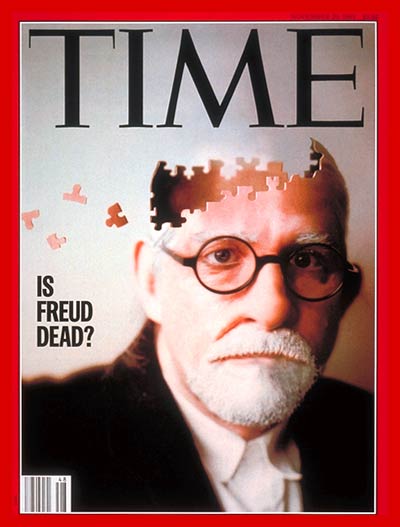
As he recounts in the introduction to this book, Busch is something of a pioneer in psychoanalytic technique and training, being one of the first clinical psychologists to be admitted in the 1970s to psychoanalytic training at an American institute. American institutes, unlike those in Canada, the UK, and parts of Europe and elsewhere, generally have been extremely reluctant to admit any but psychiatrists or those with medical degrees. In this, they take a different tack from what Freud recommended in The Question of Lay Analysis.
Here I want to lie down on Busch's couch, as it were, and speculate a bit with him on some early passages from Busch as part of an exercise asking whether his understanding of the psychoanalytic process does not in fact lend itself rather well to what confessors and spiritual directors (and indeed all of us) may be trying to do with their penitents and with the task before all of us to "put on the mind of Christ."

1) The first phase is when the patient comes to be familiar with his own inhibitions and restrictions that keep him from living: until the patient can wonder about his lack of wondering, wondering is not possible. This phase, later in the book, is called one of self-observation.
2) The middle phase of an analysis is the creation of a "psychoanalytic mind," that is, learning to observe one's own mind and its sequence of free associations. Such a psychoanalytic mind is necessary if the analysis is to bear long-term sustainable fruits in one's life. It is necessary, that is, if the patient is to be freed from the "slavery of repetition compulsion" and instead freed to "think about thinking." Later in the book Busch calls this phase one of self-reflection.
3) The terminal phase of an analysis consists of a deeper psychoanalytic mind more completely free from deceptions in understanding one's associations with greater veracity. Here the analysand can "play, muse, reflect, and interpret her own associations." This phase Busch later calls self-inquiry.
Busch says that part of his practice consists in seeing patients for a second analysis. They have benefited from their first analysis, but from that largely derived only knowledge of their unconscious--an "object," as it were, rather than a process. And for Bush, "the process of knowing is as important as what is known." Here Busch pioneers a different goal for analysis which, classically, has held up the importance of a state of knowing rather than a process of knowing. In the former, we come to know consciously what was previously unconscious. In the latter, the patient gains an understanding of how his mind works and how it affects him. Both offer freedom, albeit of a different degree and type, but Busch suggests the freedom of a psychoanalytic mind, with a process of knowing in addition to what is known, may be of greater long-term benefit.
Cast this in Christian terms, as between a penitent and his confessor or spiritual daughter and her spiritual mother, and consider the following, beginning with the distinction between a state of knowing and a process of knowing. In the former, I may well possess knowledge of my sins and weaknesses; but with the development of the latter, I may come to understand how and why it is I always fall prone to certain sins or temptations--I may, that is, come to understand a bit more about how my mind and soul work. Could such a process also unfold in a three-fold manner, as Busch suggests?
1) In the first phase, one comes to the director or confessor aware, perhaps vaguely, that something is holding him or her back from advancing in the Christian life--a besetting sin, perhaps, a stubborn habit, or a certain tristitia de bono spirituali. One is aware, or others have made him aware, that he has not yet come close to putting on the full stature of Christ, and he needs help to do this.
2) In the middle phase of the work, what is less important is discovering the underlying causes of one's sinful habits or lukewarm spiritual life; what is less important is acquiring here some insight into "cause" or some doctrinal insight which one must master and be "convicted" by or "convinced" of. Rather, one needs instead to develop a way of thinking with the Church (sentire cum Ecclesia), which is thinking with Christ. By thinking with Him and in Him, we come to a fuller understanding of ourselves, and to seeing ourselves as He sees us. In the famous words of Gaudium et Spes (no.22), "Christ, ...by the revelation of the mystery of the Father and His love, fully reveals man to man himself."
3) In the third, and perhaps terminal, phase, the patient penitent has acquired enough insight into how his own mind and soul operate that he knows how to remain free from the (to switch to Evagrian terminology) logismoi, from his previous disordered thoughts and tendencies, and to be able to "let this mind be in you which was in Christ Jesus." Here the penitent comes to see thoughts as "mental events" as Busch calls them--with, again I would suggest, clear Evagrian overtones. And with the help of divine grace, those events can all be directed towards the glory of God. They need not, in other words, be events which take us away from God or cause terror in us, but can be used, as all things can be used, to work for the good of those who love God.
Anyway, I am neither a clinician nor a spiritual director (Deo gratias), so perhaps I have overstepped, but in reading Fred Busch's interesting Creating a Psychoanalytic Mind, these thoughts did occur.