"Let books be your dining table, / And you shall be full of delights. / Let them be your
mattress,/
And you shall sleep restful nights" (St. Ephraim the Syrian).


Showing posts with label Ecclesiology. Show all posts

Monday, January 24, 2022

Oxford Handbook of Ecclesiology

Good news! Forthcoming in March this year will be a more affordable paperback edition of a book first published a few years ago, which makes an invaluable contribution to the study of the Church and churches: The Oxford Handbook of Ecclesiology (OUP, March 2022), 672pp. 

Edited by Paul Avis, this volume, with a chapter on Orthodox ecclesiology authored by the venerable Andrew Louth, is also, the publisher tells us;

a unique scholarly resource for the study of the Christian Church as we find it in the Bible, in history, and today. As the scholarly study of how we understand the Christian Church's identity and mission, ecclesiology is at the centre of today's theological research, reflection, and debate. Ecclesiology is the theological driver of the ecumenical movement. The main focus of the intense ecumenical engagement and dialogue of the past half-century has been ecclesiological and this is the area where the most intractable differences remain to be tackled. Ecclesiology investigates the Church's manifold self-understanding in relation to a number of areas: the origins, structures, authority, doctrine, ministry, sacraments, unity, diversity, and mission of the Church, including its relation to the state and to society and culture. 

The sources of ecclesiological reflection are the Bible (interpreted in the light of scholarly research), Church history, and the wealth of the Christian theological tradition, together with the information and insights that emerge from other relevant academic disciplines. This Handbook considers the biblical resources, historical development, and contemporary initiatives in ecclesiology. It offers an invaluable and comprehensive guide to understanding the Church.

Wednesday, January 19, 2022

On the Patriarchate of Constantinople

The office of the Roman papacy, of course, attracts huge attention, including from scholars. But the patriarchate of New Rome attracts considerably less attention. A new book, however, will help remind us of its venerable nature and complex history: A Companion to the Patriarchate of Constantinople, eds. Christian Gastgeber, Ekaterini Mitsiou, Johannes Preiser-Kapeller, and Vratislav Zervan (Brill, 2021), 322pp.

Part of the series Brill's Companions to the Byzantine World, Volume: 9, this book, the publisher tells us,

provides an overview of the development of the Patriarchate of Constantinople from Late Antiquity to the Early Ottoman period (4th to 15th c.). It highlights continuities and changes in the organizational, dogmatic, and intellectual framework of the central ecclesiastical institution of the Byzantine Empire in the face of political and religious upheavals. The volume pays attention to the relations of the Patriarchate with other churches in the West and in the East. Across the disciplinary divide between Byzantine and Ottoman studies, the volume explains the longevity of the Patriarchate beyond the fall of Byzantium in 1453 up to modern times. A particular focus is laid on an original register book of the 14th century. 

You will note on the list of contributors some of the leading scholars of Byzantium today: 

Contributors are: Claudia Rapp, Frederick Lauritzen, Tia M. Kolbaba, Johannes Preiser-Kapeller, Marie-Hélène Blanchet, Dimitrios G. Apostolopoulos, Machi Païzi-Apostolopoulou, Klaus-Peter Todt, Mihailo S. Popović, Konstantinos Vetochnikov, Ekaterini Mitsiou, Vratislav Zervan, and Christian Gastgeber.

Friday, October 1, 2021

In Praise of Robert Slesinski (III): Ecclesiology

In this category of Slesinski's works we place not only Holy Mother Church, but several other works as well. But to begin with this one, here is the publisher's blurb:

Holy Mother Church is the latest of Fr. Slesinski’s contributions in mystagogical catechesis, which already include ten other books, all published by Eastern Christian Publications. The Christian Faithful throughout the world at every Divine Liturgy or Holy Mass profess a creedal belief “in one, holy, catholic, and apostolic Church.” This catechetical study directly examines the full meaning of these constitutive marks of the Church–the Church in her oneness, holiness, catholicity, and apostolicity. It covers the universal aspects of the Church at the opposite end of the spectrum from ECP’s recent book The Home Church which examines mixed marriage of Catholics and Orthodox. Color icons enhance the meaning of the book throughout.  

We also have A Primer on Church and Eucharist: Eastern Perspectives, from 2007, which is also available in Spanish.

I would also put in this category some of his other books that look at crucial parts of the Church's life, starting with Holy Tradition: An Essay in Reparation from 2018. About this book we are given a short blurb befitting a short (50pp.) book: An Eastern examination of the meaning of Tradition in the context of today’s problems for the Church.  

The Church lives in, from, and with her tradition, including sacramental and liturgical traditions, which are not meant to be exclusively inward focused, but to take Christians out to The Holy Apostolate: The Liturgy After the Liturgy (2013). 


The liturgy is of course intimately connected to the sacraments, treated in The Holy Mysteries: Celebrating Christ's Sacramental Presence (2018). 

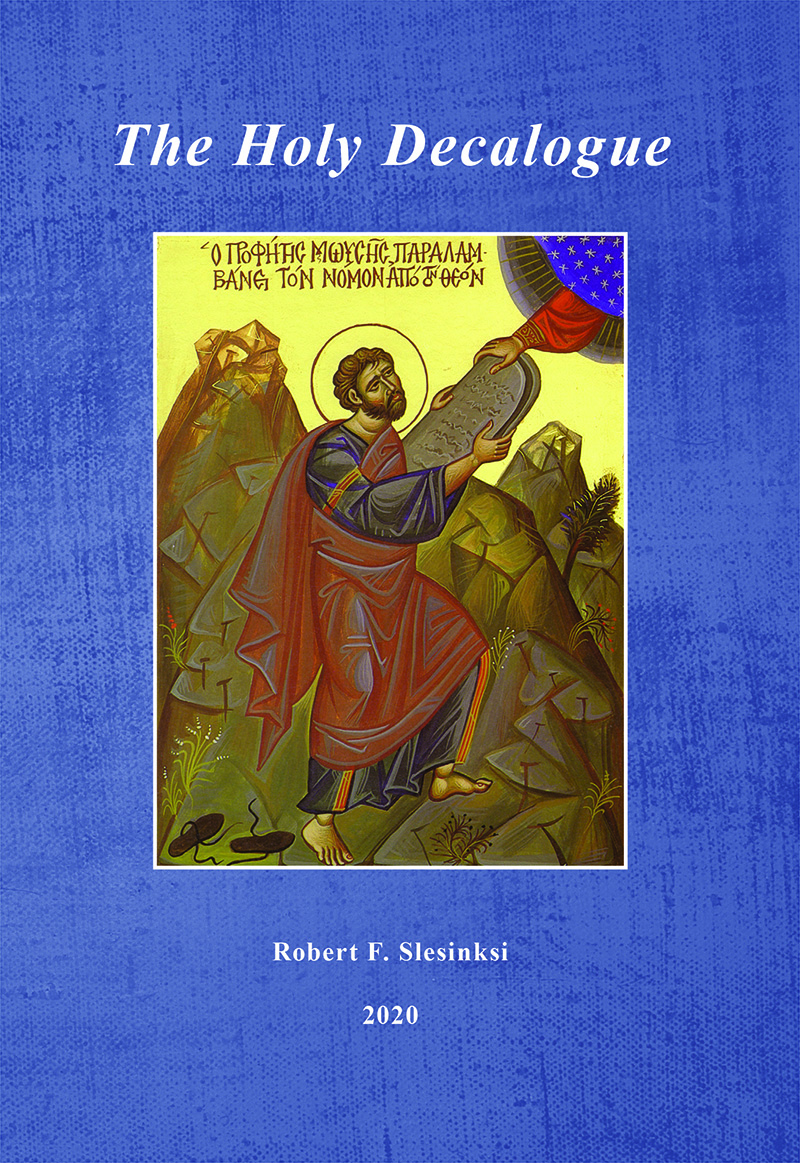
But liturgy must also give rise to new and different ways of living, well treated in this introduction to moral theology: The Holy Decalogue

Moral and liturgical life both are led in the power of the Holy Spirit and in the light of the resurrection, both well treated in The Holy Pentekostarion: Catechesis on Holy Week, Pascha, and Pentecost from 2010. 

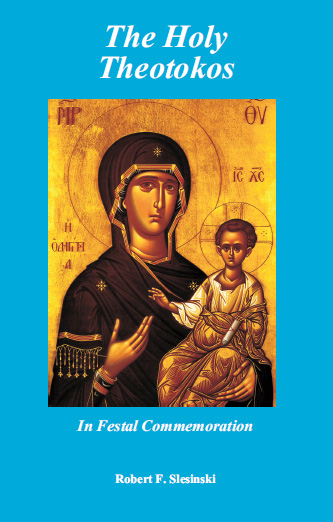
Finally, to speak 'patristically,' we can say that all sacraments, all liturgy, all ecclesial life culminate in the one who is the Ark and Temple of the Most High, The Holy Theotokos: In Festal Commemoration, published in 2012 and one of Slesinski's longest books in this category. 


About this book the publisher tells us this: 

This book continues the series of adult education on the feast days of the Byzantine Churches, their theology and liturgical texts. 200 pages with icons.


Series ended.

Friday, August 27, 2021

John Zizioulas on The Meaning of Being Human

In Eastern Christian studies, a new work by John Zizioulas has to count as a major event. He has commanded wide respect and authority across Protestant, Catholic, and Orthodox traditions for decades now. Some years back, I did an informal survey of university and seminary classes in ecclesiology where his first and still most famous book Being as Communion was assigned. It was an impressively high number in schools of all three aforementioned traditions. His ecumenical reach is very impressive and very much to the good. 

He has recently released a new book: The Meaning of Being Human (Sebastian Press, 2021), 100pp. About this book the publisher tells us this:

In this book Metropolitan of Pergamon is dealing with the most contemporary, the most urgent, the most existential issues facing the Church today. The core of author’s argument is that personhood as an ekstatic and hypostatic mode of existence is not subject to any predetermination or necessity. The book provides a perfect opportunity to look retrospectively at Metropolitan John Zizioulas’ profound theological vision. It serves both as a significant illustration of his vitality in preserving the continuance of his thought, and of his enduring faithfulness to the constants which permeate his entire theological legacy. The restoration of personhood in Christ leads inevitably to the community of the Church which, in its turn, offers impersonal nature the possibility of being “referred” to God in its integrity through the personhood of man. This makes the Church eucharistic in its very nature, and man God by participation in God. The Church’s eucharistic identity has led Zizioulas to rethink theology as a whole on the basis of ecclesial experience as a reflection of Trinitarian life.

Thursday, August 5, 2021

Church as Community and Community as Church

I am not unbiased when it comes to the work of Michael Plekon, to whom I owe much. It is a great gift to have him as a friend; but his works are also gifts, and my students delight in them when I assign his books in the classroom, including, recently his Uncommon Prayer: Prayer in Everyday Experience and Saints as They Really Are.

Now he has a new one out: Community as Church, Church as Community (July 2021), 272pp. 

About this book the publisher tells us this: 

Parishes of all denominations are in decline, shrinking, closing, dying. We know that there are increasing numbers, young and older, who are religious “nones” and “dones.” This book explores why the decline is taking place, why the distancing is going on. But it goes on to examine parishes from all over the country and from various church bodies that are resurrecting. The central theme of death and resurrection shapes the analysis of parishes covered. Parishes are resurrecting by reinventing their ministries, by repurposing their building to better serve their neighborhoods, thus replanting and reconnecting with them. All of this is the Spirit’s doing but through the community of sisters and brothers who make up each congregation of faith. Community as the core of church is the other reality shaping the book’s reflection. And community, a parish being with those around, living for more than its own survival are visions for going forward. Other aspects of congregational life are also examined, most importantly the pastors—how they serve when budgets shrink, how they are trained, how pastors act with the community not above it. No recipes are suggested for parish resurrection, but the stories of the parishes that have revived bear within numerous lessons for us in the future.

I read parts in draft, and have again read the whole book this month. I've sent some questions to him for a blog interview, and await with great interest his thoughts, which I will post in due time.  

Thursday, May 27, 2021

An Omnium Gatherum of Articles and Books on Synods and Synodality

Disarmingly published last week as a mere "note," this text from Rome portends major shifts in the ecclesiology of the Latin Church and by extension the entire Catholic communion. 

It does not arise out of nowhere and nothing, however. In his 2015 address, the bishop of Rome laid out a vision of synodality for the Latin Church that is striking and surprising.....only to those who haven't been paying attention. For those who have attended not only to Francis but also to (admittedly slow-moving) trajectories in Catholic ecclesiology for a half-century now, this vision is not really a surprise. Perhaps the only surprise is that it is this pope, rather than his immediate predecessor who wrote so much about ecclesial reforms, who is enacting a vision of synodality now.

I have been writing about synods, synodal structures, and "synodality" for well over a decade now in the Church of the West as of the East. My first contribution was in my first book Orthodoxy and the Roman Papacy: Ut Unum Sint and the Prospects of East-West Unity.

In the book and elsewhere I have tried to stress, especially to Catholics worried about the dangers of synodality, that there is no one model all must follow. If we look to the East, we find a diversity of structures arranged according to need, context, and history. Moreover, it is very important to note that a properly functioning synodal structure can only come about where both synod and primate are functioning together. (The great Orthodox theologian John Zizioulas is crystal clear on this point.) A strong primate (whether diocesan bishop, patriarch, pope, or catholicos) is needed for synods at every level. 

In other words, a synod does not exist at the expense of a primate, but only in concert with him, each acting as a check on the other. In this light, there is no reason to believe that a more robust synodality in the West would in itself weaken either the papacy or more generally the Catholic Church. Her problems are already significant and longstanding, and they have come not in the presence of robust synodality but in its absence; they have come in a time of papal centralization and maximalization.

That book has been followed up by more articles than I can count for on the topic of synods published in such places the Catholic Herald in London; Our Sunday Visitor, based here in Indiana; Catholic World Report on many occasions, most notably here; for The Catholic Thingand for other periodicals as well. 

My most recent contribution, published in the Herald this week, is here. I told the Herald's splendid editor Christopher Altieri I had an indecent amount of fun writing that piece. Is it satirical? Is it serious? Is it both? I cannot decide; perhaps you won't be able to either. In any event, what I was trying to suggest was that if we are to have synods, then let us have them to an ultramontane degree: let us go beyond the mountains north of Rome to find healthy models of synods where they still exist--in places like Armenia, for example. 

My unrequited love affair with the Armenian Apostolic Church continued in my 2019 book Everything Hidden Shall Be Revealed: Ridding the Church of Abuses of Sex and Power. There I went into even greater detail about local synods--at the parish, diocesan, and regional levels. If Catholics are to have synods, they must not be the chaotic talking shops in Rome since 1965 misleadingly called "synods." They must be organs of governance, with real powers, at every level of the Church. 

Others have begun to cite my work, most notably the cardinal-archbishop of Newark, in a piece just published here in Commonweal. In addition, Fr Bob Wild of Madonna House (whom I have known for some time and count a friend) has recently discussed some of my work on synodality here.

I mention all this not to brag or to feel smugly satisfied that at long last Very Important People are starting to discover my great work. (Truth be told, I have an absolute horror of the idea of being anything close to "famous" or a "celebrity" or even moderately well-known. I am a middle-ranking scribe whose "schizoid" tendencies--so well captured by Nancy McWilliams' invaluable essay--thrive best in one of the obscurer provinces of the American imperium. Leave me alone in my classroom and consulting room with students and patients respectively, and I might be useful.) Instead, I mention all this only as a service to those who still feel wildly unsure about what synods and synodality are and do. I have tried to allay those anxieties by showing the concrete tasks that real synods, proper synods, properly do. 

Will we get such synods? It is up to us to work for them and not be fobbed off with pseudo-synods. 

Wednesday, March 31, 2021

The Oxford Handbook of Ecumenical Studies

I was pleased and honoured to have been asked, nearly a decade ago now, to contribute to this forthcoming collection, part of a series of such Handbooks published by the world's most prestigious academic press: The Oxford Handbook of Ecumenical Studies, eds. Geoffrey Wainwright and Paul McPartlan (Oxford University Press, July 2021), 696pp. My chapter is on ecclesiology. 

As an editor myself of international scholarly collections, including my newest one, Married Priests in the Catholic Church, which likewise took nearly a decade to finish, I am well aware of how much one is at the mercy of contributors, and how long they can force you to drag things out by not submitting materials on time, or by (in some especially egregious cases) agreeing to submit and then not only failing to do so, but refusing all further communication in a vexatiously rude manner. I know from talking to Paul over the years that this forthcoming Handbook took much longer than was hoped--so much so that the other editor, Geoffrey Wainwright, died just over a year ago, before this book was in print. 

But at long last this Handbook makes its debut. About it the publisher tells us this:

The Oxford Handbook of Ecumenical Studies is an unparalleled compendium of ecumenical history, information and reflection. With essay contributions by nearly fifty experts in their various fields, and edited by two leading international scholars, the Handbook is a major resource for all who are involved or interested in ecumenical work for reconciliation between Christians and for the unity of the Church. Its six main sections consider, respectively, the different phases of the history of the ecumenical movement from the mid-nineteenth century to the present; the ways in which leading Christian churches and traditions, Orthodox, Anglican, Methodist, Catholic, Lutheran, Reformed, Baptist, and Pentecostal, have engaged with and contributed to the movement; the achievements of ecumenical dialogue in key areas of Christian doctrine, such as Christology and ecclesiology, baptism, Eucharist and ministry, morals and mission, and the issues that remain outstanding; various ecumenical agencies and instruments, such as covenants and dialogues, the World Council of Churches, the Pontifical Council for Promoting Christian Unity and the Global Christian Forum; the progress and difficulties of ecumenism in different countries, areas and continents of the world, the UK and the USA, Africa, Asia, South America, Europe, and the Middle East, ; and finally two all-important questions are considered by scholars from various traditions: what would Christian unity look like and what is the best method for seeking it? This is a remarkably comprehensive account and assessment of one of the most outstanding features of Christian history, namely the modern ecumenical movement.

Monday, January 25, 2021

The Oxford Handbook of Ecumenical Studies

The annual "unity octave," more recently and popularly known as the Week of Prayer for Christian Unity, ends today, which is as fine a time as any to draw your attention to a forthcoming international collection from the most prestigious academic publisher in the world: The Oxford Handbook of Ecumenical Studies, eds., Geoffrey Wainwright and Paul McPartlan (OUP, June 2021), 696pp.

I was asked nearly a decade ago now to contribute a chapter, which it was my pleasure and honour to do: I wrote on The Church, showing ecumenical advances in ecclesiology. My chapter was submitted in 2012. 

The final production, however, has been so long delayed that one of the editors, Geoffrey Wainwright, died last year before this book was in print. Parts of it have been available electronically for some time, but now we shall soon have the whole thing in print, which is how God intended for books to be read. I mention all this not in any critical way whatsoever, but merely to commiserate with Prof. McPartlan, for I, too, have often been in the position he has been in, waiting on contributors to send in much-delayed chapters only to have some of them utterly disappear, submitting nothing (long may they roast in Purgatory!); others to promise and promise you a chapter, dragging things out indefinitely; and so on. 

In fact, my forthcoming Married Priests in the Catholic Church also saw its first stirrings of life back in 2012, and was, I hoped, going to be in print at least 3 years ago. But we editors are at the mercy of contributors and other forces we can only rarely, and often never, dragoon to our deadlines. So things always take much longer than one plans and hopes, leading me to the longstanding if counterintuitive realization that writing a book as solo author is always much easier and faster than editing a collection even if your overall word-count is far different. 

In any event, here is what the publisher tells us about this forthcoming collection: 

The Oxford Handbook of Ecumenical Studies is an unparalleled compendium of ecumenical history, information and reflection. With essay contributions by nearly fifty experts in their various fields, and edited by two leading international scholars, the Handbook is a major resource for all who are involved or interested in ecumenical work for reconciliation between Christians and for the unity of the Church. Its six main sections consider, respectively, the different phases of the history of the ecumenical movement from the mid-nineteenth century to the present; the ways in which leading Christian churches and traditions, Orthodox, Anglican, Methodist, Catholic, Lutheran, Reformed, Baptist, and Pentecostal, have engaged with and contributed to the movement; the achievements of ecumenical dialogue in key areas of Christian doctrine, such as Christology and ecclesiology, baptism, Eucharist and ministry, morals and mission, and the issues that remain outstanding; various ecumenical agencies and instruments, such as covenants and dialogues, the World Council of Churches, the Pontifical Council for Promoting Christian Unity and the Global Christian Forum; the progress and difficulties of ecumenism in different countries, areas and continents of the world, the UK and the USA, Africa, Asia, South America, Europe, and the Middle East, ; and finally two all-important questions are considered by scholars from various traditions: what would Christian unity look like and what is the best method for seeking it? This is a remarkably comprehensive account and assessment of one of the most outstanding features of Christian history, namely the modern ecumenical movement.

Friday, November 20, 2020

Ecclesiology

I just finished teaching my re-designed ecclesiology class this semester. We made good use of my 2019 book, Everything Hidden Shall Be Revealed: Ridding the Church of Abuses of Sex and Power for one unit. Our major text was the Oxford Handbook of Ecclesiology

Speaking of handbooks, I see that T&T Clark has one just released a few weeks ago: T&T Clark Handbook of Ecclesiology, eds. Kimlyn J. Bender  and D. Stephen Long (2020, 504pp.). About this new book the publisher tells us this:

Divided into 3 parts, this handbook provides a wide-ranging survey and analysis of the Christian Church. The first section addresses the scriptural foundations of ecclesiology; the second section outlines the historical and confessional aspects of the topic; and the final part discusses a variety of contemporary and topical themes in ecclesiology.

Compiled and written by leading scholars in the field, the T&T Clark Handbook of Ecclesiology covers a range of key topics in the context of their development and importance in each stream of historic Christianity and the confessional traditions. The contributors cover traditional matters such as creedal notes, but also tackle questions of ordination, orders of ministry, and sacraments. This handbook is extensive enough to provide a true overview of the field, but the essays are also concise enough to be read as reference selections.

I note that one of the major Orthodox contributors to this new handbook is my friend Will Cohen, whose own work in ecclesiology and ecumenism is an important contribution about which I interviewed him here

Friday, June 12, 2020

Post-Communist Romanian Orthodoxy

The number of books treating post-communist religion and much else in Eastern Europe seems to have picked up pace again. Later this summer we shall have another: The Orthodox Church and National Identity in Post-Communist Romania by Adrian Velicu (Palgrave Macmillan, August 2020), 178pp.

About this book the publisher tells us this:
This book explores the Romanian Orthodox Church’s arguments on national identity to legitimize its own place in a post-communist Romania. The work traces the clergy’s deployment of the concepts of Christian Orthodoxy and Latin legacy as part of an uncharted constellation of arguments in contemporary intellectual history. A survey of public intellectuals’ opinions on national identity complements the Church’s views. The investigation attempts to offer an insight into the Church’s efforts to re-assert itself, given free rein in a post-dictatorial world of accelerated modernization. After clarifying and surveying the Church’s claims on institutional and national identity, the book then also explores the secular ideas on the subject. The subsequent analysis treats this material as “speech acts” (statements doing, not only saying, something) which are occasionally out of sync. Against a background of secularization, the Church’s rhetoric articulates a distinct line of thought in the post-89 intellectual landscape.

Monday, April 27, 2020

OCA's 50th Anniversary of Autocephaly

I have long been an admirer of the Orthodox Church of America, not least for its structures set up at and after its grant of autocephaly in 1970. In honour of that half-century anniversary, a new collection has been published:  The Time Has Come, ed. Ionut-Alexandru Tudorie (SVS Press, 2020), 464pp.

About this collection the publisher tells us this:
This is a hardback commemorative volume, compiled in celebration of the 50th Anniversary of the autocephaly of the Orthodox Church in America (OCA). Edited by St Vladimir's Academic Dean, Ionut-Alexandru Tudorie, the volume contains a collection of debates over the OCA Autocephaly reflected in St Vladimir's Quarterly (now known as the St Vladimir's Theological Journal). The various articles were written in the years leading up to and following the Russian Orthodox Church granting the Tomos of Autocephaly to the OCA (then known as the Russian Orthodox Greek Catholic Church of America) in 1970.
Along with Alexander Schmemann, other voices found in The Time Has Come include Metropolitan Leonty (Turkevich), Protopresbyter John Meyendorff, Archbishop Peter L’Huillier, Elizabeth Prodromou, Archimandrite Elpidophoros (Lambriniadis), Alexander Bogolepov, and several others.

Monday, April 20, 2020

Ecclesiology in Practice

When I first began studying ecclesiology twenty years ago, it was common to read things like the 20th century was the "century of the Church." In other words, as many remarked, one looked in vain in the patristic, scholastic, and early modern periods for systematic treatises on "the Church" in almost all major thinkers East and West.

Instead, it was only with the advent of the 20th century, and the important concomitant of the ecumenical movement--widely thought to have started at the 1910 World Mission Conference in Edinburgh--that we realized we needed to reflect carefully not just on the Church in the abstract, but also in her concrete structures, not least if the hope for Christian unity was going to make progress.

Still, much of ecclesiology has tended towards the idealistic, and only much more recently has turned to considering such things as episcopal, patriarchal, and papal structures, as I did in my Orthodoxy and the Roman Papacy. More recently still have we begun to look at even more local structures, including parishes and diocesan synods, as I did last year in my Everything Hidden Shall Be Revealed: Ridding the Church of Abuses of Sex and Power.

The ongoing attention to the concrete in ecclesiology, to a practice-informed theology, is well served in a new book by Clare Watkins, Disclosing Church: An Ecclesiology Learned from Conversations in Practice (Routledge, 2020), 282pp.

About this new book the publisher tells us this:
From 2006 to 2011 researchers at Heythrop College and the Oxford Centre for ecclesiology and Practical Theology (OxCEPT, Ripon College Cuddesdon) worked on a theological and action research project: "Action Research – Church and Society (ARCS). 2010 saw the publication of Talking About God in Practice: Theological Action research and Practical Theology (SCM), which presented in an accessible way the work of ARCS and its developing methodology. This turned out to be a landmark study in the praxis of Anglican and Catholic ecclesiology in the UK, showing how theology in these differing contexts interacted with the way in which clergy and congregations lived out their religious convictions. This book is a direct follow up to that significant work, authored by one of the original researchers, providing a systematic analysis of the impact of the "theological action research" methodology and its implications for a contemporary ecclesiology.
The book presents an ecclesiology generated from church practice, drawing on scholarship in the field as well as the results of the theological action research undertaken. It achieves this by including real scenarios alongside the academic discourse. This combination allows the author to tease out the complex relationship between the theory and the reality of church.
Addressing the need for a more developed theological and methodological account of the ARCS project, this is a book that will be of interest to scholars interested not only Western lived religion, but ecclesiology and theology more generally too.

Friday, February 28, 2020

Shaun Blanchard on Jansenism, Pistoia, and Catholic Historiography

It's always a delight to talk to new authors about their works, but in the hands of Shaun Blanchard we have a new book (some fuller thoughts on which are here) that contains multiple delights for those interested, inter alia, in the papacy, Catholic reform, early-modern Italian history, Vatican II, synodality, the synod of Pistoia, historiography, and of course the various beliefs we group under the heading of "Jansenism." As is my custom, I e-mailed him some questions about The Synod of Pistoia and Vatican II: Jansenism and Catholic Reform. Here are his thoughts.

AD: Tell us about your background

AB: I was born in a smallish town outside of Chapel Hill, NC. My parents are very devout Christians and always encouraged me to pursue my love of history. I had a great experience as an undergrad at UNC and spent a good bit of time in Ireland and England. That led me to pursue a masters in theology at Oxford, where the Sorting Hat fortuitously placed me at Blackfriars (the Dominican House). This was the most important time of my life – I really delved into Catholic history and theology (especially Vatican II and its reception), learned how to do a bit of research, and met my wife, a beautiful Australian literary scholar and creative writer.

After getting married, Ann-Marie and I both did PhDs in Milwaukee, where I worked under Ulrich Lehner and Fr. Joe Mueller SJ. After graduation, we were fortunate enough to both find faculty positions at Franciscan Missionaries of Our Lady University in Baton Rouge, LA (“FranU”, formerly Our Lady of the Lake College). So I’ve spent most of my life in the South and Midwest, with about three years overseas. I’m a rugby fan (former player) but my real love is college football – I’m a diehard UNC football fan, which has led to a deepened sensitivity to the problem of Theodicy. Since getting married I’ve become a weird cat person too.

AD: What led to the writing of The Synod of Pistoia and Vatican II: Jansenism and the Struggle for Catholic Reform?

SB: I was initially going to write a dissertation on post-conciliar reception and debates about Vatican II. But after taking a couple of historical theology seminars – American Catholicism with Pat Carey and Enlightenment and Catholicism with Ulrich Lehner – I started reading as much as I could about the “roots” of Vatican II.

Lehner, an authority on the Catholic Enlightenment, was thrilled that I had heard of and cared about stuff like late Jansenism and Auctorem fidei. He really encouraged me and showed me such a project was not only possible but needed. Since I had virtually daily access to one of the leading scholars of early modern Catholicism and Catholic Enlightenment, I really felt I could do such a project and do it well.

Fr. Joe Mueller was always someone I looked up to, so I then approached him about an independent study on Vatican II and asked him if he would co-direct my dissertation, especially to guide me in reading Congar and Vatican II scholarship, with the aim of framing my discussion of “true and false reform.” It was in Fr. Joe’s independent study that I wrote an essay on “the Ghost of Pistoia” at Vatican II that Theological Studies published, so that gave me a sense I was onto something.

Thankfully, Lehner and Fr. Mueller were enthused about a bigger project along these lines. The basic starting point was that the common narratives of the roots of Vatican II are too simplistic, and they need to be pushed back beyond Newman or even the Tübingen School to include these internecine and sometimes unsavory eighteenth century debates. Once I realized how much I could do just on the Pistoians, I cut out some other planned material (more on Muratori circles, English “Cisalpinism”, John Carroll). Getting the Smith Family Fellowship allowed me to go to England, Trier, Florence, and the Vatican Archives. In Italy, I zeroed in so much on Ricci and his circle that the result is 135,000 words, but could easily have been 200,000 (that is, I am told, how a lot of these projects go).

AD: Am I right in thinking that “Jansenism” is one of those contemporary ciphers or bogeymen often invoked but rarely historically contextualized and understood? Do you despair that it now only ever functions as a “bizarrely resilient term of abuse in Catholic discourse” (p.304)? Is it more helpful, as you do (p.197), for us to speak of “Jansenisms” instead? 

To the first two questions: yes, absolutely. No early modernists speak this way about “Jansenism” – it’s always systematic theologians or clergy or historians whose expertise is in other periods. Probably the most persistent myth is this crazy idea that “Jansenism” ruined the Church in Ireland, or Quebec, or America, even though no historians of Irish or American Catholicism claim this (because there no facts that support this idea!). We Catholics seem to have the particular inclination to need to identify some sort of “ism” to blame for our problems (Jansenism, clericalism, modernism, etc.) rather than our own repeated personal and institutional sins and failures. It allows us to externalize our shame and our problems – kind of a “no true Scotsman” type reflex. We see this happening in the far more serious territory of the abuse crisis – “it’s really about progressives and their tolerance of homosexuality,” or “it’s really about conservatives and their clericalism.”

I have had so many amusing and frustrating conversations with people who just know what Jansenism is and really don’t want to hear anything to the contrary. One elderly progressive priest insisted to me that French and Irish “Jansenist” priests had imported maximalist Marian devotion (!) and a preoccupation with clerical authority and divine judgment to America. This “Jansenism” flourished in the 1950s, but thankfully Vatican II swept it away! Sometimes the more conservative Catholics will say – repeating some very poor online articles – that Cardinal Kasper or Pope Francis are bringing back “Jansenism” because they don’t think God “really grants grace to overcome sin” or some nonsense like that. Tom O’Connor at Maynooth – foremost expert on Irish Jansenism (as in, actual Jansenism of the seventeenth century) – warned me that the struggle was futile, so I really shouldn’t get bent out of shape about it.

While some people are open to hearing that the history is much more complicated, those who invoke the term polemically usually are not really interested in historical fact, just in slamming their opponents with a purportedly heretical “ism.” It allows them to bash some contemporary phenomena or explain it in a way that doesn’t challenge their preconceived notions. It’s lazy and also reveals a certain insecurity, even childishness. I guess if I’m being more understanding, the longevity of the term owes a lot to functioning as a stand-in for “rigorist” (kind of like the inexact use of “Puritan” in Protestant circles) and to some extent that is understandable.

So yes, we should speak of “Jansenisms” and we should distinguish between different stages of a pluriform / multivalent “movement” – if we can even call it that. Sometimes what the term is really describing, even in the early modern period, is just a tendency or a set of sympathies (Italian scholars are often careful to note a lot of “Jansenists” were really filogiansenisti who opposed the Jesuits and were Augustinians or moral rigorists). But more often than not people should just say “joylessness” or “rigorism” since that is almost always what they want to denounce, and no one group has ever had a monopoly on those things.

AD: Among certain French historians, of course, it is not uncommon to speak of the longue durée surrounding pivotal events, but you open your preface by really stretching that out, arguing that a work of Lodovico Muratori from 1747 is key to understanding the ressourcement movement and the Second Vatican Council. Give us a sense of Muratori and the significance of his work. 

Reading Muratori’s brilliant Della regolata devozione dei cristiani (1747) was a huge turning point for me. Here you have an eighteenth-century Italian priest – a massively influential intellectual who was close to the reigning pope – arguing for a liturgical and devotional reform that looks awfully close to what the twentieth century ressourcement circles wanted. Muratori’s works were translated into every major European language and were sometimes mandatory reading for parish priests in the eighteenth century. He was hugely influential especially in Vienna and in other Habsburg lands like Tuscany. English speakers knew him and appreciated him too. And Muratori was not the only one who thought like this. Cardinal Tomasi (1649–1713), liturgical scholar and Theatine, was recognized as a forerunner of Vatican II in the press release for his canonization by John Paul II.

But I need to be clear – when I say Muratori was a forerunner of Vatican II I am not saying that his work was used explicitly in the drafting of Sacrosanctum Concilium or anything like that. Muratori’s influence on Vatican II, I would argue, was very real, but it is also much more subtle and very different from saying Newman’s fingerprints are all over Dei verbum 8 (a fact that my friend Andrew Meszaros proved). While some of the council fathers, especially those interested in the Liturgical Movement, were certainly aware of Muratori’s groundbreaking liturgical scholarship, I point to Muratori first and foremost as someone doing liturgical, biblical, and patristic ressourcement over 200 years before Vatican II. When I say he is a forerunner of the Council I mean that his methodology and his conclusions anticipated Vatican II. However, it is additionally true that his liturgical scholarship was still in use and being cited in the twentieth century, so perhaps that fact is more direct.

AD: You note that your initial explorations into the Synod of Pistoia revealed how much it anticipated reforms at Vatican II. At the same time you note the fathers of Vatican II were haunted by a “ghost” connected to the condemnations of Pistoia. How in the end did the council negotiate this uncomfortable tension? 

Yes, this was really fascinating and I went through the Vatican II Acta very carefully trying to figure this out, because it was (by necessity) a very subtle undertaking, because no bishop in the 1960s wanted to point to these renegade Jansenists as a positive source for anything. I wrote an article about this (the “Ghost of Pistoia”) that was then expanded upon in chapter six of the book. I think in summation I would say that the “majority” council fathers negotiated this tension very deftly regarding ecclesiology. Certain members of the conciliar minority, especially Bishop Luigi Carli of Segni, evoked Auctorem fidei, the papal condemnation of Pistoia, a number of times to try to block ideas like episcopal collegiality, or weaken any notions they saw subtracting from or obscuring a strictly monarchical view of the papacy.

There were a couple interventions where council fathers pushed back against this that are worth looking at. One is by Bishop Enrico Nicodemo (whom I discuss on pages 276–80) and the other, which goes into great detail on Pistoia, is by the Chilean Cardinal Silva Henriquez (288–94). In every case, majority-position council fathers sought to uphold Vatican I while also trying to re-situate the pope-episcopate relationship as something collegial and, frankly, more biblical and patristic. Some did use quite charged language that could be seen as anti-ultramontane, like the Archbishop of Freiburg, Hermann Schäufele, who spoke of restoring “original rights” to the bishops. I find it profoundly unlikely that this learned German was unaware that this echoed language consistently used by Febronians, Jansenists, and Gallicans. I am confident his opponents noticed this as well.

Indeed, the conservative “minority” might have had the last laugh, since Congar reports that certain fathers privately raising “the spectre of Pistoia” to Pope Paul VI is what finally convinced him to approve the appendix to Lumen gentium, the Nota praevia explicativa, which frustrated so many in the majority, including young Josef Ratzinger.

AD: Is not the use made of Pistoia at Vatican II all the more remarkable given, as you document, that its ecclesiology in particular was so roundly condemned in 1870 at Vatican I? Given that condemnation, but also and equally given that Vatican II nonetheless makes use of Pistoia, are not the fathers of the council themselves offering us a proleptic model for interpretation? In drawing on Pistoia are they themselves illustrating for us, as you say, that “the council is neither in complete continuity with preconciliar Catholic thought and practice nor in essential discontinuity with it” (p.4)? If that is so, have we perhaps spent too much time arguing about continuity and discontinuity, when it is manifestly both? 

I think the council fathers do indeed offer a proleptic model for interpretation (a great phrase, by the way), especially the ones I cited in the answer to question #5. I hope the thesis of my book pushes such an interpretation further.

Of course, the council fathers were very careful to never explicitly “draw on Pistoia” as a positive source, but unmistakably the parallels were there and many of them knew it. John O’Malley rightly called the development of doctrine one of the most important “issues-under-the-issues” at the Council. With the guidance of periti like Congar and Ratzinger, the bishops were clearly starting to more confidently assert that development in arenas such as the liturgy, ecclesiology, and religious liberty was not only possible but desirable and even necessary.

To set up continuity and discontinuity as some kind of binary is, I agree, unhelpful and manifestly wrong. Sophisticated interpreters of Vatican II have always known this, but unfortunately I think certain progressive interpreters pushed a revolutionary narrative, while certain conservatives twisted Ratzinger’s words about continuity and rupture. The result of the latter was a kind of minimizing or even erasure of Vatican II in which nothing really happened. I think O’Malley and David Schultenover, among other people, were right to point this out and bemoan it.

Something did happen and some things did change. Much of the progressive revolutionary narrative seems to have died out (or rather attached itself to new hopes and new standards), but this erasure narrative is alive and well, at the highest levels, and we see it in certain clergy and theologians who pay lip service to “ambiguous” documents like Nostra Aetate and Dignitatis Humanae but in practice teach against them. To use a rather absurd example at the diocesan level (not my current diocese, by the way), a priest who told some young students that Muslims worship a demon and they could be possessed if they read portions of the Koran for their high school world religions class was confronted with Nostra Aetate. He replied simply that it was a pastoral document and thus not binding in any way, but only “advice.” So one needn’t wander into schismatic communities to get these “erasure” perspectives. The latent anti-Semitism exposed by recent discussion of the Mortara incident reveals many people have either rejected or not really received Nostra Aetate (or decades of postconciliar magisterial teaching and Catholic social thought, for that matter).

Soon after Ratzinger was elected pope, in Christmas 2005, he gave a fantastic address to the College of Cardinals in which he clarified and deepened his perspective on Vatican II, continuity, discontinuity, and the nature of reform. I talk about this at length in my book. Ratzinger does not insist on a rigid and static “hermeneutic of continuity” in which, for example, we should try to verbally square discrete theses in Dignitatis Humanae with the numerous relevant encyclicals of the past. This is to do what biblical fundamentalists do with scripture, and Ratzinger clearly doesn’t believe this is a valid way to think about Vatican II or reform.

What he proposes is a “hermeneutic of reform” which encompasses “continuity and discontinuity” but “on different levels.” Dignitatis humanae (and the last 55 years of magisterial teaching) is clearly, manifestly, and obviously discontinuous with some past teaching documents on some questions. And yet, Ratzinger argues, our new understanding of religious liberty is continuous with a deeper tradition of the early church and – although the “J” word is often conspicuously absent from such discussions – with the example and witness of Jesus Christ. The people who just can’t accept religious liberty and claim, ludicrously, that the true teaching of the Church still allows for violent coercion up to and including death for “heretics” (including, one presumes, Protestants!) really need to re-read this address.

AD: The Pistoian synod of 1786 is, you quote Luciano Tempestini as saying, one of the “most stimulating theological events between Trent and Vatican II.” At the same time, you note that the acts of the synod were “unmistakably Jansenistic in outlook.” Was it the perceived taint of Jansenism that led to their papal condemnation, or was the papal reaction made more neuralgic because some proposed reforms (“pseudo-democratic Richerist elements” [p.137]) touched on how the papacy and episcopacy were conceived and to be exercised? 

The funny thing about this is that the ultramontane movement, which was really born in this era (1780s and 90s) can, like the more radical Jansenists, look really unhinged and paranoid in their polemic. They perceived a vast conspiracy of forces allied against the Church and the papacy. While they were wrong about some major points (connection to Protestantism, connection to atheism) they were absolutely not wrong that there were multiple forces converging against the papacy (as it understood itself), the Jesuits, and many other things that ultramontane Catholics held dear. So when the opponents of the Pistoians saw a Gallican-Febronian-Jansenist-Richerist-Erastian hydra, they were actually right that all of these intellectual tendencies had found a home in Tuscany and in Ricci’s network of friends and collaborators, and that the Pistoian Synod was the most clear and dangerous institutional expression of this coalition of sorts.

Dale Van Kley’s most recent book calls this “Reform Catholicism” and it was a fairly cogent phenomenon in the final third of the eighteenth century. It had triumphed, resoundingly, in forcing the pope to suppress the Jesuits in 1773. Had the events set in motion by the French Revolution not paradoxically strengthened the papacy and destroyed “Reform Catholicism” by rewriting the map of Europe and the balance of power in the Church, Catholicism would probably be very, very different today.

That being said, reading through the committee reports in the Vatican archives made it clear that the drafters of Auctorem fidei were mostly concerned with Jansenism, which they saw as by definition infected with Richerism and Protestantism. The political component also loomed large – this was seen as pseudo-democratic, as levelling, as republicanism, and as part of why things had gone so wrong in France. So you are right to suggest a kind of panicked, neuralgic response was the result (the vibe of the committee meetings was “hey, we condemned this already in Huss, Luther, Jansen, Quesne, etc. etc. and one need only look to France to see what an emergency this is!”).

AD: I still insist to my students every semester that we break out the atlases and look at maps for understanding all sorts of religious movements and changes and conflicts as driven in part by “location, location, location.” You allude p.16 to the role of geography, and so I’m wondering: is there a link, in your mind, between the strength of the papal denunciation of Pistoia and the fact this synod was just up the road, as it were, from the Papal States—and not more safely distant in, say, German lands, or across the English Channel, or even the Atlantic? 

You are right to do so with your students, and I really need to incorporate more maps into my church history class. Yes, location as well as personnel made the Pistoia situation particularly dicey. Pius VI and his team of authors make this clear in the preface to Auctorem fidei. The enemy was at the gates. In fact, a lot of the intellectual and theological groundwork for Ricci had been laid at the Archetto meetings in Rome, which was an anti-Jesuit, Augustinian, and philo-Jansenist circle that included some really big names.

Now, popes would certainly have wanted to condemn these tendencies wherever they could find them, but it was one thing to have “French fanatics” spouting off about Gallican liberties (to quote an irritated Cardinal investigating Pistoia) or cold-hearted Anglo-Saxons and Teutons citing the Council of Constance – these things were commonplace. Even though there was a tradition of anti-curialism and “jurisdictionalism” indigenous to Italy that acted as a check on papal power, it was mostly pragmatic. The pope and his friends knew that what was happening in Tuscany was different. Home-grown Italian ideas were being combined with imported Jansenism, Gallicanism, and Febronianism, and to make matters worse, the sovereign protecting and encouraging all this was a bright and energetic young Habsburg. So they were really limited in what they could do. Peter Leopold, the Grand Duke of Tuscany, had already made sweeping changes to religious life, expelled the Inquisition, and totally ignored the Index. He kept Jansenist books by his bedside and backed and promoted the Pistoian circle.

As to personnel, Scipione de’Ricci was not some eccentric intellectual in Utrecht; he was scion of an aristocratic Florentine family (the same family as the Dominican counter-reformation saint, Caterina de’Ricci), educated partly in Rome, and the great-nephew of the last Jesuit Superior General, Lorenzo de’Ricci. So this was really embarrassing for the papacy, but condemning the Synod right away in 1786 would have potentially backfired politically. Once Peter Leopold left Tuscany to become Holy Roman Emperor there was a bit more breathing room, and when the French Revolution really began to spread, the papacy decided the risk was worth it and published a condemnation, at least partly to try to stem the spread of Pistoian ideas to Spain. Even then, almost every Catholic government blocked publication of Auctorem fidei initially. So while the papacy was especially threatened locally, they were still thinking transnationally about the problem, because it really was a transnational (and, later, transcontinental) problem.

AD: You note various strands of Jansenism and diverse movements for reform often grouped together and condemned under one heading even though they differed very considerably. To my mind there seems to be at work here the same dynamic one encounters with the Council of Constance and subsequent condemnations of “conciliarism” (treated so fascinatingly by Francis Oakley’s haunting The Conciliarist Tradition, which you cite). Is that a fair historical analogy? Do condemnations of diverse movements—whether conciliarism, ultramontanism, or Jansenism—ultimately prove unhelpfully over-broad? 

Yes absolutely. I started to think of Jansenism, conciliarism, and Gallicanism as similar umbrella terms. The rehabilitation of conciliarism and Gallicanism began many decades ago, and I think one has to be a very narrow and triumphalistic ultramontane to not see what is good and sound in many conciliarist-Gallican ideas and tendencies, and not just ecclesiologically.

Congar spoke of the neo-Gallican bishops at Vatican I as “the vanguard of Vatican II” and I think, historically, that is indisputable. This is not to say they were right about everything, but it is to recognize they brought a lot of good to the table (healing the Great Western Schism, for one!). I roll my eyes when systematicians talk about “the Gallican heresy” and “the conciliarist heresy.” It’s just way too simplistic. I’m sorry, but Bossuet was not a heretic. The fathers at the ecumenical Council of Constance, which asserted strongly conciliarist theses, were not heretics. They were saving the Church during one of our deepest crises, and to speak anachronistically like that is at best misinformed.

I try to follow the same process with Jansenism, putting out the many good and true things they defended, often very courageously and at great personal loss. But I also acknowledge there were crazy Jansenists (maybe literally – some of them seemed sick in the head!). They spiraled into polemic and burned out in bitterness, writing books about the truth being crucified and Jesus Christ under anathema and excommunication to describe their own plight. It is important to recognize that Jansenists had debilitating problems and the Church was right to condemn some of their ideas. Most of all I think they are just a cautionary tale about what happens when one gets isolated, sectarian, and bitter. That tale has some obvious importance for our current ecclesial situation.

Oakley’s book was extremely influential, by the way. It is a masterful narrative. I disagree on a couple details, but I am really indebted to him for having a treatment like that available in English. I considered using his image of an “ideological relay station” but when my project changed it didn’t really fit anymore. But I love that image for conciliarism.

AD: Following on from that, as you examined the papal condemnation, and then the many sources and personages at Pistoia and involved in Jansenism, were there difficulties for you in reconciling the former with the latter? Were the papal condemnations precise, fair-minded, and accurate, or did they tend towards the vague, the abstract, or even the grotesque? 

It’s definitely a challenge. The authors of Auctorem fidei attempted, and succeeded in, presenting a highly authoritarian and papalist view of the Church. Their attitude towards the laity – made clear in the proceedings minutes I read in the Vatican Archives – was often paternalistic and sexist. Of course women will misinterpret scripture and the liturgy, said one cardinal, so the Synod’s plan to encourage Bible reading and translate the Mass was crazy. Women and most lay men should just read prayer books and listen to sermons. On these matters, there’s wiggle room in the condemnations themselves, but it’s hard to square this attitude with our current teaching and practice, which seems much more edifying and evangelical, and much closer to scriptural and patristic attitudes.

That being said, the more enlightened ultramontanes like Cardinal Gerdil made sure Auctorem fidei didn’t suffer from the genuine confusion resulting from the in globo approach of Unigenitus (in which all the condemnations were listed at once and not attached to specific propositions). The most serious condemnations are qualified, thanks to Gerdil, with quatenus innuit (insofar as it intimates) and sic intellecta (thus understood), and this allowed people to subscribe who otherwise wouldn’t have (like Ricci himself), but also genuinely allowed a range of interpretations. I’ll subscribe to almost anything sic intellecta. So a bishop as reform-minded as John Carroll in Baltimore appeared to not have a problem with Auctorem fidei – he uses it a number of times in ecclesiastical controversies – and he clearly believed in de iure religious liberty and the wisdom of a vernacular liturgy. Was he being disingenuous? Maybe. But he was also being a good Jesuit and reading the condemnations with a great deal of elasticity (which, ironically, Ricci the Jansenist was forced ultimately to also do).

At Vatican II, the council fathers were forced to confront the ecclesiological condemnations since they touched on the episcopate, and they were the only censures of “heresy” in Auctorem fidei (8 out of 85 condemnations). They didn’t really go there with liturgy or religious liberty, because with the latter they really had bigger (and more recent) fish to fry.

AD: Tell us a bit more about Pistoia’s bishop, Scipione de’Ricci. It seems his vision and hope for the synod extended beyond Tuscany to cover most of the Italian peninsula and much of the wider church. Was he the Cardinal Marx of his day, if you would—leader of a synodal movement loved and loathed by others around the world? 

Oh my! I could go on and on about Ricci, but I will try to restrain myself. I read thousands of his letters and virtually all of his pamphlets and surviving homilies. My wife, who revels in Baroque piety, was getting worried because she thought he sounded really lame. I hope to write a biography someday. To be really provocative I could call it Scipione de’Ricci, Bishop of Pistoia: A Catholic Luther (a title Ricci would’ve hated but his enemies would’ve loved). Or perhaps subtitle it Portrait of a Fanatic. That would make more sense. Ricci admired Savonarola so much, because both men were, above all, fanatics.

I think the first thing to say is that when we look into the past honestly we see that all of these people are a mixed bag, because we are all a battleground of sin and grace. I greatly admire John Carroll, our first American bishop. He was right on religious liberty and had great liturgical sensibilities. And yet he owned slaves. I admire and read St. Thomas Aquinas, yet it was this gentle man’s lines in the Summa on executing heretics that were so often cited to support such a horrific practice. If we can contextualize their faults (and I think we can and should) we should also contextualize and seek to understand both the good and the bad in a figure like Ricci.

Ricci was a serious, devout Christian who deeply loved his people and really wanted them to experience Jesus in the scriptures and sacraments and go to heaven. His tenderness and his genuine pastoral heart comes across in many letters and homilies. Unfortunately, he was extremely arrogant and totally ruined by polemic. He could be harsh and polarizing man. His fundamental flaw, highlighted by S. J. Miller, was “an utter unwillingness to see any good in those who opposed him.”

Ricci’s story is so tragic. There was a window there were he could have collaborated with good, holy prelates who were open to reform like Cardinal Gioanetti in Bologna and Archbishop Martini in Florence, but he alienated them with his intransigence. He still could have capitalized on a lot of goodwill amongst the priests in his twin diocese, but he confused and angered most of the laity with his abrupt changes and met those who protested him with aloof haughtiness. His pattern of behavior when he was opposed was not one of listening or dialoguing – he tried to silence, bully, or marginalize anyone who disagreed with him. Ricci’s story alone, as a kind of photo negative of the Congarian “true reformer” makes the history of the Synod of Pistoia applicable to our own day in the Church. Congar gets some stuff wrong about Jansenism but I think he is right when he said that Jansenists were wrong not necessarily in believing they had the truth, but in believing no one else had it.

Your reference to Cardinal Marx is really interesting. Yes, in the sense that Ricci really was planning for a Europe-wide (I suppose eventually worldwide) reform of Catholicism through diocesan and then national synods (and in this he was in step with broader Jansenist networks in Utrecht and France), there are parallels with Marx and the current talk of a Synodal Way. Certainly one’s opinion of both men is a fairly reliable litmus test of what one thinks about a variety of issues. But I will resist the temptation to say any more, and to say whether I think Ricci is more like Marx or Burke, Kasper or Schneider!

AD: Your long footnote on p.9 traces out some of the contemporary invocations by so-called traditionalists positing a link between Pistoia and Vatican II, especially with regards to liturgical reform. I confess that I’ve grown extremely tired of these “armchair genealogists” as MacIntyre might call them. They think they have accomplished something significant, perhaps even interesting, by asserting links between two events or personages—but have they? Is their whole point simply to suggest that the condemnation of Pistoian reforms by Pius VI should somehow still apply to comparable reforms at and after Vatican II? 

Evocations of the kind you describe are definitely done to try to discredit Vatican II or at least its implementation. These sloppy geneaologies are almost never done by people who are acquainted with the actual history. Most have just read Denzinger, or seen it cited on Twitter or a blog. I have even seen anti-Francis people who think it is Pius VI condemning the synod of a previous pope, which gives them hope that a future Pope Pius XIII will come and save them from Amoris Laetitia and the Synod on the Amazon!

And yet, the similarities are there and they are undeniable. Someone like Bernard Fellay of SSPX seeing in Lumen Gentium the ghost of early modern opponents of ultramontanism (he traces collegiality to Jansenism and calls it a “timebomb”) is not completely wrong. The council fathers were aware of this, as I show in the book. This is why only looking at discrete theses is not enough – one must have a hermeneutic of change and reform. Ironically, the fact the some so-called “traditionalists” lack this makes them susceptible to the same mistakes their hated “Jansenists” made.

AD: You refer (p. 201, fn. 17) to “the antiquarianism of many late Jansenist appeals to primitive church order and synodality.” Can you clarify what is meant by antiquarianism, both as you use it, and as it shows up as a term of reprobation in papal documents (e.g., Mediator Dei 63-64)? 

Yes, this is an important point. Pius XII slammed the Pistoians for this in Mediator Dei. His words in the passage you cite were a little over the top, and typical of papal polemic against Jansenism, but he had a real point. The Jansenists had vast historical learning but little “sense of history” (if you will) – they lacked the kind of historical consciousness that people like Muratori and, later, Newman, were figuring out. They of course instinctively understood a kind of pragmatic change and development, but they could be rigidly “fixiste” and die on a hill about stupid things. I say on page 254 (note 278) “any theological, disciplinary, or pastoral differences between the past and the present that the Jansenists encountered in their books were simply deficiencies on the part of the present Church.” That’s a bit of an exaggeration but not far off. They would select certain authors (of course Augustine first and foremost) or times and events in church history and then use those loci to too sweepingly discredit the contemporary church.

In True and False Reform Congar got some stuff wrong, in my opinion, about eighteenth-century Catholicism. But on this point about the relationship between past and present he was totally right on, and he wanted to make sure that ressourcement figures in his day and age got this right and didn’t shipwreck their reforms as late Jansenists, Josephinists, and radical Gallicans did. You can’t go back. He was right about this.

Circling around to Pius XII, I think he was preemptively fending off any idea that his own liturgical renewal – which involved restoring old things that had lapsed into disuse, like elements of the Triduum liturgies – was not mistaken for a kind of liturgical archaeology or primitivism. Anyone interested in cautious, sane reform should look into Pius XII. His positive legacy is, I think, underestimated by theologians. Ulrich Lehner has pointed out he is the most frequently cited non-biblical source at Vatican II!

AD: Sum up your hopes for the book, and tell us who especially would benefit from reading it.

I hope the book is read and enjoyed by anyone interested in early modern Catholicism, Vatican II, Jansenism, or the issues of continuity-discontinuity and true and false reform. I think certain ecclesiological issues that are very much still with us – you highlighted most or all of them in your questions – have an important history that people could learn something about from the book. My fear for the book was that it would suffer from “Goldilocks syndrome”; that is, that it would be perceived as too historical for theology folks, and too theological for historians. But initial feedback has been that this is not the case. I hope that continues.

Finally, I hope it can be comforting to people who feel exhausted and beaten down by all the controversy and mean-spiritedness on display in the Church today. I never thought of the book like this, but a couple Catholic friends who read it said they felt relieved to see that past generations have suffered from polarization, misunderstandings, and genuine crises but the Church and the faith have always endured. I was really touched to hear this.

AD: Having finished The Synod of Pistoia and Vatican II, what projects are you at work on now? 

Ulrich Lehner and I are co-editing an anthology of Catholic Enlightenment texts. This is a really exciting project which will bring Polish, German, Portuguese, Spanish, Mexican, Brazilian, and Italian texts into English for the first time. With the assistance of Glauco Schettini, I translated a 5000-word portion from Muratori’s Della regolata. We also have an amazing selection from a Mexican intellectual arguing in favor of indigenous use of marijuana. So it should be an intriguing selection of texts for undergrad classrooms and for academics interested in Catholic Enlightenment.

Next, my friend Stephen Bullivant and I are co-authoring a book on Vatican II’s for Oxford University Press’ Very Short Introduction series. This is a good chance for me to get out of the 1700s and return to the rapidly growing literature on Vatican II, and I love any chance to work with Stephen, preferably over multiple espressos, fried chicken burgers, and pints of ale.

I also have a number of smaller projects I’m excited about, like chapters in the forthcoming Oxford History of British and Irish Catholicism and the new Cambridge History of the Papacy. This summer I spend time in Ireland, England, Austria, and Italy and will have a chance to do some research and give talks on the book and on the Catholic Enlightenment and Jansenism.

Finally, I must thank you so much for this very stimulating dialogue! The questions really made me think. You highlighted some issues that I hadn’t fully thought through.

Wednesday, February 19, 2020

Jansenism and Other Bogeymen

I've sent some questions for an interview to Shaun Blanchard, author of the new and utterly fascinating book The Synod of Pistoia and Vatican II: Jansenism and the Struggle for Catholic Reform (Oxford University Press, 2019), 370pp. I will post that interview once I have it.

In reading the book preparatory to our interview, I could not put it down. It is cogently and crisply written and covers such wide swaths of Catholic history and so many controverted areas and ideas with great care and innumerable insights. At the same time, however, like all excellent history, it is aware of its limits, and sets forth what things cannot be covered in one volume but must await further treatment.

In the meantime, however, let me urge you to get this book at once, not least if you have any interest in any of the four main ideas in his title: Pistoia, Vatican II, Jansenism, and Catholic reform movements. There is a lot in here for those of us interested in ecclesiology, synodality, and the papacy as an agent of both reaction and reform. Ecumenism also shows up regularly, both in a Protestant direction but also with regard to Armenian Christians among others. There is also much here to consider when dealing with questions of Catholic historiography over the last two centuries and more. The book clearly takes the French annalist approach here, arguing that there is indeed a very longue durée from Pistoia to Vatican II in unexpected ways.

In addition the book will be an invaluable corrective for those--including some poor right-wing fantasist on Twitter imagining that his perch at some law school named after a dish of beets my mother used to make when I was a child--who feel entitled to tell the rest of us what Jansenism is and was while having no background in this complex history. Such creatures always put me in mind of this sketch of the boorish Jim Hacker complaining about "left-wing" corruption of education while revealing how little he had:


Tuesday, December 10, 2019

Updated: Nicholas Denysenko on His Superb New and now Award-Winning Book

I learned last night that the author of this book, Nicholas Denysenko, has, for his labours herein, won honorable mention with the Omeljian Pritsak Book Prize in Ukrainian Studies from the prestigious academic Association for Slavic, East European, & Eurasian Studies. That gives me an occasion to re-post this interview I did with him in September 2018.

I am always delighted when good scholarship emerges just in time to help people understand the headlines. And that is certainly the case with Nicholas Denysenko's forthcoming book, The Orthodox Church in Ukraine: A Century of Separation, set for release in a few short weeks from Northern Illinois University Press--the one academic press that arguably pays more attention to East-Slavic Orthodox realities than any other. For the debates and conflicts between Moscow and Constantinople over Ukraine have been getting mainstream press attention these past few weeks, and as always the attention is matched with a good deal of heated rhetoric and often deliberately politically motivated misunderstanding and misrepresentation. Those doing the misrepresentation often assume--correctly--that the media and its readers will not know enough history to detect the distortions, or may not in fact care.

Into such an overheated atmosphere steps the scholar doing what makes scholarship so crucial: giving a cool, serene, and comprehensive overview that surveys the scene in all of its complexity without regard for whose ox gets gored or whose agenda advanced--and without parachuting in from the outside to prescribe simplistic solutions, either. Nick Denysenko has done all that and more in this superb new book of his, which really must be read by everyone before presuming to comment further on the Moscow-Kyiv-Constantinople triangulation.

I have interviewed him several times in the past about his numerous books, and once again sent him some questions to talk about this forthcoming work of his. Here are this thoughts.

AD: When we spoke last, in August 2017, you were about to take a fellowship in Collegeville. Tell us about your work there, and then about the new position you moved into after that.

Nicholas Denysenko: I was a resident scholar at the Hill Museum and Manuscript Library (HMML) during Fall 2017, and I also participated fully in the resident scholar program at the Collegeville Institute. HMML contains the digital files to hundreds of Slavonic manuscripts from Ukraine. I examined select manuscripts to learn more about the blessing of waters on Theophany. During my manuscript research, I found two late-19th/early-20th century hymnals from West Ukraine containing the texts for several feasts in the liturgical year. These are paraliturgical texts that belong, in general, to the type of hymnal Ukrainians adopted from Central Europe. The earliest hymnals lack musical notation and are handwritten in Slavonic texts, whereas the later hymnals have music. The paraliturgical hymnal was popular in the seventeenth and eighteenth centuries, and was also adopted by Russians. I was interested in the hymnals because of the texts: they express a deep theology and piety of the faithful, one worthy of comparison with the appointed hymnography for the liturgical year. I also wrote draft chapters for my book, The People’s Faith, during my time there.  It was a lifegiving experience, to be in the place where liturgical renewal for the life of the world was such a priority.

AD: Your recent publications show an impressive range--architecture, Chrismation, Orthodox liturgical reform. And now a book on Ukraine. What led to this book in particular? 

ND: This book is a product of years of responding to requests for information on the background of the divisions among the Churches in Ukraine. After I learned about Patriarch Kirill’s Russkii Mir initiative and Ukrainian resistance to it – especially dismissal of the ideology within the UOC-MP – I began to follow events there more closely.

The Maidan and annexation of Crimea led to new opportunities to write, and I noticed a pattern in media coverage on the Orthodox Church in Ukraine. Most journalists and experts referred to 1992 as the origin of the schism and to Patriarch Filaret (of the KP) as the author of autocephaly. I knew this was not the case since Filaret joined an existing Church, and the journey to autocephaly began in 1917, with the first schism taking place in 1921. Ignoring significant historical events for convenience is like an incomplete puzzle – you don’t see the whole picture. The only way to understand what’s happening in Ukraine is to come to terms with her history. I took an inventory of English-language literature and found several strong sources, but there was nothing available the demonstrated how the first schism of 1921 evolved into the current separation of Churches. I viewed this lacuna as an opportunity to tell the story, and it’s important for a number of reasons.

First, there are very few Eastern Christian readers who know anything about the schism, so there is a gap in literacy. Second, it’s important to encourage capable scholars to write from within their traditions. In other words, why should Ukrainians rely solely on non-Ukrainian scholars to write their Church history? This is not a matter of patriotism or nostalgia for me – it’s the priority of contributing to the reconfiguration of a narrative for the sake of the truth. I knew I was entering a new field: I’m really a trained liturgist, so this was a chance to widen my own lens while contributing literature with the capacity to truly inform the reader.

AD: Your dedication and acknowledgments in The Orthodox Church in Ukraine: A Century of Separation tell the story of your grandparents and their influence on you growing up in a Ukrainian-American household. Tell us a bit about the role they played in giving you a "crash course" in the complexities of Ukrainian history and ecclesiology.

ND: They arrived in the early 1950’s having survived the Holodomor and the terror of World War II, my grandfather a priest of the UOC-USA. My brother and I spent most weekends of our childhood with them, and I recall my sense of curiosity in my grandfather’s rectory office in St. Paul. I can still smell the oak wood floor, and I would page through his books, glance at his stack of carefully handwritten sermons, and open and read the pages of a variety of Church newspapers. He also had unique photos, including one of the synod of bishops of the UAOC, on his desk.

I learned from his books and papers, but tradition is what is passed on to us, and I vividly recall community parish life. The parish passed on its core values to us, and these included learning the Ukrainian language and history, the fundamental liturgical songs, daily prayers. Immigrants strive to demonstrate that they have arrived and will remain stable communities, and this parish was among the many that never questioned their legitimacy – not that they had reason to. My grandfather’s ministry was that of a pastor – preaching, presiding, consoling, and being a companion to the community.

For him, legitimacy would be confirmed by his peers, and while that was not generally a problem within the Ukrainian community, he endured unpleasant encounters with other Orthodox. His parish choir was asked to sing the responses for a Lenten Vespers when a local priest quietly pleaded with the host parish to disinvite them because they were ‘uncanonical.’ I cannot describe the degree to which my grandfather was hurt by this, and his response was a determination to show his peers that his Church was indeed canonical because of its roots in the autocephalous Church of Poland.

Please believe me when I say that I understand why people invoke ‘uncanonical,’ but it got me to thinking: is preaching the kingdom of God, presiding, receiving with thanks, consoling, and healing ‘uncanonical’? Why is it so important to have a certificate signed by a bishop from a particular city that confirms your legitimacy? While I ask these questions of myself, he responded with vigor to show his peers that his church was both canonical and full of divine grace. At the time, with this particular priest, he did not succeed, but he persevered. This is how communities assume control of their own narrative. The burden of proof was not on his community: it was on the priest who accused them of being ‘uncanonical.’

Thus was an ugly truth exposed: we lacked the mechanism for an accused Orthodox community to plead its case, make an appeal, offer testimony on behalf of themselves. Watching his efforts and similar works of others inspired me to do what I can: to work within the academy to contribute to a narrative on Ukrainian Orthodoxy that is largely unknown. My grandparents inspired me in many other ways: their deep fidelity to God despite much suffering, their acceptance of poverty – it was worth it, for the freedom America offered – but their determination to share one’s story continues to shape me today.

AD: You tell us at the outset about the need to understand how both autocephaly and church reform "caused the Orthodox Church in Ukraine to splinter over the span of a hundred years." For those not sure what autocephaly means, tell us how you understand it. And what do you mean by church reform--what types of reform, and in which areas?

ND: Technically, autocephaly means “self-governing.” There are plenty of solid scholarly definitions of autocephaly – one of the most recent treatments is by Cyril Hovorun [interviewed here] in his book, Scaffolds of the Church. I would describe autocephaly as both the local Church and a Church that has consistently borne the fullness of the Holy Spirit and therefore does not need to depend on another Church for its existence. An autocephalous Church could be a cluster of churches around an ancient and venerable See (e.g., Alexandria, Antioch), a regional structure (Czech Republic and Slovakia), and for the most part, a local Church whose boundaries are in alignment with a nation-state (Greece, Serbia, Bulgaria, etc.). The Moscow and Ecumenical Patriarchates are unique as multinational structures.

We have to learn to see the Ukrainian situation as stuck between empire and nation-state, especially given the specific circumstances surrounding the Kyivan Metropolia. An awakening of national consciousness stirred in Ukraine in the late nineteenth and early twentieth centuries before the revolution, and discussion about the possibility of an autocephalous Church began to emerge at that time. When the tsarist regime ended, Ukraine experienced brief episodes of national sovereignty until the Soviets assumed control at the end of 1919. This was not a matter of establishing a national church; Ukrainians had complained about the eradication of native traditions of the Kyivan Metropolia, and originally, the impetus for autocephaly was to restore the Kyivan Metropolia, not to build a national Church. Of course there were nationalist figures within the larger movement, but the refrain of liberation from the tsarist regime was as much a desire to have a Church that truly represented the people, and not ruled by bishops who had sworn allegiance to the tsar.

This delicate period witnessed to public events that demonstrated a Ukrainian protest of tsarist repression, especially in a public panakhyda for Hetman Ivan Mazepa (18th c.) who had been anathematized by the Russian Church because he sided with Sweden in the war against Tsar Peter I. The autocephalists viewed the bishops as representatives who served the tsar first, and it was tsarist policies that symbolized oppression against the Ukrainian people. Their public proclamation of desire for autocephaly brought the entire picture into view: restoring the Kyivan Metropolia and its customs necessitated a permanent break from bishops loyal to the tsar. Russian clergy and leaders in Ukraine understood that this was a rejection of the idea and experience of Kyiv as the central religious cell of the Russian Empire. From the very beginning, then, autocephaly was a rejection of the Kyiv’s ecclesial union with Moscow in 1686 and it was a rejection of Russian imperialism, two of the core values of many of the Russian bishops and clergy in Ukraine, and of the narrative defining Russian Orthodox and imperial sovereignty.

As for reform, the emergence of an autocephalous Ukrainian Church took place during a time and context of modernization and renewal. While the Moscow Council of 1917-18 heard and endorsed proposals that updated the Church, especially with regards to conciliarity, other proposed reforms were either deferred or denied. We know that renovationism posed a direct threat to the survival of the Moscow Patriarchate in the early Soviet period, and the Ukrainian council of 1921 implemented many of the modernizations that have yet to permeate Orthodoxy: a married episcopate, strict limits on episcopal power, and the deliberate inclusion of the laity in Church life, not to mention liturgical Ukrainization and the audacity to establish an episcopate without bishop participating in the ordinations.

Traditional Orthodox dismissed these features as radical and innovationist, while the Ukrainians believed they were becoming a new local Church in the spirit of reforms that had been proposed in this time frame. The key point here is that Ukrainians themselves disagreed on these reforms: the 1942 UAOC arose from the Orthodox Church in Poland, a development made possible by the large number of Ukrainians who lived in Polish territory (especially Volyn’). They rejected most of the reforms adopted by the 1921 Church with the exception of liturgical Ukrainization, and their autocephalous movement fell squarely within mainstream Orthodoxy. But the 1921 UAOC created a stigma of illegitimacy that permeated each autocephlous cohort until the present day. So, the Church reforms adopted by the 1921 church challenged Ukrainian tradition, and in the final analysis, a more conservative approach prevailed among Ukrainian autocephalists.

AD: That term autocephaly, in regards to Ukraine, has often been in the news lately with developments coming out of Constantinople and then fierce reactions from Moscow. You quote (pp.127-28) a letter from Moscow to Constantinople in 1995 protesting the merger of the UOC in the USA with the Ecumenical Patriarch, noting that the Russian patriarch then fulminated and threatened a split--a frequent pattern whenever the EP seems to get involved in Ukrainian Orthodox affairs. You also note how, from 1995 to 1997, certain UOC bishops asked Patriarch Bartholomew to provide for the autocephaly of Ukraine, which he did not do then. What has changed over the last 23 years to prompt him to act now? In light of the research that went into your book, what do you expect to see happen in the coming months?

ND: I hope that at least some of the people who are jumping to crazy conclusions might look at the book. The conspiracy theories circulating online are fatuous because the theorists aren’t consulting history. Ukrainian autocephalists have reached out to Constantinople from the very beginning – this was the special mission of Oleksander Lotocky from 1919 to 1920, and Constantinople has occasionally acted, increasingly so in recent decades. For example, Constantinople established a Ukrainian diocese in the United States in 1932. This diocese eventually merged with the UOC-USA when Constantinople received them in 1995. Metropolitan Mstyslav led the UOC-USA for decades, and he was in constant communication with Constantinople, publicly declaring his support for the Phanar and calling upon the EP to convoke the Holy and Great Council. Constantinople exhibited warmth to the UOC-USA by responding to correspondence, and sent episcopal representatives who prayed (but did not concelebrate) with the Ukrainian community in South Bound Brook for the Millennium of the Baptism of Rus’-Ukraine in 1988 – hardly the action of a Church that regarded the Ukrainians as schismatics.

So Constantinople did not just enter the scene now; they have always been on the periphery, and their reception of the Canadian and American churches set the stage for them to act with more deliberation later. With all of our political analysis, we also must consider the ministry of healing and reconciliation. The EP’s reception of these Churches released them from isolation and brought them into communion with the rest of the Orthodox Church. (There are still tensions between the Ukrainian diaspora churches and the ones in Ukraine, which is another topic to be pursued.) But when the Ecumenical Patriarch says that his ministry is to heal schisms and reconcile those separated from the Church to the Church, he has done so with the Ukrainians. Furthermore, there is the issue of how an appeal is heard. In this case, the ecumenical patriarch met with the Ukrainians and got to know them. We tend to speak about these Churches and their leaders as if they were inhuman, but these communities consist of flesh-and-blood people. By meeting with them, hearing their appeal, and restoring them to the Church, the EP honored their human dignity and restored a portion of the Church that had been broken. 

Here is why Constantinople is acting now to issue a Tomos of autocephaly to the Church in Ukraine: the movement for autocephaly never went away, and it is growing steadily. While bishops and clergy have not migrated from the UOC-MP to the KP or UAOC, the KP in particular has had a steady uptick in the number of adherents. The autocephalist movement has survived Soviet liquidation, Nazi oppression, the Cold War, Crimea, and Russian aggression in Donbas. It is not going to just disappear.

Look at it this way: after the pseudo-sobor of L’viv in 1946, the Moscow Patriarchate issued numerous public statements honoring the end of the Unia and the return of Greek Catholics to Orthodoxy. If this return was real, and not coerced, there would only be a UGCC outside of Ukraine today. The autocephalist renaissance mirrors that of the UGCC – as soon as the UAOC became legal again (in 1989), the movement reappeared and grew rapidly. The autocephalists have appealed to Constantinople to recognize them – not to establish them or create them, or bless them to consider starting an autocephalous church – but to recognize already existing churches. Constantinople is addressing the reality on the ground, one that takes into account geopolitical concerns (Russian aggression) and ecclesial ones (Russia’s withdrawal from the Holy and Great Council of Crete in 2016). There is a direct link between Constantinople’s patronage of the Canadian and American Ukrainian Churches and the promise of a Tomos today – it set the stage for concrete action in Ukraine. But Constantinople was only going to act if it became clear that the autocephalist movement was a permanent fixture in Ukraine: there is no longer any question that it is.

Now that the MP has immediately ceased commemorating the EP, and Metropolitan Hilarion continues to claim that the 1686 transfer of Kyiv to Moscow was a reunion, some people will wonder if this might stop the Tomos. We have to see how this will play out since the EP has presented its case for being the only mother Church of the Kyivan Metropolia. The intrigue does not really lie in the EP’s fear to move forward – refusing to grant the Tomos at this point would undo all the claims they have recently made, and these assertions seem to be well-documented in the history of the Kyivan Metropolia. What remains a mystery is the UOC-MP.

Ukrainian religious experts have exposed the degree to which the Russian oligarch and member of Ukrainian Parliament Vadym Novinsky controls the operations of the UOC-MP. The interference of oligarchs in the UOC-MP is a problem they have yet to address, and Novinsky has not concealed his involvement as the lay patron of opposition to autocephaly: all one needs is to watch the many interviews he has granted to Ukrainian media outlets to hear his staunch and aggressive stance. Will a critical mass of clergy and laity of the MP trust in the amnesty promised by a Tomos? We will know in the coming months. Here is what we know for certain: the official stance of the EP on the canonical question, which seems to unfold little-by-little on a daily basis, is a direct threat to the Russian narrative of Kyiv as the mother of Russia. Certainly the MP is fighting to retain its prominence by keeping the UOC-MP intact and sealing the door to canonical space so the KP and UAOC cannot enter. But the loss of Kyiv is also a direct threat to the ideology of the Russkii mir, a factor that fuels the ferocity of the MP’s resistance to Constantinople’s action.

As for what to expect, there is more conjecture and rumor circulating than there are facts. We should expect Constantinople to set the stage for a unification council in Kyiv that will elect a new primate – I think that will happen this Fall. A Tomos of autocephaly would be issued to that Church, which would exist alongside churches wishing to remain in the MP. The angry reaction of the MP to this situation raises questions about what happens next, though. The period that follows the Tomos will be one of adjustment, for sure – the question concerns conflict between the MP and the new church in Ukraine. I think it all depends on how many of the clergy and faithful of the MP in Ukraine migrate to the new church. We know that approximately ten bishops signed the request for autocephaly – could more follow? Some experts predict a small percentage to migrate (10%), others a large percentage (90%). I think about 50% is a reasonable expectation, with gradual migration continuing in the period following. The more serious issue concerns the split between Constantinople and the MP. There will be a period of separation of the two patriarchates and the Chfurches in their respective orbits. It is clear that Constantinople is determined to take concrete action in Ukraine. Given the public statements they have issued, and Moscow’s swift and angry rebuttal, there is no going back now.

AD: You squarely face the nexus of problems at the outset: the relationship between church, state, and nation, stating bluntly that "the national element of the Ukrainian Church movement has perhaps been the greatest obstacle to achieving recognition of ecclesial autocephaly." Tell us why that national element has been so problematic. 

ND: The autocephalous movement coincided with the initial attempt to establish a nation-state. In these situations, priorities and strategies align, and the original initiators of autocephaly exploited the recently established model of the post-imperial nation-state as defining the local Church. Intellectuals who contributed to the state-building project were also involved in the Church, and this was true for one of the primary ideologues of the 1921 UAOC, Volodymyr Chekhivsky. The fledgling Ukrainian Directory of 1919 established a law for an autocephalous Church, and the minister of cults (Lotocky) was sent to Constantinople to see the project through. In this case, governmental leadership in Ukraine changed hands no less than four times from 1917 to 1920, and always with terrifying violence. That said, the pattern of aligned priorities on the part of intellectuals for state and church repeated itself through the course of Ukrainian history. Certain political figures attained prominent positions in the Church, especially Stepan Skrypnyk (later metropolitan Mstyslav and patriarch), who did not conceal his patriotism during his civil service in Poland, and was often a thorn in the side of Russophile churchmen in the Church of Poland.

Assessing the influence of nationalism on the Church is especially problematic during the WWII era. Many Ukrainians openly welcomed their Nazi captors, initially believing that Hitler was a modern Cyrus who came to set them free from Soviet (Babylonian) captivity only to learn that the new tyrant was just as vicious as the old one. Church leaders met with Nazi officials in Ukraine, and this suggests collaboration, but it is possible that Church officials had to deal with their occupiers to attempt to rebuild church life. It is well-known that the OUN leaders attempting to liberate Ukraine were nationalistic, sometimes extremely so. Some scholars conclude that the autocephalists contributed to the murder of the autonomist Metropolitan Oleksii Hromadskii by cooperating with the OUN. I concluded that there was not enough evidence to support it, but it was widely believed among people who belonged to the autonomist Church, which only served to deepen their separation from the 1942 UAOC, and enhance their perception of the UAOC as nationalist.

After the war, Orthodox bishops in the MP’s Ukrainian Exarchate implicated the bishops of the UGCC as collaborators with the OUN. The Cold War narrative used the Great Patriotic War as an opportunity to pit autocephalists and “uniates” as a united camp, fascist and nationalist, who betrayed their fellow citizens who fought on the right side with the motherland. I think it is easy to see how the present narrative of the Moscow Patriarchate simply recycles the Cold War polemics, blaming the UGCC and the Orthodox ‘schismatics' (KP and UAOC) for Crimea and the war in Donbas.

In other words, people who have no previous knowledge of the situation connect Ukraine with ethnophyletism on the basis of a narrative that began to take shape before World War II even ended. I’m not saying that ethnophyletism is not a problem – it can be, and a good example of the Church addressing came from the earlier dialogue between Metropolitan Volodymyr Sabodan and the UAOC, when the latter explicitly disavowed ethnophyletism through the process of negotiation. But two crucial points are lost in the noise of Soviet-era propaganda: the Orthodox Churches seeking autocephaly consistently stated their desire to restore the Kyivan Metropolia as the basis for autocephaly, and Ukraine has been ravaged by wars started by outsiders in all of the historical periods we mention here, so discussion of autocephaly always coincides with elevated patriotism because of war. We need to cleanse our lenses to take account of the whole picture before arriving at hasty conclusions on nationalism and the Church.
       
AD: Following my friend Justin Tse's writings on ecclesial colonization, I'm wondering--and could be very wide of the mark, so please correct me--whether nationalism in Ukraine is evaluated according to a different standard than in other Orthodox countries. Ukraine, it seems to me, is somehow more heavily criticized by a lot of people--not just Russians but other outsiders, including those in the American government and the Vatican--for wanting things that others take for granted, including national and ecclesial independence. Is that a fair observation? 

ND: Yes. When Ukraine’s parliament petitioned the Holy and Great Council in Crete in 2016 to grant autocephaly to the Church, they employed this exact language: the MP in Ukraine is Russian colonization of Ukraine through the Church. You can hear echoes of this language in Poroshenko’s comments as well.

Two additional observations. First, we have to distinguish the nationalistic tendencies we encounter in émigré communities from those in the native country. Post-World War II Ukrainian immigrants bore with them the painful memory of the Holodomor and the terror of the Nazis. My grandfather told us the story of the arrest and permanent disappearance of his father – arrested because he was considered an intellectual, as a school teacher!

Arriving in democratic countries after such an upheaval is an experience of deliverance and liberation, a taste of freedom. Émigré communities work hard to sustain their traditions and pass them on to the next generation. And their politics migrate with them. I think encounters with émigré communities can be jarring when one is introduced to their politics, so this raises the specter of nationalism as a threat. But we need to be honest about our assessments. Here’s the truth, and I am an eyewitness: were there instances of politics influencing the Church and occasionally becoming ugly in the émigré Ukrainian church? Yes.

But let’s also take ROCOR as an example. Their immigrants also brought their historical memories with them. Can you disentangle the politics of striving for the restoration of the monarchy from the liturgical commemoration of the tsar and royal family as royal martyrs? No. We need to be sympathetic when communities express their identities with reference to their contexts, especially when these environments were experiences of persecution, terror, and colonialism. As long as autocephalous churches are aligned with the borders of nation-states, we’re going to encounter this phenomenon of nationalism – and I have seen it among Greeks and Serbs as well as Ukrainians.

I do think Ukrainians are held to a different standard, for one reason: the hegemony of Soviet propaganda depicting Ukrainians who fought for independence as fascists. On the one hand, Ukrainians have to come to terms with their own history, which means accepting the fact that nationalism has reared its ugly head in Ukrainian history, sometimes with violence.

On the other hand, those who accuse all Ukrainians – especially the Orthodox seeking autocephaly – have to substantiate their arguments. This is a time for Orthodox soul-searching. Those who condemn the autocephaly movement in Ukraine – they’re awfully noisy on social media – can they substantiate their claims beyond articles published on polemical web sites or recycling Soviet propaganda (see chapter 4 of my book for more on this issue)? The only way to truly deal with this issue is to dialogue with Ukrainian autocephalists, to meet them in community.

But as we know well, the preferential option for division drives a growing number of Orthodox from dialogue with their brothers and sisters. Withdrawal from dialogue perpetuates isolation, and isolation breeds fear. It is fundamentally and morally wrong to refuse dialogue with Ukrainian autocephalist communities because they have been labelled as ‘schismatics’. Those who adopt this strategy attempt to isolate the community with the hope that they will dissolve, or break, and then agree to the conditions demanded by the established Church. Obviously, this is a strategy employed everywhere to gain leverage and apply pressure, but in the Church, it is a matter of employing the vocabulary of sacramental theology to imprint an identity of delegitimization on the autocephalists to justify the refusal to dialogue.

This strategy violates the history of the schism: in the earliest stages, an agreement between the opposing parties almost occurred, first in 1922 when the patriarchal exarchate in Ukraine not only declared autocephaly and adopted sobornopravist’, but also called for immediate dialogue with the 1921 UAOC, and then again in October 1942 when representatives of the autonomous and autocephalous churches reached an agreement at the Pochaiv monastery. Both attempts to unify failed because Ukraine was occupied by Soviet and Nazi regimes hostile to both churches. But these events demonstrate a willingness to dialogue, to not only hear the concerns of the other party, but to actually come to know them. This is why the Orthodox who dismiss the autocephalous cohorts without trying to know them or hear them out today need to perform some soul-searching. Does this strategy fulfill the canon of the Gospel? Will this strategy contribute to the healing of the schism? History is our teacher: refusal to dialogue breeds isolation, fear, and hate.

AD: The two councils of 1918 and 1921 play important roles here, and proposed some very interesting reforms--e.g., the restoration of a married episcopate. Tell us a bit about those councils. 

The autocephalists requested the 1918 council against the wishes of Metropolitan Volodymyr (Bohoiavlenskii), but Patriarch Tikhon blessed the council. This council prohibited using vernacular Ukrainian for the liturgy, a pastoral initiative that had been long prepared and taken up (along with vernacular Russian) at the 1917-18 Moscow Council. Two additional controversies inflamed divisions: the unilateral removal of dozens of delegates from the council to shift the balance from pro-autocephaly to pro-autonomy, a move admitted by Russian historians, and the election of Metropolitan Antonii Khrapovitskii in May 1918, a gathering that limited the number of participating delegates. The council was contentious: a battle between the pro-autocephaly and pro-autonomy parties.

In his memoirs, Metropolitan Evlogy remarked that the movement for autocephaly was relentless and the autocephalists had a clear majority until the constituency of the delegates changed. The autocephalists were enraged, as they believed that the conciliar rules were violated by exchanging one set of delegates (pro-autocephaly) for another (pro-autonomy). From their perspective, this act made the 1918 council a robber council. The deciding vote for autonomy was a surprise, but not as much as the vote to retain Church Slavonic. The conciliar decision to reject liturgical Ukrainization was the blow that began the separation of the autocephalist cohorts from the patriarchal Church in Ukraine. For them, these decisions cemented a narrative about the patriarchal bishops on the synod in Ukraine: their loyalty was to the tsar (even though the tsarist regime had passed), and could not be trusted. They rejected the 1918 council as a robber council.

The 1918 council became important again in 1941, when the portion of Western Ukraine Hitler had ceded to the USSR in 1939 came under Nazi control. In a short period of time, the Soviets managed to disrupt Church life with violence, in a region where Orthodox had reasonable freedoms in Poland. The bishops who gathered in Pochaiv declared that they recognize the 1918 council as canonical and authoritative and therefore rejoined the Moscow Patriarchate, while acknowledging that autocephaly was possible with the convocation of a new All-Ukrainian council.

But not all of the bishops participated. Metropolitan Dionisii of Warsaw had cultivated Ukrainian bishops as pastors of the Ukrainian majority in the Orthodox Church of Poland, and he declared that the reversion to the 1918 Kyiv council was a violation of the Tomos of autocephaly Constantinople bestowed on the Church in Poland in 1924. That Tomos specifically identifies the Orthodox Church in Poland as the successor of the ancient Kyivan Metropolia. The Ukrainians themselves were never able to resolve their disagreement over the canonical supremacy of the 1918 council or the 1924 Tomos.

The autocephalist cohorts received permission from Soviet authorities to use temples for vernacular liturgies (soon after the Soviets assumed control in Ukraine), and the synodal bishops tolerated this until 1920, when they suspended and then deposed all of the clergy who served in Ukrainian from holy orders. The October 1921 council failed to obtain a bishop who could inaugurate a hierarchy, so they established their own hierarchy which has never been recognized in Orthodoxy. Chapter 2 of my book goes into great detail about the 1921 council, because the patriarchal exarch, Metropolitan Michael, actually appeared at the council in a last-ditch effort to mend fences with the autocephalists – a historical example of an attempt to dialogue. The encounter was tense and emotional – the secretary notes that delegates were weeping, including the metropolitan.

I can highlight two features of the 1921 council. First, the council elucidates internal disagreement among the Ukrainians attending on the path to be adopted, especially concerning the establishment of a hierarchy to restore the Kyivan Metropolia. Some delegates who fully supported autocephaly abandoned the council when it adopted Volodymyr Chekhivsky’s rationale for ordaining bishops through the innovative conciliar rite of ordination that did not include bishops. As you mentioned, this council issued numerous new canons, precious material on the rejection of the 1918 council and married bishops. Metropolitan Vasyl Lypkivsky’s homilies are published in Ukrainian and English – and he consistently identifies the 1921 UAOC as a new Church, a modernized Orthodox body that honors the laity and discards the ‘old’ episcopo-centric Church. The 1921 council attempted to inaugurate a new era of Orthodoxy in Ukraine, but history shows that the autocephalists returned to the foundations of traditional Orthodoxy very quickly. They are and were conservative.

AD: You note that one of the recurring issues coming out of the council of 1918 is ongoing controversy over the use of Church Slavonic vs. a vernacular Ukrainian. Here again I'm wondering whether there is an unacknowledged double standard at work here--a kind of linguistic snobbery redolent again of colonialism or imperialism? I well recall my Doktorvater  and dear mentor Fr. Andriy Chirovsky once saying that "Both Poles and Russians considered Ukrainian unfit to be called a language." Had that Polish-Russian snobbery infected these debates, leading to many refusing the use of a vernacular? 

ND: This issue is much more complicated than it seems because the preparations for the Moscow Council included proposals for translating liturgical and biblical texts into vernacular Russian and Ukrainian. Those proposals were defeated, both at the Moscow Council and at the 1918 Ukrainian council. Then-Metropolitan Tikhon resisted the introduction of the vernacular into the liturgy because he hoped to restore Communion with the Old Believers. There is a certain resistance to introducing the vernacular among all of the Churches that use Slavonic, and there were and are Ukrainians sympathetic to autocephaly who would prefer to retain Slavonic. The introduction of liturgical Ukrainization in Poland caused problems in multiple eparchies, a fact that demonstrates that the Ukrainianizers could be chauvinistic in imposing their agenda on the Church. This was not always a matter of Russians mocking Ukrainians for their language: one of the compromises agreed to but not realized at the Pochaiv meeting in October 1942 was to take the time to discuss a pastoral introduction of Ukrainization without forcing it on people who appreciated Slavonic.

On the other hand, the repression of Ukrainian long before the revolution elucidates a pattern of Russification that contributed to the autocephalist agenda. In the post-Soviet period, Metrpolitan Volodymyr Sabodan blessed mild Ukrainization within the UOC-MP. The issue has become controversial again under the leadership of Metropolitan Onufry, because he bitterly dismissed vernacular Ukrainian in remarks he made at the Kyivan eparchial assembly in December 2015, which seemed to inspire Metropolitan Oleksander Drabinko to write a series of essays demonstrating the evolution of liturgical language as a justification for using Ukrainian. It remains a hot-button issue within the UOC-MP, but the KP and UAOC are firmly rooted in Ukrainization. You essentially have multiple generations of faithful who have memorized prayers and liturgical texts in Ukrainian. I don’t think Ukrainians should abandon their Slavonic heritage, but there is no going back from Ukrainization. Aside from the mistakes of the past, which we cannot ignore, you could say that the Ukrainians are leading the rest of the Slavic Orthodox world when it comes to using the vernacular for liturgy.

AD: Your third chapter focuses on Ukrainian Orthodox in Canada and the US, and how churches in both became the bearers of a longing for national sovereignty and ecclesial independence. How did the North American context shape those longings? 

ND: The autocephaly initiative migrated to North America, and the core values of democracy and liberty provided fertile soil to keep the autocephaly initiative alive and well. The Ukrainian émigré communities took a leading role in fighting for the religious rights of Ukrainian citizens during the Cold War, and they contended against the injustice of the UGCC and UAOC in Soviet Ukraine as having no legal status. St. Andrew’s Center in South Bound Brook, New Jersey, became the primary center of Ukrainian autocephaly until the UAOC attained legal status in the USSR in 1989. The émigré community succeeded in preventing the initiative from dissolving, and they took full advantage of American anti-Soviet rhetoric throughout the Cold War period.

AD: I found utterly fascinating and in fact very exciting your discussions of the various manifestations of sobornopravnist’ in terms of church councils, revised rites of ordination, and much else. Tell us a bit about what that term means and some of the visions it gave rise to. 

ND: It means governance by council, and the idea is that the entire community participates in governing the Church. For Orthodox Ukrainians, this governance draws from the creative influence and patronage of lay brotherhoods in the early seventeenth century when the Orthodox Metropolia of Kyiv lacked bishops.

Sobornopravnist’ essentially rejects a mono-episcopal model of Church. In other words, bishops do not and cannot have absolute power. In a model of sobornopravnist’, you could have a synod, but it would not rule unilaterally – decisions would include substantial lay participation, not only in deliberation, but in the actual process of voting.

In the speeches delivered at the 1921 October council, eucharistic ecclesiology enters the scene: Chekhivsky asserted that the Eucharist is an offering of the entire people, and not just the bishops, and that history testifies to episodes where lay leaders correct bishops who had strayed from the truth. The conciliar ordination of Vasyl Lypkivsky entailed a chain of hands – all of the delegates of the council laid their hands on the ordinand, in order (presbyters, deacons, then laity). The problem, of course, was the absence of bishops. But I find something valuable in the core value of sobornopravnist’ – it is a reminder that the community is the Church, not just the clergy, and the Church should consider threading that core value through Church governance and liturgy.

AD: Equally fascinating were the various forms of "political theology" that emerge and change over the past century. Tell us a bit about the prominent features of some of those political theologies and how they change. 

ND: The two most prominent political theologies are the liberation theology underpinning the original autocephalist movement and the Russkii mir political theology that identifies Kyiv as a cell in a Russian Orthodox multinational civilization. I’ll say a bit more about the liberation theology: for the 1921 UAOC, Christ’s Gospel, his resurrection enables Christians to be liberated form the political powers of the world. Ukrainians would experience this liberation from the Russian bishops in Ukraine who imposed Tsarist policies on the people. Liberation from those bishops permitted the Church to embark on modernization. Chekhivsky wrote two liturgical dramas used at St. Sophia in Kyiv that exemplify this liberation theology. I translated most of that service in my article on liturgical innovations of the UAOC published in Studia Liturgica.

This liberation theology weaved its way through up until today. For the 1942 UAOC, “Red Moscow” was the tyrant from whom liberation was desired (and this was also the case for the autonomous Church). For the émigré Church, Red Moscow remained that tyrant, with the Moscow Patriarchate itself as the Soviet government’s assistant. And for today’s proponents of autocephaly, they seek liberation from Putin’s attempt to colonize Ukraine through the Moscow Patriarchate. In other words, political theologies migrate and develop over time – they also remain resilient.

AD: Your book tells an incredibly complex tale in great depth and detail while commendably eschewing, especially in your conclusion, any heavy-handed prescribing of solutions. Sum up what your hopes were for this book, and who should read it.

ND: In a nutshell, my goal was to inform readers for the purpose of attaining a better understanding of the Ukrainian Church situation. I also hope that my book might contribute to the demythologizing of prevailing stereotypes of the Ukrainian Church. Besides students and specialists, I hope that clergy and laity will read this book. I dream that in some small way, it could contribute to the healing of the schism.

I’ve been told that I should avoid advising patriarchs on how they should act, so heavy-handed prescribing is not included. I want to conclude with this:

Please consider the optics of current events in Ukraine. People who have lived their faith for 1,030 years – 1,030! – are instructed to defer to one or another patriarchate. Over the course of 97 years, all of them have appealed, at one time or another, to either Moscow or Constantinople for a resolution. When the response from patriarchates is silence, a people who practiced their faith for a millennium will decide their own fate. Readers will be tempted to respond by claiming that the “canonical territory” of Ukraine belongs to one patriarchate or another. Some will conclude that the canons require us to draw ecclesial boundaries in this exact way, and that they cannot be changed. Interpreting the canons to impose the will of one church on another is not only ecclesial colonization – it is morally dubious.

AD: Having finished this book, what are you at work on now?

ND: I have several article projects on my desk. I’ll be writing about Schmemann’s liturgical legacy, architecture in North America, and eucharistic theology and iconography. After a short break from book projects, I hope to return, with energy, to developing a manuscript on liturgical identity with an ecumenical landscape. And I hope to follow up on this book with a project that will feature Orthodox identity in Ukraine through parish history, which would entail spending some time in Ukraine, interviewing clergy and people, and reading their texts and contexts for clues on how they identify themselves and those around them. This could be a good opportunity to take an inventory of Church life in Ukraine after the Tomos.

Related Posts Plugin for WordPress, Blogger...