"Let books be your dining table, / And you shall be full of delights. / Let them be your
mattress,/
And you shall sleep restful nights" (St. Ephraim the Syrian).


Showing posts with label Kievan Caves. Show all posts

Monday, May 21, 2012

You Damned Fool!

Earlier I drew attention to a new book about holy fools in Russia. Holy Foolishness in Russia: New Perspectives.


I've had a chance to interview Svitlana Kobets about this book and here are her thoughts:
AD: Tell us a bit about your background, research interests, and other publications.

Both I and my colleague and co-editor of the present volume, Priscilla Hunt, have a shared background in Slavic and medieval studies and a long-standing research interest in the phenomenology of holy foolishness.

Ever since my graduate studies at the University of Illinois at Urbana-Champaign, the phenomenology of holy foolishness and its versatile adaptations in Russian literature and culture have been in the focus of my research. My doctoral dissertation, entitled Genesis and Development of Holy Foolishness as a Textual Topos in Early Russian Literature (UIUC 2001), as well as my post-doctoral LMS thesis, The Prophetic Paradigms: the Fool for Christ and the Hebrew Prophet (PIMS 2009), place Russian foolishness in Christ within the context of medieval Russian literature, popular culture, and the socio-cultural history of Byzantium, Kievan Rus', and Russia.  As I continued my research, I compared (in several articles) the Russian holy fool with his counterparts from other cultures and discussed various aspects of the paradigm of holy foolishness in several other articles. Holy foolishness, the Middle Ages, and Christian ascetic traditions also provide the methodological edge for my literary critique and the venue for an exploration of contemporary literature. 


My recent article "Holy Foolishness and its Hellenistic Models: Serapion the Sindonine or Serapion the Cynic?" (forthcoming in a compilation Rewriting Holiness [KCLMS, UK]), explores the impact of the Cynical movement on the Christian hagiographic traditions about holy foolishness. My contribution to the present compilation discusses the clash and the reconciliation of historical and textual realities in the vita of the first Kievan—and later on Ukrainian and Russian—fool for Christ, Isaakii of the Kiev Caves Monastery. 

As for current projects, I am working on a monograph entitled The Holy Fool in Russian Literature and Culture, in which I explore cultural idiosyncrasies of Russian foolishness for Christ, its relationship to the Byzantine prototype, and its textual evolution in Russian religious and secular literature.

My colleague and co-editor, Priscilla Hunt, has a wide range of research interests (medieval Russian literature, theology, iconography) including the phenomenology of holy foolishness. 

Hunt’s innovative study of Ivan the Terrible’s holy foolery entitled, "Ivan IV’s Personal Mythology of Kingship," offers a versatile and most comprehensive treatment of the issue of Ivan’s orientation toward the behavioral paradigm of foolishness in Christ. Another subject of her research, Archpriest Avvakum, is an important cultural figure who extensively relied on the behavioral paradigm and theology of holy foolishness. In her scholarly work Hunt examines a variety of texts, including hagiography and iconography to understand how poetic structure embodies culturally specific models of the self, the state, history, and the world. She wrote widely on the autobiography and other writings of the Archpriest Avvakum in the 17th century; works from the age of Ivan IV and the ritualized behavior and writings of Ivan IV himself; Wisdom icons from the early 16th and 15th centuries as well as the Wisdom iconography of light as it evolved from the fifth to the fourteenth century to reflect the symbolism of a sphere of light in the works of Dionysius the Areopagite and the Neo-Platonic tradition. She is currently working on a monograph entitled Wisdom Builds her House: A Study in the Poetics of Russian Identity. In her contribution to this volume, an article entitled "The Fool and the King: The Vita of Andrew of Constantinople and Russian Urban Holy Foolishness," Hunt examines the holy fool’s show vis-à-vis a liturgical spectacle, involving the imperial ritual of the Elevation of the Cross, approaching the latter as the key to the former.

AD: Your book is entitled Holy Foolishness in Russia: New Perspectives. Perhaps you might start off by telling us just what is meant by "holy foolishness."

Iurodstvo o Khriste, or foolishness in Christ, is a peculiar form of Eastern Orthodox asceticism whose practitioners feign madness in order to provide the public with spiritual guidance but eschew praise for their saintliness. It has been noted on several occasions that iurodstvo is seminal for the understanding of Russian national self-perception, that implicitly and explicitly it provided material for the country’s aesthetic self-expression, and that it is momentous for Russia’s religious and philosophical worldview. While religious thinkers regard holy foolishness as a unique form of non-institutional asceticism, their secular counterparts perceive this phenomenon as a defining characteristic of the Russian religious tradition, the one which distinguishes it from the religious traditions of the West. 

Another seminal characteristic of the fool in Christ is that, as a liminal figure, in the cultural as well as the social sense the holy fool is simultaneously oriented towards sacred and profane values, norms, and models. Moreover, through his appearance, discourse, and behavior he simultaneously affirms and challenges the stability and the very reality of the existing social order and its values. In the figure of the holy fool the central antinomies of the old and medieval Russia (folk culture/Christian culture, blasphemy/piety, the individual/the public, the irrational/the rational) are brought together and dynamically reconciled. The claim that the whole of Russian culture, as well as the Russian people’s collective sense of self, had been markedly influenced by this phenomenon, has been advanced on several occasions.

AD: What led you to work on a book about holy fools?

This book is a collective effort of scholars who share interest in the phenomenon of Russian holy foolishness. Most of the articles found in this book were first presented as papers at thematic panels dedicated to different aspects of holy foolishness, which took place at a number of international conferences, including the Medieval Congress in Leeds, UK (2007), the International Congress of Slavists in Ohrid, Macedonia (2008), the annual meeting of the Association for Slavic, East European and Euroasian Studies (2009) and the Conference of the Canadian Association of Slavists, Ottawa (2009). These panel discussions not only brought together colleagues from different spheres of Slavic studies but also brought to the fore diverse and dynamic character of contemporary scholarship dedicated to holy foolishness. Our volume brings their interdisciplinary and innovative research to the broad reader.

AD: Your subtitle of course refers to "new perspectives." What is new in the study of holy fools today?

In the last two decades the subject of holy foolishness, its phenomenology and history as well as its adaptations in Russian literature and culture came to the scholarly focus with renewed intensity. Sergei Ivanov’s ground-breaking monograph Byzantine Holy Foolery [Vizantiiskoe iurodstvo] (1994) (expanded and translated edition Holy Fools in Byzantium and Beyond (Oxford Studies in Byzantium), became the first scholarly history of the phenomenon of Byzantine iurodstvo, making possible a more informed dialogue about its various cultural meanings. 

At the same time, there appeared works of literature and art that draw in a variety of ways on the phenomenology of holy foolishness. A number of dissertations, articles, and book-length studies on the subject followed. Studies of holy foolishness and its literary/artistic adaptations go hand in hand, delving into new aspects of the phenomenon and its different national endorsements by Russian and Ukrainian cultures. 

Our volume presents the most recent scholarship on the subject of holy foolishness. Pioneering in several respects, it offers the first and only English translation of the classic study of holy foolish phenomenology, “Laughter as Spectacle,” by A. M. Panchenko, who was the last century’s foremost Russian researcher of holy foolishness; new discussions of miniatures accompanying the text of St. Andrew’s vita; innovative explorations of hagiographical, historical, poetical, and liturgical aspects of writings about such seminal holy fools as Andrew of Constantinople, Isaakii of the Kiev Caves Monastery, and Kseniia of St. Petersburg; and new discussions of the adaptations of the holy fool’s phenomenology by modern and post-modern literature and culture. Further, it addresses foundational moments in the institutionalization of holy foolishness: the Church-calendar commemorations of holy fools inherited from Byzantium; the first Russian narrative describing holy foolishness as a form of asceticism; the first Russian holy foolish vita with verifiable facts about the protagonist’s life; the first Russian canonized female holy fool, Kseniia of St. Petersburg; and comprehensive treatments of holy foolery’s cultural significance for Leningrad underground poets, Soviet and post-Soviet performance art, and postmodern thinkers.

AD: Would you say that we have seen an evolution in the "type" of holy fool over the last several centuries? In other words, are there fools today, and are they different from historic fools like St. Isaak of the Kievan Caves, St. Basil the Fool, or St. Kseniia of St. Petersburg?

There are ‘yes’ and ‘no’ parts in the answer to this question. On the one hand the great variety of holy foolish types described in early Byzantine texts did not become outdated and accounts for the contemporary holy foolish types just as well. On the other hand, as a live phenomenon enduring in changing socio-historical circumstance, holy foolishness cannot but change and assume new forms, both in liturgical and artistic spheres.


When we talk about the types of holy fools, evolution of this cultural paradigm and the phenomenology of holy foolishness in general, we have to keep in mind that fools for Christ of late antiquity, of the medieval period, and even of early modern times are available to us only through their textualizations--mostly hagiographic portrayals. Hagiographies of such famous holy fools as St. Andrew, St. Isaak, St. Basil, and St. Kseniia are hardly dependable portrayals of historical individuals. As I argue in my article about St. Isaakii, the tale about this holy fool, at least in part, was based on factual materials, but foremost it is a textual construct. Isaakii’s hagiographer was most likely dealing with a case of real mental derangement rather than with an ascetic feat of feigned madness. However, he successfully dealt with this problem as he interpreted Isaakii’s bizarre personality and aberrant behaviors in terms of the intentional provocation of abuse and voluntary martyrdom of a holy fool. 


St. Basil (Vasilii) the Fool of Moscow can be found in the municipal records of the early sixteenth-century Moscow and there is evidence that Kseniia of St. Petersburg was a historical person as well. Although, just like in the case of Isaakii of Kievan Caves Monastery, 
there is no evidence that the latter two were iurodivye. At the same time, there are vitae, which reflect verifiable records of holy fools’ lives. Such is the vita of Simon of Iurievets, which Sergei Ivanov discusses in his article, "Simon of Iurievets and the Hagiography of Old Russian Holy Fools." Ivanov argues that the hagiographical account of Simon of Iurievets’ life was tailored by his contemporaries to fit the literary paradigm of holy foolishness.


Thus, we might as well be talking about two types of accounts of holy foolishness, one that is represented by hagiography and iconography and another one that bases itself on historical records and verifiable facts. These two overlap, diverge, and rely on each other. Both of them served as an inspiration for artistic creations, which represent yet another side of the story about Russian holy foolishness. Therefore, when we talk about the evolution of the “type” of the holy fool and the continuity of the tradition of holy foolishness, we need to account for hagiographic, historical, and literary aspects of the this tradition. All of them have their idiosyncrasies and all of them had an impact on the contemporary Russian scene. Ivanov’s article about Simon of Iur’evets, Shtyrkov’s article about Kseniia of St. Petersburg, and my article about Isaakii of the Kievan Caves Monastery all discuss interconnections between factual and literary components in these saints’ canonized images and their differences vis-à-vis their Byzantine models. Marco Sabbatini’s article offers an insight into the intricacies of the interactions of the tradition of Russian holy foolishness as a consciously adopted behavioral model. He explores its role as an inspiration for poetry as well as quest for liberty and protest in the Leningrad underground of the 1970s. Laura Piccolo discusses emulations of holy foolishness as well as its parody by contemporary Russian performance artists. These articles show that the holy fool endures in Russian culture both as an artistic derivation and a religious type. 


Since we are talking about the holy fools today, I would like to note that the iurodivy is presented seemingly only in hagiographies whereas in real life it is always a controversial, sordid, and even appalling figure, which does not make acceptance of his message easy for the onlookers. This year’s performance of the Russian punk feminist group Pussy Riot in the Cathedral of Christ the Savior in Moscow is the most recent example of a holy foolish disturbance, an ugly yet called for spectacle. 


The show of the young women, who sang a prayer “Mother of God, chase away Putin,” thus protesting against Putin’s recent election to presidency, indeed brings to mind the audacity of the holy fool vis-à-vis the tyranny of those in power. Pussy Riot triggered an upsurge of heated discussions of holy foolishness and its relevance for today’s Russia. The fact that for their unorthodox performance the young women are facing criminal charges and up to seven years of imprisonment tells us the harsh truth about today’s Russia’s rejection of their iurodivye.

AD: After the collapse of the East-Roman or Byzantine Empire, the holy fool disappears among almost all Eastern Christians except for the Russians and Ukrainians. Why has this figure retained such a place among East-Slavs? Is there something unique about East-Slavic culture that seems to allow for the on-going place of fools that other cultures may have lost?

The intriguing question about reasons for Russia’s unique predilection for holy foolishness has been ever popular and hypotheses are many. The majority of them, however, are speculative. For example, an American scholar, Ewa Thompson, finds the explanation in Russian “national character.” A number of Russian and Western scholars are in agreement. Another hypothesis by a historian of Russian culture, George Fedotov, holds that the holy fool appeared on the Russian socio-historical arena to reinstate Russia’s spiritual balance, which had been severed after the decline of saintly princes. In my recent study of the role that the model of the Hebrew prophet played in the formation of the paradigm of holy foolishness, I trace the connection between these two cultural paradigms. I suggest that in Russia these two cults went hand in hand and that the former informed the latter. I believe that prominence of the Hebrew prophet in early Russian Christianity was an important contributing factor to the emergence and escalation of the cult of the iurodivyi. I also believe that there were a number of factors that brought about the holy fool’s prominence in Russian culture. At this time, however, there is no comprehensive study that would account for a variety of reasons for the holy fool’s importance to Russian culture and the question why Russians and no other Christian nation have had a canonical category of fools for Christ’s sake remains open.

AD: Are there major differences between Slavic fools (such as St. Basil, after whom the famous Kremlin cathedral is named) and their Byzantine predecessors --people like St. Andrew of Constantinople, or St. Simeon Salos?

Here again, we are talking about texts and hagiographic types rather than real individuals. One of the differences between the two traditions is the superior craftsmanship of Byzantine hagiographers. The explicit description of the holy fool’s folly is an important distinct feature of the Byzantine hagiography, which stands in sharp contrast to Russian iurodivy’s down-played foolery. Russian vitae almost never present the iurodivy as a blasphemer (St. Basil’s destruction of an icon is a rare exception) nor are there any colorful descriptions of the holy fool’s transgressions. Scenes with prostitutes comparable to those found in vitae of Simeon of Emesa or Andrew of Constantinople or instances of the fool’s defecation in the street are unthinkable in Russian vitae. Another distinct mark of the Russian tradition is that the holy fool’s madness often received an essentially new interpretation: it would be seen as real, yet would be invested with divine connotations. Hellenistic influences, which we discern in the Byzantine vitae are important and prominent whereas Russian hagiography of holy foolishness mostly drew on the Hebrew tradition.

AD: Some Orthodox theologians such as Kallistos Ware have suggested that fools blur the boundary between eccentricity and insanity, raising the question: are these people really mad or not? Ware suggests we do not need to be too concerned about psychoanalyzing fools so much as listening to their message. What are your thoughts on the use of modern psychology in trying to understand iurodstvo?  

Kallistos Ware points to the very core of holy foolishness. The iurodivyi is indeed a madman and a sage, a prophet and a pariah who always vacillates between sacred and profane realms. I believe that the attempts to psychoanalyze the holy fool would not bring us any closer to understanding of this phenomenon or its cultural role. Practitioners of psychoanalysis usually chastise Russia for its odd cult and condemn the holy fool as an aberration. For example, an American Slavist, Rancour-Laferriere, considers both the holy fool and by extension the Russian nation that worships him, practitioners of masochism. I think the scholar’s goal should be to explore, describe, discover rather than condemn. I totally agree with Ware that the holy fool’s insanity should not be of any concern to his audiences. The paradigm of holy foolishness dictates that the holy fool feigns madness and that the question is not whether he or she is really insane but how the onlookers react to his alleged madness. By presenting himself to the world as a feeble-minded, marginal individual, the holy fool exposes himself to society, to its cruelty or mercy. The holy fool’s hagiography and mythology posit that he is a sinner in the eyes of the sinners and a holy man in the eyes of the righteous ones, yet the drama of recognition plays itself out over and over again. The iurodivyi has always been—and remains today—the benchmark of the society’s mores and each individual’s personal ethos.

AD: Your introduction to this volume notes that fools were especially common in 15-16th centuries. What was it about that time that made fools so popular and prevalent? What was it that caused their revival, as you later note, in the 19th and early 20th centuries?

The 15th and especially 16th centuries yield the biggest number of holy fools’ canonizations and largely because of that are considered centuries of the climax of the holy fool’s popularity as Russia’s saint. I believe that there were several probable contributing factors. Among them is the popular recognition of the holy fool’s messianic role as a prophet. In the reign of Ivan the Terrible (1530-1584), which was the time of unrelieved tyranny and oppression, the holy fool’s audacity vis-à-vis the tyrant supposedly solicited him favor among common people. It is during the 16th century that the Russian mythology of the holy fool sees a new development and his hagiography gains a new topos: the holy fool starts being portrayed as the mouthpiece and protector of people. The canonization of St. Basil the Fool of Moscow became yet another contributing factor to the furthering of the holy fool’s popularity. 

In the end of the 16th century, the Russian Church pronounced St. Basil the Fool Russia’s national saint in order to support Russia’s claim to the status of an independent patriarchate in the Orthodox world. (I discuss this issue in my upcoming monograph The Holy Fool in Russian Culture.) In the nineteenth century, the revival of the cult of holy fools went hand in hand with such socio-cultural developments as Russia’s search for national identity and the revival of the Church. The same factors are at play today, in the twenty-first century. In the present volume, Swedish scholar Per-Arne Bodin addresses the question of the renewed popularity of the holy fool and holy foolishness in post-modern culture. I would also like to observe that in today’s Russia the phenomenon and behavioral model of holy foolishness remain as urgent as ever. An unfortunate yet telling trigger for the urgency of the solo protest staged by the holy fool proceeds from a number of characteristics that contemporary Russia shares with medieval Muscovy. Just like in the Middle Ages, there is today a deep gap between the government and the people—the corruption and self-serving position of the former and the subdued status and suppressed rights of the latter—that calls for the brash voice and intervention of the holy fool.

AD: Until the recent canonization of St. Kseniia of St. Petersburg, holy foolishness seems to have been the almost exclusive province of men. Do you have any thoughts on why that is?

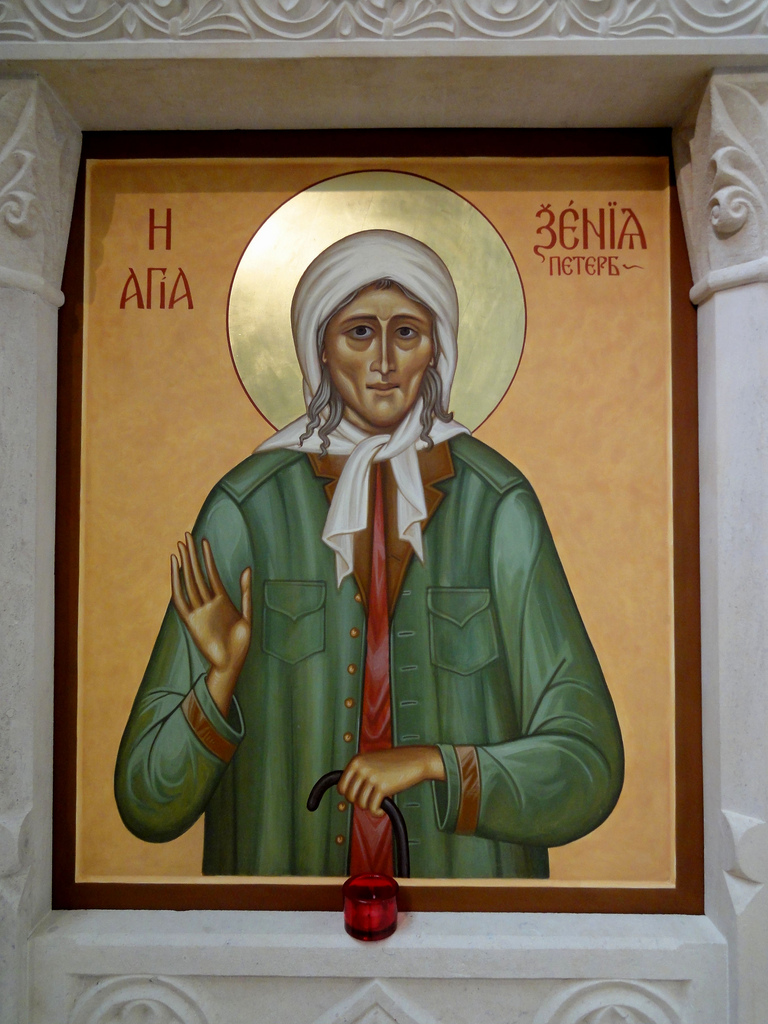
It is true that St. Ksenia of St. Petersburg is the only Russian canonized female holy fool and that male holy fools figure much more prominently in Russian hagiography as well as in scholarly discussions. At the same time, the first portrayal of the holy fool, the anonymous nun in Palladius’ Lausaic History (nun by the name of Isidora in the rendition of Isaak Syrian) is that of a female. We also have historical evidence about female holy fools from the notes of foreign travelers (Massa, XVII c.), sketches of Russian ethnographers (Pryzhov, XIX c.), and accounts of contemporary church historians (Hieromonk Damaskin [Orlov], 1992), all of whom describe a number of female fools for Christ. One of the most famous nineteenth-century holy fools, Pelagiia Ivanovna Serebrennikova, spiritual daughter and follower of Serapion Sarovskii, awaits canonization. As we learn from her vita about hardships and hindrances, which she encountered on her way to holy foolishness, we come to appreciate how difficult it was (if not next to impossible) for a healthy, mentally normal woman of a child-bearing age (both before and after her marriage) to undertake the ascetic exploit of holy foolishness. Nonetheless, female holy fools have always been a part of the tradition of holy foolishness. If they are fewer in numbers and less noticeable than male iurodivye,  it was probably because they, just like the Desert Mothers, have always been in the shadow of their male counterparts. Nevertheless, the canonization of St. Kseniia of St. Petersburg in 1988 marked the importance of this cultural type for the post-Soviet era and the contemporary Russian world. 
AD: Much of your introduction very helpfully reviews the state of the literature about fools in various languages. Are we seeing a revival in scholarly study today of holy fools?

Yes, we are certainly seeing a revival of scholarly interest in the phenomenology, history and textual appropriations of holy foolishness, which is evident from the sheer volume of publications of primary and secondary texts on this topic. The articles included in the present volume are not only representative of a wide thematic scope and multi-disciplinary nature of contemporary approaches to holy foolishness but also provide commentary on its enduring urgency for today’s Russia.

AD: You conclude by noting that this new volume marks the "bicentenary of scholarship devoted to holy foolishness." What areas do you think still need further exploration today and in the years ahead?

Holy foolishness still has a lot in store for its researchers, both historians (including comparative, church, and art historians) and scholars of literature and culture. A major lacuna in the studies of holy foolishness lies on the junction of Byzantine and Russian traditions. It is yet to be explored through what venues and in what forms (languages, redactions) Byzantine texts relevant to the tradition of holy foolishness were transmitted to Eastern Slavdom. While researching texts, which were instrumental to the formation of the Russian tradition of holy foolishness, it will be also of great interest to see how the same texts had an impact on other Christian, especially Western European, cultures. Moreover, the venues of transmission to the Slavic world and Russia of the seminal for the tradition of holy foolishness text, The Vita of Simeon of Emesa, remains almost completely unknown. 

Overall, Slavonic and Russian translations of Simeon’s vita, their availability to and influences on the Russian tradition of holy foolishness remain unstudied. Illuminated vitae of holy fools have received very scarce attention--as did Russian iconography of fools for Christ. Our compilation features two pieces on the illuminations of the Vita of St. Andrew of Constantinople (Bubnov, Kobets). Other important yet virtually unstudied issues include holy foolishness in Ukraine; the holy fool’s place within the tradition of Russian Old Believers; ethnographic accounts of contemporary holy fools and the popular/folk dimension of the tradition of holy foolishness. Meanwhile, the protean figure of the holy fool and his diverse phenomenology continue to inspire artists of all genres, creating new layers of the contemporary culture imbued with familiar spirit yet always new imagery of holy foolery. In the light of this situation it will not be an exaggeration to say that studies of holy foolishness have a lot in store for scholars that will not be exhausted in the foreseeable future.

Thursday, April 5, 2012

An Interview with John McGuckin

To know the work of the Orthodox priest and scholar John McGuckin is at once to ask: does he ever sleep? The answer to that must surely be no! Author of an acclaimed intellectual biography of St Gregory of Nazianzus and study of St. Cyril of Alexandria, of liturgical works, books of poetry, reference books on Origen and the Fathers generally, introductory texts on Byzantine spirituality, and much else besides, he has gone from strength to strength in the past two years with several major works, all discussed previously on here. I've had a chance to catch up with him and ask him about some of his recent publications as well as current and upcoming projects. Here are his thoughts:


AD: Tell us a bit about your background, including, if you will, what it is like teaching at two institutions and your directorship of the Sophia Institute. What is the Institute trying to accomplish?

I am a Romanian Orthodox Priest, of Anglo-Irish descent, husband, father of three, grandfather of six, currently working in a small parish in Manhattan and also hold down the position of Nielsen Chair (i.e. professorship) in Early Church History at Union Theological Seminary, and the Chair in Byzantine Christian Studies in Columbia University. I write a lot; and in my spare time I….come to think of it I have no spare time. 

The joy of  being involved in two very different  institutions is sometimes muted by the necessity of having to attend two sets of faculty meetings!  But Union is an old Ivy League school of theological studies that has traditionally invested much in early Christian theology. Schaff, our early leader of History here (older than Oxford’s Church History department by the way), sponsored the Nicene and Post-Nicene Fathers of the Church series, for example; and was instrumental in a very important 19th century reference set called the ‘Creeds of Christendom.’ Columbia is another old Ivy League school stressing more the phenomenology of religions (under which rubric Christianity  has a large role and voice). 

The different strands to my life, of course, are all interwoven. The theological task is  the chief coloration of my priestly service to the Church. Living in both worlds of Academy and Ekklesia is interesting--  but no more strange than most men and women will experience in the  contemporary world where multiple identities and roles often overlap, and sometimes ‘grind’ against one another. I have long held it necessary to bring critical historical scholarship to the illumination of  deep truths. I have never thought the  critical method to be its own justification, or that scholarship is self-justifying. It has inherent values (whatever one calls them – truth, qualitative difference, illumination, wisdom). One ends up as a ‘theologian’ (or at least a philosophe) in the Academy even if one is not specifically treating the  religious thought of the ancients. That or dilettantism are our choices. On the other side of the coin,  ecclesiastical  life and culture without the winnowing and aerating properties of the life of the mind, and the  currents of  broader culture, can all too easily become stifling and oppressive. They might not like each another; but they need one another.

AD: We seem to be living in a time when scholarship, at long last, is beginning to realize that "Christian" approaches to law and politics, in so far as they treat the East at all, must move beyond tiresome notions of "Caesaropapism." (I'm thinking here, e.g., of the recent three-volume collection, one volume of which was The Teachings of Modern Orthodox Christianity on Law, Politics, and Human Nature.) Where does your own forthcoming book, Ascent of Christian Law: Patristic and Byzantine Formulations of a New Civilization take the scholarly debate? What drew you to work on that topic? Why do you think there remains a very high level of interest today in studies on all aspects of Byzantium?

I agree with you about scholarship needing to renew itself. It can start by reviewing  the many clichéd presuppositions and short-cuts it clings to in lieu of addressing the primary sources. Our recent times have seen a great revival of interest in Byzantine studies, and more generally the  culture of patristic thought, and the life and culture of the Churches of the East.  When one looks at the majority of texts dealing with, let’s say, Eastern Christian religious culture,  from an earlier academic age, however, one is too often appalled by the undigested level of prejudices, false informations, and plain silliness one finds. One of the worst examples of all, I would suggest, is Donald Attwater’s books on the Eastern Churches. But even sharper scholars like Dvornik had an awful lot of silly things to say about the analysis of Byzantine subtleties of theology and politeia. His term "caesaropapism" has had a detrimental effect. So much of western scholarly attitudes to Byzantium up to the late 20th century were full of prejudices distilled from Gibbon’s Decline and Fall. They are often blind to the real balances and subtleties that a close reading of the primary texts reveal. But you know what they say: “Why let the facts stand in the way of a good theory?"

My recent book on  Ascent of Christian Law: Patristic and Byzantine Formulations of a New Civilization was written because I wanted to study and learn about an issue

where I could find very little extant literature to guide me. I don’t mean that there aren’t a bundle of books on canon law, or on Roman civil law – but rather that I could not find much to help me with a big question: What did Christianity do in its passage through the first millennium in consciously building a civilisation with its own stamp upon it? Law was surely in the heads and minds of the Christians from the times of avoiding Nero’s secret police to the legal scholastics of Justinian’s court. Christianity has invested so much in law, both civilly and ecclesiastically; and yet has always avoided the turn into becoming a religion of the law (be it Torah or Sharia) which other religious systems have chosen. My book therefore, is not so much a review of Byzantine canon law, or the Justinianic Code, as much as it is a question about principles of culture and polity-building at the heart of historical Christianity. I hope it will have much to say to a wide body of readers and theorists who might like to take a fresh look at the way so many areas (take Europe as an example) have advanced theories of human rights as a way forward to a secular paradise; yet in the  process have divorced their understanding of human rights from the sense of divinely graced anthropology by which Christianity first advanced the notion of the special dignity of  humankind. We now postulate  elevated rights for  humanity without any sense of a workable philosophical or metaphysical grounding to the theory: and we sit and wonder why the century that saw the Universal Declaration of Human Rights was also the century that reinvented slavery, and brought back genocide to the body politic.

AD:  Not a lot of academics get a chance to work on the production of a movie or documentary, but you did exactly that in Mysteries of the Jesus Prayer. Tell us about the process of producing the movie, and the traveling it involved.

Having completed the film, eight years after we initiated it, I can now appreciate why so few academics want to be involved in this genre. It was so much work; travelling, writing and rewriting scripts, hauling equipment up mountains, moving  a team by plane and bus from America to Egypt, Romania, Russia, and Ukraine. Of course now that the film is completed it is clear that it has a charm of its own and will have a life of its own, reaching into homes on TV screens and  computer monitors where an academic work of mine, for example, would never appear.  The film is a visual study of several famous monasteries (including Sinai, St. Antony’s, and Sergei Posad) where we went as film-makers and just made the simple request of the ancient Orthodox pilgrims: ‘Abba, give me a word.’ We asked the senior monastics of each place (including several convents)  to tell us something about their practice of the Jesus Prayer. We think the film gives a little window, often in an intriguing way, into Orthodox monastic life and the hesychastic tradition of the Jesus Prayer.


AD: The Jesus Prayer and the practice of Hesychasm both seem today to be attracting a great deal of attention if the number of recent books is anything to go by. What do you think might explain this interest, including from non-Orthodox? What have been the reactions so far to the movie and book?

The very few secular critics who have noticed the film have tended not to like it. The general gist was that it ‘Did not tell me anything new;’ which surprised yet heartened me that so many  of them were already experts in hesychastic prayer. Who would have thought it?  


The larger number of Orthodox and Catholic faithful who have seen it and have responded back to us are almost  all singing from the same hymn sheet: they found it charming, restful and reverent, a feast for the eye and the heart, and so on. So it seems to have greatly pleased those who were, perhaps, more likely to have found it pleasing. I suppose we did a good service for exposing more of the hidden world of Orthodox monasticism to a larger audience. But I think this is the kind of film that will work better for the heart than the head ( which is after all a good thing for a hesychastic piece is it not?). 

The more I go on in life the more depth I discover in this simplest of all prayer forms – known as the Jesus Prayer. I have been working recently, academically, in researching Byzantine mystical ideas of cognition change. A recent article of mine in the St. Vladimir’s Theological Quarterly looks at the states of soul-cognition in Elias Ekdikos, a major figure of the Great Church in Constantinople at the end of the first millennium. He shows, quite clearly, how advanced studies in cognitive changes (the theory of human consciousness) were part and parcel of what we today would call 'Byzantine spirituality.’ For many generations, of course, spirituality and  human culture, let alone the human sciences, have been artificially divided (this domain church; this domain culture; this domain critical thought, and so on). But it strikes me that in their  simplest of meditative techniques on the nature of the Holy Name, the  precise idea of rising up (from material consciousness, to intellective consciousness, to mystical awareness) is ever at the heart of what the hesychastic tradition is all about; and the literature on the Prayer speaks of this incessantly in the language of the ‘descent of the Nous into the heart.’ These are all deep things, difficult to talk about, of course. But when they are practised one sees it instinctively because (as Orthodox theology consistently says) these things are archetypal in the structure of the heart and soul of human beings (drop a cat--it will always land on its feet).  This is why many outsiders find the fire in the Orthodox spiritual traditions, while  many Orthodox remain unaware of their own treasures (because of over-familiarity?).

AD: Much of the movie saw you visiting or describing many venerable monasteries around the world, including some quite famous. But monasticism seems to struggle in North America--we have no equivalent of Athos, Sinai, the Kievan Caves, Trinity Sergius Lavra, etc. Why do you think that is?

The Kievan Caves Lavra can give an example to suggest an answer to your question. I could deduce the same thing from the monasteries of most other Orthodox countries I have visited.  Under the Soviets the Lavra was part destroyed, and more or less wholly turned over to be a museum. The monks, as you know, were thrown out. The religious memory of the place was desecrated and ridiculed. When I visited it in 1991 a tiny group of monastics had been allowed back and were inhabiting a small skete on the site, alongside many resentfully hostile government employees trying to run the site as a cash-making tourist enterprise.  

When we went back for the film, the site was more or less under the control of the Church (except for the main church). At its center was the archbishop’s administration for Ukraine, and the national seminary; but also a newly re-founded set of male and female monastic communities.  The latter were struggling to establish their typikon: a word which means not just the rule of life they should follow (how much prayer, how much study, what type of ministry etc) but also what ethos the community will manifest. It is easy to print out the typikon if it is simply the day’s schedule. It is by no means easy to “establish” the typikon in the sense of building up the spiritual ethos of a place. One needs to  have the stones and lanes of the monastery ‘prayed over’ for a long time. One needs monastics who have been themselves rebuilt by the grace of God over time. Such a  vested place is recognisable by the charisms and graces of men and women who have been rendered luminous by the Spirit: but it also an issue of having experienced and gracious pneumatikoi or startsi (spiritual elders) who can oversee the life of  these houses, nurture their members, direct and shape them over decades, and pass on the care of the houses to disciples who maintain the self-same ethos. 

America is good at building the plant for monasteries, in some cases; but it has difficulties in establishing the tradition of elders. It is still (in its head anyway) a new and ‘frontier civilization.’ The sense of quiet alignment with ancient wisdoms and old obediences does not come naturally to it. It is more Teddy Roosevelt than Paisy Velichovsky. That is why I think America still has some way to go to find itself as a monastically-graced land. It is not enough to don the klobuk and  behave as if the tsar might drop in one day. One needs to pass through the fires of God’s pitiful mercy in oneself, and emerge as someone who would like to build a shelter in the wilderness for the comfort of the poor passerby.

AD: In addition to these two major projects, you've also overseen something (to my mind) even grander, viz., the The Encyclopedia of Eastern Orthodox Christianity published this year in 2 volumes by Wiley-Blackwell. Tell us about the Encyclopedia, and the process of producing such a massive work.

The old adage says : ‘Never work with animals or children.’ I would add a line – ‘Or  with Encylopedias of Orthodoxy.’  It was, actually, great fun to do. And I can say that now that it is all over and done with. I had a team of young and enthusiastic assistant editors to cheer things on. We had the inestimable privilege of working with so many splendid  international Orthodox intellectuals (for almost all the entries were by Orthodox people with doctoral level qualifications). It heartened me to see how greatly the Orthodox world has repaired its levels of education so devastated by oppressive forces over the previous century.  Almost all English-language reference works on Orthodoxy, if I may exaggerate only a tiny degree, have been written about the Orthodox by outsiders, who have had varying degrees of patience with us, or understanding of us.  This is the first  really large-scale work that looks at us from the inside: tells the story in our own words.  

The Moscow Patriarchate is currently bringing out a mammoth Russian language version--but they are still only up to 'A,' I believe. Even when this finally emerges in the light, nevertheless, ours will not be pushed aside; but I hope it will remain as an enduring monument because our work takes the highest levels of contemporary critical scholarship and analytical refinement, and allies it with a sense of reverence and delight in the affairs and culture of our Church. Ours also might “just fit” in a book bag. Theirs will need a truck to move it around!

AD: One of the many charms of the Encyclopedia was the inclusion of copies of beautiful icons produced by your wife, Eileen. Is she a full-time iconographer? Where did she study?

Yes, you are right. I did not realize this until I actually saw the book physically in hand, when Blackwells sent me a boxed set: but how beautiful a thing it is to hold and smell (I like smelling books!). It is charming. The production costs were mounting of course, and although the publishers wanted  illustrations they could not stretch to many colored ones. So I had to reach out to another charmer, my wife Eileen, who is a very successful professional iconographer, and I had to go playing my sad violin so she would let me use her images to  demonstrate Orthodox iconography. This was no difficult task. Even though I may be biased, of course, I find her work ‘commanding’ among the many splendid new iconographers we have in our time. She, for me, is a buoyant example of some of the best things going out there internationally. So I was  blessed to be able to include her work. 

People can see a fuller range here. She studied as a fine-arts student (landscape painter) at Newcastle University in England, and went on to  have a full career as an educationalist. When we moved to America in 1997,  and I took up my academic appointment here, she retired early from academia and took up her painting again (which had been a leisure-hours activity all those years). She opened up ‘The Icon Studio’ in New York and has never since been without a list of advance commissions. She absorbed the techniques of icon painting in many places: studios in Athens and the Islands, and some ateliers in Romania. Her color palette is radiant. Her line is very pure and refined. Enough already--you might think I had a special affection for the woman!

AD: Wiley-Blackwell also brought out your own The Orthodox Church: An Introduction to its History, Doctrine, and Spiritual Culture, the latest in a considerable number of introductions to, dictionaries of, surveys covering Eastern Christianity. Why do you think we are seeing such an upsurge in major publications on Eastern Christianity today by major publishers--Wiley, Oxford, Routledge, Cambridge, Columbia, and others? Has the world--or at least the academic world--finally "discovered" the East?


Well, Wiley Blackwell is graced to have at the helm of its religion publishing list a very wonderful person called Rebecca Harkin. She is consummately professional, but also has a finely discerning eye. And, though I should not put thoughts in her head or words in her mouth, I think she saw in the traditions of the Orthodox church a fountain of real-world Christian wisdom that was both grounded and mystical at one and the same moment, and which could  be of great utility to the large numbers of intelligent Christians out there today who are ‘like sheep without a shepherd.’ It was Rebecca who came to me and pushed me to compose both these very large works. I (of course) like my Orthodox Church book.  I tried to make it always faithful to the Orthodox tradition in all respects. But I also wanted, all the way through it, to talk about the “real world.”   So it speaks of war, and human grief, and sexuality, and corporate greed in the market place; as well as speaking about the Virgin-Theotokos, the angels, the liturgy and sacraments.  That is my real world, you see: the juxtaposition of the 7th age of the unrealised hopes of humanity, with the glimmering light already breaking through of the 8th age of the Kingdom.

AD: What projects are you at work on currently?

My immediate problem is how to get through to the end of this period of Lent without staining my teeth dark brown with un-milked coffee. This is a recurring project: something of the level of what the ancients would call an aporia: roughly translatable as: Solve that one if you can!  In terms of literature I am resting my steaming head on the table at present and glad to see the release in 2012 of Prayer Book of the Early Christians

as well as The Ascent of Christian Law (SVS Press), and later in the year also the  issuing of a set of studies I have introduced and edited from a number of young scholars, titled The Concept of Beauty in Patristic and Byzantine Theology. The publisher for this is not yet settled. Make me an offer someone out there? This last book looks at the tradition in Platonic philosophy of the ‘Ascent to Transcendent Beauty’ (see the priestess Diotima’s wonderful speech in the Symposium). The Byzantine church Fathers take and adapt this theme to make it a magnificent set of reflections on the  beauty of the divine transcendent.  I think this will itself be a beautiful book, as well as a deeply instructive one. I have composed for it the Introduction on the nature of beauty as a transcendental in patristic thought; as well as an article in the  main body of the book on the manner in which St. Maximus the Confessor deals with the  idea. Other chapters deal with Plato himself, with Origen, St. Gregory of Nyssa, Niketas Stethatos and others. I like offering patristic books which are dealing with real theology, real philosophy – full of substance not merely dead and deadly exercises in academic exactitudes; and thus as dry as dust. The great Fathers of the Church were radiant mystagogues in many cases. Many of their works still leap with the  power of the Spirit. Many  modern theologians have habitually dismissed them as theologians dead and gone, who have nothing to say to the world. This is the mistake of those who have never really read them. For us Orthodox, they are our living treasure. The lights are still on in the house. 

When my head stops steaming, I am turning my mind for the latter part of 2012, towards two projects on my open list. The first is the contract  I have with IVP Academic publishers to offer them, some time before 2014, a large  text book on the history of the Christian Church in the first millennium. It is going (tentatively) to be entitled The Cross Ascendant.    I am also starting a project I have long desired to do: a translation of the Hymns of Divine Eros of St. Symeon the New Theologian, which will itself be hymnal (poetic) in character and will reflect in English blank verse the varying metric rhythms of the poetic originals. I have lived on and off with St. Symeon for most of my scholarly life, since the day he found me as a 23-year-old know-it-all in a library in Durham. And I want to render his  magnum opus   in a version which will show what a master he was in both doctrine and poetry. Just talking about it makes me want to go and smell the Greek originals again! 

So I’m off – and thank you for your kindness is asking about my work.

Saturday, March 10, 2012

Authority in the Russian Church (2)

I noted before Christmas the advent of a new book treating authority in the Russian Church, a topic which I spent some time on in my Orthodoxy and the Roman Papacy: Ut Unum Sint and the Prospects of East-West Unity. Where my treatment is necessarily relatively brief, and also includes many other Orthodox structures, Vitali Petrenko is able to analyze the Russian Church alone in great depth: The Development of Authority Within the Russian Orthodox Church: A Theological and Historical Inquiry (Peter Lang, 2011), xii+310pp.


I have now had a chance to read it in conjunction with the lecture I am putting together to give at the Huffington Institute's 2012 symposium "Pan-Orthodoxy in North America: Towards a Local Church."


Petrenko's is a very impressive book that takes a much wider sweep than I was expecting, and is all the more rewarding for it. It started off as a doctoral dissertation at the University of Durham under the formidable Orthodox scholar Andrew Louth. But the transformation from dissertation to book has been smoothly and professionally accomplished, and this is a finely written and edited book that deserves to be read by all those interested in the history of Russian Orthodoxy in general, as well as by those interested in ecclesiological questions.

The first two chapters, treating authority very widely in the ante-Nicene and Constantinian eras, initially appeared as rather superfluous--the sort of belabored detail that doctoral students have to put in so that their jury knows how widely read they are. But once you get to the third, and especially fourth, chapters, you realize how smartly Petrenko has woven key themes from those first two chapters into later ones. Certain themes thus recur throughout the history told here, especially those of "caesaro-papism," symphonia in the Byzantine and post-Byzantine periods, and the role of various forms of apocalyptic literature--most famously in Filofei's letter at the start of the sixteenth century proclaiming Moscow the "third Rome" after the fall of Rome and Constantinople--in giving the nascent Muscovite state a sense of its role in the world and in shaping what we would later call Russian nationalism.

That apocalyptic plays a role earlier than I had realized, and Petrenko argues that we can already find hints of it as early as the life of Feodosii Pecherskii in the eleventh century and the composition of The Paterik of the Kievan Caves Monastery. 
That apocalyptic also expresses a certain de haut en bas attitude towards "the Greeks" which recurs over a long period and intensifies as we get towards the fourteenth and fifteenth centuries. Two events really bring this attitude out in egregious ways. First, prior to leaving for the Council of Florence, Metropolitan Isidore is instructed by the Tsar Basil II basically to sabotage any move towards union with the Latins whom many East-Slavs had disdained from the ninth century onward: "you are going to the Eighth Council, which should never take place according to the rules of the holy fathers; when you return from it, bring us back our ancient Orthodoxy" (120-21).


With the fall of Constantinople to the Ottoman Turks in May 1453, Russian churchmen increasingly argued that they should have nothing to do with a church whose subjugation to Islam was as a result (as many Byzantine Greeks themselves readily conceded) of Greek weakness, sinfulness, and general infidelity to the Lord. How could Russia receive bishops or even general direction from a patriarch now living in captivity to a heathen religion? This issue increasingly motivates an independent streak in the Church, leading ultimately to severing relations with Constantinople in the 1589 elevation of the metropolitan of Moscow to the status of patriarch.

But Russian assertion of its autonomy increasingly leads the church and country to attempt to assume a role of "universal apostolic" (136) leadership over all Orthodox Christians throughout the entire world--a concern which, though Petrenko does not discuss it, would remain prominent in Russian foreign policy through the Crimean War and in the lead-up to World War I and the collapse of the Ottoman Empire. 

Russia, according to this mindset, is now both the "third Rome" and a "chosen nation succeeding the nation of Israel in its vocation to the rest of the world..., [an] understanding...promoted...by Filofei" (137). But there is a problem with the assertion of "apostolicity" and this, of course, leads to the famous attempt to "prove" that the apostle Andrew (the first-called, let us not forget) visited Kievan Rus', a legend famously analyzed by Francis Dvornik in his landmark book The Idea Of Apostolicity In Byzantium And The Legend Of Apostle Andrew.

Petrenko's analysis of the infamous raskol of Patriarch Nikon is a lucid treatment that does not, as he notes more than once, cover everything. But that is not a problem insofar as this territory has already been previously covered in first-class studies, including Paul Meyendorff's Russia, Ritual, and Reform: The Liturgical Reforms of Nikon in the 17th Century to say nothing of the multi-volume series from Cambridge University Press and William Palmer's pen, starting with History of the Condemnation of the Patriarch Nicon by a Plenary Council of the Orthodox Catholic Eastern Church Held at Moscow A.D. 1666-1667.

When we get to the twentieth century, and the twilight of the Romanovs, the book starts to run out of steam a bit, but not before disclosing something I had not heard before: Tsar Nicholas II forbade the convocation of a council in 1905 and 1907 and said that the solution to a lack of patriarch was simple: he "nominated himself," a move he would fulfill by abdicating in favor of his son, taking monastic vows, and then being ordained (201, f.n.11).

Only towards the end, and briefly, does Petrenko undertake a closer analysis of some of the modern statutes governing ecclesiastical life in the Russian Church in the twentieth century. Here he argues even more strongly than I did in my Orthodoxy and the Roman Papacy: Ut Unum Sint and the Prospects of East-West Unity that the Russian Church, especially since 1945, has been structured and governed in a heavily centralized fashion. 
Petrenko quotes Bulgakov here: the Russian Church suffers "from 'actual and psychological papalism'" (213). The reasons for this, in part, have to do with the fact that Stalin wanted to continue using the Church for his own purposes, and so wanted control over its patriarch and, through a super-strong patriarch, over all other bishops and clergy. Stalin's vision, in fact, was, according to Petrenko, to create  a "Moscow Vatican" (219) in a fight for ideological control and global domination of all other Christians and many others besides. Stalin also supported the calling, in 1948, of an "eighth ecumenical council" as a means of asserting Russian supremacy in global Orthodoxy.

Petrenko seems to take a dim view--or at least quotes several others who do--of the revised statutes of 2000. My own analysis of them was that they were not nearly as centralized as the 1945 statutes and returned to some limited degree to a greater practice of synodality or sobornicity. But others do not share that view, and instead see the revised statutes as backwards steps that have "suppressed the principle of sobornost" (248) and in so doing have "transferred 'the fullness of authority within the Russian Orthodox Church from the Local Sobor to the Arkhiereiskii Sobor. Effectively this established a Church which in its main outlook is opposed to Orthodox canons'" and to the decrees and decisions of the 1917-18 council (249, quoting G. Yakunin, "Podlinnyi lik Moskovskoi Patriarkhii," 2002).

One final note: Petrenko's book is very useful in helping us to understand the long history of mutual mistrust between Moscow and Constantinople, a serious problem still bedeviling relations between them today and causing problems and delays in the lead-up to the much-promised but much-delayed "great and holy council." These problems go back, as we saw, to the fourteenth century and earlier, but were especially pronounced in the twentieth century's fights over the granting of autocephaly to various churches, not least the OCA.

Missteps are few in this book: there is only one noteworthy typo when, on p.114, he dates the East-West schism to 1053 instead of the more conventional 1054. I would quibble somewhat with the sub-title of Petrenko's book insofar as it is heavy on the history, but light on the theology.

But two other more substantial questions arise in reading this book: first, Petrenko virtually ignores the Reformation and Counter-Reformation periods and the rise of the Polish-Lithuanian Commonwealth in which the Union of Brest took place. These are not small events at all, and have loomed large in at least contemporary Russian views of, and relations with, the West so it is odd that they pass by without comment.

And this points to the second omission in this book: several authors whose works are not noted at all, including Boris Gudziak (in treating not just the Union of Brest, but also the creation of the Moscow patriarchate as such); Sophia Senyk's work on the history of Kievan Christianity; and perhaps especially Hyacinthe Destivelle's very important work Le Concile de Moscou (1917-1918).

All in all, however, The Development of Authority Within the Russian Orthodox Church: A Theological and Historical Inquiry is a fine history lucidly narrated and abundantly sourced. It should be on every bibliography in Russian Orthodox history and theology, especially ecclesiology.
Related Posts Plugin for WordPress, Blogger...