"Let books be your dining table, / And you shall be full of delights. / Let them be your
mattress,/
And you shall sleep restful nights" (St. Ephraim the Syrian).


Showing posts with label Ukrainian-Canadians. Show all posts

Friday, June 25, 2021

Married Priests in the Catholic Church: the Families Speak

I have periodically drawn not nearly enough attention to my new book, released in April, on Married Priests in the Catholic Church. So let us continue to look at its many riches due to the many individual contributors from around the world. 

In previous commentaries on the book, I have noted, inter alia, Anglican contributions from the Catholic ordinariates, and discussed some of the pernicious myths which surround married priests. 

Today, let us pause to look at the voices of clergy families, who are represented in the book by such as Irene Galadza, Nicholas Denysenko, Julian Hayda, Andrew Jarmus, and William Mills. Of these five, truth be told, three are themselves clerics: Denysenko is a deacon while Jarmus and Mills join him as priests in the Orthodox Church of America. But Nick is a grandson of a long-time Ukrainian Orthodox priest, as is Jarmus; and Mills is married into a clerical family. So they have experienced both roles not just in the book but in their lives. 

I had sought many more voices from wives and children, but again and again was turned down by people who felt a sometimes understandable and sometimes puzzling reticence to talk about their experiences. Still, the few who contributed wrote worthy and important chapters. 
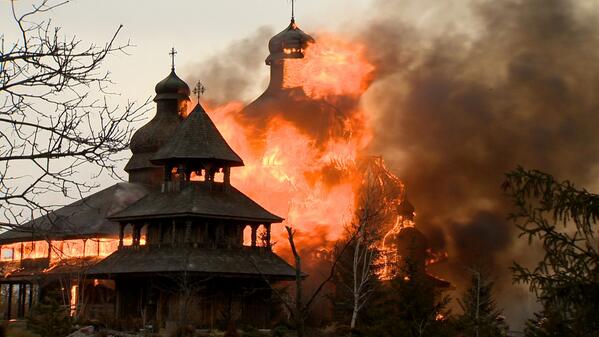
Irene has been married to her husband, the mitred archpriest Roman Galadza, for nearly half a century. So her experience is very long-standing indeed, and includes the rather rare experience of building a new parish from the ground up not once but twice! (The original St. Elias, where I was married, burned to the ground in a heart-breaking fire in 2014). She has also taught school for many years and has a fine theological mind. So her chapter in the book is very much a theological meditation on the role of the presbytera in light of the Theotokos. To borrow a phrase from antique Christological debates, Irene's view is a very "high" one, though she does note some of the "lower" or more "mundane" concerns and challenges that come to the wife of a priest and mother of (in her case) large family. But I think Irene would be the first to say that the wife of a priest should have the same freedom as others in the parish to discover her vocation for herself in all of its uniqueness. 

Nick Denysenko (a dear friend, I should note, and author of many fine books you should read, all of them noted here where you will also find interviews with him over the years about those books) is the grandson of an immigrant Orthodox priest from Ukraine about whom he writes with great and moving care, showing what sometimes hard lessons he learned from his grandfather, who had seen some of the horrors of wartime Europe and Soviet communism. His grandfather's wisdom about how, and how not, to fast have remained with me for some time. I wish I had met him. He sounds like a real mensch. Nick grew up serving in his parish in Minnesota and watching the dynamics between him and the parish. 

Similarly, Andrew Jarmus, also of Ukrainian background, grew up watching his father, also a priest in the Ukrainian Orthodox Church (but this time in Canada). Jarmus moved to the US more than a decade ago now and has been the pastor here in Ft. Wayne at one of the OCA's larger parishes which I have attended on occasion for many years now. Jarmus's chapter is especially worthwhile for its pointing out some of the subtle psychodynamics that govern (and often distort) any relationship where one man is constantly addressed as "father" and treated as such. 

Julian Hayda's father was a Ukrainian Catholic priest in Chicago until he was killed in a bike accident in 2007, leaving his wife and young children. (Julian's grandparents befriended me about a decade ago through the Orientale Lumen conferences in Washington and afterwards we had a very lovely dinner over Christmas one year when I was visiting my in-laws just down the road in Connecticut. They were splendid people.) Julian writes with a different perspective on growing up in a rectory. He does not romanticize his experiences or gloss over the difficult dynamics of living in what he aptly calls the parish "fish bowl." He rightly raises such questions as why PKs (preacher's/priest's/pastor's) are often subjected to highly unfair and discriminatory attitudes and expectations when all they want is to be regular kids like everyone else in the parish. 

William Mills also writes with compelling honesty and charming humour about the challenges of parish ministry while married. His chapter is good, but his recent memoir even better, not least for it allows him to go into more depth and detail than he could in the chapter in my book, Married Priests in the Catholic Church.

Monday, January 11, 2016

New Studies of Ukrainian Realities

The University of Toronto Press catalogue was waiting for me in my mailbox after the break. It tells us of several books forthcoming in 2016 that will be of interest to Ukrainian and Russian Christians especially, inter alia, and to those trying to understand the history of the current Russian war against Ukraine, and Ukraine's own recent history.

It also drew my attention to a wide-ranging study released last summer: Margarita Balmaceda,  Politics of Energy Dependency: Ukraine, Belarus, and Lithuania between Domestic Oligarchs and Russian Pressure (U of T Press, 2015),464pp.

The publisher tells us this about the book:
Energy has been an important element in Moscow’s quest to exert power and influence in its surrounding areas both before and after the collapse of the USSR. With their political independence in 1991, Ukraine, Belarus, and Lithuania also became, virtually overnight, separate energy-poor entities heavily dependent on Russia. This increasingly costly dependency – and elites’ scrambling over associated profits – came to crucially affect not only relations with Russia, but the very nature of post-independence state building.

The Politics of Energy Dependency explores why these states were unable to move towards energy diversification. Through extensive field research using previously untapped local-language sources, Margarita M. Balmaceda reveals a complex picture of local elites dealing with the complications of energy dependency and, in the process, affecting the energy security of Europe as a whole.

A must-read for anyone interested in Eastern Europe, Russia, and the politics of natural resources, this book reveals the insights gained by looking at post-Soviet development and international relations issues not only from a Moscow-centered perspective, but from that of individual actors in other states.

Set for release in March is George Liber's study, Total Wars and the Making of Modern Ukraine, 1914-1954 (U of T Press, 2016), 416pp.

About this book we are told:
Between 1914 and 1954, the Ukrainian-speaking territories in East Central Europe suffered almost 15 million “excess deaths” as well as numerous large-scale evacuations and forced population transfers. These losses were the devastating consequences of the two world wars, revolutions, famines, genocidal campaigns, and purges that wracked Europe in the first half of the twentieth century and spread new ideas, created new political and economic systems, and crafted new identities.

In Total Wars and the Making of Modern Ukraine, 1914–1954, George O. Liber argues that the continuous violence of the world wars and interwar years transformed the Ukrainian-speaking population of East Central Europe into self-conscious Ukrainians. Wars, mass killings, and forced modernization drives made and re-made Ukraine’s boundaries, institutionalized its national identities, and pruned its population according to various state-sponsored political, racial, and social ideologies. In short, the two world wars, the Holodomor, and the Holocaust played critical roles in forming today’s Ukraine.

A landmark study of the terrifying scope and paradoxical consequences of mass violence in Europe’s bloodlands, Liber’s book will transform our understanding of the entangled histories of Ukraine, the USSR, Germany, and East Central Europe in the twentieth century.
Also set for release this year is a collection sure to be of interest to Canada's very considerable Ukrainian community: Lisa Grekul and Lindy Ledohowski, Unbound: Ukrainian Canadians Writing Home (U of T Press, 2016), 160pp.

About this book we are told:
What does it mean to be Ukrainian in contemporary Canada? The Ukrainian Canadian writers in Unbound challenge the conventions of genre – memoir, fiction, poetry, biography, essay – and the boundaries that separate ethnic and authorial identities and fictional and non-fictional narratives. These intersections become the sites of new, thought-provoking and poignant creative writing by some of Canada’s best-known Ukrainian Canadian authors.

To complement the creative writing, editors Lisa Grekul and Lindy Ledohowski offer an overview of the history of Ukrainian settlement in Canada and an extensive bibliography of Ukrainian Canadian literature in English. Unbound is the first such exploration of Ukrainian Canadian literature and a book that should be on the shelves of Canadian literature fans and those interested in the study of ethnic, postcolonial, and diasporic literature.


Related Posts Plugin for WordPress, Blogger...