"Let books be your dining table, / And you shall be full of delights. / Let them be your
mattress,/
And you shall sleep restful nights" (St. Ephraim the Syrian).


Wednesday, February 7, 2018

Copts in Context

Nelly van Doorn-Harder's work on the Copts of Egypt is something I have been following for some time after having asked her to write a review for Logos: A Journal of Eastern Christian Studies several years ago. So I sit up and pay attention when she publishes a new book, as she did in September in hardcover and October of last year on Kindle: Copts in Context: Negotiating Identity, Tradition, and Modernity (University of South Carolina Press, 2017), 296pp.
 
About this collection, of which she is editor, the publisher tells us the following:

Though the Coptic Orthodox Church of Egypt is among the oldest Christian communities in the world, it remained relatively unknown outside of Egypt for most of its existence. In the wake of the Arab Spring, however, this community was caught up in regional violence, and its predicament became a cause for concern around the world. Copts in Context examines the situation of the Copts as a minority faith in a volatile region and as a community confronting modernity while steeped in tradition.
Nelly van Doorn-Harder opens Coptic identity and tradition to a broad range of perspectives: historical, political, sociological, anthropological, and ethnomusicological. Starting with contemporary issues such as recent conflicts in Egypt, the volume works back to topics—among them the Coptic language, the ideals and tradition of monasticism, and church historiography—that while rooted in the ancient past, nevertheless remain vital in Coptic memory and understanding of culture and tradition. Contributors examine developments in the Coptic diaspora, in religious education and the role of children, and in Coptic media, as well as considering the varied nature of Coptic participation in Egyptian society and politics over millennia.
With many Copts leaving the homeland, preservation of Coptic history, memory, and culture has become a vital concern to the Coptic Church. These essays by both Coptic and non-Coptic scholars offer insights into present-day issues confronting the community and their connections to relevant themes from the past, demonstrating reexamination of that past helps strengthen modern-day Coptic life and culture.

Friday, February 2, 2018

The Fundamental Rule of Prayer: Free Association?

Today's lovely feast, which of course brings the 40-day Christmas cycle to an end, is that of the Presentation of Christ in the Temple, often known as Candlemas. And in the Catholic world it's kept as a day to remember consecrated religious who devote their lives to prayer and contemplation. But what is prayer, and what of our difficulties with it? Here are some thoughts on that question aided by two books I read back to back last weekend--quite unintentionally, I might add, or at least without conscious (!) intent.

But hear me out when I suggest that there are connections to be discovered between late Anglo-Irish Dominican theologian Herbert McCabe's God, Christ, and Us, and the contemporary Anglo-American psychoanalyst Christopher Bollas in The Evocative Object World.

I started with McCabe's lovely short book of sermons, God, Christ, and Us. If you are casting about for suitable Lenten reading material this year, permit me very warmly to recommend it. No chapter is very long, and none suffers from that kind of revolting treacle one sometimes associates with pious utterances such a sermons. McCabe was not pious in that sense at all, but very earthy and practical in a refreshingly straight-forward kind of way. The God preached by this member of the Order of Preachers is a God you actually want to meet, indeed might actually look forward to meeting, and quite probably over a drink or meal à deux. 

I first encountered McCabe's name in the 1990s when Stanley Hauerwas made an off-hand reference to him in connection to Alasdair MacIntyre. I paid no heed as Hauerwas didn't say much and I wasn't interested enough to pursue the matter. Later I would see MacIntyre himself in several places confess debts to McCabe, but without much detail to spur on an investigation on my part.

But the person who really convinced me I must read McCabe was and is Eugene McCarraher, whom I first stumbled across in articles like this (discussing Terry Eagleton's Culture and the Death of God) and then this deeply fascinating three-part interview, the third of which avers "I swear that reading McCabe has often kept me a Christian." In my more despairing moments recently, I know exactly what McCarraher means by that, and I suspect very strongly he had lines like this from McCabe in mind:
"Like Peter and the 12 we remain Christians because there is nowhere else to go: if Christianity is not the revolution, nothing else is" (Law, Love and Language1968).
McCarraher has also written a lovely overview of McCabe's life in this Commonweal article which notes, inter alia, that McCabe's "radicalism" was precisely and only possibly because of its deep orthodoxy. Rooted in the tradition, he could see its deeply subversive potential--even if, alas, that potential is almost always domesticated, tamed, thwarted by the powers and principalities of the present age. His orthodoxy, then, allowed him freely to explore socialism and Marxism.

Though my reading is still early yet, I have not see in him so far much exploration of Freud. But the language is clearly there. Repeatedly McCabe uses classical Freudian language in unmistakable ways, especially speaking of our tendency towards "projection" and our wallowing in "illusion" about both ourselves and God. In, e.g., Faith Within Reason, reflecting on the prodigal son, McCabe writes:
Sin is something that changes God into a projection of our guilt, so that we don’t see the real God at all; all we see is some kind of judge. God (the whole meaning and purpose and point of our existence) has become a condemnation of us. God has been turned into Satan, the accuser of man, the paymaster, the one who weighs our deeds and condemns us…For damnation must be just being fixed in this illusion, stuck forever with the God of the Law, stuck forever with the God provided by our sin (155-56; my emphasis).
A little later on, McCabe uses language that very much echos the difficulties of psychoanalysis as Freud saw them for it confronts people with hidden, and often infelicitous, desires, images, and actions. But both Freud and McCabe argue that it is much better to face up to ourselves, sinful and infantile as we are:
We damn ourselves because we would rather justify and excuse ourselves, and look on our self-flattering images of ourselves, than be taken out of ourselves by the infinite love of God…Contrition, or forgiveness, is self-knowledge, the terribly painful business of seeing ourselves as what and who we are: how mean, selfish, cruel and indifferent and infantile we are (Faith Within Reason, 157).
But it is in McCabe's sermons on prayer, two of which are found in God, Christ, and Us that most put me in mind of what Bollas says in the first chapter of The Evocative Object World, and, come to think of it, what Adam Phillips has also said, as I noted here in discussing his ideas about distractions and frustrations; see also his book Side EffectsThe link between the two of them seems to be an unapologetic advocacy of free association, leading to my question: are prayer and psychoanalysis the only activities today where one's mind can range freely without being hectored and controlled by ideologues and capitalists (the two often being the same thing)? Are the pew and the couch the only places left to us today as places that do not demand anything of us but give us silence, space, freedom?

Bollas thinks that today's "attacks on psychoanalysis are thinly disguised attacks on unconscious life itself" because "there is a widespread contempt for unconcious life in modern culture." He doesn't say why this is, but it's not hard to figure out: both analysis and prayer, as activities in which our mind ranges freely in search of some outlet for our deepest desires and hurts, are precisely the vague, free-flowing, unproductive, dreamy, gimmick-free kinds of activity that cannot be monetized or commodified or turned into an app promoting "mindfulness" or some other bit of money-making chicanery.

Bollas's first chapter treats free association, noting that it's a mutual process of analyst-analysand freely associating together, creating the analysis together. As he nicely put it, this is an experience in which one can rightly and proudly say "You don't know what you're talking about!" But still you talk, and listen, and associate, and eventually certain things become clear. Other things may not become clear, but this is not necessarily a failure, for the value of analysis is not just the "what" or the content: it is also the process--as Bollas has said elsewhere, echoing D.W. Winnicott--of being held and contained, of developing a deep connection to another human being that in itself is worthwhile, not least in its transferential (and thereafter transformational) power. Furthermore, an analysis is worthwhile not just for the clarity of content that sometimes comes about, but also for the "psychoanalytic mind" it creates, as Fred Busch has so winsomely described.

The beauty of this, as I have long appreciated it, is that "psychoanalysis does not provide ready answers to patients symptoms or lives," as Bollas admits. This, he recognizes, is "disconcerting" for those who think that clinicians are supposed to be experts. In fact, Bollas--and here his thought closely tracks that of Phillips, as I have repeatedly shown on here--says that the free associating of the unconscious of both analyst and analysand "subverts the analyst's natural authoritarian tendencies as well as the patient's wish to be dominated."

In this regard, Bollas puts me in mind of how Maggie Ross describes the mistaken notions behind modern concepts and practices of "spiritual direction," much of which consists of attempts at "mind control" as she puts it, and the result of which is to reinforce one's narcissism. Silence, for Ross, whose book shows considerable familiarity with psychoanalytic ideas, is the goal, and is hugely valuable in itself--a point that also becomes abundantly clear in reading the psychoanalytic literature about silent patients who nonetheless get better--start with another fascinating English Anglican, the analyst Nina Coltart, for examples of this; see her Slouching Towards Bethlehem.

McCabe doesn't come right out and advocate freely associating during prayer, but he very much leans in that direction. This is something I'll have to think about some more, but it does seem to me a helpful way to conceive of prayer and the problems of being distracted during or bored by prayer, or restlessly wondering about the futility of it all.

Rather than fighting that, McCabe advocates letting your mind wander until you find what you really want to pray about, and then praying about it. Here, again without using the words per se, McCabe seems to me to establish the "fundamental rule" (cf. Freud's "On Beginning the Treatment") of prayer outside the shackles of whatever spiritual superegos may be trying to tell us otherwise. If we let ourselves pray for what we are really concerned about, McCabe says, those prayers not only will almost always be, but in fact should be "the vulgar and rather infantile things you really do want," instead of all the pious and high-minded things we think we should pray about.

If we're distracted during prayer, it's because we're not praying for the right things (he notes those on sinking ships never report distractions during their prayers!), and constraining ourselves to pray for the things our superego tells us to--the "proper and respectable and 'religious'" things. Instead of that, as he drolly puts it, "you could let world peace rest for a while."And while you're at it, let your mind run to those distractions because they "are nearly always your real wants breaking in on your prayer." (Lest we worry that this is an excuse for descending into infantile selfishness, McCabe says that if we are honest in prayer about our desires, the Holy Spirit will invariably lead us deeper, for prayer involves change and growing up.) If psychoanalysis involves, as Bollas argued in his first major book The Shadow of the Object, a certain "ordinary regression to dependence" for a time, does this not also describe how we are in prayer with our Father in heaven as we pray for the things closest to us that matter most to us?

Thursday, February 1, 2018

Competition and Collaboration between Psychoanalysis and "Religion"

The stereotype of psychoanalysis as hostile to something called religion goes back at least 90 years to the publication of Freud's Future of an Illusion. But that book was met with an almost instant rejoinder by the Swiss Reformed pastor Oskar Pfister (whose correspondence with Freud I discussed here), which Freud himself made a point of publishing in the journal he founded, Imago. In that book, Freud made it very clear he was not dealing with theology as such, nor with what he called the truth-claims of "religion," which he never defined adequately. It was a book that Freud himself almost instantly came to regret writing, calling it his "worst book," the book of an "old man" and not of the Freud of the early period who, as Adam Phillips has shown, wrote much more vital and unsettling works.

Moreover, at the end of his life, in writing his Autobiographical Study (while also working on Moses and Monotheism) he further distanced himself by saying that "in The Future of an Illusion I expressed an essentially negative valuation of religion. Later, I found a formula which did better justice to it...granting that its power lies in the truth which it contains."

Since then, it has nonetheless remained true that most psychoanalysts have not been theists; and most have not been inclined to regard religious faith as anything other than a neurotic holdover from childhood, best dispensed with in those serious about adult freedom.

But that concern about freedom, especially from illusion and neurotic images, that so animated Freud admits of wider application, admits, even, of making alliances with theology towards the same end. As Erich Fromm was among the first to recognize, not least in his 1950 Terry Lectures at Yale--later published as Psychoanalysis and Religion--Freud and Jesus (Jews both!) are in agreement that "you shall know the truth, and the truth shall set you free."

Other analysts were not so hostile, and a few were in fact strongly sympathetic in a variety of ways--Fromm is the clearest example here, but one must also count Winnicott, Erikson, Jung certainly (but not unproblematically), and more recent figures in Britain, including Phillips, Nina Coltart, and, as I hope to show sometime, Christopher Bollas.

More recently still, there has been a series of attempts to build bridges between psychoanalysis and "religion," usually broadly and vaguely defined. One such attempt is to be found in the collection I've just finishe dreading, Psychoanalysis and Religion in the 21st Century: Competitors or Collaborators?, edited by David M. Black and published by Routledge in 2006.

Like all collections, this one is uneven. It's fourteen contributors are mostly clinicians and mostly in Britain; one is a retired cleric of the Church of England and another has some theological background. Several have written interesting chapters, but all are pitched very widely.

One does not find, therefore, a good deal of substantial or detailed theology as such in a proper sense. Several contributors are manifestly uneasy with such a theological engagement, preferring instead to speak of "spirituality."

There is, however, in Michael Parsons chapter, "Ways of Transformation," some well-informed discussions of Western and Eastern theological sources, including Kallistos Ware and Nicholas Cabasilas. All these are marshaled towards arguing that "helping someone towards a more abundant kind of aliveness is...what a psychoanalyst is there for." Both good theology and good analytic therapy help, Parsons concludes, to free people from past ways they have thought about themselves which imprison them.

Rodney Bomford's chapter, "A Simple Question?" also makes reference to the "apophatic tradition," noting the importance of Origen, Gregory of Nyssa, and Dionysius the Ps-Areopagite. But he does not really engage the tradition beyond saying that the mystical tradition as a whole often understands the spiritual world in the same five terms that Freud used to describe the unconscious.

There is, then, a good deal of work waiting to be done on a properly theological encounter between analytic thought and the apophatic theology of the East.

Wednesday, January 31, 2018

The Tapestry of Our Life

The retired Orthodox Bishop Seraphim Sigrist was the first author I interviewed on here not long after this blog started nearly eight years ago now. Then we were discussing his book A Life Together: Wisdom of Community from the Christian East.
Now he has sent me a copy of his newest book, Tapestry (Lumin, 2017), 148pp.

The publisher gives us a very short blurb:

In Tapestry, one receives the impression of a world shimmering and glimmering, giving glimpses of the true and the beautiful, no dogma, nothing hard and fast, all in movement and knowing unknowingness.

I've sent the author some questions for an interview. When I have his responses, I'll post them.

Monday, January 29, 2018

Schmemann and Ricoeur

I'm delighted to see a paperback version of Brian Butcher's book appearing in February: Liturgical Theology after Schmemann: An Orthodox Reading of Paul Ricoeur (Fordham University Press, 2018), 360pp. Brian and I started in the doctoral program together at the Sheptytsky Institute when it was then (2002) based at Saint Paul University in Ottawa (prior to its move to the University of Toronto last summer).

About this book, which was Brian's doctoral dissertation, the publisher tells us the following:
While only rarely reflecting explicitly on liturgy, French philosopher Paul Ricoeur (1913-2005) gave sustained attention to several themes pertinent to the interpretation of worship, including metaphor, narrative, subjectivity, and memory. Inspired by his well-known aphorism, “The symbol gives rise to thought,” Liturgical Theology after Schmemann offers an original exploration of the symbolic world of the Byzantine Rite, culminating in a Ricoeurian analysis of its Theophany “Great Blessing of Water.” 
The book examines two fundamental questions: 1) what are the implications of the philosopher’s oeuvre for liturgical theology at large? and (2) how does the adoption of a Ricoeurian hermeneutic shape the study of a particular rite? Taking the seminal legacy of Orthodox theologian Alexander Schmemann (1921-1983) as its point of departure, Butcher contributes to the renewal of contemporary Eastern Christian thought and ritual practice by engaging a spectrum of current theological and philosophical conversations.

Friday, January 26, 2018

The Possibility of an Ascetical Politics in Spite of Death (III)

Continuing on with McGowan's extremely interesting book Enjoying What We Don't Have: The Political Project of Psychoanalysishe advances some insights into how the consuming impulses are exploited by capitalism through very subtle but powerful unconscious influences, including a play on nostalgia for a past we are only dimly aware of at best. Products are marketed to us but this, McGowan says, is based ultimately on a false promise: “Objects of desire are desirable only insofar as they attempt to represent the impossible lost object” (30).

Rather than try to work around this, McGowan says the genius of psychoanalysis is that it redirects our attention to the very thing we think we are missing (as Adam Phillips also does, as I noted in earlier parts of this essay), and says this thing is in fact what we should focus on: "psychoanalysis frees the subject to find satisfaction through the subject’s symptomatic disruption rather than continuing to view the disruption as the obstacle to the ultimate satisfaction that the subject is constantly missing” (57). Put more simply, in some cases rather than lamenting one's "symptoms" or what appears to be lacking in one's life, realize instead that the apparently lost object is a lie offering false hope that will never really satisfy even if one could attain it. Desire is always holding itself out as something we want, but always just outside our range, perpetually frustrating us. Desire doesn’t want satisfaction but continued desire. Capitalism depends on this. 

Our failure to come to this realization is due in part to the "cross-contamination," as it were, of desire on the part of what Freud controversially called the death drive: “The neurotic mistakes the experience of the death drive for the experience of desire" (59). The task of psychoanalysis is to help the analysand see this and move past it.

On a broader cultural level, though, the great insight offered by psychoanalysis is to frustrate capitalism by shifting focus away from the often mindless desire to accumulate the ever-new objects claiming to offer us, yet again, the hope of satisfaction that has hitherto eluded us. We do not find these objects; and in the few cases when we think we do, it turns out that satisfaction is not very satisfying and so we quickly get back into the consuming loop, thereby fueling capitalism, which needs limited dissatisfaction—just enough to propel people to think that the next object will in fact satisfy them. As McGowan says, “The fundamental project of capitalist ideology involves identifying accumulation with enjoyment.”

Unlike other theorists who have treated these issues, McGowan rightly criticizes the Marxism that is sometimes too facilely counter-posed to capitalism, arguing that Marxism itself has failed to challenge this identification of accumulation with enjoyment. In Marxism and communism, the focus shifts to the means of production, assuming that a free proletariat will produce endlessly because this is the way to endless enjoyment -as-accumulation.

What is the answer to this? Though McGowan does not use theological language about ascetic detachment, it seems very clearly to me that this is what he has in mind: “The point is not to take a vow of poverty and attempt to live without any commodities at all but to transform one’s relation to the commodity. The commodity does provide enjoyment, but only insofar as one doesn’t have it” (85). Once one has acquired the commodity, then, the enjoyment declines and ceases, in some cases almost at once; but the desire motivating its acquisition in the first place roars on, seeking new things to consume. What is the antidote to this? According to McGowan, “more enjoyment — that is, the recognition of our satisfaction — is only possible insofar as we abandon the imperative to accumulate.”

That seems a fine message to think on more deeply as we move into the detachment which is the Lenten desert in just a few short weeks.

Concluded. 

Thursday, January 25, 2018

Philo of Alexandria

One of the diverting pleasures of my life is getting new catalogues in the mail from publishers; I'm sufficiently old-fashioned enough to prefer these in print, having found several of the electronic versions highly irritating to navigate.

The newest catalogue to arrive is from Yale University Press and among its notices is that of a book just released this month: Maren Niehoff, Philo of Alexandria: an Intellectual Biography (Yale UP, 2018, 336pp.).

About this book the publisher tells us
Philo was a Hellenistic Jewish philosopher who left behind one of the richest bodies of work from antiquity, yet his personality and intellectual development have remained a riddle. Maren Niehoff presents the first biography of Philo, arguing that his trip to Rome in 38 CE was a turning point in his life. There he was exposed not only to new political circumstances but also to a new cultural and philosophical environment.
Following the pogrom in Alexandria, Philo became active as the head of the Jewish embassy to Emperor Gaius and as an intellectual in the capital of the empire, responding to the challenges of his time and creatively reconstructing his identity, though always maintaining pride in the Jewish tradition. Philo’s trajectory from Alexandria to Rome and his enthusiastic adoption of new modes of thought made him a key figure in the complex negotiation between East and West.

Wednesday, January 24, 2018

The Possibility of an Ascetical Politics in Spite of Death (II)

As I noted before, this is a book of unexpected but tremendous insight, often in spite of its best efforts to rubbish Christianity, which it sees exclusively through the eyes of American evangelicals allied to the Republican party (with an occasional Catholic thrown into the mix), a perverse and ignorant group that is nonetheless held up to represent the whole of Christianity. The fact that there are, within the Christian East, ancient and venerable thinkers who would agree with a good deal of what McGowan proposes, beginning with the Desert Fathers and continuing through the Cappadocians at the very least, escapes the author. But we set that aside in light of the many valuable insights proffered here. Once again the patristic method of "despoiling the Egyptians" (see Exodus 3:22) becomes invaluable here.

As I noted before, McGowan's point of departure is Freud's theory of the death drive, a topic which has remained controversial and relatively neglected (apart from the Kleinians and later the Lacanians) within the analytic and later psychological communities, especially American ego psychologists who, as David Pavon-Cuellar's splendid new book, Marxism and Psychoanalysis (about which more another time), makes clear, are too often the lamentably helpful handmaids of capitalism in therapeutically intervening with people to restore them to the status of normal consumers and spenders. These ego psychologists thus reject the death drive, and I wonder if part of that rejection is not situational or geographic: they had not lived through fighting on American soil in 1914-18, and not sustained the losses Freud himself did, not merely of patients and friends but of his own daughter killed by the Spanish flu epidemic immediately afterwards. As a result, they were not surrounded by the mountains of graphic evidence of man's perverse propensity towards sadism and masochism in about equal measure.

The neglect and disdain of the death drive by ego psychologists in capitalist America (which Freud, having visited once, disdained, not least for its fetishizing of medical "credentials" to the exclusion of so-called lay analysts) should not surprise us. What does surprise me at least is that the death drive seems also to have generated very little theological commentary--at least what I can discover via a few quick surveys in, e.g., the ATLA database. This is surprising to me insofar as there is here, it seems, a considerable analogy to be made to the controversy generated by, and offense taken over, Christian ideas of original sin--a point to which McGowan comes, as we shall see below.

Once again a close reading of the original Freud is indispensable here, and once again such a reading suggests much greater depth and nuance than he is often credited with, and a much greater willingness to test theories out and to amend or discard them where indicated. And Freud did test his theories out, amending his earlier work on the pleasure principle when confronted with patients whose habits of repetition were in the service of self-destruction, including destruction of the very things designed to help them--like analytic therapy. Why would people do this? Were they really trying to kill themselves (a common but faulty misrepresentation of Freud based, I suspect, in part on his use of "biological" language--drives), or were they more likely after a lesser form of destruction?

The latter is the case, as Freud made clear, and as we realize from one (the other being Terry Eagleton) of the few significant contemporary figures to engage Freud on this point: Zizek's The Parallax View rightly notes that “The Freudian death drive has nothing whatsoever to do with the craving for self-annihilation, ... for the return to the inorganic absence of any life-tension; it is, on the contrary, the very opposite of dying – a name for the ... horrible fate of being caught in the endless repetitive cycle of wandering around in guilt and pain."

What is most striking is how much of that guilt and pain is self-induced--how much of the destructiveness of our life comes from our own efforts. This was a problem that had puzzled Freud throughout much of his clinical practice, leading him to theorize beyond the pleasure principle he had articulated years earlier. Early, tentative theorizing led him to think that the search for pleasure, especially libidinal pleasure to satisfy the drives, was what motivated people, but over the years his work with patients kept showing him how often they worked to undermine their own lives and sought to destroy them, however unconsciously--a point later analysts have also noted, including Adam Phillips, and D.W. Winnicott, whose aphorism that health is much more difficult to deal with than disease springs immediately to mind here.

Moreover, the theory of the death drive was helpful in the later works of Freud as he began to grapple more seriously with the problems of aggressive violence, including repetitive cycles of sadism and masochism. In these later works, confronted by these phenomena, he had to revisit and revise earlier ideas about repetition and destruction (as seen, e.g., in the short, little-known 1916 essay"Those Wrecked by Success"  as well as other essays--"On Beginning the Treatment," "On the Universal Tendency to Debasement in the Sphere of Love," and perhaps especially "Remembering, Repeating, and Working Through"). After the Great War Freud was confronted with the seemingly strange actions of people who, claiming their life was not going well, actively but often unconsciously sought to undermine or thwart the very treatment designed to help them recover. Some of this came through pioneering work with patients traumatized by the war--what later psychiatry, as today, would call PTSD, with its frequent flashbacks and seemingly masochistic repetitions of horrors endured in conflict. Why would people keep returning to these horrors, whether in nightmares or even in waking life?

The theory of the death drive seemed to fill the same place for Freud, a self-described "godless Jew," as original sin does for Christian theology--a point McGowan partially acknowledges: “It is as if psychoanalysis accepts the Christian notion of original sin without the corresponding idea of a future recompense" (33).

But as I noted, there seems to be little contemporary theological engagement with Freud on this question--though contemporary philosophy has fared a little better with not just Zizek but also Jonathan Lear, especially his Happiness, Death, and the Remainder of Life.

And yet, as I hope to show in subsequent posts, the possibilities for a very rich theological engagement are here in abundance, ripe for the plucking.

Continues. 

Tuesday, January 23, 2018

Jesus' Granny and Friend Jimmy Go AWOL

There are many hilarious tales of the plight of relics in the early Church, revealing that even in regards to holy things human beings can be just as grasping and venal as we are with regard to more traditional objects of avaricious desire. Thus one hears of  relics stolen by monks in their mouths while pretending to kiss them; heads of saints or Baptizers forever disappearing and re-appearing; bits of bones being snatched away from one monastery to draw pilgrim traffic and money to another. In more anal-retentive hands, these might be occasions of outrage or scandal, but I find these tales at once funny and re-assuring.

Some of those tales are coming in for recent scholarly scrutiny in two books, beginning with Eirini Panou, The Cult of St Anne in Byzantium, which is set for release in May from Routledge (250pp.).

About this book the publisher tells us:
This is the first undertaking in Byzantine scholarship to focus on St Anna, the mother of the Virgin Mary. St Anna is a completely underexposed figure in Byzantine studies, and the examination of the formation, establishment, and promotion of her veneration offers a fresh insights to the way saints were manipulated in Byzantium. By studying various aspects of Byzantine culture such as topography, visual evidence and material culture, social history, theology and a variety of texts such as homilies, hagiography and histories, this work highlights the importance of examining and using different types of material for the study of the cult of Byzantine saints from the sixth century through to the fifteenth. The scholarship presented here enriches our knowledge of otherwise unknown aspects of the Byzantine culture. The variety of topics discussed makes the book an essential tool for literature and art historians, students of social, liturgical and theological studies, of early Christian and Byzantine topography, of homiletics, relics, early Christian texts and Medieval Christianity.
A second book, also from Routledge, traces one of the best-known pilgrimages in Western Europe and the saint associated with it: Translating the Relics of St James: From Jerusalem to Compostela, edited by Antón M. Pazos (2016, 252pp.).

About this collection the publisher tells us:
Analysing the narration of the translation of the body of Saint James from Palestine to Santiago de Compostela and its impact on the historical and biblical construction of Jacobean pilgrimages, this book presents an interdisciplinary approach to the two cities at the centre of the legend: Jerusalem and Compostela. Using a range of political, anthropological, historical and sociological approaches, the contributors consider archaeological research into Palestine in the early centuries and explore the traditions, iconography, and literary and social impact of the translatio on the current reality of pilgrimages to Compostela.

Monday, January 22, 2018

The Possibility of an Ascetical Politics in Spite of Death (I)

I stumbled across this book and wasn't expecting much. I have read a lot over the last two years in the areas of psychoanalysis, Marxism, and Christianity, and the vast majority of those books have proven to be extremely limited.

But not so Todd McGowan's Enjoying What We Don't Have: The Political Project of Psychoanalysis. This is a fascinating and rewarding book that is at once deeply challenging to contemporary politics and theology alike. It explicitly treats the former at length and in very interesting and reflective ways; it rarely engages the latter except via polemical denigration and sometimes near-caricature, but I shall not hold that against the author because what he does say is nonetheless, in ways he does not recognize, very amenable to parts of the theological project of Eastern Christianity in particular. (The other benefit to this book, I have found--at risk of saying too much--is to understanding my own life and the operation of certain habits of mind, to which McGowan's book delivers a sharp and welcome challenge.)

There are themes in this book which are very reminiscent of those treated by Adam Phillips, as I noted here, especially in his two books Missing Out: In Praise of the Unlived Life  and perhaps even more in Unforbidden Pleasures: Rethinking Authority, Power, and Vitality. I discussed both here and here.

In particular, both Phillips (whom McGowan does not seem to cite, at least in Enjoying What We Don't Have) and McGowan are concerned about changing how we relate to the world of advanced capitalism with its constant promotion of acquisition and accumulation. Both, in some senses--without using this term, which they might well recoil from--promote what seems to me to be a clear form of ascetical detachment that someone like Evagrius would find most commendable.

McGowan's point of departure is a relatively late, and often very controversial, work of Freud: the death drive, which he advances in the most detailed form in Beyond the Pleasure Principle of 1920.

For Freud, the death drive is not just or even primarily connected to death itself. It is most often encountered in the ways in which people sabotage themselves not once but repeatedly and on-goingly. Why do we do this? As strange as it may sound--though it seems extremely obvious to me--the very enactment and repetition is an attempt to get at something valuable, or perceived as valuable but lacking: “Subjects engage in acts of self-sacrifice and self-sabotage because the loss enacted reproduces the subject’s lost object and enables the subject to enjoy this object” (13).

As McGowan goes on
The repetition involved with the death drive is not simply repetition of any particular experience. The repetition compulsion leads the subject to repeat specifically the experiences that have traumatized it and disturbed its stable functioning. The better things are going for the subject, the more likely that the death drive will derail the subject’s activity. According to the theory implied by the death drive, any movement toward the good — any progress — will tend to produce a reaction that will undermine it (14)
The genius of McGowan's book is to take the death drive not as something to be lamented, or healed, or overcome (he doesn't really think any of those are possible, and to the extent that some suggest they can be, they are probably capitalists hawking some gimmick like "mindfulness," or "gurus" propagating some nonsense), but harnessed: he argues that it is by "adopting the death drive as its guiding principle that emancipatory politics can pose a genuine alternative to the dominance of global capitalism rather than incidentally creating new avenues for its expansion and development” (21).

Continues. 

Thursday, January 18, 2018

Nicholas Denysenko on Theophany and Chrismation

For those of you gearing up on the old calendar to celebrate tomorrow the splendid and venerable feast of Theophany, I take the opportunity of referring you again to Nicholas Denysenko's book on the topic, The Blessing of Waters and Epiphany: The Eastern Liturgical Tradition (Routledge, 2012). I interviewed Nick about that book on here shortly after it was published.

I also want to call attention to his Chrismation: A Primer for Catholics, published in 2014 by Liturgical Press.

This latter book is the subject of a lecture Nick will be giving here in Ft. Wayne at the University of Saint Francis on 20 February 2018, a Tuesday evening at 7pm in the downtown ballroom in the Business Centre.

In my classes over the last several years with Roman Catholics, especially those who work in parishes as DREs or catechists, I have used Nick's book to help them think through the vexed issue of the age and sequence of the sacraments of initiation, above all of Chrismation/Confirmation.

So come to USF in February to hear Nick lecture. Copies of this and several of his other very recent books will be available for sale and signing by him.

Syriac and Ethiopian Christianity

One of the happy benefits of living in the last two decades is that the venerable traditions of first Syriac, and more recently Ethiopian, Christianity have started to become better known. One publisher responsible for much of this is Peeters of Belgium, which has recently brought out Ralph Lee's Symbolic Interpretations in Ethiopic and Early Syriac Literature (2017), 312pp.

About this new book (whose table of contents is here) the publisher tells us the following:
The palimpsest of Ethiopian Christianity reveals the possible impact and influence of several hands: Judaic, Egyptian, and Syrian. This book investigates the influence of Syrian Christianity upon the trajectory of Ethiopian Christianity, proposing that many of the so-called 'Judaic' practices may have arisen through interaction with Judaeo-Christian Syriac Christianity, rather than from an Old Testament context, exploring Ethiopic and Syrian literary links using Ge'ez, Amharic and Syriac sources to show how Syrian and Ethiopic traditions relate. The symbolic motifs of the Ark and the Cross, as well as the perception of Paradise are explored in Ethiopic hymnody or Deggwa of St Yared, the andemta Bible commentaries, and the national epic, the Kebrä Nägäst, compared with Syriac works of the fourth century Syriac theologian-poet Ephrem, his later devotee Jacob of Serugh, and the earlier Syriac Odes to Solomon. The material common to Ethiopic and Syriac literature demonstrates the complexity of the Judaeo-Christian thought-worlds from which they derived, implying more nuanced influences than have previously been postulated.

Tuesday, January 16, 2018

Holy Rus'?

Interest in Russian Orthodoxy remains high, not least because myths around the Russian Church remain carefully cultivated, often alternating between narratives of "chosen glory" and "chosen trauma," to use Vamik Volkan's terms.

A recent book by John P. Burgess looks at these narratives, especially in the post-1991 period: Holy Rus': The Rebirth of Orthodoxy in the New Russia (Yale UP, 2017), 272pp.

About this book the publisher tells us:
A bold experiment is taking place in Russia. After a century of being scarred by militant, atheistic communism, the Orthodox Church has become Russia’s largest and most significant nongovernmental organization. As it has returned to life, it has pursued a vision of reclaiming Holy Rus’: that historical yet mythical homeland of the eastern Slavic peoples; a foretaste of the perfect justice, peace, harmony, and beauty for which religious believers long; and the glimpse of heaven on earth that persuaded Prince Vladimir to accept Orthodox baptism in Crimea in A.D. 988.
Through groundbreaking initiatives in religious education, social ministry, historical commemoration, and parish life, the Orthodox Church is seeking to shape a new, post-communist national identity for Russia. In this eye-opening and evocative book, John Burgess examines Russian Orthodoxy’s resurgence from a grassroots level, providing Western readers with an enlightening, inside look at the new Russia.

Monday, January 15, 2018

Foucault on Power and Authority in the Church (III)

When we left off, our author, Steven Ogden, had sketched out the ecclesial problems of sovereignty, power, authority, and the epistemic hubris (and other abuses) attendant upon and resulting from the first three. This section, which I regard as diagnostic, is the stronger of the two in the book. As we move into the second half, offering suggestions for alternative models, the chapters are shorter and woefully underdeveloped.

In the remainder of his book, his burden is to ketch out an alternative vision of the Church as a space of unconstrained freedom. In chapter 5, where this discussion begins, he also resumes his larger ecumenical narrative after an excursus through the Anglican Communion's contemporary polities and politics. In doing so, he explicitly eschews the role of telling others what to do or how to structure their lives, saying instead that he will outline "a suite of catalysts which could enhance ecclesiological reflection and the renewal of authority" (110), these catalysts including "critique, space, imagination, and wisdom."

The chapter begins with a definition of freedom as practice, noting that such practices must be defined anew every generation. Freedom is a gift, Ogden notes, for the service of others. But it is a limited gift, constrained by the incomplete, partial, and transient nature of human life; liberation remains incomplete; it is an eschatological hope only partially realized here and now. As Foucault noted, people can be liberated but not free (cf. Winnicott on this).

The rest of the chapter, like this section of the book as a whole, becomes progressively more circular, repetitive, self-referential, and exhortatory in an almost homiletic mode. In the end it does not really deliver on its promise of a sustained reflection on an alternative model of the Church, saying rather limply on the ante-penultimate page, "with an eye on practice, the focus of this book has been conceptual and theoretical" and denying, in its final line, that "this is not sidestepping the complexity of unresolved problems" though it rather reads like it, alas.

Still, for raising the crucial questions of the corruptions, often unconscious, brought about by notions of sovereignty, and for examining questions of power and authority, as it does so well in the first half, this book has more than demonstrated its importance.

Concluded. 

Friday, January 12, 2018

Killing Matthew Levering: A How-To Guide

If I were trapped on the proverbial island in the middle of nowhere, and could only pick one contemporary Roman Catholic theologian to share my solitude, I'm quite sure it would be Matthew Levering. Conversation with him would never flag or bore, and always unearth new things to think about, or, better, old things in a new way. He manages, with astonishing effortlessness, to range freely and widely across Christian tradition East and West (both Catholic and Protestant) in search of answers to questions today, being, as I have said of him before, that "scribe who has been trained for the kingdom of heaven [who] is like a householder who brings out of his treasure what is new and what is old" (Matt. 13:52).

This scribe, whose evangelical pen never rests, has another book coming out this month. With Lent being relatively early this year, and Lent being a time to contemplate both dying to ourselves and the dying of Christ, this book will make for very suitable ante-paschal reading in our spiritual deserts: Dying and the Virtues by Matthew Levering (Eerdmans, 2018), 352pp.

About this book the publisher tells us:
In this rich book Matthew Levering explores nine key virtues that we need to die (and live) well: love, hope, faith, penitence, gratitude, solidarity, humility, surrender, and courage.
Retrieving and engaging a variety of biblical, theological, historical, and medical resources, Levering journeys through the various stages and challenges of the dying process, beginning with the fear of annihilation and continuing through repentance and gratitude, suffering and hope, before arriving finally at the courage needed to say goodbye to one’s familiar world. 
Grounded in careful readings of Scripture, the theological tradition, and contemporary culture, Dying and the Virtues comprehensively and beautifully shows how these nine virtues effectively unite us with God, the One who alone can conquer death.

Thursday, January 11, 2018

Foucault on Power and Authority in the Church (II)

Previously I noted that this book begins from the premise that the Church's understanding of power is problematic insofar as it is tied to worldly notions of sovereignty (which I have treated elsewhere at length). Much of the burden of the author consists in his trying to show how corrupting "sovereignty" is in a body which purports to incarnate in the world the kingdom of Him who came not to be served but to serve, and who surrendered His sovereignty by taking the very nature of a servant (cf. Phil. 2). In particular, Ogden notes that the Church has often failed to protect the innocent and vulnerable in e.g., child sex abuse cases, because of a belief that bishops are sovereign.

After addressing the challenges of using Foucault theologically, the author notes in his introduction that his other major interlocutor will be the Jesuit theologian Karl Rahner.

Ogden's second chapter begins from the premise that "authority is an important concept in the Church but it is under-theorized," which I certainly find to be true. He goes on to note that in Foucault as in others, there is often a great deal of reflection on power, but relatively little on authority--which, as I noted previously, should not surprise us insofar as one of the achievements of emotivism is to obliterate precisely this distinction. Only towards the end of his third chapter will Ogden begin to attempt defining authority, a process that is itself not at all straightforward insofar as it is often self-legitimating. It is at this point that Ogden brings Hannah Arendt into the conversation with Foucault, especially her essay "What is Authority?"

For Arendt, authority is neither coercive nor persuasive, but personal and foundational, resting on an office and its respect. For Arendt (and other historians), such foundational offices passed from the Roman Empire into the Roman Church as the former began to decline and the latter picked up some of the pieces. In time, such a move would be legitimated by being considered part of "tradition," a notion Ogden addresses briefly at this point by drawing on MacIntyre.

Foucault rarely treats authority as such, preferring instead to concentrate his focus on the mesh of power-relations that is ever shifting. One must not see power in monochromatic terms here, for power is dynamic, and power-relations usually more complex than a simple binary of dominator-dominated. This is all the more true, Ogden says, in the Church whose "problems are more complex than a stereotypical bifurcation of exploitive leaders and ill-fated followers." And it is not the leaders Ogden is expecially concerned about so much as their, and the whole Church's reliance on "the influence of sovereign power" and the reliance on "a monarchical model of leadership."

From here, following Foucault, Ogden then examines the relationship between power and the production of knowledge. This has especial relevance in the Church insofar as episcopally structured ecclesial bodies see those hierarchs as having an authoritative teaching role to declare certain things to be true or false. The problem here, the very real risk abundantly in evidence in every church and indeed human organization of any sort, is that of "epistemic hubris," which Ogden introduces in ch.2 but develops further in ch.3.

The temptations to epistemic hubris seem inevitable in a system that sets up certain leaders as "my lord bishop," as patriarch of all the Russias, or "your all-holiness." Each of those figures presides over "sovereign" territory--whether a diocese, or a unit much larger. Once again, then, we are back to the problem of sovereignty, and as chapter 3 closes, Ogden rightly notes how much of the discussion here is indebted to Carl Schmitt, Walter Benjamin, Giorgio Agamben, and others.

At the end of ch. 3 Ogden has narrowed his focus to look at sovereignty, authority, and power, in the diocesan structures of the Anglican Communion, especially in Australia. But before he begins that, his next brief chapter "The Spell of Monarchy and the Sacralization of Obedience," deals with the fact that from its founding Anglicanism "still has not cut the head off the king." Thus Anglican episcopacy lives very much in imitation of monarchical patterns--ruling over sovereign territory, compelling conformity of behavior and discipline, and sacralizing authority and its commands as "pastoral."


A brief mention of the Christian East is introduced here from Foucault, whose understanding of "pastoral power" is traced through early Egyptian and Jewish monarchical ideas to later notions of spiritual direction in the Desert Fathers--so well treated in Five Models of Spiritual Direction in the Early Church by the Orthodox scholar George Demacopoulos.

The dangers of spiritual directors and confessors abusing their power is by no means limited to the first millennium, as this recent essay suggests.

If sovereignty, power, and authority all have risks--epistemic hubris, abuse of minorities and the vulnerable, etc--what alternatives have we? Here, in chapter 5, is where Ogden begins to sketch some alternative possibilities to conceive of the Church as "an open space of freedom."

Continues. 

Wednesday, January 10, 2018

The Healing Touch

One of the saddest jobs I had in my life was working in a pastoral care department of a large nursing home in Ottawa in the 1990s. The people were so desperately lonely that I often had to do nothing but sit and listen to them, sometimes holding their hand. There was one woman I was especially close to, who reminded me of my maternal grandmother, for both of them had lived through the Blitz and the Battle of Britain, and then emigrated to Canada after the war. She was rather cantankerous and many other people kept clear of her, making clear their dislike of her (which was often mutual), but I somehow really came to like her, and she me. On the afternoon when she lay dying and was no longer really conscious, I sat and held her hand for quite some time, which seemed to calm her and keep her from being agitated. Her family, who seldom if ever bestirred themselves to come visit, afterwards wrote me a note thanking me for being there, having apparently been told of my presence by one of the nurses to assuage the guilt of their absence.

Both then and since I have had occasion to reflect on the simple yet profoundly powerful role of human touch. Certainly the psychological literature is full of studies indicating how vital touch is for human flourishing.

Along comes a new book, from the leading Orthodox publisher in the anglophone world, treating this topic: Touch and the Healing of the World by Daniel Hinshaw (St. Vladimir's Seminary Press, 2017), 144pp. I noted an earlier book by Hinshaw here.

About this book the publisher tells us:

Touch and the Healing of the World explores one of the most familiar yet profound of human experiences—touch. In a series of reflections that focus upon events in the life of Christ (beautifully portrayed in contemporary icons, in full color plates), Dr Daniel Hinshaw contemplates the mystery of the incarnation, focusing on the meaning and importance of touch.
Drawing on a wide range of sources, from icons, hymns, and the writings of the Fathers of the Church to the most recent findings of modern medicine, Dr Hinshaw invites readers to understand the fuller implications of the saving work of Christ. The Lord entered into every aspect of our life—the tender embrace of mother and child, the humility of a servant as he washed his disciples’ feet, and the horror of torture as he was scourged, beaten, and crucified—so that we might enter into his life—his transfiguration, his resurrection, and the never-ending joy of his kingdom.
Daniel Hinshaw is an Orthodox Christian layman and practicing physician. He teaches Palliative Care as a Professor Emeritus of Surgery and Consultant in Palliative Medicine at the University of Michigan in Ann Arbor, at Transilvania University in Brasov, Romania, Balamand University in Lebanon, and as Sessional Professor of Palliative Care at St Vladimir’s Orthodox Theological Seminary in Yonkers, New York.

Tuesday, January 9, 2018

Foucault on Power and Authority in the Church (I)

Ever since reading MacIntyre's After Virtue more than twenty years ago, I have been fascinated with the distinction between power and authority, a distinction which, he says, emotivism obliterates. That fascination led me in part to study the questions of papal power and authority in my Orthodoxy and the Roman Papacy and in several other places.

It was, then, with great interest that I received recently in the mail Steven Ogden's new book, The Church, Authority, and Foucault: Imagining the Church as an Open Space of Freedom (Routledge, 2017), 190pp.

The author is an Anglican cleric in Australia, and much of this book is very focused on Anglicanism in particular, especially in its Australian context. But the author has a way of writing that is genuinely ecumenical without being heavy-handed about it, and thus the reader can easily see many parallels with Catholicism and Orthodoxy, two churches which are even more hierarchical than Anglicanism and which make even 'thicker' claims to authority.

The author's starting premise is that the Church has largely modeled herself (!) on age-old notions of sovereign power which still, often unconsciously, continue to haunt her imagination and inform her structures--a point I suggested recently in this essay where I noted that we need a new reading of Freud's Future of an Illusion to pry us away from an often infantilized ecclesiology with its unconscious imperial assumptions. (If you are going to read Freud's work, the Broadview edition edited by Todd Dufresne is the way to go as its translation is more felicitous than the Standard Edition's and as a bonus contains a number of other related, and often very recondite, essays, including, most significantly, Oskar Pfister's rejoinder "The Illusion of a Future: a Friendly Disagreement with Prof. Sigmund Freud," which Freud himself solicited and then had published in the psychoanalytic journal he founded, thus complicating considerably the picture of Freud as being desperately insecure about his views and very closed to critics.)

Ogden's is a worthwhile and very important study, and I shall be returning to it in the days ahead.

Monday, January 8, 2018

The Maisky Diaries

For those interested in political diaries, and for those who want glimpses inside the mind of Soviet diplomacy before and during the Second World War, then I commend to you The Maisky Diaries: Red Ambassador to the Court of St James's, 1932-1943 by Ivan Maisky and edited by‎ Gabriel Gorodetsky. Published by Yale University Press in 2015 in this condensed version (the fuller three volumes are also available), they offer revealing insights into all the largely unsuccessful diplomatic maneuvers between Britain, the USSR, and France, inter alia, in trying to prevent what everyone seems to have regarded as inevitable: another war with Germany. And then of course once war was underway, we see renewed attempts at building an alliance to defeat Hitler.

Though he says almost nothing about the plight of Eastern Christians in the USSR, he does on a couple of occasions very off-handedly dismiss Christianity in unsurprising terms as a silly bourgeois tradition--until he meets the so-called red dean of Canterbury, Hewlett Johnson. Maisky seems to find Johnson's unflagging support of the USSR useful and encouraging if at times a little de trop. But Maisky seems almost unnerved by Johnson's desire for justice for the poor, suggesting that if more Christians were like this then they might not justify dismissal everywhere as guilty of so much middle-class twaddle and superstition.

Maisky was a clever and cunning figure to survive the purges of the late 30s in the Soviet Union, and also in knowing what information to reveal and what to conceal in official communications between London and Moscow. He also developed the neat trick of reporting to Stalin confidential conversations with British cabinet ministers and Foreign Office officials in London in which Maisky put his own plans into the mouths of British officials and then reported these back to Stalin as a way of encouraging him to think about some idea or other that Maisky would not openly advocate lest he fall afoul of the regime and wind up dead.

He would survive, and then, like Churchill, go on to write (also in a semi-official capacity) some of the history in which he was himself a participant. As David Reynolds revealed in his splendid and deeply fascinating In Command of History: Churchill Fighting and Writing the Second World War, both sides used the writings of their statesmen after the war to retouch (to put it mildly in some cases) parts of the historical record in view of the politics of the immediate postwar and early Cold War periods. What they left out was often as revealing, and often more so, than what they put in.

Saturday, January 6, 2018

Veneration of the Cross in the Medieval Islamic World

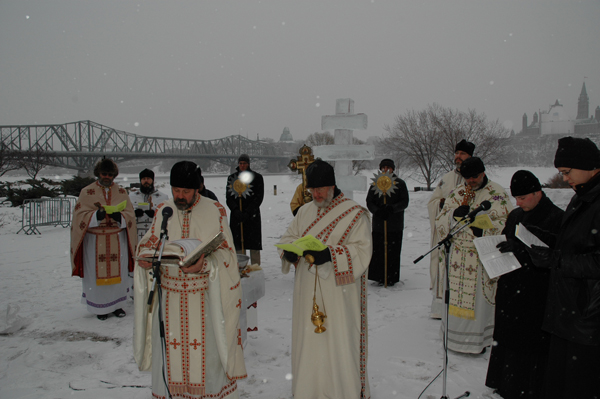
Today, the ancient and wonderful feast of the Theophany (about which see Nick Denysenko's book here), will often see many Eastern Christians carving crosses out of ice near newly blessed bodies of water, and then hurling wooden hand crosses into those waters to make of them an offering back to their Creator. This seems a quintessentially Christian ritual, but how was it handled in the Muslim world, where so many Eastern Christians lived and live?

I count it a success in my courses on Eastern Christian encounters with Islam when my students come to appreciate how often the boundaries were more blurred than they realize, or are often thought to be today. I tell them that they should leave the course recognizing that questions of identity, historically situated, are far messier than many thought, and that borrowings of, or at least attendance at, ritual practices of the "other's" community, happened more than we might realize.

Examples of this include some Muslims venerating Christian relics and praying in Christian shrines, and Christians attending Muslim village festivals, some evidence of which is to be found in such fascinating works as I noted here.

Now a new book further complicates and expounds the picture for us: Cross Veneration in the Medieval Islamic World: Christian Identity and Practice Under Muslim Rule by Charles Tieszen (I.B. Tauris, 2017), 244pp.

About this book the publisher tells us:
One of the most common religious practices among medieval Eastern Christian communities was their devotion to venerating crosses and crucifixes. Yet many of these communities existed in predominantly Islamic contexts, where the practice was subject to much criticism and often resulted in accusations of idolatry. How did Christians respond to these allegations? Why did they advocate the preservation of a practice that was often met with confusion or even contempt? To shed light onto these questions, Charles Tieszen looks at every known apologetic or polemical text written between the eighth and fourteenth centuries to include a relevant discussion. With sources taken from across the Mediterranean basin, Egypt, Syria and Palestine, the result is the first in-depth look at a key theological debate which lay at the heart of these communities' religious identities. By considering the perspectives of both Muslim and Christian authors, Cross Veneration in the Medieval Islamic World also raises important questions concerning cross-cultural debate and exchange, and the development of Christianity and Islam in the medieval period. This is an important book that will shine much needed light onto Christian-Muslim relations, the nature of inter-faith debates and the wider issues facing the communities living across the Middle East during the medieval period
Related Posts Plugin for WordPress, Blogger...