"Let books be your dining table, / And you shall be full of delights. / Let them be your
mattress,/
And you shall sleep restful nights" (St. Ephraim the Syrian).


Saturday, September 17, 2011

European Orthodoxy in the Twentieth Century

We are living in a happy time when, as I have repeatedly noted on here, interest in, and introductions to, Orthodoxy continue to be published by major publishers. Now the academic publisher Peter Lang has just sent me another, a translation of a book first published in French in 2009: Christine Chaillot, ed., The Orthodox Church in Eastern Europe in the Twentieth Century (Peter Lang, 2011, xviii+464 pp.).

About this book the publisher provides the following synopsis and table of contents:

It is common knowledge that the majority of the population of Eastern Europe belong to the Christian Orthodox tradition. But how many people have an adequate knowledge of the past or even of the present of these Orthodox churches? This book aims to present an introduction to this history written for a general audience, both Christian and non-Christian. After the 1917 revolution in Russia, communism spread to most of the countries of Eastern Europe. By 1953, at the time of Stalin's death, the division between Eastern and Western Europe seemed absolute. However, the advent of perestroika at the end of the 1980s brought about political changes that have enabled the Orthodox Church to develop once again in Eastern Europe. The foundation of the European Union in 1993 has had a broader significance for Orthodox communities, who can now participate in the future development of Europe. Some Orthodox Churches already have their representatives at the European Union in Brussels. These include the patriarchates of Constantinople, Russia and Romania, along with the Church of Greece and the Church of Cyprus. Today, Europe is becoming increasingly religiously diverse, even within Christianity itself. A growing number of Orthodox Christians have come to work and settle in Western Europe. An understanding of the history of the Orthodox communities in Eastern Europe in the twentieth century will contribute, in a spirit of informed dialogue, to the shaping of a new united Europe that is still in the process of expansion.

Contents:
Kallistos Ware: Foreword
Christine Chaillot: Introduction
Andreas Nanakis: History of the Ecumenical Patriarchate of Constantinople in the Twentieth Century
Grigorios D. Papathomas: History of the Church of Greece in the Twentieth Century
Andreas N. Mitsides: The Church of Cyprus during the Twentieth Century
Todor Sabev: The Orthodox Church of Bulgaria in the Twentieth Century
Predag Puzovic: A Short History of the Serbian Orthodox Church in the 20th century in Former Yugoslavia
Anastasios Yanoulatos: Some Notes on the History of the Orthodox Church of Albania in the Twentieth Century and its Resurrection from 1991
Mircea Pacurariu: The Romanian Orthodox Church in the Twentieth Century
Emil Dragnev: The Orthodox Church in Moldova in the Twentieth Century
Etele Kiss: A History of the Orthodox Church in Hungary in the Twentieth Century
Christopher Pulec/George Stránsk: The Orthodox Church in the Czech Lands & Slovakia
Antoni Mironowicz: The Orthodox Church in Poland in the Twentieth Century
Alexander Gavrilin/Baiba Pazane: The Orthodox Church in the Twentieth Century in the Baltic States: Latvia, Lithuania and Estonia
Feodor Krivonos: The Belarusian Orthodox Church in the Twentieth Century
Sophia Senyk: The Orthodox Church in Ukraine in the Twentieth Century
Mikhail Vitalievich Shkarovsky: The Russian Orthodox Church in the Twentieth Century
Zaza Abashidze: The Orthodox Church of Georgia in the Twentieth Century

I look forward to seeing this reviewed in Logos: A Journal of Eastern Christian Studies. 

Friday, September 16, 2011

On Lev Gillet's Lasting Significance

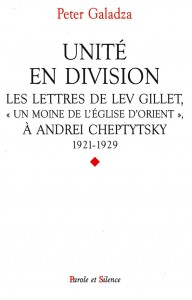
I have been fascinated with the figure of Lev Gillet for many years now--since even before Peter Galadza and I collaborated on Unité en division: Les lettres de Lev Gillet (“Un moine de l’Eglise d’Orient”) à Andrei Cheptytsky – 1921-1929 (Paris/Ottawa: 2009).

What is this book about? Here is an English translation of part of the description of our publisher, Parole et Silence:
Andrei Sheptytsky (Cheptytsky, Szeptyckyj) (1865-1944), Greco-Catholic bishop of Western Ukraine, and Lev Gillet (1893-1980), “the monk of the Eastern Church,” were two of 20th century Eastern Christianity’s more important, yet underappreciated, figures. 

The book, Unité en division: Les lettres de Lev Gillet (“Un moine de l’Eglise d’Orient”) à Andrei Cheptytsky – 1921-1929, is the annotated transcription of almost 100 letters of Lev Gillet to Archbishop Sheptytsky. The letters remained inaccessible for almost 50 years in the Soviet archives of Western Ukraine. They cover the period when Gillet went from being a Benedictine novice in England, to Greco-Catholic (“Uniate”) Studite in Ukraine, to Orthodox priest in France. During this same period, Sheptytsky went from being the “darling” of those hoping to “convert Russia,” to a giant “imprisoned in his own diocese.” The letters shed light on key elements of the biographies of these two celebrities. They also clarify various aspects of interwar Catholic and Eastern Orthodox church history.... All of these events and ideas are explained in copious annotations, which make the book an excellent source for micro-history.
Gillet, of course, was a well-known author, especially in the area of Christian spirituality. He wrote many books in this area.

But perhaps one of the works of most lasting significance of Gillet was his study of Jewish-Christian relations, a work that was published during the Holocaust in 1942 and therefore antedates many other post-war works that attempted to ask "How can one theologize in the aftermath of Auschwitz?" That work of his has remained in print ever since as Communion in the Messiah: Studies in the Relationship between Judaism and Christianity. John Jillions had a long discussion of it in Logos: A Journal of Eastern Christian Studies in 2006.


About this book we are told:
Without compromising the Christian position, Gillet sets out to show how much Christians have to learn from Jews before they can hope to communicate their own faith that Jesus is the Christ. After a historical analysis of the intellectual relations between Christianity and Judaism, the author eruditely draws out the common elements of the two traditions, challenging and correcting misconceptions about Rabbinism and Jewish life and teaching generally, misconceptions which overlook the two millennia of Jewish thought between the Old Testament and modern times. He shows how close is this connection, and how deeply spiritual is much of Jewish theology. There is, he claims, nothing in Jewish belief that a Jew become Christian ought to reject, while Christianity is the completion and fulfillment of Judaism.
The table of contents, preface, and an extract from the text may be consulted here.

Gillet's life is, as I noted at the outset, of longstanding fascination to me and many, including his close friend Elisabeth Behr-Sigel, whose own life is at least as fascinating and has been recently wonderfully told. Behr-Sigel, in her 80s, undertook the research to be able to write Gillet's biography: Lev Gillet, "un moine de l'Eglise d'Orient": Un libre croyant universaliste, evangelique et mystique (Paris: Cerf, 1993).

 An English translation of this was made available in 1999 from England's Fellowship of St. Alban and St. Sergius. Additionally, for those who wish a shorter study of him, see the chapter on Gillet in Michael Plekon's justly acclaimed Living Icons: Persons of Faith in the Eastern Church

What is it about Gillet's life that continues to fascinate? Doubtless there are many things for many people, but what is especially important to consider is (if I may be forgiven the infelicitous academic jargon) how he "problematizes" Orthodox-Catholic relations by his deliberate "transgressing" of the apparent boundary between the two. I say "apparent" because, following David Bentley Hart, I am not convinced that, at least de jure, there is any real boundary. There is, of course, the problem of the papacy, on which I have had a few things to say.
But following Hart, and the Russian Orthodox scholar Antoine Arjakovsky, as well as several modern Greek and Armenian theologians, inter alia, I am no longer convinced that any of this is sufficient to justify Catholics and Orthodox from refusing the Eucharist to one another. As Robert Taft noted at Orientale Lumen in June, it is necessary for restoration of communion only that we have identity of apostolic faith, not of historic memory.

Remarkably, Gillet in his own day seems to have thought likewise, at least as far as his own life went. This is all the more remarkable when one considers his context: in the early years of what we would come to call the "ecumenical movement" and especially in the period before Vatican II when, at least on the Catholic side, ecclesial boundaries were strictly drawn and policed, and the only permissible understanding of ecumenism was that of "return": the "schismatics" (=Orthodox) and the "heretics" (= Protestants) had to abandon their contumacy by returning to Rome to make their submission to the Roman pontiff. Thus the problem of Christian disunity would be solved. That model, thankfully, was abandoned at Vatican II, and officially reprobated in the 1990s by Edward Cardinal Cassidy, then president of the Pontifical Council for Promoting Christian Unity, and more authoritatively still by Pope Benedict XVI who, in Cologne in 2005, said that "unity does not mean what could be called ecumenism of the return: that is, to deny and to reject one's own faith history. Absolutely not! It does not mean uniformity in all expressions of theology and spirituality, in liturgical forms and in disciplines."

If there is no longer a "return," then what are we seeking? Here Gillet's life was prescient in showing us a model we are only beginning to appreciate: an ecumenism of communion in which he boundary between East and West simply disappears into the background. Gillet sought out this communion by simply doing it, and so he remains a forerunner of those who, impatient with the plodding pace of official dialogues, want to push East and West closer together faster. For Gillet, his moving from Catholicism to Orthodoxy was a move undertaken "without denying the Catholic faith" and "without breaking spiritual ties" to the man he regarded, Behr-Sigel says, not merely as his spiritual father until the end, Metropolitan Andrei Sheptysky, but also as a saint.

When Gillet was received into Orthodoxy in Paris by Metropolitan Evlogii, Gillet simply recited with him the Nicene Creed (sans filioque of course): "no abjuration of faith had been imposed on him" and "nothing more had been required." Thus, his biographer tells us, "any act which might have implied a break was avoided." Moreover, and more astonishing still, Gillet, in a letter to his mother, said that "I have not been asked to subscribe to any formula or to make any profession of faith, and I have been formally invited to continue to mention Metropolitan Andrei in the liturgy"! Later in this letter to his mother he tries to calm her by saying that "nothing separates us. The same Saviour and the same sacraments unite us. So be calm. Do not distress yourself." His reception into Orthodoxy, he would later tell a friend, was not a conversion or renunciation, but simply a case of perceiving in Orthodoxy that "the light of Christ...is a fraction brighter, but it is the same light, and not another which also shines in the Western Church." Would that there was such a generosity of vision on the part of more Orthodox--and Catholics--today! Through the prayerful intercession of this "monk of the Eastern Church," may we all hasten to that day when we are one around the Lord's table.

Wednesday, September 14, 2011

Metropolitans in Print

St. Vladimir's Seminary Press has recently released two books, one from its own primate, Metropolitan Jonah, and another from the prolific Russian Metropolitan Hilarion Alfeyev, author of books on hell, the canonical structure of the Church, Isaac the Syrian, Symeon the New Theologian, Orthodox witness today, and many musical works.

The first book, from the OCA's primate, whom I was delighted to meet in June at Orientale Lumen, is entitled Reflections on a Spiritual Journey, eds. Virginia Nieuwsma and Chad Hatfield (SVS Press, 2011), 207pp. 

About this book the publisher tells us:
Reflections on a Spiritual Journey —a collection of essays and addresses by Metropolitan Jonah— provides a glimpse into His Beatitude’s spiritual formation and thinking. The book, which contains not only a lengthy biography of the author but also a Foreword by The Right Rev. Benjamin, bishop of San Francisco and the West, is divided into two main sections. Part One, “The Spiritual Life,” contains the author’s reflections on forgiveness and reconciliation; becoming and purifying the true self; the connection between shame and the passions; and human personhood and the value of suffering. Part Two, “One, Holy, Catholic, and Apostolic Church,” conveys the author’s vision regarding the identity and mission of the Orthodox Church in America as well as his perspectives on episcopacy, primacy, and the mother churches.
The volume is the first in the press’s new Orthodox Profiles series, which acquaints readers on an intimate level with Orthodox figures who have shaped the direction of the Orthodox Church in areas of mission, ascetical and liturgical theology, scholarly and pastoral endeavors, and various other professional disciplines. Archpriest Chad Hatfield, Chancellor/CEO of the seminary, is the Series Editor.
The second publication is not so much a new publication as a new version of a previously published book by Met. Hilarion: The Mystery of Faith: An Introduction to the Teaching and Spirituality of the Orthodox Church.

About this book, the publisher says:
The Mystery of Faith: An Introduction to the Teaching and Spirituality of the Orthodox Church, by Metropolitan Hilarion, was written when His Eminence was a priest, lecturing in dogmatic theology at the Moscow Theological Seminary in 1992. It was published in Russian in 1996, and it was first printed in English by Darton, Longman and Todd, Ltd. in the United Kingdom in 2002. It is, in the words of the author “…neither a systematic exposition of the dogmatic theology of the Orthodox Church, nor a comprehensive analysis of Orthodox spiritual tradition. It is rather a personal commentary by an Orthodox priest on the dogmas of the Orthodox Church as they relate to spiritual life.” A collection of texts, mostly patristic, which illustrate the author’s points, follows each chapter.
It is, I must note, very sad that a man of Hilarion's caliber, who can produce many theological books of considerable erudition, nonetheless recently popped up in the media to repeat the same tedious nonsense about Ukrainian Greco-Catholics and the so-called conditions for the pope of Rome to meet the patriarch of Moscow. This is the same tendentious rubbish that the Russians slanderously spout every few months when it suits their mendacious purposes. No serious historian believes them (Robert Taft, inter alia, has long debunked all this, first in Logos: A Journal of Eastern Christian Studies in 2001, and again at Orientale Lumen in June of this year) and it is a mystery that such an intelligent and Oxford-educated man as Hilarion can put this forward with a straight face. After reading Taft's article "The Problem of 'Uniatism' and the 'Healing of Memories'," and listening to his OL lecture, Hilarion should next go out immediately and buy a copy of a new book by his fellow Russian Orthodox theologian, Antoine Arjakovsky: En attendant le Concile de l'Eglise Orthodoxe

I have read this book with great interest, and am reviewing it for a journal in Ukraine this fall. In chapter 24 of this very meaty and wholly welcome book, "Memories of the Pseudo-Synod of Lviv," Arjakovsky writes movingly and powerfully about that attempted suppression by Stalin of the Ukrainian Greco-Catholic Church (UGCC) with clear and demonstrably verifiable collusion from the Russian Church. Arjakovsky, as a well-trained historian (with a doctorate from the Sorbonne), simply lays out all the evidence without polemics or hysterics, allowing the absurdity of Russian claims, still mindlessly mouthed by Met. Hilarion, to be made manifest. He goes on to note that the other notion, that Ukraine somehow today remains part of Russia's "canonical territory" is equally risible to anyone who, in Taft's memorable words, actually studies and understands history instead of just making it up:
la difficulté ici n’est pas seulement que la justification historique présentée est loin de pouvoir convaincre. Le principal problème est que le patriarcat de Moscou ná eu à aucun moment de son histoire de juridiction en Galicie ! L’Église de Kiev-Halitch a toujours relevé du patriarcat de Constantinople (499). 
This chapter is especially useful in updating the discussion with all the documentation issued in 2006 on the occasion of the fiftieth anniversary of the pseudo-synod. Thus we read the letter from Pope Benedict XVI on the anniversary, the letter from then-president Victor Yuschenko, and a handful of rather reluctant acknowledgements from some Orthodox, including Nicolas Lossky. In the end, though, as Arjakovsky notes, memories of 1946 remain an enormous wound (“une blessure profonde”) that, in truth and justice, must be acknowledged and then healed. How long will it take for the Russian hierarchy to admit this? 

The Universal Exaltation of the Life-Giving Cross

Today's feast, observed in East and West, celebrates the central paradox at the heart of Christianity: an instrument of torture and death is the instrument of everlasting life. As we commemorate this feast, I think especially of the role of the dowager empress Helena, who has been much on my mind after I have been re-reading (in preparation for a public lecture later this month) that absolutely wonderful
eponymous historical novel about her by Evelyn Waugh.

We are fortunate this year to have a new book about the sign of the cross from the hand of the young scholar Andreas Andreopoulos, author of previous works on iconography and art, who, his publisher tells us,
was born in Greece in 1966 and is recognized throughout the world as one of the most eloquent young scholars of Christianity. He earned his Ph.D. in theology at the University of Durham under Fr. Andrew Louth and has taught in Toronto, Montreal, and Philadelphia. He is currently Lecturer of Christian Theology at the University of Wales.

About this book, the publisher tells us:

Millions of Christians around the world use the sign of the Cross—and have done so for centuries—as a gesture of blessing. It is practiced when alone, during worship, before sleep, upon waking, before eating, before travel, and many other times throughout the day. But, what does it mean? Where did it originate? What did the sign of the Cross mean to the first Christians, and how has this simple movement of the hand evolved over the centuries?
The sign of the Cross is literally a tracing of the Cross of Christ onto the body. By so doing, Christians invite the mystery of the Cross into their everyday lives. Now and for the first time, young Greek scholar Andreas Andreopoulos explains the tremendous meaning, mystery, and history of this dramatic gesture shared by Christians worldwide. This readable account will fascinate and inspire all who desire to know more about the inherited spiritual practices of everyday life.

Tuesday, September 13, 2011

Muslim-Christian Relations

In the most recent issue of Logos: A Journal of Eastern Christian Studies, the Antiochian Orthodox theologian Theodore Pulcini reviewed Mahmoud Ayoub's A Muslim View Of Christianity: Essays on Dialogue,

noting that the book is an extremely careful and thoughtful discussion of the deep theological differences between Christianity and Islam. The book pays special attention to Eastern Christians. Such dialogue between members of the two faiths, Pulcini argued in his review, is likely going to be ever more important as the twenty-first century continues to unfold.


One such recent effort to continue that dialogue comes in Waleed El-Ansary and David K. Linnan, eds., Muslim and Christian Understanding: Theory and Application of "A Common Word" (Palgrave MacMillan, 2010), 300pp.

This book includes a a chapter on the Ecumenical Patriarchate and its role in Muslim-Christian dialogue written by John Chryssavgis.

The publisher further tells us that
This book explores “A Common Word Between Us and You,” a high-level ongoing Christian-Muslim dialogue process. The Common Word process was commenced by leading Islamic scholars and intellectuals as outreach in response to the Pope’s much criticized Regensburg address of 2007, and brings to the fore, in the interest of developing a meaningful peace, how the Islamic and Christian communities representing well over half of the world's population might agree on love of God and love of neighbor as common beliefs.

Monday, September 12, 2011

The Splendors of Old Cairo

Forthcoming from Oxford University Press is a new collection by Gadwat Gabra and edited by Carolyn Ludwig, with photographs from Sherif Sonbol and Morris Jackson, Stefan Reif, Tarek Swelim, Gertrude van Loon: The History and Religious Heritage of Old Cairo: Its Fortress, Churches, Synagogue, and Mosque (Oxford UP, 2011), 250pp + 250 illustrations.

This book, the publisher tells us, is:
A celebration of the history of religious life in the early Egyptian capital, in text and pictures.

Just to the south of modern Cairo stands the historic enclave known as Old Cairo, which grew up in and around the Roman fortress of Babylon, and which today hosts a unique collection of monuments that attest to the shared cultural heritage of ancient Egyptians, Christians, Jews, and Muslims.

In this lavishly illustrated celebration of a very special place, renowned photographer Sherif Sonbol's remarkable images of the fortress, churches, synagogue, and mosque illuminate the living fabric of the ancient and medieval stones, while Gawdat Gabra describes the history of Old Cairo from the time of the ancient Egyptians and the Romans to the founding of the first Muslim city of al-Fustat. Stefan Reif focuses on the Jewish history of the area, exploring the famous Genizah documents found in the Ben Ezra Synagogue that tell so much about everyday life in medieval Egypt. Gertrud van Loon looks at the early Coptic Christian churches, some of the oldest in the world, and Tarek Swelim describes the arrival of the Muslims in the seventh century, their establishment of al-Fustat on the edge of Old Cairo, and the building of the Mosque of 'Amr ibn al-'As, the oldest mosque in Africa.
I look forward to seeing this reviewed in Logos: A Journal of Eastern Christian Studies.

Sunday, September 11, 2011

What Would Jesus Snort?

Controversies over images are neither new nor confined to Islam today. Christians and Jews have long had fierce debates over what images, if any, especially of hieratic realities, may legitimately be made and honored, and how. Iconoclasm is a problem beyond Byzantium. What makes an image an "icon" and how do we treat such icons? These and similar questions are taken up in a new book: Martin Kemp, Christ to Coke: How Image Becomes Icon (Oxford UP, 2011), 352pp.

About this book the publisher tells us:
How does an image become iconic? In Christ to Coke, eminent art historian Martin Kemp offers a highly original look at the main types of visual icons. Lavishly illustrated with 165 color images, this marvelous work illuminates eleven universally recognized images, both historical and contemporary, to see how they arose and how they continue to function in our culture.

Kemp begins with the stock image of Christ's face, the founding icon--literally, since he was the central subject of early Christian icons. Some of the icons that follow are general, like the cross, the lion, and the heart-shape (as in "I heart New York"). Some are specific, such as the Mona Lisa, Che Guevara, and the famous photograph of the napalmed girl in Vietnam. Other modern icons come from politics, such as the American flag (the "Stars and Stripes"), from business, led by the Coca-Cola bottle, and from science, most notably the double helix of DNA and Einstein's famous equation E=mc2.

The stories of these icons--researched using the skills of a leading visual historian--are told in a vivid and personal manner. Some are funny; some are deeply moving; some are highly improbable; some center on popular fame; others are based on the most profound ideas in science. The diversity is extraordinary.
Along the way, we encounter the often weird and wonderful ways that these images adapt to an astonishing variety of ways and contexts.

Informative, amusing, and surprising by turns, Christ to Coke will entertain and intrigue readers with the narratives that Martin Kemp skillfully weaves around these famous images.

Saturday, September 10, 2011

Relics and Miracles

When I was a student, I remember a professor telling me a story, likely apocryphal and doubtless embellished, of why there are, in the Byzantine sanctoral, so many days (four, at least) devoted to finding various bits of John the Baptist--chiefly his chronically lost or "misplaced" head. The answer, it was said, lies in the rivalry of ancient monasteries to have relics of the Forerunner, and one way, apparently, for this to happen was for monks to visit a rival monastery with some or better relics and then to pilfer them away, often under a performance of piety: e.g., when going to kiss his finger-bone or some other appendage, certain monks would often not merely kiss but in fact suck up part or all of the bone in their mouth and thus smuggle it out of the monastery and back to their own place.

Relics are the focus of the latest translation of a book by Sergius Bulgakov. As I have noted before, we are seeing a revival in Bulgakov studies as the number of translations into English of his works continues apace, mostly from the hand of Boris Jakim (though T.A. Smith has also translated Bulgakov's book on angels) and the efforts of Eerdmans. Now another one has been set for release in October:  Relics and Miracles: Two Theological Essays (Eerdmans, 2011), 128pp.


About this book, the publisher tells us:
Esteemed translator Boris Jakim here presents for the first time in English two major theological essays by Sergius Bulgakov. In “Relics,” a 1918 response to Bolshevik desecration of the relics of Russian saints, Bulgakov develops a comprehensive theology of holy relics, connecting them with the Incarnation and showing their place in sacramental theology. In “Miracles” (1932) Bulgakov presents a Christological doctrine of the Gospel miracles, focusing on the question of how human activity relates to the works of Christ. Both works are suffused with Bulgakov’s faith in Christian resurrection — and with his signature “religious materialism,” in which the corporeal is illuminated by the spiritual and the earthly is transfigured into the heavenly.

Friday, September 9, 2011

Turkey, Armenia, and Genocide

The question of the Armenian genocide continues to haunt not merely historians and other scholars, but also the politics of Europe. The genocide remains a hugely controversial notion in Turkey, where the very discussion of it is actually a criminal offense. Turkey continues to deny responsibility for any wrong-doing. And yet Turkey is also interested in joining the European Union: the prospects of the latter happening are diminished while the former denial remains in place. This November sees another book set to review all these issues: Vahakn N. Dadrian and Taner Akçam, Judgment at Istanbul: The American Genocide Trials (Berghahn, 2011), 372pp. 

About this book the publisher tells us:
Turkey’s bid to join the European Union has lent new urgency to the issue of the Armenian Genocide as differing interpretations of the genocide are proving to be a major reason for the delay of the ratification. This book provides vital background information and is a prime source of legal evidence and eye-witness testimony of the intent and the crime of genocide against the Armenians. After a long and painstaking effort, the authors, one an Armenian, the other a Turk, generally recognized as the foremost experts on the Armenian Genocide, have prepared a new, authoritative translation and detailed analysis of the Takvim-i Vekâyi, the official Ottoman Government record of the Turkish Military Tribunals concerning the crimes committed against the Armenians during World War I. The authors have compiled the first-known English-language documentation of the trial proceedings and situated them within their historical and legal context. These documents show that Wartime Cabinet ministers, Young Turk party leaders, and a number of other parties inculpated in these crimes were court-martialed by the Turkish Military Tribunals in the years immediately following World War I. Most were found guilty and received sentences ranging from prison with hard labor to death. In remarkable contrast to Nuremberg, the Turkish Military Tribunals prosecuted solely on the basis of existing Ottoman domestic penal codes. This substitution of a national for an international criminal court stands in history as a unique initiative of national self-condemnation. This compilation is significantly enhanced by an extensive analysis of the historical origins, political nature and legal implications of the criminal prosecution of the twentieth century’s first state-sponsored crime of genocide. For a better understanding of one of key controversies in Genocide Studies, this book is essential for historians, political scientists, sociologists, legal scholars, and policy makers. 

Thursday, September 8, 2011

David Fagerberg on Edith Humphrey's Grand Entrance

I have received a book review from the liturgical scholar David Fagerberg of Notre Dame, himself the author of one of my favorite books in liturgical theology, which I ensure my students always read: Theologia Prima: What Is Liturgical Theology? 

In his book, Fagerberg shows, inter alia, extensive familiarity with the great--many would say the greatest--Orthodox liturgical theologian of the last century, Alexander Schmemann.

I asked Fagerberg, at once equally at home in Western and Eastern liturgical sources, to review a new book by Edith Humphrey, a former Canadian Anglican who entered the Antiochian Orthodox Church recently. We will publish Fagerberg's review in Logos next spring.

As I noted previously, Humphrey has written a number of really excellent critical reviews for Logos: A Journal of Eastern Christian Studies including of  Partakers of the Divine Nature: The History and Development of Deification in the Christian Traditions and also, more controversially, Eugene Rogers' After the Spirit.

She is also herself the author of a number of interesting books, to be discussed in more detail next week when we have an interview with her on here. I asked Fagerberg to review her most recent book, Grand Entrance: Worship on Earth as in Heaven (Brazos Press, 2011), 272pp.

The contents of Grand Entrance are as follows:
Introduction: The Crisis of Corporate Worship and the Life of the Church
1. "Teach Us to Pray": What Is Worship, and Where Does Corporate Worship Fit?
2. "Praise God in His Sanctuary": Worship as Entrance in the Old Testament
3. "In Spirit and in Truth": Entrance in the New Testament
4. "From You Comes . . . Praise": Traditional Liturgies of the East
5. "In the Great Congregation": Traditional Liturgies of the West
6. "Your Church Unsleeping": Expressions of Worship Today
7. "That Your Prayers Not Be Hindered": Avoiding Pitfalls in Corporate Worship
Conclusion: "To Sing Is a Lover's Thing"
Glossary
Index
Humphrey's "ecumenical" approach is an encouraging one, and puts me in mind of  a book I recently received: Anton Usher, Replenishing Ritual: Rediscovering the Place of Rituals in Western Christian Liturgy (Marquette UP, 2011), 277pp.  Usher shows some familiarity with noted Eastern liturgists and historians, including Robert Taft and Peter Galadza.

But back to Humphrey. Fagerberg's review of her book notes that one of Humphrey's major concerns is to rescue the very notion of corporate-communal worship from the individualistic culture of today, especially among some evangelicals. A related concern is justifying the use of very ancient forms and venerable traditions in Catholic and especially Orthodox worship. As he drolly puts it:
The answer to questions like why cannot we reverse the sequence of word and sacrament, or why we cannot revise the stations of the cross to align with the United Nations’ Millennium Development Goals is simple: it is not done this way. Asking "what elements do you include in your worship?" is like asking "in our laboratory we make water with two hydrogen atoms and one oxygen atom – what do you use?"

Tuesday, September 6, 2011

Author Interview: Veronica della Dora

Earlier this year, as I noted, a good deal of attention focused on Mt. Athos thanks in part to a 60 Minutes documentary. This appeared alongside a new book about the mount: Veronica della Dora, Imagining Mount Athos: Visions of a Holy Place, from Homer to World War II (University of Virginia Press, 2011), 336pp. 

This book carries some significant endorsements from leading scholars, including:

Alice-Mary Talbot:
This is an extraordinarily original and innovative book. Although at first it might seem strange for a female scholar to write a book about a place she can never visit, Dr. della Dora turns this challenge to her advantage by focusing on the Holy Mountain as an 'object of desire,' and analyzing how various perceptions of it were transmitted over the centuries to viewers and readers, most of whom themselves never set foot on Athos. The book is not intended to be the 'inside story' of Athos, from the point of view of the monks, but Athos as seen "from the outside."

Metropolitan Kallistos WareAmong the many books written about the Holy Mountain, this is one of the most exciting and original. It uncovers an aspect of Athos hitherto little explored and makes a genuinely significant contribution to existing scholarship. Veronica della Dora is concerned not with the external history of the monastic peninsula but rather with the part that it has played over the centuries, and continues to play, in the imagination of monks, pilgrims and travelers. Beautifully written, scrupulously researched, fully illustrated, this is a visionary work, remarkable in its insight. 

I asked the author for an interview about her book, and here are her thoughts:

AD: Please tell us about your background:

VdD: I graduated from the University of Venice, Italy and continued my studies in the Geography Department of the University of California at Los Angeles. I received my PhD in 2005 and, after two years as a postdoctoral researcher by the same institution and at the Getty Research Institute, I moved back Europe to start my current appointment as Lecturer in Geographies of Knowledge at the University of Bristol.

I was baptized Orthodox Christian in the metochion (dependency) of the Athonite monastery of Docheiariou in Sochos-Lagkada (Greece) in 2001, before moving to the States.

AD: What about your own background led you to the writing of this book?

The path that led me to this book is both academic and spiritual. As a cultural and historical geographer I have always been interested in processes of place making and in the ways people perceive place and landscape. There is a basic distinction between these two concepts. Place we tend to associate to meaning, to personal experience, to emotions; landscape to aesthetic contemplation. We always look at it from a distance.

I first encountered Mount Athos as a landscape. I was about to finish college and not quite sure what to do with my life. I had decided to learn Greek for a change and attend to a summer school in Thessalonica. One weekend the boys were taken to Athos. We girls were offered a boat tour of the peninsula. The night before, we were given a slide show. Images of magnificent buildings and black-robed monks ‘living like centuries ago’ captured my imagination.

Our boat left Sithonia early in the morning. Athos’ dark cone slowly started to loom on the horizon. When we passed the last monastery, Docheiariou, I suddenly remembered I had once talked to a monk from there through amateur radio. ‘Hold on, how can a monk be on a ham radio?!’ I couldn’t quite match images of austere clerics reading ancient manuscripts with HF transceivers and antennas. I became intrigued.

I decided to put my Greek to practice and wrote him a letter—out of pure curiosity, nothing else. Months passed by. ‘Maybe monks are misogynist and don’t write to women’, I thought. But one day I found an envelope stamped with the double-headed Byzantine eagle in my mailbox. ‘Dear Veronica, I am sorry it took me so long to reply, but I was working in the mainland over the summer and just found your letter’. It turned out that he and a small group of fellow-monks were building a nunnery outside of Athos, a place where women could live Athonite liturgical life.

The guy must have felt for my broken Greek and offered help. ‘I am glad you are trying to learn Greek not only because it is my mother tongue, but because it is the language of the Gospels. As a monk, however, it is not appropriate for me to keep a correspondence with a woman unless you have spiritual interests. Do you?’ ‘I am agnostic and know nothing about Orthodoxy. But I want to learn’.

We started to correspond, first through letters, later by phone. I would ask him about his daily routine and his faith. With patience and fatherly care, he would listen to me, correct my mistakes, teach me new words, and introduce me to his world.

One year later I met him at the nunnery. He was excavating the foundations of a new building with other fathers under midday’s burning sun. A bunch of sweating, dust-covered bearded men dressed in rugs—definitely not the image of monk I had in mind!
I spent few days there. I attended a long vigil. I couldn’t pick up a single word, but the chanting kept echoing in my mind for entire months after my return home. I revealed to him anxieties and personal problems. He provided me with sound advice which I treasured over the years. I found a safe shelter. I regained my faith.

I also found that dozens of other laypeople turned to the monastery, usually broken, suffering people: poor families, mothers of drug-addicted teenagers, couples who had lost their only child, the terminally sick. To each of them the monks would provide comfort, prayer, sometimes even financial help. They would not ‘preach’, but live people’s daily sufferings from within. For all these laypeople Athos continues to be a beacon of light and hope. For me it has ironically become the most stable landmark in a life of continuous changes and moves. From landscape, it has become a place.

AD: Tell us why you wrote this book:

This book was originally written as my PhD dissertation. Like, I believe, any PhD student, I wanted to work on a topic about which I was truly passionate.

I originally moved to the States in 2001 as an exchange student between my former institution in Italy and UCLA. That was two months after my baptism and exactly three days before 9/11. For a 23-year-old who had never lived by herself, let alone abroad, it was no easy task being catapulted to the other end of the globe under such dramatic circumstances. I think this is when my tie with Mount Athos started to grow stronger and stronger. In the midst of daily difficulties and uncertainties, I knew the fathers would light a candle for me and this gave me strength. I liked to think that every night, as Europe was still asleep, the monks would get up to go to church and would pray for the entire world. Everyday I saw a little miracle happen and felt closer and closer to the Holy Mountain, even though I was so distant.

The year I was preparing for my ABD exams, the European parliament had just passed a resolution of fundamental rights in the EU calling the Greek government to lift Athos’s avaton. All the articles I came across in the newspapers and on the web talked about the exclusion of women from Athos; none of them talked about the social and spiritual role of the Holy Mountain in the lives of those thousands of men and women, like myself, unable to visit it. As an insider-outsider, I felt disturbed by the caricaturization of Athos and its inhabitants in the press as a monolithic exotic other cut out from the rest of the world. As a scholar, I became interested by the genealogy of these perceptions and representations. More generally, I became interested in the processes through which a place circulates outside of its physical boundaries. 

I guess I ultimately wanted to show that physical distance does not necessarily mean exclusion from a place, and conversely, physical access does not always mean inclusion. The stories of many western travelers of the past and their orientalist constructions of Athos seem to confirm the latter point.

Finally, I wanted to show the cultural complexity of the place. I found that most scholarly monographs and tourist guides tended to focus only on certain aspects of Athos, which is its Byzantine legacy and sacredness. As I started to dive in the archives, I discovered a plethora of other stories: pre-Christian stories, stories of war refugees, botanists, sociologists, military strategists, and women. Some of these stories have appeared in specialized studies in various languages; many others just lay forgotten on dusty library shelves. I thought that taking these stories out of the archives and grouping them in a single volume would add another dimension to current scholarship on the Holy Mountain.

AD: For whom was the book written—did you have a particular audience in mind?

When I set to write my dissertation proposal, the audience I had in mind was predominantly academic. As I moved on and came across so many exciting stories and images, however, I felt more and more compelled to write for a general public interested in Mount Athos. I thought it would be a shame to confine these materials to a specialized scholarly audience. When I rewrote the work for publication, I set this as my main task, by expunging academic jargon, for example, and trying to make the book accessible and pleasant to read also to a non-academic audience.

AD: Were there any surprises you discovered in your writing?

Yes, definitely. There were many surprises and I believe this the beauty of research: you set off with a set of research questions and expectations and end up with something totally different. For example, I had no idea Athos had been a geopolitical observatory or a refuge for WWII allied soldiers, or that late Byzantine scholars and western Renaissance mapmakers represented it as some sort of insular utopia.

Every account or image I encountered during my research was a surprise in itself. I found some stories bizarre, populated as they were by eccentric philhellenes who would normally lecture in togas, by voracious bibliomaniacs after Athos’ precious manuscripts, or by lunatic early-twentieth-century adventurers gaining a reputation for having crossed the Alps on elephant back. Other stories I found moving. For example, I could not hold back my tears while reading the autobiography of WWII Australian heroine and philanthropist Joice Nankivell Loch, who for many years inhabited the Byzantine tower of Ouranoupoli and, with her husband, helped rescue the village from famine. Like myself and many other women, Joice felt part of the Athonite community even though she could not physically cross the border.

AD: Are there similar books out there, and if so, how is yours different?

There are several excellent monographs on Mount Athos, including Graham Speake’s beautifully illustrated Renewal in Paradise.

I guess two things make Imagining Mount Athos unique, or at least sui generis: the first is my female authorship (and thus my positionality); the second is my approach as a cultural geographer. I am not so much interested in the factual history of the place (this has been already written), as in ways of seeing it and in the multiple narrative channels through which Mount Athos travelled outside of its boundaries throughout the centuries.

Since pre-Christian times, Athos has been usually narrated as an island. Today many still tend to forget it is a peninsula. It continues to silently stretch far beyond its boundaries, as it always did. A woman named Maria Lagoude wrote in the eleventh century:
From old and from the beginning, and so to speak, from the time I was in my mother’s womb I was raised by the monks of Lavra. During our entire life my husband and I have been devoted to the Lavra and have much faith in it because of the virtue of the fathers who live there and their compassionate soul-loving disposition... At the Holy Lavra my husband and I found a harbour of salvation (A.M. Talbot, ‘Women and Mt Athos’, in Mount Athos and Byzantine Monasticism, p.78).
As Alice-Mary Talbot commented, this woman envisaged the abbot of the monastery as ‘her spiritual father, the Lavra as her mother, and herself as one of the brethren and children of the Lavra’—a place she never saw, even from the boat.

Monday, September 5, 2011

Canonical Territory

It is fascinating to read that other Orthodox hierarchs have finally come around to challenging the Russian Church over its (shall we say) sui generis understanding of the canons of the Ecumenical Councils. Though the English in this piece is somewhat tortured in places, the import of it is not:
“Due to the events which have recently taken place in the Orthodox Church,” the Council stressed the necessity that the Orthodox Churches should respect and strictly observe the geographical borders of their jurisdictions “as defined by the holy canons and Tomoses on the foundation of these Churches.” 
In addition, it is heartening to see the Ecumenical Patriarchate stating clearly that
the Constantinople Patriarchate stated in the Tomos on the autocephaly of the Orthodox Church in Poland issued in 1924 that it never legally renounced its jurisdiction over the Kyivan Metropolitanate. As for the whole Moscow Patriarchate and its canonical borders, the Constantinople Council observes the Thomos of 1589 according to which the territory of the present-day Ukraine is not part of the Moscow Patriarchate.
This takes us into some very complicated history, much of which is very clearly sorted out in Borys Gudziak's superlative study, Crisis and Reform: The Kyivan Metropolitanate, the Patriarchate of Constantinople, and the Genesis of the Union of Brest (Harvard Series in Ukrainian Studies, 2001), 512pp. One should also see the collection of articles edited by B. Groen, Four Hundred Years Union of Brest (1596-1996) A Critical Re-Evaluation (Peeters, 1998), 269pp. 

I follow these seemingly recondite debates with great interest and have for five years been working on an article on the notions of canonical territory, which I was able to treat only very briefly in my Orthodoxy and the Roman Papacy: Ut Unum Sint and the Prospects of East-West Unity.

Much nonsense is talked when this phrase about "canonical territory" is invoked. One of the few decent studies I have seen is Johannes Oeldemann, "The Concept of Canonical Territory in the Russian Orthodox Church," in the collection edited by Thomas Bremer, Religion and the Conceptual Boundary in Central and Eastern Europe: Encounters of Faiths (Studies in Central and Eastern Europe).

"Canonical territory" is a nice theory, but nobody lives it today, as Robert Taft acidly observed both in his famous interview with John Allen in 2004 and more recently and with an abundance of historical documentation in his lecture in June at Orientale Lumen. These are problems afflicting not merely Orthodoxy, but also the Roman Catholic Church and, since at least 2003, the Anglican Communion. I'm giving a lecture on these notions in a few weeks and that prospect, together with encouraging discussions with Taft and Met. Kallistos Ware at Orientale Lumen in June, has encouraged me to return to that article I started five years ago. Several interesting developments have since taken place in the last half-decade, including the erection of Anglican ordinariates on the part of the Roman Catholic Church, and the so-called Chambésy process in the Orthodox world. Both of these developments suggest to me that the Roman and Eastern Churches might finally be getting serious about "canonical territory." We shall see.
Related Posts Plugin for WordPress, Blogger...