"Let books be your dining table, / And you shall be full of delights. / Let them be your
mattress,/
And you shall sleep restful nights" (St. Ephraim the Syrian).


Monday, February 20, 2012

Lenten Consumption

Unlike last year, alas, the Julian and Gregorian paschalions do not coincide this year but are a week apart. Today is Pure Monday for Byzantine Christians on the Gregorian calendar; next Monday is the same for those on the Julian. 

It is a singular cause for despair that, after forty-odd years of talking about the importance of finding a common date for Pascha--an issue so important it was addressed by the first ecumenical council of Nicaea in 325 no less--Christians still have not done so, an unhappy state that rather strongly suggests that more than a few of us are not, in fact, willing to do so. Talk is cheap: where is the action? In the absence of action, sometimes one cannot entirely escape the otherwise intolerable thought that perhaps unity really is an eschatological prospect. In that case, all of us had better be prepared for a very stiff trial indeed before the awesome tribunal of Christ. 

Anyway, for the start of Great Lent on either calendar, we have a new book from Oxford University Press reminding us that Christians not only fast and abstain from food, but are called to askesis and discernment in all of life: Laura M. Hartman, The Christian Consumer: Living Faithfully in a Fragile World (OUP, 2011), 272pp.

About this book the publisher tells us:
Be it fair trade coffee or foreign oil, our choices as consumers affect the well-being of humans around the globe, not to mention the natural world and of course ourselves. Consumption is a serious ethical issue, and Christian writers throughout history have weighed in, discussing topics such as affluence and poverty, greed and gluttony, and proper stewardship of resources. These voices are often at odds, however. In this book, Laura M. Hartman formulates a coherent Christian ethic of consumption, imposing order on the debate by dividing it into four imperatives: Christians are to consume in ways that avoid sin, embrace creation, love one's neighbor, and envision the future. An adequate ethics of consumption, she argues, must include all four considerations as tools for discernment, even when they seem to contradict one another. The book includes discussions of Christian practices such as fasting, gratitude, solidarity, gift-giving, Sabbath-keeping, and the Eucharist. Using exemplars from the Christian tradition and practical examples from everyday life, The Christian Consumer offers a thoughtful guide to ethical consumption. 

Saturday, February 18, 2012

Vatican II and Eastern Catholics in Canada

As I have noted before, 2012 marks the 50th anniversary of the opening of the Second Vatican Council, that landmark event that, inter alia, did so much to reshape for the better relations between Orthodoxy and Catholicism. A recent book looks at the council's legacy in Canada, and three chapters in that book focus on Eastern Christian reactions: Michael Attridge, Catherine Clifford, Gilles Routhier, eds.,Vatican II: Experiences Canadiennes/Canadian Experiences (University of Ottawa Press, 2011), 580pp.).

About this book the publisher tells us:
Le deuxième concile du Vatican (1961-1965) fut l’un des événements religieux les plus importants du vingtième siècle. Au Canada, il coïncida avec une période de changements culturels et sociétaux sans précédent, entraînant chez les évêques catholiques canadiens un réexamen de la place et de la mission de l’Église dans le monde. Pendant quatre ans, les évêques catholiques canadiens se réunirent avec leurs collègues de partout dans le monde pour réfléchir aux questions urgentes qui se posaient à l’Église et en débattre. Ce livre bilingue étudie l’interprétation et la réception de Vatican II au Canada, analysant diverses questions, dont le rôle des médias, les réactions des autres chrétiens, les contributions des participants canadiens, l’impact du Concile sur la pratique religieuse et sa contribution à la progression du dialogue interreligieux.
The Second Vatican Council (1961-1965) was one of the most significant religious events of the twentieth-century. In Canada, it was part of a moment of unprecedented cultural and societal change, causing Canadian Catholics to reexamine the church’s place and mission in the world. For four years, Canadian Catholic bishops met with their peers from around the globe to reflect on and debate the pressing issues facing the church. This bilingual volume explores the interpretation and reception of Vatican II in Canada, looking at many issues including the role of the media, the reactions of other Christians, the contributions of Canadian participants, the council’s impact on religious practice and its contribution to the growth of inter-religious dialogue.
The chapters of particular interest include:
  • The Council Diary of Metropolitan Maxim Hermaniuk and Turning Points in the History of the Catholic Church: An Interpretation (Peter Galadza, Saint Paul University, Ottawa) 
  • Canada's Ukrainian Catholics and Vatican II: A Guide for the Future or Struggling with the Past? (Myroslaw Tataryn, St. Jerome’s University, Waterloo) 
  • ‘A Great Historic Day’: The Conciliar Diaries of Metropolitan Maxim Hermaniuk (Jaroslav Z. Skira, Regis College, Toronto)

Thursday, February 16, 2012

Daniel Buxhoeveden and Gayle Woloschak on Orthodoxy and Science

A recent publication from Ashgate looks set to begin filling a considerable gap in the science-religion debate: Science and the Eastern Orthodox Church. Under the editorship of Daniel Buxhoeveden and Gayle Woloschak, this volume brings together numerous scholars reflecting on some of the most pressing questions today:
Contents: Preface; Part I Science and Orthodox Christianity: Compatibility and Balance: Living with science: Orthodox elders and saints of the 20th century, Daniel Buxhoeveden; Science and the Cappadocians: Orthodoxy and science in the 4th century, Valerie Karras; Divine action and the laws of nature: an Orthodox perspective on miracles, Christopher Knight; Ecology, evolution and Bulgakov, Gayle Woloschak. Part II Science and Orthodox Christianity: Limitations and Problems: Science and reductionism, Thomas Mether; Limitations of scientific knowledge and Orthodox religious experience, Daniel Buxhoeveden; Discerning the spirit in creation: Orthodox Christianity and environmental science, Bruce Foltz; Orthodox bioethics in the encounter between science and religion, John Breck. Part III Science and Orthodox Christianity: Selected Topics: The broad science-religion dialogue: Maximus, Augustine, and others, Gayle Woloschak; Technology: life and death, Gayle Woloschak; Apophaticism and political economy, C. Clark Carlton; Towards an Orthodox philosophy of science, Thomas Mether; Bibliography; Index.
I asked both the editors for an interview to discuss this book and the issues it addresses. Here are their thoughts:

AD: Tell us about both your backgrounds:

Daniel: I received my BS from the State University of New York, Stony Brook with a major in philosophy and minor in physical anthropology; my MS and Ph.D. in biological anthropology from the University of Chicago; and a JD from Loyola University, New Orleans. My scientific specialty is the minicolumnar organization of the neocortex and I have researched differences between humans and nonhuman cortex as well as differences between controls and individuals with autism, Asperger's syndrome, Down syndrome, and schizophrenia in extant populations.

My focus in the last few years has been religion and science. I received a grant from the John Templeton Foundation and the Virginia Farah Foundation to pursue this topic in the Orthodox Church. I am director of the science and religion initiative at the University of South Carolina in Columbia. I began this endeavor some 6-7 years ago with about 8 faculty and now have over 30 faculty on a mailing list.

Gayle: I received my Ph.D. from the Medical College of Ohio in Toledo and did post-doctoral training at the Mayo Clinic in Minnesota. I worked at  Argonne National Laboratory outside Chicago as a senior scientist, and then moved to Northwestern as a professor about ten years ago. I teach radiation oncology to residents, and nanotechnology and molecular biology to graduate students. I have a lab group of about fifteen people and enjoy my research in nanotechnology and radiation biology.

I also teach several science-religion courses at the Zygon Centre for Religion and Science at the Lutheran School of Theology in Chicago, and am associate director of the Centre. I am a member of the Ukrainian Orthodox Church of the USA and active in a number of groups within the Church in the US. 

AD: How did you come to work together on this particular volume?

Daniel: One of the aims of the grants, especially from the Virginia Farah Foundation, was to complete a book on science and the Orthodox Church. I asked Gayle if she would work with me on this project since we have worked together since I first began my science and religion initiative. Gayle is probably the single most qualified Orthodox person in North America on the topic of science and religion and I was fortunate to have her help.

Gayle: Dan had a Templeton Grant to work on this, and I was a collaborator on his grant and we had agreed to do this book as part of the grant funding. Dan and I have known each other for at least five or six years now, and so collaboration was natural.

AD: For whom did you put together this volume--did you have a particular audience in mind?

Daniel: The primary audience would be scholars and academics. This was not aimed specifically for a lay audience. Having said this, the goal of the book is to engage the Orthodox community beginning with Orthodox scholars. The Orthodox Church lags behind the efforts of other Christians in the dialogue with science and this book is an attempt to turn this around.

Gayle: I think we were hoping for a scholarly audience of people who are interested in the interface of science and religion within the Orthodox Church. The Orthodox Church does not have as much dialogue on this issue as needed in the face of the many technological issues that are coming up. The book was part of a plan to engage Orthodox and other Christians in the discussion more intensely. These sorts of discussions will require an interdisciplinary approach and our goal was to try to bring different people with different backgrounds together for discussion.

AD: This book seems in many respects to be ground-breaking. Work on science
and religion has not often been done from an Eastern Christian perspective.
What areas especially remain under-explored?

Daniel: What I am hoping for is to stimulate interest in and discussion among the Orthodox community. The lay people may rightly be confused if they do not have a sense of where the Orthodox church stands on some important issues. I used the word ‘Church’ in the title rather than theology precisely because I think this is a Church issue and not one that needs to be addressed only by theologians and scholars, though they need to lead the way. Gayle would have a better grasp of what is lacking in the Orthodox Church in this regard than I would. However, I would say that the topic of biological evolution cannot be avoided. Another vital and under- explored area is neuroscience and the question of consciousness and brain. The latter topic is especially critical for theology. A more general but equally important theme that needs to be openly addressed is what is our approach to modern science (and technology)? Is it one of hostility, dialogue with mutual respect? Can science ever inform theology and vice versa? Is modern science fundamentally at odds with an Orthodox understanding of life as some claim? So I see both fundamental questions like this as well as specific issues that need to be addressed in an atmosphere of mutual respect that involves scientists, Church scholars, other academic disciplines, and clergy among others.

Gayle: It would be easy for me to come up with a huge laundry list here, but I think you can find Orthodox scholars who have written on many of the issues engaged by modern science. The broader issue is the need for discussion on these topics. Few problems can be resolved by a single scholar writing a single book or article. The hope is always that a work of scholarship elicits more discussion to help the Orthodox faithful gain a consensus on a given issue. I gave a workshop recently to a parish on stem-cell research, and I did a survey before and after the presentation. I was stunned at how much of a convergence of ideas there was after the presentation, mostly as a result of discussion that took place during and after the presentation. Within our parishes there is a huge need to engage many of the topics discussed in Science and the Eastern Orthodox Church and others as well. We need to create space where these discussions can be done openly and honestly.

AD: Are there unique perspectives on science that Orthodoxy has to offer that may have been overlooked or are otherwise missing from Western Christian
discussions and treatments?

Daniel: I think so. Certainly work by people like Alexei Nesteruk is a different approach that utilizes a definition of theology as knowledge of God rather than its more academic understanding. I think the emphasis on the experiential aspect of Orthodox experience of God may be different than many other Christian perspectives and actually remove a sense of conflict with science. This kind of approach (knowledge of God as experiential and hence ‘positive’ as opposed to speculative and rationalistic) is argued by a number of modern Greek theologians as well. Another persective is that historically there has not been the antagonism and problems with modern science that arose in the West.

Gayle: Because of my position at the Zygon Center, I am often asked to attend and speak at Lutheran Church conferences in bioethics, science and religion, and on other topics. There are some common grounds that can be found among Christians and perhaps all believers on particular issues--e.g., respect for the earth, love and caring for the other, respect for life, and others. Nevertheless, the Orthodox Church brings a unique perspective to these discussions.  Among Christians, the Orthodox view is often highly respected as being well-grounded in the Fathers and Tradition of the Church. I often tease my Lutheran colleagues that we may get to the same place on particular issues after all but we will probably get there differently, calling to mind different teachings and perspectives than they would.

AD: In the US there is a debate now going on 80 years or more about whether
theories of evolution can or should be taught in school. What perspectives
does Orthodoxy bring to those debates?

Daniel: In high schools we teach the current models used in the sciences. My approach is that if biological evolution is a model in science then that is what we use. We do not make exceptions for those we do not like. The problem is multifaceted but includes a misunderstanding of what biological evolution is, what the evidence is, the nature of a model in science, what kind of knowledge scientific knowledge is, as well as the literal approaches to Genesis that seem unnecessary and un-Orthodox. Coming to Orthodoxy I found in general a much more open approach to evolution, to science, and an appreciation that Genesis is not a book that is concerned or focused on geology, biology, or physics.

Gayle: This question would take me a long time to answer. I wrote an article for St. Vladimir's Theological Quarterly recently on the issue and some of the chapters in the book also touch on the matter.  I do not believe that the Orthodox Church ever accepted a literal interpretation of Scripture and an acceptance of the Genesis 1 account of creation as literal would negate the many other creation accounts found in the Old Testament, including those in Genesis 2, Psalms, Job, and others. As a scientist I believe that the evidence for evolution is not refutable and therefore I can find no grounds as to why it would not be taught in schools. Evolution is the unifying model for all of biology, and without it nothing in biology makes sense (to paraphrase the evolutionary scholar and Orthodox Christian Theodosius Dobzhansky). Most of medicine uses evolution--we test drugs on chimpanzees and not on frogs because chimps are evolutionarily more related to us; thus rational drug design uses evolutionary tools and more.

AD: One area where Orthodoxy seems to have made a particular and manifest
mark recently is in the religion-ecology debate, led in no small part by the so-called Green Patriarch, His All-Holiness Bartholomew of Constantinople. What is unique about the Orthodox contributions to this debate? Who else is doing work in the area from an Orthodox perspectives.

Daniel: I just reviewed a new book by a host of Orthodox scholars on this topic. I was very impressed with the scope of discussion and look forward to the publication of this work. The best answer I can give to that is to take a look at Science and the Eastern Orthodox Church. This is a topic that easily fits into an Orthodox ethos and at the same time Orthodoxy can rescue the ‘ecological movement’ from excesses like pantheism misanthropy.

Gayle: There is a large number of scholars working in this area, and you can find some of them in our book. I know that Fr. Deacon John Chryssavgis and Bruce (Seraphim) Folz have been trying to complete a book edited from a conference on Orthodoxy and ecology held several years ago.  The Orthodox Society of the Transfiguration has worked for many years to bring an ecological consciousness to the Orthodox Church. Many parishes have green activities including several that have gone to solar panels and other means of ecological awareness.  

AD: It has almost become a truism that technology today far outstrips our moral reflection. That is, we can do things, but the question of whether we should do them remains unexplored or under-explored. Which issues in particular do you think Orthodoxy should be more deeply addressing in the twenty-first century?

Daniel: One of them may be transhumanism, the use of technological replacements for the human body. At the extreme some call for going beyond the human with the merging of biological aspects to machines. This mindset sees the body as weak and the machine as enduring and is also associated with attempts to prolong life indefinitely. The latter is also something we should examine: the notion of trying to prolong human life beyond the traditional norms. Another is the use of communication devices and their effects on loss of the personal. One writer described our age as one in which communication has increased immensely while 90% of what is being communicated is banal in nature. There is also the question of technology and privacy and the overall problem of how to fit our devices into a sacramental world view and personal life. Can it be done? Is there anything inherently wrong with our technological ‘progress’ or is it merely how it is used?

Gayle: I work in a medical school so perhaps I am most aware of technological issues in that context. I touched upon some of those in one of my chapters in Science and the Eastern Orthodox Church. Overall I believe that issues of stem-cell research and in-vitro fertilization, questions of genetic selection of offspring, genetic testing of individuals: these are issues really at the front line of life today that need to be examined. As technology increases, the number of decisions in a person's life also increases. When there was no in-vitro fertilization, the childless couple could decide to adopt or not. Now it is not just a question of whether to adopt or not, but then do we have a baby by in-vitro fertilization, do we have surrogate parents, do we do genetic testing of our child, do we do genetic selection of our child, and what do we do with unused fertilized eggs? These are just a few of the complex issues that most priests are not trained to address. I highly support the development of parish teams that include the priest and other professionals (doctors, nurses, scientists, etc.) to provide advice and counsel on these matters.

AD: Some people automatically assume the truth of the caricature that "science" is always antithetical to "religion," the former being ostensibly objective and evidence-based, and the latter subjective and superstitious. How can Orthodoxy help to overcome this divide?

Daniel: There are maybe four general ways to view the science and religion interface. One of them is the conflict model. Historians now discard this model as having no sound historical basis. Rather it was derived from two influential but highly biased and inaccurate books written in the 19th century and is also known as the Draper-White conflict thesis. Atheist and agnostic scholars seem to agree that there is no inherent conflict here. That being said, too many lay people and academics hold this view. A recent study of scientists (physical, biological, and social) at elite universities found that 47% of them believed in God. On the one hand, this is far lower than the national average but on the other it does not show an across-the-board hostility. Education is the key, which is why I am involved in the science and religion dialogue. We need to talk about this so the perceived divide does not become wider. Inherent in this is a proper understanding of what scientific knowledge is. We have to move away from what atheist philosopher of science Mary Midgley (and others), refer to as ‘imperial science.’ The key is that there is more than one form of knowing, one approach to reality, to what IS. The physical aspects of a Monet painting (the chemistry, oils, canvas, etc) are true as such but do not ‘explain’ the entirety of what the painting as a thing IS. Monet was not doing chemistry or physics: he was creating art. It depends on the question being asked: is this good art? How do we help prevent deterioration from the elements? The answer derives from different forms of knowledge. On the other hand, the physical attributes are hardly at war with the object as art--that would be silly. They help give rise to the art. We need perspective and balance.

Gayle: Francisco Ayala, the winner of the Templeton Prize for Science and Religion two years ago and a Catholic priest and scientist, wrote that science is one way of knowing, but it is not the only way--we derive knowledge from many other sources including spiritual reflection, artistic expression, and others. To limit ourselves only to what is scientific limits us to the material dimension only. For Orthodox Christians, as humans we are spiritual and physical creatures both, undivided. I do not think this division between science and religion, which is the perception of much of the culture around us, is natural for humans, and certainly not natural for Orthodox. It is somehow a product of a limited way of looking at the world.

AD: Sum up for us the main themes and achievements of the book.


Daniel: The main theme is perhaps the fact that we have Orthodox scholars in North America who are willing to engage this topic. I envisioned this as only a start and hope to see follow up editions with other authors added. Most books of this kind in English are not only scarce but written by one author. I wanted to get multiple views so no one person dominates the discussion or attempts to speak for the Church at large. This is the beginning of what I hope will be a nationwide discussion. If the book helps move this along in anyway, it will have achieved its primary purpose.

Gayle: Science and the Eastern Orthodox Church was the work of a group of Orthodox scholars who showed their tremendous commitment to the science-religion debate by their willingness to put their thoughts and ideas to words in a cohesive way. This was exciting for me personally. The quality of the scholars and the work that was done is truly amazing and it is a credit to their talents that the book was completed. I hope that this is the first of many such projects to engage discussion on science and religion together.

Wednesday, February 15, 2012

The Blessing of Waters

On the feast itself, I noted a forthcoming book about the great blessing of waters on Theophany. Now we have an official notice from the publisher:


Nicholas E. Denysenko, The Blessing of Waters and Epiphany: the Eastern Liturgical Tradition (Ashgate, August 2012), 196pp.

About this book the publisher tells us:
This book examines the historical development of the blessing of waters and its theology in the East, with an emphasis on the Byzantine tradition. Exploring how Eastern Christians have sought these waters as a source of healing, purification, and communion with God, Denysenko unpacks their euchology and ritual context. The history and theology of the blessing of waters on Epiphany is informative for contemporary theologians, historians, pastors and students. Offering important insights into how Christians renew Baptism in receiving the blessed waters, this book also proposes new perspectives for theologizing Christian stewardship of ecology in the modern era based on a patristic liturgical synthesis. Denysenko presents an alternative framework for understanding the activity of the Trinity, enabling readers to encounter a vision of how participants encounter God in and after ritual. 
We are also given the contents:
Contents: Preface; Foreword; Introduction; Early history of the blessing of waters; History of the blessing of waters: stage 1 (8th–10th centuries); History of the blessing of waters: stage 2 (11th–13th centuries); History of the blessing of waters: stage 3 (14th–16th centuries; The origins of the 'Great are You' prayer; Memory and praise of the Lord's theophany; Epiclesis and the gift of the Holy Spirit; Pastoral considerations; Conclusion; Appendices; Bibliography; Index.
Logos: A Journal of Eastern Christian Studies has published Denysenko's work in the past--both original articles and a book review, and it has always been of superlative quality according to our international jury of reviewers. I am greatly looking forward to seeing this book and to having it expertly reviewed in 2013. 

Food and Faith in Christian Culture

The great Protestant theologian Stanley Hauerwas once said--quoting, I believe, the Jewish scholar and theologian David Novak of the University of Toronto--that "any religion that does not tell you what to do with your genitals and your pots and pans is simply uninteresting." As Eastern Christians start to think about and prepare for the Great Fast of Lent, a new book, released just before Christmas, takes a wide look at different practices by different Christians in relating to food: Ken Albala and Trudy Eden, eds., Food and Faith in Christian Culture (Columbia U Press, 2011, 280pp.)

The publisher says of this book:
Without a uniform dietary code, Christians around the world used food in strikingly different ways, developing widely divergent practices that spread, nurtured, and strengthened their religious beliefs and communities. Featuring never-before published essays, this anthology follows the intersection of food and faith from the fourteenth to the twenty-first century, charting the complex relationship among religious eating habits and politics, culture, and social structure.
Theoretically rich and full of engaging portraits, essays consider the rise of food buying and consumerism in the fourteenth century, the Reformation ideology of fasting and its resulting sanctions against sumptuous eating, the gender and racial politics of sacramental food production in colonial America, and the struggle to define "enlightened" Lenten dietary restrictions in early modern France. Essays on the nineteenth century explore the religious implications of wheat growing and breadmaking among New Zealand's Maori population and the revival of the Agape meal, or love feast, among American brethren in Christ Church. Twentieth-century topics include the metaphysical significance of vegetarianism, the function of diet in Greek Orthodoxy, American Christian weight loss programs, and the practice of silent eating rituals among English Benedictine monks. Two introductory essays detail the key themes tying these essays together and survey food's role in developing and disseminating the teachings of Christianity, not to mention providing a tangible experience of faith.
Chapter 9 will be of especial interest to Easter Christians: "Fasting and Food Habits in the Eastern Orthodox Church."

Tuesday, February 14, 2012

Retrieving Nicaea

Earlier I drew attention to a new book by Khaled Anatolios, whom I interviewed here. A patrologist and specialist in Athanasius of Alexandria, Anatolios, himself a child of Egyptian parents, has recently written Retrieving Nicaea: The Development and Meaning of Trinitarian Doctrine (Baker Academic, 2011).

I have been re-reading it in seminar this semester with my students, and finding even more buried gems in it. The issues, and especially the personages, are treated with a care and attention to detail that is not always common in histories of the conciliar era, especially histories treating doctrinal controversy. There are no cheap or easy polemics here demonizing Arius and his friends, whose thought is and was much more complex than was often portrayed. Anatolios, through patient exposition, is able serenely to show what was good in Arius--recognized as such even by his erstwhile opponents, including Alexander of Alexandria, and Athanasius--as well as what was problematic in him and in others. The book is a marvel of careful scholarship, lucid prose, and clear organization, and I warmly commend it to all who are interested in issues of Christology, Triadology, and the faith of the early Church before, during, and after Nicaea.

Monday, February 13, 2012

The Mystery of Death

November is traditionally accounted the time of the dead in the West, but in the Byzantine tradition the Saturday just before the Great Fast, and several during the Fast, are accounted "Soul Saturdays" for remembering in prayer and liturgy those whom we have "loved long since but lost a while" (Newman).

Prayer for the dead is a salutary practice, as I noted before, and one which is all the more important today in a world deeply confused about death. Some of the most moving prayers in the Byzantine funeral tradition are ascribed of course to St. John of Damascus, including this idiomela in tone 8:

I weep and lament when I consider death, and when I think of those who are laid in the grave. Where is now that moving beauty created in the likeness of God? Where is the glorious form? Oh, wonder: what happened that we are now delivered up to corruption? And how did death come into our life? God alone by his will and command has power to grant peace and rest to our souls.

Two books, in addition to Juliet du Boulay's lovely book on which I have commented previously, help us think through death theologically.
The first of these is one of the books that I inherited from the vast library of the late Fr. Bob Anderson. I had never before come across Nikolaos P. Vassiliadis, The Mystery of Death (Athens: the Orthodox Brotherhood of Theologians, 1993).

In the front of this book, Fr. Bob noted that "This is a very well written book. It should be read by all seminarians. It spells out quite clearly and thoroughly some basic and fundamental teachings of Christianity and makes reference to scriptural and patristic sources." 

More recently, Taylor Carr drew to my attention a book published last year treating an Orthodox view of death and burial customs in modern North America: Mark and Elizabeth Barna, A Christian Ending (Divine Ascent Press, 2011), 169pp.

This book is described in part as "a handbook for burial in the ancient Christian tradition. While aimed at Orthodox Christians, this book would be a very helpful guide to anyone who is interested in preparing for a funeral within the context of community, without the use of corporate funeral homes, and using green and sustainable methods."

Further details, including the table of contents, and background of the authors, can be found at their website here.


Friday, February 10, 2012

Logos: A Journal of Eastern Christian Studies

The spring issue (vol. 53, nos. 1-2) of Logos: A Journal of Eastern Christian Studies is beginning to take shape quite nicely. I will have more details as articles move through the review process and are accepted. Here for now are just some of the books we are having reviewed:

Daniel Galadza reviews Stefano Parenti, A Oriente e Occidente di Costantinopoli. Temi e problemi liturgici di ieri e di oggi (2010), a collection of articles by Parenti, a professor of liturgy at the Pontificio Ateneo Sant'Anselmo in Rome and co-editor of the oldest Byzantine euchologion, Barberini gr. 336. Galadza notes that this collection helps to "answer fundamental problems troubling liturgical scholars for the last century."

Galadza also reviews a new book on the Liturgy of St. James first noted here.

Robert Klymasz, the Zurawecky Research Fellow at the Centre for Ukrainian Canadian Studies at the University of Manitoba, reviews Myrna Kostash, Prodigal Daughter: A Journey to Byzantium, calling it a book whose journey leaves the reader "humbled, enlightened, and refreshed." 

Michael Plekon reviews Antoine Arjakovsky, En attendant le Concile de l'Eglise Orthodoxe. (For my own thoughts on this book, see the lengthy review here.) Plekon notes that this book "witnesses that he [Arjakovsky] is...a wonderful theologian of the Christian life in the 21st century."

Bradley Daugherty reviews Allen Brent, Cyprian and Roman Carthage, saying of it that it will "become a standard work and necessary reading for those seeking to understand the bishop of Carthage and his milieu."


Brenda Llewellyn Ihssen reviews John Renard, Islam and Christianity: Theological Themes in Comparative Perspective, calling it an "articulate and eloquent rendering of the major features of the theological language of Islam and Christianity."

North America's greatest Dante scholar, Anthony Esolen, reviews E.D. Karampetsos, Dante and Byzantium.

Michael Lower of the University of Minnesota reviews Thomas Asbridge, The Crusades: The Authoritative History of the War for the Holy Land. Asbridge's scholarship has attracted a great deal of attention recently, especially in Britain. Lower says that anyone interested in the Crusades "can learn a great deal from this book," which he further calls "a wonderful achievement."


Peter Galadza reviews Thomas Pott, Byzantine Liturgical Reform: A Study of Liturgical Change in the Byzantine Tradition. In a long, critical review, Galadza notes that the book is not without several problems, but that it raises crucial issues in a groundbreaking way and it "will become a classic work on Eastern Christian liturgical reform."


Myroslaw Tataryn reviews Chris Hann and Hermann Goltz, eds., Eastern Christians in Anthropological Perspective, saying of this collection that it is "very readable, well organized, and highly recommended for its refreshing and thorough perspectives on contemporary Eastern Christianity."

Thursday, February 9, 2012

Libyan Christianity

With all the recent attention on Libya, and the conflict leading to the ouster of its dictator, a new book about Christianity in that country could not be more timely: Thomas C. Oden, Early Libyan Christianity: Uncovering a North African Tradition (IV Press, 2011), 336pp.
About this book, the publisher tells us: 
The chronicle of early Libyan Christianity is not a story for a Christian audience only but also for Muslims, especially those who have an African heritage. Just as Spain has a rich history of Islam, Libya has a rich history of Christianity. In both cases the history has centuries of experience to offer to a broken and conflicted world. Libyans will benefit by more clearly realizing this fact: the soil on which they walk daily has embedded in it five hundred years of Christian roots and residues. This does not imply any claim to any form of territorial or political legitimacy. It only asks for the accurate recollection of a story long forgotten. Nor is it a story whose audience primarily resides in schools and churches and mosques. It is for all who seek the truth that is revealed through the honest study of history.
All three of the monotheistic faiths—Judaism, Christianity and Islam—hark back to Abraham. All three impinge on Libyan history. All three agree on one crucial premise: The majesty of God is revealed in history. The providence of God is being worked out in actual personal histories. This history can be examined by skeptics and secularists, as well as those already convinced.Whether recognized or not, the truth of God’s presence is being revealed before our eyes daily through humans, according to Jews and Christians, with some analogies in Islam. This is a beginning point in the comparative exegesis of sacred texts of all three traditions. The Christian narrative will be informative to open-minded Muslims willing to listen to the ancient African background and ancestry of their own classic Muslim intellectual history. The Muslim phase of the African story emerges in the last half of the Common Era’s first millennium. The Muslim narrative will be illuminating to open-minded Christians without denying their faith. Christians will learn about how much of the spirit of Western intellectual achievement began in Africa, and in no small part in Libya. In doing so, they will learn of the ways in which Christians of Spain and Europe have been beneficiaries of Muslim philosophical, moral and scientific wisdom.Whether Christian or Muslim or secular or tradition-oriented, African youth have not had the opportunity to hear their own full story told. The texts and ideas and movements that Africa spawned before Europe discovered them must be more fully translated, disseminated and studied before this will happen.

Wednesday, February 8, 2012

What is a Book?

The University of Notre Dame Press--which, let's be honest, publishes, as we all know, only the most outstanding of books--will, in March, be bringing out a volume sure to interest all bibliophiles, Eastern Christian and otherwise: Joseph A. Dane, What Is a Book?: The Study of Early Printed Books (UND Press, 2012, 288pp. 

Dane is the author of numerous previous and related works, including: 
In What is a Book? the publisher tells us that Dane offers 
an introduction to the study of books produced during the period of the hand press, dating from around 1450 through 1800. Using his own bibliographic interests as a guide, Dane selects illustrative examples primarily from fifteenth-century books, books of particular interest to students of English literature, and books central to the development of Anglo-American bibliography. Part I of What Is a Book? covers the basic procedures of printing and the parts of the physical book—size, paper, type, illustration; Part II treats the history of book-copies—from cataloging conventions and provenance to electronic media and their implications for the study of books. 
Dane begins with the central distinction between a “book-copy”—the particular, individual, physical book—and a “book”—the abstract category that organizes these copies into editions, whereby each copy is interchangeable with any other. Among other issues, Dane addresses such basic questions as: How do students, bibliographers, and collectors discuss these things? And when is it legitimate to generalize on the basis of particular examples? Dane considers each issue in terms of a practical example or question a reader might confront: How do you identify books on the basis of typography? What is the status of paper evidence? How are the various elements on the page defined? What are the implications of the images available in an online database? And, significantly, how does a scholar’s personal experience with books challenge or conform to the standard language of book history and bibliography? Dane’s accessible and lively tour of the field is a useful guide for all students of book history, from the beginner to the specialist.
Then, the following month, the University of Toronto Press will be bringing out a book that looks at the process of writing, editing, and publishing: Darcy Cullen, ed., Editors, Scholars, and the Social Text. 

About this book the publisher tells us:
An academic book is much more than paper and ink, pixels and electrons. A dynamic social network of authors, editors, typesetters, proofreaders, indexers, printers, and marketers must work together to turn a manuscript into a book. Editors, Scholars, and the Social Text explores the theories and practices of editing, the processes of production and reproduction, and the relationships between authors and texts, as well as manuscripts and books. By bringing together academic experts and experienced practitioners, including editorial specialists, scholarly publishing professionals, and designers, Editors, Scholars, and the Social Text offers indispensable insight into the past and future of academic communication.

Tuesday, February 7, 2012

Christianity in Persia and Iran

Iran continues to exercise great attention in geopolitics and the media. It is often portrayed as a Muslim theocracy, but that notion overlooks much, especially in Persian history. A recent study helps us to understand better Christianity in Persia and Iran: A. Christian Van Gorder, Christianity in Persia and the Status of Non-Muslims in Modern Iran (Lexington Books, 352pp).


About this book, the publisher tells us:
Writing on an often overlooked section of contemporary Persian culture, A. Christian Van Gorder provides a comprehensive and readable introduction to the experience of Christians and other non-Muslims in Iran throughout history and into the present day. Van Gorder gives a fascinating account of the history of Christianity in Persia. By debunking the common misconceptions and stereotypes driven by recent political events and the media, he shows the current relationship that Muslim majority in Iran has taken toward people of other faiths.

Monday, February 6, 2012

Origen and Exegesis

Interest in the great Origen of Alexandria remains very high today, as I have noted in the past. A new book from the Oxford Early Christian Studies series looks in particular at his exegetical work: Peter W. Martens, Origen and Scripture: The Contours of the Exegetical Life (Oxford UP, 2012, 352pp.).

About this book, the publisher tells us:
Scriptural interpretation was an important form of scholarship for Christians in late antiquity. For no one does this claim ring more true than Origen of Alexandria (185-254), one of the most prolific scholars of Scripture in early Christianity. This book examines his approach to the Bible through a biographical lens: the focus is on his account of the scriptural interpreter, the animating centre of the exegetical enterprise. In pursuing this largely neglected line of inquiry, Peter W. Martens discloses the contours of Origen's sweeping vision of scriptural exegesis as a way of life. For Origen, ideal interpreters were far more than philologists steeped in the skills conveyed by Greco-Roman education. Their profile also included a commitment to Christianity from which they gathered a spectrum of loyalties, guidelines, dispositions, relationships and doctrines that tangibly shaped how they practiced and thought about their biblical scholarship. The study explores the many ways in which Origen thought ideal scriptural interpreters (himself included) embarked upon a way of life, indeed a way of salvation, culminating in the everlasting contemplation of God. This new and integrative thesis takes seriously how the discipline of scriptural interpretation was envisioned by one of its pioneering and most influential practitioners.
I look forward to seeing this expertly reviewed in Logos: A Journal of Eastern Christian Studies. 

Saturday, February 4, 2012

The Creed

It was the Methodist theologian Will Willimon who, about fifteen ago now in a short article in The Christian Century (if my memory serves) wrote of once taking a class at Yale in which a Greek Orthodox bishop was asked to address the students on the role of the Niceno-Constantinopolitan Creed. At one point, a young student stood up and asked "What do you do when you can't say the creed?" The bishop responded to the effect: "You just say it; eventually you'll learn it." The young student, frustrated, responded: "But what do you do when you don't really believe certain parts, like the Virgin birth?" The bishop again responded "Well, you just say them, especially the difficult parts. Eventually it will come to you." Now really exasperated, the student demanded: "How can I profess a creed I don't really believe in?" The Orthodox theologian then asks how old this man is, and he's something like 21, to which the bishop responds with the lovely rebuke to this man's self-importance and narcissism by saying that nobody knows or understands anything at 21 and to remember that "it's not your creed: it's our creed. Just keep saying it and eventually it will come to you."

The creed is indeed a part of our common patrimony as Christians--Protestant, Orthodox, and Catholic. A new DVD has recently been released and, taking a break from our usual bibliographic focus around here, I thought I would offer a review of The Creed: What Christians Profess, and Why It Ought to Matter. Directed by Tim Kelleher, and produced under the aegis of the journal First Things, this is a smartly produced short film that marries commentary from leading Protestant, Catholic, and Orthodox scholars and writers with lush imagery and beautiful music, much of it courtesy of St. Vladimir's Seminary Choir.


About this DVD, the producers tell us:

A Film by Tim Kelleher. From the back cover: The Nicene Constantinopolitan Creed, professed by billions of Christians throughout the world, makes radical claims about the nature of reality and the identity of Jesus Christ. What are those claims? Can they withstand contemporary scrutiny? Who should care? Andy, why? In this remarkably succinct consideration, the 12 basic articles that compose the Creed are examined historically, theologically, philosophically, linguistically, scientifically and culturally, in order to appreciate more fully this treasure that is so often "hidden in plain sight." You are invited to join this stirring conversation, featuring an eminent group of scholars and thinkers, whose insights are the fruit of life-long study, prayer and reflection. Whether you are a student or a teacher; one struggling with questions of faith or a believer, THE CREED: What Christians Profess, and Why It Ought to Matter, will be a challenging and rewarding experience.

I watched this film, which is only thirty minutes long, chiefly as a professor trying to see if it would be suitable and useful in my classes. I have over the years seen again and again the amazement, and often the bewilderment, in students when first confronted with the messy and often hotly debated nature of Christian dogmatic history in the era of the ecumenical councils. I have also frequently seen the glazed-over look of too many people who mindlessly accept modern prejudices in assuming that creedal, doctrinal, or dogmatic statements are ipso facto boring, abstract lists of things nobody cares about and that such lists do nothing except make Christianty seem "intolerant" and irrelevant in a twenty-first-century world of technology and terrorism. Creeds, according to this mindset--the product of feverish readings of Foucault and Nietzsche--are little more than the products of a will-to-power in which the so-called orthodox try to "discipline and punish" the so-called heterodox, these latter often being portrayed as brave but persecuted dissidents fighting, well, a proleptic version of the French or American revolutions against jack-booted bishops who have not yet encountered the Enlightenment.

The DVD offers a very vigorous defense of the importance and the centrality of the creed against its modern despisers. It is generously ecumenical in the best ways, lucidly drawing on such prominent Orthodox theologians as John Behr, Catholic historians such as Robert Louis Wilken, biblical scholars such as Luke Timothy Johnson (himself the author of a 2004 book entitled The Creed: What Christians Believe and Why it Matters), particle physicist Stephen Barr, and other writers such as Frederica Mathewes-Green. 

My only criticism of this otherwise very well done production is that it is unaccountably short. It is an appetizer when I was expecting an entrée. Indeed, it ends with one of the commentators expressing the hope that parishes and others will form groups to dive into the creed in depth. That was exactly what I was hoping this DVD would do: not just present an apologia for the existence and use of the creed, but a more systematic exposition of each clause. We get some exposition throughout, but not all articles are covered, and none with as much historical detail as I was expecting and thought necessary. Still, if this does nothing so much as provoke people to consider anew the basic tenets of Christianity, this will have done a great good. If it raises new questions for people, that is all to the good, and the producers and participants are to be commended for this compelling and elegantly executed presentation. 

Friday, February 3, 2012

Holy Fools

I gave a paper at an academic conference last September on the role of holy fools and suggested in the course of my essay, which will be published late this year as part of a collection, that one could see the phenomenon of holy fool at work in certain characters and novels of the great English Catholic writer Evelyn Waugh. Now a new book gives us an occasion to take a fresh look at them: Priscilla Hunt and Svitlana Kobets, eds., Holy Foolishness in Russia: New Perspectives (Slavica Publications, 2011), 413pp. (Slavica is a division of Indiana University Press.)

Kobets in particular has been publishing a number of extremely insightful essays on the topic of holy foolery over the years. Many of these are available at, or linked from, her website, which is a rich resource in this regard. 

About this book the publisher tells us that "this richly illustrated volume’s innovative interdisciplinary approaches and engagement with the newest scholarly literature presents a new basis for exploration of holy foolishness in Russia as a unique expression of national identity." The website also helpfully gives us PDFs of the introduction and table of contents. 


In the coming weeks, I hope to feature on here an interview with Dr. Kobets about her work and this book. 

Liturgical Chant among the East-Slavs

Daniel Galadza drew my attention to this doctoral dissertation entirely on-line. Written by Jopi Harri at the University of Turku in Finland, and defended only last week, it analyzes St. Petersburg Court chant and its relation to obikhod, Kievan, and other chant-systems among the East-Slavs. I have not read it yet, but just skimming the table of contents I find it looks fascinating and hope to get back to it at some point this semester.

While on this topic of the study of Eastern Christian chant, go here to the International Society for Orthodox Church Music to see a number of recent publications containing the proceedings of international conferences in different aspects pertaining to Eastern church music.

I am, I confess, an unrepentant and unapologetic snob about these matters, finding Galician and Kievan chant more beautiful than just about anything else on this earth. And the best place to experience it lived out--really lived by an amazing community of real people--week in and week out is the great St. Elias parish in Brampton, Ontario. If you are not following their myriad videos on YouTube, you don't know what you are missing. Pace Hans Urs von Balthasar, when the angels attend the throne of God, they do not always sing Bach and Mozart: they often sing like this:

Wednesday, February 1, 2012

Bill Mills on Encountering Jesus in the Gospels

My friend, the prolific pastoral theologian and Orthodox priest Bill Mills, whom I interviewed last summer, and whose website is here, has a new book out:  Encountering Jesus in the Gospels (Orthodox Research Institute, 2012), xii+119pp.

I was asked to read it before publication, and said of it (as you'll see on the back cover) that it is a short, simple, wonderfully accessible book that skillfully cuts through the fog of the Jesus wars and helps readers discover for themselves the richly diverse answers provided in the gospels to Jesus' own question: Who do you say that I am?


I was able to interview Fr. Bill about this latest publication, and here are his thoughts:

AD: Tell us why you wrote this book. 

Well, with all my books I tried to bring the Gospels to life for people. I think most people want to learn more about Jesus, his message, and the Gospels but they don’t know where to start. I mean, a lot of people don’t read anything these days except for e-mail, a few blogs maybe--and as for the Bible? Well, let's put it this way: it's rare to find someone who reads the Bible regularly--or at least that has been my experience. And those who do read the Bible often get stuck when they come across different words, images, or metaphors that they find when reading. I try to “translate” the Gospel into everyday language, drawing upon stories, images, and words that we use everyday.

AD: Which parts of the gospel portrayals of Jesus do you think most people today overlook? 

All of them! Those of us in the Eastern Church (both Byzantine Catholic and Eastern Orthodox) are stuck with Jesus the miracle-worker. I mean, nearly every Sunday we have a miracle story read to us. If one ONLY heard the Sunday gospel lessons one would think that Jesus was a magician. There are other wonderful stories and narratives in the Gospels that are not read on Sunday, and that’s a shame really. That is why I encourage people to read the entire Gospel collection in order to have a well-rounded understanding of Jesus.

AD: What is your favorite image or story of Jesus in the gospels? Which do you find most disturbing? 

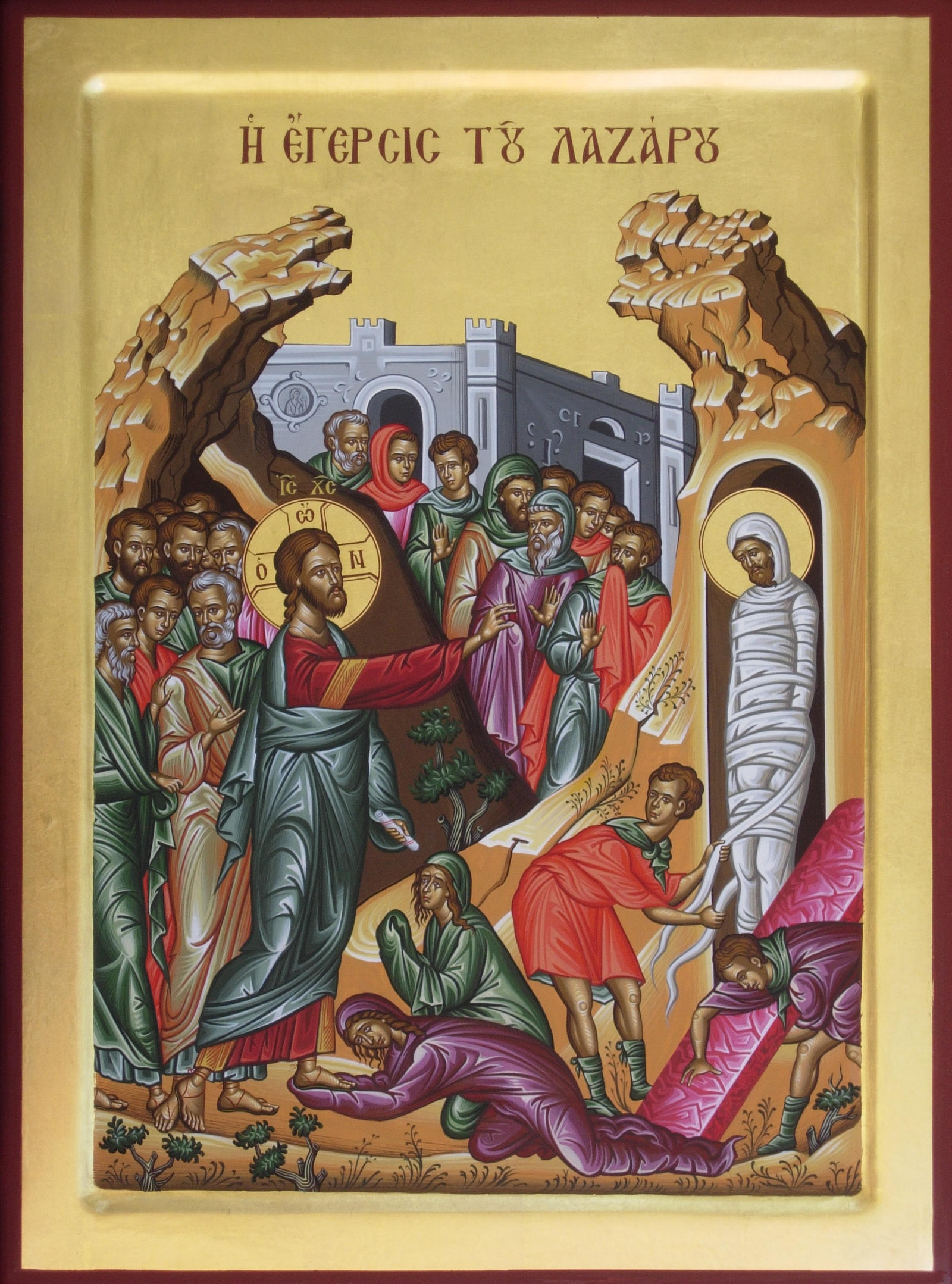
I always loved the raising of Lazarus narrative in John’s Gospel. Now before I go on you’re going to say but you just said that there are too many miracle stories! What I find lovely about this particular narrative is that it really shows Jesus’ humanity. When he finds out that his friend Lazarus is dead, John tells us that Jesus weeps, He cries. I find this so powerful. Also the fact that this lesson is read one week prior to Holy Saturday and Pascha is moving as well, a foreshadowing of Jesus’ own death and resurrection. I am, further, amazed that Jesus stays an extra day in Bethany before coming to see Lazarus: He makes Lazarus’ family wait. I mean, really, if I did that to a parishioner, I’d be fired!

AD: Many books today purport to tell us that the "real" Jesus was obscured by the early Church or distorted by the gospels. What do you make of such claims? 

Well, this is a long story. In short a lot of this has to do with the search for the “historical Jesus” started mostly in the late 19th century and well into the 20th century when scholars and historians tried to find or search for the historical person behind the text. Shelves and shelves of books fill libraries arguing for who the “real” or “historical Jesus” was. My answer: the only Jesus we have is the Jesus in the text; there is no Jesus outside of the text of the New Testament, or of the Bible for that matter. One can speculate and reflect on what it meant to be a Jewish male in the first century, a prophet, so to speak, but the search for a historical person named Jesus or Yeshua is fruitless. A lot of authors make a lot of money on this though. I guess I’m in the wrong profession maybe! Just stick with the Jesus in the Bible and you won’t go wrong with that.

AD: Such books often insist that the "real" Jesus can only be discovered in apocryphal or deutero-canonical texts--the gospel of Judas, say, or other such texts. Why do you trust the canonical gospels, and what would you say to those who might doubt the authenticity or veracity or reliability of them? 

Firstly, the Gospels were canonized or accepted by the Great Church (Christendom in general). The other texts--e.g., the gospel of Judas, the gospel of Mary Magdalene, etc.--were always hotly contested and debated and were never accepted into the canon. Now, canonical books such as the Apocalypse (Revelation) and the Epistle to the Hebrews were also debated but they were eventually received and canonized, however late. The gospel of Judas and others are interesting reading for the narrative effect but since most laity don’t have time to read, I’d encourage them to read the four Gospels before reading those others.

AD: Assuming that most Eastern Christians probably get their primary exposure to the gospels in church, do you think the Byzantine liturgical cycle gives people enough exposure to the gospels, or do we need to consider some changes here? 


As I said earlier the Sunday gospel lessons repeat themselves year after year in an annual cycle. Now if people read the daily readings they’d get more of the New Testament. I really admire the three-year lectionary used in many mainline Christian Churches where the gospel lessons change from year to year. That makes preaching a bit easier too. I mean every year I have to preach twice on Jesus and the pigs: once in early summer and then again in early autumn. Talk about challenging! Through the years, though, I manage to incorporate into my homilies other gospel lessons and other passages from the New Testament and also from the Old Testament too.

On that latter issue, I would like to see the Old Testament readings restored to regular use in the Byzantine tradition. I am not a liturgical expert by any means but I do know that at one time Old Testament lessons were prescribed, namely those from the prophets. Now that would really be a great thing for pastors. The prophetic readings have fed and nourished me as a pastor; I read through them regularly throughout the year and it would be good to have them read publicly on Sunday. So you’d have a reading from the prophets; a reading from Paul or from the Pauline corpus; and then a gospel reading. But as you know change comes at a glacial pace for those of us in the East!

AD: Which English translation(s) of the Scriptures do you most often use? 

I use a variety. Typically I’ll read through the gospel reading for a Sunday beginning with the RSV and then look at the same reading in the NIV for any nuances. (My NIV is a study Bible which has an abundance of notes and Old Testament references.) Then I’ll look maybe at the KJV and finally The Message.

I found The Message a few years ago and fell in love with it. The Message is a modern English translation created by Eugene Peterson which took over a decade. Peterson is a well-known pastor in the Presbyterian Church and he started to do a translation just for his parish Bible study and for small group devotional reading. Anyway, his publisher urged him to keep on going and he did. It took a long time to do it. The thing I like about The Message is that it is both a fresh modern English translation of the text but also faithful to the original Greek. It’s more than just leaving out the “thee’s and thou’s” but the entire sentence reads like a novel or front headlines from the newspaper. I really like it very much. (Back in the 70’s there was a similar translation called Today’s Message for Modern Man which was originally meant to be used in prison ministry I think, but The Message is a much better translation and is a bit deeper.) I actually would encourage people to buy a copy of The Message: they’ll be amazed at how well it reads.

AD: What course of action would you recommend to, say, a new Christian who really wants to understand Jesus and to begin reading the gospels, but does not know how or where to begin? 

Start with Mark. It’s the shortest of the Gospels with only 16 chapters. Read it once quickly to get the overall message and then read it over again slowly, maybe pausing every so often. Then after Mark go to the other gospels too. I’d also encourage the person to join a parish Bible study if there is one.

AD: It's often said that every age turns Jesus, at least a little bit, into an image of itself. Do you see signs of that today in North American culture? 

Oh what a big question. I guess today what is very strong in our culture is the “wealth gospel” that is heard a lot in community churches and by TV evangelists; that Jesus wants us to be wealthy and healthy--and do you know why? So you can give more money to those TV evangelists who drive Rolls Royce’s and have big mansions! But this has always been a problem: just look at Paul’s letters to the Corinthians. Every generation wants to turn Jesus into their own image and likeness.

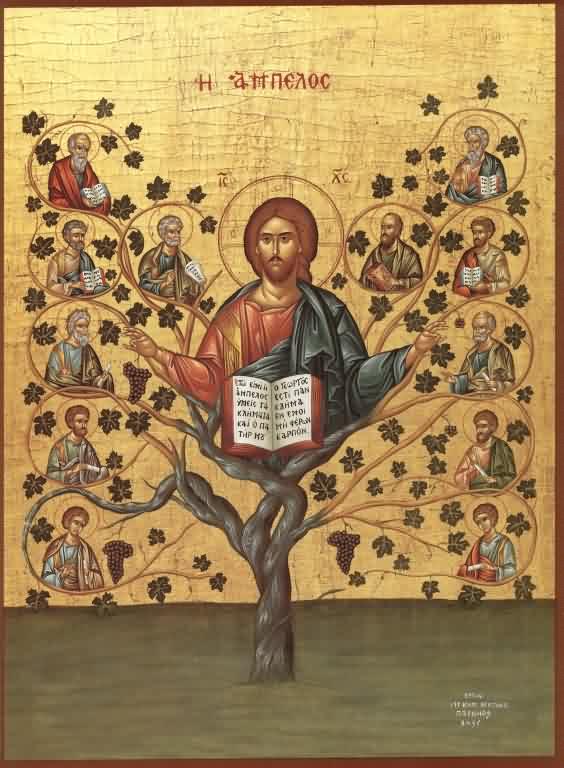
AD: In ch. 2 you begin by noting that most of us today live urban or suburban lives quite different from the agrarian and pastoral life common at the time of Jesus. Do you think that some of the gospel imagery--Jesus as shepherd, or vine-dresser, or lamb--might be hard for people to appreciate today?


Yes and no. I think if pastors can explain these images, perhaps even incorporating or including contemporary images that the laity might understand, people will get the message. Pastors need to trust our laity that they do have a mind and they’re not stupid either!

AD: It's a common cliché today to say "Jesus: Yes! Church: No!" How do you as a pastor respond to such slogans? 

Such a temptation! This is a loaded question too. With the first part we have to always be reminded, especially pastors and clergy, that our faith and trust is in Jesus Christ. Yes we are also members of one another in what we call the Church but sometimes we can confuse the externalities of the institutional Church with that of Jesus, which are supposed to have the same aim and goal: salvation. But as you might know that isn’t always the case. There is a famous quote by St. Augustine-- and I don’t know exactly where it is in his writings but he says--“The Church is a whore but she’s also your mother.” That, of course, is right from the prophetic writings; that Israel is whoring around with false gods and idol worship (see Hosea and Amos for example) while Yahweh is running around trying to get Israel back; he is a devoted bridegroom. The Church is the Body of Christ and sometimes the body gets sick and needs help, but we are always members of this community. That is what being a Christian is all about, members of one another, hopefully striving towards the same end too: salvation in Christ Jesus.
Related Posts Plugin for WordPress, Blogger...