It is always a joy and delight to be able to talk to my friend Nicholas Denysenko, as I have on here several times over the years about his many books. Today we have a chance to hear from him about his new book The People's Faith: The Liturgy of the Faithful in Orthodoxy (Fortress Press, 2018), 240pp.
AAJD: Tell us about your background and what led to the writing of The People's Faith.
ND: I’m trained in the sciences of liturgiology, having taken my Ph.D. from The Catholic University of America in 2008. I studied liturgy with Paul Meyendorff (as a student at St. Vladimir’s Seminary), Dominic Serra, Kevin Irwin, and Mark Morozowich. My doctoral coursework at CUA immersed me in liturgical history (esp. Serra and Morozowich), and liturgical theology (Serra, Morozowich, and esp. Irwin).
My interest in liturgical reform increased with the fiftieth anniversary of Sacrosanctum Concilium in 2013. Alexander Schmemann’s legacy among Western Christians piqued my interest, and I learned a lot about the contributions of liturgiology to liturgical practice during the course of researching and writing Liturgical Reform After Vatican II: The Impact on Eastern Orthodoxy (Fortress Press, 2015).
I reflected on the existence of numerous liturgical practices that are not recorded in official liturgical texts, a thought process that yielded new questions. Since liturgy is an event enacted by God and a local assembly, what is the real authority of official liturgical texts? Are official texts anything more than patterns communities should adopt – with the freedom to subtract and add, as needed, but without disrupting the essential ore of the ordo, to accommodate the particularities of parish life?
Acknowledging the gaps between official liturgical texts and local liturgical practices, are there also gaps between official liturgical theologies and the liturgical theology of the ordinary laity?
I consider the identification of the ordinary person in the pew as the true practitioner of theologia prima to be one of the great recoveries of twentieth-century sacramental theology. Aidan Kavanagh and David Fagerberg identified “Mrs. Murphy” as this theologian, but the idea hearkens back to a saying attributed to Evagrius Pontus – the theologian is the one who prays.
It’s not absurd to say that we’re all theologians, and the scholarship of sociologists of religion like Nancy Ammerman and experts in ritual studies like Nathan Mitchell remind us that the non-expert testimony on the encounter with God in and through prayer is no less real than oft-quoted sayings of the desert fathers. To paraphrase Mitchell – theological tradition is handed down from to grandchildren from the knees of their grandparents with great authority.
Having taken these lessons to heart, I sought to attempt to begin the process of recording a sampling of the liturgical theology of ordinary laity in this study, and then to bring that theology into dialogue with official liturgical theology.
AAJD: Are there connections between this new book and your 2015 book Liturgical Reform After Vatican II: The Impact on Eastern Orthodoxy?
ND: Yes. My study of liturgical reform in Orthodoxy yielded dozens of questions that are not easily answered. The process of introducing reform is the fundamental issue here. Scholars have contributed to the codification of a process of liturgical reform that has become a popular myth in the academy and the Church. The basic idea is that a group of experts studies liturgical history and writes a paper proposing a change or modification on the basis of research. At some point, a synod will hear the committee’s report and make a decision to be implemented through a revision to the liturgical books. All of this sounds clean, and good, and quite bureaucratic, but it is often incompatible with reality. Parishes introduce liturgical reforms on a regular basis, to meet the needs of their people. Some of these are so modest that one would have to observe a local parish liturgy with meticulous attention to detail to notice a change. But some changes to the official pattern of liturgy printed in liturgical texts are substantial. I have served in parishes where an official liturgical book is replaced by a local publication, especially if there is a preference for another translation of a text circulating among clergy.
Other changes are even more noticeable. Some parishes have applied the principle of which Fr. Taft (of blessed memory) reminds us: “the Eucharist is a gift to be received,” meaning that everyone received communion from the hand of another – including the presider. Taft’s principle was based on his research, so this is not surprising, but what catches my attention is the innate ecclesiology of the rite – the true presider is Christ, and the rite forms the leader – a bishop or priest – into a recipient of communion, like everyone else. (Now we should also consider the next step by re-introducing the reception of communion in both kinds by first eating and then drinking – but that is a topic for another time).
A much more controversial local tradition takes place when the Liturgy of Holy Saturday (Paschal Vigil) is celebrated on the shroud (epitaphios, plashchanitsa). I do not know how widespread this practice is, but I understand its DNA, driven by popular piety surrounding Christ’s shroud, a piety that influenced the historical development of the Divine Liturgy itself. The parishes that introduced this practice were responding to a local, community-driven phenomenon, and it caused controversy when multiple bishops issued edicts prohibiting the practice.
All of this leads to a fundamental question we should engage: do we sell liturgical theology short when we limit it to the musings of experts and official texts? I’m not calling for the dismissal of the official, not at all, because the official texts provide a pattern rooted in a traditional ordo. Nevertheless, we need to seriously consider the depth of meaning one can glean from non-expert, unofficial practices and observations. We learn a lot from official sources, authoritative teachings, homilies from bishops, hymns composed by famous saints. But all of these are not ‘the’ Church. Everyone constitutes the Church, and we have a lot to learn by consulting non-experts, popular practices, and interpretations of liturgy. I have tried to capture a sampling of this unofficial, non-expert reflection on liturgy in this study to get a sense of what we might learn if we consider the testimony of the whole body of Christ.
AAJD: As you know, a lot of work in Byzantine liturgiology has been driven by history and texts and written by experts. But here you adopt a very different approach, reading and listening to the responses of people in selected parishes. Tell us about your methods of field research in this book.
ND: My objective was to gain insights into ordinary lay perspectives on the liturgy. A number of extant studies influenced my approach. From the perspective of the larger field of religion and sociology, Nancy Ammerman’s studies were influential, and really set the pace and the bar for ethnographic research into religious and devotional practices of communities and individuals. Ricky Manalo’s study that brings prayer and devotional practices into dialogue with Vatican II’s teaching on the liturgy was likewise inspiring. Amy Slagle is one of the best researchers on North American Orthodoxy, and I suspect that her study of converts to the Eastern Church will remain the seminal work in this field for decades to come (together with D. Oliver Herbel’s).
I drew from the principles articulated by these researchers and decided to organize focus groups of volunteers from diverse parishes who would be willing to share their perspectives on the liturgy. I received permission from the Institutional Review Board at Loyola Marymount University (my employer at the time), and organized focus groups with laity from four Orthodox parishes. The focus group sessions required discipline and restraint. In all instances, some of the participants asked me to share my thoughts on the questions I posed, so it took effort and energy to remain still, listen and record dispassionately, and reflect on the sessions afterwards. It’s essential to note the limits of the methodology, especially since I did not have the resources to devote time and space to frequent meetings over a period of time in these communities. Despite this limitation, the sessions themselves were eye-opening. On the one hand, one might glean more in a private meeting. On the other hand, the focus group environment stimulated responses – participants often spoke to one another and elaborated their thoughts on my questions, occasionally even forgetting that I was in the room. I recorded the sessions and studied them repeatedly as I developed the project. I also interviewed the pastors of each parish to obtain a sense of the parish’s history and liturgical practices.
AAJD: How did you select the four parishes you worked with?
ND: My objectives included regional and jurisdictional diversity, and I wanted to have one small parish included in the study. Three of the four parishes are in urban environments, and one is in the desert. I selected two Greek parishes because the Greek Orthodox Archdiocese constitutes about 50% of Orthodox Christianity in America. Ideally, I would have included Antiochian, ROCOR, and Serbian parishes, too. But obstacles presented themselves – the Antiochian focus group was cancelled because of a scheduling issue, and I was unable to connect with the Serbian and ROCOR parishes I had in mind. So, there is room for more research in this area, and there is a need for it as well. It would be of great benefit to include Eastern Catholic and Oriental Orthodox communities in such studies. I’m pleased with the outcome, though, because the four parish focus groups provided a plethora of material for this study – more than enough for a solid monograph.
AAJD: You note in your conclusion to chapter two that "parish liturgy is constantly evolving and changing." Tell us a bit more about that because it seems to run counter to certain narratives one sometimes hears about how "conservative" the East is, and how resistant to liturgical change it is imagined to be.
Liturgiologists have delivered profound gifts to the academy and Church with the historical studies produced over the last 100-plus years. We continue to learn more about our history, and the method of comparative liturgy – one thriving in large part because of the pioneering work of scholars like Juan Mateos, S.J., Robert Taft (S.J.), and sustained by the likes of Gabriele Winkler and Michael Zheltov – this method is not limited to presenting the history of a rite, but it also shows us what is possible. During the course of the IOTA conference in Iasi, Symeon Stig Froyshov presented a paper suggesting that the Horologion – our Liturgy of the Hours – has cathedral roots. His paper exemplified the relevance of good liturgical history since he is essentially challenging the longstanding assumption of monastic dominance in the “fusion” of cathedral and monastic liturgy.
In our scrupulous attention to liturgical texts, one can involuntarily neglect a fundamental fact about liturgy: it is a local rite, enacted by people together with God, in a community. Let us not assume that we have diocese or eparchy in mind when we say “local.” Certainly, there is a common core of Byzantine liturgy that unites all local celebrations. We all sing the Cherubikon, receive communion with a spoon from a chalice, and know that Holy Week and Pascha will be a veritable feast of Scripture with seemingly endless prostrations and venerations of the epitaphios (or plashchanitsa).
Local, parish traditions create some healthy variation in the liturgy. I have been in two parishes where a censing occurs during the Trisagion hymn – in one case, the presider censed at this point because it was part of his particular Serbian legacy. In two parishes I know of, the resurrection hymns recited by the deacon as he places the Lord’s body into the cup before consumption are instead sung by the people. These local practices accentuate Sunday as the day of resurrection.
I could describe dozens of examples in this space of local variations of liturgy, along with abbreviations, rites, customs, censing patterns, melodies, and even translations of the liturgy. These examples verify liturgy as an event of encounter between God and the community, and it’s important for us to honor these variations because liturgy itself originated as observance of rituals that were not dependent on codified texts. The late antique evidence of the extemporaneous orations of the Eucharistic prayer reminds us that Liturgy is filled with the Holy Spirit and is therefore not circumscribed – even to texts we would like to define as canonical. It has to be this way, to respect the fact that a single culture does not hold privilege over all the others in the rites, gestures, and words we use for worship. The Church is always a Church in a specific place and location, hence the local or particular quality of the Church – our unity comes from our one Lord, and our one baptism.
Throughout history, certain clergy have attempted to impose uniformity through the liturgy. To this day, you will hear clergy complain that father so-and-so doesn’t celebrate the Liturgy “correctly,” or that the Greeks “innovated” in their nineteenth century revisions. If corrections that come from Church authorities are designed to correct errors that are leading people away from Christ, then they are needed. But if these corrections and directives are motivated by the demands of a compliance seeking to eradicate local differences, they are more often than not actually attempts to assert authority and establish control of clergy and people through the liturgy. Appeals to authorities like this one are misapplications of authority because they do not honor the tradition of the local community.
They also attempt to circumscribe liturgy – you can’t control it, because liturgy is not a text, nor is it merely human: God is the presider at each assembly. A serious examination of parish liturgical practice would illustrate that the vast majority of parishes observe the common liturgical core quite faithfully. The tendency to opt for variation here and there is a necessity. It is a well-established tradition of both East and West that was compromised by the invention of the printing press that enabled authorities to distribute a single liturgy and define it as the only correct one. We shouldn’t mess with local parish variations unless they are creating divisions in the parish or leading people away from Christ. I honestly believe that those who seek to eradicate healthy local practices that are not printed in the service books have way too much time on their hands and should find something more useful to do.
AAJD: Your third chapter notes some generational shifts in both preparation to receive the Eucharist, and the frequency of doing so. Did your research uncover any commonalities here in the 21st century? E.g., I've often heard it said that since Schmemann's work on liturgy, a lot more people receive a lot more frequently than they once did. Is that a generalization your research could support?
Yes, at least in the parishes of my study. I was particularly intrigued by the stories shared by people who were raised with rigorous preparation for Communion and continue to feel self-conscious about frequently receiving communion now, even if they have been receiving more often for a number of years. Many older respondents of my study wondered if other parishioners were observing them with disapproval. It is certainly normal, and healthy to take stock of one’s readiness and worthiness to receive Christ.
But there is another dimension to this question, and that concerns the formative aspect of ritual and how that affects the introduction of a major change. Receiving communion more frequently requires a permanent change of habit, adopting a whole new perspective on the meaning of Communion, and learning a new way of preparing for it. The respondents’ sustained questioning of their worthiness and their sensitivity to the way others perceived them demonstrates that receiving liturgical change and establishing it as a permanent new practice is a complicated process that requires time, patience, and continued instruction. Scholars and students of the Church should consider how the process of reception works outside of the Liturgy as well – it tells us a lot about how much sustained ministry is required to implement any process, even if it is designed to do good in the Church.
AAJD: You note (p.91) that a "primary objective" of your work is to strengthen the connection between "academic liturgical theology" and people's experience of liturgy. Are there particular areas where that connection is very attenuated? Are there areas where it may be relatively strong?
There are both gaps and areas of intense relationship between academic liturgical theology and the people’s experience of liturgy. One of the gaps is somewhat paradoxical, as many of the people expressed gratitude for the liturgical experience of sharing in a journey. I remain somewhat awestruck by the people’s gratitude for being a part of a community that receives communion together, a sense that one is not alone in this journey of receiving divine grace through communion, despite being unworthy. Without prompting, a number of adults idealized their view of the children who line up to drink from the fountain of immortality. They admire the children’s gravitas in simply obeying the command to approach, to draw near, without overanalyzing all of the social, spiritual, and theological dimensions.
Certainly, Orthodox academics have a lot of work to do in deconstructing the hierarchy that has been idealized and falsely affixed as an ecclesial structure. A view of an assembly of all receiving the same communion, together, from the ages of a few months up to one-hundred, is truly unique, an authentic representation of what we pray – the communion of the Holy Spirit, including all, without discrimination. Again, because it is worth repeating – the youngest infant and the highest ranking patriarch are all recipients of the same gift of our Lord. My sense was the people were deeply grateful for this experience of the fullness of community, in the ritual of receiving God’s gift. The next step for us Byzantines is to revise the ritual in such a way so that all truly receive in the same way – by eating the bread and drinking from the cup, and receiving from the hands of another (which will require bishops – yes, even bishops! – to actually receive communion from the hands of another, to which I referred earlier in this interview).
Let me refer to communion as a portal through which to view an attenuated connection between academic theology and the people’s perception. Many of the same people who expressed gratitude for experiencing communion together also lamented the exclusivity of the liturgical event, shedding tears over those who would like to partake of the cup but cannot because of ecclesial divisions.
No patriarch will hasten to restore Eucharistic communion with non-Orthodox Christians because some people are sad that other Christians cannot partake.
But the study reminds us that the privilege of partaking of the Eucharist is one that was originally open to all. I view the perceptions of the people here as a reminder that excluding other Christians after inviting all to “approach” is scandalous, and that the Eucharist should be the source of renewing the urgency to heal divisions, not to enhance them. This is an invitation for the academics to revisit the Eucharist as a symbol of true unity – not of exclusivity and division.
AAJD: You note how many participants in your study commented on a "fissure between the Lenten cycle and the rest of the year on account of the sheer weight and demand of the requirement for Orthodox Lenten worship" (p.111). You also note how often the topic of fatigue is raised by participants during Lent. Did your participants have any thoughts as to how to overcome these challenges? Do you?
Most of the parishioners in the study viewed the rigors of Holy Week and Pascha as ideals laity should attempt to meet, to the best of one’s ability. Many respondents expressed admiration for clergy who participate in the entirety of Holy Week and Pascha. One elderly respondent noted the repetition of Gospel passages throughout the Holy Week offices and suggested that the clergy could review the lectionary for Holy Week and revise it to eliminate repetition. The lectionary is an amalgamation of Constantinopolitan and hagiopolite traditions, so the respondent’s observation is true, and it would be healthy for the Church to examine the lectionary, and also the times appointed for the services to suggest a revised pattern that eliminates at least some of the repetition and makes the transition from Holy Saturday to Pascha more sensible.
The explanations for the existing Holy Week pattern are spurious, at best. For example, the obsession with Judas as the antagonist throughout the week displaces Jesus as the suffering servant – Jesus should be our focus, not Judas. And the most glaring thematic problem is the continued appointment of anti-Semitic texts in the hymnography of Good Friday Matins (and elsewhere). The most popular pastoral justification for retaining these texts is that we need to learn how to hear them correctly. Similarly, many pastors try to diminish the paschal character of the Vigil (Holy Saturday Vesperal liturgy) by reducing it to a “breaking through” of the resurrection, in “anticipation” of the real vigil to come at midnight.
Such justifications are both unfortunate and absurd. The liturgical scholar Bert Groen has published an essay exposing the anti-Semitic tropes throughout Byzantine Holy Week, and has stated the problem directly: no one wants to reform the ordo of Holy Week on their own because of its solemnity. This is the reason we retain the multiple overlaps of Gospels and popularize the false teaching that the Paschal Vigil is not really Pascha, at least not yet.
I would not call for a complete overhaul of Holy Week, in deference to the reception issue I mentioned above. As a Church, we have the responsibility to fine-tune it, though. The solution will come from a bolder initiative: to invite poets, linguists, artists, theologians, and musicians to engage the creative process and compose new hymns, new music, and new art that could be adopted for the services. Holy Week is an invitation to enter into the bridal chamber of Christ, to die and rise with him. Our services should proclaim this invitation in word, rite, and gesture. And they make this proclamation with unfathomable profundity! But the proclamation is often paused by the obsession with Judas, the condemnation of the Jews, the schizophrenic celebration of resurrection only to resume lamentation at the tomb.
A more general comment from a number of respondents will break open the larger point here, one with serious consequences for liturgical vitality: too much of the liturgy is concealed from the people because the clergy are performing it in private. A plea for the clergy to make their prayers the people’s prayers was a refrain among respondents. A desire for assurance that the living God is truly with them as they journey through the rigors of life was another refrain.
We appeal to the antiquity of our liturgical tradition to demonstrate our connection with the apostles. But we tend to forget that all of the prayers, rites, and songs we cling to with such fervor were once quite new and innovative. Our collective refusal to compose new hymns, prayers, and to rethink our order violates the spirit of the Byzantine tradition. We should be alarmed by our aversion to the brilliant creativity in liturgical composition that was the very hallmark of the patristic tradition we claim. The time for us to reclaim that creative energy of the Holy Spirit is now.
AAJD: You note the dangers of "the canonization of a particular theological interpretation of a rite" as leading in part to rigidity (p.135) and this brings me back to your admirable opening comment about your "ascetical" approach in the interviews to being the one who listens rather than the expert correcting every idea and answering every question. How strong was the urge among people you talked to for there to be a "correct" or, dare one say, "orthodox" view of what liturgy is and does? Or were people more generally comfortable with a certain polyvalence here?
For the most part, respondents approached the sessions with openness. On several occasions, they asked me to elaborate an issue, and I declined, reminding them that my task was to take account of their observations. I was struck by their hunger to learn more, though. When Christians have questions, they do what everyone else does in the attempt to find a quick answer: perform an Internet search. My exchanges with the respondents heightened my own awareness of the information illiteracy afflicting the general public. We have a golden opportunity to identify opportunities to teach people the meaning of the various liturgies. Considering the shifting demographics of the Byzantine Churches, a more earthy, hands-on approach to teaching the Liturgy would be suitable for our times, alongside the creation of updated catechetical texts that present the fundamentals of the Liturgy. For example, it could be beneficial to spend some time reflecting on the Eucharistic Prayers in small groups in an extraliturgical context to consider the deeper meanings of offering, anamnesis, epiclesis, and commemoration.
AAJD: Your participants having raised, often in painful terms, the problem of eucharistic hospitality with their family and friends who are not Orthodox, you later return to this issue in the context of "the anti-ecumenical turn in Orthodoxy" (pp.147-49), noting that it's not even possible to have a "public discussion on allowing non-Orthodox to receive Communion" (151). What lies behind all this do you think? Why is even a discussion of the problem--never mind a change in practice--off limits?
I think, my friend, that your recent scholarship on the Catholic sexual abuse crisis discloses what lies behind all of this. It is psychological, a mindset cultivated by the continuous formation of communities on the basis of what distinguishes us from other Christians as opposed to how we are all one in Christ.
For most of the history of Orthodoxy in North America, the institutional Church has exploited encouragement of cultural pluralism to show how we are different. Greek immigrants hosted food festivals to demonstrate their legitimacy as good citizens of this land, a symbol of émigré arrival. Communities emphasized sustenance of their core values to ensure multigenerational longevity. We believed that there were two keys to keeping young people in the Church: through the unique beauty of Orthodoxy, and by making it accessible through English-language liturgies. Since Eastern Churches have always emphasized the local nature of the Church, it was easy enough to pass on a sense of fidelity to the covenant – to remain within the covenant of an exclusive community, be it Greek, Russian, Romanian, Ukrainian. Orthodox ecclesiology was and is also exclusive – there is no “subsistit in” in our conciliar theology, we claim to be THE one, holy, catholic, and apostolic church. (See paragraph no. 1 of “Relations of the Orthodox Church with the Rest of the Christian World,” from the Holy and Great Council in Crete, 2016).
My sense is that Orthodoxy has turned inwards during the post-Soviet period in an effort to reclaim a legacy that was paused during the Soviet period and the Cold War. The raging of the cultural wars in the North American religious context eased the enhancement of an anti-ecumenical turn inwards among Orthodox here. All of these factors combined are like ingredients thrown into a pot for a dinner at which discussion of the possibility of healing divisions with other Christians is discouraged at best, and often prohibited. These factors have combined to form a collective mindset of sectarianism, a disposition in which communities are content with the status quo of mutual exclusivity – even if our children attend the same schools and the parents fraternize at basketball practices.
Ecumenical urgency resurfaces with global catastrophes, when the faces of victims of genocide beckon us to stop looking inwards. God forbid that a global human catastrophe is the only reason for re-igniting the sense of urgency for serious ecumenical dialogue among Christians.
AAJD: The vast majority of your participants seem to have confined their reflections to Sunday Divine Liturgy--though many also spoke of the Lenten-Paschal cycle. Do you have any plans for more narrowly focused further research into, say, people's experience of funeral liturgies, or baptisms?
I think two studies are necessary, and I may or may not pursue them. First, a study of children’s perceptions of liturgy. A tightly-conceived and careful methodological approach to the study is needed. It would be particularly insightful to work with children in the same parishes. Such a study could teach us a lot about the process of learning through experience, of the whole community partaking of the liturgy together.
An appropriate follow-up would be a study of people’s engagement in all aspects of Church life – reading the Bible, daily prayer, confession, fasting, domestic observance of feasts, and personal behavior. Ammerman’s studies in particular demonstrate the value of non-expert observance of religious practices outside of official worship – and Manalo’s study, especially his engagement with Peter Phan, reminds us that the point of Liturgy is not its celebration, but communal union with God – an aspiration that is not exclusive to liturgy alone.
AAJD: Were there any big surprises in each of the parishes you worked with?
This is not so much a surprise, but an observation that deserves attention, reflection, and prayer. The people I interviewed viewed the Liturgy as an invitation that should not be taken for granted. They consistently expressed frustration at their failure to achieve the ideal established by the liturgy itself. Many of them expressed frustration at preoccupations with the details of life during Liturgy. This was the most important insight, that they were able to identify the Liturgy as a divine gift for us, and found diverse ways to express their desire to engage it as people at their very best, devoting full attention to laying aside the cares of everyday life and being present to God. The tension of confession of unworthiness and gratitude for God’s gift was thick – and beautiful in its thickness.
AAJD: Having finished this book, what are you at work on now?
Ever since the publication of The Orthodox Church in Ukraine last year, I have been cranking out essay after essay of in-depth analysis of the religious scene in Ukraine. I am in the slow process of developing a sequel. The sequel will discuss the tomos and the birth of the OCU, but there is a desperate need for a sophisticated look at the intersection of religion and politics in Ukraine, to cut through the unfortunate post-truth propaganda and regurgitation of Soviet-era narratives popularized by confessional media sites. To that end, the study will address the problem of political religion in Ukraine, and will also discuss the role of the media, both in Ukraine and elsewhere.
I am also developing essays on sacramental reconciliation, Eucharistic theology, iconography, and liturgical idolatry. Watch for information about a one-day symposium to be held at Valparaiso University on April 24, 2020: “Religion, State, and Nationalism: Problems and Possibilities.” We are honored to host a number of theologians and experts such as Antoine Arjakovsky, Dorian Llywelyn, and Atalia Omer.
Showing posts with label liturgical reform. Show all posts
Showing posts with label liturgical reform. Show all posts
Thursday, May 9, 2019

Monday, April 9, 2018
David Fagerberg on Alexander Schmemann's Liturgical Theology
I have previously discussed on here several of David Fagerberg's splendid books, and I have often used them in classes, especially Theologia Prima: What is Liturgical Theology, and recommended them to students, including On Liturgical Asceticism.
Additionally, I have often discussed on here the works of Alexander Schmemann (see, inter alia, my interview here with Bill Mills about his book on Schmemann), who remains such a welcome voice within Orthodoxy today and well beyond it also.
So it is a double delight, then, to have a book about Schmemann authored by fagerberg. I am always interested to hear when David has published something new, as he recently has: Liturgy Outside Liturgy: the Liturgical Theology of Fr. Alexander Schmemann. His publisher sent me a copy of and I in turn sent to him some questions for an interview. Here are his thoughts.
AD: Tell us about your background.
DF: It is now three decades since I arrived at Yale and asked Fr. Aidan Kavanagh to do a directed readings with me. He agreed on the stipulation that we would read everything we could lay our hands on by Schmemann, because he was in the midst of the lectures that would become his book On Liturgical Theology. That was my introduction to Schmemann, who died a year later in 1983 before I ever had the chance to meet him in person.
I sometimes say that my subsequent PhD work was trying to get the number of the bus that hit me. My understanding of liturgical theology changed completely. I had been ordained a pastor in the Lutheran Church (ELCA), and done a Masters at St. John’s in Collegeville, intending to raid the Benedictine pantry for some liturgical geegaws to import. But I wrote myself into Catholicism in chapter 5 of my dissertation (the sort of existential effect not usually expected of dissertations). I taught for 12 years at a Lutheran undergraduate college in Minnesota (Concordia), and was two years at the Liturgical Institute at Mundelein when an invitation to join the faculty at Notre Dame came, and I have been here now 15 years.
Additionally, I have often discussed on here the works of Alexander Schmemann (see, inter alia, my interview here with Bill Mills about his book on Schmemann), who remains such a welcome voice within Orthodoxy today and well beyond it also.
So it is a double delight, then, to have a book about Schmemann authored by fagerberg. I am always interested to hear when David has published something new, as he recently has: Liturgy Outside Liturgy: the Liturgical Theology of Fr. Alexander Schmemann. His publisher sent me a copy of and I in turn sent to him some questions for an interview. Here are his thoughts.
AD: Tell us about your background.
DF: It is now three decades since I arrived at Yale and asked Fr. Aidan Kavanagh to do a directed readings with me. He agreed on the stipulation that we would read everything we could lay our hands on by Schmemann, because he was in the midst of the lectures that would become his book On Liturgical Theology. That was my introduction to Schmemann, who died a year later in 1983 before I ever had the chance to meet him in person.
I sometimes say that my subsequent PhD work was trying to get the number of the bus that hit me. My understanding of liturgical theology changed completely. I had been ordained a pastor in the Lutheran Church (ELCA), and done a Masters at St. John’s in Collegeville, intending to raid the Benedictine pantry for some liturgical geegaws to import. But I wrote myself into Catholicism in chapter 5 of my dissertation (the sort of existential effect not usually expected of dissertations). I taught for 12 years at a Lutheran undergraduate college in Minnesota (Concordia), and was two years at the Liturgical Institute at Mundelein when an invitation to join the faculty at Notre Dame came, and I have been here now 15 years.
AD:With my students
over more than a decade now, I’ve used your Theologia
Prima, and more recently OnLiturgical Asceticism. What connections, if any, do you see between these
two and your new book, Liturgy Outside Liturgy?
DF: The five lectures that make up this book were delivered in Sweden during January 2017. The first three were given at a conference on Schmemann sponsored by the ecumenical community at Bjarka-Saby, at the invitation of Peter Halldorf. The latter two were given on the campus of the University of Lund to a graduate seminar and a group of laity, at the invitation of Samuel Rubenson, who presides over a theological study center called the Academy of St. John. The invitation said there has been growing interest in the heritage of Schmemann in Sweden, and his writings have been important for this community with members from Orthodox, Catholic, Lutheran and evangelical traditions.
I therefore approached this as an opportunity to make a fresh survey and summary of Schmemann. It was a chance to try and unpack Schmemann’s frequent insistence that liturgical theology is “the slow and patient bringing together of that which was for too long a time broken and isolated – liturgy, theology, and piety, their reintegration within one fundamental vision.” One might see Theologia Prima as my attempt to reintegrate liturgy and theology, and On Liturgical Asceticism as my attempt to reintegrate liturgy and piety (read: asceticism); this was a chance to delve into why Schmemann felt this was so important. So the lectures let me cast a glance over my previous work.
DF: The five lectures that make up this book were delivered in Sweden during January 2017. The first three were given at a conference on Schmemann sponsored by the ecumenical community at Bjarka-Saby, at the invitation of Peter Halldorf. The latter two were given on the campus of the University of Lund to a graduate seminar and a group of laity, at the invitation of Samuel Rubenson, who presides over a theological study center called the Academy of St. John. The invitation said there has been growing interest in the heritage of Schmemann in Sweden, and his writings have been important for this community with members from Orthodox, Catholic, Lutheran and evangelical traditions.
I therefore approached this as an opportunity to make a fresh survey and summary of Schmemann. It was a chance to try and unpack Schmemann’s frequent insistence that liturgical theology is “the slow and patient bringing together of that which was for too long a time broken and isolated – liturgy, theology, and piety, their reintegration within one fundamental vision.” One might see Theologia Prima as my attempt to reintegrate liturgy and theology, and On Liturgical Asceticism as my attempt to reintegrate liturgy and piety (read: asceticism); this was a chance to delve into why Schmemann felt this was so important. So the lectures let me cast a glance over my previous work.
AD: It will be 35
years this December since Fr Alexander’s death, and yet he seems more widely
read today than ever. What do you think is the key to this longstanding
interest in his writings?
DF: I remember Robert Taft quipping at a conference on Schmemann held at St. Vladimir’s Orthodox Seminary that Schmemann “has a remarkably long shelf life.” It’s true. And as remarkable is the additional fact that Schmemann continues to hold the interest of Orthodox, Catholics, and Protestants. No doubt each audience brings their own expectations to his writings: conservative or liberal, tradition or renewal, sacred high liturgy or connection to the profane world, etc. But I think it is a testimony to Schmemann’s balance and complexity that he can speak to such a varied audience without personal self-contradiction. His writings contain both safeguards against excesses, and a vivifying power for renewal. The only way I can account for this is to suggest that he writes out of a deep personal love of Christ and his Church.
DF: I remember Robert Taft quipping at a conference on Schmemann held at St. Vladimir’s Orthodox Seminary that Schmemann “has a remarkably long shelf life.” It’s true. And as remarkable is the additional fact that Schmemann continues to hold the interest of Orthodox, Catholics, and Protestants. No doubt each audience brings their own expectations to his writings: conservative or liberal, tradition or renewal, sacred high liturgy or connection to the profane world, etc. But I think it is a testimony to Schmemann’s balance and complexity that he can speak to such a varied audience without personal self-contradiction. His writings contain both safeguards against excesses, and a vivifying power for renewal. The only way I can account for this is to suggest that he writes out of a deep personal love of Christ and his Church.
AD: Tell us a bit
about how you, and Schmemann, understand the liturgy outside liturgy—what does
this mean, and what are the implications for Christians once they walk out the
door Sunday mornings?
DF: I am proposing that in addition to looking at liturgy (a perfectly responsible scholarly thing to do) it is also important to look through liturgy – through it at life, spirituality, faith, theological understanding, providence, asceticism, justice in society, and so forth.
When Schmemann gave his 1963 keynote lecture that spoke of liturgy existing For the Life of the World, he was aware of liturgical scholarship, but that was of secondary concern to him. He repudiated the view of other liturgical scholars who interpreted him as the sort of person who wanted to “prepare grounds for a liturgical reform that would restore the ‘essence’ of the liturgy” and relegate accessories to their place. He patiently explains that this is not his concept of liturgical theology at all. Rather, he seeks to show how the fruit of our new life in Christ is grounded in the Church’s leitourgia. So my idea is that liturgy gives birth to something beyond itself.
DF: I am proposing that in addition to looking at liturgy (a perfectly responsible scholarly thing to do) it is also important to look through liturgy – through it at life, spirituality, faith, theological understanding, providence, asceticism, justice in society, and so forth.
When Schmemann gave his 1963 keynote lecture that spoke of liturgy existing For the Life of the World, he was aware of liturgical scholarship, but that was of secondary concern to him. He repudiated the view of other liturgical scholars who interpreted him as the sort of person who wanted to “prepare grounds for a liturgical reform that would restore the ‘essence’ of the liturgy” and relegate accessories to their place. He patiently explains that this is not his concept of liturgical theology at all. Rather, he seeks to show how the fruit of our new life in Christ is grounded in the Church’s leitourgia. So my idea is that liturgy gives birth to something beyond itself.
AD: Your introduction
notes that your first reading of Schmemann, for your doctorate, was focused in
one way, but for this book you had a chance to widen the focus to other
writings. Which ones in particular, and why?
DF: It was a risk to return to an author who was so important to me over three decades ago – will I find him passé? Will my interests have moved on?
I am happy to report that Schmemann was as stimulating and fruitful a tutor as he ever was. For my doctoral study I zeroed in on articles where he defined liturgical theology, and explore the relationship between liturgy and theology. For these lectures I tried to speak to the liturgical question by staying in Schmemann’s voice, but gathering material from a much broader range of essays he wrote, in which I had not yet read. With the benefit of digitalized journals now, I downloaded about seventy essays, of all sorts of genres: reports to the holy Synod of bishops concerning OCA concerns, history of Byzantium, memoria to deceased Orthodox theologians, the Western rite in Orthodoxy, secularism. Three might be singled out from 1964, which were a sequential series in the St. Vladimir’s Quarterly, and bore the common main title “Problems of Orthodoxy in America,” but three subtitles: The Canonical Problem, The Liturgical Problem, The Spiritual Problem.
DF: It was a risk to return to an author who was so important to me over three decades ago – will I find him passé? Will my interests have moved on?
I am happy to report that Schmemann was as stimulating and fruitful a tutor as he ever was. For my doctoral study I zeroed in on articles where he defined liturgical theology, and explore the relationship between liturgy and theology. For these lectures I tried to speak to the liturgical question by staying in Schmemann’s voice, but gathering material from a much broader range of essays he wrote, in which I had not yet read. With the benefit of digitalized journals now, I downloaded about seventy essays, of all sorts of genres: reports to the holy Synod of bishops concerning OCA concerns, history of Byzantium, memoria to deceased Orthodox theologians, the Western rite in Orthodoxy, secularism. Three might be singled out from 1964, which were a sequential series in the St. Vladimir’s Quarterly, and bore the common main title “Problems of Orthodoxy in America,” but three subtitles: The Canonical Problem, The Liturgical Problem, The Spiritual Problem.
AD: You begin with
Schmemann’s famous “negations” of what liturgical theology is not—not a
theology of worship, and not a “reduction of theology to liturgy.” What, then,
is it in both his eyes and yours?
I had begun graduate school as a systematic theologian, intent on finding some topic on worship, or sacraments, or prayer to make the object of my study. That was my understanding of what “liturgical theology” was. The academy had taught me that the best way to investigate something is to dissect it, and to do so, of course, one must kill the object of investigation, pin it open on the board, and look inside.
Kavanagh and Schmemann suggested I might learn more if I watched the liturgy in motion. And as it moved, it would throw off theology, like a grinding wheel throws off sparks. The question Schmemann asked--which leads people to describe him as having started a revolution in liturgical studies--was whether liturgy is an object of theology, or the source of theological thinking? What if liturgy is not just the pious straw of simple believers that awaits an academic Rumpelstiltskin to spin it into real theological gold (Western scholasticism)? What if instead we follow the Church fathers’ approach? “Just as they do not theologize about the Church, the Fathers do not theologize about the liturgy. Liturgy as the life, as the ‘sacrament’ of the Church is not the ‘object’ but the source of their theology because it is the epiphany of the Truth, of that fullness from which the ‘mouth speaks.’”
I had begun graduate school as a systematic theologian, intent on finding some topic on worship, or sacraments, or prayer to make the object of my study. That was my understanding of what “liturgical theology” was. The academy had taught me that the best way to investigate something is to dissect it, and to do so, of course, one must kill the object of investigation, pin it open on the board, and look inside.
Kavanagh and Schmemann suggested I might learn more if I watched the liturgy in motion. And as it moved, it would throw off theology, like a grinding wheel throws off sparks. The question Schmemann asked--which leads people to describe him as having started a revolution in liturgical studies--was whether liturgy is an object of theology, or the source of theological thinking? What if liturgy is not just the pious straw of simple believers that awaits an academic Rumpelstiltskin to spin it into real theological gold (Western scholasticism)? What if instead we follow the Church fathers’ approach? “Just as they do not theologize about the Church, the Fathers do not theologize about the liturgy. Liturgy as the life, as the ‘sacrament’ of the Church is not the ‘object’ but the source of their theology because it is the epiphany of the Truth, of that fullness from which the ‘mouth speaks.’”
AD: You quote Fr
Alexander (p16) as noting that too often people are not interested in
understanding liturgy, much less theology, because instead they are in search
of some mystification—some kind of “’spiritual experience, spiritual food’”
provided to those in a “'cultic society’.” How does he recommend Christians
begin to overcome this kind of thinking?
Schmemann loves the liturgy because he loves his Lord. I often begin my semester with an anecdote about the time I was dressed in cap and gown waiting to enter for commencement exercises, and the person behind me, knowing I did liturgical studies, said “you must like this sort of thing.” Yes, I sarcastically thought; this excessive pomp and extravagant formality is the shiny object that attracted me to it.
Schmemann does not seem to swoon over liturgy, rather liturgy is the Paschal mystery encountering us in the deepest moments of our lives. I suppose he thus disappoints activist liberals because he stands firmly in Church liturgical tradition, and I suppose he disappoints spiritualist conservatives because he is not enraptured by rite. He wrote, “I realize how spiritually tired I am of all this ‘Orthodoxism,’ of all the fuss with Byzantium, Russia, way of life, spirituality, church affairs, piety, of all these rattles. I do not like any one of them, and the more I think about the meaning of Christianity, the more it all seems alien to me. It all literally obscures Christ, pushes Him into the background.”
Schmemann loves the liturgy because he loves his Lord. I often begin my semester with an anecdote about the time I was dressed in cap and gown waiting to enter for commencement exercises, and the person behind me, knowing I did liturgical studies, said “you must like this sort of thing.” Yes, I sarcastically thought; this excessive pomp and extravagant formality is the shiny object that attracted me to it.
Schmemann does not seem to swoon over liturgy, rather liturgy is the Paschal mystery encountering us in the deepest moments of our lives. I suppose he thus disappoints activist liberals because he stands firmly in Church liturgical tradition, and I suppose he disappoints spiritualist conservatives because he is not enraptured by rite. He wrote, “I realize how spiritually tired I am of all this ‘Orthodoxism,’ of all the fuss with Byzantium, Russia, way of life, spirituality, church affairs, piety, of all these rattles. I do not like any one of them, and the more I think about the meaning of Christianity, the more it all seems alien to me. It all literally obscures Christ, pushes Him into the background.”
AD: You note the
importance of antinomy to Schmemann, and for this you draw on Pavel Florensky.
Tell us a bit about the connections between the two, and how they help us
understand antinomy.
While I do not find quotations of Florensky in Schmemann, I know he knew about him by his introductory survey to Russian theology. Florensky provides a very valuable way of dealing with contradiction as paradox. He writes in his thesis,
While I do not find quotations of Florensky in Schmemann, I know he knew about him by his introductory survey to Russian theology. Florensky provides a very valuable way of dealing with contradiction as paradox. He writes in his thesis,
“Life is infinitely fuller than rational definitions and therefore no formula can encompass all the fullness of life. … Antinomicalness does not say, ‘Either the one or the other is not true.’ It also does not say, ‘Neither the one nor the other is true.’ It only says, ‘Both the one and the other are true, but each in its own way.”In my earlier works I tried to explain Schmemann’s idea of “cultic antinomy:” the Church uses cultic categories to express something that cult cannot contain. In this book I use the concept to explain how Christians are all the time leaving the world, but all the time remaining in it.
AD: In your section on
the consecration of the world (also addressed at greater length in your Consecrating the World: On Mundane Liturgical Theology), you note that liturgy, properly speaking, must
have an impact on matter, anthropology, hearts, and history. Tell us a bit more
what you mean here and how you see its impact on each.
Suppose that liturgy puts a light into our eyes by which we can see. Suppose it is the light of Mount Tabor illuminating creation so that its truth, beauty, and goodness glorifies God. And suppose having a theological eye means seeing by this light. If all this is so, then Mrs. Murphy is a theologian not for having attended academic courses to learn scholarly jargon: she is a liturgical theologian for having this charismatic sight by which to see matter, persons, hearts, and history.
This idea, sketched out in my book Consecrating the World, derives from Schmemann’s complex (antinomous) understanding of world. On the one hand, world means rebellion, death, communion with a dying world; “food itself is dead,” Schmemann writes, “it is life that has died and it must be kept in refrigerators like a corpse.” But on the other hand, world is simply “in which and by which we live,” and if we could reestablish the world and its proper relationship to God then we could be said to consecrate the world. This, of course, would require overcoming the passions so that we no longer misuse the world. That’s why liturgy and asceticism are connected. There’s nothing wrong with money, sex, or beer; the problem lies in avarice, lust, and gluttony.
Suppose that liturgy puts a light into our eyes by which we can see. Suppose it is the light of Mount Tabor illuminating creation so that its truth, beauty, and goodness glorifies God. And suppose having a theological eye means seeing by this light. If all this is so, then Mrs. Murphy is a theologian not for having attended academic courses to learn scholarly jargon: she is a liturgical theologian for having this charismatic sight by which to see matter, persons, hearts, and history.
This idea, sketched out in my book Consecrating the World, derives from Schmemann’s complex (antinomous) understanding of world. On the one hand, world means rebellion, death, communion with a dying world; “food itself is dead,” Schmemann writes, “it is life that has died and it must be kept in refrigerators like a corpse.” But on the other hand, world is simply “in which and by which we live,” and if we could reestablish the world and its proper relationship to God then we could be said to consecrate the world. This, of course, would require overcoming the passions so that we no longer misuse the world. That’s why liturgy and asceticism are connected. There’s nothing wrong with money, sex, or beer; the problem lies in avarice, lust, and gluttony.
10. Sum up what you
were hoping to accomplish in Liturgy Outside Liturgy: the Liturgical Theology of Fr. Alexander Schmemann, and tell us who would benefit from
reading it.
Tradition has said that liturgy has two purposes: the glorification of God and the sanctification of man. I hope to suggest to people that the former is accomplished when the latter occurs. God sanctifies so that we may glorify. When we are given new life, then God is glorified. This means that liturgy has consequence on every aspect of Christian life, and it is not confined to the temple etiquette alone.
Another of my other mentors, Paul Holmer, wrote “It would be odd to say that Christian worship and liturgy are only stimulating or expressive. For worship requires not that one like the liturgy but that one come to abide in God himself.” The Fall was the forfeiture of our liturgical career, but in his grace God redeems and deifies, and liturgy becomes the trysting place for a cosmic and eschatological liturgy. My hope is to explain what Schmemann meant when he said liturgical theology is not academic theology staring at liturgy: liturgical theology is the reunification of liturgy, theology and piety.
Tradition has said that liturgy has two purposes: the glorification of God and the sanctification of man. I hope to suggest to people that the former is accomplished when the latter occurs. God sanctifies so that we may glorify. When we are given new life, then God is glorified. This means that liturgy has consequence on every aspect of Christian life, and it is not confined to the temple etiquette alone.
Another of my other mentors, Paul Holmer, wrote “It would be odd to say that Christian worship and liturgy are only stimulating or expressive. For worship requires not that one like the liturgy but that one come to abide in God himself.” The Fall was the forfeiture of our liturgical career, but in his grace God redeems and deifies, and liturgy becomes the trysting place for a cosmic and eschatological liturgy. My hope is to explain what Schmemann meant when he said liturgical theology is not academic theology staring at liturgy: liturgical theology is the reunification of liturgy, theology and piety.
AD: Having finished Liturgy Outside Liturgy, what are you at
work on now? Any new publishing projects?
I don’t know what will come to fruition, but there are two subjects intriguing me now. First, current reading of spirituality in Western sources has made me think this should be better connected to liturgy, so I am thinking about Liturgical Mysticism.
Second, if liturgy is as connected to theology as Schmemann suggests, I wonder if one could write a Liturgical Dogmatics. I can express myself in an interior conversation I had with myself in a second and a half. One day I was asked if I could teach the course on liturgical history, and the following shot through my mind: “Liturgical history is an important topic; where shall we begin? I suppose with Abraham, then find ourselves with Moses at the burning Bush, and then Israel’s Kings and prophets. No, wait, probably the Noachic covenant needs to be mentioned. No, actually, liturgical history begins with Adam and Eve’s cosmic priesthood, the forfeiture of their liturgical career, and the long story of salvation history designed to restore man and woman to their liturgical state by making them apprentices to Christ, the premier liturgist, to be led to the heavenly Jerusalem. That would be a liturgical history of man and creation and redemption.” But, of course, my interlocutor was only asking if I could teach a history of the liturgy. It seems to me a parallel move could be made about liturgical anthropology, liturgical cosmology, liturgical ecclesiology, liturgical exegesis, liturgical morality, liturgical Mariology, liturgical eschatology. I wonder.
I don’t know what will come to fruition, but there are two subjects intriguing me now. First, current reading of spirituality in Western sources has made me think this should be better connected to liturgy, so I am thinking about Liturgical Mysticism.
Second, if liturgy is as connected to theology as Schmemann suggests, I wonder if one could write a Liturgical Dogmatics. I can express myself in an interior conversation I had with myself in a second and a half. One day I was asked if I could teach the course on liturgical history, and the following shot through my mind: “Liturgical history is an important topic; where shall we begin? I suppose with Abraham, then find ourselves with Moses at the burning Bush, and then Israel’s Kings and prophets. No, wait, probably the Noachic covenant needs to be mentioned. No, actually, liturgical history begins with Adam and Eve’s cosmic priesthood, the forfeiture of their liturgical career, and the long story of salvation history designed to restore man and woman to their liturgical state by making them apprentices to Christ, the premier liturgist, to be led to the heavenly Jerusalem. That would be a liturgical history of man and creation and redemption.” But, of course, my interlocutor was only asking if I could teach a history of the liturgy. It seems to me a parallel move could be made about liturgical anthropology, liturgical cosmology, liturgical ecclesiology, liturgical exegesis, liturgical morality, liturgical Mariology, liturgical eschatology. I wonder.
Monday, November 6, 2017
In Praise of Robert F. Taft, S.J.
 |
| Taft wearing the rarely bestowed double pectoral insignia, the second one from the Ecumenical Patriarch. |
I last saw him when we were on a panel together at the Orientale Lumen conference in Washington, DC in June 2011. (The talks were recorded here.) He was still quite vigorous then, but clearly slowing down.
When I came on board with Logos: A Journal of Eastern Christian Studies in 2002, we were at work on an issue that was published in tribute to Taft on what was then his 70th birthday. That issue included his blockbuster article "The Problem of 'Uniatism' and the 'Healing of Memories': Anamnesis, not Amnesia" as well as a shorter article "Remembrance and Hope."
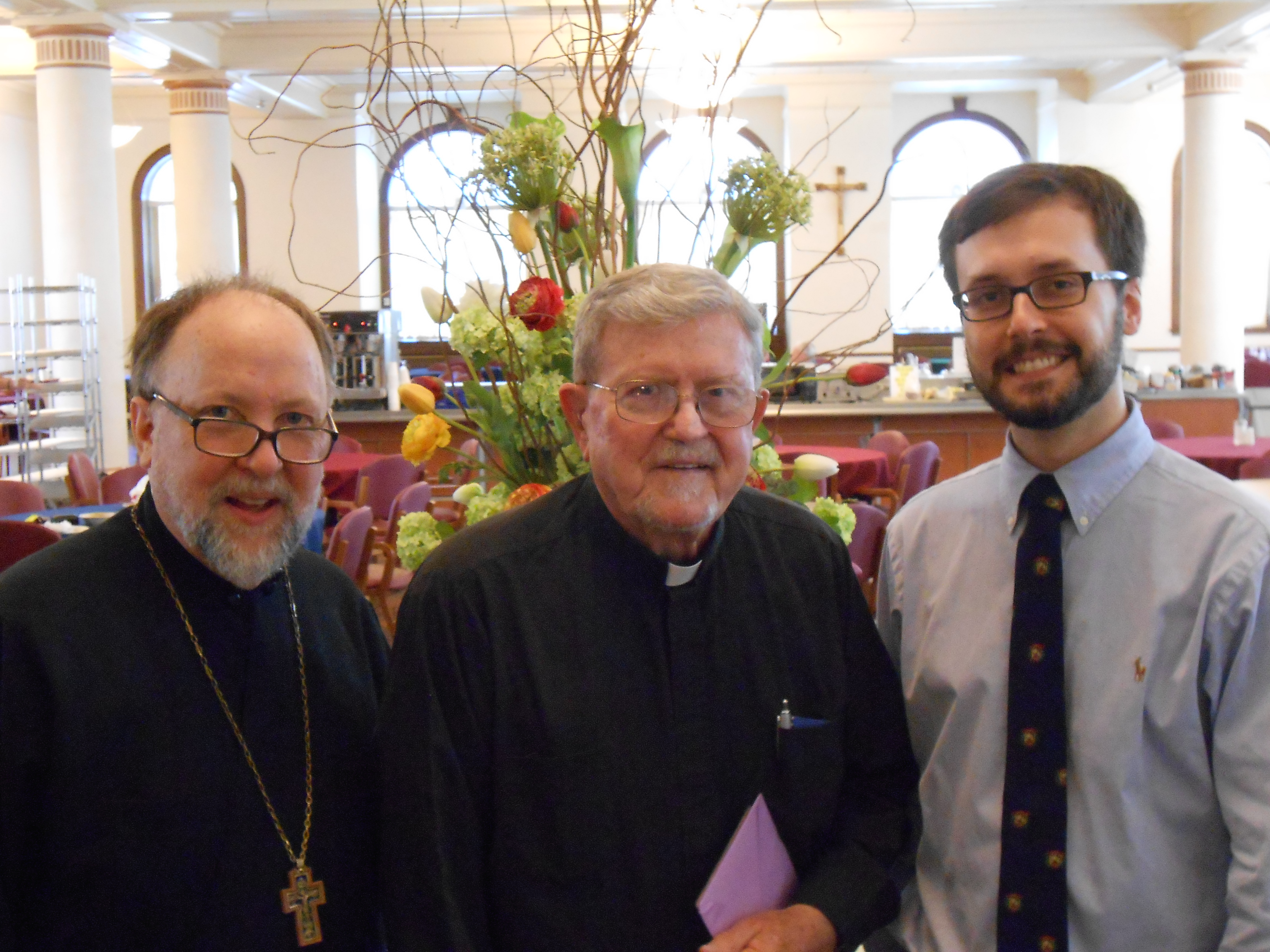
In the editorial introduction to that volume, Fr Peter Galadza (pictured below at left, with his son Daniel on the other side of Taft: Peter having studied with Taft at Notre Dame in the 1980s, and Daniel in the last decade at the PIO in Rome, where he wrote the dissertation to be published next year, as I noted here) recognized that Taft was such a giant of Byzantine liturgical history that there would be no single successor to him, but there could only be many building on the legacy of "one who has given so much."
And then, published in Antiphon in 2000 (and periodically popping up on various internet sites), “Eastern Presuppositions and Western Liturgical Renewal.” This latter article is especially useful in understanding how and why liturgical reforms in the Latin Church happened after Vatican II. A good bit of the game was already up before the reforms were implemented as people plundered Eastern traditions to justify what they had decided in advance to do to the Latin liturgy--albeit in often twisted and distorted fashion.
In 2003 he published a synopsis of an ecumenically vital process he was involved in behind the scenes: the recognition of the Anaphora of Addai and Mari.
When I began reading Taft nearly two decades ago now, part of what I greatly admired was his blunt speech. There is no greater illustration of this than his infamous interview with John Allen from 2004, which many of us read with almost horrified glee. Less notoriously and controversially, and more recently, here is another interview from 2014.
In this more recent interview, Taft, asked about books he wishes he might have written, picks two non-liturgical historians: Robert Louis Wilken (The First Thousand Years: A Global History of Christianity) and Klaus Schatz (Papal Primacy: From Its Origins to the Present, a book I drew on a great deal in writing my own Orthodoxy and the Roman Papacy).
In addition to these interviews and to his articles, there are of course the books, and in the 2014 interview Taft talks a bit about the bibliographical history of some of those studies.
For what it's worth, I begin by admitting I have not read all of Taft's books. Of those that I have, I think the first book I read was the collection of articles published under the title Beyond East and West. Problems in Liturgical Understanding, published in 2001 by the Pontifical Oriental Institute, where Taft was a professor for nearly half a century. There are many gems in that book, including an autobiographical chapter in which Taft recounts some of his early formation.
With my students over the years, I have often assigned Taft's The Liturgy of the Hours in East and West (Liturgical Press, 1986). It's a dense book, and by Taft's own admission focused much more on the East than the West, but that detracts nothing from its value.
For those coming to the Byzantine tradition with no background whatsoever, Taft's 1992 book The Byzantine Rite: A Short History is a good place to start.
For those, by contrast, ready for an in-depth history, then there is of course Taft's magnum opus, the multi-volume history of the liturgy of St. John Chrysostom. I have not read all volumes, but those that I have are vintage Taft: an amassing of sources in a variety of languages, judiciously sifted to tell a history with all the best virtues of the academy: objectivity, fairness, discernment, and comprehensiveness. These are the virtues which are hallmarks of Taft's scholarship, marking him out as a scholar's scholar and an historian whose works we shall be drawing on for many years to come. Rightly has he been recognized by the Ecumenical Patriarch, the Catholicos of the Armenian Church, Harvard University's Dumbarton Oaks Centre, and the British Academy, inter alia.
Rather later in life Taft seemed to me to move somewhat towards a different way of doing history as suggested in his short 2006 book Through Their Own Eyes: Liturgy as the Byzantines Saw It. There he recognized how much history, including that which he had done, was largely textual history, which is understandable and useful but also limited. What he said we needed more of was history through the eyes not of the scholars or clerics writing the books, but of those in the churches--more a social history of ritual enactment and engagement by the (to quote the always acerbic and droll Fr. John Hunwicke) "plebs sancta Dei, God's common ordinary folk, not of chaps with clever ideas who write learned papers about Inculturation but treat Liturgy like a gamesboard on which they and their chums are entitled to move the counters around."
Lest it be thought that I am here writing a hagiography before the man is dead, let me note that I disagreed, and disagree, with Taft's 2008 article lauding (uncritically, it seems to me) the Latin liturgical reforms of Vatican II which, with Ratzinger, I regard as having caused undeniably grave damage to the Latin church based, as Pickstock has memorably said, upon an entirely sinister conservative worldview of the fathers and reformers of the council that failed to challenge the pathologies of modernity (a point which, I think, owes not a few things to Mary Douglas's short, difficult but vital book Natural Symbols: Explorations in Cosmology).
But unlike those whom Taft criticizes there in his 2008 America essay, I am in all other respects a staunch defender of Vatican II, especially for its ecclesiological and ecumenical advances, as I make abundantly clear in my chapter published this year in The Reception of Vatican II, edited by Matthew Levering and Matthew Lamb and published by Oxford University Press.
With Taft, in fact--not least in his 2011 Orientale Lumen lecture--I ardently wish for further implementation of the council's reforms to the Catholic Church's structures and ecumenical outreach, as I have argued, and continue to argue, in numerous places, not least my 2011 book Orthodoxy and the Roman Papacy.
Taft's own ideas about Orthodox-Catholic rapprochement are contained in several places, but see in particular his chapter in Orthodox Constructions of the West, that invaluable collection edited by George E. Demacopoulos and Aristotle Papanikolaou which I lavished some time on here, here (quoting Taft extensively), and here.
Let me end, as Taft's life is coming to its end, with his book on prayer, which he says in his 2014 interview is one he himself returns to with some regularity. For those of us who only knew and know Taft as this formidable scholar of gruff, uncompromisingly blunt demeanor, this book comes as something of a surprise. For here we see that he is after all a priest with a tender (if unsentimental) care for souls. (I've heard over the years from some of his former students such as Daniel Galadza and Sr Vassa Larin that Taft would surprise people, including students, with pastoral visits to them in hospital.)
For such tenderness, as well as his fierceness in investigating sources, inveighing against bad history that propagates Christian division, and pushing Eastern and Western Christians alike to face up to our history in all its messiness, may the Lord count it all unto him as righteousness! And may his memory, when that time comes, be eternal.
Friday, December 9, 2016
Who Wants to See a Bloodbath in Church?
It was nearly 30 years ago now when, in a small (and now, sadly, closed) Anglican parish in southern Ontario, I witnessed my maternal grandmother go to war with the parish liturgical committee as it tried to impose the 1985 Book of Alternative Services of the Anglican Church of Canada. Ever since then I have, in Anglican, Roman Catholic, Eastern Catholic, and Eastern Orthodox contexts been aware of how profoundly neuralgic liturgical and musical questions are for people--and rightly so. For contrary to all the arrogant bollocks one hears from self-important "liturgists" about how they alone have the "qualifications" and "credentials" to talk about such matters, the liturgy is, perforce, the work of the people. And getting it right is not, contrary to the endless chatter of the current incumbent of the Roman bishoprick, a form of "rigidity" as I argued here, quoting one of the triumvirate (the others being MacIntyre and Newman) who made me a Catholic, Stanley Hauerwas:
About this book the publisher tells us:
Foreword
Ben Quash
Introduction: What Does ‘Musical Meaning’ Mean? Jeremy Begbie
SECTION 1: THE MEANINGS OF MUSIC IN WESTERN HISTORY
1. Providence and Prayer: the Theology of Music in the Patristic Church
Carol Harrison
2. Music in the Great Chain of Being: Medieval Christianity
Emma Dillon
3. Hearing Revelation: Music and Theology in the Reformation
Jonathan Arnold
4. Music, Atheism and Modernity
Gareth Wilson
SECTION 2: MUSIC’S MEANING IN WORSHIP
4. The Worship of God and the Quest of the Spirit: ‘Contemporary’ versus ‘Traditional’ Church Music
Gordon Graham
5. The Rise of the Individual, and the Fall of Communal Participation
Anthony Ruff
SECTION 3: MUSICAL MEANING IN CHURCH AND WORLD
6. Musical Promiscuity: the Gods Music Serves
Lucy Winkett
7. What’s Sacred About ‘Sacred Music’?
John Butt
SECTION 4: GOD, THE COSMOS, AND THE MEANING OF MUSIC
8. Christ the Song of God: Is Music Absolute?
Daniel Chua
9. Sacred Music and the Holy Trinity
David Bentley Hart
CONCLUSION
Response to the Essays Rowan Williams
One reason why we Christians argue so much about which hymn to sing, which liturgy to follow, which way to worship is that the commandments teach us to believe that bad liturgy eventually leads to bad ethics. You begin by singing some sappy, sentimental hymn, then you pray some pointless prayer, and the next thing you know you have murdered your best friend.Disputes about music and liturgy will surface afresh next spring with the publication of a collection edited by James Hawkey, Ben Quash, and Vernon White: God’s Song and Music’s Meanings: How Shall we Sing the Lord’s Song?
About this book the publisher tells us:
The public making of music in our society happens more often in the context of chapels, churches and cathedrals than anywhere else. The command to sing and make music to God makes music an essential part of the DNA of Christian worship. Taking seriously the practice and not just the theory of music, this ground-breaking collection of essays establishes a new standard for the interdisciplinary conversation between theology, musicology and liturgical studies. Framed by two substantive essays by leading theologians with a profound interest in music, the book’s four main sections will address questions about the history, the performance, the contexts, and the nature of music, as Christians understand it. It will show how any serious discussion of music opens onto considerations of time, tradition, ontology, anthropology, providence, and the nature of God.We are also given the contents. While some chapters obviously pertain to a Western context, the first chapter, by the patristics scholar Carol Harrison, will obviously be of especial interest to Eastern Christians; and then the final chapter by the Orthodox theologian David Bentley Hart will be likewise along with the response from the Anglican scholar of Orthodoxy, Rowan Williams:
Foreword
Ben Quash
Introduction: What Does ‘Musical Meaning’ Mean? Jeremy Begbie
SECTION 1: THE MEANINGS OF MUSIC IN WESTERN HISTORY
1. Providence and Prayer: the Theology of Music in the Patristic Church
Carol Harrison
2. Music in the Great Chain of Being: Medieval Christianity
Emma Dillon
3. Hearing Revelation: Music and Theology in the Reformation
Jonathan Arnold
4. Music, Atheism and Modernity
Gareth Wilson
SECTION 2: MUSIC’S MEANING IN WORSHIP
4. The Worship of God and the Quest of the Spirit: ‘Contemporary’ versus ‘Traditional’ Church Music
Gordon Graham
5. The Rise of the Individual, and the Fall of Communal Participation
Anthony Ruff
SECTION 3: MUSICAL MEANING IN CHURCH AND WORLD
6. Musical Promiscuity: the Gods Music Serves
Lucy Winkett
7. What’s Sacred About ‘Sacred Music’?
John Butt
SECTION 4: GOD, THE COSMOS, AND THE MEANING OF MUSIC
8. Christ the Song of God: Is Music Absolute?
Daniel Chua
9. Sacred Music and the Holy Trinity
David Bentley Hart
CONCLUSION
Response to the Essays Rowan Williams
Thursday, April 28, 2016
Nicholas Denysenko on Liturgical Reform
It has been my happy--and frequent!--duty on here to note the many recent publications of my friend, Nicholas Denysenko, a deacon in the Orthodox Church of America and a prolific liturgical scholar at Loyola Marymount University in Los Angeles, where he also heads the Huffington Ecumenical Institute. Previously on here I have interviewed him about his two most recent books, Chrismation, and The Blessing of Waters and Epiphany.
Now it is my pleasure to interview him about his latest book published at the end of last year by Fortress Press, Liturgical Reform After Vatican II: The Impact on Eastern Orthodoxy.
AD: For readers new to your work, give us again a bit of your background.

I am a first-generation American, grandson of an Orthodox priest of Ukrainian descent. Like many other people in clerical families, I spent my child and adolescent years serving at the altar and singing in the parish choir. My first full-time job after receiving my business degree at the University of Minnesota was music director at St. Mary’s Orthodox Cathedral (OCA) in Minneapolis.
I sensed that God was calling me to presbyteral ordination, so I enrolled at St. Vladimir’s Seminary and graduated in 2000. After a few years working in Minneapolis and getting married, we moved to the Washington, DC area in 2003, and I received my Ph.D. in liturgical studies and sacramental theology from The Catholic University of America in 2008.
I began teaching at Loyola Marymount University in 2008 and am now associate professor and director of the Huffington Ecumenical Institute here. I have also been a deacon since 2003, ordained and serving OCA parishes. For me, all teaching and writing is giving blood to the Church (to paraphrase Fathers Meyendorff and Hopko of blessed memory).
AD: Tell us the origins or genesis of Liturgical Reform After Vatican II: the Impact on Eastern Orthodoxy and how you came to write it.
ND: I did not plan on writing this book. I was and remain intrigued by liturgical ecclesiology and in writing my book on Chrismation was quite intrigued by the twentieth-century retrieval of patristic and liturgical testimonies to anointing and the imparting of the Christic offices of priest, prophet, and king to each person, the priestly foundation of the order of the laity. It was an ecumenical endeavor and the retrieval transcended the boundaries separating Catholics and Orthodox.
For many years, I attempted to digest Fr. Alexander Schmemann’s complex response to Sacrosanctum concilium; on the one hand, he celebrated the eucharistic revival in Orthodoxy and lauded the principles of the liturgical movement. On the other hand, he was sharply critical of the Roman reception of Sacrosanctum concilium and he stated that Orthodoxy needs a theological rationale for liturgical reform. I was and remain painfully aware of the liturgy wars afflicting all the churches, including the Orthodox. The project was born after I presented a paper at a symposium on the fiftieth anniversary of Sacrosanctum concilium at Catholic University in 2013. I was determined to make sense of liturgical reform in Orthodoxy and its sources in the milieu of Vatican II, and the book delivers on the promise.
AD: As you know, the very prospect of liturgical reform is a neuralgic issue for just about all Christians, East and West, raising all kinds of fears and feelings. Did you have any dread about diving into such choppy waters?
ND: Yes, I was concerned about the tendency for discussions on liturgy to devolve into a subjective exchange of opinions on this or that musical style, or the permeation of political agendas into the fabric of the liturgy. In fact, this happened in the last few days when a popular Orthodox writer reflected on the section I have on women in the Church, with social media and other blogs re-posting his assessment of my opinion. The problem with his essay is that it ignored the entire trajectory of my study and instead illuminated one of the potential outcomes of reform, an increase of women’s exercise of liturgical ministries.
Many theologians have written on the history of the order of the deaconess or have offered theological rationales for and against the ordination of women. My book is about the liturgy as a whole and the theological rationale for reform; I am not advocating for a particular political agenda, but for the orders of the Church to exercise their Spirit-laden ministries – especially the first order of the laity. In my view, this particular essay subverted the discourse to take on a polarizing political issue. As you know, when we teach, we try to form students to adopt habits of responsible engagement of authors and their ideas, and this example violates the principle of engagement.
I am supremely confident that the people of our Churches have the intelligence and the integrity to consider how liturgical structures and components might manifest the theological rationale for liturgical reform. If we are successful in swinging the pendulum away from passionate arguments about style and towards a serious discussion of how liturgical participation discloses God as the lover of humankind and capacitates faithful to become christbearers for the life of the world, the liturgy itself will evolve into forms that are lifegiving. Experts in comparative liturgy are already offering much for our consideration; I felt I had a duty to attempt to address the question of a theological rationale for reform. And by reform, I mean a clarification of what we mean when we talk about organic liturgical development.
AD: As one who has been through liturgical wars in Anglican, RC, and Byzantine Catholic parishes, I greatly cheered your first paragraph on p.1 that discussions about liturgy are not the exclusive domain of academics but "internal Church discourse involves ordinary people and their experiences of the liturgy." Does such a perspective place you in a minority among liturgists?
Liturgical studies is essentially a product of classical patristics. I have made modest contributions to the field of comparative liturgy with my book on the blessing of waters along with several articles. As I read the initial assessments of liturgical reform, I was struck by the hegemony of referring to texts and their interpretation by experts as “liturgical theology.” Giants like Aidan Kavanagh, Robert Taft, and Nathan Mitchell have reminded us that Mrs. Murphy, Mrs. Ivanova, and the grandmother explaining Mass to the grandchild on her lap are also models for liturgical theology.
But when we explain the meaning of a particular rite or office, how often do we consider how the people respond to that rite? Our fidelity to text has caused us to ignore the perspective of the people in the pew. Liturgy is not the sum of texts and ritual performance. Liturgy is an encounter with a community and the living God. We’ll have a much more robust understanding of the liturgy when we begin paying attention to how people respond (or adjust) to liturgical participation. Certainly, there are select people in the field of liturgical ritual studies who are doing groundbreaking work in this area, but yes, I think this group is a minority in the sea of liturgical historians.
AD: Give us a brief understanding of how you arrived at the four models of liturgical reform you focus on
I was determined to begin with Fr. Schmemann. As I read Schmemann and became convinced that he was continuing the work done in preparation for the Moscow Council, I was struck by the divergent responses to proposals for liturgical renewal within the Russian Orthodox community. Thus I decided to write next about ROCOR because of ROCOR’s steadfast fidelity to observing the Typikon, and also for their superlative patronage of the liturgical arts. I learned a great deal from ROCOR’s preference for the canonical singing promoted by the Moscow Synodal Choir, and the existence of a school devoted to the Petersburg style within ROCOR was abundantly informative.
Then I decided to profile the Church of Greece because of the unique symposia they hold which are devoted to liturgical rebirth.
Finally, New Skete fascinates me. It might seem that their creativity attracted me, but I was much more interested in their reconstruction of cathedral rites to create a liturgical order for a contemporary monastery. I found common threads underpinning the models, but also found tensions between them, and these findings permitted me to tell a fascinating story.
AD: I flipped to your chapter on New Skete first, not least because their origins as Byzantine Franciscans have fascinated me since I had a grad student who wrote his thesis on the Byz. Franciscans of Hazleton, PA. Do you think New Skete, with such a "reforming impulse" in the decade of Vatican II, would have been possible had they started out in Orthodoxy originally? Or were their Catholic roots essential to the work they have done?
ND: I think their Catholic roots gave them the courage, the freedom to discover an ordo that worked for them. I would caution readers to beware of assuming that New Skete's ordo is an innovation without reference to tradition: New Skete created a liturgical order drawing abundantly from tradition that coalesces with the rhythms and needs of their community life. I most certainly think that a reform would have been possible for New Skete had they started in Orthodoxy if they had a bishop-patron to bless their freedom in translating careful academic research into a liturgical order based on traditional structures.
That said, contemporary Orthodoxy views liturgy as unchanged and unchangeable, a perspective partially attributable to the memory of Russian renovationists whose liturgical reforms appeared to be inseparable from their attempt to subvert the patriarchate during the early years of the revolution. Some Orthodox view New Skete as a community of innovators whose adoption of a reconstructed ordo is actually a violation of Orthodoxy. In my view, New Skete epitomizes the objective of liturgical studies: to show us what is possible. The Churches of East and West have much to learn from New Skete.
AD: Sum up what your hopes were for Liturgical Reform After Vatican II: the Impact on Eastern Orthodoxy. and who should read it.
ND: My initial hope is that this book might catalyze the approach we adopt towards liturgical celebration and move us away from the liturgical wars. If we are all Christ’s concelebrants in the liturgy, what does this mean for our rituals, our texts, and our daily lives? Should we assess liturgical traditions that are difficult to interpret and comprehend?
Take, for example, the preponderance of Holy Week hymns on Judas and the Jews. Do we continue to chant these texts to honor tradition even if we have to explain that Holy Week is about the crucified Christ (and not the impious Judas) or that we are not anti-Semitic? My hope is that this book will help us to adopt a mindset that always focuses Christ’s priesthood at the center of a liturgy, eternally offered to God and received as a gift for the life of the world. As for the ultimate objectives of my project, my hope is that we will begin to view the liturgy as the source of our transformation into God’s body. What does that look like in tangible terms? I refer you to pages 371-373 of the book. I wrote this book for students and clergy.
AD: Tell us what you are at work on next.
ND: I’m working on two projects. First and foremost is the sequel to this study: The People’s Faith: The Liturgy of the Faithful in Orthodoxy. I’ll be spending much of the next year analyzing survey results and meeting with small groups of people in Orthodox parishes to hear their descriptions of the impact of liturgy on their daily lives.
I’m also continuing to work hard on a manuscript devoted to making sense of the divisions within the Orthodox Church in Ukraine. The contemporary literature on this matter tends to be reactionary and lacks grounding in history, so my objective is to lay out the facts of the movement and disclose its complexities. Essentially, the world knows the history of Ukraine and her Churches through Russian historians. I value the contributions of Russian historians, but we need narratives that present the Ukrainian perspective, and I think the results of the study will prove to be both surprising and rewarding.
Now it is my pleasure to interview him about his latest book published at the end of last year by Fortress Press, Liturgical Reform After Vatican II: The Impact on Eastern Orthodoxy.
AD: For readers new to your work, give us again a bit of your background.

I am a first-generation American, grandson of an Orthodox priest of Ukrainian descent. Like many other people in clerical families, I spent my child and adolescent years serving at the altar and singing in the parish choir. My first full-time job after receiving my business degree at the University of Minnesota was music director at St. Mary’s Orthodox Cathedral (OCA) in Minneapolis.
I sensed that God was calling me to presbyteral ordination, so I enrolled at St. Vladimir’s Seminary and graduated in 2000. After a few years working in Minneapolis and getting married, we moved to the Washington, DC area in 2003, and I received my Ph.D. in liturgical studies and sacramental theology from The Catholic University of America in 2008.
I began teaching at Loyola Marymount University in 2008 and am now associate professor and director of the Huffington Ecumenical Institute here. I have also been a deacon since 2003, ordained and serving OCA parishes. For me, all teaching and writing is giving blood to the Church (to paraphrase Fathers Meyendorff and Hopko of blessed memory).
AD: Tell us the origins or genesis of Liturgical Reform After Vatican II: the Impact on Eastern Orthodoxy and how you came to write it.
ND: I did not plan on writing this book. I was and remain intrigued by liturgical ecclesiology and in writing my book on Chrismation was quite intrigued by the twentieth-century retrieval of patristic and liturgical testimonies to anointing and the imparting of the Christic offices of priest, prophet, and king to each person, the priestly foundation of the order of the laity. It was an ecumenical endeavor and the retrieval transcended the boundaries separating Catholics and Orthodox.
For many years, I attempted to digest Fr. Alexander Schmemann’s complex response to Sacrosanctum concilium; on the one hand, he celebrated the eucharistic revival in Orthodoxy and lauded the principles of the liturgical movement. On the other hand, he was sharply critical of the Roman reception of Sacrosanctum concilium and he stated that Orthodoxy needs a theological rationale for liturgical reform. I was and remain painfully aware of the liturgy wars afflicting all the churches, including the Orthodox. The project was born after I presented a paper at a symposium on the fiftieth anniversary of Sacrosanctum concilium at Catholic University in 2013. I was determined to make sense of liturgical reform in Orthodoxy and its sources in the milieu of Vatican II, and the book delivers on the promise.
AD: As you know, the very prospect of liturgical reform is a neuralgic issue for just about all Christians, East and West, raising all kinds of fears and feelings. Did you have any dread about diving into such choppy waters?
ND: Yes, I was concerned about the tendency for discussions on liturgy to devolve into a subjective exchange of opinions on this or that musical style, or the permeation of political agendas into the fabric of the liturgy. In fact, this happened in the last few days when a popular Orthodox writer reflected on the section I have on women in the Church, with social media and other blogs re-posting his assessment of my opinion. The problem with his essay is that it ignored the entire trajectory of my study and instead illuminated one of the potential outcomes of reform, an increase of women’s exercise of liturgical ministries.
Many theologians have written on the history of the order of the deaconess or have offered theological rationales for and against the ordination of women. My book is about the liturgy as a whole and the theological rationale for reform; I am not advocating for a particular political agenda, but for the orders of the Church to exercise their Spirit-laden ministries – especially the first order of the laity. In my view, this particular essay subverted the discourse to take on a polarizing political issue. As you know, when we teach, we try to form students to adopt habits of responsible engagement of authors and their ideas, and this example violates the principle of engagement.
I am supremely confident that the people of our Churches have the intelligence and the integrity to consider how liturgical structures and components might manifest the theological rationale for liturgical reform. If we are successful in swinging the pendulum away from passionate arguments about style and towards a serious discussion of how liturgical participation discloses God as the lover of humankind and capacitates faithful to become christbearers for the life of the world, the liturgy itself will evolve into forms that are lifegiving. Experts in comparative liturgy are already offering much for our consideration; I felt I had a duty to attempt to address the question of a theological rationale for reform. And by reform, I mean a clarification of what we mean when we talk about organic liturgical development.
AD: As one who has been through liturgical wars in Anglican, RC, and Byzantine Catholic parishes, I greatly cheered your first paragraph on p.1 that discussions about liturgy are not the exclusive domain of academics but "internal Church discourse involves ordinary people and their experiences of the liturgy." Does such a perspective place you in a minority among liturgists?
Liturgical studies is essentially a product of classical patristics. I have made modest contributions to the field of comparative liturgy with my book on the blessing of waters along with several articles. As I read the initial assessments of liturgical reform, I was struck by the hegemony of referring to texts and their interpretation by experts as “liturgical theology.” Giants like Aidan Kavanagh, Robert Taft, and Nathan Mitchell have reminded us that Mrs. Murphy, Mrs. Ivanova, and the grandmother explaining Mass to the grandchild on her lap are also models for liturgical theology.
But when we explain the meaning of a particular rite or office, how often do we consider how the people respond to that rite? Our fidelity to text has caused us to ignore the perspective of the people in the pew. Liturgy is not the sum of texts and ritual performance. Liturgy is an encounter with a community and the living God. We’ll have a much more robust understanding of the liturgy when we begin paying attention to how people respond (or adjust) to liturgical participation. Certainly, there are select people in the field of liturgical ritual studies who are doing groundbreaking work in this area, but yes, I think this group is a minority in the sea of liturgical historians.
AD: Give us a brief understanding of how you arrived at the four models of liturgical reform you focus on
I was determined to begin with Fr. Schmemann. As I read Schmemann and became convinced that he was continuing the work done in preparation for the Moscow Council, I was struck by the divergent responses to proposals for liturgical renewal within the Russian Orthodox community. Thus I decided to write next about ROCOR because of ROCOR’s steadfast fidelity to observing the Typikon, and also for their superlative patronage of the liturgical arts. I learned a great deal from ROCOR’s preference for the canonical singing promoted by the Moscow Synodal Choir, and the existence of a school devoted to the Petersburg style within ROCOR was abundantly informative.
Then I decided to profile the Church of Greece because of the unique symposia they hold which are devoted to liturgical rebirth.
Finally, New Skete fascinates me. It might seem that their creativity attracted me, but I was much more interested in their reconstruction of cathedral rites to create a liturgical order for a contemporary monastery. I found common threads underpinning the models, but also found tensions between them, and these findings permitted me to tell a fascinating story.
AD: I flipped to your chapter on New Skete first, not least because their origins as Byzantine Franciscans have fascinated me since I had a grad student who wrote his thesis on the Byz. Franciscans of Hazleton, PA. Do you think New Skete, with such a "reforming impulse" in the decade of Vatican II, would have been possible had they started out in Orthodoxy originally? Or were their Catholic roots essential to the work they have done?
ND: I think their Catholic roots gave them the courage, the freedom to discover an ordo that worked for them. I would caution readers to beware of assuming that New Skete's ordo is an innovation without reference to tradition: New Skete created a liturgical order drawing abundantly from tradition that coalesces with the rhythms and needs of their community life. I most certainly think that a reform would have been possible for New Skete had they started in Orthodoxy if they had a bishop-patron to bless their freedom in translating careful academic research into a liturgical order based on traditional structures.
That said, contemporary Orthodoxy views liturgy as unchanged and unchangeable, a perspective partially attributable to the memory of Russian renovationists whose liturgical reforms appeared to be inseparable from their attempt to subvert the patriarchate during the early years of the revolution. Some Orthodox view New Skete as a community of innovators whose adoption of a reconstructed ordo is actually a violation of Orthodoxy. In my view, New Skete epitomizes the objective of liturgical studies: to show us what is possible. The Churches of East and West have much to learn from New Skete.
AD: Sum up what your hopes were for Liturgical Reform After Vatican II: the Impact on Eastern Orthodoxy. and who should read it.
ND: My initial hope is that this book might catalyze the approach we adopt towards liturgical celebration and move us away from the liturgical wars. If we are all Christ’s concelebrants in the liturgy, what does this mean for our rituals, our texts, and our daily lives? Should we assess liturgical traditions that are difficult to interpret and comprehend?
Take, for example, the preponderance of Holy Week hymns on Judas and the Jews. Do we continue to chant these texts to honor tradition even if we have to explain that Holy Week is about the crucified Christ (and not the impious Judas) or that we are not anti-Semitic? My hope is that this book will help us to adopt a mindset that always focuses Christ’s priesthood at the center of a liturgy, eternally offered to God and received as a gift for the life of the world. As for the ultimate objectives of my project, my hope is that we will begin to view the liturgy as the source of our transformation into God’s body. What does that look like in tangible terms? I refer you to pages 371-373 of the book. I wrote this book for students and clergy.
AD: Tell us what you are at work on next.
ND: I’m working on two projects. First and foremost is the sequel to this study: The People’s Faith: The Liturgy of the Faithful in Orthodoxy. I’ll be spending much of the next year analyzing survey results and meeting with small groups of people in Orthodox parishes to hear their descriptions of the impact of liturgy on their daily lives.
I’m also continuing to work hard on a manuscript devoted to making sense of the divisions within the Orthodox Church in Ukraine. The contemporary literature on this matter tends to be reactionary and lacks grounding in history, so my objective is to lay out the facts of the movement and disclose its complexities. Essentially, the world knows the history of Ukraine and her Churches through Russian historians. I value the contributions of Russian historians, but we need narratives that present the Ukrainian perspective, and I think the results of the study will prove to be both surprising and rewarding.
Subscribe to:
Posts (Atom)
