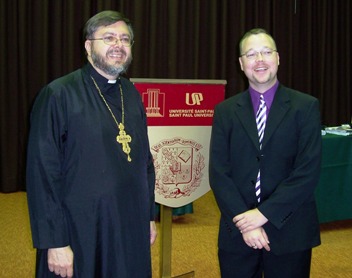
I count it one of the great gifts of Providence that Andriy Chirovsky, a mitred Ukrainian Catholic priest and scholar who founded the
Sheptytsky Institute of Eastern Christian Studies, became my
Doktorvater. I don’t use that word just because academics are supposed to throw around pretentious German terms to impress others, but because it describes, in a real and lasting way, the relationship he had to me: a real father in God concerned that my work not just be about academic attainment, advancement, and glory; but that it serve the Church and not my own vainglory.
He made it very clear to me from our first class together in the spring of 1997 that anyone studying God—which is what theology aspires to do—is on very dangerous territory and must proceed with the greatest reserve. The dangers of idolatry are all around us, and so too are the dangers of pride and presumption, any one of which can blind us and bind us to our own downfall. “Keep yourself low to the ground,” he used to advise—if only, he continued with characteristic wry humour, so that you don’t have to far to fall when you trip yourself up or your enemies try to knock you down!
More than that, there is another gift I received from him, and that was an introduction to Evagrius of Pontus, on whom, happily, an explosion of research has been published since the turn of the century as seen in books by, inter alia,
Luke Dysinger,
Gabriel Bunge,
Jeremy Driscoll, and other scholars, including those to be found in this
important collection.
We also have many translations published of, e.g.,
Ad Monachos and other works.
George Tsakiridis's book
Evagrius Ponticus and Cognitive Science: A Look at Moral Evil and the Thoughts is interesting for its attempts to link Evagrius with some aspects of modern psychology.
Since I first learned of Evagrius, I find myself quoting from his
On Prayer every semester when classes start: “if you are a theologian, you will pray truly. And if you pray truly, you are a theologian.” That is a reminder, of course, that unlettered peasants in the fields who pray while they rake potatoes can be far holier and closer to God than those of us with advanced degrees but a sterile prayer life. It is a reminder--to put it in a Pauline idiom--not to be puffed up with knowledge.
It should not, however, be taken as license for anti-intellectualism, which I see some Catholic and Orthodox Christians do with some regularity. Evagrius is, as it were, the patron saint of those traduced by seemingly pious anti-intellectual mobs who think the Church of Christ should be turned into some self-created purity cult. A hugely influential figure of the fourth century, he had an enormous impact on the foundation of monasticism and much else, including what we would call moral theology: what the West knows as the seven capital or deadly sins is a condensed derivative version of the eight logismoi or “disordered thoughts” first schematized and very vividly described by Evagrius (who, himself, got parts of his scheme from various places, not all of them Christian it seems).
The hostile and unjust treatment of Origen and Evagrius is instructive, for though it happened in the first half of the first millennium, it happens still today. We can see it on many websites and read about it with some regularity. People get mobbed by social media and various websites for their supposed deviation from whatever the orthodox line is supposed to be. (This latest outrage for Latin Catholics is apparently the reading of a
book in an English class at
some school in Steubenville, Ohio. For Eastern Catholics and Orthodox, the latest
supposed outrage was splashed about by some blogger whose entire business model depends on a steady supply of such things.)
This manufacturing of outrage is completely unattractive when anybody does it, but doubly so when Christians do so, whether outwardly against "the world" or by inwardly turning on each other, jacking up the outrage while fancying themselves to be defending “holy mother Church” or protesting against some “blasphemy” in, say, a movie or commercial. I wish all such people clearly understood this:
God does not need your outrage, or your brittle and shrill “defense” of Him, or His Mother, or the angels and saints. He does not need, nor does He want, your anger. (Neither do the rest of us most assuredly.) He is unmoved by all this, and you should be, too. Worse, your anger is an anti-icon: the image you reveal is not an image of God. Your outrage accomplishes nothing good, but in fact does you (and quite possibly others) great harm.
Any time a TV show, movie, website, book, or person “offends” you by what it says about God, you need to be impassible in the face of it. That is not some pious bit of badly disguised sanctimony from me. (Heaven—and Google—know that I’ve dished out my share of polemics and outrage over the years, though the older I get the less I find that attractive and the more I regret having done it in the past.) It comes from Evagrius.
For Evagrius, impassibility (being, that is, without the disordered and destructive passions that drive the logismoi) is the highest and most perfect of all the spiritual states to attain. It is also the most difficult. When, last year, I finally had a chance—after quoting him piecemeal for nearly two decades—to teach a full course on Evagrius, it was a wonderfully bracing experience for Evagrius does not mess around, but writes with a vividness and a bluntness that is very refreshing. He helpfully overturns many of our covert assumptions about what the “worst” vices are. He must, therefore, come as quite a shock to those American Christians, at any rate, who assume, falsely, that the worst vices have to do with sex. When such Christians find what they think are sexual sins in others—even fictional ones in books they have not read—their outrage is predictable, tiresome, and wholly counter-productive. Evagrius foresaw all this with his usual clinical precision.
But we are often deceived as to the causes of our anger. Evagrius has keen insights into how we deceive ourselves, and his methods for dealing with such deceptions are, as I have argued elsewhere, psychoanalytic
avant la lettre. (As the eminent historian Peter Brown nicely put it, “the lonely cells of the recluses of Egypt have been revealed, by the archaeologist, to have been well-furnished consulting rooms.”) As Freud would realize only much later (and then--as Madelon Sprengnether's new book,
Mourning Freud makes clear--only incompletely), there is an intimate connection between anger and unresolved grief and mourning; there is also often a connection to thwarted desire, some of it quite often sadistic or
masochistic in nature.
I assigned my students to read Robert Sinkewicz’s
Evagrius of Pontus: The Greek Ascetic Corpus (Oxford, 2006) for its translation of On the Eight Thoughts. There, Sinkewicz notes that “among the individual vices considered by Evagrius, none receives greater attention than anger, for it is this vice that presents the
greatest obstacle to the advancement in gnostic life and pure prayer” (my emphasis). Sinkewicz’s translation and accompanying apparatus are long and dense, and require revisiting from time to time. But this claim about the pre-eminence of anger as the “greatest obstacle” has stuck with me as a salutary thorn in my side.
I have come to think of this claim of Evagrius often, and to counter-pose the move away from anger with a move towards kindness and graciousness. Thus I cannot think of Evagrian warnings except alongside the wise counsel of a short and unjustly neglected little book by the psychoanalyst Adam Phillips and Barbara Taylor,
On Kindness. Increasingly I realize that when I die, I should much more gladly be thought a kindly fool than an outraged old man.
“But wait!” some will insist. “Mine is righteous anger, like Jesus with the money-changers! I’m angry at this book/meme/movie/show/Catholic university professor because I’m defending God/Mary/Holy Mother Church!!!” That bogus claim is as pure an example as I’ve ever seen of what psychoanalysis calls “projective identification” in which we project onto God our own outrage and assume He must feel it too.
But once more the psychoanalysts were anticipated by Evagrius some 1500 years before Freud was even born. And so Evagrius deals handily with this deception, as Sinkewicz notes: “when recommending the use of anger against the demon of fornication, Evagrius warns that the demon of anger may engage strategies similar to the spirit of fornication by instilling images in the mind,” which lead only to more anger disguised by our supposed righteousness. (That is, of course, precisely what has happened in the Steubenville case.) In other words, by reacting to one imagined thing (for that is all we have on-line—our imagination of how horrid some novel must be that we have never read) we fall into another. It is, Evagrius notes, extremely difficult for most of us to direct anger against the other demons and vices without ourselves being consumed by that anger, which he vividly describes as “a plundering of prudence, a destruction of one’s state, a confusion of nature, a form turned savage, a furnace for the heart, an eruption of flames, a law of irascibility, a wrath of insults, a mother of wild beasts, a silent battle, an impediment to prayer.”
By contrast, says Sinkewicz, summing up and quoting Evagrius, a “soul free of anger is a temple of the Holy Spirit; a gentle person is remembered by God; ‘Christ reclines his head on a patient spirit’; and ‘an intellect at peace’ is ‘a shelter for the Holy Trinity’.” In other words, to be free from anger means that one has and practices the virtues of gentleness and patience, which virtues are to be found at “the summit of the spiritual life.” Perhaps if we spent a little less time on Twitter and social media ginning up outrage at the alleged offenses of others, we might have energy left to begin the arduous climb to the top.