"Let books be your dining table, / And you shall be full of delights. / Let them be your
mattress,/
And you shall sleep restful nights" (St. Ephraim the Syrian).


Showing posts with label Helena. Show all posts

Thursday, September 14, 2017

On the Invention of the True Cross and its Universal Exaltation*

"It is reported (and I, for one, believe it) that some few years ago a lady prominent for her hostility to the Church returned from a visit to Palestine in a state of exultation. 'I got the real low-down at last,' she told her friends. 'The whole story of the crucifixion was made up by a British woman named Ellen. Why, the guide showed me the very place where it happened. Even the priests admit it. They call their chapel "the Invention of the Cross".'"
Attentive readers will recognize this as the uproarious Preface to the hilarious historical novel by Evelyn Waugh, Helena. As a treat--and to avoid tedious editorial work--I decided to re-read it last Saturday knowing that today's feast was coming up. In so doing, I realized I'd forgotten just how much of the novel is given over to ruthless mocking of the pieties and politics of empire.

In Waugh's hands Helena is the key figure who "invents" the true cross and so allows Christians, from her day to our own, to mark September 14th as a festival of the cross's exaltation and triumph. Waugh, a master craftsman of English prose who would have been educated in Latin and who loved using deliberate archaisms, is of course using the verb "invent" here in an older sense of "to come upon, to find"--while also slyly playing on the more common connotation of "creating or producing with the imagination," which of course his novel was itself doing. (The word itself is derived from the Latin verb invenire, to come upon or find.)

Helena was published in 1950 by Waugh as an historical novel and roman à clef devoted to exploring the notion of vocation through the life of the Dowager Empress of Rome, St. Helena, mother of Constantine the great. Her vocation, in Waugh's eyes, was to 'invent' (=find) the true cross that had been thought to be lost forever.

This novel is full of archaic language, buried puns, double entendres, and jokes at the expense of just about everybody--socialist politicians in 1950s Britain, heretical churchmen, tendentious historians (e.g., Gibbon), sclerotic bureaucracies of both church and state, youth "culture" and much else besides, including Eastern Christians. Such mockery holds up strikingly well today--plus ça change....

Waugh's exposure to the Christian East was extremely limited, and he never missed an opportunity to trumpet the supposed superiority of Latin Christianity, rather provincially portraying the East in the worst light possible (cf. his description of Alexandrian liturgies of coronation in Scoop) but I have never held that against him.

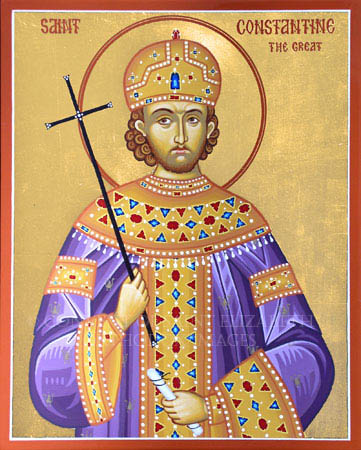
Here in this scene Waugh clearly seems to have in his sights the Eastern exaltation of Constantine, whom the Byzantine tradition calls "co-equal to the apostles," a notion Waugh ridicules mercilessly. After a long exile from court, Helena is back in Rome to see her son Constantine, whose court is portrayed as nothing so much as an opéra bouffe, with the emperor himself perhaps the most absurd figure:
From the neck down he was all upholstery. A surcoat of imperial purple, laced with floriations of gold wire and studded with amorphous pearls, hung stiff as a carpet to the carpeted floor. It was sleeveless, and at the arms an undergarment billowed out, peacock-hued, ending in lace ruffles and a pair of coarse, much-jewelled hands. Above the surcoat was a wide collar of gold and enamel, a massive thing suited to the bull-neck; its miniatures told indifferently the stories of the gospel and of Mount Olympus. Above the collar rose the face, pale now as his father's; he was rouged but purely for ornament
But none of this much interests Helena. Instead, she cannot take her eyes off her son's imperial head:
'My dear boy, what on earth have you got on your head?'
The face above the collar assumed an expression of alarm. 'On my head?' He put up a hand as though to dislodge some bird which might inadvertently have perched there. 'Is there anything on my head?'
Two courtiers danced forward. They were shorter than Constantine and made little jumps to see what was amiss.
Without excess of ceremony Constantine inclined to them. 'Well, what is it? Take it off at once, whatever it is.'
The courtiers craned and peered; one raised a finger and touched. They looked at one another. They looked at the Empress Dowager in abject consternation.
"That green wig,' said Helena.
After telling his mother he has a whole collection of such wigs ("some are very pretty") he attempts to rescue his image by barking at his courtiers:
'To work, to work,' said the Thirteenth Apostle.
For those who are interested in more on Waugh: Earlier this year I noted some thoughts on Waugh here, and elaborated on them here at greater length. But for a fun and funny read, a quick read, to celebrate today's feast, read Helena

____________________
* In honour of today's feast, this post is a reprint from 2016. 

Tuesday, April 10, 2012

Screw the Rich?

In the late 90s, I had a lot of fun writing a short article on Evelyn Waugh's famously incorrect views about money, wealth, and social class. (I did this mischievously, I admit, in part because I had a lot of leftist friends whose pieties I wished to tweak. One in particular was left fulminating incoherently after reading my article, which was of course enormously amusing.) I tried, inter alia, to draw attention to the oft-ignored verse that comes immediately after the gospel's famous warning that the rich will find getting to heaven as easy as camels going through needles' eyes: "but with God all things are possible." Waugh showed, especially in his wonderful historical novel Helena, that it was possible for the rich and powerful not only to make it to heaven, but to do so after having lived saintly lives on earth. That may be the exception, but it is at least possible--with God.

If the dowager empress of the Roman Empire, the richest and most powerful woman of her time, could become a saint, there was hope for everyone, the rich included, which is precisely the oft-overlooked conclusion to the famous gospel passage above. (As Waugh said in one of his letters to his friends about his treatment of the upper classes in both Helena and the even more famous Brideshead Revisited, "it's not true that Catholics think the poor go to a servants' hall in heaven.")

Anyway, a new book has recently been published giving us Clement of Alexandria's treatment of the question of whether the rich will be saved: Quel riche sera sauvé ? (Texte grec d'O. Stählin et L. Früchtel [GCS 17²] — Introduction, notes et index par Carlo Nadi, Professeur à la Faculté de théologie de Florence et Patrick Descourtieux, Professeur à l'Institutum Patristicum Augustinianum — Traduction par Patrick Descourtieux; Éditions du Cerf, 2011, 264pp).

About this book the publisher tells us:

En déclarant qu'il était plus difficile à un riche d'entrer dans le Royaume des cieux qu'à un chameau de passer par le trou d'une aiguille (cf. Mc 10, 25), Jésus n'a-t-il pas voué à la perdition tout détenteur de capitaux ? L'effroi de ses auditeurs n'a pas échappé à Clément d'Alexandrie, ni la détresse spirituelle qui guettait les riches de la ville, quand ils voyaient la distance existant entre leur mode de vie et les exigences de l'Évangile.

Mais la parole du Christ avait-elle été bien comprise ? L'auteur des « Stromates » se révèle ici tour à tour exégète, dogmaticien, moraliste et directeur spirituel. Dans l'Alexandrie bigarrée de la fin du IIe siècle, sa pensée de fin lettré allait ouvrir à ses auditeurs et à ses lecteurs des perspectives insoupçonnées sur les richesses de la parole divine. Cette première homélie sur un sujet difficile et controversé devait connaître un grand succès.

Après une entrée en matière qui invite chacun à l'espérance, Clément analyse soigneusement le texte évangélique. Il s'élève ensuite à de profondes considérations sur l'amour de Dieu et du prochain, avant de conclure à nouveau par un vibrant appel à l'espérance. Le « Quis dives salvetur » est la première tentative de réflexion chrétienne sur les rapports de la foi et de l'argent. Le « Mamon de l'injustice » y devient un moyen d'accéder aux « tentes éternelles ».

Thursday, October 21, 2010

Constantine: Co-Equal to the Apostles?


Eastern Christian hymnody has long lauded Constantine as "co-equal to the apostles" and as "apostle among kings" (apolytikion in the 4th tone). He is considered a saint by many Eastern churches alongside his mother Helena, both being feted on May 21. (For Helena, one simply must read the hilarious but moving historical-fictional novel Helena by the great and incomparable Evelyn Waugh. It has been unjustly neglected, though Waugh regarded it as his masterwork, and I would agree.) Lately in the West, however, it has been fashionable for a good twenty years or so to bash Constantine or, better, "Constantinianism," i.e., this belief that Christianity became too entangled with the business of empire and has suffered ever since. John Howard Yoder and Stanley Hauerwas are perhaps most clearly associated with this line of thinking. Now along comes a new book to revise, or at least challenge, their revisionism:

Peter Leithart, Defending Constantine: The Twilight of an Empire and the Dawn of Christendom (IVP, 2010).

This will be reviewed in Logos in 2011 by Daniel Larison.
Related Posts Plugin for WordPress, Blogger...