"Let books be your dining table, / And you shall be full of delights. / Let them be your
mattress,/
And you shall sleep restful nights" (St. Ephraim the Syrian).


Showing posts with label Evelyn Waugh. Show all posts

Wednesday, October 2, 2019

Episcopal Hearts of Stone

The last, and arguably most "radical" chapter in my Everything Hidden Shall be Revealed: Ridding the Church of Abuses of Sex and Power concerns the episcopate. It was only very late in the process of writing and revising that I included the recommendations in there for major changes to the episcopate based on reading reports (especially in Pennsylvania and California) of how utterly--indeed, demonically--cold, callous, calculated, and uncaring bishops were and are in their responses to people whose lives have been destroyed by the abuse, leading not a few of them to death at their own hands, through drug overdoses, or by similar means. It's not for nothing that Leonard Shengold has called child sex abuse "soul murder."

It was bad enough that bishops moved abusers around and protected the Church's assets first and last. What was truly sickening was their complete refusal even to see the victims as fellow human beings. They were an abstract category--a problem to be made to go away as quickly and quietly as possible, with mendacious promises of reform preferably, a lean cheque if necessary, and a confidentiality agreement in either case.

In reflecting on this, I realized, as Claudia Rapp and others have shown, that bishops have functioned as a self-protecting elite insulated from real life for some 1500 years, and the most important, and most pathological, criteria for membership in this elite is disdain for normal sexual and more generally human intimacy. More recently this episcopal elitism (the nastiest strain of the disease Pope Francis has often criticized as "clericalism") is made infinitely worse by the system which processes and produces these developmentally arrested men, first by requiring celibacy of them, and second by sending them to seminaries at unhealthy ages. In some cases they are taken out of human relationships as early as adolescence, sent to a high-school seminary with all men, then a regular seminary with all men, and on to ordination in a male-only presbyterate.

All the while they are told never to have "particular friendships" or really even human feelings and regular relationships. In addition, they are coddled and catered to, swanning about in collars and cassocks even before ordination, expecting and receiving the "docility" of "pious laity" whom they will shortly be given license to boss about however they see fit. This is a sick system stripped of humanity, and one way (there are many others in the book) to begin an overdue reform is to return, as I argued, to a married episcopate so that these men who are made bishop come from in-tact families and themselves remain human beings molded, humbled, and humanized by having children of their own whose very presence will give hierarchs an otherwise missing element of basic sympathy when confronted with child sex abuse victims.

Along comes a new report confirming yet again the need for such reforms. This story concerns the East Coast. I happen to know a priest of the Archdiocese of New York (to which Egan was "promoted" because, hey, he was good with money and that's all these men really care about) who said of Cardinal Egan (and not a few of his predecessors) that one always and only met the cardinal-archbishop of New York: one never met a human being. That is true for virtually all bishops today.

One is here put in mind of Julia Marchmain's regretful comments (in Waugh's Brideshead Revisited) about the man she foolishly ended up marrying, Rex Mottram, when thinking of Egan and others: “He wasn't a complete human being at all. He was a tiny bit of one, unnaturally developed; something in a bottle, an organ kept alive in a laboratory....He was something absolutely modern and up-to-date that only this ghastly age could produce. A tiny bit of a man pretending he was the whole.” Mottram was solely concerned with money and reputation. He would make a perfect candidate for the episcopacy.

That is clearly confirmed in the report of Egan's handling of cases with open contempt and a total lack of humanity. If he has made it as far as purgatory, I hope he's there for a billion years repenting of this and begging the Lord to replace whatever blackened stone he had rattling around in his chest with a beating, human heart of flesh to experience the pain and suffering he inflicted, or allowed to happen, on all the victims in his several dioceses. In a Church concerned about justice, we should pray that the memories of the victims are indeed eternal, but that memories of Egan and his ilk be subject to damnatio memoriae. 

Monday, April 15, 2019

Ratzinger's Guilty Conscience

I thought I'd wait until the immediate rush of commentary on Ratzinger's latest letter had passed in order to see how those comments have shaped up. There has, of course, been the predictable fawning over his letter from the usual crowd, who find in it confirmation of all their devoutly held ideological nostrums about sex and the 60s. I have said over the years that for some liberal Catholics, including many in my native Canada, it's always 1968; but what I didn't realize until now is that Ratzinger the supposed "conservative" and "traditionalist" is himself un soixante-huitard of the most intransigent sort.

"1968" is clearly for him what Vamik Volkan calls a "chosen trauma" conveniently invoked to justify all sorts of things--bad liturgy, bad moral theology, bad priests abusing kids--but nary a word about bad bishops or popes who were themselves abusers or participated in a cover-up, and who bear sole responsibility for advancing to the episcopate the men now resigned in disgrace, deposed from office, or jailed. Ratzinger's silence in this regard is deafening.

But there has also been some interesting commentary "across the aisle" as it were--or, perhaps better, commentary which is not playing to type in some of the things it both criticizes and praises. One of the most interesting things I have noted in the Church in the past year or so is the turning upside down of a lot of the politics. Thus we find Ratzinger's letter being criticized by people often labelled "conservative" and those often considered "liberal" are seen criticizing him in different ways--while both sides end up agreeing with each other in certain limited and unexpected ways. In witness of this, see Carl Olson's editorial on Ratzinger's letter, and Massimo Faggioli's column in Commonweal. But do not fail to consider Justin Tse's fascinatingly original essay which surfaces many of Ratzinger's caricatures while also considering the problems raised by being too much in thrall to von Balthasar's aesthetics.

Apart from Christopher Altieri's column in the Catholic Herald, every word of which deserves careful re-reading, virtually nobody looked at the problems of power and structures in Ratzinger's letter, which fairly drips with sneering condescension at those issues, an astonishingly adolescent reversal from a nonagenarian who, more than almost any other major Catholic leader of the 20th century, had written more extensively and more intelligently on such reforms, and done so going back at least to 1970. For him, at this very late hour, to pour scorn on the very concept of structural and political reform in the Church today can only be taken an an attempt to buffer his conscience from the slings and arrows of his super-ego, which is plainly rebuking him for his failures in this regard, leading to the acute expressions of guilt we find in the text.

But before I criticize him, let me note and underscore that what follows is written by someone who, until this week, ceded nothing to anybody in his respect for the writings of Joseph Ratzinger. I have been reading them since at least 1997, the year I was received into the Catholic Church when my sponsor gave me a copy of Ratzinger's Church, Ecumenism, and Politics: New Endeavors in Ecclesiology as a gift to commemorate my reception. After that I quickly devoured other Ratzinger books: The Feast of Faith, Called to Communion, Principles of Catholic Theology, Milestonesand The Spirit of the LiturgyThis latter, along with Feast of Faith, are two books I have assigned to students for more than a decade in courses on liturgy.

If you read my first book, Orthodoxy and the Roman Papacy, you will see there my giving him credit for being a real pioneer in certain ecclesiological trajectories. I defended him publicly over the years from people--including those in Catholic theology faculties--who were content to slander him without ever having read a single book by him. (My book has one of my favourite pictures of him on the front cover.)

That picture conveys something of the very high hopes I had for his papacy. But my exuberance was misplaced for in the end his papacy did only two things of significance: the enormous good of Summorum Pontificum, liberating the liturgy for local communities to decide; and resigning his office, which as I said at the time and have ever after repeated was a wholly welcome burst of iconoclasm of the best sort: a smashing of the false image of the pope as some demiurge, some super-bishop, some sempiternal "father of princes and kings, the ruler of the world" (as the old coronation formula put it). Au contraire: if every other bishop in the world is expected to resign at 75 there is no theologically coherent reason for the bishop of Rome to be held to a different standard. Within all the absurd mewling in reaction to his resignation one found not a word of theology but only the emotional meltdown of an infantilized people.

The only way I can understand this letter is to see it as an attempted justification of his inaction from 2005 to 2013. He failed, as pope, to do many of the things he said should be done, above all in reforming the structures of the Church. For someone who had--starting at least as far back as 1971, and repeatedly in many places--written about the need for such reforms, the fact that he did nothing must be weighed against him. The closest he came to any action was in 2006 when he monkeyed about with the title "patriarch of the West" but then failed to follow up, leading to wholly unnecessary panic on the Orthodox side which I spent no little energy trying to tamp down in a number of articles and lectures--and again addressed in my Orthodoxy and the Roman Papacy.

So he knew and plainly knows the need for structural reforms, and clearly has a guilty conscience in this regard. There is no other explanation for this new text's fatuous question, "Perhaps we should create another Church for things to work out? Well, that experiment has already been undertaken and has already failed." It is impossible to see this as anything other than a counsel of despair of the most cravenly self-justifying sort. Nobody is calling for the creation of another Church, and the desire to reform the one true Church given by Christ is not an "experiment," nor has it "failed": it has not yet been tried, but it must be, precisely to make her pure for Him who is her bridegroom.

Lest we miss the point, he later elaborates by using the standard tactic of people who inhabit a crypto-monophysite ecclesiological imaginary rather than a real Church. Thus he vaguely waves his hand fearfully in the direction of some supposedly sinister thing called "politics" by immediately trying to claim that calls for reform conceal some kind of "political" agenda:
Indeed, the Church today is widely regarded as just some kind of political apparatus. One speaks of it almost exclusively in political categories, and this applies even to bishops, who formulate their conception of the church of tomorrow almost exclusively in political terms.
Perhaps there are bishops who do this (can he name any of them, or cite their writings?). But serious proposals for reconceiving and reconfiguring the Church are not drawn from, say, German polities or American federalism, or the Westminster model of cabinet governance. (Even if they were, there's nothing wrong with such provenance necessarily. The Church has long despoiled the Egyptians in many ways. Does he not remember Dvornik's documenting how the very language and structures we still use--e.g., diocese, prefect, metropolia, province--are taken from the political structures of the Roman Empire?)

Rather, serious proposals for reform are drawn, as I do in Everything Hidden Shall Be Revealed: Ridding the Church of Abuses of Sex and Power from within the Church's tradition fully conceived and broadly understood. They are first and last theological proposals drawn from within, not "secular" or "political" solutions imposed from without. It's time to let go of this bogus binary.

Ratzinger's letter continues: "the crisis, caused by the many cases of clerical abuse, urges us to regard the Church as something almost unacceptable, which we must now take into our own hands and redesign. But a self-made Church cannot constitute hope."

This is another tedious bogeyman. Nobody who is serious, least of all me, regards the one, holy, catholic, and apostolic Church, the "pillar and bulwark of the truth" (I Tim. 3:15), as unacceptable. And nobody is proposing to replace it with a "self-made Church"--whatever that is. This is silliness on stilts.

But it cannot be denied by anybody that the present structures in the Church are plainly and fully unacceptable for they have aided and abetted the present crisis, and are retarding any serious reforms. Such unjustified and unjustifiable structures must be taken up by us, using our hands and minds and brains and gifts, all given by God, to find new forms, new structures, to prevent such abuses--which are always and everywhere abuses of power and sex simultaneously--from ever occurring again. Absent such structural reforms, all the appeals in the world from Ratzinger for better liturgy, for overcoming "atheism," and for "spiritual" reform in the Church will be grossly incomplete and inadequate at best.

Is this "self-made"? As opposed to what? Given his once-brilliant intellect, surely he cannot fondly imagine, like the "Nestorians" in Waugh's uproarious Black Mischief, that the Church, untouched by human hands and fully formed in every respect by God alone, just fell down from heaven during one Good Friday luncheon some years back? Given his ecclesiological self-awareness, he knows the role of humans shaping and re-shaping the structures of the Church--dioceses, conclaves, episcopal elections, parish councils, etc. He himself called for human beings to do more of that re-shaping in his writings going back to at least 1970.

If being "self-made" is bad, why would he call, e.g., for removing many responsibilities out of Rome and back to the regions in the decentralization he advocated in, e.g., God and the World? If "self-made" reforms are bad, then surely Summorum Pontificum should be retracted for it was his very self that made such reforms possible, along with others--e.g., the Anglican ordinariates. Should we retract those arrangements and pitch out former Anglicans?

Surely these and other reforms proffered by him must be reprobated (by the logic of ecclesiological crypto-monophysites) as "self-made"--or is that only a problem when performed by anyone other than a pope?

Thursday, September 14, 2017

On the Invention of the True Cross and its Universal Exaltation*

"It is reported (and I, for one, believe it) that some few years ago a lady prominent for her hostility to the Church returned from a visit to Palestine in a state of exultation. 'I got the real low-down at last,' she told her friends. 'The whole story of the crucifixion was made up by a British woman named Ellen. Why, the guide showed me the very place where it happened. Even the priests admit it. They call their chapel "the Invention of the Cross".'"
Attentive readers will recognize this as the uproarious Preface to the hilarious historical novel by Evelyn Waugh, Helena. As a treat--and to avoid tedious editorial work--I decided to re-read it last Saturday knowing that today's feast was coming up. In so doing, I realized I'd forgotten just how much of the novel is given over to ruthless mocking of the pieties and politics of empire.

In Waugh's hands Helena is the key figure who "invents" the true cross and so allows Christians, from her day to our own, to mark September 14th as a festival of the cross's exaltation and triumph. Waugh, a master craftsman of English prose who would have been educated in Latin and who loved using deliberate archaisms, is of course using the verb "invent" here in an older sense of "to come upon, to find"--while also slyly playing on the more common connotation of "creating or producing with the imagination," which of course his novel was itself doing. (The word itself is derived from the Latin verb invenire, to come upon or find.)

Helena was published in 1950 by Waugh as an historical novel and roman à clef devoted to exploring the notion of vocation through the life of the Dowager Empress of Rome, St. Helena, mother of Constantine the great. Her vocation, in Waugh's eyes, was to 'invent' (=find) the true cross that had been thought to be lost forever.

This novel is full of archaic language, buried puns, double entendres, and jokes at the expense of just about everybody--socialist politicians in 1950s Britain, heretical churchmen, tendentious historians (e.g., Gibbon), sclerotic bureaucracies of both church and state, youth "culture" and much else besides, including Eastern Christians. Such mockery holds up strikingly well today--plus ça change....

Waugh's exposure to the Christian East was extremely limited, and he never missed an opportunity to trumpet the supposed superiority of Latin Christianity, rather provincially portraying the East in the worst light possible (cf. his description of Alexandrian liturgies of coronation in Scoop) but I have never held that against him.

Here in this scene Waugh clearly seems to have in his sights the Eastern exaltation of Constantine, whom the Byzantine tradition calls "co-equal to the apostles," a notion Waugh ridicules mercilessly. After a long exile from court, Helena is back in Rome to see her son Constantine, whose court is portrayed as nothing so much as an opéra bouffe, with the emperor himself perhaps the most absurd figure:
From the neck down he was all upholstery. A surcoat of imperial purple, laced with floriations of gold wire and studded with amorphous pearls, hung stiff as a carpet to the carpeted floor. It was sleeveless, and at the arms an undergarment billowed out, peacock-hued, ending in lace ruffles and a pair of coarse, much-jewelled hands. Above the surcoat was a wide collar of gold and enamel, a massive thing suited to the bull-neck; its miniatures told indifferently the stories of the gospel and of Mount Olympus. Above the collar rose the face, pale now as his father's; he was rouged but purely for ornament
But none of this much interests Helena. Instead, she cannot take her eyes off her son's imperial head:
'My dear boy, what on earth have you got on your head?'
The face above the collar assumed an expression of alarm. 'On my head?' He put up a hand as though to dislodge some bird which might inadvertently have perched there. 'Is there anything on my head?'
Two courtiers danced forward. They were shorter than Constantine and made little jumps to see what was amiss.
Without excess of ceremony Constantine inclined to them. 'Well, what is it? Take it off at once, whatever it is.'
The courtiers craned and peered; one raised a finger and touched. They looked at one another. They looked at the Empress Dowager in abject consternation.
"That green wig,' said Helena.
After telling his mother he has a whole collection of such wigs ("some are very pretty") he attempts to rescue his image by barking at his courtiers:
'To work, to work,' said the Thirteenth Apostle.
For those who are interested in more on Waugh: Earlier this year I noted some thoughts on Waugh here, and elaborated on them here at greater length. But for a fun and funny read, a quick read, to celebrate today's feast, read Helena

____________________
* In honour of today's feast, this post is a reprint from 2016. 

Saturday, December 3, 2016

Evelyn Waugh: A Brief Note About Another Biography

I have previously paid fulsome tribute to Evelyn Waugh on here and elsewhere. At the time I noted the forthcoming publication of another biography, which has since appeared and I have since read: Philip Eade, Evelyn Waugh: a Life Revisited.

I have read it, and after doing so found my judgment unaltered: Douglas Lane Patey's 1998 The Life of Evelyn Waugh: A Critical Biography is far, far and away the superior--indeed superlative--biography of Waugh. Patey's book is not only a scholarly analysis of Waugh's life and work, but it is the most theologically informed and intelligent biography every written of Waugh. Indeed, I would say that it's very high and elegant theological literacy sets the standard for other biographies of Christian writers.

Eade's book, by contrast, pays scant attention to theology, and overall breaks very little new ground. His groundbreaking is extremely workmanlike, without great flourish or insight. So there is nothing wrong, per se, with the book--only that it is superfluous. What few new letters he has purportedly seen he manages, strangely, to render in a very flat and bloodless way, leaving the book teetering on the one social sin Waugh himself regarded as unforgivable: to be a bore.

Sunday, April 10, 2016

Eternal Memory Indeed: 50 Years Since the Death of Evelyn Waugh

Portrait of the Artist as a Bright Young Thing
In the late 90s, I made the enormously, endlessly delightful discovery of the life and works of Evelyn Waugh. Now, as this very day commemorates the fiftieth anniversary of his death, I thought readers might indulge me a look back at his writings (a second and longer look back, that is, having written a different and shorter essay last week on the anniversary, which you may find here). Apart from some hilariously incorrect satire about Ethiopian liturgy--he was a paid correspondent for a London paper at the coronation of Haile Selassie as Abyssinian emperor in November of 1930--and later some official military travels among some Orthodox Christians in wartime Yugoslavia, Waugh was a staunch Latin Catholic who had little to say about the Christian East, and none of it positive. So I can't and shan't pretend that this post has a lot to do with Eastern Christianity.

But it does have everything to do with a man who during his life and after his death on Easter Sunday (April 10) 1966 was often acclaimed the greatest Catholic novelist of the 20th century--and more widely acclaimed, even by people who didn't like him, as having been one of the funniest novelists and greatest literary craftsmen of the last century as well. On those terms alone he deserves continued attention--or fresh discovery by those who have not yet had the joy of reading a wonderful writer. He is, in sum, a delightfully droll antidote to and distraction from the woes of the world today, not least the endless ghastly pageant that is modern politics, which he loathed (as we shall see below).
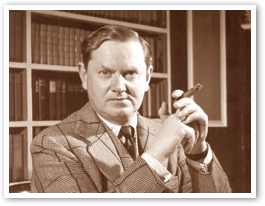
The Artist's Famously Terrifying 1000-Yard Stare

At the time of my discovery of Waugh I was living with a bunch of leftist grad students for roommates, and Waugh’s splenetic views of socialism (calling even its mild version in the 1945 Labour government such things as “the Atlee terror” and the “grey lice”) came in handy as stink bombs to be dropped over dinner, alternately perplexing and enraging my comrades in a combination I found greatly amusing. Like the 5-year-old boy that lives inside almost all men and exults in banging all the more and all the louder with his toy hammer upon discovering how greatly it vexes his mother, I would regularly and repeatedly quote Waugh whenever I sensed that doing so would drive at least one person into apoplexy.

Indulging this jejune pastime farther afield, I published articles in Canada and the United States, and gave lectures in both countries as well as Ukraine, about Waugh, deliberately using provocative titles (e.g., “In Defense of Christian Snobbery,” some excerpts of which and commentary on which may be found here) and highlighting choice bits from his rich correspondence and diaries as well as his novels and short stories. One in particular has often come in handy over the years as we are assaulted with fad diets and hectoring health nazis: "Food can and should be a source of delight. As for 'nutrition'--that is all balls."

More recently, I gave a scholarly lecture at a literary conference examining some of Waugh's characters and asking whether they could be considered examples of "holy fools" or iurodivy. My article was later published in Unruly Catholicsa book I first detailed here.

Now, a half-century after his early but--for him--welcome death (his letters and diaries for much of the last decade of his life indicate clearly how he welcomed the prospect of death), let us look back at both what he wrote, and what has been written about him.

To start with the latter category first: Biographies. There are four major biographies that have been written about him. All are interesting, and each contributes something unique, partly because each is written from a very different perspective. To take the weakest first, we start with Martin Stannard's two-volume Evelyn Waugh: The Early Years 1903-1939. The first is somewhat the more problematic of Stannard's two volumes, indulging as it does--though less so in the second volume, Evelyn Waugh: The Later Years 1939-1966--in subjecting Waugh to a crude kind of hostile armchair psychoanalysis.


The second biography was actually the first to appear within a decade after Waugh's death in April 1966, and it was written by his friend and sometime traveling companion Christopher Sykes, Evelyn Waugh: A Biography (1975). This did not pretend to be anything like a comprehensive and totally objective biography. The author was a sometime friend of Waugh, but had nonetheless enough distance to write a fair study of the man without indulging in any kind of romantic hagiography.

The third biography that came out was very good, and when it was published in 1994 was to that point the most comprehensive study extant: Selina Hastings, Evelyn Waugh: A Biography (1994). It was a literary study, and quite good, but it left one large lacuna: Waugh's faith, which Hastings, to her credit, seems to have felt unqualified to address and so she commendably passed over it largely in silence rather than make a hash of it, as Stannard did and others did during Waugh's life and since his death.

But far and away the best biography of Waugh, which has never been surpassed, was and is the absolutely splendid and superlative Douglas Lane Patey, The Life of Evelyn Waugh: A Critical Biography (1998). Patey's study is a true monument to the art of scholarly biography. I have often returned to it not only because it is such a delightful book, but also because it is a model of how to write a scholarly biography with great lucidity, intelligence, insight, and grace. Alone of the four biographies Patey's is not only the most penetrating and comprehensive, but also the only theologically literate study of Waugh's mid-century Catholic worldview. It is Patey's very considerable achievement that he could describe Waugh's faith accurately and without the rancor of a Martin Stannard, the dry dismissiveness of Sykes in some places, or the near-total silence of Hastings. Patey really makes it clear that Waugh cannot be understood without understanding his Catholic Christian faith. If you read only one biography, this is the one to read, and indeed the only one you really need unless you want to study the man as obsessively as I have. (It seems, in October of this year, we are to have a fifth biography: Evelyn Waugh: A Life Revisited. I look forward to reading it when it appears.)

Memoirs, Diaries, and Letters:

But there are other semi-biographical books or personal memoirs treating Waugh in whole or in part, most of them written by some of his friends. Frances Donaldson was Waugh's neighbor in the last decade of his life, and her short book offers some lovely and hilarious anecdotes about him: Evelyn Waugh: Portrait of a Country Neighbor.

A similar study of Waugh at one brief period of his life may be found in W.F. Deedes, At War with Waugh: the Real Story of Scoop. This is a very narrowly and very modestly interesting study of interest only to die-hard Waugh fanatics.

At points, Waugh was friends with nearly all the celebrated Mitford sisters, and insights into his friendship with Nancy Mitford, an accomplished novelist in her own right, may be found in The Letters of Nancy Mitford and Evelyn Waugh.

In a similar vein, one should also see Mr. Wu and Mrs.Stitch: The Letters of Evelyn Waugh and Diana Cooper, 1932-66. This collection of letters is perhaps especially useful in dispelling the notion that Waugh was always a cranky and rude old man, even with his friends. We see a tender side to him in, e.g., consoling Diana after the death of her husband, and constantly extending invitations to her to visit afterwards. When he indulges in some rather rough and ready Catholic apologetics with her, she rebukes him and he straightaway apologizes with complete grace and sincerity, thereby putting another lie about him to rest.

But perhaps the most diverse collection of remembrances was edited by David Pryce-Jones, Evelyn Waugh and His World. Containing, inter alia, essays by the priest who received Waugh into the Church in 1930, and his comrades in arms in Yugoslavia in the early 1940s, it offers many fascinating glimpses into various aspects of Waugh's life, as well as one of the most generous samplings of photographs and reproductions of Waugh's sketches for many of his novels. (Waugh had tremendous respect for the crafts, and for craftsmanship--sketching, painting, sculpting, and furniture-making. Indeed, he himself thought about furniture making as a career at one point, and his last son, Septimus Waugh, has long had a career as a cabinet-maker, joiner, and carver--as well as dabbling in the "family business" of writing.)

Going beyond piecemeal correspondence, the largest single collection of letters is very much worth a read: Mark Amory, ed., The Letters of Evelyn Waugh. (You can get a taste of one of Waugh's letters, recounting one of his outrageous experiences in the war, here, read by Geoffrey Palmer.)

I found it an interesting exercise to read his letters alongside his Diaries, trying to pair them up whenever possible to see what he was saying publicly in a letter on a given day and then more or less privately in his diaries.

Fathers and Sons is in a category of its own as far as biographical studies are concerned. It was written and published in 2004 by Waugh's grandson Alexander (who, at last report, is editing all of his grandfather's works to appear in an opera omnia from Oxford University Press at some point). It is a wonderful book as much for its winsome style as its revealing discussion of Evelyn Waugh, his son the journalist Auberon (whose Will This Do? the First Fifty Years of Auberon Waugh: An Autobiography was, I thought, a bit of a dud), and the "family business" of writing.

Finally in this category, and a suitable bridge as we turn next to his novels, one simply must read Paula Byrne's 2011 book, Mad World: Evelyn Waugh and the Secrets of Bridesheada hugely entertaining and deeply fascinating study of some of the real life family and friends who were, mutatis mutandis, behind some of the characters who occupy Waugh's most famous novel, Brideshead Revisited. (A similar, though not nearly as interesting, study was attempted by Humphrey Carpenter in Brideshead Generation: Evelyn Waugh and His Friends.)


Novels:

As just noted, Brideshead Revisited was a huge best-seller upon publication in 1945 and made Waugh a very wealthy man; and it has remained his best known work ever since, thanks not least to the lavish and lovely 1981 television adaptation featuring such illuminaries as Sir John Gielgud, Sir Laurence Olivier, and a young Jeremy Irons. For viewers of 2016: this 1981 series was the Downton Abbey of its time. If you have not seen it, then you simply must. (Pray do not pay the slightest heed to the wretched and beastly movie that came out in 2008 purporting to be based on Waugh's novel. It was, to use a Waughism, "too, too sick-making." As Charles Ryder's father from Brideshead would have said of the movie, "Such a lot of nonsense.") Jeremy Irons is also the reader for the audio book version of the novel, which is fantastic for long car rides.

Brideshead, for more than 70 years, has remained the best-known of his works, as I noted, but Waugh came to find the book distasteful in some ways, not least, as he later admitted, because it was deliberately written in a lush, lavish, luxuriant style, with great attention to food, wine, and wealth while he was a serving solder during the Second World War, with all the sensual deprivations of wartime Britain under severe rationing.

During the 1950s he traveled to Hollywood to negotiate a film deal about the novel, but it fell through in part because it featured an adulterous and divorced couple which American censorship rules of the time would not permit to be shown on screen. Waugh was just as glad it did not come to pass as he found the would-be producers totally obtuse and tone-deaf to the novel, which he regarded not as a paean to wealth or an encomium for the loss of the British aristocracy but as a lesson in the operation of divine grace.

It is on this point--how grace operates, and what it does, but especially does not do--that I think Brideshead is such a bracing corrective to too much of modern Christianity, perhaps especially in its moralistic-therapeutic North American versions of success and prosperity. The character clearly made out to be the worst in the novel--the morally degenerate, sexually disordered alcoholic Sebastian--emerges at the end to be the holiest of his family, spending his remaining days in the lowliest toil at a North African monastery, where he is treated as something of a joke: half-in, half-out the monastery, bottles of brandy hidden about the garden for a bender a few days of the month before pulling himself together again and appearing once more at chapel, repentant and sober (more or less).

His pseudo-saintly mother--whom the Joel Osteens of this world would gladly salute for her riches and apparent success--was a misguided and largely destructive force whose treacly piety does not adequately mask her libido dominandi, especially that directed at her adulterous husband ("that Reinhardt nun, my dear, has destroyed him but utterly," as Anthony Blanche memorably and accurately puts it, noting that she "has convinced the world that Lord Marchmain is a monster"). She screws up her own life and that of all her children, though they each in turn add to their woes. (Her friends, too, fare no better: "She sucks their blood" as Blanche says.) But grace does not swoop down to rescue any of them (just as their enormous wealth does not protect them either) from all the ill effects of their sin. Sebastian is "saved" in the end, but only as through fire; grace perfects and transforms nature, but the scars remain, as even the body of the resurrected Christ makes clear.

Brideshead appeared relatively late in Waugh's career, even if he was only 42 at its advent. He had, long before the war, made his mark for such novels as Decline and Fall (1928), Vile Bodies (1930), Black Mischief (1932), and A Handful of Dust (1934). These satirical-comical novels treated, inter alia, the vapidities of the inter-war generation of "bright young things" (of whom Waugh himself was sometimes accounted a part) and the vacuous promises of "progress," a word and concept that never failed to move Waugh to mockery ("Progress is a word that must be dismissed from our conversation before anything of real interest can be said"). By these novels he also became widely acclaimed as the great chronicler of the bright young things


Black Mischief in particular got him in some trouble by the editor of the Tablet, an obtuse sycophant who did not appreciate Waugh's satire about such things as African cannibalism. (One can only imagine the shrieking outrage of the banshees on Twitter were a publisher courageous enough to bring out such a book today.) This novel also made clear Waugh's lifelong disdain for "this revolting age" with all its preening technological advances and social "progress" that do nothing but cover over its moral, artistic, and spiritual bankruptcy. The longer the 20th century went on, the darker Waugh's vision of it became, so that by the time (1949) he would write the preface to Thomas Merton's Elected Silence he would say "the modern world is rapidly being made uninhabitable by the scientists and the politicians."

My favourite novel from this period is Scoop, published in 1938. It is loosely based on Waugh's real-life adventures as a journalist paid by London papers to report from Abyssinia on the imperial coronation of 1930 mentioned above. Anyone who thinks the laziness and mendacity of journalists which Waugh mocks in this novel are a thing of the past has simply not been paying attention to today's shenanigans. As Conrad Black, himself an erstwhile London newspaperman, noted several years ago,
a substantial number of journalists are ignorant, lazy, opinionated, and intellectually dishonest. The profession is heavily cluttered with aged hacks toiling through a miasma of mounting decrepitude and often alcoholism, and even more so with arrogant and abrasive youngsters who substitute 'commitment' for insight.
Historical-Biographical-Fictional Works:

The 30s were Waugh's most productive period because in addition to all the foregoing, he also produced a prize-winning historical-fictional account of the martyrdom of the Jesuit priest Edmund Campion. Written in a restrained, rather formal style, this book, published in 1935, was one of several semi-fictionalized treatments of important Catholic figures. Waugh felt that this book was, in part, a re-payment of personal debts owed to the Jesuits, not least the Jesuit priest, Martin D'Arcy, who instructed him and received him into the Church in 1930. It was also something of an aide-mémoire, reminding audiences of the 1930s that the martyrdom of Catholic clergy in 16th- century England had contemporary and ongoing parallels in those martyrdoms then occurring in the violence of revolutionary Mexico, which Waugh treated in Robbery Under Law (about which more below).

Two other such studies would follow, but not until the 1950s:

Helena (1950) was regarded by Waugh (according to Patey) as his true magnum opus. It is a short book, but full of buried jokes and puns, deliberately anachronistic speech, and political pot-shots at the socialism of the Atlee government. Waugh--who was often falsely accused of sucking up to the aristocracy and upper classes--deliberately chose to write about the life of the dowager empress of the Roman Empire in part because as the richest and most powerful woman of her time she showed that wealth and power were not, per se, obstacles to sanctity. (And Helena is indeed a canonized saint in the Catholic Church, and feted by Byzantine Christians as "co-equal to the apostles" along with her emperor son Constantine.) Moreover, he liked her, as he explains in his letters, because of her understanding of vocation: it did not necessarily require being thrown to the lions, or living in a desert eating locusts.

I love Helena not only for the humour but especially for her description of the feast of Epiphany/Theophany, and for what she says about the gifts brought by the wisemen, gifts that were not needed but "were accepted and put carefully by, for they were brought with love. In that new order of charity that had just come to life, there was room for you, too.....For His sake who did not reject your curious gifts, pray always for the learned, the oblique, the delicate. Let them not be quite forgotten at the Throne of God when the simple come into their kingdom."

Finally from this period, a formal, factual, and authorized biography, published in 1959, was devoted to Waugh's friend, the Roman Catholic convert, priest, and scholar: The Life of the Right Reverend Ronald Knox: Fellow of Trinity College, Oxford and Protonotary Apostolic to His Holiness Pope Pius XII. It is a slender study in a highly formalized style that does not pretend to be exhaustive. It, too, was repayment of a debt of sorts, and also, I think, something of a plaidoyer for Knox, whom Waugh and others felt had been badly treated by the English bishops, perhaps out of envy at Knox's superior education and background.

Semi-Autobiographical Works:

Waugh, though nearly 40 when war broke out, was desperate to obtain a position serving because he thought that wartime adventures would give him fresh material for later novels, and in this he was right. George Weigel has retailed some (possibly apocryphal) tales about Waugh's military service, including needling people by asking whether “in the Romanian army no one beneath the rank of Major is permitted to use lipstick.” And Patey's biography gives us tales of Waugh's researches in Tito's Yugoslavia. Waugh came to loathe Tito for his vicious persecution of Christians, and began a long campaign of mocking Tito as really a lesbian, whom he called "Auntie." ("Her face is pretty, but her legs are very thick.")

His resultant war trilogy is based in part on his own experiences, and has been acclaimed as one of the most realistic portrayals of what actual wartime service was like.

That trilogy was also turned into a movie which is not bad at all: Sword of Honour stars Daniel Craig and Nick Bartlett, inter alia.

Desperate to get out of England after the war, especially during the winter, and desperate therefore for a trip to warmer climes that someone else would pay for, Waugh undertook a number of trips, including most infamously a sea voyage in January 1954 for Rangoon. Waugh at this point in his life was plagued with boredom, melancholy, and insomnia. To deal with all three, but especially the latter, he was accustomed to regular imbibing of pharmacologically primitive sleeping potions liberally taken with large splashes of crème de menthe (on top of copious drinking during the day--gin, claret, champagne, wine). Over time, these sleeping draughts were slowly intoxicating him in what would be medically diagnosed as bromide psychosis, causing the fantastic delusions and hallucinations he had aboard the ship. Instead of hiding this embarrassing escapade, he used it as the basis for what he openly acknowledged was his most heavily autobiographical novel, The Ordeal of Gilbert Pinfold, which is also available in audio form. After he returned and went through a period of detox, he gleefully reported to friends "I've been mad!" and "I was clean off my onion!" He then adapted these experiences for use in Pinfold. 

Finally, Waugh attempted an actual autobiography, A Little Learning. It is a laconic work and clearly Waugh's heart was not really in it. He never finished it: this is the first of what were expected to be at least two volumes. Published in 1964 less than two years before his death, this book only goes up to Waugh's suicide attempt in 1925 which, like the book itself, was rather desultory and manifestly incomplete. Waugh died before bringing out a second volume, but even before undertaking the writing of this one, his diaries and letters are full of his worries that his writing days were over, that he saw nothing but boredom and tedium in the years ahead, and that he had run out of anything fresh to say.

In addition, his spirits were not helped by the Second Vatican Council, whose reforms, he confessed, had knocked the stuffing out of him, making attendance at church now "pure duty parade." He regarded the liturgical reforms above all with nothing short of horror and was glad that his life would not last long enough to have to endure further changes. He confessed to family and friends that the council had sucked the last bits of joy from his life, and everyone agreed that his death, on Easter Sunday itself in 1966 shortly after hearing Mass in the traditional form he loved so well, was something he greatly welcomed. (Had he further exposure to the clunky, graceless, ideologically driven English translations of the Mass, one could well imagine Waugh saying of the translators what he himself said of the socialist writer Stephen Spender: ''to see him fumbling with our rich and delicate language is to experience all the horror of seeing a Sèvres vase in the hands of a chimpanzee.'')

Waugh's disgust with the changes, and especially with the mendacity and treachery of the hierarchy in the 1960s, comes through in a short but powerful little book, A Bitter Trial: Evelyn Waugh and John Carmel Cardinal Heenan on Liturgical Changes. Waugh was not, however, solely against John XXIII or Paul VI. He regarded Pope Pius XII as a villain for his reforms (also brought about by Bugnini) to Holy Week services, which Waugh felt had been completely wrecked in the name of restoring so-called earlier usages.


Political and Occasional Works:

Waugh made no secret of his disdain for modern politics. He hated being at parties where people wanted to talk politics, and found the whole area tedious. In the run-up to the 1959 election, the Spectator asked him to write a short piece, which he did: "Aspirations of a Mugwump," published in The Essays, Articles and Reviews of Evelyn Waugh. This collection, edited by Donat Gallagher, is absolutely invaluable for collecting a lot of Waugh's short and early pieces--essays, book reviews, and other doggrel he wrote to earn money before he made it into the big leagues.

In his short 1959 essay, Waugh noted that "I have never voted in a parliamentary election. I shall not vote this year." He regarded the whole process as a "very hazardous process" for the Sovereign to choose ministers. Calling popular election a source of "many great evils," he ended thus: "I do not aspire to advise my sovereign in her choice of servants."

For all his voluble disdain of politics, however, he did give it some sustained attention in what is perhaps his least known non-fiction work, viz., Robbery Under Law. This was a study he undertook after a paid trip to Mexico to see what life was like after the revolution there. He memorably described himself as a "conservative" after that trip, saying, inter alia:
Civilization has no force of its own beyond what is given it from within. It is under constant assault and it takes most of the energies of civilized man to keep going at all. There are criminal ideas and a criminal class in every nation and the first action of every revolution, figuratively and literally, is to open the prisons. Barbarism is never finally defeated; given propitious circumstances, men and women who seem quite orderly, will commit every conceivable atrocity. The danger does not come merely from habitual hooligans; we are all potential recruits for anarchy. Unremitting effort is needed to keep men living together at peace; there is only a margin of energy left over for experiment however beneficent. Once the prisons of the mind have been opened, the orgy is on. 
American civilization was one with which Waugh had an ambivalent relationship. There was much in 1950s America he admired, and American audiences made him very rich, not least when Brideshead was a Book of the Month pick, and sold well over 100,000 copies in the US alone.  But American treatments of death provoked what is perhaps Waugh's most masterful work of social satire, the 1948 novella The Loved One. It is a brutal fictionalized take-down of the treacly euphemisms emanating from and the vulgar death-denying, money-making machinations of the gruesome funeral industry, a parallel to the non-fiction and equally scathing work of Waugh's compatriot Jessica Mitford, The American Way of Death.

There is more that could be said about Waugh, and further works that could be discussed, but this covers his main works and is sufficient, I trust, to illustrate my main point: tolle, lege. 
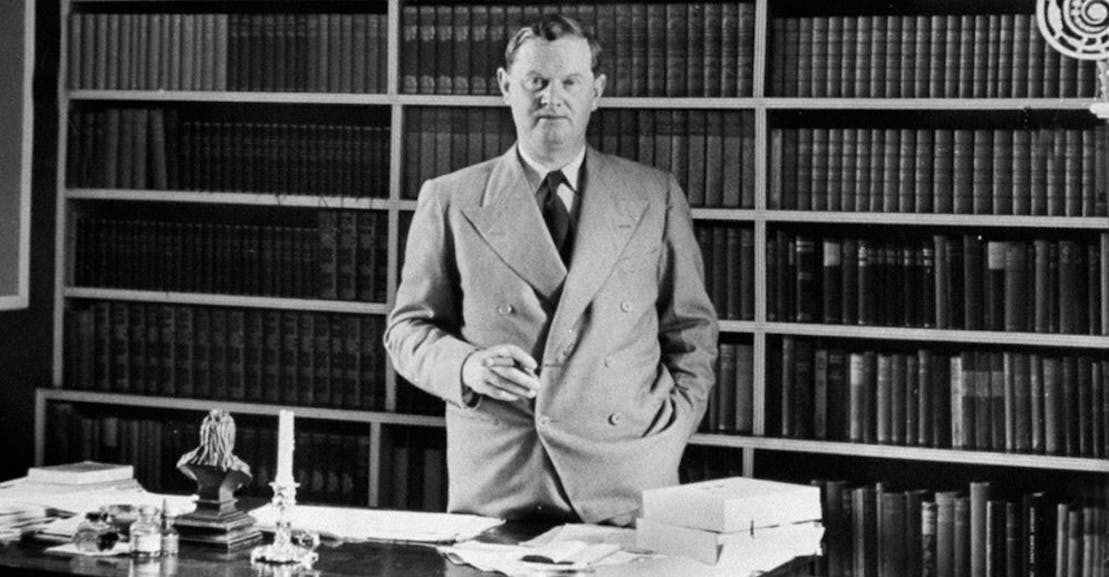
Our Hero in His Library

Monday, May 18, 2015

The Messiness of Synodality

It always astonishes me that my students are astonished at the development of Christian doctrine. These innocents, knowing very little even recent American history, know absolutely nothing about ancient Christian history. They seem fondly to have imagined—if they have thought about the matter at all—that, e.g., the Nicene Creed “had fallen from heaven quite unexpectedly during Good Friday luncheon some years back” (to use one of the lines from Evelyn Waugh’s uproariously politically incorrect novel Black Mischief). When they discover that it did not—that the creed was a lengthy process of synodal or conciliar debate going on for decades—they are not only amazed but some of them even a little disgusted. The raw humanity of the Church--which, I must remind them, has two natures, as Christ did: divine and human--seems to be rather disdainful to some. (Others, of course, can see only the human side, and therefore reductionistically and simplistically assume that every decision was the result always and only of political machinations of the most sordid and self-interested variety, with no possible room for the Holy Spirit to drop His ready-made creeds into the diners' laps.)

When we cover the era of The First Seven Ecumenical Councils (325-787): Their History and Theology, starting at Nicaea I in 325 and ending with Nicaea II in 787, and spending the most time on Chalcedon in 451, every one of them in classes going back nearly a decade has professed to be amazed at how messy, protracted, polemical, and confrontational the process was by which Christological doctrine was shaped and defined, not least in the creed. In the passive-aggressive argot of today, they ask: Why was everyone so “divisive”? Wasn’t the reaction to Arius rather “extreme”? Couldn’t they have just tolerated a diversity of opinions? After all, who cares how many natures Christ has, or what the relationship, if any, between them is. This is all irrelevant nonsense--isn't it? We can still be nice persons whether Christ has one nature, two, or 391,704.

Eventually, of course, the Church was guided to understand the dyophysite nature of Christ, and to settle other related and controverted matters. But it took time and effort lasting centuries. There was, then, no neat, tidy, simple, quick process for the formation of doctrinal claims that most of us take for granted today and have seemed settled for ages if not forever. It was a process taking decades and centuries, and in the meantime there was a lot of unsettled opinion and a great deal of vigorous, and occasionally violent, fighting. A very good, if dense, book for the formation of Christological doctrine remains that of Khaled Anatolios (whom I interviewed here), Retrieving Nicaea: The Development and Meaning of Trinitarian Doctrine.

Such is the way of synods and councils, East and West, ancient and modern. As we finish the seemingly endless commemorations of Vatican II this year, Catholics of a certain age--now fewer and fewer with each passing year--will remember the tumult in the post-conciliar period. Those with longer historical memories will know that whether it is Nicaea I, Chalcedon, Lateran IV, Trent, or some other synod, it takes decades for things to settle down, and in the meantime the process remains often painfully messy. Indeed, in not a few cases, things get worse after a synod/council, and the question is often raised: was the "cure" not worse than whatever the precipitating "disease" was? Such is the way synodality down through the ages.

I mention all this in anticipation of what I fully expect to be a shambolic synod in Rome in October, picking up where last year's session left off. I've talked to many people who have been disconcerted by the messiness and controversy last fall, but such concern is, in part, likely a function of just how unfamiliar the West is with synodality, though there is a long history of the same going back to the earliest centuries, as I documented in my book, Orthodoxy and the Roman Papacy: Ut Unum Sint and the Prospects of East-West Unity.

For those wishing more depth and detail on the topic, see the hefty scholarly collection (of uneven quality, and with articles in French and other European languages), Synod and Synodality: Theology, History, Canon Law and Ecumenism in New Contact.

Other works, most of them mentioned or reviewed on here over the years, that may be of interest would include Paul Valliere's rather uneven but still insightful Conciliarism: A History of Decision-Making in the Church.

Valliere's title does not really treat what one expects under the heading of "conciliarism," on whose history, in the West, Francis Oakley is the doyen. As I have noted before, Oakley's book on the topic, The Conciliarist Tradition: Constitutionalism in the Catholic Church 1300-1870, discussed in depth here, is a deeply disturbing one raising age-old questions that nobody has bothered to answer--preferring instead to ignore them or "forget" them. I am using part of it in a lecture I am giving at Fordham next month at the OTSA meeting.

Finally, I would recommend a rich collection discussing ecclesiological and ecumenical issues, including synodality: Receptive Ecumenism and the Call to Catholic Learning: Exploring a Way for Contemporary Ecumenism.

Wednesday, March 11, 2015

Jean Vanier on Loving Human Beings

Normally I find Canadian nationalism utterly risible, and a long time ago I developed an allergy to the pathetically passive-aggressive boosterism that some Canadians use (what is the current and apt portmanteau? "humblebragging"?) to try to prove their worth in the face of superior cultures. But in at least one instance, I am glad indeed to share the same terre de nos aïeux with this year's Templeton Prize winner, Jean Vanier. Axios!

I think I first heard Vanier (who has a lovely and lyrical speaking voice) during his 1998 Massey Lecture, and thereafter began to read him. I have remained haunted by this man's life and work for he is an example to all of us, but especially those of us who endanger our faith and humanity by being academics. Descended from a famously distinguished and much-decorated vice-regal family of deep Christian faith, Vanier could have had a conventional academic career, for which he received a doctorate in Paris. But truly here is a man who has heeded and embodied that famous Evagrian dictum that Eastern Christians are forever quoting to each other: the "theologian" is a man of prayer, of service, and of love. All the degrees in the world matter not a whit if you have not love, especially for the most unlettered and unloved of people, including, in Vanier's case, those "handicapped" people otherwise condemned to be warehoused away.

Vanier, appalled at such treatment, founded the now widespread international movement L'Arche, with 147 communities in 35 countries. L'Arche puts Christian hospitality into action, creating houses where "handicapped" people can love and be loved. Early on he helped me understand one thing clearly: people involved with serving others can often be prone to a kind of paternalism in thinking of themselves as only the givers, but in fact they often receive back far more than we give, and far more important gifts too. Moreover, Vanier, together with Henri Nouwen, helped me to realize that all of us are "wounded healers" and we need to be open to receiving from others even as we need also to be able to give. Vanier's life of heroic virtue shows us the wisdom that Charles Ryder utters in Evelyn Waugh's Brideshead Revisited: "to know and love one other human being is the root of all wisdom."

Wednesday, November 20, 2013

Icons of Death

Driving home the other day, I turned off the radio in a fury when some nitwit on the local NPR station kept referring to people who recently "passed." To that insufferable recent usage, I always reply with heavy sarcasm: Passed what? wind? the off-ramp on the highway they were supposed to take? a school examination? "Passed away" was bad enough--which I never used not only because I abhor death-denying euphemisms but also because it's shoddy theology--but this "passed" business really is intolerable. People die; when they have done so, they are dead. We are--as Evelyn Waugh noted, in his own myth-busting, euphemism-mocking satire of death and funerals, The Loved One--parched for this kind of straight-talk today, stranded in a desert of denial and obfuscation. The inability or unwillingness to speak candidly about death serves nobody well.

Released this month is a Kindle version of an interesting book that reveals a very different approach to death taken by Eastern Christians, an approach that looks death in the face and avoids the cowardly dodges so many take today. Originally published in 1997 by a leading classicist and historian who is well acquainted with Byzantine iconography is Robin Cormack's Painting the Soul: Icons, Death Masks and Shrouds.

About this book we are told:
Icons are among the most elusive subjects in the history of art, but at the same time their study constitutes possibly its fastest expanding field, and with the opening-up of the former Soviet Union many new objects are being discovered, studied and exhibited. In this book, Robin Cormack considers the icon as an integral document of society and gives us new insights into the nature of Byzantine art. Painting the Soul explores both the creation and the development of the icon. After the early Christians – like the pagans before them – had come to expect their god to be visually present among them, endless questions confronted both the artist and the Church. What did Christ look like? How should Christ be represented? Should Christ be represented (as he is for example on the Turin Shroud)? Appropriately, Cormack’s study ends with Venetian Crete, where the icon underwent its final development and transformation into the art of the Renaissance. Here, established Byzantine forms of religious art confronted developing Renaissance modes of expression: the first ‘icons’ of El Greco were painted in Crete. Painting the Soul is beautifully illustrated, featuring many little-known works of art. Even so, Cormack treats the icon not as a mere artistic product, but as the symbolic face of medieval Europe. He shows how this new field within the history of art – the study of the icon – will transform our understanding of European art and culture.
As noted, Cormack is the author of Byzantine Art (Oxford UP, 2000), 256pp. as well as Icons (Harvard UP, 2007), 144pp.
Related Posts Plugin for WordPress, Blogger...