"Let books be your dining table, / And you shall be full of delights. / Let them be your
mattress,/
And you shall sleep restful nights" (St. Ephraim the Syrian).


Showing posts with label Georges Florovsky. Show all posts

Friday, October 15, 2021

The Theological Work and Witness of Matthew Baker

I only met Matthew Baker once. He also happened not long after to contribute an essay to the journal I edit, Logos: A Journal of Eastern Christian Studies. And then suddenly he was gone, killed in a car accident, leaving a lovely family and many other lives and loves behind. It was clear to everybody that had he lived, he would have been a very prominent and influential academic theologian. 

In September of this year, St. Vladimir's Seminary Press gathered together and published a Festschrift for him: Faith Seeking Understanding (2021), 368pp. About this book the publisher tells us this: 

This book offers a collection of the essays, letters, interviews, and correspondence of Fr Matthew Baker, exploring the works of Fr Georges Florovsky and the writings of the Church Fathers.

‘The Fathers are ahead of us, with Jesus—it is we who should be running to catch up to them.’ Thus Fr Matthew Baker, in one of the interviews included in this volume, summarizes and defends the understanding of Orthodox theological method espoused by his hero, Fr Georges Florovsky, known as neopatristic synthesis. We tend to be programmed in Western societies into thinking that simply by virtue of living in the twenty-first century, we are somehow ‘ahead,’ that we are intellectually, morally, and theologically superior to our forebears just because we happen to live later than they did, and in an age of technological marvels. But the measure of what puts us ‘ahead’ as human beings is neither time nor technology, but our proximity to Jesus Christ. This is what allows the category of the Fathers to remain a steadfast one in Orthodox theology: not simply because in the distant past they forged lasting and faithful expressions of the Gospel, but because in doing so they assimilated the very life of the One they sought to defend and glorify, the Coming One, thereby becoming living witnesses before us (not just behind us) to the only truth that can save human beings….

Monday, November 23, 2020

Schmemann and Florovsky's Correspondence

I just got the new (and very thick!) catalogue of St. Vladimir's Seminary Press in the mail. There are, as you can imagine, all sorts of gems in it, but the first that leapt out concerns two pivotal figures I first read and studied in one of my doctoral classes almost 20 years ago now: Alexander Schmemann and Georges Florovsky. Both are towering figures of 20th-century Orthodoxy, and both are always fascinating to read. 

Both men entered into a post-war correspondence that has just been published under the translation of Paul Gavrilyuk (whose previous superlative study of Florovsky I discussed in detail here): On Christian Leadership: the Letters of Alexander Schmemann and Georges Florovsky (1947-1955) (New York: SVS Press, 2020), 416pp.

I am a great reader of and believer in the value of letters, diaries, and journals and the utility of all of them to scholarship. So I shall greatly look forward to reading this new collection, about which the publisher tells us this:

Fr Georges Florovsky (1893-1979) and Fr Alexander Schmemann (1921-1983) profoundly shaped twentieth-century Orthodox theology. Their correspondence, edited and translated for the first time, provides a unique window into their theological visions, leadership styles, and interactions with their contemporaries. Most of the letters were written when Florovsky had recently moved to the US to lead and organize the fledgling St Vladimir s Orthodox Theological Seminary in New York, while Schmemann was still teaching at the St Sergius Orthodox Theological Institute in Paris. The correspondence also reveals the circumstances of Schmemann s move to the US at the request of Florovsky, and offers glimpses into their subsequent collaboration at St Vladimir s Seminary until their tragic rift in 1955. Reminiscent of the style of Schmemann s Journals, the letters lay out the challenges of leadership with brutal honesty and good humor, bearing an eloquent testimony to their authors dedication to launching a new era of seminary education.

Wednesday, May 22, 2019

Faith and Science in Russian Orthodox Thought

For some people, there is apparently a conflict between what they conceive of as 'faith' on the one hand and 'science' on the other. This has always seemed to me to rest upon one, and likely several, mistakes, but for those who struggle with such questions a new book may help: Teresa Obolevitch, Faith and Science in Russian Religious Thought (Oxford University Press, July 2019), 240pp.

Faith and Science in Russian Religious Thought provides a comprehensive analysis of the relationship between science and faith in Russian religious thought. Teresa Obolevitch offers a synthetic approach on the development of the problem throughout the whole history of Russian thought, starting from the medieval period and arriving in contemporary times. She considers the relationship between science and religion in the eighteenth century, the so-called academic philosophy of the 19th and 20th century, the thought of Peter Chaadaev, the Slavophiles, and in the most influential literature figures, such as Fedor Dostoevsky and Lev Tolstoy.

The volume also analyses two channels of the formation of philosophy in the context of the relationship between theology and science in Russia. The first is connected with the attempt to rationalize the truths of faith and is exemplified by Vladimir Soloviev and Nikolai Lossky; the second wtih the apophatic tradition is presented by Pavel Florensky and Semen Frank. The book then describes the relation to scientific knowledge in the thought of Lev Shestov, Nikolai Berdyaev, Sergius Bulgakov, and Alexei Losev as well as the original project of Russian Cosmism (on the examples of Nikolai Fedorov, Konstantin Tsiolkovsky, and Vladimir Vernadsky). Obolevitch presents the current state of the discussion on this topic by paying attention to the Neopatristic synthesis (Fr Georges Florovsky and his followers) and offers the brief comparative analyse of the relationship between science and religion from the Western and Russian perspectives.

Friday, December 15, 2017

Robert Slesinski on Sergius Bulgakov

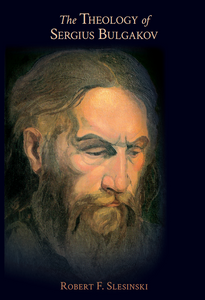
Robert Slesinski is always worth reading, and has established himself as a leading and wide-ranging scholar of several of the noteworthy figures of the Russian Silver Age and of her theological renaissance from the end of the 19th through the middle of the 20th centuries. He has published a number of articles and reviews in Logos: A Journal of Eastern Christian Studies over the years. And now, I'm delighted to tell you, St. Vladimir's Seminary Press has just published his newest study, The Theology of Sergius Bulgakov (2017), 280pp

Following my usual practice, I e-mailed some questions to Fr. Bob about the book, and here are his thoughts.

AD: Tell us about your background

RS: I am a Ruthenian Byzantine Catholic priest (Eparchy of Passaic, NJ) of over 40 years, but my surname gives me away as something else.  On my paternal side, I am Polish, but not insignificantly on my maternal side I am German-French-English.  In sum, I'm a hybrid.  But growing up in Worcester, Massachusetts, there was never a time when I did not have to pronounce and spell my last name!

Going on to college I would have liked to have taken Polish as a "foreign language" requirement course, but few colleges offer Polish as a subject of study.  But Russian was offered--and that was the beginning of my interest in all things "Russian."

Having discerned a possible vocation to the priesthood, I was accepted as a candidate by the RC Diocese of Worcester--my pastor at the time, by the way, was a Melkite turned RC and I was his first vocation to the priesthood. I was sent to the North American College in Rome with the understanding I could frequent the Russian College. Well, after a year at NAC I transferred to the Russicum and subsequently was accepted by the Eparchy of Passaic...the beginning of a life's journey.

AD: Your 1984 book was a real scholarly landmark, devoted to Pavel Florensky. Are there connections you see from him to Bulgakov?

RS: My first book, Pavel Florensky: A Metaphysics of Love, my doctoral dissertation was, indeed, published by SVS Press, and now they are publishing my fourteenth book, The Theology of Sergius Bulgakov.  The two figures are intimately connected, the former serving as a "spiritual father" to his "spiritual son."


There is a famous painting of the two, "The Philosophers," by M. Nestervov in the Saint Petersburg, Russia, Art Museum of the two walking in Florensky's garden at Sergiev Posad.  The whole composition has Florensky as a "Plato," as it were, and Bulgakov as an Aristotle. (AD: the photo is on the cover of the book at left.)

AD: There's been a huge upswing in studies devoted to Bulgakov over the last couple of decades. Why do you think he continues to command such a wide interest?

RS: Bulgakov has surprisingly been neglected in Orthodox circles--after all, he was "convicted" of "heresy."  Westerners--like Hans Urs von Balthasar--who were interested in possible insights from the Christian East rediscovered him.

AD: Your introduction seems to suggest that Orthodoxy did not pay much attention to Bulgakov until and after Western Christians began doing so. What led the West--among whom you single out such luminaries as Rowan Williams, Aidan Nichols, and John Milbank inter alia--to Bulgakov? Was it a perceived gap in the Western tradition that he somehow filled, or was it something else?

RS: This continues your next question: people like myself--Westerners--are, indeed, interested in gaining insights into our common Christian tradition from the East.

AD: Your first chapter notes "some truly eye-opening statements" about Bulgakov's openness to the Catholic Church, not least about the papacy and the filioque, about which he said "I am a 'filioquist'." What do you think he meant by that?

RS: Bulgakov as a person was deeply, indelibly, steeped in Orthodox tradition, but was devastated by the Bolshevik Revolution. Just as at the time of the Council of Florence as the Turks were overwhelming Constantinople, Bulgakov flirted with a possible help from Rome.  Now he remained a confirmed Orthodox, but still affirmed certain "Catholic" beliefs like the filioque, embracing Augustine's paradigm of love to explain the Holy Trinity.

AD: My perception of Bulgakov (admittedly it's been a few years since I read T.A. Smith's translation of The Burning Bush) is that he often finds a way to accept or even agree, broadly speaking, with the substance of Catholic doctrine, but finds ways to disagree methodologically--either the categories of definition, or the papal mechanisms of definition of the modern Marian dogmas. Is that a fair distinction?

RS: To continue the discussion...the esteemed late Alexander Schmemann, an actual student of Bulgakov, made the observation that however "Orthodox" Bulgakov was, he always wanted to put his original stamp of "things"--novelty being his mode of action.  Catholic doctrine/dogma he was wont to characterize in his own terms--not necessarily of those of Catholics themselves.  Curiously, as "opposed" as he was to the dogma of the Immaculate Conception (he was a partisan of Aquinas in this matter), he fervidly argued in favor of the Theotokos being a "Co-Redemptrix."

AD: You note at the beginning of ch.7 that Bulgakov's understanding of the Catholic dogma of the Immaculate Conception "is found to be wanting" but the rest of his Mariology is not. Tell us more about that.

RS: My answer to this question is to repeat what I say in response to the last question--only to add that Bulgakov was utterly convinced in his sophiological understanding of May, she truly was the Pneumatophore--the Bearer of the Holy Spirit!


AD: In ch.8 you note Florovsky's influence on modern Orthodoxy's turn to history and patrology at the expense of more systematic theology such as Bulgakov's. Why is that? What is behind the focus on history and the fathers--and also behind the fear of Bulgakov's more speculative and systematic work?

RS: Florovsky's influence, to my mind, became paramount after the indictment of heresy.  He was an historian--hence patristics.  And we all know of the centrality of the Divine Liturgy for the Christian experience of God, hence liturgical theology.  Speculative theology/philosophy of the likes of Bulgakov did not, alas--to my mind--find a resonant ear in the Orthodox.

AD: Having done some work in both Orthodox and Catholic ecclesiology, I naturally read your 14th chapter, "Ecclesiological Musings in Bulgakov," with great interest. The word 'musings' is especially noteworthy, as you go on to suggest that Bulgakov may have been a bit sloppy with the scriptural texts, claiming they give no "'indications concerning the Church as an organization'" (p.209).  Later on you speak of his rather 'cloudy' approach to the Church's sacramental character. And once again his love-hate relationship to Catholicism returns in his discussion of papal infallibility. What lies behind these rather conflicted views?

RS: There is no doubt in my mind that the weakest theology of Bulgakov is in the area of ecclesiology.  I would surmise he was reading too much of German Protestant theology.  Catholics and Orthodox are truly one in this area.

AD: Tell us what your hopes were for this book, The Theology of Sergius Bulgakovand who should read it.

RS: Well, my book is intended to inspire any philosopher-theologian to consider Bulgakov as an area for insight in coming to terms with understanding God and the cosmos.  Now that ALL the major works of Bulgakov are in English translation, I would hope that my "modest" monograph may assist in appreciating the theological genius of Bulgakov.

AD: Having finished this, what projects are you at work on now?

RS: Over the ten years I worked on my Bulgakov book I have written seven other books in "mystagogical catechesis;" I am now working on another one The Holy Mysteries: Celebrating Christ's Sacramental Presence.

Wednesday, December 9, 2015

Georges Florovsky and the Fathers

I just got the T&T Clark/Bloomsbury catalogue in the mail, and noticed a volume coming out in late 2016 edited by B.Gallaher with P. Ladouceur as co-editor: The Patristic Witness of Georges Florovsky: Essential Theological Writings (October 2016, 304pp).

About this book the publisher tells us:
This book is a collection of major articles and texts by Georges Florovsky (1893-1979), an important 20th-century theologian, historian, ecumenist and patristic scholar. It includes representative and widely influential but now largely inaccessible writings, some newly translated, with explanatory and bibliographical notes, covering all periods of his career and divided into four major thematic sections: 1) Creation and Incarnation; 2) The Nature of Theology; 3) Ecclesiology and Eschatology; 4) Scripture, Worship and Eschatology.
A foreword by Metropolitan Kallistos Ware presents the theological vision of Georges Florovsky and discusses the continuing relevance of his work not only for Orthodox theology but also for modern theology in general. The Introduction by Brandon Gallaher and Paul Ladouceur gives a broad theological and historical overview of Florovsky's work, relating it to trends in both modern Roman Catholic and Protestant theology and outlining his importance to contemporary ecumenism, patristics and Orthodox thought and life. The book includes explanatory notes, translation of patristic citations and an index of proper names.
Florovsky, of course, remains one of the most important (some would say the most important) Orthodox theologians of the 20th century, and his death in 1979 has if anything only increased interest in his work, as Paul Gavrilyuk's recent book on Florovsky makes clear. 

Wednesday, October 28, 2015

Florovsky and the Russian Religious Renaissance

It's hard to believe it was a full year ago since I was in Brookline for the annual meeting of the Orthodox Theological Society of America, where I was an invited panelist and respondent to Paul Gavrilyuk's excellent book, Georges Florovsky and the Russian Religious Renaissance. (I posted my response here.)

Now we are told that in December, a more affordable paperback version of the book is to be published so you really do have no excuse for not getting a copy!

This is a major study of the man widely regarded as the most influential Russian theologian of the 20th century. It raises acute issues not only about Florovsky but about many other matters--historiography, Russian culture, Orthodox identity and engagement with both Western and "Eurasian" culture, etc.

As the publisher told us about this book when it first appeared:
Georges Florovsky is the mastermind of a "return to the Church Fathers" in twentieth-century Orthodox theology. His theological vision--the neopatristic synthesis--became the main paradigm of Orthodox theology and the golden standard of Eastern Orthodox identity in the West. Focusing on Florovsky's European period (1920-1948), this study analyzes how Florovsky's evolving interpretation of Russian religious thought, particularly Vladimir Solovyov and Sergius Bulgakov, informed his approach to patristic sources. Paul Gavrilyuk offers a new reading of Florovsky's neopatristic theology, by closely considering its ontological, epistemological, and ecclesiological foundations.
It is common to contrast Florovsky's neopatristic theology with the "modernist" religious philosophies of Pavel Florensky, Sergius Bulgakov, and other representatives of the Russian Religious Renaissance. Gavrilyuk argues that the standard narrative of twentieth-century Orthodox theology, based on this polarization, must be reconsidered. The author demonstrates Florovsky's critical appropriation of the main themes of the Russian Religious Renaissance, including theological antinomies, the meaning of history, and the nature of personhood. The distinctive features of Florovsky's neopatristic theology--Christological focus, "ecclesial experience," personalism, and "Christian Hellenism"--are best understood against the background of the main problematic of the Renaissance. Specifically, it is shown that Bulgakov's sophiology provided a polemical subtext for Florovsky's theology of creation. It is argued that the use of the patristic norm in application to modern Russian theology represents Florovsky's theological signature.
Drawing on unpublished archival material and correspondence, this study sheds new light on such aspects of Florovsky's career as his family background, his participation in the Eurasian movement, his dissertation on Alexander Herzen, his lectures on Vladimir Solovyov, and his involvement in Bulgakov's Brotherhood of St Sophia.

Friday, October 24, 2014

Paul Gavrilyuk, Georges Florovsky, and Alasdair MacIntyre Meet in a Bar....

I'm in Boston this weekend at the annual conference of the Orthodox Theological Society of America. I was asked to come to give a response to Paul Gavrilyuk's excellent and important new book Georges Florovsky and the Russian Religious Renaissance.

I've taken the liberty of posting below the comments that I shall be making this weekend as one of the respondents to the book:
 
A Response to Paul Gavrilyuk, Georges Florovsky and the Russian Religious Renaissance (OUP, 2014)
Delivered 24 October 2014 at the Orthodox Theological Society of America’s Annual Conference,
Holy Cross College, Brookline, MA
Adam A.J. DeVille, Ph.D.[1]

Introduction:
            I’m delighted to be asked to take part in this symposium, especially with such distinguished fellow panelists. I’m delighted, moreover, because it gave me an opportunity to read a book I have wanted to read for most of this year. Fr. Michael Plekon read and reviewed Georges Florovsky and the Russian Religious Renaissance for the upcoming fall issue of Logos: A Journal of Eastern Christian Studies, of which I am editor, and when he sent me his review in the spring of this year, I was immediately jealous and annoyed with myself that I did not first read the book before sending it to him for review! It sounded utterly fascinating, and indeed it is. Reading Gavrilyuk’s study took me back more than a decade to one of my doctoral courses at the Sheptytsky Institute in Ottawa that was devoted entirely to the thought of Florovsky, to whom I still turn in small ways on a regular basis as in, e.g., having my graduate students read his essay, “St. Gregory Palamas and the Tradition of the Fathers.”[2]
In what follows, I shall proceed by way of three sections. First I begin with some brief laudatory comments. Second, I note several areas where I would like to hear further from the author. And in the third and longest section, I suggest an alternate way of conceiving of Florovsky’s problematic and unsatisfactory notions of the “pseudomorphosis” and “Western captivity” of Orthodoxy, which I draw from the landmark work of the leading moral philosopher of our time, Alasdair MacIntyre.

Laudations:
            This is a crisply written book that brings together wide-ranging discussions—history, philosophy, Russian culture and politics both pre- and post-Bolshevik, and of course theology in the context of Florovsky’s life. It cannot have been easy, it would seem to me, to maintain such an even-handed tone throughout for it seems Florovsky was an infuriating person both in some of his arguments and then, as the author painfully records, particularly in his rather ruinous trail of thwarted personal and institutional relations across Europe and North America. Put more simply, it would have been both easy and understandable for the author to offer polemical and simplistic rejoinders to the polemics and dubious theoretical generalizations of Florovsky, but those were all avoided and the book is much the better for it. There were many moments in reading this book when I was little short of staggered and sorely vexed by what Florovsky had to say but in almost all those cases, the author had gotten in ahead of me to at least mention, and often share, many of the concerns I had. This is neither a “take-down” nor a pious hagiography, but intellectual history and biography of the best sort, allowing us to see the man in full. If, as Cardinal Newman famously said, the danger of hagiography is that it reduces complex people and their messy lives to mere “clothes racks for virtues,” we can be grateful to the author that he avoided that danger and allowed us to see everything Florovsky “wore,” winsomely captured in the beret and cassock on the front cover!

For Further Elaboration:
            There were, if I may so say, a number of lapidary formulations in this book that were tantalizingly under-developed. If time permits, I should like to hear even just a bit more from the author when he says, but does not really develop, such things as:

  • Florovsky viewed American pragmatism as preferable to European rationalism (65)? Why?
  • To “reclaim its true identity, Russia had to recover its Byzantine cultural roots” (66). Did Florovsky ever specify what such roots consisted of, and whether such a process of recovery was even possible?
  • All of medieval Russia was “monolithic” and “united by the common religious ideal of Eastern Orthodoxy” (73). Did Florovsky ever document this claim with serious evidence? (I’m far from an expert in medieval Russian history, but what I have read would suggest that this is too simplistic and neat a claim.)
  • It’s possible “to ‘enter’ the mind of the Fathers through ‘ecclesial experience’” (91)? To channel Alasdair MacIntyre here (about whom much more below): Whose ecclesia? Which experience?[3] And what about F’s famous aversion to mystical/spiritual experiences?
  • It has, it seems to me, become a deplorably common habit in Orthodox apologetics (especially on-line) to constantly recycle fourth-hand stereotypes and calumnies against Anselm, and I’ve long wondered where this got started. Nobody, of course, ever bothers to cite sources, least of all primary texts, but perhaps Florovsky is the originator of this, given the discussion that starts on p.154 (and esp. the article cited there in footnote 81)?
  • Florovsky “was more receptive to the thought of Augustine, especially his ecclesiology” (239). Why was he more receptive—especially when considered against the rather tenuous (if not hostile) relationship most of 20th-century Orthodoxy seems to have had towards Augustine, at least until recently?[4] 
  • Vatican Expansionist Policy (70-71): this discussion was, I thought, rather too brief and overlooked some important recent scholarship. Through frightfully ungenerous and shamefully triumphalistic in its “soteriological exclusivism,” (Waclaw Hryniewicz), Catholic policy in this period was not nearly as monolithic or almost “monstrous” as Florovsky seemed to think. There are several studies that would have been welcome here, as they add important distinction and nuance, and would be pivotal for later changes at the Second Vatican Council.[5]
  • F “assumed that nothing good whatsoever could come to Russia (more precisely, to Ukraine) from adopting the Jesuit educational paradigms” (180). Why? What was so problematic about the Jesuit paradigm that Florovsky could be so flippantly dismissive of it?

Pseudomorphosis and Western Captivity or Epistemological Crisis?
            Let me come to what I regard as the most central arguments for which Florovsky is best known, arguments which, more than a decade after I first encountered them, seem to me far less clear or convincing than they once did. In what Paul Gavrilyuk writes, I take the following to be the central statement of the problem:
Crucial for understanding Florovsky’s analysis of the western influences in Russian intellectual history was the concept of pseudomorphosis, which he adopted from Oswald Spengler…..Florovsky was familiar with the concept of pseudomorphosis both in the broad culturological sense proposed by Spengler and in a related sense to denote the process of Orthodox theology’s succumbing to the western influences and the consequent alienation of theological thought from the life and worship of the Orthodox Church (pp.178-79).

From here, G narrates “a history of Russian theology as a drama in three acts” (179ff):
  •  Prelude: from 988 until 16th century: crisis of Russian Byzantinism as a departure from the Fathers
  •  First Act: 16th century Kiev: “acute Latinization” under Mohyla. 
  •  Second Act: Peter the Great’s Protestant pseudomorphosis 
  •  Interlude: heroic struggles of the 19th century under Filaret to shake off the West and reintroduce patristics into seminary curricula 
  •  Final Act: Soloviev and Renaissance bring in German Idealism, the “most damaging western influence” (182). 

My questions here are not dissimilar to those above and are two-fold: what is the evidence for all this? And: is such a theory of captivity and pseudomorphosis not too neat by half? That is, does it not grossly oversimplify what I suspect to be rather more complicated history? To be clear: I’m not saying Florovsky is entirely wrong. There is clear evidence of Western influence on Orthodoxy in each of the three periods noted above (as Ukrainian Catholics know only too well!). My central rejoinder to Florovsky would be: you bemoan Western influence as deleterious, and see the entire process in negative, passive terms.  I, however, would like to suggest the process was, in part, a sign of life and vitality as two traditions encountered one another. The process of pseudomorphosis was not all bad. I am not being Pollyannaish here; nor am I defending (much less trumpeting) the Jesuits or “the West”; nor am I denying that there were problems in what they did, and in the Orthodox tradition that encountered “the West.” What I am suggesting is that the Spenglerian categories are, as least as Florovsky used them, unhelpful insofar as they seem far too unilateral and negative, and allow Orthodoxy to portray itself in grossly unflattering light.[6] These categories obscure more than they reveal. I want to suggest an alternate way of conceiving of the encounter between Orthodoxy and “the West.”
I was glad to see that the author here argues, rightly in my view, that Florovsky is to be faulted for “rarely taking the trouble to explain how precisely a given ‘western influence’ actually distorts the Orthodox teaching. Cultural morphology is particularly ill-suited for making normative theological truth-claims” (189).[7] If Florovsky’s theory and use of cultural morphology are not helpful, then perhaps we may think instead in the terms of the history of philosophy. Here I draw on the work of Alasdair MacIntyre, widely recognized as the most important and influential moral philosopher of the post-war period. I shall use MacIntyre to illustrate my rejoinder above. Rather like Florovsky, MacIntyre’s work as a philosopher is deeply embedded within a thick historicist narrative.[8] In what follows, I want to draw on an important essay of MacIntyre to see if Florovsky’s dubious ideas of “captivity” and “pseudomorphosis” can be more firmly situated on more intellectually defensible ground.
            In a 1977 essay “Epistemological Crises, Dramatic Narrative, and the Philosophy of Science”[9] MacIntyre begins to sketch out what happens to various narrative traditions diversely conceived as they encounter one another in literature, science, and philosophy. MacIntyre says that we all face epistemological crises on a regular basis, in ways large and small as rival traditions of interpretation raise troubling questions in what we assumed were settled narratives: “Every tradition therefore is always in danger of lapsing into incoherence and when a tradition does so lapse it sometimes can only be recovered by a revolutionary reconstitution.”[10] He begins with homely examples: a happily married husband returns home one day to find out his wife has left and is filing for divorce; or a seemingly respected and appreciated employee arrives at work one day to find out she has been given the sack. In cases such as these, what the man thought he knew about himself, his wife, and his marriage is revealed to be faulty; and what the woman thought about her employment and employer are similarly revealed to be mistaken in crucial aspects. Both the man and the woman thus enter into an epistemological crisis, one sign of which, MacIntyre says, is “that its accustomed ways for relating seems and is begin to break down.”[11]
When faced with a breakdown, whether on a personal-domestic level or on a scientific or philosophical level (MacIntyre references people like Galileo and Copernicus here), the newly crumbling narrative tradition—whether of my marital life or of cosmological history—is forced to choose one of three paths. In essence, the crumbling tradition can collapse and disappear into total defeat; it can resist the new knowledge as far as possible and thereby disappear into ever-increasing irrelevancy and obscurantism; or it can begin the process of discerning where it may well have been mistaken in the past, what it needs to survive in the present, and what the rival narrative newly emerging will offer to the tradition to allow it to survive into the future, albeit in a newly reconstituted way. As MacIntyre puts it:
The criterion of a successful theory is that it enables us to understand its predecessors in a newly intelligible way. It, at one and the same time, enables us to understand precisely why its predecessors have to be rejected or modified and also why, without and before its illumination, past theory could have remained credible. It introduces new standards for evaluating the past. It recasts the narrative which constitutes the continuous reconstruction of the scientific tradition.[12]
In a moment, I shall attempt something of a recasting of the narrative told by Florovsky in an effort to reconstruct it in light of what we now know about the history of Eastern and Western Christianity in the nineteenth and twentieth centuries. In order to do that—to construct a theory capable of withstanding the upheaval of various epistemological crises—MacIntyre says that the crucial thing is to offer a capacious and verifiable historical narrative subject to ongoing correction and revision. [13] He argues that “the best account that can be given of why some scientific theories are superior to others presupposes the possibility of constructing an intelligible dramatic narrative which can claim historical truth and in which such theories are the subject of successive episodes.”[14] Failing to do this will leave us in one of two dead-ends: “It is only when theories are located in history, when we view the demands for justification in highly particular contexts of a historical kind, that we are freed from either dogmatism or capitulation to skepticism.”[15]
            Florovsky, I would submit, tended towards a pejorative “dogmatism” in his narrative of the captivity and pseudomorphosis of the Orthodox tradition, and one is tempted to respond with a perhaps all-pervasive and corrosive skepticism of his entire work. But neither is helpful or just. If, as MacIntyre says, one sign of a healthful theory is its capacity for on-going revision and correction—its ability, that is, to stand upright between the peaks of dogmatism and skepticism—how are we to analyze Florvsky’s theory of captivity and pseudomorphosis? In F’s hands, the theory does not seem especially open to correction or regular revision, and on that ground alone is suspect. But there are other reasons for suspecting it as well.
Following MacIntyre’s third way out of an epistemological crisis, can we not see the various encounters between Orthodoxy and “the West” as having been “resolved,” in the main, through changes that, far from being purely those of decline or artificially imposed change on a helpless Orthodox victim, were in fact, to some limited extent, far messier and more multilateral, and saw Orthodoxy emerge afterwards in different form, but still very much alive and recognizably distinct from the West? To hear Florovsky tell it, Orthodoxy was virtually a corpse which her Western masters forcibly redressed with the latest fashionable outfits from London or Paris or Milan without Russian resistance or response.[16] But surely this view of Orthodox passivity or, worse, “captivity” is (to put it mildly) de trop. Not all Orthodox were incapable of acting and re-acting to Western developments. Some, in fact, took very robust and courageous steps towards resolving the crisis as in, e.g., the bold actions of the Orthodox bishops at the Union of Brest.[17] You may disagree—as doubtless Florovsky did—with that precise reaction, but at least they were still acting! In its various encounters with “the West,” Orthodoxy did not collapse and disappear—whether under Mohyla, Peter the Great, or German Idealism. It emerged different, to be sure—on this nobody can gainsay Florovsky—but the idea that it was somehow totally “captured” and forced to endure an artificial or corrupting “pseudomorphosis” simply strains credulity  and I would lay it aside as a failed theory for at least three additional reasons.
First, as Gavrilyuk recognizes (see p. 189), Florovsky has simply failed to provide enough proof for a conviction. F’s sweeping generalizations—whether through sloppiness, indolence, or malice—are sophomoric and insufficiently substantiated with serious evidence.  Nobody looks good here. The Orthodox East is made out to be some sickly and helpless victim beset upon by some rapacious and ravishing thug from the West.
Second, these ideas of captivity and pseudomorphosis presuppose some pristine past untouched by anyone who is not a pure laine Russian working in some hermetically sealed “Russian culture” (or, worse, “Eastern Christianity”) in which no “Western” ideas or influences may be found. I do not believe that any such cultures exist, least of all in Europe; just as I do not believe any church is ever totally isolated from influences from other churches—nor should be! Here I would follow MacIntyre and suggest that Florovsky is an acutely modern man insofar as he has failed to appreciate precisely the extent to which he is himself a creature of the very traditions and cultures whose existence he disputes! As Gavrilyuk very nicely puts it: “It is ironic that the self-appointed guardian of the western corruption of Orthodox theology would succumb to the most fundamental form of westernization by choosing English over his mother tongue as his primary medium of scholarly expression” (199)![18]
Third, I would suggest to Florovsky—and here is where I think MacIntyre’s account of an epistemological crisis far more helpful because it recognizes mutual agency and mutual responsibility for change over against Spengler’s idea of captivity, implying as it does that the “captive” is always totally helpless, always a victim: Orthodoxy did make certain choices and did decide to act in certain ways when confronted with rival traditions—whether the bolder actions at Brest or through the Kiev Mohyla Academy, or in other ways. In responding in diverse ways, the Orthodox were not being passive captives jerry-rigging a pseudomorphosis: they were resolving an epistemological crisis as best as they could in their time and place, adopting some new ideas, adapting others, rejecting still others. Whatever else you may say of Mohyla, given his vast industry he cannot be accused of being merely passive and helpless according to at least three recent scholarly studies.[19] Also important here is Metropolitan Filaret who, by Florovsky’s own admission, took the initiative to restore patristic study to seminary curricula in Russia in the 1840s (p.182)!
Here I will go out on a limb and suggest speculatively that Filaret and the Russian seminaries were, in fact, ahead of the West, actively leading the West (rather than being led by them) in recovering the study of the Fathers—a process that would take at least two more generations in the West. Though I am not expert in the history of Western seminary curricula and so cannot say for certain that the Fathers were never studied, there was, from what I have seen, scant attention paid to them (which is true even today in some places). In proof of this, consider the reception of Cardinal Newman into the Catholic Church in October 1845: he had been immersed in patristics as an Oxford Anglican for much of the first half of his life, and it was precisely this immersion in the Fathers, rather than the scholastics, that made him suspect from 1845 until at least 1878 when Pope Leo XIII made him a cardinal. Newman deplored the West’s fortress mentality, coining the phrase—long before Churchill used it in 1946—about an “iron curtain” that descended over Catholicism after Trent, cutting off very nearly the whole of the first millennium and imprisoning Catholicism in stultified scholastic categories, cut off from her vital patristic heritage.[20]
Consider, moreover, the work of such towering figures as Yves Congar and others in the ressourcement movement who recovered the study of the Fathers in the West only in the interwar period of the twentieth century.[21] The idea that Orthodoxy is only ever led by the West or captured by it, rather than at least some of the time showing the way, is thus, I would submit, a thesis very much in need of revision in light of these two examples.[22] To be sure, the West has often had the upper-hand, but I do not think that one can say that Orthodoxy is only ever acted upon, captured even, or forced to endure a “pseudomorphosis.” History, including Christian history, is much messier than that, and it is to Paul Gavrilyuk’s great credit that he has helped us appreciate that with renewed depth in his splendid book.


[1] Associate professor and chairman of the Dept. of Theology-Philosophy, University of Saint Francis, Fort Wayne, IN; and editor Logos: A Journal of Eastern Christian Studies. adeville@sf.edu.
[2] I have them read this alongside similar arguments, on the Catholic side, from Hans Urs von Balthasar in his 1939 essay “Patristik, Scholastik, und Wir,” published in English in 1997 in Communio as “The Fathers, the Scholastics, and Ourselves.”
[3] Cf. MacIntyre’s Whose Justice? Which Rationality? (UND Press, 1988).
[4] Cf. Aristotle Papanikolaou and George E. Demacopoulos, eds., Orthodox Readings of Augustine (SVS Press, 2008).
[5] Cf., inter alia, Léon Tretjakewitsch’s book Bishop Michel d'Herbigny SJ and Russia: A pre-ecumenical approach to Christian unity (Augustinus Verlag, 1990); Raymond Loonbeek et Jacques Mortiau, Un pionnier, Dom Lambert Beauduin (1873-1960). Liturgie et Unité des chrétiens, 2 vol. (Chevetogne, 2001); and then the life and writings of Metropolitan Andrey Sheptytsky of the Ukrainian Greco-Catholic Church, who tried to work within the straitened approach of his time but with more generosity and sensitivity than many in Rome would evidence, especially in Sheptytsky’s relationship to his erstwhile spiritual son, Lev Gillet. Peter Galadza and I collaborated on Sheptytsky’s correspondence in Unité en division: Les lettres de Lev Gillet (“Un moine de l’Eglise d’Orient”) à Andrei Cheptytsky – 1921-1929 (Paris: Parole et Silence, 2009). For an Orthodox appreciation of Sheptytsky’s ecumenical and ecclesiological efforts, see Ihor George Kutash, “Metropolitan Andrey Sheptytsky: A Pioneer of the Sister Churches Model of Church Unity?” and Archbishop Vsevelod, “Metropolitan Andrei and the Orthodox,” both in Logos: A Journal of Eastern Christian Studies 43-45 (2002-2004):31-40 and 41-56 respectively.
[6] The portrait that emerges through Florovsky’s hands is that Orthodoxy never has moral agency: always acted upon, never actor; always victim, never vanquisher. It is a thoroughly unattractive portrait.
[7] Moreover, my fellow Ukrainian Catholics may be infuriated to find that I agree with Met. Hilarion Alfeyev in this one instance as recorded by the author when the former rightly “points out that not every instance of western influences led to a pseudomorphosis” (255).
[8] That is evident in one of his early books A Short History of Ethics (Macmillan, 1966) and then his most famous book After Virtue (UND Press, 1981).
[9] The essay was first published in The Monist 60 (1977): 453-472, from which I shall quote; and later reprinted in Idem, The Tasks of Philosophy: Volume 1: Selected Essays, vol. I (Cambridge UP, 2006).
[10] Ibid., 461.
[11] Ibid., 459.
[12] Ibid., 460.
[13] In this light, I am wondering, given a considerable number of new books in Russian history and theology published in the last two decades, what the historical picture as it is now emerging would have to say to and about Florovsky’s historical narrative of unilateral decline. Surely there would have to be significant revision in his thesis? I have in mind here such books as those by John and Carol Garrard; Judith Deutsch Kornblatt; Johannes M. Oravecz; Thomas Bremer; Antoine Arjakovsky; and others.
[14] MacIntyre, “Epistemological Crises,” 470.
[15] Ibid., 471.
[16] If Orthodoxy was indeed so moribund, then Florovsky fails to answer a very serious question. If “Russia’s adoption of Byzantine Christianity did little to stimulate the philosophical activity in the country” (180) and if, later under Mohyla, Peter the Great, and German Idealism, Orthodoxy is similarly portrayed as being passive and helpless—too weak to do much of anything—then what are we to infer about the state of Russian culture, whether in the tenth, sixteenth, seventeenth, or subsequent centuries? Must we not at least consider the possibility that Russian culture was not, in fact, a terribly strong, vital, robust creature but instead some sickly, underdeveloped creature at least partially responsible for its own poor state of health?
[17] The crucial study here is Borys Gudziak, Crisis and Reform: The Kyivan Metropolitanate, the Patriarchate of Constantinople, and the Genesis of the Union of Brest (Harvard Series in Ukrainian Studies) (Harvard, 1999). Whatever one thinks of Brest and the phenomenon of “uniatism,” the union was one attempt at resolving an epistemological crisis, and arguably it was a relatively successful resolution following MacIntyre’s third path—adapt and emerge in a different form. In saying this, I reject, as I do above, the unproven idea that Orthodoxy was purely a victim at Brest of Polish-Lithuanian-Jesuitical-papist power ploys.
[18] MacIntyre is even more acid in dismissing modern men, especially intellectuals, as being quintessentially blind and yet endlessly acclaiming their own ability to see—they cannot see the traditions they come out of because they are too busy denying that they are part of a tradition, that is, of modern Enlightenment liberalism. See After Virtue, 96.
[19] There are at least three recent studies that complicate the picture of Mohyla as a mindless Latinizer living under Uniate hegemony: Marcus Plested’s recent book Orthodox Readings of Aquinas (Oxford, 2012) makes it clear that the Kiev Academy under Mohyla “cannot be written off as a corruption of Orthodoxy.” (See my interview with the author where he makes that claim here: http://easternchristianbooks.blogspot.com/2013/02/marcus-plested-on-orthodoxy-and-aquinas.html.) Second, see Ronald Popivchak, “The Life and Times of Peter Mohyla, Metropolitan of Kiev,” Logos: A Journal of Eastern Christian Studies 43-45 (2002-2004): 339-360; and finally Peter Galadza, “An Analysis of the Mohyla Kiev Liturgicon of 1639,” [in Ukrainian] in Leiturgiarion: The Service Book of the Divine Liturgy Published at the Monastery of the Caves, Kiev, 1639 [facsimile edition] (Fairfax, VA: Eastern Christian Publications, 1996), 1-22.
[20] Benjamin King’s 2009 book, in the same Oxford series of Gavrilyuk’s, Newman and the Alexandrian Fathers: Shaping Doctrine in Nineteenth-Century England, nicely documents this, as did earlier studies in the 1970s by the Oratorian C.S. Dessain and, more recently, the Greek Orthodox scholar George Dion Dragas, who has shown that Newman was the only nineteenth century Western theologian translated into Greek in his own day.
[21] See, inter alia, Gabriel Flynn and Paul Murray, Ressourcement: A Movement for Renewal in Twentieth-Century Catholic Theology (Oxford, 2014).
[22] Others could be multiplied here, beginning, as Robert Taft has shown, with Orthodox influence on Catholic liturgical revision; and Orthodox influence—especially in the person of Afanasiev—on Catholic ecclesiology in Vatican II’s Lumen gentium.
Related Posts Plugin for WordPress, Blogger...