"Let books be your dining table, / And you shall be full of delights. / Let them be your
mattress,/
And you shall sleep restful nights" (St. Ephraim the Syrian).


Showing posts with label Augustine of Hippo. Show all posts

Monday, March 28, 2022

Augustine's Influences, Contexts, and Legacies

It is not often that a publisher proclaims a collection of essays "an indispensable resource for those looking to understand Augustine’s place in religious and cultural heritage," but given some of the contributors, and the editors, especially David Hunter (who has a chapter in my own recent book), this seems like no exaggeration: Augustine and Tradition: Influences, Contexts, Legacy , eds. David G. Hunter and Jonathan P. yates (Eerdmans, 2021), 501pp. 

Augustine, of course, has for some time been a convenient whipping-boy in the hands of those fourth-rate bloggers and other half-wits who pass themselves off as Orthodox apologists in our day. Some of that nonsense began to be dismantled with the publication in 2008 of the invaluable book Orthodox Readings of Augustine, which you should definitely read alongside this new one, about which the publisher tells us this:

Augustine towers over Western life, literature, and culture—both sacred and secular. His ideas permeate conceptions of the self from birth to death and have cast a long shadow over subsequent Christian thought. But as much as tradition has sprung from Augustinian roots, so was Augustine a product of and interlocutor with traditions that preceded and ran contemporary to his life. 

This extensive volume examines and evaluates Augustine as both a receiver and a source of tradition. The contributors—all distinguished Augustinian scholars influenced by J. Patout Burns and interested in furthering his intellectual legacy—survey Augustine’s life and writings in the context of North African tradition, philosophical and literary traditions of antiquity, the Greek patristic tradition, and the tradition of Augustine’s Latin contemporaries. These various pieces, when assembled, tell a comprehensive story of Augustine’s significance, both then and now.

Contributors: Alden Bass, Michael Cameron, John C. Cavadini, Thomas Clemmons, Stephen A. Cooper, Theodore de Bruyn, Mark DelCogliano, Geoffrey D. Dunn, John Peter Kenney, Brian Matz, Andrew McGowan, William Tabbernee, Joseph W. Trigg, Dennis Trout, and James R. Wetzel.

Friday, July 24, 2020

Original Sin? Guilt? Neither?

Is there a topic more prone to abuse at the hands of tendentious pamphleteers and apologists than original sin? Is there a figure more prone to being turned into a theological grotesque than Augustine of Hippo, whether by Calvinist or Orthodox apologists? I confess I have no patience with these games. Nor do I have the least patience for those denying belief in original sin, evidence of which is manifestly available as soon, far, and near as the eye can see.

Along comes a new book that puts Christians of different traditions into dialogue with one another on this topic, and it includes (as you would expect) strong reflections and rebuttals from the venerable Orthodox scholar Andrew Louth alongside several others in Original Sin and the Fall: Five Views, eds. J. B. Stump and Chad Meister (IVP Academic, June 2020), 200pp.

About this book the publisher tells us this:
"What is this that you have done?" Throughout the church's history, Christians have largely agreed that God's good creation of humanity was marred by humanity's sinful rebellion, resulting in our separation from God and requiring divine intervention in the saving work of Christ. But Christians have disagreed over many particular questions surrounding humanity's fall, including the extent of original sin, the nature of the fall, the question of guilt, how to interpret the narratives from Genesis, and how these questions relate to our understanding of human origins and modern science. This Spectrum Multiview book presents five views on these questions: Augustinian-Reformed, Moderate Reformed, Wesleyan, Eastern Orthodox, and a Reconceived view. Each contributor offers both an articulation of their own view and responses to the other views in question. The result is a robust reflection on one of the most central―and controversial―tenets of the faith. Views and Contributors:
  • An Augustinian-Reformed View (Hans Madueme, Covenant College)
  • A Moderate Reformed View (Oliver Crisp, The University of St. Andrews)
  • A Wesleyan View (Joel B. Green, Fuller Theological Seminary)
  • An Eastern Orthodox View (Andrew Louth, Durham University)
  • A Reconceived View (Tatha Wiley, University of St. Thomas)

Friday, March 6, 2020

Orthodox Readings of Augustine

Few things move me to mockery faster, or awaken a deeper sense of scorn, than those ignorant ravings proffered by people who, without the slightest facility in Latin or the least evidence of any ability to read primary sources and critical editions, nonetheless purport to subject us to their grand theories about how all errors of Latin Christianity may be found in what I call the A Team of Latin Christians: Augustine, Anselm, and Aquinas. Which of us has not been subject to some bore holding forth about Augustine's doctrine of original sin, or Anselm's atonement theory, or just about anything in Aquinas as the paradigmatic figure of that wicked movement of "scholasticism"?

That is why that this book, now well over a decade old, is so important to have in a newly reissued form. Both at time of its original publication, and again today, this is such a welcome and important volume, a landmark really, showing significant progress not just in East-West rapprochement but also in the crucial question of how our historiography sometimes keeps us apart as we continue to tell tales about each other's saints and traditions rather than studying them together. If you missed it in 2008 when it first appeared, do not make that mistake again now but be sure to get your copy of this scholary collection newly reissued with a smart Coptic icon on the cover: Orthodox Readings of Augustine, eds. Aristotle Papanikolaou and George E. Demacopoulos (New York: Fordham University Press, 2020), 314pp.

When the original was published, we asked the now-deceased Augustine scholar and sometime Augustinian priest J. Kevin Coyle to review it for Logos: A Journal of Eastern Christian Studies, which he did in glowing terms.

About this newly reissued collection the publisher tells us this:
Orthodox Readings of Augustine examines the theological engagement with the preeminent Latin theologian Augustine of Hippo in the Orthodox context. Augustine was not widely read in the East until many centuries after his death. However, following his re-introduction in the thirteenth century, the Latin Church Father served as an ecumenical figure, offering Latin and Byzantine theologians a thinker with whom they could bridge linguistic, cultural, and confessional divides.
Contributors: Lewis Ayres, John Behr, David Bradshaw, Brian E. Daley, George E. Demacopoulos, Elizabeth Fisher, Reinhard Flogaus, Carol Harrison, David Bentley Hart, Joseph T. Lienhard, Andrew Louth, Jean-Luc Marion, Aristotle Papanikolaou, and David Tracy

Tuesday, November 13, 2018

Augustine's Confessions: A New Translation

Augustine of Hippo occupies a famously ambivalent place in certain Eastern Christian circles. As a rough rule of thumb, one may estimate that the higher the percentage of polemics he attracts from Orthodox, the higher the certainty that he has never been read comprehensively in original critical editions. Instead, like other major Western figures--one thinks immediately of Anselm and Aquinas in this regard--he has been traduced by ignorant apologists. Much of this was addressed in a volume that's been out for a decade now, but remains absolutely crucial: Orthodox Readings of Augustine, eds.  George E. Demacopoulos and Aristotle Papanikolaou (Fordham University Press, 2008).

But regardless of what one thinks of Augustine's theology--if, indeed, one can use such a term and assume thereby to have captured something simple and singular in so vast a corpus of writings--he has profoundly shaped the world we live in through his City of God as well as his Confessions--to say nothing of myriad other works. And no person considering oneself reasonably educated in antique literature can ignore The Confessions, which have, of course, often been described as the first major Western "autobiography" or reflection on one's inner life. They may be that, but they are much more than that.

They have also been regularly released in translation from major and minor scholars. Along comes another new translation which is the subject of a searching and laudatory review by Adam Phillips (who always attracts attention in these parts) in a recent edition of the London Review of Books which I read with great interest. While recognizing the uses of other major translators (including especially that of Henry Chadwick), Phillips commends to us Confessions: A New Translation by Peter Constantine (Liveright, 2018), 368pp. He notes that Constantine's translation helps us more sharply realize just how unreliable language is in and for Augustine, and how inadequate all our attempts to describe our searching for and desiring of Him who is beyond our categories of language and being.

About this book the publisher tells us this:
No modern, well-versed literature lover can call her education complete without having read Augustine’s Confessions. One of the most original works of world literature, it is the first autobiography ever written, influencing writers from Montaigne to Rousseau, Virginia Woolf to Gertrude Stein―and most recently informing Stephen Greenblatt’s provocative thesis about one of our foundational mythologies in The Rise and Fall of Adam and Eve. It is here that we learn how one of the greatest saints in Christendom overcame a wild and reckless past, complete with a rambunctious posse of friends, an overly doting mother, and an affair that produced a “bastard” child. Yet English translators have long emphasized the ecclesiastical virtues of Augustine’s masterpiece, often at the expense of its passion and literary vigor. Restoring the lyricism of Augustine’s original language, Peter Constantine offers a masterful and elegant rendering of Confessions in what will be a classic for decades to come.


Friday, July 25, 2014

Apokatastasis Again

If you remember the Rob Bell controversy from a few years ago, you will realize that some ideas never die, but get recycled in various forms down through the ages. Some debates are never concluded because their subject matter would seem to foreclose such tidy conclusion. And some names, it seems, are forever going to be associated with the adjective "controversial" or, worse, "heretical." The debate over the universal nature of salvation is one such debate, and Origen is one such name. A recent hefty tome looks afresh at the whole issue of what it means to hope that all things might be restored in Christ: Ilaria L. E. Ramelli, The Christian Doctrine of  Apokatastasis : A Critical Assessment from the New Testament to Eriugena (Brill, 2013), 912pp.

About this book we are told:

Friday, September 20, 2013

Why Study History--and How?

I have, since I was a child, been fascinated by history, particularly military and political history. I have read a great deal of such histories, and numerous others besides. During the five years I was working on my Orthodoxy and the Roman Papacy: Ut Unum Sint and the Prospects of East-West Unity, I read a great deal of papal history and ecclesiological history.

And of course I have read, long admired, and been influenced by, the greatest Byzantine liturgical historian of our time, Robert Taft. More recently, I have been working in the area of the history of relations between Muslims and Eastern Christians, about which my next book is coming out late next year (D.v.). And all along the way, I have been haunted, as I briefly alluded here, to the problems of history, that is, to historiographical problems: how do we access history? what do we make of it? how do we tell it in a way free, so far as possible, from present political purposes? what are the "ground rules" for historical research? what are the hermeneutical problems of historiography and can we surmount them?

These are far from arcane academic questions. The failure to tell history faithfully and truthfully has wrought untold damage to numerous groups, causes, nations, peoples, and Christians in their search for unity. The abuses of history are exceedingly damaging and dangerous.

I was asked to give a lecture this December, and for my topic I chose "Rules for Thinking about the Past," coming up with sixteen such rules. That list was generated in part by an article I recently published in the area, which was itself based upon Taft's article "Ecumenical Scholarship and the Catholic-Orthodox Epiclesis Dispute," Ostkirchlische Studien 45 (1996): 201-226.

My research and writing in this area is increasingly motivated by something I've come to see more and more since finishing my first book: relations between Catholics and Orthodox turn, in many places, not so much on doctrinal disputes as on misconceptions about each other grounded in faulty history. It would be nice to think that this faulty history was merely the result of a  few ignorant souls gently laboring under a few factually incorrect premises the removal of which will immediately bring us all into the light of truth, harmony, and unity. But that is far from the case. Too often history is nothing more or other than a weapon with which, simultaneously, I protect my ecclesial identity and smite you, fiendish heretic.

In the Orthodox-Catholic context, there is no easier or more common way to prove this than to trot out those whom I refer to as the three theologians of the apocalypse: Augustine, Anselm, Aquinas. How many times have these three, singly or collectively, been trotted out by Orthodox as proof that the West is not only hopelessly lost in "heresy" but is indeed "ontologically" deformed by them.Of course if you press these hyperventilating "traditionalists" to specify which works from the vast canons of these three they have read, or, better yet, whether they have the Latin sufficient to understand them (since, as the Italians always say, traduttore, traditore), and whether they have fairly represented each on his own terms, you are greeted with answers that could only charitably be called risible. Such people are fundamentally unserious, and their stories are not history but what Taft rightly derides as "confessional propaganda."

Orthodox, of course, are not alone in doing this: you will also find Catholic "traditionalists" plundering the past for present felt purposes, particularly on questions of liturgy, or "ultramontane" Catholics doing this about the pope, as we depressingly witnessed during the papal transition earlier this year. Such sentiments can be found elsewhere, too--not least among Muslims and, of course, in the wretched abuses to which the Crusades are subject.

We have, thankfully, begun to see real Orthodox scholars try to counter some of this gross abuse, first about Augustine, and then more recently, thanks to Marcus Plested's splendid work, about Aquinas. All that remains is for someone to do the same thing for Anselm, though David Bentley Hart has begun that task in a very commendable article which very much merits close reading: "A Gift Exceeding Every Debt: An Eastern Orthodox Appreciation of Anselm's Cur Deus Homo," Pro Ecclesia 7 (1998): 333-348.

All this is but preface to notice of a new book just published this month, which I am greatly looking forward to reading and which strikes me as just the sort of book Christians have long needed in these debates: John Fea, Why Study History?: Reflecting on the Importance of the Past (Baker Academic, 2013), 192pp,

About this book the publisher tells us:
The interpretation of the past is at the core of many of today's divisive political and cultural debates. In this introductory textbook, accomplished historian John Fea shows how studying the past can help us understand the present world in which we live. Deep historical thinking has the potential to transform the lives of individuals and society, because it enables us to understand those with whom we differ on important issues. Studying history can relieve us of our narcissism; cultivate humility, hospitality, and love; and transform our lives more fully into the image of Jesus Christ.

Why Study History? explains why Christians should study history, how faith is brought to bear on our understanding of the past, and how studying the past can help us more effectively love God and others. Professors and students of history will value this unique, accessible introduction to the study of history and the historian's vocation.
We are also given the table of contents and an excerpt here.  
Prologue
1. What Do Historians Do?
2. In Search of a Usable Past
3. The Past Is a Foreign Country
4. Providence and History
5. Christian Resources for the Study of the Past
6. History for a Civil Society
7. The Power to Transform
8. So What Can You Do with a History Major?
Epilogue: History and the Church
Appendix: A Proposal for the Center for American History and a Civil Society
Index

Wednesday, February 1, 2012

Bill Mills on Encountering Jesus in the Gospels

My friend, the prolific pastoral theologian and Orthodox priest Bill Mills, whom I interviewed last summer, and whose website is here, has a new book out:  Encountering Jesus in the Gospels (Orthodox Research Institute, 2012), xii+119pp.

I was asked to read it before publication, and said of it (as you'll see on the back cover) that it is a short, simple, wonderfully accessible book that skillfully cuts through the fog of the Jesus wars and helps readers discover for themselves the richly diverse answers provided in the gospels to Jesus' own question: Who do you say that I am?


I was able to interview Fr. Bill about this latest publication, and here are his thoughts:

AD: Tell us why you wrote this book. 

Well, with all my books I tried to bring the Gospels to life for people. I think most people want to learn more about Jesus, his message, and the Gospels but they don’t know where to start. I mean, a lot of people don’t read anything these days except for e-mail, a few blogs maybe--and as for the Bible? Well, let's put it this way: it's rare to find someone who reads the Bible regularly--or at least that has been my experience. And those who do read the Bible often get stuck when they come across different words, images, or metaphors that they find when reading. I try to “translate” the Gospel into everyday language, drawing upon stories, images, and words that we use everyday.

AD: Which parts of the gospel portrayals of Jesus do you think most people today overlook? 

All of them! Those of us in the Eastern Church (both Byzantine Catholic and Eastern Orthodox) are stuck with Jesus the miracle-worker. I mean, nearly every Sunday we have a miracle story read to us. If one ONLY heard the Sunday gospel lessons one would think that Jesus was a magician. There are other wonderful stories and narratives in the Gospels that are not read on Sunday, and that’s a shame really. That is why I encourage people to read the entire Gospel collection in order to have a well-rounded understanding of Jesus.

AD: What is your favorite image or story of Jesus in the gospels? Which do you find most disturbing? 

I always loved the raising of Lazarus narrative in John’s Gospel. Now before I go on you’re going to say but you just said that there are too many miracle stories! What I find lovely about this particular narrative is that it really shows Jesus’ humanity. When he finds out that his friend Lazarus is dead, John tells us that Jesus weeps, He cries. I find this so powerful. Also the fact that this lesson is read one week prior to Holy Saturday and Pascha is moving as well, a foreshadowing of Jesus’ own death and resurrection. I am, further, amazed that Jesus stays an extra day in Bethany before coming to see Lazarus: He makes Lazarus’ family wait. I mean, really, if I did that to a parishioner, I’d be fired!

AD: Many books today purport to tell us that the "real" Jesus was obscured by the early Church or distorted by the gospels. What do you make of such claims? 

Well, this is a long story. In short a lot of this has to do with the search for the “historical Jesus” started mostly in the late 19th century and well into the 20th century when scholars and historians tried to find or search for the historical person behind the text. Shelves and shelves of books fill libraries arguing for who the “real” or “historical Jesus” was. My answer: the only Jesus we have is the Jesus in the text; there is no Jesus outside of the text of the New Testament, or of the Bible for that matter. One can speculate and reflect on what it meant to be a Jewish male in the first century, a prophet, so to speak, but the search for a historical person named Jesus or Yeshua is fruitless. A lot of authors make a lot of money on this though. I guess I’m in the wrong profession maybe! Just stick with the Jesus in the Bible and you won’t go wrong with that.

AD: Such books often insist that the "real" Jesus can only be discovered in apocryphal or deutero-canonical texts--the gospel of Judas, say, or other such texts. Why do you trust the canonical gospels, and what would you say to those who might doubt the authenticity or veracity or reliability of them? 

Firstly, the Gospels were canonized or accepted by the Great Church (Christendom in general). The other texts--e.g., the gospel of Judas, the gospel of Mary Magdalene, etc.--were always hotly contested and debated and were never accepted into the canon. Now, canonical books such as the Apocalypse (Revelation) and the Epistle to the Hebrews were also debated but they were eventually received and canonized, however late. The gospel of Judas and others are interesting reading for the narrative effect but since most laity don’t have time to read, I’d encourage them to read the four Gospels before reading those others.

AD: Assuming that most Eastern Christians probably get their primary exposure to the gospels in church, do you think the Byzantine liturgical cycle gives people enough exposure to the gospels, or do we need to consider some changes here? 


As I said earlier the Sunday gospel lessons repeat themselves year after year in an annual cycle. Now if people read the daily readings they’d get more of the New Testament. I really admire the three-year lectionary used in many mainline Christian Churches where the gospel lessons change from year to year. That makes preaching a bit easier too. I mean every year I have to preach twice on Jesus and the pigs: once in early summer and then again in early autumn. Talk about challenging! Through the years, though, I manage to incorporate into my homilies other gospel lessons and other passages from the New Testament and also from the Old Testament too.

On that latter issue, I would like to see the Old Testament readings restored to regular use in the Byzantine tradition. I am not a liturgical expert by any means but I do know that at one time Old Testament lessons were prescribed, namely those from the prophets. Now that would really be a great thing for pastors. The prophetic readings have fed and nourished me as a pastor; I read through them regularly throughout the year and it would be good to have them read publicly on Sunday. So you’d have a reading from the prophets; a reading from Paul or from the Pauline corpus; and then a gospel reading. But as you know change comes at a glacial pace for those of us in the East!

AD: Which English translation(s) of the Scriptures do you most often use? 

I use a variety. Typically I’ll read through the gospel reading for a Sunday beginning with the RSV and then look at the same reading in the NIV for any nuances. (My NIV is a study Bible which has an abundance of notes and Old Testament references.) Then I’ll look maybe at the KJV and finally The Message.

I found The Message a few years ago and fell in love with it. The Message is a modern English translation created by Eugene Peterson which took over a decade. Peterson is a well-known pastor in the Presbyterian Church and he started to do a translation just for his parish Bible study and for small group devotional reading. Anyway, his publisher urged him to keep on going and he did. It took a long time to do it. The thing I like about The Message is that it is both a fresh modern English translation of the text but also faithful to the original Greek. It’s more than just leaving out the “thee’s and thou’s” but the entire sentence reads like a novel or front headlines from the newspaper. I really like it very much. (Back in the 70’s there was a similar translation called Today’s Message for Modern Man which was originally meant to be used in prison ministry I think, but The Message is a much better translation and is a bit deeper.) I actually would encourage people to buy a copy of The Message: they’ll be amazed at how well it reads.

AD: What course of action would you recommend to, say, a new Christian who really wants to understand Jesus and to begin reading the gospels, but does not know how or where to begin? 

Start with Mark. It’s the shortest of the Gospels with only 16 chapters. Read it once quickly to get the overall message and then read it over again slowly, maybe pausing every so often. Then after Mark go to the other gospels too. I’d also encourage the person to join a parish Bible study if there is one.

AD: It's often said that every age turns Jesus, at least a little bit, into an image of itself. Do you see signs of that today in North American culture? 

Oh what a big question. I guess today what is very strong in our culture is the “wealth gospel” that is heard a lot in community churches and by TV evangelists; that Jesus wants us to be wealthy and healthy--and do you know why? So you can give more money to those TV evangelists who drive Rolls Royce’s and have big mansions! But this has always been a problem: just look at Paul’s letters to the Corinthians. Every generation wants to turn Jesus into their own image and likeness.

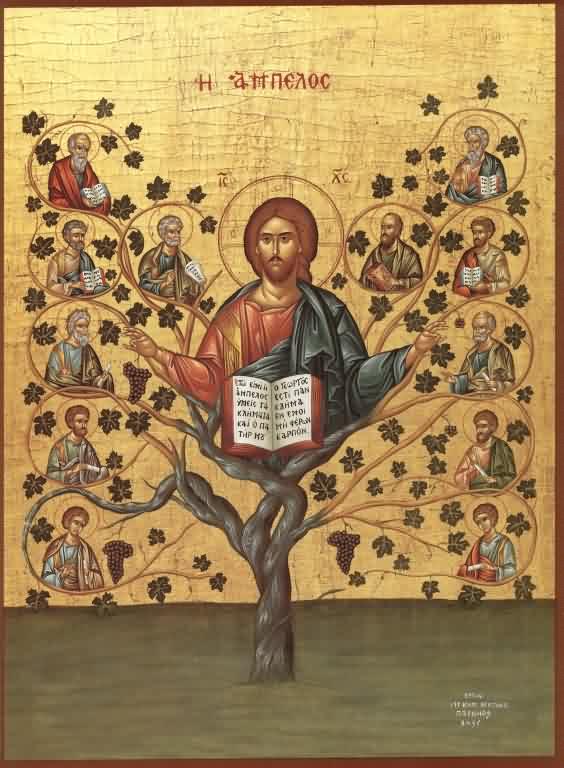
AD: In ch. 2 you begin by noting that most of us today live urban or suburban lives quite different from the agrarian and pastoral life common at the time of Jesus. Do you think that some of the gospel imagery--Jesus as shepherd, or vine-dresser, or lamb--might be hard for people to appreciate today?


Yes and no. I think if pastors can explain these images, perhaps even incorporating or including contemporary images that the laity might understand, people will get the message. Pastors need to trust our laity that they do have a mind and they’re not stupid either!

AD: It's a common cliché today to say "Jesus: Yes! Church: No!" How do you as a pastor respond to such slogans? 

Such a temptation! This is a loaded question too. With the first part we have to always be reminded, especially pastors and clergy, that our faith and trust is in Jesus Christ. Yes we are also members of one another in what we call the Church but sometimes we can confuse the externalities of the institutional Church with that of Jesus, which are supposed to have the same aim and goal: salvation. But as you might know that isn’t always the case. There is a famous quote by St. Augustine-- and I don’t know exactly where it is in his writings but he says--“The Church is a whore but she’s also your mother.” That, of course, is right from the prophetic writings; that Israel is whoring around with false gods and idol worship (see Hosea and Amos for example) while Yahweh is running around trying to get Israel back; he is a devoted bridegroom. The Church is the Body of Christ and sometimes the body gets sick and needs help, but we are always members of this community. That is what being a Christian is all about, members of one another, hopefully striving towards the same end too: salvation in Christ Jesus.

Thursday, October 13, 2011

Augustine of Hippo and Orthodoxy

Too many Orthodox polemicists and apologists, who--as the Orthodox theologian David Bentley Hart has himself admitted--invariably know very little about what they are railing against and have almost never read the sources they fatuously criticize (and do not have the languages to read those sources in their originals), are fond of holding up Augustine of Hippo as one of the worst offenders in Western theology's supposed long trajectory into heresy and outer darkness and ultimately separation from the East. To be able to sum up thus the unspeakably vast and complex corpus of Augustine's works is a little breath-taking. (That is not to say that there are not aspects of Augustine thinking unworthy of criticism--indeed there are.)

The place and understanding of Augustine came up last weekend at the outstanding ASEC conference where Amy Slagle--on whose wonderful new book I shall have more to say next week I hope--presented a paper on the influence of the late Seraphim Rose. In the discussion after her lecture, I asked for her thoughts on why, in some respects, Rose seemed to return to Augustine each year for the former's Lenten readings when (a) Rose seemed to rather severely misunderstand Augustine; and (b) Rose was so highly critical of many other aspects of Latin Christianity.

I read Rose many years ago now and put him out of my mind as an obvious crank whose interpretation of Augustine (to whom he always referred with strange circumlocutions and epithets), inter alia, was, to put it charitably, sui generis. But in misunderstanding Augustine, Rose is not at all sui generis in many respects. Augustine is, in fact, regularly (tendentiously) misunderstood by some Eastern Christians today, though if they attended to three recent studies many of the misunderstandings would be cleared up. First, more than ten years ago now, there was Myroslaw Tataryn's Augustine and Russian Orthodoxy, a careful study that still repays attention today.

Then in 2008, we had two important studies. The first was a very lucid and compelling article by Peter Galadza, “The Liturgical Commemoration of Augustine in the Orthodox Church: An Ambiguous Lex Orandi for an Ambiguous Lex Credendi,” St Vladimir’s Theological Quarterly 52 (2008): 111-130.

The second was a very welcome, and widely praised, collection of articles by George E. Demacopoulos and Aristotle Papanikolaou, eds., Orthodox Readings of Augustine (St. Vladimir's Seminary Press, 2008), 304pp.

About this book, the publisher tells us that it
not only presents Eastern Orthodox readings of the great Latin theologian, but also demonstrates the very nature of theological consensus in ecumenical dialogue, from a referential starting point of the ancient and great Fathers. This collection exemplifies how, once, the Latin and Byzantine churches, from a deep communion of the faith that transcended linguistic, cultural and intellectual differences, sang from the same page a harmonious song of the beauty of Christ. Contributors are: Lewis Ayres, John Behr, David Bradshaw, Brian E. Daley, George E. Demacopoulos, Elizabeth Fisher, Reinhard Flogaus, Carol Harrison, David Bentley Hart, Joseph T. Lienhard, Andrew Louth, Jean-Luc Marion, Aristotle Papanikolaou, and David Tracy. 
In the last review he ever wrote for Logos: A Journal of Eastern Christian Studies, the noted Augustine scholar J. Kevin Coyle--before his untimely death a year ago--noted of Orthodox Readings of Augustine that "all the volume’s entries are thoughtfully written and rarely does the reader’s mind wander" and in sum this book constitutes "a welcome contribution to dialogue between East and West on Augustine."
Related Posts Plugin for WordPress, Blogger...