This is an important defense of book reviews with which I am entirely in agreement.
Readers of this blog who have expertise in relevant areas and who are interested in reviewing new books in Eastern Christianity, either those featured on here or those you have come across elsewhere, are always invited to contact me:
logoseasternchristianjournal@gmail.com.
"Let books be your dining table, / And you shall be full of delights. / Let them be your
mattress,/And you shall sleep restful nights" (St. Ephraim the Syrian).
Saturday, April 9, 2016
In Defense of Book Reviews
Labels:
Book Reviews,
David Beer,
Times Higher Ed
Friday, April 8, 2016
The Mythology of the Third Rome
I yield nothing to nobody in my respect for Russian Orthodox Christian traditions--the staggering architectural beauty of her churches, the philosophers of her so-called Silver Age, the long-suffering influence of Trinity-Sergius Lavra and her other monastic centres, and many of her liturgical and musical celebrations, inter alia. But neither respect nor affection are increased by conniving at nonsense used to advance a nationalist and neo-imperialistic agenda. Thus one can only dissent from, if not openly disdain, the notion of Russia as a "Third Rome," a notion that has a long history but has come in for fresh criticism in a new book released just this month from a Norwegian scholar: Jardar Østbø, The New Third Rome: Readings of a Russian Nationalist Myth Ibidem Press, 2016), 270pp.
Ibidem Press is a Hanoverian publisher whose North American works in English are made available by Columbia University Press in New York. From them we learn the following about this book:
Drawing on theories of political myth and concepts of nationalism, Jardar Østbø analyzes the content and ideological function of the myth of Russia as a Third Rome. Through case studies of four prominent nationalist intellectuals, Østbø shows how this messianic myth was used to reinvent Russia and its allegedly rightful place in the world after the collapse of the Soviet Union. Though it exists in many radically different versions, the Third Rome myth in general embodies particularism and rabid anti-Westernism. At best, it portrays Russia as an essentially isolationist country. At worst, it casts the country as superior to all other nations, divinely elected to rule the world.
Tuesday, April 5, 2016
Confirmation Season Upon Us
In the Roman Catholic world, this springtime/Paschaltide is often Confirmation season, a season and a sacrament that raise at least as many questions as they purport to answer. Now is as good a time as any to recall my friend Nick Denysenko's book, which my grad students, all Roman Catholics, have found invaluable in thinking through some of these thorny pastoral, pedagogical, psychological, mystagogical, and sacramental questions: Chrismation: A Primer for Catholics.
I interviewed Nick here about this book, and you will want to check that out for his further thoughts.
Labels:
Chrismation,
Confirmation,
Nicholas Denysenko
Monday, April 4, 2016
Re-Introducing Eastern Christianity?
I have already contacted the editor, Amir Azarvan, requesting an interview about his newly published collection, Re-Introducing Christianity: an Eastern Apologia for a Western Audience (Wipf and Stock, 2016), 210pp. With any luck, we'll be able to hear from him in answer to my questions in a few weeks.
About this book, released this month, the publisher tells us:
"Faith means making a virtue out of not thinking. . . . And those who preach faith, and enable and elevate it are intellectual slaveholders, keeping mankind in a bondage to fantasy and nonsense that has spawned and justified so much lunacy and destruction" (Bill Maher). Many seem unaware that contemporary critiques of Christianity are relevant mostly to its modern offshoots (whose followers have to some extent earned Bill Maher's unflattering caricatures). To its detriment, Christianity is increasingly identified in people's minds with these more recent expressions. As a result, a growing number of people are turning away from Christianity and, indeed, religious faith altogether. Drawing from an eclectic group of theologians, clergy members, monastics, and lay scholars, this edited volume re-introduces Christianity to a modern audience. It presents a more authentic, experiential side of Christianity to the religious skeptic; a side that eschews blind faith, legalism, and judgment; a side that is rarely given a hearing in the ongoing debate with today's skeptics. Re-Introducing Christianity is also directed at modern Christians, and refutes their most frequently expressed criticisms of what the contributors boldly, but humbly, call the Apostolic Faith.The book is divided into seven sections, often with several essays in each, covering such topics as theosis, the communion of saints, the process of salvation, icons, sacraments, the reality of the resurrection, women in the Orthodox Church, and much else besides.
Friday, April 1, 2016
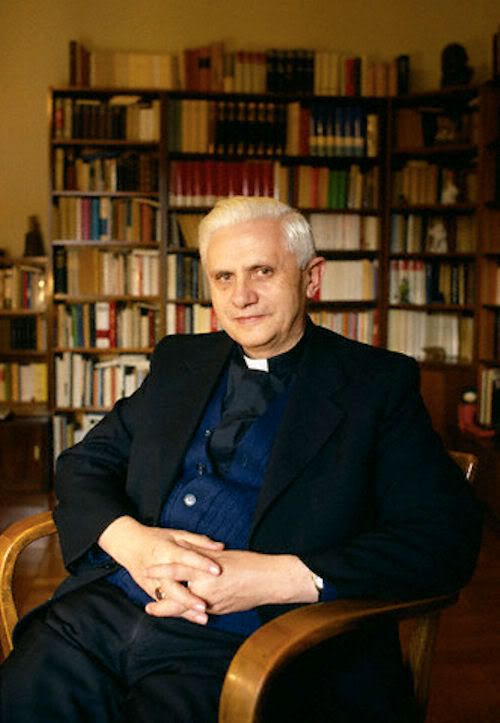
Joseph Ratzinger and the Christian East
However near or yet far off his death may be, it is clear that his written corpus will see no new additions, and so now is as good a time as any for a look back at just some of his books and their impact on Catholic-Orthodox relations and on issues of especial concern to Eastern Christians.
I think my first two introductions to his writings were of a personal nature. There was, first, his moving and deeply human homily (which I have often quoted on here) at the funeral Mass of his friend Hans Urs von Balthasar, reprinted in the collection edited by David Schindler, Hans Urs Von Balthasar: His Life and Work. This collection I read from my hospital bed in 1996 where I was immobilized for three months after being hit by a bus while riding my bike. It was, perhaps, my first introduction to a thinker who was not only subtle and scholarly, but also gracious, warm, and human--not at all the Panzerkardinal of the lurid and gratuitously unjust grotesques constructed by the mass media with the encouragement of not a few jejune Catholics who get their theology from the New York Times.
The next year, Ratzinger published the first (and, alas, the only) volume of his memoirs, Milestones, which rather hinted at being the first of at least two volumes. It stopped in 1977, the year Ratzinger was quickly vaulted into both the episcopacy and the college of cardinals--the last such appointment Pope Paul VI would make before his death the next year. (Had a second volume appeared, covering his Rome years as prefect of the CDF.....oh how the mind reels with thwarted excitement at the tales he could have told! Of course, some of his views from that time were candidly shared in his several book-length interviews, starting with the first and greatest bombshell given after a scant three years in the Roman
After a brief stint as archbishop of München und Freising in his native Bavaria, Ratzinger would be lured to Rome by his friend Pope John Paul II in 1982....and never be able to leave, though his desire to do so, especially as the 1990s ground on, was well known.
The year after Milestones appeared, 1998, I was in Rome at a conference at which Ratzinger was the keynote lecturer talking about his favored topic, the liturgy. In English his first treatment of this vital area came about in the 1981 translation, The Feast of Faith, a short little book more than worth its price for its preface and introduction alone, where he deals, as succinctly as anyone ever has, with the "relevance" of studying liturgy in a world full of political conflicts and social problems. It was the first of several studies about liturgy that would make their way into English and enrich my thinking on this most vital of topics.
In addition to liturgy (about which more presently), Ratzinger offered important clarifications and corrections as to how theology should be done in such books as The Nature and Mission of Theology. He was of course often not just criticized but attacked, often in the most adolescent way, not least by not a few of the preening members of the Catholic Theological Society of America who thought that Ratzinger's ideas of theology--unofficially expressed in this book, and more officially in CDF pronouncements such as Donum Veritatis, about which I have written here--were intolerable impositions and odious expressions of a libido dominandi when, of course, they were simply invitations to return to doing theology as it must always be done, viz., on its knees, as he was wont to say--as "praying theology." This, as Eastern Christians will at once recognize, is simply how the holy Fathers did theology, and to the extent that Ratzinger helped to re-orient theology, he performed a service at once theological and ecumenical. I found nothing whatsoever objectionable in such invitations as his, and indeed much that was inspirational.
Ratzinger has also, of course, been influential in shaping Catholic ecclesiology from Vatican II onward, as encapsulated in his little book Called to Communion, which is a helpful summary of the so-called eucharistic or communio ecclesiology whose recovery in both East and West in the last half-century has been the single greatest such development and has served to bring each closer to the other.
More than that, however, Ratzinger, more than any other figure in 20th-century Roman Catholicism, was the first and most sustained thinker--starting in a series of scholarly articles from the late 1960s--to focus on the importance of papal decentralization as seen through a recovery of the institution of the patriarchate within the otherwise bipartite structures of the Latin Church. He returned to these thoughts somewhat in at least one of his later book-length interviews, both of which were conducted by Peter Seewald.
And then.....and then there was of course his election in 2005 as bishop of Rome, and almost immediately (as in the insignia at his inauguration in April of that year) he gave signs of a return to an earlier, and more commonly recognized, tradition. He had written and spoken frankly during John Paul II's pontificate of his pronounced dis-ease with the cult of celebrity that had grown up around the papal office, and gave every sign of wanting this pared back. (He also gave clear evidence, I thought, of his own discomfort with the office, and I felt acutely sympathetic towards him as a fellow introverted academic happiest in his library. How often did I look at him and think of the Petrine conclusion to John's gospel when Christ says "when you are old, you will stretch out your hands, and another will gird you and carry you where you do not wish to go.")
A year later, he announced, rather abruptly and indirectly, that the title "Patriarch of the West" was being deleted from the list of titles in the Annuario Pontificio. There was much shock at this, and I spent considerable effort writing articles in a variety of places trying to reassure Orthodox Christians that this was a good thing--that it was the start of the re-structuring of the Latin Church, and the creation of regional patriarchates, that Ratzinger single-handedly had talked about creating for 40 years. Readers of my Orthodoxy and the Roman Papacy will be familiar with all these arguments in detail.
And then? Nothing. No further developments beyond a hastily cobbled together and badly translated statement from Cardinal Kasper trying to defuse the situation. There were no further developments--no new titles, no new offices, no newly created patriarchates of, say, North America, or francophone Africa, or Latin America. What seemed by every indication to be the beginning of a significant ecclesiastical re-structuring came to nothing, which I confess was an enormous disappointment at the loss of an opportunity to make arguably the most ecumenically significant changes the East could ask for.
Ratzinger did, however, go some distance towards the East in his earlier book, The Spirit of the Liturgy. There he also tried, however inadequately, to address one of the most acute crises in the Latin Church at and following Vatican II: its rampant and flagrant iconoclasm.
The book is not only a much-needed critical treatment of just some of the many disastrous developments in Latin liturgy over the last 50 years. It is also a frank acknowledgement that neither in the 20th century, nor really for any of the twelve centuries before that, has the Church in the West adequately or fully received the teaching of the seventh Ecumenical Council of Nicaea in 787, the one devoted to the defeat of Christian iconoclasm. Ratzinger rightly called for Nicaea II to be newly appropriated in the West--a development which, sadly, few seem inclined to undertake.
If his book continues to serve as a thorn in the side of Western Christians, prompting them to re-evaluate their iconoclasm, as Jeana Visel (almost alone) seems to be doing, then it will remain in my estimation the most lasting contribution of a most estimable scholar and gracious gentleman now in the sunset of his richly productive and long life. When that sad day comes and Joseph Ratzinger leaves the Church militant for, one hopes, the Church triumphant in heaven, may the Lord's judgment be swift and merciful: "Well done, good and faithful servant! Enter into the joy of your master."
Labels:
Ecclesiology,
Ecumenism,
iconoclasm,
Joseph Ratzinger,
Liturgics
Thursday, March 31, 2016
What Does It Mean to Convert?
We live in a time of regular "conversions" among Christians from one tradition to another--to say nothing of moving between Christian and non-Christian traditions. People move into and out of Protestant, Catholic, and Orthodox traditions with some regularity now. Conversions into Eastern Orthodoxy have of course been coming in finally for some welcome and fascinating scrutiny in such studies as Amy Slagle's, The Eastern Church in the Spiritual Marketplace: American Conversions to Orthodox Christianity and more recently D. Oliver Herbel's Turning to Tradition: Converts and the Making of an American Orthodox Church.
Now a new collection looks at conversions more widely still. With chapters on the Ethiopian Church, and with the conversions of Eastern Christians to Islam in the Eastern Mediterranean in the first millennium, this book will be of interest to those who study the movement of people from one tradition into another: Ira Katznelson and Miri Rubin, eds., Religious Conversion: History, Experience and Meaning (Routledge, 2016), 276pp.
About this collection the publisher tells us:
Now a new collection looks at conversions more widely still. With chapters on the Ethiopian Church, and with the conversions of Eastern Christians to Islam in the Eastern Mediterranean in the first millennium, this book will be of interest to those who study the movement of people from one tradition into another: Ira Katznelson and Miri Rubin, eds., Religious Conversion: History, Experience and Meaning (Routledge, 2016), 276pp.
About this collection the publisher tells us:
Religious conversion - a shift in membership from one community of faith to another - can take diverse forms in radically different circumstances. As the essays in this volume demonstrate, conversion can be protracted or sudden, voluntary or coerced, small-scale or large. It may be the result of active missionary efforts, instrumental decisions, or intellectual or spiritual attraction to a different doctrine and practices. In order to investigate these multiple meanings, and how they may differ across time and space, this collection ranges far and wide across medieval and early modern Europe and beyond. From early Christian pilgrims to fifteenth-century Ethiopia; from the Islamisation of the eastern Mediterranean to Reformation Germany, the volume highlights salient features and key concepts that define religious conversion, particular the Jewish, Muslim and Christian experiences. By probing similarities and variations, continuities and fissures, the volume also extends the range of conversion to focus on matters less commonly examined, such as competition for the meaning of sacred space, changes to bodies, patterns of gender, and the ways conversion has been understood and narrated by actors and observers. In so doing, it promotes a layered approach that deepens inquiry by identifying and suggesting constellations of elements that both compose particular instances of conversion and help make systematic comparisons possible by indicating how to ask comparable questions of often vastly different situations.
Labels:
Conversions,
Ira Katznelson,
Miri Rubin,
Orthodox converts
Wednesday, March 30, 2016
Armenians and Turks after the Genocide
As I noted last year and the year before, 2015 marks the centenary of the Armenian genocide, about which studies continue to pour forth from various publishers. I have a unit on Armenia which I cover every year in my course on Eastern Christian encounters with Islam, and we watch, inter alia, a documentary about the assassination of Hrant Dink, showing the power of traumatic memories even a century afterwards. A new study on those deadly memories has recently been published: Vicken Cheterian, Open Wounds: Armenians, Turks and a Century of Genocide (Oxford UP, 2015), 416pp.
About this book we are told:
The assassination of the author Hrant Dink in Istanbul in 2007, a high-profile advocate of Turkish-Armenian reconciliation, reignited the debate in Turkey on the annihilation of the Ottoman Armenians. Many Turks soon re-awakened to their Armenian heritage, reflecting on how their grandparents were forcibly Islamised and Turkified, and the suffering their families endured to keep their stories secret. There was public debate around Armenian property confiscated by the Turkish state and the extermination of the minorities. At last the silence had been broken.
Open Wounds explains how, after the First World War, the new Turkish Republic forcibly erased the memory of the atrocities, and traces of Armenians, from their historic lands -- a process to which the international community turned a blind eye. The price for this amnesia was, Vicken Cheterian argues, "a century of genocide." Turkish intellectuals acknowledge the price society must pay collectively to forget such traumatic events, and that Turkey cannot solve its recurrent conflicts with its minorities -- like the Kurds today -- nor have an open and democratic society without addressing the original sin on which the state was founded: the Armenian Genocide.
Labels:
Armenian Genocide,
Genocide,
Hrant Dink,
trauma,
Turkey,
World War I
Monday, March 28, 2016
Church Slavonic Making a Come Back?
Though it's long been a staple of Eastern self-presentation, and sometimes of Eastern polemics against "the Latins," the notion of Eastern Christian liturgy always being in the "vernacular" is of course rather problematic when one considers the widespread usage of Church Slavonic in Russia especially. Whose "vernacular" is that, exactly, in 2016? What does the continued usage of Slavonic entail not just liturgically but also ritually, psychologically, and politically? Treating these questions is a book published this month for the first time in paperback by Brian P. Bennett, Religion and Language in Post-Soviet Russia (Routledge, 2016), 214pp.
Having first appeared in 2011, this book is summed up thus by the publisher:
Church Slavonic, one of the world's historic sacred languages, has experienced a revival in post-Soviet Russia. Blending religious studies and sociolinguistics, this is the first book devoted to Church Slavonic in the contemporary period. It is not a narrow study in linguistics, but uses Slavonic as a passkey into various wider topics, including the renewal and factionalism of the Orthodox Church; the transformation of the Russian language; and the debates about protecting the nation from Western cults and culture. It considers both official and popular forms of Orthodox Christianity, as well as Russia's esoteric and neo-pagan traditions. Ranging over such diverse areas as liturgy, pedagogy, typography, mythology, and conspiracy theory, the book illuminates the complex interrelationship between language and faith in post-communist society, and shows how Slavonic has performed important symbolic work during a momentous chapter in Russian history. It is of great interest to scholars of sociolinguistics and of religion, as well as to Russian studies specialists.We are also given the table of contents:
1. Introduction 2. Religion, language, religious language 3. Az, buki, vedi: the ABC’s of religious literacy 4. Translator, traitor? the debate over liturgical language 5. Logos: Slavonic letterforms and the graphic environment 6. From Marx and Lenin to Cyril and Methodius 7. Scripting Russian history: alphabet mysticism and conspiracy theory
Wednesday, March 23, 2016
Wartime Churches
As these recent anniversary years have ticked by, commemorating the two world wars and the genocides associated with them, we have seen greater scholarly attention to the role of the churches in those conflicts. First we had the latest of many books by the great historian Philip Jenkins, The Great and Holy War: How World War I Became a Religious Crusade, which I very briefly discussed here. What is especially fascinating about Jenkins' book is the vast change in martial language used by Christians over the course of less than a century. In 1914, the language was bloodthirsty in ways that most Christians today would blanch at.
Then we had Panteleymon Anastasakis, The Church of Greece Under Axis Occupation, showing all the complexities of wartime Greece which the Nazis occupied, the communists wanted to occupy, and the British to free from both.
Now this month we have another study coming out, Jan Bank with Lieve Gevers, Churches and Religion in the Second World War, trans. Brian Doyle (Bloomsbury Academic, 2016), 624pp.
About this book the publisher tells us:
Despite the wealth of historical literature on the Second World War, the subject of religion and churches in occupied Europe has been undervalued – until now. This critical European history is unique in delivering a rich and detailed analysis of churches and religion during the Second World War, looking at the Christian religions of occupied Europe: Catholicism, Lutheranism, Calvinism, and Orthodoxy.
The authors engage with key themes such as relations between religious institutions and the occupying forces; religion as a key factor in national identity and resistance; theological answers to the Fascist and National Socialist ideologies, especially in terms of the persecution of the Jews; Christians as bystanders or protectors in the Holocaust; and religious life during the war. Churches and Religion in the Second World War will be of great value to students and scholars of European history, the Second World War and religion and theology.
Labels:
World War II
Monday, March 21, 2016
Fools and Holy Fools in Theatre
I have discussed other publications about holy fools on here over the years, including my own; and interviewed authors about their work in this area. Now we have a new book treating the fool in film: Alina Birzache, The Holy Fool in European Cinema (Routledge, 2016), 220pp.
About this book we are told:
This monograph explores the way that the profile and the critical functions of the holy fool have developed in European cinema, allowing this traditional figure to capture the imagination of new generations in an age of religious pluralism and secularization. Alina Birzache traces the cultural origins of the figure of the holy fool across a variety of European traditions. In so doing, she examines the critical functions of the holy fool as well as how filmmakers have used the figure to respond to and critique aspects of the modern world. Using a comparative approach, this study for the first time offers a comprehensive explanation of the enduring appeal of this protean and fascinating cinematic character. Birzache examines the trope of holy foolishness in Soviet and post-Soviet cinema, French cinema, and Danish cinema, corresponding broadly to and permitting analysis of the three main orientations in European Christianity: Orthodox, Catholic, and Protestant. This study will be of keen interest to scholars of religion and film, European cinema, and comparative religion.The publisher also gives us the contents:
Introduction. 1. The Pauline Holy Fool and Its Successors. 2. Speaking Truth to Power: The Holy Fool in Soviet and Russian Cinema. 3. Holy Fools in the Films of Andrei Tarkovsky. 4. The Suffering Fool in French Cinema. 5. The Bressonian Holy Fool. 6. The Fool’s Challenge to Reason in Danish Cinema. 7. Idiocy as Technique: The Dogme 95 Movement. Conclusion.
Labels:
Alina Birzache,
Cinema,
Holy Fools,
Theatre
Friday, March 18, 2016
Fondly Imagining the Liturgical Past
The Byzantine liturgical historian Robert Taft's 2000 essay, "Eastern Presuppositions and Western Liturgical Renewal" first alerted me to the uses and abuses of Christian history in service of present political agendas. It is a fascinating study in the selective appeal to "the East" by Latin liturgical reformers to give cover to what they wanted to do.
Later this year we shall have a collection of scholarly articles that continues to explore such istoriographical questions: Teresa Berger and Bryan D. Spinks, eds., Liturgy's Imagined Past/s (Pueblo Books, 2016), 320pp.
About this book we are told:
Later this year we shall have a collection of scholarly articles that continues to explore such istoriographical questions: Teresa Berger and Bryan D. Spinks, eds., Liturgy's Imagined Past/s (Pueblo Books, 2016), 320pp.
About this book we are told:
This book calls attention to the importance of scholarly reflection on the writing of liturgical history. The essays not only probe the impact of important shifts in historiography but also present new scholarship that promises to reconfigure some of the established images of liturgy’s past. Based on papers presented at the 2014 Yale Institute of Sacred Music Liturgy Conference, Liturgy’s Imagined Past/s seeks to invigorate discussion of methodologies and materials in contemporary writings on liturgy’s pasts and to resource such writing at a point in time when formidable questions are being posed about the way in which historians construct the object of their inquiry.
Wednesday, March 16, 2016
The Therapeutic Power of Byzantine (and other) Rituals
Well do I remember seeing first hand, more than a decade ago, the healing power of ritual--in this case the Byzantine "rite of forgiveness" served on the eve of the Great Fast each year. Two people who had been bitterly estranged for years prostrated themselves before each other--as they and we all did--and it served at last to overcome their anger and misunderstanding. One of them reported to me right afterwards--with an enormous sigh of visible relief--that even after decades of knowing intellectually the power of liturgy, it still amazed him emotionally to experience so powerfully the real healing and reconciliation the rite had just enacted between him and his erstwhile brother in the faith.
I myself have explored this possibility of ritual healing in several articles over the years, wondering in particular whether the "healing of memories" of divided Christians can be effected, in part, through liturgy. As I have written about that over the years, it has long remained unclear to me exactly how a vague psychological phrase can be enacted among millions of people in a collective like the Church. Most of the exploration of "healing of memories" has taken place from the theology side, with little contribution from psychological, liturgical, or ritual studies--until now. Set for release later this month is a work from the psychiatrist Erik D. Goodwyn, Healing Symbols in Psychotherapy (Routledge, 2016), 240pp.
About this book we are told:
I myself have explored this possibility of ritual healing in several articles over the years, wondering in particular whether the "healing of memories" of divided Christians can be effected, in part, through liturgy. As I have written about that over the years, it has long remained unclear to me exactly how a vague psychological phrase can be enacted among millions of people in a collective like the Church. Most of the exploration of "healing of memories" has taken place from the theology side, with little contribution from psychological, liturgical, or ritual studies--until now. Set for release later this month is a work from the psychiatrist Erik D. Goodwyn, Healing Symbols in Psychotherapy (Routledge, 2016), 240pp.
About this book we are told:
Ritual scholars note that rituals have powerful psychological, social and even biological effects, but these findings have not yet been integrated into the practice of psychotherapy and psychiatry. In Healing Symbols in Psychotherapy Erik D. Goodwyn attempts to rectify this by reviewing the most pertinent work done in the area of ritual study and applying it to the practice of psychotherapy and psychiatry, providing a new framework with which to approach therapy. The book combines ritual study with depth psychology, placebo study, biogenetic structuralism and cognitive anthropology to create a model of interdisciplinary psychology.
Goodwyn uses examples of rituals from history, folklore and cross-cultural study and uncovers the universal themes embedded within them as well as their psychological functions. As ritual scholars show time and again how Western culture and medicine is ‘ritually impoverished’ the application of ritual themes to therapy yields many new avenues for healing. The interdisciplinary model used here suggests new ways to approach problems with basic identity, complicated grief, anxiety, depression meaninglessness and a host of other problems encountered in clinical work.
The interdisciplinary approach of this accessibly-written book will appeal to psychotherapists, psychiatrists and Jungian analysts as well as those in training and readers with an interest in the science behind ritual.The publisher also gives us the table of contents:
Part 1: Foundations. The Study of Ritual – Depth Psychology and Symbolic Anthropology. The Interdisciplinary Approach to Ritual. Part 2: The Dynamic Interdisciplinary Approach. Biological—Mind/Body Interactions. Cognitive—Cognitive Anthropology and Psychological Resonance. Psychodynamic—Projection, Narrative, Meaningful Coincidence and Dissociation. Cultural – Structures and Functions. Part 3: Applications. Magical Inscriptions. Healing Rituals. Transitional Rituals. Death. Part 4: Conclusions. The Technology of Ritual and the Ritual Expert. Summary. Afterword.
Labels:
Byzantine rite,
Liturgics,
Psychoanalysis,
psychology,
ritual studies
Tuesday, March 15, 2016
"A Bible Study Followed by a Meal": Ephrem Lash on the Eucharist
More than a decade ago now, in a graduate class on Byzantine liturgical translations, I was first introduced to the Orthodox liturgical scholar and translator Archimandrite Ephrem Lash. Most of his work has been freely available on his very useful website, which I check regularly. Some of his other printed translations are linked here on the right and left.
I've watched a number of his videos more recently, and he has long struck me as embodying a unique kind of English Orthodoxy seemingly without pretense (which cannot always be said): English because marked by dry wit (calling the Divine Liturgy structurally "a Bible study followed by a meal") and unromantic reflection on human nature; Orthodox because of a commitment to beauty and truth.
He died yesterday in London. We pray that his memory be eternal, and that his soul be placed where all the righteous dwell in (to use his translation) "a place of light, a place of green pasture, a place of refreshment, whence pain, grief and sighing have fled away."
I've watched a number of his videos more recently, and he has long struck me as embodying a unique kind of English Orthodoxy seemingly without pretense (which cannot always be said): English because marked by dry wit (calling the Divine Liturgy structurally "a Bible study followed by a meal") and unromantic reflection on human nature; Orthodox because of a commitment to beauty and truth.
He died yesterday in London. We pray that his memory be eternal, and that his soul be placed where all the righteous dwell in (to use his translation) "a place of light, a place of green pasture, a place of refreshment, whence pain, grief and sighing have fled away."
Monday, March 14, 2016
Alexander Men, Prophet of Our Time
Northern Illinois University Press continues to bring forth important works in their Russian Studies series as well as their Orthodox Christian series. Fitting into both categories is a book set for release at the end of April, about a man whose martyrdom came at the end of the official Soviet period even as Soviet methods of exterminating "enemies" persisted: Wallace L. Daniel, Russia's Uncommon Prophet: Father Aleksandr Men and His Times (Northern Illinois University Press, 2016), 468pp.
About this book the publisher tells us:
This lucidly written biography of Aleksandr Men examines the familial and social context from which Men developed as a Russian Orthodox priest. Wallace Daniel presents a picture of Russia and the Orthodox Church different from the stereotypes found in much of the popular literature. Men offered an alternative to the prescribed ways of thinking imposed by the state and the church. Growing up during the darkest, most oppressive years in the history of the former Soviet Union, he became a parish priest who eschewed fear, who followed Christ’s command “to love thy neighbor as thyself,” and who attracted large, diverse groups of people in Russian society. How he accomplished those tasks and with what ultimate results are the main themes of this story.
Conflict and controversy marked every stage of Men’s priesthood. His parish in the vicinity of Moscow attracted the attention of the KGB, especially as it became a haven for members of the intelligentsia. He endured repeated attacks from ultra-conservative, antisemitic circles inside the Orthodox Church. Father Men represented the spiritual vision of an open, non-authoritarian Christianity, and his lectures were extremely popular. He was murdered on September 10, 1990. For years, his work was unavailable in most church bookstores in Russia, and his teachings were excoriated by some both within and outside the church. But his books continue to offer hope to many throughout the world—they have sold millions of copies and are testimony to his continuing relevance and enduring significance. This important biography will appeal to scholars and general readers interested in religion, politics, and global affairs.
Labels:
Alexander Men,
Wallace L. Daniel
Saturday, March 12, 2016
Gregory of Narek's Festal Works
Pope Francis, the pope of surprises, last year declared the Armenian saint Gregory of Narek a "doctor of the Church," a unique category in the Western Church, as I was trying to explain to my students only last week, that elevates certain saints and Fathers to an even more exalted rank. Now Gregory's works are getting some attention thanks to an English translation that Liturgical Press has just alerted me to. Forthcoming later this month is Abraham Terian, trans., The Festal Works of St. Gregory of Narek (Liturgical Press, 2016), 464pp.
About this book we are told:
This is the first translation in any language of the surviving corpus of the festal works of St. Gregory of Narek, a tenth-century Armenian mystic theologian and poet par excellence (d. 1003). Composed as liturgical works for the various Dominical and related feasts, these poetic writings are literary masterpieces in both lyrical verse and narrative. Unlike Gregory’s better-known penitential prayers, these show a jubilant author in a celebratory mood. In this volume Abraham Terian, an eminent scholar of medieval Armenian literature, provides the nonspecialist reader with an illuminating translation of St. Gregory of Narek’s festal works. Introducing each composition with an explanatory note, Terian places the works under consideration in their author’s thought-world and in their tenth-century landscape.
Labels:
Armenian Church,
Armenians,
Gregory of Narek,
mysticism
Friday, March 11, 2016
Dostoevsky's Global Ethic
Is there any other Russian novelist (apart from Tolstoy perhaps) who continues to attract such scholarly attention as Dostoevsky? I've noted other studies of him over the years, and in May of this year we will have this fascinating-sounding book: Leonard Friesen, Transcendent Love: Dostoevsky and the Search for a Global Ethic (University of Notre Dame Press, 2016), 240pp.
About this book the publisher tells us:
In Transcendent Love: Dostoevsky and the Search for a Global Ethic, Leonard G. Friesen ranges widely across Dostoevsky's stories, novels, journalism, notebooks, and correspondence to demonstrate how Dostoevsky engaged with ethical issues in his times and how those same issues continue to be relevant to today's ethical debates. Friesen contends that the Russian ethical voice, in particular Dostoevsky's voice, deserves careful consideration in an increasingly global discussion of moral philosophy and the ethical life.
Friesen challenges the view that contemporary liberalism provides a religiously neutral foundation for a global ethic. He argues instead that Dostoevsky has much to offer when it comes to the search for a global ethic, an ethic that for Dostoevsky was necessarily grounded in a Christian concept of an active, extravagant, and transcendent love. Friesen also investigates Dostoevsky's response to those who claimed that contemporary European trends, most evident in the rising secularization of nineteenth-century society, provided a more viable foundation for a global ethic than one grounded in the One, whom Doestoevsky called simply "the Russian Christ." Throughout, Friesen captures a sense of the depth and sheer loveliness of Dostoevsky's canon. Dostoevsky was, after all, someone who believed that the ethical life was sublimely beautiful, even as it recklessly embraced suffering and unreasonably forgave others. The book will appeal to both students and scholars of Russian literature and history, comparative ethics, global ethics, and cultural studies, and togeneral readers with an interest in Dostoevsky.
"Others have written about Dostoevsky's ethics, but I am not aware of any single-authored, sustained attempt to make the case for Dostoevsky's 'transcendent love' as part of a larger discussion of a global ethic. Moreover, Leonard Friesen presents his case in an engaging and highly accessible form. He believes passionately that Dostoevsky is deeply relevant to the discussion; his commitment rings through the pages and draws the reader in. In this way, his essay makes an original contribution to Dostoevsky studies that will appeal to scholars in a variety of disciplines and to educated lay readers with ethical concerns about the path of modernity, as well as to the many fans of Dostoevsky's work." —Russell Hillier, Providence College
Labels:
Dostoevsky,
Leonard Friesen
Wednesday, March 9, 2016
Transcendence and Transition in Sacred Music
With chapters on the Orthodox musician Arvo Part (about whom see my interview with Peter Bouteneff) and one on the revival of chant on Mt. Athos, this book will belong in every library with an interest in the diverse musical traditions of the Christian East: Jeffers Engelhardt and Philip Bohlman, eds., Resounding Transcendence: Transitions in Music, Religion, and Ritual (Oxford University Press, 2016), 304pp.
About this book the publisher tells us:
Resounding Transcendence is a pathbreaking set of ethnographic and historical essays by leading scholars exploring the ways sacred music effects cultural, political, and religious transitions in the contemporary world. With chapters covering Christian, Muslim, Jewish, and Buddhist practices in East and Southeast Asia, the Indian subcontinent, North America, the Caribbean, North Africa, and Europe, the volume establishes the theoretical and methodological foundations for music scholarship to engage in current debates about modern religion and secular epistemologies. It also transforms those debates through sophisticated, nuanced treatments of sound and music - ubiquitous elements of ritual and religion often glossed over in other disciplines.
Resounding Transcendence confronts the relationship of sound, divinity, and religious practice in diverse post-secular contexts. By examining the immanence of transcendence in specific social and historical contexts and rethinking the reified nature of "religion" and "world religions," these authors examine the dynamics of difference and transition within and between sacred musical practices. The work in this volume transitions between traditional spaces of sacred musical practice and emerging public spaces for popular religious performance; between the transformative experience of ritual and the sacred musical affordances of media technologies; between the charisma of individual performers and the power of the marketplace; and between the making of authenticity and hybridity in religious repertoires and practices. Broad in scope, rich in ethnographic and historical detail, and theoretically ambitious, Resounding Transcendence is an essential contribution to the study of music and religion.
Monday, March 7, 2016
Orthodoxy and the Enlightenment
It has often been said, when people are rushed for a quick explanation as to why Eastern Christianity has not been as riled by philosophical difficulties and doctrinal divisions as the West has, that the East has yet to come to terms with the Enlightenment. I'm not convinced of that thesis for several reasons, but may have to think about these matters differently after reading a collection edited by Paschalis Kitromilides, Enlightenment and Religion in the Orthodox World (Oxford University Studies in the Enlightenment, 2016), 336pp.
I have found other studies by Kitromilides (discussed very briefly here), who is a political scientist at the University of Athens, to be very valuable, including his study of the influence of the French Revolution on the rise of nationalism and the modern nation-state in such places as Greece, Romania, and other former Ottoman states.
About this book we are told:
Paschalis M. Kitromilides, Preface
Paschalis M. Kitromilides, 1. The Enlightenment and the Orthodox world: historiographical and theoretical challenges
Vassilios N. Makrides, 2. The Enlightenment in the Greek Orthodox East: appropriation, dilemmas, ambiguities
Efthymios Nicolaidis, 3. The Greek Enlightenment, the Orthodox Church and modern science
Dimitrios Moschos, 4. An alternative ‘enlightenment’: the Philokalia
Iannis Carras, 5. Understanding God and tolerating humankind: Orthodoxy and the Enlightenment in Evgenios Voulgaris and Platon Levshin
Elena Smilianskaia, 6. The battle against superstition in eighteenth-century Russia: between ‘rational’ and ‘spiritual’
Andrei Pippidi, 7. The Enlightenment and Orthodox culture in the Romanian principalities
Nenad Ristović, 8. The Enlightenment of Dositej Obradović in the context of Christian classical humanism
Marija Petrović, 9. The Serbian Church hierarchy and popular education in the Hapsburg lands during the eighteenth century
Bojan Aleksov, 10. The vicissitudes of Dositej Obradović’s Enlightenment cult among the Serbs
Vassilis Maragos, 11. The challenge of secularism in Bulgarian Orthodox society
Eugenia Drakopoulou, 12. The interplay of Orthodoxy and Enlightenment in religious art
Summaries
Bibliography
Index
The place of religion in the Enlightenment has been keenly debated for many years. Research has tended, however, to examine the interplay of religion and knowledge in Western countries, often ignoring the East. In Enlightenment and religion in the Orthodox world leading historians address this imbalance by exploring the intellectual and cultural challenges and changes that took place in Orthodox communities during the eighteenth century.
The two main centres of Orthodoxy, the Greek-speaking world and the Russian Empire, are the focus of early chapters, with specialists analysing the integration of modern cosmology into Greek education, and the Greek alternative ‘enlightenment’, the spiritual Philokalia. Russian experts also explore the battle between the spiritual and the rational in the works of Voulgaris and Levshin. Smaller communities of Eastern Europe were faced with their own particular difficulties, analysed by contributors in the second part of the book. Governed by modernising princes who embraced Enlightenment ideals, Romanian society was fearful of the threat to its traditional beliefs, whilst Bulgarians were grappling in different ways with a new secular ideology. The particular case of the politically-divided Serbian world highlights how Dositej Obradović’s complex humanist views have been used for varying ideological purposes ever since. The final chapter examines the encroachment of the secular on the traditional in art, and the author reveals how Western styles and models of representation were infiltrating Orthodox art and artefacts.
Through these innovative case studies this book deepens our understanding of how Christian and secular systems of knowledge interact in the Enlightenment, and provides a rich insight into the challenges faced by leaders and communities in eighteenth-century Orthodox Europe.The publisher also gives us the contents:
Paschalis M. Kitromilides, Preface
Paschalis M. Kitromilides, 1. The Enlightenment and the Orthodox world: historiographical and theoretical challenges
Vassilios N. Makrides, 2. The Enlightenment in the Greek Orthodox East: appropriation, dilemmas, ambiguities
Efthymios Nicolaidis, 3. The Greek Enlightenment, the Orthodox Church and modern science
Dimitrios Moschos, 4. An alternative ‘enlightenment’: the Philokalia
Iannis Carras, 5. Understanding God and tolerating humankind: Orthodoxy and the Enlightenment in Evgenios Voulgaris and Platon Levshin
Elena Smilianskaia, 6. The battle against superstition in eighteenth-century Russia: between ‘rational’ and ‘spiritual’
Andrei Pippidi, 7. The Enlightenment and Orthodox culture in the Romanian principalities
Nenad Ristović, 8. The Enlightenment of Dositej Obradović in the context of Christian classical humanism
Marija Petrović, 9. The Serbian Church hierarchy and popular education in the Hapsburg lands during the eighteenth century
Bojan Aleksov, 10. The vicissitudes of Dositej Obradović’s Enlightenment cult among the Serbs
Vassilis Maragos, 11. The challenge of secularism in Bulgarian Orthodox society
Eugenia Drakopoulou, 12. The interplay of Orthodoxy and Enlightenment in religious art
Summaries
Bibliography
Index
Labels:
Enlightenment,
Paschalis Kitromilides
Saturday, March 5, 2016
On Learning to Forget
As I noted last summer, I have become more and more fascinated not just with the uses and abuses of memory--in the context of, e.g., the "Crusades," which have become an all-purpose stick with which certain Orthodox Christians and certain Muslims try to beat the Catholic Church--but also with the question of forgetting. Our last century has, for justifiable reasons, been concerned to say "Never again!" by saying "Never forget!" And that is noble, commendable, important if we wish to guard against a repeat of, say, the Holocaust, Armenian Genocide, or Holodomor.
But sometimes it seems the only way forward is by not remembering. That is, the way forward is precisely through forgetting. The problem here, of course, is that most of us have been conditioned to think of forgetting as a morally reprobated activity, as a deplorable oversight, as a sin of omission--forgetting the dog in the car on a hot day, say, or failing to remember the dental appointment that morning at 9, or not remembering to buy a card for my spouse's birthday.
But as we ought to have learned by now from Freud, not all forms of remembering are healthful and helpful; and not all forms of forgetting are evidence of unhealthy repression or unconscious frustration. Certain forms of remembering are necessary, while certain others are not. Certain remembrances can help with healing with others can hinder it. This is as true for individuals as it is for Christians and their churches. Indeed, on this latter score, I think there are certain things that Christians can and must come to forget if we are ever to live together again as one body.
I've been thinking about these things for a while now, and continue to work on them for a lecture I'm to give in 2017. These thoughts have also been recently addressed in this fascinating article, which in turn put me in mind of Bradford Vivian's welcome and important book, Public Forgetting: The Rhetoric and Politics of Beginning Again
The author of the article, David Rieff, has a book coming out in May: In Praise of Forgetting: Historical Memory and Its Ironies (Yale UP, 2016), 160pp.
About this book we are told:
But sometimes it seems the only way forward is by not remembering. That is, the way forward is precisely through forgetting. The problem here, of course, is that most of us have been conditioned to think of forgetting as a morally reprobated activity, as a deplorable oversight, as a sin of omission--forgetting the dog in the car on a hot day, say, or failing to remember the dental appointment that morning at 9, or not remembering to buy a card for my spouse's birthday.
But as we ought to have learned by now from Freud, not all forms of remembering are healthful and helpful; and not all forms of forgetting are evidence of unhealthy repression or unconscious frustration. Certain forms of remembering are necessary, while certain others are not. Certain remembrances can help with healing with others can hinder it. This is as true for individuals as it is for Christians and their churches. Indeed, on this latter score, I think there are certain things that Christians can and must come to forget if we are ever to live together again as one body.
I've been thinking about these things for a while now, and continue to work on them for a lecture I'm to give in 2017. These thoughts have also been recently addressed in this fascinating article, which in turn put me in mind of Bradford Vivian's welcome and important book, Public Forgetting: The Rhetoric and Politics of Beginning Again
The author of the article, David Rieff, has a book coming out in May: In Praise of Forgetting: Historical Memory and Its Ironies (Yale UP, 2016), 160pp.
About this book we are told:
The conventional wisdom about historical memory is summed up in George Santayana’s celebrated phrase, “Those who cannot remember the past are condemned to repeat it.” Today, the consensus that it is moral to remember, immoral to forget, is nearly absolute. And yet is this right?
David Rieff, an independent writer who has reported on bloody conflicts in Africa, the Balkans, and Central Asia, insists that things are not so simple. He poses hard questions about whether remembrance ever truly has, or indeed ever could, “inoculate” the present against repeating the crimes of the past. He argues that rubbing raw historical wounds—whether self-inflicted or imposed by outside forces—neither remedies injustice nor confers reconciliation. If he is right, then historical memory is not a moral imperative but rather a moral option—sometimes called for, sometimes not. Collective remembrance can be toxic. Sometimes, Rieff concludes, it may be more moral to forget.
Ranging widely across some of the defining conflicts of modern times—the Irish Troubles and the Easter Uprising of 1916, the white settlement of Australia, the American Civil War, the Balkan wars, the Holocaust, and 9/11—Rieff presents a pellucid examination of the uses and abuses of historical memory. His contentious, brilliant, and elegant essay is an indispensable work of moral philosophy.
Labels:
Bradford Vivian,
Crusades,
David Rieff,
Forgetting,
Healing of Memories,
Memory
Friday, March 4, 2016
Italo-Albanian Chant
There are certain groups, even within the often maddeningly confused world of Eastern Christianity, that are especially small and therefore acutely prone to being overlooked. The Italo-Albanians are arguably in this category. But at least one part of their heritage will no longer be so obscure, thanks to the publication next month of Bartolomeo di Salvo, Girolamo Garofalo, and Christian Troelsgård, eds., Chants of the Byzantine Rite: The Italo-Albanian Tradition in Sicily: Canti Ecclesiastici della Tradizione Italo-Albanese in Sicilia (Monumenta Musicae Byzantinae, Subsidia) (Museum Tusculanum Press 2016), 288pp.
About this book we are told:
This book presents for the first time the complete chant repertory of an orally transmitted collection of church hymns for the celebration of the Byzantine Rite in Sicily. Cultivated by Albanian-speaking minorities since their ancestors arrived in Sicily in the late fifteenth century, this repertory was transcribed by Bartolomeo di Salvo, a Basilian monk from the monastery of Grottaferrata, and is presented here in English, Italian, and Greek.
Thursday, March 3, 2016
Arabs and Ottomans
Sam Noble continues the absolutely vital work of making Arab Christian history better known. Fresh off his edited collection with Sasha Treiger (read my interview with them here), Noble has collaborated with Constantin Alexandrovich Panchenko on Arab Orthodox Christians Under the Ottomans 1516-1831 (Holy Trinity Publications, 2016), 676pp.
About this book we are told:
Following the so called “Arab Spring” the world’s attention has been drawn to the presence of significant minority religious groups within the predominantly Islamic Middle East. Of these minorities Christians are by far the largest, comprising over 10% of the population in Syria and as much as 40% in Lebanon.The largest single group of Christians are the Arabic-speaking Orthodox. This work fills a major lacuna in the scholarship of wider Christian history and more specifically that of lived religion within the Ottoman empire. The author draws on archaeological evidence and previously unpublished primary sources uncovered in Russian archives and Middle Eastern monastic libraries to present a vivid and compelling account of this vital but little-known spiritual and political culture, situating it within a complex network of relations reaching throughout the Mediterranean, the Caucasus and Eastern Europe. The work is made more accessible to a non-specialist reader by the addition of a glossary, whilst the scholar will benefit from a detailed bibliography of both primary and secondary sources.
Wednesday, March 2, 2016
Priests of my People
It has been a commonplace for some time that the development of the Christian priesthood is a relatively late one. How and why that happened has been the subject of varying theories. A recent book, part of the publisher's Patristic Studies series, offers a new one: Bryan A. Stewart, Priests of My People: Levitical Paradigms for Early Christian Ministers (Peter Lang, 2015), 250pp.
About this book we are told:
This book offers an innovative examination of the question: why did early Christians begin calling their ministerial leaders «priests» (using the terms hiereus/sacerdos)? Scholarly consensus has typically suggested that a Christian «priesthood» emerged either from an imitation of pagan priesthood or in connection with seeing the Eucharist as a sacrifice over which a «priest» must preside. This work challenges these claims by exploring texts of the third and fourth century where Christian bishops and ministers are first designated «priests»: Tertullian and Cyprian of Carthage, Origen of Alexandria, Eusebius of Caesarea, and the church orders Apostolic Tradition and Didascalia Apostolorumpolis in their own right in the Greco-Roman world, they also saw themselves theologically and historically connected with ancient biblical Israel. This religio-political ecclesiology, sharpened by an emerging Christian material culture and a growing sense of Christian «sacred space», influenced the way Christians interpreted the Jewish Scriptures typologically. In seeing the nation of Israel as a divine nation corresponding to themselves, Christians began appropriating the Levitical priesthood as a figure or «type» of the Christian ministerial office. Such a study helpfully broadens our understanding of the emergence of a Christian priesthood beyond pagan imitation or narrow focus on the sacrificial nature of the Eucharist, and instead offers a more comprehensive explanation in connection with early Christian ecclesiology.
Labels:
Bryan Stewart,
priesthood
Monday, February 29, 2016
Beyond Boswell's Tendentious Pamphleteering
Well do I remember the controversy in the mid-90s when a handsome young historian at some school or other started putting it about that Christians, especially in the East, had been hiding for centuries some ritual that he claimed was a proto-marriage liturgy for same-sex couples. The "mainstream" media, with their usual dreary lack of imagination and empty-headed cheerleading, pounced on this, of course, and spread this nonsense far and wide, tarting it up with pity because this "revolutionary" finding was authored by a man who would not enjoy the results, dying of AIDS in the same year as his book appeared. I read first the book and then, with great relish, one take-down after another in scholarly journals by serious historians and theologians (Robin Darling Young among them) who showed that John Boswell's Same-Sex Unions in Premodern Europe had tendentiously ginned up a case for pre-determined conclusions, and made the evidence fit those conclusions because today's politics seemed to demand doing so. It was my first awareness of the uses and abuses of history by Christians.
Now we have a serious Byzantinist examining this evidence anew in her just-released book: Claudia Rapp, Brother-Making in Late Antiquity and Byzantium: Monks, Laymen, and Christian Ritual (Oxford UP, 2016), 368pp.
About this book we are told:
Now we have a serious Byzantinist examining this evidence anew in her just-released book: Claudia Rapp, Brother-Making in Late Antiquity and Byzantium: Monks, Laymen, and Christian Ritual (Oxford UP, 2016), 368pp.
About this book we are told:
Among medieval Christian societies, Byzantium is unique in preserving an ecclesiastical ritual of adelphopoiesis, which pronounces two men, not related by birth, as brothers for life. It has its origin as a spiritual blessing in the monastic world of late antiquity, and it becomes a popular social networking strategy among lay people from the ninth century onwards, even finding application in recent times. Located at the intersection of religion and society, brother-making exemplifies how social practice can become ritualized and subsequently subjected to attempts of ecclesiastical and legal control.
Controversially, adelphopoiesis was at the center of a modern debate about the existence of same-sex unions in medieval Europe. This book, the first ever comprehensive history of this unique feature of Byzantine life, argues persuasively that the ecclesiastical ritual to bless a relationship between two men bears no resemblance to marriage. Wide-ranging in its use of sources, from a complete census of the manuscripts containing the ritual of adelphopoiesis to the literature and archaeology of early monasticism, and from the works of hagiographers, historiographers, and legal experts in Byzantium to comparative material in the Latin West and the Slavic world, Brother-Making in Late Antiquity and Byzantium examines the fascinating religious and social features of the ritual, shedding light on little known aspects of Byzantine society.
Friday, February 26, 2016
New Publication from the Pope!
Catholics have grown weary of papal speeches and interviews, whether on airlines or in other fora. The endless yammering has turned even the most caricatured ultramontane fantasies or the most outrageous Protestant polemics about "papolatry" into reality: the pope as oracle, ceaselessly pontificating on matters large and small, well beyond his brief and far exceeding any authority he has, and thereby causing far more confusion than clarity.
How much better the example of the other pope, the one whose use of the title, according to some historians, pre-dates that of the Roman bishop's adoption of it. I refer, of course, to the Pope and Patriarch of Alexandria, successor to St. Mark.
Perfectly timed for this Lenten season is a book about repentance hot off the presses from St. Vladimir's Seminary Press, which has just put into my hands: †Pope Shenouda III, The Life of Repentance and Purity, 2nd. Eng. ed., trans. H.G. Bishop Suriel (SVS Press, 2016), 322pp.
About this book, now in a second issue from the late pope (who died in 2012), the publisher tells us:
The Life of Repentance and Purity provides readers with a comprehensive overview of the practice of repentance and purity, essential aspects of Christian life. Pope Shenouda III draws on Scripture, the Church Fathers, his own experience of desert monasticism, and his experience as a shepherd to millions of Christians to provide a practical understanding of how to live a life of continually turning to God.
My advice to you, instead of saying, I promise you that I will repent, O Lord, say to the Lord: Restore me, and I will return (Jeremiah 31:18). Ask for repentance as a good gift from him, for he himself promised this, saying: I shall give you a new heart and put a new spirit within you (Ezekiel 36.26).
The Coptic Studies Series at St Vladimir s Seminary Press was conceived with a two-fold purpose: to increase the accessibility of the many treasures of Coptic Orthodox Christianity to a wider English-speaking audience; and to cross-pollinate the spiritual minds of Coptic Orthodox Christians and their Eastern Orthodox brethren with the knowledge of a common faith in the incarnate Word of God who is the true source of all wisdom and knowledge.I am delighted at both this book, and also this new Coptic Studies Series from SVS Press. I am delighted because I have an abiding affection for the Copts thanks to my friendship with Iman Nashed, through whom I was first introduced to the writings of Pope Shenouda in the mid 90s, and to the Coptic tradition in Canada, at whose flagship parish of St. Mark's in Scarborough I gave lectures over the years. The Copts in Egypt have suffered enormously over the years at the hands of Muslims in Egypt but all the while have been a faithful witness to the gospel. In addition, they are second to nobody in the number and rigor of their fasting days each year. They are a model to us all.
Labels:
Coptic history,
Coptic Liturgy,
Coptic Papacy,
Coptology,
Copts,
Pope Shenouda III
Thursday, February 25, 2016
Marriage: Law and Sacrament
Given the on-going turmoil in the Catholic Church over the disciplines of marriage, divorce, re-marriage, and annulments, as well as the potential for turmoil at the upcoming 'great and holy synod' of Orthodoxy, whose agenda includes the topic of marriage, this forthcoming study may be of wide interest: Philip Reynolds, How Marriage Became One of the Sacraments: The Sacramental Theology of Marriage from its Medieval Origins to the Council of Trent (Cambridge UP, 2016), 1077pp.
About this hefty tome the publisher tells us:
Among the contributions of the medieval church to western culture was the idea that marriage was one of the seven sacraments, which defined the role of married folk in the church. Although it had ancient roots, this new way of regarding marriage raised many problems, to which scholastic theologians applied all their ingenuity. By the late Middle Ages, the doctrine was fully established in Christian thought and practice but not yet as dogma. In the sixteenth century, with the entire Catholic teaching on marriage and celibacy and its associated law and jurisdiction under attack by the Protestant reformers, the Council of Trent defined the doctrine as a dogma of faith for the first time but made major changes to it. Rather than focusing on a particular aspect of intellectual and institutional developments, this book examines them in depth and in detail from their ancient precedents to the Council of Trent.We are also given the table of contents:
1. Marriage as a sacrament
Part I. Augustine:
2. Marriage in Augustine's writings
3. Bonum prolis, bonum fidei: the utility of marriage
4. Bonum sacramenti: the sanctity and insolubility of marriage
Part II. Getting Married: Consent, Betrothal, and Consummation:
5. Betrothal and consent
6. Consummation
7. From competing theories to common doctrine in the twelfth century
Part III. The Twelfth Century: Origins and Early Development of the Sacramental Theology of Marriage:
8. Introduction to the sentential literature on marriage
9. The theology of marriage in the Sententiae
10. Hugh of Saint-Victor
11. The early doctrine of marriage as one of the sacraments
Part IV. The Thirteenth and Fourteenth Centuries: Development of the Classical Doctrine:
12. Marriage as union
13. Scholastic sexual ethics
14. Marriage as a sacrament
15. The question of grace
16. Human contract and divine sacrament
Part V. The Council of Trent:
17. On the eve of the General Council
18. The Sacrament of marriage at Bologna and Trent
19. Clandestine marriage: Bologna, 1547
20. Clandestine marriage: Trent, 1563.
Part I. Augustine:
2. Marriage in Augustine's writings
3. Bonum prolis, bonum fidei: the utility of marriage
4. Bonum sacramenti: the sanctity and insolubility of marriage
Part II. Getting Married: Consent, Betrothal, and Consummation:
5. Betrothal and consent
6. Consummation
7. From competing theories to common doctrine in the twelfth century
Part III. The Twelfth Century: Origins and Early Development of the Sacramental Theology of Marriage:
8. Introduction to the sentential literature on marriage
9. The theology of marriage in the Sententiae
10. Hugh of Saint-Victor
11. The early doctrine of marriage as one of the sacraments
Part IV. The Thirteenth and Fourteenth Centuries: Development of the Classical Doctrine:
12. Marriage as union
13. Scholastic sexual ethics
14. Marriage as a sacrament
15. The question of grace
16. Human contract and divine sacrament
Part V. The Council of Trent:
17. On the eve of the General Council
18. The Sacrament of marriage at Bologna and Trent
19. Clandestine marriage: Bologna, 1547
20. Clandestine marriage: Trent, 1563.
Labels:
Canon Law,
Council of Trent,
Marriage,
Philip Reynolds,
Sacraments
Subscribe to:
Posts (Atom)