The newly released exhortation from Pope Francis, Gaudete et exsultate, almost from its opening lines put me immediately in mind of the themes that my friend, the Orthodox scholar Michael Plekon, has so often pursued in many of his recent books. He recently retired after teaching for more than forty years at the City University of New York; but he never told me he was going to use his spare time to take up ghost writing for the pope! The parallels are, as our father among the saints Sigmund of Vienna might say, uncanny.
See, in particular, Plekon's Saints as They Really Are, about which I interviewed him here.
And Hidden Holiness also anticipates in striking ways many of these new papal themes.
Michael's most recent book, The World as Sacrament: an Ecumenical Path toward a Worldly Spirituality, was released just over a year ago, and I interviewed him about that book here.
In the fall of 2016 he published Uncommon Prayer: Prayer in Everyday Experience. My interview with him about this book is here.
He is also the author and editor of other books, any one of which will be worth your time and repay re-reading over the years. And he has been feted in this Festschrift, noted here.
I may post further thoughts on this new papal document next week. I see (e.g. paragraph 96: "Holiness, then, is not about swooning in mystic rapture") already some other striking parallels to Maggie Ross, whom I discussed at length here and here. I'm sure there will be others.
Showing posts with label Maggie Ross. Show all posts
Showing posts with label Maggie Ross. Show all posts
Wednesday, April 11, 2018

Monday, February 26, 2018
On Fasting from Noise or Against Asceticism and Spirituality (II)
When we were last met to discuss Maggie Ross's wonderfully cool diagnosis of much that ails us, Silence: A User's Guide, I sketched out some of the background influences and concerns to this book, and to my reading of it. I also noted one or two places in the first part of the book where we get some hints of what is to come as we move now into the third chapter, "The Language of Silence," where Ross really lets fly, inveighing against many common, but even more commonly misunderstood and misapplied terms, concepts, and practices.
This entire third chapter, as I commented previously, really could bear the title "Glossary of Nonsense Terms Fatuously Flung About by Careless Christians." In the book it functions very much as an excursus between the background she lays out in chs.1-2, and the objections to silence in the rest of the book. I will only give you a taste, but the entire chapter is very much worth your time.
One of the biggest misunderstandings--as I have long thought myself--comes down to the primacy people give to the notion of "experience," which Ross says is "perhaps the most significant of the frequently misused words in this list." Experience, Ross says, is solipsistic in today's usage, running totally contrary to "ancient, patristic, and medieval" wariness of the term; it invites narcissism and notions of control.
Faith is another misused word--and here Ross agrees very much with Fr. Paul Tarazi, as his interview on here last week showed--because it refers, wrongly, to a set of abstract doctrines rather than the practice of trust.
Mystical/Mystic/Mysticism: All these terms "have become useless and misleading" and function to justify "weirdness," "exoticism," "voyeurism (a kind of spiritual pornography" (90). See below for more on the problems with "mysticism."
Spiritual Direction: I was moving from studying psychology to theology in the late 1990s when all of a sudden it seemed (as I noted in part I) that the study of something called "spirituality" exploded in revolting fashion, and along with it, very predictably, came the attempts to make money off that by people setting themselves up as "spiritual directors" everywhere, offering expensive courses in how you, too, could become a director, or at least benefit from on-going direction. A couple of these people to whom I spoke, including one woman in charge of just such a brand-new centre for spiritual direction and formation, were so dim and tedious, so incurious and uninformed about everything, that I felt myself falling rapidly into a coma after about two sentences.
But what these newly minted "spiritual directors" lacked in intellectual substance was more than made up for by the aggressively preening self-importance of their tone. All this is to say I greatly cheered Ross's denunciation of "spiritual direction, so-called" as having "little to no relationship to the desert practice of manifestation of thoughts. It evolved as a form of mind control." As she continues, "modern so-called spiritual direction is counter-productive and a distraction: it tends to make the 'directee' become increasingly preoccupied with his or her self-construct and imagined 'spiritual life' instead of moving towards self-forgetfulness in beholding the divine other."
After this swamp-clearing excursus, the rest of the book is a more extended critical analysis of how to practice silence and of the obstacles towards doing so. She begins chapter 4 by briefly surveying how few modern thinkers are interested in silence because they operate under a Cartesian method. Of the few who, she says, escape this influence to some extent, she cites the Canadians Charles Taylor and Bernard Lonergan; and the Greek Orthodox scholar John Panteleimon Manoussakis, whom I interviewed here.
One of the points Ross makes clear here, and elsewhere in the book, is that most of us have lost the capacity for observing how our minds work. Indeed, as Christopher Bollas (inter alia) has also recently noted, we live in a time that scorns the idea of thinking about our minds and the unconscious influences on them. But this loss, this refusal, this scorn, makes us incapable of enduring silence and so living in the wellsprings of the deep mind. Without this, we are bereft of what we need for any serious transfiguration in our life. (In this regard I would say that Ross's critique echoes those who suggest our reliance on overly hasty "cures" approved by modern "therapists" and pharmaceutical companies, and especially the insurance companies who pay the bills of both, are, as I suggested here, far less effective than the slower work of often silently lying on the couch of unknowing.)
It is that lack of control over "unknowing" that makes silence so suspect. Much of this and later chapters in her book are spent by Ross discussing problems with the many translations of the famous work The Cloud of Unknowing, almost all versions of which use the word "experience and other anachronisms" the effect of which is to "have obscured behold, so that it rarely appears." Beholding something, as she is at pains to show at length, is different from thinking we "experience" (and thus presumably, at least partially, control) it. It is the Gallacher edition of the Cloud (linked above and at left) that she says almost alone avoids this problem.
Later on she also decries the elimination of "behold" and cognates from modern biblical translations. This term, she says, is "arguably the most important word in the Bible..., which occurs more than 1300 times in the Hebrew and Greek" (179).
Lots of churchmen, she says, have been quite content to eliminate ideas of beholding and the silence which it requires, in part because both are suspect and hard to control. Of those very few not guilty of this, Ross cites some of the Desert Fathers and Mothers, including our old friend Evagrius, whom I have often cited on here and whom I taught to my students last semester. According to Ross, the writings of Evagrius "speak to human beings in every age....His advice is just as applicable today in an urban culture."
In the final part of the book Ross presents something of an apologia for the fruits of silence, noting that there is a reciprocal relationship: the more one enters into the silence of the deep mind, the more mind is released from tightly held ideas and hostile emotions, especially avarice, anger, and judgment. Instead of these, one emerges more compassionate, detached, and willing to forgive. At the same time, she notes, one's powers of discernment are heightened as silence encourages a ruthless honesty.
For those worried about the "political" implications of all this, Ross is clear in several places that emergence into silence does not give rise to a crabbed "me and my cell and the rest of you go to hell" Christianity. Rather, she says the ethics and politics of silence are "green" in caring for creation. Silence, she says, makes one simultaneously more liberal and more conservative: liberal in wanting to share the riches with everyone, and conservative in wanting to hang onto the experience of silence and protect it via a sort of "custody of the ears." Those who are immersed in silence come quickly to have a pronounced intolerance for reading about violence, for going to loud parties and pointless meetings, etc.
Finally, those who live in silence find there a refuge but not an escape. The silent are never at home in our culture again, but are able nonetheless to live because the richness of silence enables a life-sustaining transfiguration, which this book, Silence: A User's Guide, itself goes some very considerable distance to advancing in surprising and welcome ways.
Concluded.
This entire third chapter, as I commented previously, really could bear the title "Glossary of Nonsense Terms Fatuously Flung About by Careless Christians." In the book it functions very much as an excursus between the background she lays out in chs.1-2, and the objections to silence in the rest of the book. I will only give you a taste, but the entire chapter is very much worth your time.
One of the biggest misunderstandings--as I have long thought myself--comes down to the primacy people give to the notion of "experience," which Ross says is "perhaps the most significant of the frequently misused words in this list." Experience, Ross says, is solipsistic in today's usage, running totally contrary to "ancient, patristic, and medieval" wariness of the term; it invites narcissism and notions of control.
Faith is another misused word--and here Ross agrees very much with Fr. Paul Tarazi, as his interview on here last week showed--because it refers, wrongly, to a set of abstract doctrines rather than the practice of trust.
Mystical/Mystic/Mysticism: All these terms "have become useless and misleading" and function to justify "weirdness," "exoticism," "voyeurism (a kind of spiritual pornography" (90). See below for more on the problems with "mysticism."
Spiritual Direction: I was moving from studying psychology to theology in the late 1990s when all of a sudden it seemed (as I noted in part I) that the study of something called "spirituality" exploded in revolting fashion, and along with it, very predictably, came the attempts to make money off that by people setting themselves up as "spiritual directors" everywhere, offering expensive courses in how you, too, could become a director, or at least benefit from on-going direction. A couple of these people to whom I spoke, including one woman in charge of just such a brand-new centre for spiritual direction and formation, were so dim and tedious, so incurious and uninformed about everything, that I felt myself falling rapidly into a coma after about two sentences.
But what these newly minted "spiritual directors" lacked in intellectual substance was more than made up for by the aggressively preening self-importance of their tone. All this is to say I greatly cheered Ross's denunciation of "spiritual direction, so-called" as having "little to no relationship to the desert practice of manifestation of thoughts. It evolved as a form of mind control." As she continues, "modern so-called spiritual direction is counter-productive and a distraction: it tends to make the 'directee' become increasingly preoccupied with his or her self-construct and imagined 'spiritual life' instead of moving towards self-forgetfulness in beholding the divine other."
After this swamp-clearing excursus, the rest of the book is a more extended critical analysis of how to practice silence and of the obstacles towards doing so. She begins chapter 4 by briefly surveying how few modern thinkers are interested in silence because they operate under a Cartesian method. Of the few who, she says, escape this influence to some extent, she cites the Canadians Charles Taylor and Bernard Lonergan; and the Greek Orthodox scholar John Panteleimon Manoussakis, whom I interviewed here.
One of the points Ross makes clear here, and elsewhere in the book, is that most of us have lost the capacity for observing how our minds work. Indeed, as Christopher Bollas (inter alia) has also recently noted, we live in a time that scorns the idea of thinking about our minds and the unconscious influences on them. But this loss, this refusal, this scorn, makes us incapable of enduring silence and so living in the wellsprings of the deep mind. Without this, we are bereft of what we need for any serious transfiguration in our life. (In this regard I would say that Ross's critique echoes those who suggest our reliance on overly hasty "cures" approved by modern "therapists" and pharmaceutical companies, and especially the insurance companies who pay the bills of both, are, as I suggested here, far less effective than the slower work of often silently lying on the couch of unknowing.)
It is that lack of control over "unknowing" that makes silence so suspect. Much of this and later chapters in her book are spent by Ross discussing problems with the many translations of the famous work The Cloud of Unknowing, almost all versions of which use the word "experience and other anachronisms" the effect of which is to "have obscured behold, so that it rarely appears." Beholding something, as she is at pains to show at length, is different from thinking we "experience" (and thus presumably, at least partially, control) it. It is the Gallacher edition of the Cloud (linked above and at left) that she says almost alone avoids this problem.
Later on she also decries the elimination of "behold" and cognates from modern biblical translations. This term, she says, is "arguably the most important word in the Bible..., which occurs more than 1300 times in the Hebrew and Greek" (179).
Lots of churchmen, she says, have been quite content to eliminate ideas of beholding and the silence which it requires, in part because both are suspect and hard to control. Of those very few not guilty of this, Ross cites some of the Desert Fathers and Mothers, including our old friend Evagrius, whom I have often cited on here and whom I taught to my students last semester. According to Ross, the writings of Evagrius "speak to human beings in every age....His advice is just as applicable today in an urban culture."
In the final part of the book Ross presents something of an apologia for the fruits of silence, noting that there is a reciprocal relationship: the more one enters into the silence of the deep mind, the more mind is released from tightly held ideas and hostile emotions, especially avarice, anger, and judgment. Instead of these, one emerges more compassionate, detached, and willing to forgive. At the same time, she notes, one's powers of discernment are heightened as silence encourages a ruthless honesty.
For those worried about the "political" implications of all this, Ross is clear in several places that emergence into silence does not give rise to a crabbed "me and my cell and the rest of you go to hell" Christianity. Rather, she says the ethics and politics of silence are "green" in caring for creation. Silence, she says, makes one simultaneously more liberal and more conservative: liberal in wanting to share the riches with everyone, and conservative in wanting to hang onto the experience of silence and protect it via a sort of "custody of the ears." Those who are immersed in silence come quickly to have a pronounced intolerance for reading about violence, for going to loud parties and pointless meetings, etc.
Finally, those who live in silence find there a refuge but not an escape. The silent are never at home in our culture again, but are able nonetheless to live because the richness of silence enables a life-sustaining transfiguration, which this book, Silence: A User's Guide, itself goes some very considerable distance to advancing in surprising and welcome ways.
Concluded.
Friday, February 16, 2018
The Problems with Orthodox Mysticism
I've just received The Rise of Scripture, and sent to its author, the long-time Orthodox biblical scholar Paul Nadimi Tarazi, some questions for an interview I'll be glad to run as soon as he gets back to me. Tarazi has written many books about the Bible, as you can see here. This one takes a more comprehensive and far-reaching approach than some of his more tightly tailored commentaries.
The Rise of Scripture is a wide-ranging book that does not pull its punches in places, and I'm looking forward to having the author unpack his thoughts about many things, including his clear disdain for "mysticism," a problematic notion, you will have noted, I've been exploring on here with the help of Maggie Ross's fine book, Silence: A User's Guide, to which I shall be returning presently.
"Mysticism" is one of those things one endlessly hears about from apologists for the East, perhaps most famously in that dreary book, The Mystical Theology of the Eastern Church by Lossky that at one point it seems everyone was required to read--before, that is, the explosion in Eastern Christian scholarship of the last three decades, which has had the welcome effect, inter alia, of dethroning Lossky.
Just to give you a taste, with more to come: Tarazi repeatedly decries the "perversion" that theology--East and West, Jewish and Christian--has wrought to the scripturally revealed God, introducing terminology that is not just unhelpful but unscriptural (ousia, physis, etc). Worse, we go from theology to "mysticism," about which Tarazi inveighs thus:
I've asked him to comment further in our interview on this and other wonderfully bracing arguments in his The Rise of Scripture. Stay tuned!
The Rise of Scripture is a wide-ranging book that does not pull its punches in places, and I'm looking forward to having the author unpack his thoughts about many things, including his clear disdain for "mysticism," a problematic notion, you will have noted, I've been exploring on here with the help of Maggie Ross's fine book, Silence: A User's Guide, to which I shall be returning presently.
"Mysticism" is one of those things one endlessly hears about from apologists for the East, perhaps most famously in that dreary book, The Mystical Theology of the Eastern Church by Lossky that at one point it seems everyone was required to read--before, that is, the explosion in Eastern Christian scholarship of the last three decades, which has had the welcome effect, inter alia, of dethroning Lossky.
Just to give you a taste, with more to come: Tarazi repeatedly decries the "perversion" that theology--East and West, Jewish and Christian--has wrought to the scripturally revealed God, introducing terminology that is not just unhelpful but unscriptural (ousia, physis, etc). Worse, we go from theology to "mysticism," about which Tarazi inveighs thus:
As for us Orthodox, we shall continue to approach scripture from the sacred theology of the 'tradition of man' established by our church fathers, and the closer to our own times the 'father' is, the more authoritative he is.....It is no wonder that Orthodox seminary students take a short cut by reading as authoritative Vladimir Lossky's twentieth-century The Mystical Theology of the Eastern Church and live in the mystical clouds of their imaginations instead of listening repeatedly until the end of days--and teaching others to do (Mt 5:17-20)--to the words of the scroll written by the hand of the One who alone speaks out of his scriptural, not mystical, cloud (Ezek 1-2).Lest any Eastern apologist still try to insist that our mysticism is somehow different, unique, true, and untainted by that so-called pan-heresy of ecumemism, Tarazi says this ignores "my repeated insistence that mysticism is a (fourth monotheistic) religion of its own besides Judaism, Christianity, and Islam, the proof thereof being that Jewish, Christian, and Muslim mystics speak the exact same language, and even refer to, if not even quote, one another" (437).
I've asked him to comment further in our interview on this and other wonderfully bracing arguments in his The Rise of Scripture. Stay tuned!
Monday, February 12, 2018
On Fasting from Noise or Against Asceticism and Spirituality (I)
The paschal calculations are only out by a week this year (see here for some further thoughts on this absurd problem), so today begins Great Lent on the Gregorian Calendar, and next week it begins on the Julian.
Always around this time in the past, as here, I have listed some good books, especially Alexander Schmemann's Great Lent: Journey to Pascha, and I would not unsay what I have said there. But I am increasingly uneasy about much of this discussion and increasingly given to rethinking the categories of asceticism thanks to a book I mentioned at the beginning of the month in discussing the links between Freudian and Dominican notions of prayer: Maggie Ross, Silence: A User's Guide vol. I.
This builds on a longstanding dislike I have had of the whole notion of "spirituality." I remember very clearly in the early 1990s, as I moved from studying psychology to theology, taking my first undergraduate course in "spirituality" taught by a man who was bouncing across the stage with excitement that, at long last, "spirituality" was emerging as its own academic discipline, with new journals being founded every other week to prove its bona fides. The eagerness with which he raced to embrace all the trappings of middle-class North American academic respectability were then distasteful to me and have become all the more so over the passing years. I rapidly became deeply suspicious--before I had the language to express it--that "spirituality" was yet another triumph of the process of commodification that Western capitalism does with such seductive ease.
Thus I am increasingly inclined to the view that there is no such thing as spirituality, and that's a very good thing too. Some of this I got more recently from reading Robert Farrar Capon, as well as Schmemann's For the Life of the World. But the first two who really helped me to see this were, of course, John Milbank's Theology and Social Theory and John Bossy's underappreciated but delightful minor classic, Christianity in the West 1400-1700. Ross reinforces this suspicion early on in Silence: A User's Guide by quoting Meister Eckhart: if you think you are doing anything "spiritual" or "special," you're not seeking God!
But my few suspicious and criticisms are anodyne compared to the scathing, cold dissection in the hands of Maggie Ross. Her book seems increasingly to me to be a rare and welcome knife cutting through so much nonsense, some of it positively harmful. We'll start with the first two chapters before getting to the third chapter, which should really be called "A Glossary of Fatuous Terms of Destruction and Illusion Masquerading as Piety." In this third chapter she really takes the gloves off, though she drops a hint in ch. 1 when, e.g., she says that "mysticism (a dog's breakfast of a word that needs to be eliminated from the discussion) is tainted with voyeurism and self-aggrandizement and has become a consumer circus" (25). A little later on she will also scorn all language of having an "experience" of God, noting that "God" may be operative in the experience, but God is not the experience: that would be to hack Him down to our little self-conscious concepts.
The burden of the first two chapters is to sketch out her psychology, as it were, noting the tension between the self-conscious mind, which is always noisy, and the "deep mind," as she calls it. If the former, as she says, "makes us human, then its elision opens the door to...divinity" (1).
Too many of us are scared to open that door for several reasons. First, we may think that the deep mind is a morass of irrational instincts and urges, but, she says, it is itself also thinking. This deep mind, however, cannot be forcibly accessed: to get here you have to find ways to subvert self-consciousness. Perhaps, she says in a few places, the most common technique is to focus on a single word or exhalations until self-consciousness gradually falls away for a time.
However we do it, she makes the claim that putting on the mind of Christ is silence: to put on the mind of Christ is to relinquish projections and imagined stereotypes and to receive a transfigured mind back instead. This is impossible without the "work of silence," as she repeatedly calls it. The mind of Christ, then, is not an inhibited self-conscious mind, but the deep mind that avoids all notions of pious "imitation" because such ideas depend on our own suspect concepts and projections of Christ.
To become transfigured it is necessary to enter into solitude and silence: she notes the desert fathers and mothers (and modern commentators, as I have often noted--e.g., Thomas Merton) said that if you went and sat silently in your cell, your cell will teach you everything. This, she notes later, is surely why Pascal could claim that our unhappiness arises from only one thing: our inability to remain alone and silent in a room.
In reading her so far, I am put in mind of one French and two other British writers whom I read in the 1990s on these themes. The first would be the psychiatrist Anthony Storr's little book Solitude.
The second is the psychoanalyst Nina Coltart, the publication of whose Slouching Towards Bethlehem in 1992 was influential for me in deciding to enter full-time psychoanalysis in 1994. Among the many fascinating chapters in that book, I have often returned to her reflections on the silent patient, which she defines as the patient who speaks for less than 10% of the total analysis; and then her own experiences of solitude and meditation as an Anglican who later embraced Buddhism.
In the midst of reading these two, then somehow I discovered Simone Weil and her especially searing insights on solitude. One of these days I must go back to Weil, on whom an explosion of scholarship has developed in the two decades since I last read her.
For Ross, engaging deep silence requires no gimmicks, programs, gurus, or expensive memberships. It costs nothing. That, of course, makes it highly suspect to the powers and principalities of our present age, which can make no profits off it--but, as she shows, suspicion of silence goes back many centuries within a Christian context alone.
There is also another factor at work, one which, as I noted in previous discussions of Christopher Bollas, centres on the fact that many of us today dismiss and disdain any notion of an unconscious life not least because the unconscious, the hidden mind is a thinking mind and we don't want to entertain Freud's insight here about that. How dare our minds go on thinking without our self-conscious approval and, above all, control!
But Ross hastens here to insert a welcome reassurance, especially for those who are worried that--as she noted earlier--the deep mind, the hidden and unconscious mind, is an irrational mass of desires that will lead you astray and deceive you. On the contrary, she says, the silence of the deep mind is perhaps most objective of all insofar as it leads away from self-consciousness and its suspect motives to simply see what is real not just in ourselves but especially in the world around us. In doing the work of silence, we can see, but see differently: deep silence transfigures. We learn to figure things out differently.
And part of what we figure differently is the relationship between what is known and unknown--here echoing what Adam Phillips has written about in several places, as I've noted on here the past two years, and more recently in discussing Christopher Bollas's pivotal idea of the "unthought known."
And yet, in addition to fear of the hidden and unconscious, and to disdain for its simplicity, silence is also scorned by some who abandon the work because they think it should transform them into something unique, a new self--only to discover that it does not. It leads them into communion with the ordinary, and to seeing our life in the daily things.
Moreover, it is feared by some who think it will change them rather too much. But, she says, you have to abandon and change nothing at the outset! The silence will elicit changes organically. This is very much my own recollection of the analytic experience as well: the change comes quite as much as a result of the process itself as of (and perhaps more than) any individual insights developed or traumatic memories analyzed.
Silence, Ross argues, leads us out of our very narrow, repetitive, cramped, noisy self-conscious minds into what Weil called the absolute unmixed attention which is prayer. (Cf. Coltart's understanding of the analyst proffering "evenly hovering attention," as Freud called it, and as Coltart saw as a deeply spiritual, almost sacred, practice.) How can this happen?
For Ross, "the only requirement is to observe one's own mind at work, to discover its permutations, to engage, receive, and realize the effects that arise from learning to inhabit deepest silence" (32). From here, it may be useful for some people to try meditation as an entry-level way into silence but it is not the whole thing. It can also dangerously magnify existing beliefs. So context and intent become key.
Sometimes, she notes, the way into silence can be inadvertent and this is often a sign of authenticity. But the most common entry point is through focus on one thing only: e.g., a word. There is most likely not one universal way to do this, but much depends on the individual. The point is to find a way to defeat the self-conscious mind by turning towards liminality, where the self-conscious mind submits its knowledge to the deep mind and receives it back transfigured. In the end, she says, silence can effect such dramatic change that even the way a person looks is changed.
Continues.
Always around this time in the past, as here, I have listed some good books, especially Alexander Schmemann's Great Lent: Journey to Pascha, and I would not unsay what I have said there. But I am increasingly uneasy about much of this discussion and increasingly given to rethinking the categories of asceticism thanks to a book I mentioned at the beginning of the month in discussing the links between Freudian and Dominican notions of prayer: Maggie Ross, Silence: A User's Guide vol. I.
This builds on a longstanding dislike I have had of the whole notion of "spirituality." I remember very clearly in the early 1990s, as I moved from studying psychology to theology, taking my first undergraduate course in "spirituality" taught by a man who was bouncing across the stage with excitement that, at long last, "spirituality" was emerging as its own academic discipline, with new journals being founded every other week to prove its bona fides. The eagerness with which he raced to embrace all the trappings of middle-class North American academic respectability were then distasteful to me and have become all the more so over the passing years. I rapidly became deeply suspicious--before I had the language to express it--that "spirituality" was yet another triumph of the process of commodification that Western capitalism does with such seductive ease.
Thus I am increasingly inclined to the view that there is no such thing as spirituality, and that's a very good thing too. Some of this I got more recently from reading Robert Farrar Capon, as well as Schmemann's For the Life of the World. But the first two who really helped me to see this were, of course, John Milbank's Theology and Social Theory and John Bossy's underappreciated but delightful minor classic, Christianity in the West 1400-1700. Ross reinforces this suspicion early on in Silence: A User's Guide by quoting Meister Eckhart: if you think you are doing anything "spiritual" or "special," you're not seeking God!
But my few suspicious and criticisms are anodyne compared to the scathing, cold dissection in the hands of Maggie Ross. Her book seems increasingly to me to be a rare and welcome knife cutting through so much nonsense, some of it positively harmful. We'll start with the first two chapters before getting to the third chapter, which should really be called "A Glossary of Fatuous Terms of Destruction and Illusion Masquerading as Piety." In this third chapter she really takes the gloves off, though she drops a hint in ch. 1 when, e.g., she says that "mysticism (a dog's breakfast of a word that needs to be eliminated from the discussion) is tainted with voyeurism and self-aggrandizement and has become a consumer circus" (25). A little later on she will also scorn all language of having an "experience" of God, noting that "God" may be operative in the experience, but God is not the experience: that would be to hack Him down to our little self-conscious concepts.
The burden of the first two chapters is to sketch out her psychology, as it were, noting the tension between the self-conscious mind, which is always noisy, and the "deep mind," as she calls it. If the former, as she says, "makes us human, then its elision opens the door to...divinity" (1).
Too many of us are scared to open that door for several reasons. First, we may think that the deep mind is a morass of irrational instincts and urges, but, she says, it is itself also thinking. This deep mind, however, cannot be forcibly accessed: to get here you have to find ways to subvert self-consciousness. Perhaps, she says in a few places, the most common technique is to focus on a single word or exhalations until self-consciousness gradually falls away for a time.
However we do it, she makes the claim that putting on the mind of Christ is silence: to put on the mind of Christ is to relinquish projections and imagined stereotypes and to receive a transfigured mind back instead. This is impossible without the "work of silence," as she repeatedly calls it. The mind of Christ, then, is not an inhibited self-conscious mind, but the deep mind that avoids all notions of pious "imitation" because such ideas depend on our own suspect concepts and projections of Christ.
To become transfigured it is necessary to enter into solitude and silence: she notes the desert fathers and mothers (and modern commentators, as I have often noted--e.g., Thomas Merton) said that if you went and sat silently in your cell, your cell will teach you everything. This, she notes later, is surely why Pascal could claim that our unhappiness arises from only one thing: our inability to remain alone and silent in a room.
In reading her so far, I am put in mind of one French and two other British writers whom I read in the 1990s on these themes. The first would be the psychiatrist Anthony Storr's little book Solitude.
The second is the psychoanalyst Nina Coltart, the publication of whose Slouching Towards Bethlehem in 1992 was influential for me in deciding to enter full-time psychoanalysis in 1994. Among the many fascinating chapters in that book, I have often returned to her reflections on the silent patient, which she defines as the patient who speaks for less than 10% of the total analysis; and then her own experiences of solitude and meditation as an Anglican who later embraced Buddhism.
In the midst of reading these two, then somehow I discovered Simone Weil and her especially searing insights on solitude. One of these days I must go back to Weil, on whom an explosion of scholarship has developed in the two decades since I last read her.
For Ross, engaging deep silence requires no gimmicks, programs, gurus, or expensive memberships. It costs nothing. That, of course, makes it highly suspect to the powers and principalities of our present age, which can make no profits off it--but, as she shows, suspicion of silence goes back many centuries within a Christian context alone.
There is also another factor at work, one which, as I noted in previous discussions of Christopher Bollas, centres on the fact that many of us today dismiss and disdain any notion of an unconscious life not least because the unconscious, the hidden mind is a thinking mind and we don't want to entertain Freud's insight here about that. How dare our minds go on thinking without our self-conscious approval and, above all, control!
But Ross hastens here to insert a welcome reassurance, especially for those who are worried that--as she noted earlier--the deep mind, the hidden and unconscious mind, is an irrational mass of desires that will lead you astray and deceive you. On the contrary, she says, the silence of the deep mind is perhaps most objective of all insofar as it leads away from self-consciousness and its suspect motives to simply see what is real not just in ourselves but especially in the world around us. In doing the work of silence, we can see, but see differently: deep silence transfigures. We learn to figure things out differently.
And part of what we figure differently is the relationship between what is known and unknown--here echoing what Adam Phillips has written about in several places, as I've noted on here the past two years, and more recently in discussing Christopher Bollas's pivotal idea of the "unthought known."
And yet, in addition to fear of the hidden and unconscious, and to disdain for its simplicity, silence is also scorned by some who abandon the work because they think it should transform them into something unique, a new self--only to discover that it does not. It leads them into communion with the ordinary, and to seeing our life in the daily things.
Moreover, it is feared by some who think it will change them rather too much. But, she says, you have to abandon and change nothing at the outset! The silence will elicit changes organically. This is very much my own recollection of the analytic experience as well: the change comes quite as much as a result of the process itself as of (and perhaps more than) any individual insights developed or traumatic memories analyzed.
Silence, Ross argues, leads us out of our very narrow, repetitive, cramped, noisy self-conscious minds into what Weil called the absolute unmixed attention which is prayer. (Cf. Coltart's understanding of the analyst proffering "evenly hovering attention," as Freud called it, and as Coltart saw as a deeply spiritual, almost sacred, practice.) How can this happen?
For Ross, "the only requirement is to observe one's own mind at work, to discover its permutations, to engage, receive, and realize the effects that arise from learning to inhabit deepest silence" (32). From here, it may be useful for some people to try meditation as an entry-level way into silence but it is not the whole thing. It can also dangerously magnify existing beliefs. So context and intent become key.
Sometimes, she notes, the way into silence can be inadvertent and this is often a sign of authenticity. But the most common entry point is through focus on one thing only: e.g., a word. There is most likely not one universal way to do this, but much depends on the individual. The point is to find a way to defeat the self-conscious mind by turning towards liminality, where the self-conscious mind submits its knowledge to the deep mind and receives it back transfigured. In the end, she says, silence can effect such dramatic change that even the way a person looks is changed.
Continues.
Friday, February 2, 2018
The Fundamental Rule of Prayer: Free Association?
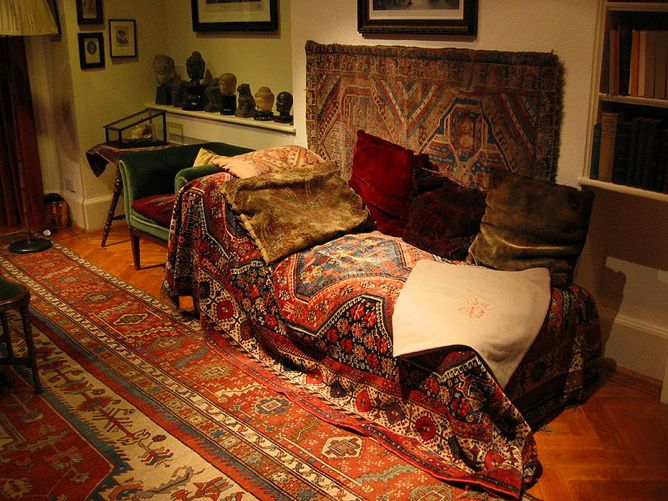
 Today's lovely feast, which of course brings the 40-day Christmas cycle to an end, is that of the Presentation of Christ in the Temple, often known as Candlemas. And in the Catholic world it's kept as a day to remember consecrated religious who devote their lives to prayer and contemplation. But what is prayer, and what of our difficulties with it? Here are some thoughts on that question aided by two books I read back to back last weekend--quite unintentionally, I might add, or at least without conscious (!) intent.
But hear me out when I suggest that there are connections to be discovered between late Anglo-Irish Dominican theologian Herbert McCabe's God, Christ, and Us, and the contemporary Anglo-American psychoanalyst Christopher Bollas in The Evocative Object World.
I started with McCabe's lovely short book of sermons, God, Christ, and Us. If you are casting about for suitable Lenten reading material this year, permit me very warmly to recommend it. No chapter is very long, and none suffers from that kind of revolting treacle one sometimes associates with pious utterances such a sermons. McCabe was not pious in that sense at all, but very earthy and practical in a refreshingly straight-forward kind of way. The God preached by this member of the Order of Preachers is a God you actually want to meet, indeed might actually look forward to meeting, and quite probably over a drink or meal à deux.
I first encountered McCabe's name in the 1990s when Stanley Hauerwas made an off-hand reference to him in connection to Alasdair MacIntyre. I paid no heed as Hauerwas didn't say much and I wasn't interested enough to pursue the matter. Later I would see MacIntyre himself in several places confess debts to McCabe, but without much detail to spur on an investigation on my part.
But the person who really convinced me I must read McCabe was and is Eugene McCarraher, whom I first stumbled across in articles like this (discussing Terry Eagleton's Culture and the Death of God) and then this deeply fascinating three-part interview, the third of which avers "I swear that reading McCabe has often kept me a Christian." In my more despairing moments recently, I know exactly what McCarraher means by that, and I suspect very strongly he had lines like this from McCabe in mind:
"Like Peter and the 12 we remain Christians because there is nowhere else to go: if Christianity is not the revolution, nothing else is" (Law, Love and Language, 1968).McCarraher has also written a lovely overview of McCabe's life in this Commonweal article which notes, inter alia, that McCabe's "radicalism" was precisely and only possibly because of its deep orthodoxy. Rooted in the tradition, he could see its deeply subversive potential--even if, alas, that potential is almost always domesticated, tamed, thwarted by the powers and principalities of the present age. His orthodoxy, then, allowed him freely to explore socialism and Marxism.
Though my reading is still early yet, I have not see in him so far much exploration of Freud. But the language is clearly there. Repeatedly McCabe uses classical Freudian language in unmistakable ways, especially speaking of our tendency towards "projection" and our wallowing in "illusion" about both ourselves and God. In, e.g., Faith Within Reason, reflecting on the prodigal son, McCabe writes:
Sin is something that changes God into a projection of our guilt, so that we don’t see the real God at all; all we see is some kind of judge. God (the whole meaning and purpose and point of our existence) has become a condemnation of us. God has been turned into Satan, the accuser of man, the paymaster, the one who weighs our deeds and condemns us…For damnation must be just being fixed in this illusion, stuck forever with the God of the Law, stuck forever with the God provided by our sin (155-56; my emphasis).A little later on, McCabe uses language that very much echos the difficulties of psychoanalysis as Freud saw them for it confronts people with hidden, and often infelicitous, desires, images, and actions. But both Freud and McCabe argue that it is much better to face up to ourselves, sinful and infantile as we are:
We damn ourselves because we would rather justify and excuse ourselves, and look on our self-flattering images of ourselves, than be taken out of ourselves by the infinite love of God…Contrition, or forgiveness, is self-knowledge, the terribly painful business of seeing ourselves as what and who we are: how mean, selfish, cruel and indifferent and infantile we are (Faith Within Reason, 157).But it is in McCabe's sermons on prayer, two of which are found in God, Christ, and Us that most put me in mind of what Bollas says in the first chapter of The Evocative Object World, and, come to think of it, what Adam Phillips has also said, as I noted here in discussing his ideas about distractions and frustrations; see also his book Side Effects. The link between the two of them seems to be an unapologetic advocacy of free association, leading to my question: are prayer and psychoanalysis the only activities today where one's mind can range freely without being hectored and controlled by ideologues and capitalists (the two often being the same thing)? Are the pew and the couch the only places left to us today as places that do not demand anything of us but give us silence, space, freedom?
Bollas thinks that today's "attacks on psychoanalysis are thinly disguised attacks on unconscious life itself" because "there is a widespread contempt for unconcious life in modern culture." He doesn't say why this is, but it's not hard to figure out: both analysis and prayer, as activities in which our mind ranges freely in search of some outlet for our deepest desires and hurts, are precisely the vague, free-flowing, unproductive, dreamy, gimmick-free kinds of activity that cannot be monetized or commodified or turned into an app promoting "mindfulness" or some other bit of money-making chicanery.
Bollas's first chapter treats free association, noting that it's a mutual process of analyst-analysand freely associating together, creating the analysis together. As he nicely put it, this is an experience in which one can rightly and proudly say "You don't know what you're talking about!" But still you talk, and listen, and associate, and eventually certain things become clear. Other things may not become clear, but this is not necessarily a failure, for the value of analysis is not just the "what" or the content: it is also the process--as Bollas has said elsewhere, echoing D.W. Winnicott--of being held and contained, of developing a deep connection to another human being that in itself is worthwhile, not least in its transferential (and thereafter transformational) power. Furthermore, an analysis is worthwhile not just for the clarity of content that sometimes comes about, but also for the "psychoanalytic mind" it creates, as Fred Busch has so winsomely described.
The beauty of this, as I have long appreciated it, is that "psychoanalysis does not provide ready answers to patients symptoms or lives," as Bollas admits. This, he recognizes, is "disconcerting" for those who think that clinicians are supposed to be experts. In fact, Bollas--and here his thought closely tracks that of Phillips, as I have repeatedly shown on here--says that the free associating of the unconscious of both analyst and analysand "subverts the analyst's natural authoritarian tendencies as well as the patient's wish to be dominated."
In this regard, Bollas puts me in mind of how Maggie Ross describes the mistaken notions behind modern concepts and practices of "spiritual direction," much of which consists of attempts at "mind control" as she puts it, and the result of which is to reinforce one's narcissism. Silence, for Ross, whose book shows considerable familiarity with psychoanalytic ideas, is the goal, and is hugely valuable in itself--a point that also becomes abundantly clear in reading the psychoanalytic literature about silent patients who nonetheless get better--start with another fascinating English Anglican, the analyst Nina Coltart, for examples of this; see her Slouching Towards Bethlehem.
McCabe doesn't come right out and advocate freely associating during prayer, but he very much leans in that direction. This is something I'll have to think about some more, but it does seem to me a helpful way to conceive of prayer and the problems of being distracted during or bored by prayer, or restlessly wondering about the futility of it all.
Rather than fighting that, McCabe advocates letting your mind wander until you find what you really want to pray about, and then praying about it. Here, again without using the words per se, McCabe seems to me to establish the "fundamental rule" (cf. Freud's "On Beginning the Treatment") of prayer outside the shackles of whatever spiritual superegos may be trying to tell us otherwise. If we let ourselves pray for what we are really concerned about, McCabe says, those prayers not only will almost always be, but in fact should be "the vulgar and rather infantile things you really do want," instead of all the pious and high-minded things we think we should pray about.
If we're distracted during prayer, it's because we're not praying for the right things (he notes those on sinking ships never report distractions during their prayers!), and constraining ourselves to pray for the things our superego tells us to--the "proper and respectable and 'religious'" things. Instead of that, as he drolly puts it, "you could let world peace rest for a while."And while you're at it, let your mind run to those distractions because they "are nearly always your real wants breaking in on your prayer." (Lest we worry that this is an excuse for descending into infantile selfishness, McCabe says that if we are honest in prayer about our desires, the Holy Spirit will invariably lead us deeper, for prayer involves change and growing up.) If psychoanalysis involves, as Bollas argued in his first major book The Shadow of the Object, a certain "ordinary regression to dependence" for a time, does this not also describe how we are in prayer with our Father in heaven as we pray for the things closest to us that matter most to us?
Subscribe to:
Posts (Atom)
