"Let books be your dining table, / And you shall be full of delights. / Let them be your
mattress,/
And you shall sleep restful nights" (St. Ephraim the Syrian).


Showing posts with label Stanley Hauerwas. Show all posts

Monday, August 31, 2020

What is Truth?

My entry into the world of academic theology, in the latter half of the 1990s, coincided almost exactly with the advent of the Radical Orthodoxy movement out of Cambridge. Having obsessively read everything written by Stanley Hauerwas, I followed his encouragement and next read John Milbank's landmark Theology and Social Theory: Beyond Secular Reason. I then met him during his brief sojourn teaching at the University of Virginia, where he agreed to be my dissertation director if I were to come there, but he returned to England not long after.

Before that, as soon as it was published over the Christmas break of 1997-98, I eagerly and devoutly devoured Catherine Pickstock's After Writing: on the Liturgical Consummation of Philosophy. It was a book I was in awe of for a long time, and I made a mental commitment to make sure I read everything she published. I have cited it countless times, and still think--though I have not followed debates in Latin liturgiology for several years now so perhaps someone has finally responded to Pickstock's challenge--that it makes a criticism of post-conciliar Latin liturgical reform that has never been acknowledged let alone answered: the elimination of structural repetitions in the post-conciliar Mass.

Not long after, in late 1998, I remember clearly standing in a bookstore in downtown Ottawa when Radical Orthodoxy: A New Theology was published. I bought it immediately. All three of these books cemented for me--as I know it did for a lot of others for a time--this almost mystical faith in the supposed philosophical corruptions of the High Middle Ages, not least those brought about by Scotus and Ockham, at whose names we all learned to expectorate in disgusted unison.

This all coincided with strong encouragement to pursue doctoral studies, which I had not considered myself worthy of doing. So I wrote to Pickstock with a possible dissertation topic--medieval corruptions of notions of authority in the Church, especially papal authority--and we entered into a dialogue by e-mail and letter and phone. She was enormously charming and encouraging. So I applied to the doctoral program at Cambridge and she agreed to be my director. I was admitted for the fall of 2000, but for reasons I will not bore you with here did not take up the position.

Nevertheless, I have always thought back on our conversations with fondness, and admired her work even if now I would regard parts of it--and, mutatis mutandis, the work of Milbank even more so--with a different eye.

All that is a typically prolix way of introducing you to a book of hers that is set for release in September: Aspects of Truth: A New Religious Metaphysics (University of Cambridge Press, 2020), 275pp. I'm looking forward to reading this and, if I can arrange it, to interviewing her about it.

About this book the publisher tells us this:
What is 'truth'? The question that Pilate put to Jesus was laced with dramatic irony. But at a time when what is true and what is untrue have acquired a new currency, the question remains of crucial significance. Is truth a matter of the representation of things which lack truth in themselves? Or of mere coherence? Or is truth a convenient if redundant way of indicating how one's language refers to things outside oneself? In her ambitious new book, Catherine Pickstock addresses these profound questions, arguing that epistemological approaches to truth either fail argumentatively or else offer only vacuity. She advances instead a bold metaphysical and realist appraisal which overcomes the Kantian impasse of 'subjective knowing' and ban on reaching beyond supposedly finite limits. Her book contends that in the end truth cannot be separated from the transcendent reality of the thinking soul.
The book comes with some hefty endorsements, not least from someone who also endorsed my own book last year:
'This is emphatically an important book – one of the most innovative and wide-ranging essays in philosophical theology to appear in recent years – from a scholar quite capable of tackling the most sophisticated minds of secular academic philosophy on their own ground, and showing that theology has a serious contribution to make to our thinking about thinking. This seriously original work – which addresses the fundamental question of what we think we are doing/claiming when we say we are speaking truthfully – has the capacity to make a major difference in its field.' Rowan Williams, Master of Magdalene College, Cambridge; formerly Archbishop of Canterbury
'Aspects of Truth is an original, serious and demanding work that seeks to come to a novel metaphysical perspective on the nature of truth, a perspective both adequate to and informed by Christian liturgy. Over the course of ten chapters, it draws upon the insights and reflects upon the inadequacies it finds in the writings of a great pantheon of philosophical and theological figures. It crosses and re-crosses boundaries between analytic philosophy, continental philosophy and theology. It's an exciting journey to take, in Pickstock's company. Aspects of Truth is provocative and challenging, written in a style that crosses boundaries as much as its arguments. I can think of no other book quite like it.' Fraser McBride, University of Manchester

Wednesday, November 13, 2019

Killing the Inconvenient and Inefficient

In the mid- and late-1990s, I was a volunteer in the pastoral care department of a large nursing home and was saddened by the neglect of many people there who were simply warehoused away pending their expiration date, which their families certainly found inconveniently far off into the future. And several of the residents themselves, bored, lonely, and often in declining health, felt the pressure to do the decent thing by hurrying along to their graves. The experience of visiting the residents, and sometimes bringing them the Eucharist, bestowed on my far more gifts than anything my poor efforts might have given them in return.

It was during this time that debates in Canada over euthanasia began to emerge, and it was smack in the middle of all that that Pope John Paul II rightly raised his finger in his powerful and still entirely relevant encyclical Evangelium Vitae. Some wrote that off as the "abortion letter" but its critique of the idol and ideology of "efficiency," developed at some length in several parts of the letter, admits of very wide application today, including how we handle the questions of human disease, decline, and death.

As I was reading the late pope's letter, I was also smack in the middle of my Hauerwas period, where I read every one of his books then extant, and even had whole sections memorized. He was hugely influential for my development, and became, unexpectedly, a friend when I wrote to him about my difficulties defending my MA thesis, which was heavily indebted to him and Alasdair MacIntyre. Hauerwas has written a powerful foreword to the new book Euthanasia and the Patristic Tradition by Ioannis Bekos (James Clarke & Co., 2019), 284pp.

About this book the publisher tells us this:
Euthanasia and Patristic Tradition presents secular and Christian bioethics as opposing forces in dialogue, highlights the importance of the Christian Patristic tradition in revealing disguised characteristics of bioethics in our era, and challenges the idea of individualism in modern societies through the development of a Christian individualism. While the book is focused on euthanasia, it also offers important perspectives on other ethical dilemmas. Ioannis Bekos applies Panagiotis Kondyliss theory for the emergence of worldviews as a function of power where all ethical theories have been proved to be subjective. Bringing together bioethical theories and just war theory, he exposes the disguised power claims of modern bioethics over human existence. Then, through an account of the history of thought, society, and politics of the twentieth and twenty-first centuries, Bekos delivers a profound critique of the idea of common morality, popular theories such as principlism and contractualism, ethicists like Peter Singer, and philosophers like Habermas. Using the works of St John Damascene and St Symeon the New Theologian, Bekos shows the fundamental elements of a Christian anthropology regarding the constitution of man, the character of pain and death, and the importance of the free will in man, offering a critique of modern bioethics.

Friday, September 6, 2019

Historical Contingency

As I argued here, I am increasingly convinced that many conflicts within Catholic and Orthodox Christianity today (and between their so-called apologists) are historiographical in nature. Much of what--especially in more "popular" forms, or in the proliferation of books appearing from dodgy publishers or even self-published, as well as on myriad blogs and websites--makes it into print today purporting to tell Christians about our past is not serious and scholarly history told, as I argued, with requisite asceticism, serenity, and comprehensive accounting of the evidence in a manner free of ideological bias or a tendentiousness designed to thwart your imaginary enemies--the "Franks" and "Latins" and "Greeks" and "modernist heretics" and, of course, "the Masons."

This kind of history exults in creating grotesques and fatuously glosses over any acknowledgement of the contingency of human affairs, pretending that one can here, now, today, in an unaided fashion make infallible snap judgments about long-ago events half hidden in the mists "between two waves of the sea" (Eliot). When the evidence is lacking for such judgments, then one magics up some conspiracy theories to account for such lacunae and to stitch together wholly implausible events in search of a kind of coherence which is often mythical and almost invariably constricting and constraining, sometimes lethally so if one cares about the truth.

Where, in this, is the awareness of the contingency of our lives (a theme I first learned many years ago from Stanley Hauerwas and then Alasdair MacIntyre and finally Newman)?

For some Christians, perhaps most, like people in general, they abhor any notion of contingency and instead prefer (often unconsciously) to find their lives to be determined, and to make others' lives be determined, too, according to the dictates of some pope or patriarch or preacher on the TV, or perhaps some politician, all of them offering a program, group, party you can join (for a fee, of course) and be magically rescued from having to contend ever again with the messiness of your own life--never mind that of your community, country, and Church. This thinking is typically manifest via "if only" statements: if only the pope weren't a modernist; if only the seventeenth secret of Fatima were revealed; if only we didn't have the media/deep state/Clinton/Trump/Phanar/Mt. Athos/Moscow/Constantinople (etc.) to contend with then we could really smite our enemies and bring the messiness of history to an uncluttered end.

But surely contingency is the very price and stuff of our freedom as creatures? Surely it is, and is to be welcomed as, a gift, however disguised it may often seem to people who would rather make themselves "slaves of the Immaculate Heart of Mary" or who "exult in the freedom to submit themselves to church authority with wild abandon" (Neuhaus)?

But that itself raises two further questions: do we secretly hate freedom, as suggested here? And do we in fact prefer to have determined lives, not only determined by others (including those wreathed about with pious smoke) but also by our own self-generated narratives and internal censors and self-diagnoses, as Adam Phillips suggests in his invaluable book, Unforbidden Pleasures, discussed here?

The question of historical contingency comes in for examination in a new book, Contingency and the Limits of History: How Touch Shapes Experience and Meaning by Liane Carlson (Columbia University Press, 2019), 304pp.

About this new book the publisher tells us this:
Central to the historicizing work of recent decades has been the concept of contingency, the realm of chance, change, and the unnecessary. Following Nietzsche and Foucault, genealogists have deployed contingency to show that all institutions and ideas could have been otherwise as a critique of the status quo. Yet scholars have spent very little time considering the genealogy of contingency itself—or what its history means for its role in politics.
In Contingency and the Limits of History, Liane Carlson historicizes contingency by tying it to its theological and etymological roots in “touch,” contending that much of its critical, disruptive power is specific to our current historical moment. She returns to an older definition of contingency found in Christian theology that understands it as the lot of mortal creatures, who suffer, feel, bleed, and change, in contrast to a necessary, unchanging, impassible God. Far from dying out, Carlson reveals, this theological past persists in continental philosophy, where thinkers such as Novalis, Schelling, Merleau-Ponty, and Serres have imagined contingency as a type of radical destabilization brought about by the body’s collision with a changing world. Through studies of sickness, loneliness, violation, and love, she shows that different experiences of contingency can lead to dramatically dissimilar ethical and political projects. A strikingly original reconsideration of one of continental philosophy and critical theory’s most cherished concepts, this book reveals the limits of historicist accounts.

Monday, March 11, 2019

Hauerwas and Vanier on Violence and Gentleness

The one person who has forced me to think about pacifism and the role of violence within Christianity more than any other is Stanley Hauerwas; and the one person who has probably done more than any other to make me aware of the invaluable lessons we can learn from those with Down syndrome and other handicaps is Jean Vanier. Now the two of them have teamed up to co-author Living Gently in a Violent World: The Prophetic Witness of Weakness (Downers Grove, Illinois: IVP, 2018).

About this book we are told the following:
How are Christians to live in a violent and wounded world? Rather than contending for privilege by wielding power and authority, we can witness prophetically from a position of weakness. The church has much to learn from an often-overlooked community―those with disabilities. In this fascinating book, theologian Stanley Hauerwas collaborates with Jean Vanier, founder of the worldwide L'Arche communities. For many years, Hauerwas has reflected on the lives of people with disability, the political significance of community, and how the experience of disability addresses the weaknesses and failures of liberal society. And L'Arche provides a unique model of inclusive community that is underpinned by a deep spirituality and theology. Together, Vanier and Hauerwas carefully explore the contours of a countercultural community that embodies a different way of being and witnesses to a new order―one marked by radical forms of gentleness, peacemaking, and faithfulness. The authors' explorations shed light on what it means to be human and how we are to live. The robust voice of Hauerwas and the gentle words of Vanier offer a synergy of ideas that, if listened to carefully, will lead the church to a fresh practicing of peace, love and friendship. This invigorating conversation is for everyday Christians who desire to live faithfully in a world that is violent and broken. This expanded edition now includes a study guide for individual reflection or group discussion.

Tuesday, May 1, 2018

Christians and Class Warfare

If you listened, in the aftermath of the Florida school massacre, to that moral cretin heading up the NRA, he fatuously claimed that there was a "God-given" right to bear arms. Even a cursory review of Catholic social teaching, which has reflected in very considerable detail on human rights since 1948, would show that there is no such right theologically understood. And if you listen to the great moral philosopher and intellectual historian Alasdair MacIntyre, you would know from his historical review that the very concept of rights is an entirely human invention dating no earlier than the year 1400. As a result, people like LaPierre resort to uttering rubbish fit only for the splendid riposte of MacIntyre: “there are no such rights, and belief in them is one with belief in witches and in unicorns” (After Virtue).

One of MacIntyre's great influences was the late Dominican theologian Herbert McCabe. Indeed, in the acknowledgements to Whose Justice? Which Rationality, the successor book to After Virtue (and part of the so-called trilogy along with Three Rival Versions of Moral Enquiry), MacIntyre pointedly and rather fulsomely acknowledges how much he owes McCabe more than anyone for the latter's critical responses to After Virtue.

I have previously reflected on some of McCabe's writings on here in conversation with other thinkers who come out of and are shaped by the post-war British left, including Adam Phillips and Christopher Bollas.

But the work of McCabe's that bears on this debate in some ways, and which is perhaps the most challenging thing he wrote, is his 1980 essay "The Class Struggle and Christian Love," reprinted in God Matters.

The language of "class struggle" is of course more familiar to Eastern, especially Slavic, Christians than to anyone else due to the Russian Revolution. Some, especially Americans, may be inclined smugly to dismiss this language as a relic of losers in the Cold War. But as others have argued very recently, that language cannot be abandoned quite so facilely if one hopes to bring about any real political and economic change.

McCabe was writing when the Cold War was at its height, having been deeply influenced by Marxism, as was his close friend Terry Eagleton, a man of the British Catholic left whose books Why Marx Was Right and The Gatekeeper: A Memoir are rollicking good reads. 

In his essay "The Class Struggle and Christian Love," McCabe begins by stating that "the class struggle is the revolution--not just a means toward it, but the thing itself"(182).  He immediately notes that many, perhaps most, Christians will reject this notion of class struggle as incompatible with the gospel--and in doing so find themselves in bed with those who agree with them, viz., Joseph Stalin, Margaret Thatcher, and the International Marxist Group.

But, later in the essay, McCabe will more stoutly insist that Christian participation in the class struggle is in fact required by the dominical call to love our neighbor, and that such struggle and such love may sometimes be found in "circumstances in which even violence itself--by which I mean killing people--is not only compatible with Christian love but demanded by it" (185). 

Later still, he wants to unpack, just a little bit, what this notion of "class struggle" entails. It is not, he begins, just a variant on English class snobbery; it is not about simple conflict between haves and have-nots; and it is not differences of wealth that cause class conflict, but "class differences that cause differences of wealth" (188).

In mentioning all this, McCabe along the way notes that the gospels say nothing of course about these issues, though they say plenty about the dire perils posed by riches and the neglect of the poor. But the gospels are silent on any notion "that everyone has to have equal shares of wealth" (189). And if we think class conflict is about envious maneuvering to establish total equality with everyone having the same share, we are mistaken. Equally mistaken are we if we think we are not somehow already involved in a struggle, and have been for a very long time. Finally, we delude ourselves if we think there is a position of neutrality somewhere here: those who are neutral, he says, are inevitably on the side of "the class in power" (192). Christians cannot be neutral, he insists, but must fight against the class conflict and war.

What is that conflict and war based upon? Here, McCabe's Marxism is most clearly on display: in capitalism the fundamental divide, and so the fundamental factor in class conflict, is over surplus value created by workers (beyond what they need strictly for subsistence) which is appropriated by capitalists to enrich themselves and extend their own power in defense of their interests against others. The system of capitalism has at its heart an "intrinsic" need for class conflict (190).

There is, then, "human antagonism" at the heart of capitalism (192). That antagonism sometimes breaks out in open shooting wars in which the state goes to battle on behalf of the ruling classes to preserve them in power. Can Christians join in? Can Christians be involved in a class struggle up to and including the use of violence? Or is it the case that this antagonism at the heart of capitalist-driven class conflict means that it will forever be opposed to and by Christianity properly lived and understood?

Is Christianity, in other words, always going to be opposed to capitalism insofar as the former claims against the latter the possibility (however poorly embodied) that conflict can be overcome, that conflict is not inevitable, that we can live together in love? McCabe certainly thinks so: "Christianity is deeply subversive of capitalism precisely because it announces the improbable possibility that men might live together without war; neither by domination nor by antagonism but by unity in love" (193).

Christianity must therefore fight the class war because it is ipso facto fighting capitalism and its antagonism which is most precisely opposed to the universal call to love. But does the Christian fighting that war have to use violence or have the right to do so--or must it be forsworn? McCabe, as is his wont, calmly and carefully considers the arguments of his opponents while advancing his own. And so he picks up the Christian concern that any idea of a class struggle somehow requires violence, which no Christian can support. But does it? Does the idea of a class struggle inevitably mean a violent or armed struggle? McCabe says no: "It is perfectly possible to believe passionately in the importance of the class struggle and to renounce all political violence" (183).

He goes on to argue that there is no incompatibility in working, as a Christian, for the just overthrow of the ruling class while forswearing the killing of that class.

But leave aside such principles: there are much more pragmatic considerations to forswearing killing. McCabe notes that any time you go up against the modern state, it is bound to win. You can recruit a few starry-eyed idealists to your cause--the IRA, say, or ISIS--but the other side will always have more men under arms and better arms, and thus will always defeat you. The ruling class, then, is much better at killing on a much larger scale than any of its opponents can ever hope to do.

Here McCabe quotes General Patton's aphorism that you don't win wars by getting young men to die for your country, but by convincing the other men to die for their country--a neat twist to this having been pulled off by the Americans and British in the Second World War, where the Soviet Union lost far more men than their erstwhile allies, and they all knew it but tried to avoid talking about it. In reading The Maisky Diaries: Red Ambassador to the Court of St. James 1932-1943 last year, I came across the suspicion expressed again and again by the Soviet ambassador, Ivan Maisky, along with his boss Molotov, and his boss Stalin, that the refusal of a second front in Europe until mid-1944, while not without certain technical considerations, was also secretly motivated by a desire to bleed Russia white. The British of course denied this at all times, and not totally insincerely, it seems to me; but at the same time we cannot forget that a scant 20 years before the British regarded the Bolsheviks as terrible enemies to be wiped off the earth.

And, in fact, much of this is born out later on. As David Reynolds' deeply fascinating book In Command of History: Churchill Fighting and Writing the Second World War showed, the British premier was certainly aware of the fact that the Russian losses were on a scale never seen or matched in the West, which is why Churchill's chapters on the war in Russia are among the shortest, least attentive, and poorly researched of his entire six-volume memoirs of the war. E.g., lavish attention is given to British battles in North Africa while Stalingrad gets only the barest treatment; Churchill also withheld certain criticisms of Eisenhower as the latter was elected when the former was finishing his last volume in the early 1950s. Seldom has the writing of "history" been so transparently tendentious and subordinate to the political moment.

But back to McCabe. who continues to note that there are other pragmatic but in fact powerful reasons to forswear violence: it takes you away from spending time and energy on the one thing that might dislodge the ruling class from power, that is, exposing its carefully concealed lie that preservation of its power is necessary for the preservation of the peace and prosperity of those further down the social hierarchy. For the moment, McCabe says, Christians doing this are doing the best they can, and are not mistaken in seeing what they see and doing what they do. Conditions are not yet in place for them to be called upon to do more. Capitalism, he says, has not yet reached that stage of crisis where Christians might be called on to undertake violent actions.

And here's where the essay starts to raise difficulties at least for me when he says that "I think...that the pacifist is mistaken in supposing that violence is always incompatible with the Christian demand that we love our neighbor" (185). I suppose my difficulty comes in part from having first read Stanley Hauerwas in the early 1990s when I was beginning to take theology seriously. His repeated arguments in favour of pacifism have never really left me. On this score, see, inter alia, his early The Peaceable Kingdom; see also his memorable essay "The Non-Violent Terrorist: In Defense of Christian Fanaticism" in Sanctify Them in the Truth; and then see some of his more recent works after September 11th, including War and the American Difference: Theological Reflections on Violence and National Identity.

Though I don't know how pacifism works out in practice, it seems to me in theory, that is, in theology, to be true that Christians should forswear violence, for the use of violence seems to me to be a theological mistake in the strict sense: that is, God in Christ has kenotically abandoned the path of violence when, as the gospels make plain, He easily could have summoned legions of angels to destroy His enemies....but did not.

My difficulty with McCabe's claim is lessened, briefly, towards the end of his essay. For he turns to the practical question of how a Christian must fight the class war, and here he issues some strong counsels: "In the first place be meek" because nobody likes a loud-mouthed, ungracious bully-boy advancing a cause; such behavior is counter-productive. Second and further, be "loving, kind, gentle, calm, unprovoked to anger." Real revolutionaries, he says, are all these things and just to that extent "they are extremely dangerous" to the lies and liars of capitalism who view conflict as inevitable, as something one must be well armed against and willing to kill over. In addition, "we should not lose our sense of humour" and become tedious and unpleasant scolds.

But just when you think McCabe might left you off easy, he comes back to say "We still need though to face the question of revolutionary violence" (196). Here he notes with his usual self-critical bluntness that no churchmen have the right to demand nonviolence when "their cathedrals are stuffed with the regimental flags and monuments to colonial wars. The Christian Church, with minor exceptions, has been solidly on the side of violence for centuries" as long as it has supported the status quo and the right class. The Church's opposition to violence begins "only when the poor catch on to violence."

Nevertheless, it is not the case, he concedes, that the Church has always and everywhere been only on the side of violence in promotion of selected interests. The Church has not quite lost total credibility insofar as it has tried to maintain a call for justice, however poorly realized. And that call sometimes requires the use of violence. In doing so, we may not think it terribly loving to kill certain people--the love may not, he says, be very "perspicuous"--but we cannot conclude that such actions, sinful though they are, are totally lacking in love. They are motivated by love for the innocent who are suffering injustice. To that extent, then, we may describe violence not as intrinsically wrong but as at least partially loving.

Here McCabe knows his Christian history in ways that almost all of us today have forgotten. Here I was reminded of something Phillip Jenkins documents in hair-raising detail from just a century ago, and Jonathan-Riley Smith documents for at least ten centuries before that: the Christian tradition, until the aftermath of the First and then Second World Wars, never saw violence as intrinsically wrong and always to be avoided. That perspective, it seems to me, is a purely post-1945 development aided, in part, by popes going to the UN in New York to pound the podium and (ahem) pontificate "War no more!" Until those developments, the Christian tradition for the overwhelming part of its history did not presuppose that violence was ruled out of course with prejudice. Rather, it evaluated the use of violence based on broader moral considerations, including righting injustice and protecting the innocent.Thus it gave us the just war tradition, which tradition McCabe invokes here by saying that "the only just war is the class war, the struggle of the working class against the exploiters. No war is just except insofar as it is part of this struggle" (197).

Having said that, however, he immediately returns to his earlier point to reiterate that "violence can have very little part in the class struggle as such" right now given current conditions (197), not least the overwhelming preponderance of force on the side of the ruling class.

Finally, in his closing paragraphs, McCabe almost anticipates what I said above about it being a theological mistake to condone violence because Christ forswore its use: "we cannot imagine Jesus taking part in such violence; he was wholly and entirely a perspicuous example of what love means; he was and is the presence of the Kingdom itself; we, however, are only on the road towards it" (197).

That road is rooted in the present but already concluded in the future. As a result, we can see with two sets of eyes: the injustice of the present, but its destruction and forgiveness in the future. As a result, Christians cannot hate anybody, even those who exploit the poor or inflict other injustices. The Christian engaged in class warfare can only do so once he understands that "hatred is impossible" and that even one's class enemies are those for whom Christ also died.

Friday, February 2, 2018

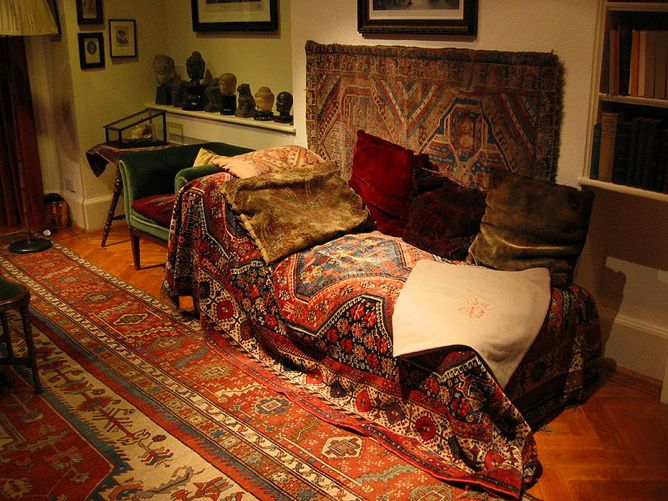
The Fundamental Rule of Prayer: Free Association?

Today's lovely feast, which of course brings the 40-day Christmas cycle to an end, is that of the Presentation of Christ in the Temple, often known as Candlemas. And in the Catholic world it's kept as a day to remember consecrated religious who devote their lives to prayer and contemplation. But what is prayer, and what of our difficulties with it? Here are some thoughts on that question aided by two books I read back to back last weekend--quite unintentionally, I might add, or at least without conscious (!) intent.

But hear me out when I suggest that there are connections to be discovered between late Anglo-Irish Dominican theologian Herbert McCabe's God, Christ, and Us, and the contemporary Anglo-American psychoanalyst Christopher Bollas in The Evocative Object World.

I started with McCabe's lovely short book of sermons, God, Christ, and Us. If you are casting about for suitable Lenten reading material this year, permit me very warmly to recommend it. No chapter is very long, and none suffers from that kind of revolting treacle one sometimes associates with pious utterances such a sermons. McCabe was not pious in that sense at all, but very earthy and practical in a refreshingly straight-forward kind of way. The God preached by this member of the Order of Preachers is a God you actually want to meet, indeed might actually look forward to meeting, and quite probably over a drink or meal à deux. 

I first encountered McCabe's name in the 1990s when Stanley Hauerwas made an off-hand reference to him in connection to Alasdair MacIntyre. I paid no heed as Hauerwas didn't say much and I wasn't interested enough to pursue the matter. Later I would see MacIntyre himself in several places confess debts to McCabe, but without much detail to spur on an investigation on my part.

But the person who really convinced me I must read McCabe was and is Eugene McCarraher, whom I first stumbled across in articles like this (discussing Terry Eagleton's Culture and the Death of God) and then this deeply fascinating three-part interview, the third of which avers "I swear that reading McCabe has often kept me a Christian." In my more despairing moments recently, I know exactly what McCarraher means by that, and I suspect very strongly he had lines like this from McCabe in mind:
"Like Peter and the 12 we remain Christians because there is nowhere else to go: if Christianity is not the revolution, nothing else is" (Law, Love and Language, 1968).
McCarraher has also written a lovely overview of McCabe's life in this Commonweal article which notes, inter alia, that McCabe's "radicalism" was precisely and only possibly because of its deep orthodoxy. Rooted in the tradition, he could see its deeply subversive potential--even if, alas, that potential is almost always domesticated, tamed, thwarted by the powers and principalities of the present age. His orthodoxy, then, allowed him freely to explore socialism and Marxism.

Though my reading is still early yet, I have not see in him so far much exploration of Freud. But the language is clearly there. Repeatedly McCabe uses classical Freudian language in unmistakable ways, especially speaking of our tendency towards "projection" and our wallowing in "illusion" about both ourselves and God. In, e.g., Faith Within Reason, reflecting on the prodigal son, McCabe writes:
Sin is something that changes God into a projection of our guilt, so that we don’t see the real God at all; all we see is some kind of judge. God (the whole meaning and purpose and point of our existence) has become a condemnation of us. God has been turned into Satan, the accuser of man, the paymaster, the one who weighs our deeds and condemns us…For damnation must be just being fixed in this illusion, stuck forever with the God of the Law, stuck forever with the God provided by our sin (155-56; my emphasis).
A little later on, McCabe uses language that very much echos the difficulties of psychoanalysis as Freud saw them for it confronts people with hidden, and often infelicitous, desires, images, and actions. But both Freud and McCabe argue that it is much better to face up to ourselves, sinful and infantile as we are:
We damn ourselves because we would rather justify and excuse ourselves, and look on our self-flattering images of ourselves, than be taken out of ourselves by the infinite love of God…Contrition, or forgiveness, is self-knowledge, the terribly painful business of seeing ourselves as what and who we are: how mean, selfish, cruel and indifferent and infantile we are (Faith Within Reason, 157).
But it is in McCabe's sermons on prayer, two of which are found in God, Christ, and Us that most put me in mind of what Bollas says in the first chapter of The Evocative Object World, and, come to think of it, what Adam Phillips has also said, as I noted here in discussing his ideas about distractions and frustrations; see also his book Side Effects. The link between the two of them seems to be an unapologetic advocacy of free association, leading to my question: are prayer and psychoanalysis the only activities today where one's mind can range freely without being hectored and controlled by ideologues and capitalists (the two often being the same thing)? Are the pew and the couch the only places left to us today as places that do not demand anything of us but give us silence, space, freedom?

Bollas thinks that today's "attacks on psychoanalysis are thinly disguised attacks on unconscious life itself" because "there is a widespread contempt for unconcious life in modern culture." He doesn't say why this is, but it's not hard to figure out: both analysis and prayer, as activities in which our mind ranges freely in search of some outlet for our deepest desires and hurts, are precisely the vague, free-flowing, unproductive, dreamy, gimmick-free kinds of activity that cannot be monetized or commodified or turned into an app promoting "mindfulness" or some other bit of money-making chicanery.

Bollas's first chapter treats free association, noting that it's a mutual process of analyst-analysand freely associating together, creating the analysis together. As he nicely put it, this is an experience in which one can rightly and proudly say "You don't know what you're talking about!" But still you talk, and listen, and associate, and eventually certain things become clear. Other things may not become clear, but this is not necessarily a failure, for the value of analysis is not just the "what" or the content: it is also the process--as Bollas has said elsewhere, echoing D.W. Winnicott--of being held and contained, of developing a deep connection to another human being that in itself is worthwhile, not least in its transferential (and thereafter transformational) power. Furthermore, an analysis is worthwhile not just for the clarity of content that sometimes comes about, but also for the "psychoanalytic mind" it creates, as Fred Busch has so winsomely described.

The beauty of this, as I have long appreciated it, is that "psychoanalysis does not provide ready answers to patients symptoms or lives," as Bollas admits. This, he recognizes, is "disconcerting" for those who think that clinicians are supposed to be experts. In fact, Bollas--and here his thought closely tracks that of Phillips, as I have repeatedly shown on here--says that the free associating of the unconscious of both analyst and analysand "subverts the analyst's natural authoritarian tendencies as well as the patient's wish to be dominated."

In this regard, Bollas puts me in mind of how Maggie Ross describes the mistaken notions behind modern concepts and practices of "spiritual direction," much of which consists of attempts at "mind control" as she puts it, and the result of which is to reinforce one's narcissism. Silence, for Ross, whose book shows considerable familiarity with psychoanalytic ideas, is the goal, and is hugely valuable in itself--a point that also becomes abundantly clear in reading the psychoanalytic literature about silent patients who nonetheless get better--start with another fascinating English Anglican, the analyst Nina Coltart, for examples of this; see her Slouching Towards Bethlehem.

McCabe doesn't come right out and advocate freely associating during prayer, but he very much leans in that direction. This is something I'll have to think about some more, but it does seem to me a helpful way to conceive of prayer and the problems of being distracted during or bored by prayer, or restlessly wondering about the futility of it all.

Rather than fighting that, McCabe advocates letting your mind wander until you find what you really want to pray about, and then praying about it. Here, again without using the words per se, McCabe seems to me to establish the "fundamental rule" (cf. Freud's "On Beginning the Treatment") of prayer outside the shackles of whatever spiritual superegos may be trying to tell us otherwise. If we let ourselves pray for what we are really concerned about, McCabe says, those prayers not only will almost always be, but in fact should be "the vulgar and rather infantile things you really do want," instead of all the pious and high-minded things we think we should pray about.

If we're distracted during prayer, it's because we're not praying for the right things (he notes those on sinking ships never report distractions during their prayers!), and constraining ourselves to pray for the things our superego tells us to--the "proper and respectable and 'religious'" things. Instead of that, as he drolly puts it, "you could let world peace rest for a while."And while you're at it, let your mind run to those distractions because they "are nearly always your real wants breaking in on your prayer." (Lest we worry that this is an excuse for descending into infantile selfishness, McCabe says that if we are honest in prayer about our desires, the Holy Spirit will invariably lead us deeper, for prayer involves change and growing up.) If psychoanalysis involves, as Bollas argued in his first major book The Shadow of the Object, a certain "ordinary regression to dependence" for a time, does this not also describe how we are in prayer with our Father in heaven as we pray for the things closest to us that matter most to us?

Wednesday, May 27, 2015

The God Who is Dark

Among the self-congratulatory shibboleths some Eastern Christians like to use to disdain a Western tradition about which they know virtually nothing and thus bolster their shaky self-confidence is the claim that all Eastern theology is apophatic, while all Western theology is rationalistic, scholastic, kataphatic. Even before I became an Eastern Christian I knew this was bunk after Stanley Hauerwas told me in the late 90s that if I was going to Cambridge for doctoral studies then I had to get in touch with her Norris-Hulse Professor of Divinity, Denys Turner, and read his book The Darkness of God: Negativity in Christian Mysticism, which helped me to see that the West has its own deep tradition of apophatic mysticism even as the West also has had certain periods and persons who are indeed rationalistic and scholastic--and not always in a completely good way. These latter do not, however, represent the entire Western tradition (any more than one can say that everyone in the East is a hesychast).

Turner moved back across the Atlantic to Yale, and in November of this year is being honored with a Festschrift: Eric Bugyis and David Newheiser, eds., Desire, Faith, and the Darkness of God: Essays in Honor of Denys Turner (UND Press, Nov. 2015), 480pp.

About this book the publisher tells us:
In the face of religious and cultural diversity, some doubt whether Christian faith remains possible today. Critics claim that religion is irrational and violent, and the loudest defenders of Christianity are equally strident. In response, Desire, Faith, and the Darkness of God: Essays in Honor of Denys Turner explores the uncertainty essential to Christian commitment; it suggests that faith is moved by a desire for that which cannot be known.
This approach is inspired by the tradition of Christian apophatic theology, which argues that language cannot capture divine transcendence. From this perspective, contemporary debates over God’s existence represent a dead end: if God is not simply another object in the world, then faith begins not in abstract certainty but in a love that exceeds the limits of knowledge.
The essays engage classic Christian thought alongside literary and philosophical sources ranging from Pseudo-Dionysius and Dante to Karl Marx and Jacques Derrida. Building on the work of Denys Turner, they indicate that the boundary between atheism and Christian thought is productively blurry. Instead of settling the stale dispute over whether religion is rationally justified, their work suggests instead that Christian life is an ethical and political practice impassioned by a God who transcends understanding.
Contributors: Eric Bugyis, Katie Ann-Marie Bugyis, David Burrell, C.S.C., Oliver Davies, Terry Eagleton, John Hare, Karl Hefty, Robin Kirkpatrick, Karmen MacKendrick, Philip McCosker, Bernard McGinn, Vittorio Montemaggi, David Newheiser, Cyril O’Regan, Mary-Jane Rubenstein, Denys Turner, Ludger Viefhues-Bailey, A. N. Williams
“Desire, Faith, and the Darkness of God: Essays in Honor of Denys Turner is a testament to the range of Denys Turner’s influence and the varieties of modes of argumentation with which his work is conversant. The volume will be read with pleasure by scholars in the history of Christianity, particularly of Christian mysticism, Christian theologians, and philosophers of religion, as well as scholars across a range of subdisciplines." — Amy Hollywood, Elizabeth H. Monrad Professor of Christian Studies, Harvard Divinity School

Wednesday, February 26, 2014

Then Cometh the End

One of the high points of my tenure as editor of Logos: A Journal of Eastern Christian Studies was when Stanley Hauerwas sent me an article to publish, which we happily did in 2006. It was an essay treating the thought of St. Gregory the Theologian on poverty and learning. Hauerwas used Gregory to ask the question of whether a Christian university that really cares for the poor can continue to operate as its secular counterparts do, or whether it needs to be structured differently.

Back in the mid-1990s, Hauerwas and I became, as he insisted, friends--even if it was an epistolary friendship, with our not actually meeting until 2004 when we both gave papers at a conference in Prince Edward Island. He was very helpful in getting my MA thesis defended, and providing much counsel along the way. He, Alasdair MacIntyre, and Cardinal Newman (the "three wise men") laid the intellectual groundwork for my becoming Catholic.

But never mind this tedious autobiography. Hauerwas's significance and importance stretches far beyond my little world. He has been, for more than twenty years now, widely thought of as one of the most important Protestant theologians in North America. Indeed, in 2001, Time magazine (back when it was something of an institution and people actually read it--does anybody bother with it today?) put him on its cover as theologian of the year in the aftermath of Hauerwas's controversial comments on the 9/11 attacks.

Hauerwas recently retired from Duke, but continues to publish. As he moves through his 70s now, the title of his most recent book seems doubly fitting: Approaching the End: Eschatological Reflections on Church, Politics, and Life (Eerdmans, 2013), xvii+251pp. About this book we are told:

In this book Stanley Hauerwas explores the significance of eschatological reflection for helping the church negotiate the contemporary world.

In Part One, "Theological Matters," Hauerwas directly addresses his understanding of the eschatological character of the Christian faith. In Part Two, "Church and Politics," he deals with the political reality of the church in light of the end, addressing such issues as the divided character of the church, the imperative of Christian unity, and the necessary practice of sacrifice. End, for Hauerwas, has a double meaning -- both chronological end and end in the sense of "aim" or "goal."

In Part Three, "Life and Death," Hauerwas moves from theology and the church as a whole to focusing on how individual Christians should live in light of eschatology. What does an eschatological approach to life tell us about how to understand suffering, how to form habits of virtue, and how to die?

Tuesday, July 9, 2013

Constantine the Emperor: Debating the Legacy

Two decades ago when I began to read Stanley Hauerwas, I found him frequently railing against the baleful influence of "Constantinianism," by which he meant (at the time) the interference in, and thus taming of, the Church by the empire--notions Hauerwas borrowed, if memory serves, from John Howard Yoder. I was not entirely convinced of this line of argumentation at the time, and over the years have become less so; I think Hauerwas has himself moderated his views somewhat.

In the last two decades, and especially in the last five years, this legacy of Constantine (whom the Byzantine tradition calls "equal to the apostles") continues to be debated, as I have noted repeatedly before. But much of what people today seem to be "rediscovering" or reconsidering about Constantine was, at least in inchoate fashion, discussed more than half a century ago by the Jesuit historian Francis Dvornik, as I mentioned before.

Further studies about Constantine coming out this year, on top of a book recently published by Oxford University Press: David Potter, Constantine the Emperor (OUP, 2012), 368pp.

About this book the publisher tells us:

This year Christians worldwide will celebrate the 1700th anniversary of Constantine's conversion and victory at the Battle of the Milvian Bridge. No Roman emperor had a greater impact on the modern world than did Constantine. The reason is not simply that he converted to Christianity but that he did so in a way that brought his subjects along after him. Indeed, this major new biography argues that Constantine's conversion is but one feature of a unique administrative style that enabled him to take control of an empire beset by internal rebellions and external threats by Persians and Goths. The vast record of Constantine's administration reveals a government careful in its exercise of power but capable of ruthless, even savage actions. Constantine executed (or drove to suicide) his father-in-law, two brothers-in-law, his eldest son, and his once beloved wife. An unparalleled general throughout his life, even on his deathbed he was planning a major assault on the Sassanian Empire in Persia. Alongside the visionary who believed that his success came from the direct intervention of his God resided an aggressive warrior, a sometimes cruel partner, and an immensely shrewd ruler. These characteristics combined together in a long and remarkable career, which restored the Roman Empire to its former glory.

Beginning with his first biographer Eusebius, Constantine's image has been subject to distortion. More recent revisions include John Carroll's view of him as the intellectual ancestor of the Holocaust (Constantine's Sword) and Dan Brown's presentation of him as the man who oversaw the reshaping of Christian history (The Da Vinci Code). In Constantine the Emperor, David Potter confronts each of these skewed and partial accounts to provide the most comprehensive, authoritative, and readable account of Constantine's extraordinary life.
The other study, apparently published at the end of June, is a critical scholarly engagement of Peter Leithart's 2010 book (which we had expertly reviewed in Logos: A Journal of Eastern Christian Studies) Defending Constantine: The Twilight of an Empire and the Dawn of Christendom. Leithart's work engendered a good deal of criticism, some collected in John Roth, ed., Constantine Revisited: Leithart, Yoder, and the Constantinian Debate (Pickwick, 2013), 216pp.

About this collection we are told:
This collection of essays continues a long and venerable debate in the history of the Christian church regarding the legacy of the Roman emperor Constantine the Great. For some, Constantine's conversion to Christianity early in the fourth century set in motion a process that made the church subservient to the civil authority of the state, brought a definitive end to pacifism as a central teaching of the early church, and redefined the character of Christian catechesis and missions.

In 2010, Peter J. Leithart published a widely read polemic, Defending Constantine, that vigorously refuted this interpretation. In its place, Leithart offered a thoroughgoing rehabilitation of Constantine and his legacy, while directing a rhetorical fusillade against the pacifist theology and ethics of the Mennonite theologian John Howard Yoder.

The essays gathered here in response to Leithart reflect the insights of eleven leading theologians, historians, and ethicists from a wide range of theological traditions. They engage one of the most contentious issues in Christian church history in irenic fashion and at the highest level of scholarship. In so doing, they help ensure that the "Constantinian Debate" will continue to be lively, substantive, and consequential.

Tuesday, April 9, 2013

In Defense of Christian "Extremism"

For fifty cents at a local "antique" shop, I recently found an old copy of a book edited by Harold Faber The Road to the White House: The Story of the 1964 Election. The book pulls together the coverage in the New York Times of the 1964 US presidential election. It's mildly interesting, and of course it covers Barry Goldwater's infamous acceptance speech and its unapologetic declaration that "extremism in the defense of liberty is no vice."

That line came back to me upon hearing the recent news that one arm of that vast Leviathan we call the US federal government has classified certain groups, including Catholic and evangelical Christians, as "extremist." The report is rightly being criticized on a number of grounds, not least for sounding like some lazy functionary more or less cribbed a lot of this nonsense from that fount of all wisdom, Wikipedia.

But there are two responses I have not yet seen to this. The first is that of tu quoque. The second is to concede, happily, the charge but then redefine the terms. For the first, we turn to Alasdair MacIntyre; for the second, to Stanley Hauerwas.

MacIntyre, as I have noted before, has rightly written that no institution is more "extreme" than the state:
The modern nation-state, in whatever guise, is a dangerous and unmanageable institution, presenting itself on the one hand as a bureaucratic supplier of goods and services, which is always about to, but never actually does, give its clients value for money, and on the other as a repository of sacred values, which from time to time invites one to lay down one’s life on its behalf… [I]it is like being asked to die for the telephone company.
As William Cavanaugh, picking up from MacIntyre, argues, the dangerous and unmanageable modern state is never so furiously self-aggrandizing as during situations of war or perceived "national security" threats, when the organs and arms of the state, and their "extreme" infringements (soon to become regularized as routine) on the lives of its citizens grow like mad. Compared to this, no "religion" (an impossibly vague term I reject not least because it is capable of meaning just about anything) stands a chance at being "extreme" for no "religion" has so many organs capable not merely of controlling the lives of people, but of compelling them, under threat of lethal force, to do its bidding and of potentially punishing them with loss of life if they fail to do so. This is perforce true of today's state, when more and more parts of the US government--including seemingly anodyne ones like the department of "education"-- have their own armed SWAT teams. If this isn't "extreme" growth of state power, I don't know what is.

I was given a nasty taste of this last fall when on an Amtrak train (a shabby service today and a far cry from the fabled Pullman cars which, in the 1950s, sent Evelyn Waugh, traveling across country from New York to Los Angeles to discuss film rights for Brideshead Revisited, into raptures about the "luxury" of American railway travel) en route to Penn Station in New York to attend the Orthodox Theological Society of America conference, where I gave a paper. In upstate New York, south of Rochester, at least an hour from the Canadian border, very heavily armed troops in fatigues from the Border Patrol came on the train and demanded documents from everyone on there, stalking through cars at 11:30pm impudently interrogating people, "US citizens?" Note well: this was on US soil, the train never crossed any international borders (as noted, we were a good hour from that dangerous hotbed of "extremism" known as Canada), and yet we were stopped. As I furiously texted to my wife, "What is this? The Soviet Union redux where you have to have internal passports to travel from city to city?" One woman across from me was foolish enough to admit she was a German on a student visa, so she, along with a woman in a hijab in front of me, were both disappeared for an hour and interrogated, coming back looking very shaken indeed.  To their credit, these troops did not force the issue with people--I pretended to be asleep and they walked on past me--as though aware, however reluctantly and for however much longer, that, they do not (yet)  have the legal right to demand documents for internal travel, or expect people to prove their citizenship on a train in the middle of nowhere late at night in their own country far from any international borders never crossed by this particular train on this particular route. Nevertheless, the very fact of their menacing presence is a case of the "extreme" overreach of the modern security state.

Turning to Stanley Hauerwas, let us adopt his strategy (also that of LGBT [etc. etc.] activists) and reclaim the vocabulary here. Christianity is "extreme" and anybody who is surprised by this, or worse, alarmed enough to put Christians on some government watch list, has simply not been paying attention. Some time ago, Stanley Hauerwas already adopted this reversal of terms in an essay "The Non-Violent Terrorist: In Defense of Christian Fanaticism" from his 1998 book Sanctify Them in the Truth: Holiness Exemplified. During our correspondence in the 1990s, Stanley sent me a draft of this before it was published, and the phrase has always stuck with me as one of his many bon mots. He ends up in a direction I cannot entirely follow, namely pacifism. But still the arguments are important.

It builds on his earlier essay "Preaching as though We Had Enemies." In that latter essay, he argues that "one hopes that God is using this time to remind the Church that Christianity is unintelligible without enemies. Indeed, the whole point of Christianity is to produce the right kind of enemies." Note well: the right kind of enemies. In both places, and elsewhere, as in his most recent book on war, Hauerwas reminds Christians of what, in perhaps most other ages, would have been unremarkable: that the world has always regarded us as "odd" at best, and as "crazy," "extremist," "enemies," etc. at worst. And that is indeed correct: the Church is the enemy of any state so "extreme" that thinks itself the supreme power and authority in the world, unhindered by, and unaccountable to, any higher power, and free therefore to run roughshod over the rights and dignity of the human person. The Church opposes such totalitarian extremism in political systems and actors wherever they may be found.

Moreover, the God whom we worship, the God revealed in Jesus Christ, is "extreme." He goes, as Eastern Christians know from the hymnody of Holy Saturday, and from the anastasis icon, down to the very depths of hell to destroy its power even over those who first betrayed Him, Adam and Eve, portrayed here as being helped out of their tombs; He goes to the ends of the earth to rescue the lost sheep; He welcomes back the prodigal when all our earthly notions of "justice" would side with the elder brother and give nothing to the returning son except a sanctimonious harangue about "loose living."

But it is, I suppose, harmless enough for God to be thought of as "extreme." He at least is presumably not (yet) on a government watch list. Now, however, Christians are on such a silly list--but usually not, alas, for the right reasons.It is no surprise to me that the US government is openly adopting this language--which I'm sure has already been used sotto voce for some time, and no doubt in reference to such things as the pro-life witness of Christians, especially evangelicals and Catholics. (As Kathy Shaidle likes to say, more abortionists shot by Christians appear in Law and Order episodes than have ever appeared in real life.) Still, Christians, when living the faith fully and properly, should be "extreme" in resisting enemies through the power of love, in serving the poor, in loving God in all people. Christianity, by definition, is "extreme" in making claims that most of the bien pensants today find offensive: e.g., that Jesus Christ is the one true way to heaven; that all people need to come to know Christ; that allegiance to Him trumps allegiance to any other group, including the supposedly secular (but covertly sacralized) state; and that those who follow Him are expected to live in ways deeply offensive to those shaped (inter alia) by the incredibly tedious but highly intolerant mores of the sexual revolution.

If your Christianity is respectable, if it allows you to live as a comfortable petite bourgeois, then you are doing it wrong. Or, put negatively in the argot of our government minders, if your Christianity does not get you labeled as "extreme" then you're also doing it wrong. I have been trying to make this point to my students this semester--not, I fear, entirely successfully--when looking at the example of the Way of the Pilgrim and the holy fool in Ostrov. A peasant who wanders around Russia, or who washes up on a northern Russian monastery, both spending their days staggering around saying the Jesus Prayer thousands of times every day, are "extreme" relative to most of us who count it a good day if we can rattle off a couple Aves and Paters as we snatch the last bites of scrambled egg and race for the car. Loving those who hate you, even to the point of forgiving them as they are torturing and executing you, is by any definition "extreme." Serving those who have nothing to repay you with, doing the menial jobs of bathing stinking wounds on people who would be otherwise dying in gutters, is "extreme" in the eyes of most. Defending the dignity and life of everyone, including those (babies, the handicapped, the elderly, the sick) whom the world condemns as Lebensunwertes Leben is apparently "extreme" today. But all this is part of following the most extreme Godman, the king who voluntarily undertakes to be born in the degrading circumstance of an animal feeding trough in the middle of antique "flyover country"; the one who forgives even those who torture and kill him. This God is extreme, and that label should be a badge of honor for all who rightly follow Him.

Tuesday, March 26, 2013

Bible Wars!

One of the most wonderfully provocative (there are many) of Stanley Hauerwas's books that I read a long time ago was his Unleashing the Scripture: Freeing the Bible from Captivity to America, which begins by saying that no Bibles should be left lying about for untrained people to pick up and attempt to read for themselves. Hauerwas says nobody--not kids at their confirmation or graduation, not adults in church--should be able to just pick up a Bible and decide for himself what it means. We are all too corrupted by the reading habits of modernity to be able to do that and we need to submit to the Church to learn how to live in peace with one another before opening the Scriptures together under the authority of the Church.

That book came back to me in reading of a forthcoming study later this spring: Stephen Batalden, Russian Bible Wars: Modern Scriptural Translation and Cultural Authority (Cambridge University Press, 2013), 360pp.

About this book the publisher tells us:
Although biblical texts were known in Church Slavonic as early as the ninth century, translation of the Bible into Russian came about only in the nineteenth century. Modern scriptural translation generated major religious and cultural conflict within the Russian Orthodox church. The resulting divisions left church authority particularly vulnerable to political pressures exerted upon it in the twentieth century. Russian Bible Wars illuminates the fundamental issues of authority that have divided modern Russian religious culture. Set within the theoretical debate over secularization, the volume clarifies why the Russian Bible was issued relatively late and amidst great controversy. Stephen Batalden's study traces the development of biblical translation into Russian and of the 'Bible wars' that then occurred in the nineteenth and twentieth centuries in Russia. The annotated bibliography of the Russian Bible identifies the different editions and their publication history.

Wednesday, February 20, 2013

The Ways of Pilgrims in 2013

I am teaching a new (to me) course this semester on prayer and worship, and took a bit of a chance with it in both focus and texts. But it seems to have paid off rather handsomely. We have just finished reading Gleb Pokrovsky's translation of The Way of a Pilgrim: The Jesus Prayer Journey— Annotated and Explained (Skylight, 2001), 138pp.

There are, of course, numerous other translations extant of this classic work, but the Pokrovsky edition works for undergraduates in part because of the helpful annotations on the facing page which explain unusual terms, geographical and biblical references, and other recondite matters.This text is short, simple, and very accessible. Nevertheless, I was not sure what they (i.e., students who, with one exception, have never even heard of Eastern Christianity before, and who generally hail from relatively conservative WASP families with little experience of the world beyond the Mid-West) would make of the story, but we have had numerous really excellent discussions in class about it, and the simple faith and resolute purpose of the pilgrim have been deeply impressive to many more students than I would have expected. They admire his determination and his sincere and humble search without pretenses--travelling around praying, reading Scripture, and talking to people about the search for God, especially in the face of great suffering and loss.

Though some in the academy have not caught on to the fact yet, today's students have radically different interests from those of the last two or three generations, a point documented with wonderful and lavish detail in an invaluable book from Barbara Walvoord: Teaching and Learning in College Introductory Religion Courses (Wiley-Blackwell, 2007).

In this superlative survey of tens of thousands of students and faculty across the country, Walvoord uncovers the reality that today's students are not seeking to "deconstruct" some religious tradition or to pour on the "acids of modernity" or read everything through a "hermeneutic of suspicion." They are not interested in being taught to be suspicious or "critical" thinkers because they don't have anything truly substantial to criticize or deconstruct in the first place, having been bereft of coherent traditions because of their 60s-era parents. Unlike their parents with their tedious self-preoccupation and endless social agitation, students today are often confused, incoherent, but nonetheless sincerely open to asking very different questions and coming to very different conclusions than their parents. While not necessarily invested in or impressed by religious institutions, they are deeply impressed by people who themselves lead lives of religious discipline. Moreover, they are, in my experience, vastly more pro-life than just about any other comparable group, but at the same time gay marriage is a non-issue to them. (If anything unites such seemingly disparate positions, it is probably the notion of "rights": babies have the right to life, and gays have the right to be left alone to do what they want.)

Along with reading The Way of a Pilgrim, I also decided we would watch the 2006 Russian film Ostrov (The Island), and here again I was unsure what to expect--perhaps they would be bored, perhaps thinking this was too much film noir, or perhaps they would not find the humour in it. But they found Fr. Anatoly to be indeed a funny holy fool whose life interested them and raised profound questions.

I think, then, that there is something to be said for talking about prayer indirectly, and for understanding a life of prayer, fasting, and pilgrimage narratively rather than directly didactically--a point I learned in part many years ago in one of the first of many books by Stanley Hauerwas that I read with great profit: A Community of Character: Toward a Constructive Christian Social Ethic. In other words, The Way of a Pilgrim is a more engaging and less threatening introduction than, say, Dummie's Guide to Prayer or, say, 101 Tips to an Incredible, Mind-Blowing Prayer Experience!!!!
Related Posts Plugin for WordPress, Blogger...