"Let books be your dining table, / And you shall be full of delights. / Let them be your
mattress,/
And you shall sleep restful nights" (St. Ephraim the Syrian).


Showing posts with label Elisabeth Behr-Sigel. Show all posts

Wednesday, January 3, 2018

Walter Sisto on Bulgakov's Mariology

I first came across Walter Sisto's name several years ago after he published an insightful article on ecumenical method. Not long after, he submitted an article to Logos: A Journal of Eastern Christian Studies, which we published after very strong recommendations from the reviewers.

Now he is out with a new book, The Mother of God in the Theology of Sergius Bulgakov: The Soul Of The World and following my usual custom I sent him some questions for an interview. Here are his thoughts:

AD: Tell us a bit about your background

WNS: My name is Walter Nunzio Sisto. I am a Roman Catholic theologian and assistant professor of Religious Studies at D’Youville College in Buffalo, NY. I completed my master’s degree in theology at Seton Hall University and my doctorate at The University of St. Michael’s College in Toronto. In both instances my research interest was the Orthodox-Catholic ecumenical movement. My doctoral work focused primarily on an ecumenist and Russian theologian, Father Sergius Bulgakov. I have written various articles in journals such as Logos: A Journal of Eastern Christian Studies, Irish Theological Quarterly, Ecumenical Trends, and Marian Studies. Recently I published a book for courses that I teach called Death and the World Religions: How Religion Informs End-of-Life Decisions. The book was inspired by Bulgakov’s sophiology of death.

AD: What led to the writing of this book?

As a young man, I spent much of my time at our local Ruthenian Catholic Church as well as the local Roman Catholic Church. I have always had a fascination with Mary and how she is encountered in the Eastern churches as well as the Western. However, I was never fully able to reconcile our Lady of the Rosary with the Most Holy Theotokos.

As a graduate student at St. Michaels in Toronto, I recall having a conversation about this, and my professor, Dr. Jaroslav Skira, suggested that I read The Burning Bush by Sergius Bulgakov, which was then being translated by his colleague, Dr. T. Allan Smith—who later become my mentor, adviser, and thesis director. When I started studying Bulgakov, I was somewhat astonished by how little was written on his theology, and his Mariology. This led to my dissertation on Bulgakov’s Mariology that was eventually revised into this book.

AD: You note in the introduction that Bulgakov thought the Theotokos was the "hidden nerve of the whole movement towards reconciliation" among Christians. This will surely strike not a few people as very counter-intuitive: isn't Mary precisely one of the areas where we are divided? Tell us a bit more about what Bulgakov meant by this.

Bulgakov would agree that Mary is indeed one of the areas that divide. His point is that the Theotokos underpins the entire discussion of division. A Christian tradition that dismisses or ignores Mary falls into either the heresy of Apollinarianism or Doesticm. There is no possibility to reunite unless we accept the dogma of the Theotokos and the implications that dogma has for Christology and the life of the Church. Remember that Bulgakov lived at the beginning of the ecumenical movement before there were any bilateral dialogues on the Theotokos. His goal was to raise awareness of the importance of the Theotokos to Orthodox and Catholic theology, and to show that reunion was impossible without taking seriously her role in the life and theology of both traditions. For Bulgakov, Mariology is a litmus test for orthodox Christology: without a shared understanding of who Christ is, the ecumenical movement cannot bear fruit. 

AD: Tell us how you arrived at some of your interlocutors. E.g., what led you to Elizabeth Johnson's work on Mary as opposed to other modern RC theologians?

Bulgakov is generally ignored or unknown by non-Orthodox theologians. The interlocutors that I choose are those that are not only widely regarded as such but also have had an important influence on modern Orthodox thinking, particularly in the Western world. Because Bulgakov’s anthropology and Mariology rely on his understanding of gender and femininity, it was appropriate that I apply feminist theory to his Mariology.

Although there is no shortage of good research on Mary by feminist theologians, Johnson’s work, Truly our Sister: A Theology of Mary in the Communion of Saints (2006), is, in my opinion, the most comprehensive study of Mary from a feminist perspective. Johnson not only engages pneumatological Mariologies that share close affinity to Bulgakov’s, but Johnson also poses a challenge to the Marian tradition: it must engage the historical Mary, a Mary who was far from a passive vessel but a historical woman, actively engaged in salvation history. Johnson’s study was relevant to my research in these ways. I argue that Bulgakov’s Mariology does in fact meet Johnson’s challenge, but also offers a corrective to Johnson’s research that neglects Mary’s role in the life of the Church.

AD: Today, of course, debates about sexuality and gender are rampant. But you note that many of these conversations (especially about bisexuality and androgyny) were already happening in Russia while Bulgakov was a young man. What brought those questions to the fore in Bulgakov's time in Russia?

I cannot do justice to this question in the space provided. Much like the current cultural fascination with sex for which there is not a sole source, there is not a single source for the fascination with sex in Russia during Bulgakov’s youth. I think the emerging field of psychology greatly influenced Russian thinkers at the turn of the twentieth century on this topic. For instance, C.G. Jung's work treated bisexuality as the archetypal element of the human psyche. However, the influence of Otto Weininger’s text, Geschlecht und Charakter: Eine prinzipielle Untersuchung should not go unnoticed. Both thinkers stressed androgynous terminology to explain human psychology.

AD: Your second chapter, devoted to Bulgakov's methods and sources, begins by noting that one must grapple with his Sophiology. For some, that is a very intimidating prospect--either in itself, or because of what they've heard about Bulgakov's Sophiology. You, however, begin by calling that his theological methods "quite conservative and traditional," which seems to fly in the face of some people who allege he was an innovator or 'heretic.' Tell us how you understand the controversy that surrounded Bulgakov.

Bulgakov is to Orthodoxy what Karl Rahner is to Catholicism. He was a brilliant mind that pushed the boundaries of theological thought, and for these reasons he was controversial (as Rahner was) and condemned by many of his contemporaries. Nevertheless, he was unwaveringly faithful to the Orthodox Church.

Many of his publications have a polemical tone, as they were authored to explain Orthodox teaching in contradistinction to Catholic and Protestant theology. If you read Bulgakov carefully—although be aware that the English translations of his major trilogy drop many of his footnotes that function as proof texts—he was concerned about the fidelity of his thought to the liturgy, the Fathers, and Orthodox teaching. He certainly uses non-traditional sources and is influenced by various non-Orthodox philosophers, but these sources are tools that help him to better explain Orthodox theology.

Nevertheless, Sophia was not conjured out of the air, but was inspired by the Russian liturgical tradition and the Bible. Bulgakov uses all the sources you might expect an Orthodox theologian to use. He is generally viewed as the antithesis of the neo-patristic movement, but the reality is that Bulgakov did not want to leave the Fathers behind but used them as his inspiration to engage the modern world. Bulgakov takes pains to demonstrate that Sophiology is a development of Palamas’ energy-essence distinction. Bulgakov does not view his theology as something “new” but rather as making explicit the belief of the Orthodox faith.


I understand the controversy surrounding Bulgakov as primarily a debate over methodology. I found it interesting that Vladimir Lossky, who instigated the Sophiology controversy, in his pamphlet Spor i Sofii, primarily rejects Bulgakov’s method. He does not deny the validity of the sources Bulgakov uses, but in his estimation Bulgakov’s Sophiology is abstract speculation that cherry-picks from the Orthodox tradition and overemphasizes minor points in the theology of the Fathers, as well as overemphasizes minor Church Fathers. What is dangerous about Sophiology is that uses the veneer of Orthodoxy, but does not engage the Orthodox mindset for theology.

AD: In noting Bulgakov's rejection of the RC doctrine of the Immaculate Conception, you note that it was of several pieces, including an objection to it being declared by a pope alone, who lacks authority to define dogma on his own; but that it also based on a fallacious anthropology, and then a violation of Mary's free will. But a little earlier in this chapter you also note that "Bulgakov did not completely reject the teaching of the Immaculate Conception" (p. 116). Where, in the end, does Bulgakov come down on this?

Bulgakov views the dogma of the Immaculate Conception as an inappropriate expression of a correct teaching. He of course rejects the authority of the pope to define dogma. But his main issue is with the definition. Bulgakov considered it a great heresy to admit that Mary sinned in her life. Mary never personally sinned; this is an Orthodox dogma for Bulgakov. However, to say that God removed the stain of the original sin at the moment of Mary’s conception not only robs Mary of her accomplishment but also contradicts the scriptural presentation of God, who is always actively engaged with humanity, but rarely interjects directly and arbitrarily. Moreover, the Immaculate Conception assumes an understanding of the original sin and anthropology, which Bulgakov does not share. 

In the third chapter, I address the connections between Bulgakov, Florensky, and Soloviev. On the topic of the Immaculate Conception, Bulgakov follows Florensky closely.  I argue that not only did Bulgakov consider Florensky his friend and mentor, but after comparing Bulgakov’s Mariology to Florensky’s Mariology, the similarities in their thought suggest that it is highly probable that Florensky’s thought inspired Bulgakov’s Mariology. Soloviev was also an important influence for both Bulgakov and Florensky. He initiated the Sophiological theological movement that Florensky and later Bulgakov edit and systematize. Bulgakov had no qualms in publically admitting the influence of both men on his thought. For good reason, however, he is much more critical of Soloviev than Florensky. The topic of the Immaculate Conception is one point where Bulgakov follows Florensky and diverges from Soloviev, who embraced this dogma.

AD: Your last chapter, on Bulgakov's critics, notes that he's largely been ignored by "Orthodox feminists" with the exception of Elisabeth Behr-Sigel. Why do you think that is?

With exception of his students and disciples (Elisabeth Behr-Sigel was one of them), Bulgakov was ignored by most theologians after his death. There is no doubt that the condemnation of his thought by two major Orthodox patriarchates and the rise of the neo-patristic movement, as well as interest in patristics not Sophiology among Western institutions and academics contributed to this neglect. I also suspect that Orthodox feminist theologians may not be keen to embrace his Sophiology because Bulgakov was not sensitive to feminist criticisms of patriarchy; he uses androcentric language; and, as Behr-Sigel rightly noted, he tends to mystify women.

AD: Sum up your hopes for this book, and who in particular should read it.

My hope  is that it will contribute to the reception and discussion of Bulgakov’s theological thought, but also to a better understanding of the role and importance of the Mother of God for the life of the Church, theology, and the ecumenical movement. Everyone should read this book! However, persons who are interested in Bulgakov, Sophiology, or Marian studies from a non-Roman Catholic perspective may find this text particularly meaningful. 

AD: Having finished The Mother of God in the Theology of Sergius Bulgakov, what are you at work on now?

I am currently working on a few projects related to Bulgakov’s Sophiology. In addition to a new article that is in-press with the Irish Theological Quarterly on Bulgakov’s theology of  Christ’s Ascension, I am working on a few articles, including Bulgakov’s theology of the icon, the application of his theology of ancestral sin to the contemporary study of epigenetics, and the role of his near-death experiences in his mature theological works.

Thursday, October 12, 2017

On Elisabeth Behr-Sigel's Ecclesiology and Related Matters

In late August I first drew attention to this book, and noted a few other sources of relevance to the life of Elisabeth Behr-Sigel.

I have now had a chance to read A Communion in Faith and Love: Elisabeth Behr-Sigel's Ecclesiology (2017, 176pp), edited by Sarah Hinlicky Wilson.

It is, as with all such collections, very mixed. The first three chapters revisit a lot of Behr-Sigel's biography, and for those who are familiar with this material, as I am, these chapters offer little that is new and fresh.

The fourth chapter, by Antoine Arjakovsky, whom I have often discussed on here and interviewed in the past, is an interesting reading of Behr-Sigel in dialogue with Celia Deane-Drummond, especially her 2000 book, Creation Through Wisdom: Theology and the New Biology.

Teva Regule's chapter, the fifth, is the first one to really deliver on the promise of the title, focusing as it does on Behr-Sigel's "ecclesiological vision."

Valerie Karras writes an interesting but by no means original chapter on the questions of sex, gender, the Trinity, and ordination of women in Orthodoxy in light of Behr-Sigel. This is a helpful synthesis of questions she and others have engaged elsewhere, and for those new to those debates, this would not be a bad place to start. I'm not entirely convinced of some of her conclusions, but she certainly raises some of the right questions.

Amal Dibo's chapter is perhaps the weakest of the book, and I confess to being rather cross with it insofar as it is content yet again to repeat that tiresome slogan about the Orthodox Church not being "an institution; it is a new life with Christ." One hears this constantly, though one almost never detects the slightest effort on the part of the one making this claim to actually defend it with the necessary detail and elaboration it requires to be anything more than an empty, romanticizing, self-congratulatory assertion. (Certainly my students, coming fresh to Orthodoxy, find it the most heavily and ponderously institutional of all Christian expressions they have every encountered--regularly saying they thought Catholics were bad enough, but Orthodox are much worse!)

The editor's chapter, "Behr-Sigel's New Hagiography and its Ecumenical Significance" is a treat--indeed, the true highlight of the volume. Sarah Hinlicky Wilson writes with grace and insight and knows what the really important questions are to ask. Noting the connection between hagiography and ecclesiology whereby nobody is saved alone--that is, that we are all saved together, as part of the communion of saints, that great cloud of witnesses mentioned in Hebrews--Wilson shows how these twin themes were developed in Behr-Sigel who, though she moved from Lutheranism and the Reformed Church into Orthodoxy, nonetheless retained what Wilson calls a "characteristically gracious attitude: she always insists on validating what she finds good and worthy in other communities, even in the one she has chosen to leave." Given the shrill slandering one finds in so much of Orthodox apologetics today, especially among on-line converts who have nary a good word about their now-despised Protestant (or Catholic) pasts, this is a model worthy of holding up again and again.

Behr-Sigel's approach to hagiography was first pioneered in some of her writings in her Master's thesis, Prayer and Holiness in the Russian Church, a translated excerpt of which Wilson offers as the final chapter to this book. Behr-Sigel focused on a married woman about whom little was known: Juliana Lazarevskaya, the telling of whose life advanced a new approach to hagiography much closer to modern biography, that is, an approach that does not drown its subject "in a fog of golden legend." Among other things, Juliana was noteworthy for being married and nobody's idea of pious or "monastic."

In this--as well as in telling the life of Mother Maria Skobtsova and Tikhon Zadonsk--Behr-Sigel's hagiographic methods become something of a model for the work of Michael Plekon, a close friend of Wilson (and of me) whom she mentions with gratitude several times in A Communion in Faith and Love.

Fr. Michael's books, including Hidden Holiness as well as Saints as They Really Are, have rightly won several awards and I know students to whom I recommend them have found them very valuable and insightful. I have interviewed him over the years about most of these books, and the most recent interview is here.

Wednesday, August 23, 2017

The Ecclesiology of Elisabeth Behr-Sigel

Nearly four years ago now, I interviewed Sarah Hinlicky Wilson about her book Woman, Women, and the Priesthood in the Trinitarian Theology of Elisabeth Behr-Sigel.

Behr-Sigel, for those who do not know of her fascinatingly complex life, has been told in a wonderful biography I discussed here.

Sarah wrote to me recently to draw my attention to a fascinating new collection I'm looking forward to reviewing: A Communion in Faith and Love: Elisabeth Behr-Sigel's Ecclesiology (2017, 176pp).

About this book we are told:
The life and work of Orthodox theologian and ecumenical pioneer Elisabeth Behr-Sigel (1907-2005) still holds radical implications for how we understand authentic Christian life. Born into a Lutheran and Jewish family and ordained in the Reformed tradition, Behr-Sigel converted to Orthodox Christianity and continued a lifetime of theological wrestling with the major questions and leading thinkers of her time. Immersed in the religious and social struggles of twentieth-century Europe, she dove deep into the tradition and saw clearly the relevance of Orthodox spirituality and theology for our turbulent age and Christian communion in the church. Here are featured the latest and best scholarship on the theological legacy of Behr-Sigel, her restless and searching spirit, her deep appreciation of the early church writers, her creative endurance of the assaults of wartime Europe, and her grappling with and championing of the ordination of women--all point to her relevance for today.
I look forward to reading this and having more to say about it in due course.

Saturday, November 23, 2013

Sarah Hinlicky Wilson on Elisabeth Behr-Sigel

Last week I received from the publisher a copy of Sarah Hinlicky Wilson's book Woman, Women, and the Priesthood in the Trinitarian Theology of Elisabeth Behr-Sigel (T&T Clark, 2013).

I have been reading it with great interest after being introduced to Elisabeth Behr-Sigel by my friend Michael Plekon who, over lunch a few years ago, gave me a copy of a wonderful biography he edited, Toward the Endless Day: The Life of Elisabeth Behr-Sigel. If you are interested in her fascinating life, or simply want a good biography about an unusual figure who led a long and interesting life, this biography is for you. 

(photo credit: Jim Forrest)
Elisabeth Behr-Sigel (EBS) (left) is not as well known as some of her other contemporary Orthodox theologians, perhaps in part because she does not fit into the usual categories. Her thought on several issues stands out, but it is perhaps on the question of women, and their possible sacramental ordination in the Orthodox Church, that most marks Behr-Sigel's thought. This question has been treated in a new book just published by Sarah Hinlicky Wilson, whom I asked for an interview. Here are her thoughts:

AD: Tell us a bit about your background:

SHW: I’m an east-coast American Lutheran of assorted European heritage who lived in a very Lutheran bubble until leaving college. Thereafter I worked at a journal under the leadership of an ardent Catholic, went to a Presbyterian seminary, and ended up the consultant to the international Lutheran-Orthodox dialogue at the Institute for Ecumenical Research in Strasbourg, France, which serves the Lutheran World Federation, itself an organ of communion among about 95% of the world’s Lutherans.

Sarah Hinlicky Wilson
AD: How did you, an American Lutheran writing a dissertation at the Presbyterian-affiliated Princeton Theological Seminary, end up writing about a French Orthodox theologian?  

SHW: The easy and uninteresting answer is: I needed a topic I could finish in a year, so that meant Luther was out of the question! I highly recommend doing dissertations where the secondary literature is virtually nonexistent. 

The more interesting answer is this. During my college years, I was in a very Catholic-oriented crowd of Lutherans, and some of them thought that eliminating the ordination of women in Lutheranism would increase our chances of ecumenical reconciliation with Catholics. (Now I think that’s not only placing an unfair burden on women but ignores the vast number of other issues that continue to separate us.) At the same time, one of my mentors said to me, “You’re the only reason I still believe in the ordination of women.” I was really shocked by this ad hominem (ad feminam?) argument, which I knew he would refuse in any other context. Ironically, I didn’t actually have any intention at the time of becoming a pastor—for awhile I myself was opposed to the ordination of women because it was the surest way to keep safe from such a terrible fate! 

Enter my friend Michael Plekon, an esteemed Orthodox theologian and priest, who said: you need to read Elisabeth Behr-Sigel’s book. I did, and it cleared my head beautifully. Here was a woman outside of the Lutheran-Catholic crossfire, who knew and appreciated feminism but did not consider it determinative for Christian faith, and who built on Scripture, patristic studies, and contemporary Orthodox theology to make a case for the ordination of women. Though the set of arguments on this topic is different depending on one’s confessional location, tracing the argument in another church’s setting was extremely illuminating of my own. I went to France to meet her the following year and exchanged occasional letters with her until her death. In many ways, my dissertation was paying a debt of gratitude to this remarkable woman. (And I did end up getting ordained after all. Oh well.)  

AD: You currently hold a position at the Institute for Ecumenical Research in Strasbourg. Among some Orthodox (and others) “ecumenical” is a bad word (the “pan-heresy” even), thought to mean the evacuation of all doctrine and the reduction of Christianity to the lowest common denominator. Tell us how you understand ecumenism and the search for Christian unity. 
 
I think we can get at ecumenism best via a cultural analogy. The gift of the Holy Spirit at Pentecost was not to make everybody speak and understand one language, but to make all the people there understand the gospel in their own language. In mission, we don’t seek to draw all people into one single culture that alone houses the gospel, but for the gospel to move out into every culture and make each culture its dwelling place. This means that people are entitled to remain “at home” in their own cultures, even as the gospel takes hold of those cultures, inhabits them, and transforms them. But Pentecost also implies that we need to step outside of our home cultures, out of those places comfortable for us, to see what other people’s homes are like. Note how hard it was even for the apostles to leave Jerusalem; the Spirit had to keep nudging them out—sometimes only persecution would do the job! It is an essential part of growth into Christian maturity not to make the mistake of thinking that the gospel and our home culture are logical equivalents; we will naturally equate the two if not pushed beyond our boundaries. The tension between “at home” and “away” has to be maintained, not eliminated. We are allowed to be at home where we are at home; we are not allowed to deny other people the right to be at home where they are at home. 

Analogously, ecumenism should not demand that no one feel at home anymore, leaving one theological tradition for an ecumenical super-theology or minimum-theology that belongs to everybody and nobody. But ecumenism should drive people to travel beyond the borders of their home theology and home church to see what else is out there, which will then help them to be better Christians both at home and abroad. Ecumenical voyaging helps people see the weaknesses and failures in their home church—every church has them, for none can manage everything perfectly—and also to recognize their own real strengths. It should make them discover that there are real Christians over there—and thus that their church is also Christ’s church, which means it is also our church, even if in different clothing! We may legitimately critique other Christians, but we may not deny them the baptism that made and keeps them Christian. I think there has to be a lot more of this “ecumenical voyaging” before any further talk about unity can even be meaningful.


AD: Elisabeth Behr-Sigel herself had an interesting “ecumenical” path in her own life, moving from the Protestant tradition to Orthodoxy but continuing to be deeply engaged with the World Council of Churches and other Christians. What message does her life have for Orthodox Christians today--and others?


I think of Elisabeth as a shining example of the beauty of hybridity in Christian faith. We have only one God, but where creation is concerned we are not to be locked boxes or fall into essentializing delusions. Elisabeth’s earliest experience was of the cultural hybridity of Alsace (where I live now!), a place both French and German, always negotiating those two realities. Then there was her multilayered religious hybridity: her father was a Protestant Christian but her mother was Jewish. Elisabeth was baptized in a Lutheran church but experienced the friendly engagement of Lutherans and Reformed, something that has been impossible or rejected in other parts of the world, and her most significant mentors in her teen years were Reformed. Then she became Orthodox through chrismation, not rebaptism—but even after that, she served as a lay pastor in a Reformed church for eight months. She married a Russian, learned the language, and participated in Orthodox churches whose identity at the time was much more Russian than French. Her dearest friend Lev Gillet had a Catholic-Orthodox hybrid identity. And on and on. 

The basic thing she calls into question is the idea that authenticity means closure. I resonate deeply with this part of her witness. Earlier in life I would have thought that ecumenism would mean watering down my Lutheranism; in reality, I think it’s made me a better Lutheran, because I am no longer an ideological Lutheran: I have a better sense of our genuine strengths as well as a humbling sense of our serious weaknesses. (I also am an American living in France, and a white mother of a brown child, so I experience hybridity at many levels of my being.) I once thought ecumenism was a winner-takes-all struggle to be the true church—whether through the triumph of one confession over the others, or a reduction of all local and confessional details to a minimal acceptable homogenous standard. These kinds of perspectives only survive if you assume that you have to be one thing and one thing only. If hybridity is OK, proper to the church instead of alien to it, the whole question shifts radically. I think this is the challenge that world Christianity especially poses to “historic” churches.


AD: You note in your introduction that the question of The Ordination of Women in the Orthodox Church is assumed by some to be an “intrusion” of “secularism” or “feminism.” You argue that it was not so with EBS. Tell us how she approached the question.

It wasn’t an intrusion, because Elisabeth went out after it herself! Again, such a perspective assumes a “locked box” attitude toward the church, which is further premised on some kind of competition between creation and redemption. They’re not the same thing, but they’re not mortal enemies, either. Changes and movements in the world’s history and culture may have prompted the discussion about women in the church, but Elisabeth was convinced that these changes were already the long-term outcome of the gospel itself: that the leaven of Galatians 3:28 had taken nearly two millennia to raise the heavy lump of pagan societies. To assume that questions about women are an intrusion is basically to assume that being a woman is somehow not natural or proper to Christian life. Well, you can find remarks to that effect here and there—but these must be considered as much a heresy as a radical feminist denial of the Fatherhood of God or the incarnation of Jesus Christ.

AD: Your second chapter is devoted to Paul Evdokimov’s thought on women. I’ve heard it repeatedly said that, had he lived longer, he would have revised his writing and thinking in the area. If so, what in his thinking likely could or should have been revised?

He said as much to his wife, who reported this in a letter to Michael Plekon—that’s my hard proof—though I think others heard him say the same. Evdokimov was a pioneer: nobody had thought and written so extensively but also positively about women in the Orthodox world before him (and it wasn’t exactly an ancient tradition in the Western world by his time, either). He wanted to validate and honor women in the church and criticize their maltreatment. He also perceived a particular variant of feminism that actually despised sexual difference and wanted to make women the same as men, so he set out to oppose that. (I find many people think that this is the single unanimous goal of feminism; it is certainly not.) So it always happens that people at the forefront are starting from scratch, trying things out, making things up—and some things work, while others don’t. What Elisabeth ultimately came to differ with Evdokimov on was his essentializing of feminine being and attributing it to the being of God the Spirit. The more she searched, the less she could find to support such a notion. Had Evdokimov lived longer and stayed in conversation with Elisabeth, I think he probably would have begun to revise in the direction she laid out.

AD: Your third chapter begins by noting that prior to 1976, EBS had never put anything in print about women in the Church. What led to the change in her thinking and writing? 
 
I expect she thought about it quite a bit before. But the impetus for writing was her invitation to give the keynote address at the first-ever international gathering of Orthodox women at the Agapia convent in Romania. By then, the ordination of women was in the air in the West, so she touched on the matter briefly (and rejected it). But I think a lifetime’s experience as a woman in the Orthodox church was ready to erupt, and once she got started there was no holding her back!

AD: Tell us a bit about the female diaconate, treated in your sixth chapter. I’ve often heard it remarked by competent historians (e.g., Robert Taft) that the evidence of female deacons cannot be doubted. How did EBS approach the question? 

She accepted the conclusions of many scholars that there had once been an active female diaconate, and she spearheaded a petition to the ecumenical patriarch asking for it to be reinstated—however, not simply re-created from the past, but adapted to present needs. At the same time, she was concerned it could be seen as “throwing a bone” to women as a way of giving them an office but avoiding further discussion of ordination to the presbyteral and episcopal offices. My own sense is that the interrelationship of the three offices is strong enough that there is great fear that a real female diaconate today would inevitably lead to a female presbyterate—and that has been enough to strangle all progress on reinstating a female diaconate.  

AD: Ultimately your argument, if I understand it correctly, is that discussions about the ordination of women to the priesthood depend less on what Tradition says, or which passages of Scripture one consults. Ultimately everything rests on Trinitarian theology—an argument I’ve made elsewhere in writing about same-sex marriage. Tell us what light Trinitarian theology sheds on these debates. 
 
Yes, the Trinity is determinative, but probably not in the way expected. Elisabeth doesn’t follow the social trinitarian approach of community-in-diversity. In fact, had she known it, I think she would have been suspicious of it, because it was precisely the assertion of gender diversity within God that she found so problematic. Evdokimov had argued that the Son is masculine, the Spirit is feminine, the two together image the unknowable Father; Thomas Hopko made this line of thought famous, and it was finally accepted by the Rhodes Consultation on women in the church in 1998. Elisabeth, by contrast, followed the trail blazed by Vladimir Lossky and his work on personhood in both God and humanity. To be a person is to be fully one’s nature and yet not reducible to one’s nature, not enclosed by it or self-identical to it. For Lossky, this was the proper reading of what it means to be in God’s image—we don’t share God’s nature, but we share God’s non-reducibility to His nature in His tripartite personhood. For Elisabeth, this is how Jesus could take on and redeem the flesh of women without sharing their “female nature,” and therefore why women could iconically image Jesus as priests. The last chapter of my book traces this out at greater length, for while Elisabeth referred to Lossky frequently, she never developed the exact line of correspondence between her thinking and Losksy’s, so I tried to reconstruct her line of thought to make it clearer.

AD: Having finished this book, what writing projects are you at work on now? 
 
Most immediately in front of me is a kind of handbook on Pentecostalism and charismatic movements for Lutheran churches in the Lutheran World Federation, as Pentecostalism is our most pressing ecumenical challenge at the moment (and the other side of my responsibilities at the Institute, along with Orthodoxy). Longer term, I’m working on re-evaluating the practice and theology of saint veneration within Lutheranism. While we definitely dispensed with the invocation of the saints, I see compelling evidence that we quietly created our own Lutheran version of veneration, including of our own indigenous Lutheran saints. Once again, Elisabeth was a huge help to me here, as a practitioner of the “new hagiography”: one that doesn’t shy away from the flaws and failures of the saints but takes them up into the greater view of God’s transformation of humanity. I think there is a great deal of ecumenical potential to be found in attention to one another’s saints. For my basic perspective on the matter, see my contribution to Church and Culture!

Thursday, September 5, 2013

Priesthood in the Thought of Elisabeth Behr-Sigel

As I noted a few years back after reading and reviewing the splendid biography of her, Elisabeth Behr-Sigel remains a singular and fascinating figure within Orthodoxy. A new book will explore her thought, particularly with reference to the vexed issue of the ordination of women: Sarah Hinlicky Wilson, Woman, Women, and the Priesthood in the Trinitarian Theology of Elisabeth Behr-Sigel (T&T Clark, 2013), 208pp.

About this book we are told:
Elisabeth Behr-Sigel (1907-2005), a convert to Orthodoxy in her early twenties and a central figure of Orthodox theology among Russian émigrés in Paris, first began to reflect on the question of women in the priesthood in 1976. Initially supporting the general consensus that priesthood would be impossible for the Orthodox, she came to retract this view, finding a basis for female ordination in women's distinct spiritual charisms. Behr-Sigel later shifted the foundation of her case to personhood, inspired by the work of fellow Orthodox theologian Vladimir Lossky, and arrived at the conclusion that all the Orthodox arguments against the ordination of women were, in fact, heretical at root. In this volume, Wilson analyzes all of Behr-Sigel's writings about women and the priesthood across the whole sweep of her career, demonstrating the development of her thought on women over the last thirty years of her life. She evaluates her relationship to feminism, Protestantism and movements within Orthodoxy, finally drawing conclusions about this much-contested matter for the ongoing debate in both the East and the West.

Friday, September 16, 2011

On Lev Gillet's Lasting Significance

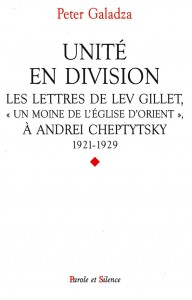
I have been fascinated with the figure of Lev Gillet for many years now--since even before Peter Galadza and I collaborated on Unité en division: Les lettres de Lev Gillet (“Un moine de l’Eglise d’Orient”) à Andrei Cheptytsky – 1921-1929 (Paris/Ottawa: 2009).

What is this book about? Here is an English translation of part of the description of our publisher, Parole et Silence:
Andrei Sheptytsky (Cheptytsky, Szeptyckyj) (1865-1944), Greco-Catholic bishop of Western Ukraine, and Lev Gillet (1893-1980), “the monk of the Eastern Church,” were two of 20th century Eastern Christianity’s more important, yet underappreciated, figures. 

The book, Unité en division: Les lettres de Lev Gillet (“Un moine de l’Eglise d’Orient”) à Andrei Cheptytsky – 1921-1929, is the annotated transcription of almost 100 letters of Lev Gillet to Archbishop Sheptytsky. The letters remained inaccessible for almost 50 years in the Soviet archives of Western Ukraine. They cover the period when Gillet went from being a Benedictine novice in England, to Greco-Catholic (“Uniate”) Studite in Ukraine, to Orthodox priest in France. During this same period, Sheptytsky went from being the “darling” of those hoping to “convert Russia,” to a giant “imprisoned in his own diocese.” The letters shed light on key elements of the biographies of these two celebrities. They also clarify various aspects of interwar Catholic and Eastern Orthodox church history.... All of these events and ideas are explained in copious annotations, which make the book an excellent source for micro-history.
Gillet, of course, was a well-known author, especially in the area of Christian spirituality. He wrote many books in this area.

But perhaps one of the works of most lasting significance of Gillet was his study of Jewish-Christian relations, a work that was published during the Holocaust in 1942 and therefore antedates many other post-war works that attempted to ask "How can one theologize in the aftermath of Auschwitz?" That work of his has remained in print ever since as Communion in the Messiah: Studies in the Relationship between Judaism and Christianity. John Jillions had a long discussion of it in Logos: A Journal of Eastern Christian Studies in 2006.


About this book we are told:
Without compromising the Christian position, Gillet sets out to show how much Christians have to learn from Jews before they can hope to communicate their own faith that Jesus is the Christ. After a historical analysis of the intellectual relations between Christianity and Judaism, the author eruditely draws out the common elements of the two traditions, challenging and correcting misconceptions about Rabbinism and Jewish life and teaching generally, misconceptions which overlook the two millennia of Jewish thought between the Old Testament and modern times. He shows how close is this connection, and how deeply spiritual is much of Jewish theology. There is, he claims, nothing in Jewish belief that a Jew become Christian ought to reject, while Christianity is the completion and fulfillment of Judaism.
The table of contents, preface, and an extract from the text may be consulted here.

Gillet's life is, as I noted at the outset, of longstanding fascination to me and many, including his close friend Elisabeth Behr-Sigel, whose own life is at least as fascinating and has been recently wonderfully told. Behr-Sigel, in her 80s, undertook the research to be able to write Gillet's biography: Lev Gillet, "un moine de l'Eglise d'Orient": Un libre croyant universaliste, evangelique et mystique (Paris: Cerf, 1993).

 An English translation of this was made available in 1999 from England's Fellowship of St. Alban and St. Sergius. Additionally, for those who wish a shorter study of him, see the chapter on Gillet in Michael Plekon's justly acclaimed Living Icons: Persons of Faith in the Eastern Church. 

What is it about Gillet's life that continues to fascinate? Doubtless there are many things for many people, but what is especially important to consider is (if I may be forgiven the infelicitous academic jargon) how he "problematizes" Orthodox-Catholic relations by his deliberate "transgressing" of the apparent boundary between the two. I say "apparent" because, following David Bentley Hart, I am not convinced that, at least de jure, there is any real boundary. There is, of course, the problem of the papacy, on which I have had a few things to say.
But following Hart, and the Russian Orthodox scholar Antoine Arjakovsky, as well as several modern Greek and Armenian theologians, inter alia, I am no longer convinced that any of this is sufficient to justify Catholics and Orthodox from refusing the Eucharist to one another. As Robert Taft noted at Orientale Lumen in June, it is necessary for restoration of communion only that we have identity of apostolic faith, not of historic memory.

Remarkably, Gillet in his own day seems to have thought likewise, at least as far as his own life went. This is all the more remarkable when one considers his context: in the early years of what we would come to call the "ecumenical movement" and especially in the period before Vatican II when, at least on the Catholic side, ecclesial boundaries were strictly drawn and policed, and the only permissible understanding of ecumenism was that of "return": the "schismatics" (=Orthodox) and the "heretics" (= Protestants) had to abandon their contumacy by returning to Rome to make their submission to the Roman pontiff. Thus the problem of Christian disunity would be solved. That model, thankfully, was abandoned at Vatican II, and officially reprobated in the 1990s by Edward Cardinal Cassidy, then president of the Pontifical Council for Promoting Christian Unity, and more authoritatively still by Pope Benedict XVI who, in Cologne in 2005, said that "unity does not mean what could be called ecumenism of the return: that is, to deny and to reject one's own faith history. Absolutely not! It does not mean uniformity in all expressions of theology and spirituality, in liturgical forms and in disciplines."

If there is no longer a "return," then what are we seeking? Here Gillet's life was prescient in showing us a model we are only beginning to appreciate: an ecumenism of communion in which he boundary between East and West simply disappears into the background. Gillet sought out this communion by simply doing it, and so he remains a forerunner of those who, impatient with the plodding pace of official dialogues, want to push East and West closer together faster. For Gillet, his moving from Catholicism to Orthodoxy was a move undertaken "without denying the Catholic faith" and "without breaking spiritual ties" to the man he regarded, Behr-Sigel says, not merely as his spiritual father until the end, Metropolitan Andrei Sheptysky, but also as a saint.

When Gillet was received into Orthodoxy in Paris by Metropolitan Evlogii, Gillet simply recited with him the Nicene Creed (sans filioque of course): "no abjuration of faith had been imposed on him" and "nothing more had been required." Thus, his biographer tells us, "any act which might have implied a break was avoided." Moreover, and more astonishing still, Gillet, in a letter to his mother, said that "I have not been asked to subscribe to any formula or to make any profession of faith, and I have been formally invited to continue to mention Metropolitan Andrei in the liturgy"! Later in this letter to his mother he tries to calm her by saying that "nothing separates us. The same Saviour and the same sacraments unite us. So be calm. Do not distress yourself." His reception into Orthodoxy, he would later tell a friend, was not a conversion or renunciation, but simply a case of perceiving in Orthodoxy that "the light of Christ...is a fraction brighter, but it is the same light, and not another which also shines in the Western Church." Would that there was such a generosity of vision on the part of more Orthodox--and Catholics--today! Through the prayerful intercession of this "monk of the Eastern Church," may we all hasten to that day when we are one around the Lord's table.

Wednesday, September 8, 2010

The Vita of Elisabeth Behr-Sigel

Fr. Michael Plekon, with whom I had lunch in Connecticut in July, very kindly gave me a copy of his most recent publication, the newly translated biography of the extraordinary Elisabeth Behr-Sigel.


Toward the Endless Day: The Life of Elisabeth Behr-Sigel is a wonderful book written originally in French by Olga Lossky, great-granddaughter of the famous theologian Vladimir Lossky. It has been skillfully translated into English by Jerry Ryan and very smoothly edited by Michael Plekon, to whom all English readers owe an ever increasing debt for his ongoing labors to bring Francophone Orthodoxy to Anglophone audiences via the University of Notre Dame Press.

The book contains a foreword written by Olivier Clement before his death in January 2009. It covers Behr-Sigel's life, which ran from the beginning of one century to the beginning of another--98 years jam-packed with incredible activity, first as a Reformed pastor, then a wife and mother, and then an Orthodox theologian who late in life became so renowned as to acquire the epithet "the grand old dame of Orthodoxy." She knew, and was known by, anybody and everybody of any significance in 20th-century European Orthodoxy, and many Catholics and Protestants, too, thanks to her work with the World Council of Churches. An entire cast of characters passes through this book, which recounts a life that itself passed through all the major events of the last century--2 world wars, the Cold War, the rise of feminism, the ecumenical movement, Vatican II, etc.

Behr-Sigel was an embodiment of the Christian East's love of antinomy: an Alsatian of Jewish extraction who spoke German, a Reformed pastor (the first such one in France) who tended her parish after becoming Orthodox, a faithful and long-suffering wife and mother who had an emotionally intense--but physically chaste--relationship with the celebrated "Monk of the Eastern Church," viz., Lev Gillet: all these wonderful facets, and many others besides, are told in this splendid book.

She was at once loyally faithful to the Orthodox Church but also open to the world and to other Christians. Her experience of close collaboration with other Christians in wartime France impressed itself deeply upon her, and she sought to advance Christian unity, especially between Catholics and Orthodox, calling for limited eucharistic sharing to spur us on towards full communion.

Behr-Sigel died in 2005, but we have not yet begun in any serious way to unpack her thought, especially on the still-controverted topic of gender. This book, I hope, will encourage others to know her more deeply and take her work more seriously, giving it the critical analysis it deserves.

Related Posts Plugin for WordPress, Blogger...