"Let books be your dining table, / And you shall be full of delights. / Let them be your
mattress,/
And you shall sleep restful nights" (St. Ephraim the Syrian).


Showing posts with label Conversions. Show all posts

Friday, July 29, 2022

Muslim Converts to Greek Orthodoxy

I am greatly looking forward to reading this new study which will begin filling a very considerable gap in the literature on conversion: Proselytes of a New Nation: Muslim Conversions to Orthodox Christianity in Modern Greece by Stefanos Katsikas  (Oxford UP, 2022), 248pp. About this study the publisher tells us this:

Proselytes of a New Nation analyzes questions such as: Why did many Muslims convert to Greek Orthodoxy? What did conversion mean to the converts? What were their economic, social, and professional profiles? And how did conversion affect the converts' relationships with Muslim relatives in Greece and the Ottoman Empire?

Because Sharia law and the Ottoman legal system could keep Muslim apostates--Muslims who had converted to other religions--from inheriting family property, Stefanos Katsikas examines the ways in which conversion complicated family relations and often led to legal disputes. This volume also discusses the method used by the Greek state to adjudicate legal disputes on property issues between neophytes (converts) and their Muslim relatives.

Proselytes of a New Nation maintains that religious conversion in the era of nationalism was far more consequential for the convert, their family, and their social relations. Converts received not only community attention, but also national. Depending upon the religious affiliation and nationality of an individual, they regarded neophytes as either "traitors" or "heroes." Against this sociopolitical backdrop, conversion more drastically affected the social fabric of communities than in the pre-modern era, and more often led to violence and conflict.

Wednesday, September 9, 2020

Eastern Christian Converts to Islam

One of the tasks I face with my students when looking at the history of Orthodox-Muslim encounters is to help them grasp the idea that one can belong more or less simultaneously to two seemingly divergent communities, and this is not necessarily experienced as "schizophrenic" in the pejorative sense. There is often a degree of overlap in multiple "identities" that some today find difficult to fathom. And the movement between communities is not simple, either, as though invasion at once begins a massive reversal rather than a long, drawn-out process.

All these phenomena are addressed in a new book: Conversion to Islam in the Premodern Age: A Sourcebook First Edition, eds., Nimrod Hurvitz, Christian C. Sahner, Uriel Simonsohn, and Luke Yarbrough (University of California Press, 2020, 366pp.).

About this book, the publisher tells us this:
Conversion to Islam is a phenomenon of immense significance in human history. At the outset of Islamic rule in the seventh century, Muslims constituted a tiny minority in most areas under their control. But by the beginning of the modern period, they formed the majority in most territories from North Africa to Southeast Asia. Across such diverse lands, peoples, and time periods, conversion was a complex, varied phenomenon. Converts lived in a world of overlapping and competing religious, cultural, social, and familial affiliations, and the effects of turning to Islam played out in every aspect of life. Conversion therefore provides a critical lens for world history, magnifying the constantly evolving array of beliefs, practices, and outlooks that constitute Islam around the globe. This groundbreaking collection of texts, translated from sources in a dozen languages from the seventh to the eighteenth centuries, presents the historical process of conversion to Islam in all its variety and unruly detail, through the eyes of both Muslim and non-Muslim observers.

Thursday, June 16, 2016

Nationalism, Apostasy, and the Ottoman Empire

We have seen a number of new books in the last five years or so treating both the sunset of the Ottoman Empire, and also the phenomenon of nationalism both in that empire and in the national Orthodox Churches that emerged from it. A recent study looks at nationalism alongside two other fraught issues involving Eastern Christians: Selim Deringil, Conversion and Apostasy in the Late Ottoman Empire (Cambridge UP, 2015), 332pp.

About this book we are told:
The commonly accepted wisdom is that nationalism replaced religion in the age of modernity. In the nineteenth-century Ottoman Empire, the focus of Selim Deringil's book, traditional religious structures crumbled as the empire itself began to fall apart. The state's answer to schism was regulation and control, administered in the form of a number of edicts in the early part of the century. It is against this background that different religious communities and individuals negotiated survival by converting to Islam when their political interests or their lives were at stake. As the century progressed, however, and as this engaging study illustrates with examples from real-life cases, conversion was no longer sufficient to guarantee citizenship and property rights as the state became increasingly paranoid about its apostates and what it perceived as their "denationalization." The book tells the story of the struggle for the bodies and the souls of people, waged between the Ottoman State, the Great Powers, and a multitude of evangelical organizations. Many of the stories shed light on current flash-points in the Arab world and the Balkans, offering alternative perspectives on national and religious identity and the interconnection between the two.

Thursday, March 31, 2016

What Does It Mean to Convert?

We live in a time of regular "conversions" among Christians from one tradition to another--to say nothing of moving between Christian and non-Christian traditions. People move into and out of Protestant, Catholic, and Orthodox traditions with some regularity now. Conversions into Eastern Orthodoxy have of course been coming in finally for some welcome and fascinating scrutiny in such studies as Amy Slagle's, The Eastern Church in the Spiritual Marketplace: American Conversions to Orthodox Christianity and more recently D. Oliver Herbel's Turning to Tradition: Converts and the Making of an American Orthodox Church.

Now a new collection looks at conversions more widely still. With chapters on the Ethiopian Church, and with the conversions of Eastern Christians to Islam in the Eastern Mediterranean in the first millennium, this book will be of interest to those who study the movement of people from one tradition into another: Ira Katznelson and Miri Rubin, eds., Religious Conversion: History, Experience and Meaning (Routledge, 2016), 276pp.

About this collection the publisher tells us:

Religious conversion - a shift in membership from one community of faith to another - can take diverse forms in radically different circumstances. As the essays in this volume demonstrate, conversion can be protracted or sudden, voluntary or coerced, small-scale or large. It may be the result of active missionary efforts, instrumental decisions, or intellectual or spiritual attraction to a different doctrine and practices. In order to investigate these multiple meanings, and how they may differ across time and space, this collection ranges far and wide across medieval and early modern Europe and beyond. From early Christian pilgrims to fifteenth-century Ethiopia; from the Islamisation of the eastern Mediterranean to Reformation Germany, the volume highlights salient features and key concepts that define religious conversion, particular the Jewish, Muslim and Christian experiences. By probing similarities and variations, continuities and fissures, the volume also extends the range of conversion to focus on matters less commonly examined, such as competition for the meaning of sacred space, changes to bodies, patterns of gender, and the ways conversion has been understood and narrated by actors and observers. In so doing, it promotes a layered approach that deepens inquiry by identifying and suggesting constellations of elements that both compose particular instances of conversion and help make systematic comparisons possible by indicating how to ask comparable questions of often vastly different situations.

Wednesday, January 20, 2016

Christian and Muslim Conversions in Late Antiquity

One of the unanswered, and unanswerable, questions in early Christian-Muslim encounters is how many people abandoned Christianity when it was politically or economically feasible for them to do so in order to hitch a ride with a newly ascendant Islam. In many places, such people simply dropped out of sight, and nothing like a mass census of them has ever been possible. At the same time, while conversion out of Islam to something else is officially a capital offense in Islamic law, that does not mean it never happened--though here, too, such conversions were often hidden for obvious reason. This whole process of conversion--how it happened, how many converts there were, and what their motives were--is a complex business indeed.

A volume released last year from Ashgate sheds light on the process of what it means to "convert" to or from Christianity, Islam, and other traditions: Arietta Papaconstantinou, ed., with Neil Mclynn and Daniel Schwartz, Conversion in Late Antiquity: Christianity, Islam, and Beyond (Ashgate, 2015), 396pp.

About this book we are told:
The papers in this volume were presented at a Mellon-Sawyer Seminar held at the University of Oxford in 2009-2010, which sought to investigate side by side the two important movements of conversion that frame late antiquity: to Christianity at its start, and to Islam at the other end. Challenging the opposition between the two stereotypes of Islamic conversion as an intrinsically violent process, and Christian conversion as a fundamentally spiritual one, the papers seek to isolate the behaviours and circumstances that made conversion both such a common and such a contested phenomenon. The spread of Buddhism in Asia in broadly the same period serves as an external comparator that was not caught in the net of the Abrahamic religions. The volume is organised around several themes, reflecting the concerns of the initial project with the articulation between norm and practice, the role of authorities and institutions, and the social and individual fluidity on the ground. Debates, discussions, and the expression of norms and principles about conversion conversion are not rare in societies experiencing religious change, and the first section of the book examines some of the main issues brought up by surviving sources. This is followed by three sections examining different aspects of how those principles were - or were not - put into practice: how conversion was handled by the state, how it was continuously redefined by individual ambivalence and cultural fluidity, and how it was enshrined through different forms of institutionalization. Finally, a topographical coda examines the effects of religious change on the iconic holy city of Jerusalem.

Friday, February 7, 2014

Oliver Herbel on Turning to Tradition

Last week I posted a review of Fr. Oliver's splendid new book. I had previously sent him some questions for an interview, and here are his replies. 

AD: When we last talked on here, it was about your book on Serapion of Thmuis. How, in the last two years, have you moved from ancient Egyptian patristics to Turning to Tradition: Converts and the Making of an American Orthodox Church? Was this a planned development or an unexpected move? What, if anything, links the progress from the first book to the second?

OH: I admit that is a jump!  Would it surprise you to know I published an article on Anselm and one on Bonaventure during the interim (in addition to articles on American Orthodoxy)?  The move was both planned and unplanned.  Dr. Lois Malcolm at Luther Seminary told our systematics class (and presumably she tells each class this) that it is wise and helpful to have two periods of church history from which to draw when developing one’s theology.  That stuck with me and so I have always felt it to be important to have a handle on some geographical and temporal location in the early church together with a later period.  I privately decided to one-up Lois’ class challenge and committed to finding three periods, to triangulate my theology. It’s been a slow go to develop the third (Byzantine theology of the eighth, ninth, and tenth centuries, which is slowly coming to the fore and lies behind the Anselm and Bonaventure articles and guides a current project in collaboration with Brian Matz of Carroll College on the filioque dispute of the ninth century—may we see that through!). 

In my case, I wanted to be grounded in patristic thought and at St. Vladimir’s, I encountered Sarapion, who intrigued me, as he was a desert father, but also clearly an astute, philosophical intellectual.  I also admitted that I had sympathy for him as a little known saint—there’s something about a “dark horse.”  Anyhow, when I went to SLU, I fully intended to write a dissertation on Sarapion.  About a year-and-a-half into my studies, though, I found American historical theology to be not only the second area in which to ground my theology, but the area that interested me more.  I didn’t expect that.  So, finding a second, modern period was planned (because of that class at Luther) but finding it to be “American” and finding that to be more interesting to me than fourth century Egypt was unplanned.  Up to that time, I had a relatively generic view of Orthodox history in America.  As I researched and wrote my paper-turned-article on Nicholas Bjerring, the first convert priest in 1870, however, I realized just how much Orthodox overlapped with theological movements in America.  I also realized that many of the generalizations of that generic history needed to be questioned.  It was all downhill after that.  By that time, I had done so much translation work on Sarapion (with encouragement from Fr. McLeod) that I decided to finish that up and complete a manuscript, which I did.  It took a little while for it to go through the publication process, but it did.  So, I published a book on what would have become a dissertation and then completed a dissertation and have now published that book. 

I should note that Cornelia Horn gave as good a pitch as any to get me to re-prioritize my areas of research, and I’m thankful for working with her as well, but American Orthodoxy is too fascinating to me.  There is also the fact that Fr. John Erickson, who was on my dissertation committee, and my advisor, Michael McClymond, have an interest in American Christianity that is contagious.

So, in the last few years I have found myself writing articles on American Orthodoxy and completing this book.  I’m quite thankful to be where I’m at in terms of research and publications.

AD: In your introduction you use several striking and revealing terms such as "ecclesiastical restorationism" Could you elaborate a bit on that term for us?

OH: Sure.  By using the phrase ecclesiastical restorationism, I meant to highlight two things.  First, that what is going on here is something more than merely switching denominations on the one hand (say, going from Lutheranism to Presbyterianism).  The converts were doing more than denominational hopping.  They were operating within a restoration paradigm, seeking to restore, or reconstitute, something. 
             
The second (and most important) thing I hope this phrase highlights is that the converts in question were not simply looking for a past historical standard but a past historical ecclesiastical standard—a past church that set Christian norms.  This is why tradition was such a concern.  They were concerned not merely with a tradition of ideas, but a tradition of a kind of religious existence.  In fairness, of course, any restorationist Christian movement will seek to reestablish the early church but in the case of these converts, it went beyond that, with them looking for a “church” that could be found to have existed early on and to have set the standards to which, they believed, we are all to adhere.  That is to say, “church” was not a secondary or derivative concern, but a primary one.

AD: You speak of the role of theology in conversion. Is there one consistent role for theology? At risk of generalization, could one inquire as to whether theology plays a major role positively--coming to embrace Orthodox theology for its own sake as the fullness of truth--or is the role of theology largely "negative" for converts insofar as Orthodoxy represents what my former tradition is not (liberal, pro-gay, etc)? Or perhaps it's a mixture of both?
 
OH: This is an interesting question.  When I began looking at theology as a factor, I had primarily the work of Lewis Rambo and Amy Slagle in mind.  For Rambo (and for Scot McKnight who has adopted Rambo’s system), theology sets patterns of behavior.  I didn’t think that was really the primary role of theology in these conversion narratives, at least not initially.  Additionally, Slagle’s study had noted theological factors but it wasn’t her task to assess them.  I decided to investigate what theological conclusions were driving  the conversion process and whether those conclusions fit within any larger trend(s) within American Christianity.  Interestingly, what I found could be argued to have brought me back full circle, inasmuch as three of the four converts studied pioneered theological norms for intra-Christian conversion to Orthodoxy.  That is to say, they promoted their way of looking at things and it guided many into the Orthodox Church. 
             
I say all this by way of preface, because what I found was that theology was, indeed, a “mix.”  It could operate both positively or negatively, in the ways you describe.  I think the primary way in which it functioned as “positive” was that the converts were making legitimate conclusions to the best of their ability.  If we deny that, then I think we end up down-playing what was motivating them at their core.  That said, this positive use was very much wedded to a negative use at times.  You see that in Toth with his polemics, which could be quite vehement.  You see this in Morgan and Berry on the issue of race and in Berry’s case in seeking something that isn’t too tied to “this world.”  You see it in Gillquist in his disgust with “parachurch.”  Others within the EOC who converted with Gillquist and are mentioned likewise had some negative motivations.  These negative motivations were important, but the motivations in and of themselves did not create the conclusions, for the converts could have chosen any other number of possible solutions than Orthodox Christianity.

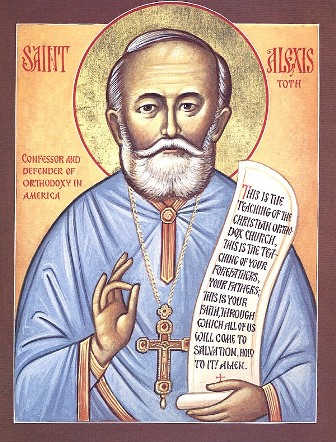
AD: Your chapter on Alexis Toth also discusses Josaphat Kuntsevych, and it has long been a question of mine as to how each side should regard the other's saints, especially as one works towards unity. To put it crudely, one church's heretic is another church's hero. Toth, of course, was a former Eastern Catholic who became Orthodox and was canonized by the OCA while Kuntsevych went the opposite route, ending up a canonized martyr in the Ukrainian and Roman Catholic Churches. What are your thoughts on these competing martyrologies? How should we regard them today--as embarrassing emblems of nasty practices from the past we think we would never do again today? Or should their holiness be considered primarily on its own more individual and personal terms without regard to the ecclesial politics? (This issue came up in the Byzantine-Oriental dialogues where both liturgical traditions have canonized saints and anathematized heretics that are the direct opposite of each other, and neither side seems to know what to do about that since they do not want to simply abandon liturgical texts that have been prayed for centuries.)

OH: Oh, wow.  This is a tough one and one I will admit not having thought about nearly as much as I probably should, even though I first encountered this in a real way at seminary, when Dr. Bouteneff asked us the same question in a class looking at Orthodox and Oriental Orthodox relations.  So, I can only tell you where I’m at currently, which may not be my mature thought as I give this more time. 

I would say that what makes this question seem difficult is our sinful desire to hold grudges and identify with an imagined past.  It seems to be easy to identify with our own church brothers and sisters who were wronged in the past and then to retain the accusation of abuse against the contemporary expression of the opposing religious body.  One might claim this is a “sacramental” aspect to “church.”  This could be especially so in the case of Orthodox and Catholics.  Something like:  “My church is the body of Christ and therefore I am mystically present with the past abused persons when I go to liturgy/mass and therefore those past abuses are still meaningful and real.”  At other times, it’s much less profound and is simply a way of attacking the church you do not belong to simply because it doesn’t agree with your church.

However it is expressed, it seems to me that what is needed a reconfiguration based on the fact that the Church is, indeed, the Body of Christ.  If I believe my church is the Church (or at least part of it) then I should see the past martyrs as being able to exist at a level in which they can say “Father forgive them, for they know not what they do.”  This perspective should then be combined with humility, such that we no longer think it pertains to us to continue the violence (even if by way of rhetoric).  If these are combined, we can then become open to the fact that each church has canonized people who helped people against abuse from the other side.  That is, we will realize our side sinned too.  Our side also helped create tensions and violence. 

So, to return to your examples: a faithful Roman Catholic should be able to say that Toth was right to oppose the prejudice he encountered from Western Catholics and a faithful Orthodox Christian should be able to say Josef Kuntsevych’s murder was wrong, as were the subsequent exaggerations later told to “justify” his murder.  At the same time, each side should hope that in a reunited church, a former Roman Catholic could say Toth’s faith is now dogmatically acceptable (even if he himself was mistaken at times) and a former Eastern Orthodox could say Kuntsevych’s faith is dogmatically acceptable (even if he was mistaken at times).  Their faiths would be seen as reunited.  So, in that context, I really don’t see the problem for canonizing both men.  In fact, I think reunion would require that both remain canonized.  For a real, lasting peace never ignores the difficulties, but reconciles them.

AD: I'm struck by the very different ways in with Catholic and Orthodox immigrants in the last century adjusted to the American context. Archbishop Ireland seems to be a paragon of the Catholic attempt to prove, as strenuously as possible, that Catholics were just like Americans--they spoke English, they were patriotic, they worked hard, they tried to blend in; but Orthodox seem more content to have retained indigenous languages and practices and more comfortable, perhaps, appearing as "exotic." And yet, the main burden of your book is in showing just how very much Orthodox did strive to become American through, as you aptly put it, the very American "anti-traditional tradition." Tell us a bit more about what you mean by that phrase.

OH: Yes, well, that gets at the central irony running through this book.  Here you have this faith that many Americans would still categorize as “exotic,” that has received many converts who have operated according to a very American pattern, and on the basis of that American pattern have, in turn, sought to evangelize other Americans.  That American pattern is one of anti-tradition (which could be called an anti-traditional tradition).  America has a long history of religious mavericks who emphasize a part of their previously received tradition in order to create something new.  This has led to an increasingly diversified and complex religious scene.  Restorationist movements embody this anti-traditional tradition by emphasizing aspects of what they had received in order to recreate what had once allegedly existed prior to that tradition that was given to them.  So, it is “anti-tradition” in trying to by-pass the received tradition but a “tradition” nonetheless by virtue of being an ongoing way of doing religion in America.  One restoration bequeaths another.  What has happened in the case of many American Orthodox converts, especially those I examined in my study, was that their very desire to find tradition was undertaken in a manner that represented the anti-tradition tradition. 
       
What is more, these converts then used this approach to lead and/or attract other converts.  This is important to note because some have taken such actions by new converts as simply perpetuating Orthodoxy’s “defensiveness” in the face of American culture when, in fact, it is evidence of engaging American pluralism.  One sees this in the case of Gillquist, for instance when he went on to encourage other Christians to join the Orthodox Church by arguing the Orthodox Church exists not merely as a non-denominational church but as a pre-denominational church.  It also becomes a way of trying to present the Orthodox Church to America in a way that Americans could appreciate it.
 
AD: In your discussion about the reception of many former Evangelical Orthodox into the Antiochian Archdiocese, it occurred to me that in some clear ways Met. Philip is precisely an embodiment of your 'anti-traditional tradition," yes? I'm thinking here of his handling of the Joseph Allen affair as well as his performing a "mass" ordination for the EO clergy in one liturgy. Is that a fair assessment of him?

OH:  Hmmm.  Interesting that you should ask this.  Not long after the book came out, a colleague and friend emailed me and wrote that Metropolitan Philip came off looking more like a lone ranger than this friend had previously thought.  I should point out that Metropolitan Philip was not a focus of my study.  He did, however, play significant roles in the conversions of Gillquist and the most of the former Evangelical Orthodox Church and so he appeared with some frequency in the last two chapters of this work.  He was connected to controversial decisions that affected that group of converts, including that of their ordinations and the remarriage of Fr. Joseph Allen, which you mention.  And, to be fair, he performed other actions surrounding those decisions that were (and are) controversial in themselves and this doesn’t even touch on Ben Lomond and fallout from that.  So, I can see how one might wonder if Metropolitan Philip doesn’t represent the anti-traditional tradition, but I would argue he does not fit the anti-traditional tradition as I set it out in my narrative.  Whatever one might think of his actions at times, he has not, from the sources I consulted, sought to recover and reestablish a previous norm.  He may be a religious maverick, but he did not exhibit the intention to reestablish a previous norm by establishing a new church or some larger church reform.  Indeed, the only common denominator I saw was himself.  I suppose if one were to broaden anti-traditional tradition far enough, he would fit, but then the phrase would merely be a synonym for a religious maverick of any kind whereas I wanted to highlight the founding of new denominations, religions, or reform efforts.  Perhaps someday someone will study his legacy, for all its complexities.  When that day arrives, I would encourage that scholar to consult the sources I did in addition to other sources that are relevant and to seek to be as unpartisan as possible, allowing the sources to speak for themselves.

AD: Your work shows, as you sum up at the end (p.156) that many converts "prioritized an earlier expression of Christianity and have identified the Orthodox Churches as continuations of that earlier church." This gets at something I've been thinking about more and more over the past year--and have discussed in my reviews of the new collection, Orthodox Constructions of the West: how many Eastern Christians (and in a different direction, but with similar methods, many "traditionalist" Roman Catholics also) appropriate history. I've heard it said that few of us read history on its own terms. Instead we "plunder it for present political purposes." Do you think that's generally true?
 
OH: That’s a great question because suspect there will be Orthodox who are not yet prepared to allow the historical evidence to be what it is but will believe that somehow I must have slanted it so that things did not look as neat and tidy (and triumphalistic) as might be found in books such as Orthodox America, 1794-1776 or Becoming Orthodox. What I would counter with is that we need to distinguish between plundering for our own purposes and investigating to address current concerns.  One can cherry pick any period of history to “prove” nearly anything but that is different from saying, “here is a topic that is important to us today—what is its history, its back story and what can we learn from this”?

AD: Following this, have you set out, or have other especially Orthodox historians set out, any basic hermeneutical and historiographical guidelines on reading and writing about church history? It's often seemed to me that some guidelines or ground-rules like that would be useful in trying to talk about (and defuse the tensions surrounding) controverted issues like, say, the Fourth Crusade or the Union of Brest and similar issues.

OH:  You’re determined to turn this interview into a book project of its own!  I actually think that what is eventually needed is an Orthodox philosophy/theology of history.  I actually have that as a long range goal, sometime later in my career.  I’m not even close to that yet, but I suppose there are a few things I could say.  I have outlined what I think historical theology means (see attached PDF).  I think the most important element is the ascetic—the effort to remain dispassionate as one researches and studies.  This is not easy, for any number of reasons.  One might already have a predetermined outcome one wants.  For instance, I suspect this happens at times when we want to canonize a particular person or particular kind of person.  One might also be cherry picking in order to defend a particular point of view.  This is an extreme version of the predetermined outcome.  Alternatively, one might simply be too colored by one’s political or ecclesiastical allegiance.  Here, the historian may be looking at all the evidence but the way in which it is weighed might seem questionable.  We all have perspective and that shouldn’t be denied but I think the biggest lesson we need to learn is to go into historical inquiry as an act of disciplining the soul and achieving dispassion.  It may be a never ending goal, but must be our goal nonetheless, especially those of us who would ground dispassion in theosis, which comes through Christ. 

AD: Sum up your hopes for this book:

OH: I have several hopes for this book.  First, I hope it provides scholars a way to assess many Orthodox conversions, if not the majority of them.  As a by-product, I think my thesis could be applied to analogous situations within the church, as you suggested by asking about Metropolitan Philip.  It didn’t work in his case, but maybe it could still apply in others.  Second, I hope this provides scholars, Orthodox clergy, and Orthodox laity with a more realistic view of some important converts and convert movements.  Orthodox have developed a fair amount of mythology surrounding Orthodox converts, a mythology that has often been wedded to triumphalism (talk about a lack of dispassion!).  This work clearly breaks through that and in that way, I hope it can serve as an example of the kind of historical inquiry Orthodoxy in America needs (whether internally, from Orthodox such as myself, or externally).

AD: What projects do you have on the go now? What will the next book likely be?

OH: In  true fashion for one who could simultaneously work on Sarapion and American Orthodox converts, I have three projects in progress. 

First, I am collaborating with my friend and colleague Brian Matz on translations of texts from the ninth century filioque dispute.  We hope to have a manuscript that we could submit a year from now.  Ed Sciecienski mentioned our work in his book, but Brian and I got distracted by our other projects, so it will be nice to return to this and publish it. 

Second, I am also working on a project that develops a virtue ethic from iconography.  This work is intended not simply as an academic piece, but as something that will be easily accessible to clergy and interested laity.  I am not sure how soon I will have something to a publisher with this project.  It will depend on what this spring and summer bring. 

A third project I am working on is more in-depth than the first two.  It builds from my convert book, taking up the idea of engaging American pluralism.  This project will be an exploration of American Orthodox engagement with religious freedom.  I believe this is a much needed area of exploration and in the conclusion I will directly engage some Orthodox political theology, and argue for an Orthodox-informed “Christian secularism.”  So, if I hope the first two will be to publishers within a year or so, this one will likely take a couple of years just to get into (rough) manuscript form.  This one might take a little while but I hope it will be worth it.

Tuesday, November 5, 2013

Converts to Orthodoxy

I am delighted to read of the forthcoming book by the Orthodox priest and scholar Oliver Herbel, whom I met last year and some of whose scholarship Logos: A Journal of Eastern Christian Studies published recently: Turning to Tradition: Converts and the Making of an American Orthodox Church (Oxford University Press, 2013), 256pp.

About this book we are told:
Recent years have seen increasing numbers of Protestant and Catholic Christians converting to Eastern Orthodox Christianity. In this book D. Oliver Herbel examines Christian converts to Orthodoxy who served as exemplars and leaders for convert movements in America during the twentieth century. These convert groups include Carpatho Rusyns, African Americans, and Evangelicals.
Religious mavericks have a long history in America--a tradition of being anti-tradition. Converts to orthodoxy reject such individualism by embracing an ancient form of Christianity even as they exemplify it by choosing their own religious paths. Drawing on archival resources including Rusyn and Russian newspapers, unpublished internal church documents, personal archives, and personal interviews, Herbel presents a close examination of the theological reasons for the exemplary converts' own conversions as well as the reasons they offered to persuade those who followed them. He considers the conversions within the context of the American anti-tradition, and of racial and ethnic tensions in America. This book offers the first serious investigation of this important trend in American religion and the first in-depth investigation of any kind of African-American Orthodoxy.
This will likely build on the important work begun by Amy Slagle, whose book I reviewed here. 

I greatly look forward to reading this, and then to interviewing the author (whom I previously interviewed here about his earlier book).

Wednesday, January 23, 2013

Philosopher Converts

As I noted recently, and have done so repeatedly on here, many Christians today migrate across traditions. In the last quarter-century, numerous Western Christians have found themselves becoming Orthodox. A new collection looks at the stories of those who are academic philosophers who embraced Orthodoxy: Rico Vitz, Chad Hatfield, eds., Turning East: Contemporary Philosophers and the Ancient Christian Faith (SVS Press, 2012), 369pp.

About this book we are told:

The Orthodox Church is one of the largest religious groups in the world. Yet, it remains an enigma in the West, especially among those who mistake it either for a Greek version of Roman Catholicism or for an exotic mixture of Christianity and eastern religion. Many, however, are coming to recognize the Orthodox Church for what it is: a worldwide community of Christian disciples that has been faithful to the apostolic command, stand fast and hold the traditions which you were taught, whether by word or by our epistle (2 Thess 2.15). Consequently, growing numbers of people are finding their true home in the Church that has continued steadfastly in the apostles doctrine and fellowship, in the breaking of bread, and in prayers (Acts 2.42).

Among these converts are dozens of contemporary philosophers. Some are accomplished, world-renowned, senior scholars. Others are junior scholars in the earliest stages of their careers. As a group, they belong neither to any particular philosophical school nor to any particular Orthodox jurisdiction. What they have in common is a desire to enter deeply into an authentic and loving communion with the Living God, with God s people, and ultimately with all of God s creation.

Turning East is a collection of autobiographical essays in which sixteen of these philosophers describe their personal journeys to the Orthodox Church, explain their reasons for becoming Orthodox Christians, and offer a sense of how their conversions have changed their lives.
Contributors include such well known figures as H. Tristram Engelhardt, easily one of the most provocative bioethicists writing today, as I noted here.

Wednesday, January 9, 2013

Conversion Stories

It has become rather common for people, especially in North America, to find themselves--to use Stanley Hauerwas' phrase--"ecclesially homeless." Those who are in that position do not often remain so for long, but instead seek out a new ecclesial home, and not a few of those find their home in Orthodoxy or Catholicism, as I have noted before in reviewing Amy Slagle's excellent book, and in my interview with Mickey Mattox and A.G. Roeber, one of whom became Catholic, the other Orthodox. A recent addition to this genre of "convert" stories was recently published: Robert Plummer et al, eds., Journeys of Faith: Evangelicalism, Eastern Orthodoxy, Catholicism, and Anglicanism (Zondervan, 2012), 256pp.

About this book the publisher tells us:
Research indicates that on average, Americans change their religious affiliation at least once during their lives. Today, a number of evangelical Christians are converting to Catholicism, Eastern Orthodoxy and Anglicanism. Longtime Evangelicals often fail to understand the attraction of these non-Evangelical Christian traditions. Journeys of Faith examines the movement between these traditions from various angles. Four prominent converts to Eastern Orthodoxy, Catholicism, Evangelicalism and Anglicanism describe their new faith traditions and their spiritual journeys into them. Response chapters offer respectful critiques. Contributors include Wilbur Ellsworth (Eastern Orthodoxy), with a response by Craig Blaising; Francis J. Beckwith (Roman Catholicism), with Gregg Allison responding; Chris Castaldo (Evangelicalism) and Brad S. Gregory's Catholic response; and Lyle W. Dorsett (Anglicanism), with a response by Robert A. Peterson. This book will provide readers with first-hand accounts of thoughtful Christians changing religious affiliation or remaining true to the traditions they have always known. Pastors, counselors and students of theology will gain a wealth of insight into current faith migration within the church today.
The first section contains three essays on becoming Orthodox--a pattern followed in subsequent sections on those who become Protestant and Catholic.

Friday, August 31, 2012

Ottoman Converts and Apostates

We still do not know enough about relations between Jews, Christians, and Muslims in the late Ottoman Empire. In particular, we have conflicting and incomplete accounts of the permissibility, process, and punishment (if any) for those leaving one of those faiths for another, especially for those leaving Islam to become Christians. A new book forthcoming in late September may shed some welcome light here: Selim Deringil, Conversion and Apostasy in the Late Ottoman Empire (Cambridge UP, 2012), 294pp.

About this book the publisher tells us:
The commonly accepted wisdom is that nationalism replaced religion in the age of modernity. In the nineteenth-century Ottoman Empire, the focus of this book, traditional religious structures crumbled as the empire itself began to decline. The state's answer to schism was to administer controls and regulations, and it was against this background that religious communities negotiated their survival by converting to Islam when their political interests or their lives were at stake. As the century progressed, however, and as this engaging study illustrates with real-life case-studies, conversion was no longer sufficient to guarantee citizenship as the state became increasingly paranoid about its apostates and what it perceived as their "denationalization." The book tells the story of the struggle for the bodies and the souls of people, waged between the Ottoman State, the Great Powers, and a multitude of evangelical organizations. Many of the stories shed light on current flash-points in the Arab world and the Balkans, offering alternative perspectives on national and religious identity and the interconnection between the two.

Friday, July 27, 2012

Conversion Under the Ottomans

We are seeing an upsurge in books about Ottoman history, and that is a welcome development in all sorts of ways. Much remains to be studied, including relations between Eastern Christians and Muslims in the empire. A new book may shed some welcome light here:  Selim Deringil, Conversion and Apostasy in the Late Ottoman Empire (Cambridge UP, 2012), 294pp.

 About this book the publisher tells us:
The commonly accepted wisdom is that nationalism replaced religion in the age of modernity. In the nineteenth-century Ottoman Empire, the focus of Selim Deringil's book, traditional religious structures crumbled as the empire itself began to fall apart. The state's answer to schism was regulation and control, administered in the form of a number of edicts in the early part of the century. It is against this background that different religious communities and individuals negotiated survival by converting to Islam when their political interests or their lives were at stake. As the century progressed, however, and as this engaging study illustrates with examples from real-life cases, conversion was no longer sufficient to guarantee citizenship and property rights as the state became increasingly paranoid about its apostates and what it perceived as their "denationalization." The book tells the story of the struggle for the bodies and the souls of people, waged between the Ottoman State, the Great Powers, and a multitude of evangelical organizations. Many of the stories shed light on current flash-points in the Arab world and the Balkans, offering alternative perspectives on national and religious identity and the interconnection between the two.

Sunday, October 16, 2011

Orthodoxy in the Spiritual Marketplace

Twice in as many years, I have heard lectures by Amy Slagle of the University of Southern Mississippi, and both were fascinating. Both were delivered in the context of the ASEC conference, which is really one of the most outstanding academic conferences I've attended, marked by a wonderful spirit of collegiality, thanks in no small part to the leadership of the lovely and delightful Jenn Spock, an historian of Russian monasticism teaching at Eastern Kentucky University under whom the Association for the Study of Eastern Christian History and Culture (ASEC) goes from strength to strength. At the most recent conference, held at Ohio State University (whose Hilandar Research Library and Resource Centre for Medieval Slavic Studies, under Dr. Predrag Matejic's leadership, really is an outstanding place) October 7-8, Slagle gave another paper on the role of Seraphim Rose in contemporary American Orthodoxy.

Slagle has just recently published her first book, based on her doctoral dissertation: The Eastern Church in the Spiritual Marketplace: American Conversions to Orthodox Christianity (Northern Illinois University Press, 2011), 207pp.

This is a superlative study, and I warmly recommend it. I think that sociologists of religion, anthropologists studying religious communities, and of course Eastern Christians themselves, perhaps especially pastors and hierarchs looking to understand the mindset of many converts to Orthodoxy today, would benefit greatly from reading the only study of its kind in North America today.

One of the several happy aspects of this book is how wonderfully it is written. Slagle--unlike too many people trained in the methods of the modern social sciences--writes with great lucidity and cogency, eschewing the often jargon-laden, leaden, and lethal prose one so often finds in social-science journals and books. Slagle herself said to me that the book is a fast read, and indeed it is; but one should not allow the speed with which the pages turn to distract one from the many and significant insights she weaves into her analysis of the fascinating stories of the forty-eight converts to Orthodoxy whom she studied in different parts of the country and in different Orthodox churches. This is a ground-breaking book, and in its care to tell stories honestly and analyze them without imposing an ideological agenda, Slagle sets the bar high for future studies--and notes the need for such studies because hers has not, she is at pains to say, been "a complete, comprehensive, or generally representative portrait of  'the conversion experience' of American-born converts to Orthodox Christianity" (37).

After two introductory chapters--the first on Orthodoxy in general, the second on Eastern Orthodoxy in the context of late-modern North American pluralism--Slagle turns, in chapter three, to the diversity of practices used to receive converts into Orthodoxy, depending, inter alia, on whether they were baptized before or not; and if so, from which tradition they may be coming. There is, as John Erickson and others have noted, no consistent practice on how other Christians are received into Orthodoxy. Chapters 4-6 are the heart of the book, exploring the meaning and motivation of conversion, the perspectives of converts on Orthodox liturgics and ritual, and then the convert's perspective on the question of ethnicity in Orthodoxy.

One of the many fascinating insights Slagle uncovers through structured interviews with her subjects, and through participant-observation of Orthodox parish life, is that "even in their embrace of Orthodox tradition, converts retain generalized American assumptions that religion should promote interior growth, fulfillment, and psychological comfort" (15). Many of them come to embrace Orthodoxy through a quintessentially modern American method of  "church shopping" in which "church affiliation [is] more a matter of personal taste than an imperative to find the doctrinally true" (47). I was especially fascinated by Slagle showing that even for those converts for whom some notion of objective truth was ostensibly their motive for converting, a "subjective view of religion as a kind of handmaiden to the needs of the self was not easily shaken" (48). The paradoxes of modernity, and the The Triumph of the Therapeutic, are extremely difficult, if not impossible, to outwit. (In the memorable words of the late Richard John Neuhaus in his The Catholic Moment: The Paradox of the Church in the Postmodern World, converts are often those who "exult in the freedom to submit to authority with wild abandon"!) This idea of "religion" as therapeutic, aimed towards my happiness, runs smack into "one of the most common informant responses to the question of difficulties they [coverts] had encountered in becoming or being Orthodox," namely fasting.

Slagle's chapter on ethnicity and converts is full of surprises (as are her findings of the differences in how converts by marriage are treated vs. converts who come as seekers from other traditions) on the part of the attitude both of the converts, and of the parishioners and clergy in their new-found communities. The stories of converts, and the reactions of priests and cradle members of parishes, are all told with Slagle's careful, unobtrusive, and very even-handed manner.

In her conclusion, Slagle notes that "these conversions defy simple characterizations" (157) and are often not the end of the story: "many converts...leave the Orthodox Church for other religious options" (161). Let us hope that Slagle will next turn her hand to exploring these converts who leave Orthodoxy, and their reasons for doing so, for that would make for another welcome book, as likely as fascinating and well-written as The Eastern Church in the Spiritual Marketplace: American Conversions to Orthodox Christianity.
Related Posts Plugin for WordPress, Blogger...