"Let books be your dining table, / And you shall be full of delights. / Let them be your
mattress,/
And you shall sleep restful nights" (St. Ephraim the Syrian).


Showing posts with label Augustine Casiday. Show all posts

Monday, June 8, 2020

Ronald Heine on Origen's Life and Thought

One of the several interesting "rehabilitations" we have seen in the last several decades of previously controverted figures is of course Origen. We've already seen, thanks to Augustine Casiday, that Origen's supposed "disciple" Evagrius has been exonerated of various charges against him. Now it seems increasingly hard to sustain some of the charges against Origen as well.

For an overview of his life, which has been much studied in the last 15 years or so, we have a new book by Ronald Heine: Origen: An Introduction to His Life and Thought (Cascade, 2019), 182pp. I previously interviewed Heine here about an earlier work on Origen.

Heine is a well-known Origen scholar, and author, editor, and/or translator of such previous works as The Commentary of Origen on the Gospel of St Matthew as well as Origen's Commentary on the Gospel According to John, Books 13-32.

About this new book of his, the publisher tells us this:
The late second and early third century was a turbulent time in the Roman Empire and in the relationship between the empire and the church. Origen was the son of a Christian martyr and was himself imprisoned and tortured in his late life in a persecution that targeted leaders of the church. Deeply pious and a gifted scholar, Origen stands as one of the most influential Christian teachers in church history, and also one of the most controversial. This introduction to Origen begins by looking at some of the circumstances that were formative influences on his life. It then turns to some key elements in his thought. The approach here differs from that taken by most earlier studies by working from the central position that Scripture had for Origen. Heine argues that Origen’s thought, in his later life especially, reflects his continual interaction with the Bible.

Friday, January 18, 2019

God Does Not Need Your Outrage

I count it one of the great gifts of Providence that Andriy Chirovsky, a mitred Ukrainian Catholic priest and scholar who founded the Sheptytsky Institute of Eastern Christian Studies, became my Doktorvater. I don’t use that word just because academics are supposed to throw around pretentious German terms to impress others, but because it describes, in a real and lasting way, the relationship he had to me: a real father in God concerned that my work not just be about academic attainment, advancement, and glory; but that it serve the Church and not my own vainglory.
He made it very clear to me from our first class together in the spring of 1997 that anyone studying God—which is what theology aspires to do—is on very dangerous territory and must proceed with the greatest reserve. The dangers of idolatry are all around us, and so too are the dangers of pride and presumption, any one of which can blind us and bind us to our own downfall. “Keep yourself low to the ground,” he used to advise—if only, he continued with characteristic wry humour, so that you don’t have to far to fall when you trip yourself up or your enemies try to knock you down! 

More than that, there is another gift I received from him, and that was an introduction to Evagrius of Pontus, on whom, happily, an explosion of research has been published since the turn of the century as seen in books by, inter alia, Luke Dysinger, Gabriel Bunge, Jeremy Driscoll, and other scholars, including those to be found in this important collection.

We also have many translations published of, e.g., Ad Monachos and other works.

George Tsakiridis's book Evagrius Ponticus and Cognitive Science: A Look at Moral Evil and the Thoughts is interesting for its attempts to link Evagrius with some aspects of modern psychology.

Since I first learned of Evagrius, I find myself quoting from his On Prayer every semester when classes start: “if you are a theologian, you will pray truly. And if you pray truly, you are a theologian.” That is a reminder, of course, that unlettered peasants in the fields who pray while they rake potatoes can be far holier and closer to God than those of us with advanced degrees but a sterile prayer life. It is a reminder--to put it in a Pauline idiom--not to be puffed up with knowledge. 

It should not, however, be taken as license for anti-intellectualism, which I see some Catholic and Orthodox Christians do with some regularity. Evagrius is, as it were, the patron saint of those traduced by seemingly pious anti-intellectual mobs who think the Church of Christ should be turned into some self-created purity cult. A hugely influential figure of the fourth century, he had an enormous impact on the foundation of monasticism and much else, including what we would call moral theology: what the West knows as the seven capital or deadly sins is a condensed derivative version of the eight logismoi or “disordered thoughts” first schematized and very vividly described by Evagrius (who, himself, got parts of his scheme from various places, not all of them Christian it seems). 

Evagrius was later denounced by certain enemies who left a vague impression that he had stumbled into “Origenism” (another dubious construction) and was thus tainted with a soupçon d'hétérodoxie (to borrow Marc Froidefont’s phrase). Recent research, above all by Augustine Casiday in his Reconstructing the Theology of Evagrius Ponticus: Beyond Heresy, has finally laid all this to rest. (I interviewed Casiday here.)

The hostile and unjust treatment of Origen and Evagrius is instructive, for though it happened in the first half of the first millennium, it happens still today. We can see it on many websites and read about it with some regularity. People get mobbed by social media and various websites for their supposed deviation from whatever the orthodox line is supposed to be. (This latest outrage for Latin Catholics is apparently the reading of a book in an English class at some school in Steubenville, Ohio. For Eastern Catholics and Orthodox, the latest supposed outrage was splashed about by some blogger whose entire business model depends on a steady supply of such things.)

This manufacturing of outrage is completely unattractive when anybody does it, but doubly so when Christians do so, whether outwardly against "the world" or by inwardly turning on each other, jacking up the outrage while fancying themselves to be defending “holy mother Church” or protesting against some “blasphemy” in, say, a movie or commercial. I wish all such people clearly understood this: God does not need your outrage, or your brittle and shrill “defense” of Him, or His Mother, or the angels and saints. He does not need, nor does He want, your anger. (Neither do the rest of us most assuredly.) He is unmoved by all this, and you should be, too. Worse, your anger is an anti-icon: the image you reveal is not an image of God. Your outrage accomplishes nothing good, but in fact does you (and quite possibly others) great harm.

Any time a TV show, movie, website, book, or person “offends” you by what it says about God, you need to be impassible in the face of it. That is not some pious bit of badly disguised sanctimony from me. (Heaven—and Google—know that I’ve dished out my share of polemics and outrage over the years, though the older I get the less I find that attractive and the more I regret having done it in the past.) It comes from Evagrius.

For Evagrius, impassibility (being, that is, without the disordered and destructive passions that drive the logismoi) is the highest and most perfect of all the spiritual states to attain. It is also the most difficult. When, last year, I finally had a chance—after quoting him piecemeal for nearly two decades—to teach a full course on Evagrius, it was a wonderfully bracing experience for Evagrius does not mess around, but writes with a vividness and a bluntness that is very refreshing. He helpfully overturns many of our covert assumptions about what the “worst” vices are. He must, therefore, come as quite a shock to those American Christians, at any rate, who assume, falsely, that the worst vices have to do with sex. When such Christians find what they think are sexual sins in others—even fictional ones in books they have not read—their outrage is predictable, tiresome, and wholly counter-productive. Evagrius foresaw all this with his usual clinical precision. 

But we are often deceived as to the causes of our anger. Evagrius has keen insights into how we deceive ourselves, and his methods for dealing with such deceptions are, as I have argued elsewhere, psychoanalytic avant la lettre. (As the eminent historian Peter Brown nicely put it, “the lonely cells of the recluses of Egypt have been revealed, by the archaeologist, to have been well-furnished consulting rooms.”) As Freud would realize only much later (and then--as Madelon Sprengnether's new book, Mourning Freud makes clear--only incompletely), there is an intimate connection between anger and unresolved grief and mourning; there is also often a connection to thwarted desire, some of it quite often sadistic or masochistic in nature. 

I assigned my students to read Robert Sinkewicz’s Evagrius of Pontus: The Greek Ascetic Corpus (Oxford, 2006) for its translation of On the Eight Thoughts. There, Sinkewicz notes that “among the individual vices considered by Evagrius, none receives greater attention than anger, for it is this vice that presents the greatest obstacle to the advancement in gnostic life and pure prayer” (my emphasis). Sinkewicz’s translation and accompanying apparatus are long and dense, and require revisiting from time to time. But this claim about the pre-eminence of anger as the “greatest obstacle” has stuck with me as a salutary thorn in my side. 

I have come to think of this claim of Evagrius often, and to counter-pose the move away from anger with a move towards kindness and graciousness. Thus I cannot think of Evagrian warnings except alongside the wise counsel of a short and unjustly neglected little book by the psychoanalyst Adam Phillips and Barbara Taylor, On Kindness. Increasingly I realize that when I die, I should much more gladly be thought a kindly fool than an outraged old man. 

“But wait!” some will insist. “Mine is righteous anger, like Jesus with the money-changers! I’m angry at this book/meme/movie/show/Catholic university professor because I’m defending God/Mary/Holy Mother Church!!!” That bogus claim is as pure an example as I’ve ever seen of what psychoanalysis calls “projective identification” in which we project onto God our own outrage and assume He must feel it too. 

But once more the psychoanalysts were anticipated by Evagrius some 1500 years before Freud was even born. And so Evagrius deals handily with this deception, as Sinkewicz notes: “when recommending the use of anger against the demon of fornication, Evagrius warns that the demon of anger may engage strategies similar to the spirit of fornication by instilling images in the mind,” which lead only to more anger disguised by our supposed righteousness. (That is, of course, precisely what has happened in the Steubenville case.) In other words, by reacting to one imagined thing (for that is all we have on-line—our imagination of how horrid some novel must be that we have never read) we fall into another. It is, Evagrius notes, extremely difficult for most of us to direct anger against the other demons and vices without ourselves being consumed by that anger, which he vividly describes as “a plundering of prudence, a destruction of one’s state, a confusion of nature, a form turned savage, a furnace for the heart, an eruption of flames, a law of irascibility, a wrath of insults, a mother of wild beasts, a silent battle, an impediment to prayer.”

By contrast, says Sinkewicz, summing up and quoting Evagrius, a “soul free of anger is a temple of the Holy Spirit; a gentle person is remembered by God; ‘Christ reclines his head on a patient spirit’; and ‘an intellect at peace’ is ‘a shelter for the Holy Trinity’.” In other words, to be free from anger means that one has and practices the virtues of gentleness and patience, which virtues are to be found at “the summit of the spiritual life.” Perhaps if we spent a little less time on Twitter and social media ginning up outrage at the alleged offenses of others, we might have energy left to begin the arduous climb to the top. 

Thursday, October 29, 2015

LOGOS: A Journal of Eastern Christian Studies Fall 2015

I am delighted to be putting the finishing touches on the upcoming fall issue of Logos: A Journal of Eastern Christian Studies, the oldest academic revue of its kind in North America whose editor I am. We have two interesting articles, several shorter essays, and a nice array of book reviews and notices.

Articles:

The lead article is especially fascinating: it treats relations between Orthodox and Greek Catholic clergy in Soviet Ukraine, showing the messiness and complexity of those relations after the forced pseudo-sobor of 1946. Some UGCC clergy wanted to regard others who went over to Russian Orthodoxy as "Judases" while others had a much more sympathetic view and co-operated with them unofficially at the parish level. Entitled "After 'Reunion': Soviet Power and the 'Reunited' and 'Non-Reunited' Greek Catholic Clergy in Eastern Galicia (1950s-1960s)," the article is written by Kateryna Budz, a doctoral candidate in history at the National University of Kyiv-Mohyla Academy (Kyiv, Ukraine) and, until the end of this month, holder of a scholarship at the Max Planck Institute for Social Anthropology in Germany. She draws on original archival research in a variety of repositories in Ukraine to see what official records among Soviet state agencies reveal as well as ecclesial bodies and their own archives. Some figures in this story are well known--e.g., Josyf Slipyj--but others have not received much scholarly attention until now. 

The second article by Timothy Wilkinson treats the phenomenon of Christians appropriating Jewish traditions as seen in the popularity of celebrating a "seder" supper in many Protestant traditions over the last two decades.Entitled "The Contemporary Protestant Seder: An Orthodox Critique," the article reviews the rise of seder suppers and what they say about a late-modern Christian understanding of church and Jewish history, Jewish-Christian relations ancient and modern, and contemporary Western liturgical theology, which is critiqued gently in light of such Orthodox figures at Alexander Schmemann.

Notes/Essays/Lectures:

In the Notes/Essays/Lectures section, we feature three pieces. The first is an up-to-the-moment report from Andriy Chirovsky on the recent patriarchal sobor and synod of bishops, both held in and for the Ukrainian Greco-Catholic Church in Ivano-Frankivsk this August. 

The second is a short excerpt from my lecture at OTSA at Fordham this past June in which I treat the questions of memory and "forgetting" in Orthodox-Catholic relations, focusing on the upcoming 70th anniversary in 2016 of the pseudo-sobor of Lviv which saw the Stalin-approved destruction of the Ukrainian Greco-Catholic Church with the collusion of the Russian Orthodox Church.This is a

Finally, Augustine Casiday, author of the invaluable landmark work Reconstructing the Theology of Evagrius Ponticus: Beyond Heresy (whom I interviewed about this very book here) has a fascinating and learned essay treating the uses and abuses of Evagrius' famous definition of theology and a theologian from his treatise On Prayer. This maxim, which I have myself quoted regularly, and which seems to be a staple of contemporary Eastern spiritual and apologetical literature, is often used as little more than a thinly disguised sneer at intellectual work--as a cloak for anti-intellectual obscurantism in other words. Casiday's treatment of what Evagrius really meant is important and not to be missed. 

Book Reviews: 

Finally, in this section we have reviews by the Orthodox scholar Will Cohen of Maximos Vgenopoulos' important study (which I read in draft form before publication), Primacy in the Church from Vatican I to Vatican II: An Orthodox Perspective.


Daniel Galadza of the University of Vienna reviews the hefty scholarly collection Languages and Cultures of Eastern Christianity: Georgian, one of the latest installment in this invaluable series of books from Ashgate to which I have drawn attention on here before.

Michael Plekon reviews a new French-language publication of autobiographical "notes" from Sergius Bulgakov. 

And finally we have two review essays: the first by the Orthodox priest-historian D. Oliver Herbel (whom I interviewed here about his recent outstanding book) looks at two books both published recently and both treating the question of Orthodox identity: Orthodox Identities in Western Europe: Migration, Settlement and Innovation and Eastern Orthodox Encounters of Identity and Otherness: Values, Self-Reflection, Dialogue.

The second review essay is mine, reviewing two recent treatments of papal primacy and Orthodox-Catholic searches for unity: the first is from the Orthodox philosopher and Greek priest, John P. Mannoussakis, whom I interviewed here about the book, For the Unity of All: Contributions to the Theological Dialogue between East and West.

The second is by the Roman Catholic theologian Paul McPartlan,A Service of Love: Papal Primacy, the Eucharist, and Church Unity. Both are short but valuable contributions from scholars noted for their clarity of argument and their charity in engaging those they disagree with. 

All told then, given this cornucopia of riches, what keeps you from subscribing today? 

Friday, July 31, 2015

The Legacy of Evagrius

As I have noted before, there remains a debate about the supposed "heterodoxy" of Evagrius, about whom a steady stream of books has been published in the last fifteen years. I am of the view that such doubts and debates have now been concluded in favor of Evagrius thanks to the landmark work of Augustine Casiday, whom I interviewed here.

But those debates do not seem to be over, and a new book edited by an important Catholic patristic scholar, Robin Darling Young, together with Joel Kalvesmaki, will bring us further insights from them and other scholars, including Gregory Collins, Brian E. Daley, Luke Dysinger, Julia Konstantinovsky, Columba Stewart, and others: Evagrius and His Legacy (University of Notre Dame Press, 2015), 376pp.

About this book the publisher tells us:

Evagrius of Pontus (ca. 345-399) was a Greek-speaking monastic thinker and Christian theologian whose works formed the basis for much later reflection on monastic practice and thought in the Christian Near East, in Byzantium, and in the Latin West. His innovative collections of short chapters meant for meditation, scriptural commentaries in the form of scholia, extended discourses, and letters were widely translated and copied. Condemned posthumously by two ecumenical councils as a heretic along with Origen and Didymus of Alexandria, he was revered among Christians to the east of the Byzantine Empire, in Syria and Armenia, while only some of his writings endured in the Latin and Greek churches. 
A student of the famed bishop-theologians Gregory of Nazianzus and Basil of Caesarea, Evagrius left the service of the urban church and settled in an Egyptian monastic compound.  His teachers were veteran monks schooled in the tradition of Clement of Alexandria, Origen, and Anthony, and he enriched their legacy with the experience of the desert and with insight drawn from the entire Greek philosophical tradition, from Plato and Aristotle through Iamblichus.
Evagrius and His Legacy brings together essays by eminent scholars who explore selected aspects of Evagrius’s life and times and address his far-flung and controversial but long-lasting influence on Latin, Byzantine, and Syriac cultures in antiquity and the Middle Ages. Touching on points relevant to theology, philosophy, history, patristics, literary studies, and manuscript studies, Evagrius and His Legacy is also intended to catalyze further study of Evagrius within as large a context as possible.
"The scholarship on Evagrius Ponticus has seen a veritable explosion in the last ten to fifteen years. Now recognized as a major fourth-century intellectual figure, Evagrius and his role within contemporary networks continue to be reassessed. Evagrius and His Legacy is a valuable contribution to that effort; focused and excellently structured, this splendid volume represents the state of the art of Evagrian scholarship while leading the way toward further inquiry." —Susanna Elm, professor of history and classics, University of California, Berkeley

Tuesday, October 14, 2014

Trashing Heretics on Twitter and Facebook

Perhaps it is from a painfully personal awareness of the power of Twitter or Facebook to destroy reputations in a gratuitous and unjust fashion based as often as not on one's "friends" or those to whom one links or fails to link, but my students seem especially fascinated and engaged when I talk about how many early Christians--Origen of Alexandria or Evagrius of Pontus, to name perhaps the most prominent--could have been invoked, or alternately celebrated or trashed, often posthumously, on the basis of hearsay, the types of friends they kept or failed to keep, or the posthumous antics of their so-called friends and disciples invoking the master's name to promote various ideas and causes. To my mind, one of the clearest examples of this is Evagrius of Pontus, who has been under such a "glare of unwelcome light" (Anthony Blanche) and has been treated in lurid and hostile terms with what seems to me very thinly sourced and very ambiguous "evidence." Fortunately, Evagrius has come in for a wholly welcome re-examination by Augustine Casiday, as noted here in my interview with him. Now a new book looks at the whole phenomenon of how people were trashed with the label of "heretic": Geoffrey S. Smith, Guilt by Association: Heresy Catalogues in Early Christianity (Oxford UP, 2014), 216pp.

About this book we are told:
Few literary innovations have exercised as much influence upon Christian attitudes toward internal diversity as has the practice of organizing the names and alleged misdeeds of rival teachers into heresy catalogues. For two millennia, followers of Jesus have employed the heresy catalogue as a powerful weapon in internal struggles for legitimacy, authority, and supremacy. Despite its enduring popularity and influence within the Christian tradition, the heresy catalogue remains an underappreciated polemical genre among historians of early Christianity.Guilt by Association explores the creation, publication, and circulation of heresy catalogues by second- and early third-century Christians. Polemicists made use of these religious blacklists, which include the names of heretical teachers along with summaries of their unsavory doctrines and nefarious misdeeds, in order to discredit opponents and advocate their expulsion from the "authentic" Christianity community. The heresy catalogue proved to be especially effective because it not only recast rival teachers as menacing adversaries, but also reinforced such characterizations by organizing otherwise unaffiliated teachers into coherent intellectual, social, and scholastic communities that are established and sustained by demonic powers. Geoffrey Smith focuses especially on the earliest Christian heresy catalogues, including those found within the works of Justin, Irenaeus, and Hegesippus, to shed new light upon the complex process through which early Christianity took shape.

Friday, June 20, 2014

Taking the Fathers Back

Whenever I heard self-appointed Orthodox apologists bashing people over the head with references to "the Fathers" or "the Holy Fathers said....X" I long for someone to write a bracing polemic subjecting such claims to the same treatment as Stanley Hauerwas did more than twenty years ago now in challenging people who make the same claims, substituting only "the Bible" or "the Holy Bible says....X." In his Unleashing the Scripture: Freeing the Bible from Captivity to America, Hauerwas begins by arguing thus:
Most North American Christians assume they have a right, if not an obligation, to read the Bible. I challenge that assumption. No task is more important for the church to take the Bible out of the hands of individual Christians in North America. Let us no longer give the Bible to every child when they enter the third grade or whenever their assumed rise to Christian maturity is marked….Let us rather tell them and their parents that they are possessed by habits far too corrupt for them to be encouraged to read the Bible on their own.

.....North American Christians are trained to believe that they are capable of reading the Bible without spiritual and moral transformation. They read the Bible not as Christians, not as a people set apart, but as democratic citizens who think their ‘common sense’ is sufficient for ‘understanding’ the Scripture. They feel no need to stand under the authority of a truthful community to be told how to read. Instead, they assume they have all the ‘religious experience’ necessary to know what the Bible is about. As a result the Bible inherently becomes the ideology for a politics quite different from the politics of the Church.
Could not every word of that be applied to self-styled "traditionalists" quoting from Maximus the Confessor here, Gregory Palamas there, and Athonite elders everywhere? These types fail to realize that not anybody can pick up and read patristic literature, and read it intelligently and profitably. Their readings almost always do hermeneutic violence to the texts, and fail to realize that their own readings reflect not these ancient texts so much as their own late-modern "democratic" belief in their abilities to read and understand, seemingly above ideology and politics when, of course, they are steeped in it. (Come to think of it, someone has written an attack on these abuses--Christos Yannaras.)

Over the past half-century, intelligent people have offered some wise reflections on how to read the Fathers, and how to avoid the pitfalls in doing so. Georges Florovsky, in an article over fifty years old but still very much worth paying attention to, offered such wisdom.  So did Alexander Schmemann. Hans Urs von Balthasar, in the lovely and elegant introduction to his Presence and Thought: Essay on the Religious Philosophy of Gregory of Nyssa also offered perceptive reflections on what we can, and cannot, take from the Fathers, and how they can, and cannot, be used today--something he also wrote about in an important article from 1939, "Patristik, Scholastik und wir."

Now Augustine Casiday has come along to help us with these issues in his splendid new book, Remember the Days of Old: Orthodox Thinking on the Patristic Heritage. This is a very accessible, wonderfully useful book for those who want to learn more about the nature of reading and interpreting, about Christian historiography, and the place of the Fathers in the Church and in Christian history generally. It is cogently written and its crisp, clear prose makes difficult issues accessible, so this would be an ideal book for a parish study or for use in an undergraduate classroom. It should also be on reading lists for catecheumens coming in to the Orthodox Church so that they do not fall into the traps, and commit the errors, of too many zealots and apologists one finds online.

Casiday, whom I interviewed earlier this week about his book on Evagrius, has here written a short book of four chapters, beginning with the question "What is the Patristic Heritage?" Almost immediately he offers important cautions about what could be called the problem of "genre" in patristic literature. We have to watch out for certain aspects--e.g., technical vocabulary, say, or caustic personal attacks or vindictive rhetoric--that  mark certain texts, and we have to be aware, moreover, of the context in which these texts were written. Perhaps their disputatious context is too far removed from our own day to be entirely profitable for contemporary readers. It is not enough to blindly yank a fourth-century Cappadocian father into 21st-century North America and expect that everything will "fit" and the meaning and application will become clear. Here Casiday rightly avers to one of the classic treatments of hermeneutics, H.G. Gadamer's Truth and Method. Here I would also note an apt comment by another landmark work in hermeneutics, Bernard Lonergan's Insight: A Study of Human Understanding,where Lonergan pours scorn on the idea that knowing and understanding consist simply in "taking a good look." It involves time and effort, and the patience for both. Merely picking up a collection of patristic sayings, or a volume of The Philokalia and flinging a paragraph around in a Facebook debate does very little, and may in fact be little more than obscurantism in a high-tech medium and thus totally counter-productive. As Casiday nicely puts it:
the reputation that we as Orthodox enjoy (and sometimes cultivate) [is] for unrivalled continuity with the Christian past. On the basis of that reputation, one could assert that being Orthodox leads to a privileged understanding of the ancient church and that this understanding is preferable to the results of academic study. This option has the satisfying outcome of securing the theological study of patristic sources. But it does so at a cost. The security it provides is the security of a ghetto. It also increases the likelihood of confusing prejudices with insights. Above all, it betrays our responsibility to bear witness to Christ (35).
Much of the rest of this chapter is spent dealing with the not entirely satisfactory ways others in the past century tried to deal with the patristic heritage. Casiday singles out Florovsky and Paul Valliere for extended discussion. He ends the chapter with a reminder of the limitations of human knowing, and the importance of being mindful of those limitations.

Chapter 2 asks the question "How is it Transmitted?" How do we transmit the heritage of the Fathers of the Church? How is it received? Again, those who have attended to the processes of hermeneutics will recognize that these are deceptively simple questions hiding a rather involved process of transmission and reception, of translation, interpretation, and application. This chapter makes use of a tried and true scholarly method, which I often profitably use with undergraduates, namely case-studies. He begins with Vincent of Lerins and his treatment of Origen and Augustine, showing how one father grappled with other fathers before moving on to St. Maximus the Confessor, particularly his Ambigua. 

Casiday's final case study concerns the filioque,which is treated with great sensitivity and intelligence as the author notes, rightly, that "it is a fact of history that the theological literature of antiquity provides evidence which can be taken to support either the dual procession of the Holy Spirit (called 'filioquism') or the procession of the Holy Spirit from the Father alone (called 'patrimonism'). The origins of this difference are obscure" (81). In the debates, within East and West and between them, over this issue, there was sometimes the tendency to regard "the Fathers" as having infallible authority here as elsewhere. But as Casiday repeatedly notes, one can be held up and respected as a father while having made errors and been wrong about one or more matters. This is an important point to underscore to some who seem to act as though the Fathers were immune to error and we must unquestioningly accept everything they wrote.

His next chapter focuses on symbols and creeds, and later in the chapter Casiday returns to the filioque again, asking why it is some focus on this as a sign of apparently insurmountable East-West difference while we ignore other discrepancies in other versions of the creeds. Drawing on the classical and pioneering anthropology of Mary Douglas in her Purity and Danger: An Analysis of Concepts of Pollution and Taboo, he notes that "something odd is going on in this particular case" because "there survive not only the Latin and Greek received texts, but also Armenian and Syriac texts. No two are completely identical, even allowing for the exigencies of translation. The Syriac and Armenian versions are not without interest--we have already noted that a Syriac version of the creed says that the Spirit is 'from the Father and the Son'" (129).

Casiday sharpens the point by referring to Tia Kolbaba's recent and important historical works Inventing Latin Heretics: Byzantines and the Filioque in the Ninth Century and The Byzantine Lists: Errors of the Latins. Why is it, both ask, that of all the controversies the Byzantines generated and of all the charges they threw at the West, the filioque is about the only one anybody still talks about today? (Can we not, as I asked yesterday, finally declare this discussion over and move on?)

The last chapter is appropriately titled "Forward with the Fathers," and spends no little time on the work of John Zizioulas, particularly his landmark work Being as Communion: Studies in Personhood and the Church. Zizioulas claims that book is based on patristic, and especially Cappadocian, theology, and it is, but it is also in dialogue with modern philosophy and theology. Sharp critical responses (notably from Lucian Turcescu) have suggested that Zizioulas tends to read back into his patristic sources distinctions and conceptions that are not found there, but only found in modern philosophy. And yet, this in itself is not objectionable if one is clear about it. (The problem is that Zizioulas rather flatly and not very convincingly asserts he is merely allowing the Fathers to speak through his work, without adding anything to that process.) It is, indeed, the same method the Fathers themselves used, as Casiday demonstrated earlier in the book. Casiday does not adjudicate these disputes, but once again uses them as a sort of case-study on the process of reading and reception of the Fathers, arguing that they--and we--have "the Christian freedom...in the business of articulating their good news in the idiom of their contemporaries" (149). Thus we must resist those who would insist that the Fathers and only the Fathers are entirely and absolutely normative for Eastern theology and nothing and nobody can challenge or go beyond them--something that Aristotle Papanikolaou has called "patristic fundamentalism."

How then to proceed? Clearly Orthodox theology cannot jettison the Fathers, but neither must it treat them as adamantine objects to be imposed on an unruly and wicked age. Instead, turning once again to the Fathers themselves--especially Origen and Augustine--Casiday uses their own tried and true method of "despoiling the Egyptians." We take what is good and useful for the glory of God, and use that, regardless of its provenance--a form, to use another old expression, of "baptizing paganism" if you will. This is precisely what the Fathers themselves did, and would tell us to do today. So scorning all of modern "Western" culture, philosophy, literature, and, yes, theology, is a deeply un-patristic thing to do. We cannot all sit around snorting incense and endlessly quoting from John of Damascus or Augustine of Hippo as though that would--as von Balthasar put it--absolve us of our responsibilities to and for our own age. As Casiday nicely puts it, "If we want to join the early fathers in 'despoiling the Egyptians' and imitate them in making the best of the world in which we find ourselves as Christians, we will find fairly quickly that there is more to living patristically than carefully articulating theological doctrines to rejoice the angels and refute the heretics" (172). Casiday then concludes by offering several suggestions for what the Fathers would say to us today, not least in challenging us to a greater service of the poor as seen, e.g., in St. Basil the Great.

In sum, Remember the Days of Old: Orthodox Thinking on the Patristic Heritage is an extremely useful and deeply compelling book, written with great clarity, insight, and restraint, and it very much deserves a wide audience, not merely among other academics, but especially in parish study groups, catechetical classes, and similar venues. The Fathers would applaud.

Monday, June 16, 2014

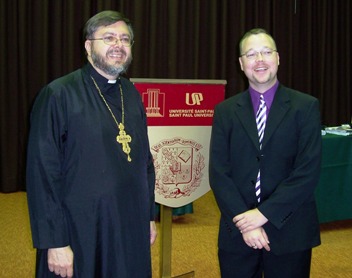
Augustine Casiday on Evagrius of Pontus

I have been fascinated by the figure of Evagrius of Pontus for more than a decade now since I first encountered him in a doctoral class that was focusing on his treatment of the logismoi or disordered thoughts or passions (eventually, in a round-about way, to be better known in the West as the seven deadly/capital/cardinal sins). Equally interesting is Evagrius's rather controverted reputation, which has been debated off and on for centuries: was he an "Origenist" (and if so, what does that mean, and is it fair first to Origen and then to Evagrius to be so tarred)? Was he therefore a heretic? Did he fall under the apparent condemnations of the fifth ecumenical council?

To answer some of these questions and others, we turn to a fantastic new book by Augustine Casiday, whom I interviewed last year about his other recent work, The Orthodox Christian World.
 
AD: What led you to write Reconstructing the Theology of Evagrius Ponticus: Beyond Heresy? 

Augustine Casiday: My first major project was about the theme tradition in John Cassian’s writing and his theology. The first thing anyone notices upon reading Cassian’s monastic works is how garrulous the monks are whose conversations and teachings he relates in his Institutes and Conferences– so much so that it is sometimes difficult to comment satisfactorily about a coherent underlying position that can be attributed to Cassian himself. Now in Conferences 9 and 10, Cassian relates Abba Isaac’s teachings on prayer and these teachings are strikingly similar to positions advanced by Origen and his followers. Taking those points of correspondence for a start, Salvatore Marsili worked up a full analysis of Cassian’s dependence upon Evagrius Ponticus’ teachings and published the results in 1936 as Giovanni Cassiano ed Evagrio Pontico: Dottrina sulla carità e contemplazione. Since then, Evagrius’ writings have been an essential reference for anyone working seriously on Cassian. So I started reading Evagrius’ works and I started reading secondary literature about him, the better to understand John Cassian.

There was a fairly narrow consensus about Evagrius’ significance, stretching back at least to the seventeenth century with the great Tillemont’s Mémoires. This consensus identifies Evagrius as the continuator and synthesiser of Origen’s thought, under whose influence that tradition became unquestionably heretical. Hans Urs von Balthasar accused Evagrius of reducing the fluid beauty of Origen’s theology to a severe, mathematical precision; a French philologist named Antoine Guillaumont argued that the condemnations of Origen at the Fifth Ecumenical Council were quoted from a version of a text by Evagrius that he discovered; Elizabeth Clark took these ideas and ran with them, sacrificing the finesse and precision of the continental scholarship. These accounts didn’t resonate with what I was reading from Evagrius himself. They rested on the presumption that Evagrius had rightly been condemned in the sixth century, with scholars like Guillaumont going so far as to assert that the condemnations disclosed the inner significance of Evagrius’ teaching. An assortment of works by Evagrius appeared in English translation from a distinguished scholar of later Byzantine monastic literature, which was that scholar’s first major contribution to the study of Evagrius and which was wholly dependent upon Guillaumont’s work for its theoretical orientation, thus further popularising that perspective. 

On the other hand, someone – almost certainly my supervisor, Fr Andrew Louth – put me on to a series of booklets about various themes in Evagrius’ works that the German monk, Gabriel Bunge, had written. These publications opened up another perspective on Evagrius, one that attempted to evaluate Evagrius with reference to antecedent texts and ideas (rather than with reference to the subsequent condemnations) and that, as such, was fresher. It was also a more theological project. There was conspicuously little interest in the other publications to anything that could be remotely construed as theology. Exceptions to my statement come in the form of attention dedicated to controversies about theological topics. For all the difference it made to the publications, though, those controversies could have been about imperial succession or the price of grain. In 2004, I published a review essay in which I analysed these two trends at some length. That same year, a dossier of text by Evagrius in my own translation appeared in the Routledge Early Church Fathers series as Evagrius Ponticus.

I’ve lost track of how many pieces I have published in the decade since then about themes in the writing of Evagrius and about trends in the study of Evagrius’ writings. Despite the increased prominence of the research project I identified in that review essay as the “Benedictine Perspective,” it was disappointing to notice that publications in English continued to pop up that were splendidly oblivious to the principled alternative to research in the mode of Antoine Guillaumont. People persisted (and still persist) in interpreting Evagrius in terms of a mystical Neoplatonic synthesis with Christian monastic practices, and in these interpretations they betray scant familiarity with advances in scholarship about Neoplatonism, about late ancient philosophy and religion, about monasticism, about changes in Eastern Roman society from the fourth to the sixth centuries, about the transmission and reception of Christian texts, about the formation of orthodoxy, about the thematization of heresy…. I could go on, but I think you understand my point. 

All of these advances directly bear on any responsible reconstruction of Evagrius’ thought, and several specialist pieces about Evagrius have been published that simply fail to recognise that the terms for scholarly assessment have changed. Of the three books published in English since 2009 that mention Evagrius in their title or subtitle, two of them are hopelessly isolated from the scholarly conversations where the action is happening. (In fact, one of those books made some pretty snotty comments about a fine book that appeared in 2005, Luke Dysinger’s Psalmody and Prayer in the Writings of Evagrius Ponticus, and in doing so betrays that its author seriously misjudged the state of the research.) Those monographs, along with many articles and shorter pieces, have kept indefatigably to the path worn smooth by three centuries of study, contributing to the discussion not much more than a dash of modern terminology. My assessment is that, in doing so, they have attempted to explain the obscure by means of the ambiguous. What was needed was an English-language book that would introduce Evagrius’ life and his writings and attempt a theological interpretation of those writings that was fully engaged with the research. I wanted to present Evagrius as a theologian – whether an orthodox theologian or a heretical theologian matters less to me than simply as a theologian – in the round and to familiarize a broad audience with the advances that have been made over the past decades and that inform how scholars interpret Evagrius’ works. I tried to write so as to be comprehensible to a general readership. The book in hand is the result. It was written from 2005-2007, and revised episodically during the intervening years as my work shifted from being driven primarily by research to being driven primarily by teaching.  

AD: For those not overly familiar with him, give us a brief sketch of who Evagrius was and why he was and is a significant figure. 

Evagius’ likely dates were 345 to 399. He was from a town near the Black Sea. His family were Christian, were well-to-do, and were on friendly terms with the family of Basil the Great. Basil himself seems to have had a hand in Evagrius’ early moral and intellectual formation, as did Gregory the Theologian. When Gregory became archbishop of Constantinople, Evagrius was with him as his deacon. Although there is still work to be done on this subject, readers familiar with Gregory’s celebrated Theological Orations and the writings by Evagrius have sometimes commented on the likelihood that Evagrius helped to draft the former. In any case, Evagrius left Constantinople shortly after Gregory did. He made his way to Palestine, where he was received by Melania the Elder and Rufinus at their monastery on Mt Olivet. Eventually he continued on to the deserts of Lower Egypt, where he was inducted further into monastic life by Macarius the Egyptian and Macarius the Alexandrian. He lived the rest of his life in the company of monks who were in the second generation (roughly speaking) after Anthony the Great “made the desert a city.”

Evagrius was highly educated and articulate. In due course, people sought him out for guidance. He wrote dozens of letters as well as brief notes on books from the Bible, treatises on specific topics, and kephalaia – pithy sayings often arranged into complex structures. These works were circulating in Greek, but also in translation: we know that, within the first half of the fifth century, at least some of his writings were available in Latin, Coptic, Syriac, and Armenian. By that time, they were being read in Constantinople and in Marseilles. Scraps dating to a later period have been found along the Silk Road translated into Sogdian, and in Ethiopia translated into Ge‘ez. There are countless reasons to read Evagrius’ works, but I’m sure I am not alone in finding his integration of morality, understanding and prayer to be compelling. Even after his name became controversial in the sixth century (it is unanimously agreed by scholars that there is no evidence his reputation was contested before then, but not all of us agree about why that matters), writings like his Praktikos, Gnostikos, and Kephalaia Gnostika – a trilogy of kephalaia about asceticism, exegesis and theology – and his On prayer continued to be read and copied. That latter text was re-attributed to preserve it and eventually it came to be included in the Philokalia. Evagrius was the leading theoretician of early Christian monasticism, and also a theologian of remarkable insight and subtlety. 

AD: To the extent that people may be familiar with Evagrius, it is often because he is tarred by association with Origen (who is himself held in suspicion by some). Is the skepticism surrounding Evagrius justified--or is that a question likely to be debated endlessly in view of the fact (as you note—p. 59) that we “lack the primary material…to evaluate…the claims made by the anti-Origenists”? 

I think some justification can be had for scepticism because, as you rightly say, typically Evagrius’ name is initially presented in a negative light. Disavowing him has for centuries been some kind of badge of orthodoxy. However, the case of Evagrius’ reputation is a goad to further thinking because, no matter how negative that initial presentation, it remains the case that Evagrius wrote one of the golden verses of Eastern Christianity: ‘If you are a theologian, you will pray truly; and if you pray truly, you will be a theologian.’ I accept that the text in which that kephalaion was found was attributed to Nilus, not to Evagrius, for hundreds of years. But equally I accept that scholarship has decisively overturned the traditional attribution. Anyone who insists (for whatever reason) that Evagrius didn’t write that line is plain wrong. Anyone who mounts an argument against the attribution to Evagrius is probably also intellectually perverse. Evagrius’ reputation prompts us to consider how pristine we think the Christian heritage must have been. Vladimir Lossky warned against a “monophysite ecclesiology” which “manifests itself in a desire to see the Church as essentially a divine being whose every detail is sacred” – a vivid extension of Christological terminology; I’m sure a similar attitude is at work in some church histories, so with a nod to Lossky maybe we should be on guard against “monophysite ecclesiastical histories.”

I think I’m straying from your question. The point I’d like to make is that an initial suspicion is justified, but there is mounting evidence that Evagrius has been systematically misinterpreted. In the early sixth century, Cyril of Scythopolis related suspicions that have no real foundation in Evagrius’ texts but linked those suspicions to Evagrius’ name. A perspective attributed to some saintly and authoritative figure doesn’t have to be repeated too frequently before people begin to think they know what Evagrius taught despite never having read a word by him. There is also mounting evidence from around the same period that people were translating, and in some cases tampering with, earlier texts. I’ve argued that the Syriac version of Evagrius’ Kephalaia Gnostika discovered by Guillaumont attests to a version that was reworked in the sixth century, and subsequent to the publication of my book I’ve further argued that a Greek translation of writings by John Cassian also belongs to the same milieu. We also have some evidence of teachings by a nearly contemporary mystic, Stephen bar Sudaili, who resided in Palestine and whose teachings correspond at some points to the condemnations of Origen, Didymus, and Evagrius. There is not adequate evidence for my interpretation to be compelling, but there are certainly good reasons to think that what has generally been called “Origenism” (and that Guillaumont identified as “Evagrian Origenism”) is in fact a product of the sixth century and, pace Guillaumont, is not the true teaching of Evagrius. 

AD: You note that while some Greeks may have been ambivalent about Evagrius, “Syriac Christians were undisguised in their enthusiasm” (p. 62). Why is that—why the enthusiasm? 

I’ll be honest: my limited grasp of Syriac is in service to my study of Evagrius. So what I know about the Syriac tradition washes on the shores of the Evagrius’ writings. Probably that isn’t so unusual. My sense is that lots of people learn Syriac to study a particular author. I never moved very far beyond that practical use. All this is to say I can only speculate in answer to your question. Here goes: Even though we have evidence of some Syriac Christian debates about Evagrius (most notably, in Babai the Great’s commentary to the Kephalaia Gnostika), I am aware of no evidence that there were Syriac developments parallel to the Second Origenist Controversy; that is to say, so far as I know, Evagrius was never at the heart of a far-reaching Syriac controversy. Evagrius was never the polarizing figure for them that he became for the Greeks, to the best of my knowledge. So what I speculate is that no sense of propriety ever acted as a barrier to the widespread appropriation of his writings. Evagrius’ writings that are available in Syriac, some of which are unavailable in Greek, are lively and appealing. I have to resort to contrasts here because I am by no specialist in Syriac Christianity, but it seems to me that the Greek tradition is uniquely paranoid when it comes to Evagrius – unlike the Latins, who never really internalised Evagrius and primarily got his influence as mediated by Cassian; and unlike the Syrians, who didn’t have debates about Hellenism and Christianity that sheared over Evagrius. Let me try to answer with an analogy. The Greeks fought amongst themselves fiercely about iconography. The Romans didn’t, the Carolingians didn’t, the Syrians didn’t. I can’t think of any reason to suppose all other Christians should be obliged to defer to debates that were internal to Greek Christendom and to structure their positions with reference to the Greek debates and the resolutions to those debates. 

AD: You note that pace von Balthasar and others, Evagrius did not have a rigid system of concepts. Is such a lack of systematic conceptualization part of the reason that Evagrius has been subject to misunderstanding? 

There must be a system that underlies Evagrius’ teachings. Jeremy Driscoll showed beyond any possible doubt in his work Evagrius Ponticus: Ad Monachos that structures can be identified linking and interlinking the kephalaia that make up that text. And Fr Jeremy was motivated to seek out those connections by noting that Evagrius suggests his readers should diligently seek out patterns in his writings. The most conspicuous example is the trilogy that I mentioned earlier, which recapitulates the three themes of Christianity that Evagrius identifies in the first kephalaion of the first work of that trilogy: “Christianity is the teaching of our Saviour Christ, composed of [1.] ascetical practice, and [2.] natural contemplation, and [3.] theological encounter.” Those three terms, I expanded for the sake of English grammar, are πρακτικῆς και φυσικῆς καὶ θεολογικῆς; they correspond to the central themes of the Praktikos, the Gnostikos, and the Kephalaia Gnostika respectively. In consideration of these indicators of structure, I’m not prepared to write off the possibility that Evagrius’ teachings are informed by a systematic conceptualization. 

Even so, I’m convinced that many earlier students of Evagrius were looking in the wrong places for his system. Balthasar said some pretty silly things, the silliest of which was to claim that Evagrius’ spirituality was more Buddhist than Trinitarian; Hausherr flatly contradicted the obvious meaning of a kephalaion in Evagrius’ On prayer in his own commentary to it, expressly preferring to maintain his own system instead of acknowledging Evagrius’ plain teaching that the Holy Spirit is not bound to act in accordance with our formulation of the spiritual life; numerous lesser scholars have also been too enthralled to the claim (stated by no one more clearly than by Guillaumont) that the anathemas from the sixth century and Evagrius’ Great Letter, sometimes wrongly called the letter “to Melania,” provide a key that unlocks the mysteries of Evagrius’ thought. That grand old tradition seems to me no longer plausible, since it privileges debates that occurred roughly 150 years after Evagrius’ death – debates, lest we pass over this point too quickly, that specialists unanimously agree were importantly different to the debates current around the time of Evagrius’ death – as disclosing the inner meaning of Evagrius’ theology. I don’t know a single person who has studied the evidence and who seriously thinks that the Second Origenist Controversy is a direct continuation of the First Origenist Controversy. So it baffles me that some people, including a few self-professed experts, work on the assumption that Second Origenist Controversy was the moment when Evagrius’ system was revealed at long last. At very long last indeed, actually. 

To make better sense of Evagrius’ system, my inclination is to follow the example set by Bunge, by Driscoll, and by Dysinger amongst others. An interrogation of Evagrius’ writings conducted with knowledge of the Bible (especially the Psalter), with knowledge of theological trends contemporary to Evagrius, and with knowledge of the ascetical and ethical practices that he observed is, I suspect, more likely to disclose substantial patterns – even a conceptual system – than is reference to condemnations that were meaningful within circumstances that evolved in the decades after Evagrius had died, but not meaningful before then.

AD: You reflect at length on the role of the emotions in prayer, and note that for Evagrius prayer should be understood as “joy surpassing every other.” Am I wrong in thinking that too often we do not think of strict ascetics like Evagrius as being terribly joyful? 

No, you are quite right that too often we don’t think of Evagrius and others in those terms. The reason, I think, is that Greek monastic literature (including Evagrius’) stresses ἀπάθεια, freedom from the passions or, as I translated that term for the collection of Evagriana, imperturbability. But in advocating freedom from the passions, they weren’t calling for emotionlessness. There are scattered traces through Evagrius’ works of evidence that he recognised how useful emotions could be if they are disciplined to serve the Christian life. There is a nice little passage in the Causes for monastic observances in which Evagrius makes clear that monks should aim to be happy and that happiness is not incompatible with seeking freedom from perturbations or seeking stillness (ἡσυχία): 
Do you wish, then, beloved, to take up the monastic life as it is, and hurry toward the trophies of stillness? Then abandon the cares of this world and the principalities and powers set over them! That is, be free from material things and from perturbations, set apart from every desire. If you thus become a stranger to all that concerns them, you will be able to be still in happiness; yet if one does not withdraw from them, he will never be able to follow this way of life rightly. 
I seem to recall that there are also some nice examples in Evagrius’ Antirrhetikos – a fascinating book, translated by David Brakke fairly recently as Evagrius Of Pontus: Talking Back: A Monastic Handbook for Combating Demons, in which Evagrius identifies verses from the Bible that are particularly suitable for recitation under specific circumstances and arranges them according to the eight generic thoughts – but no precise quotations occur to me. What I think I remember is that, nestled along the common suggestions about passages to say in response to demonic temptation, there are a few joyful psalms that he encourages people to recite when things go well. 

AD: In this book, in some of your earlier work (I think, e.g., of your very insightful and helpful 2012 article on Evagrius and heresy in the Heythrop Journal), and in your newest book from SVS Press Remember the Days of Old: Orthodox Thinking on the Patristic Heritage, there are clear and overlapping themes about Christian historiography and its methods. Can you distill out for the Christian of the twenty-first century any general guidelines on how to look at Christian history, the Church Fathers, and texts from vastly different contexts and eras than our own? (I ask this because I too often see Christians doing hermeneutic violence to texts, and using, say, an ancient canon, or obscure passage from a Cappadocian or an Alexandrian to condemn or promote this idea or that.) 

One theme dear to Evagrius that applies here is the need for humility, which is a great place to start. And not that noxious vice of corporate pride that presents itself as humility, either – but the real thing: humility before God. I reckon one of the quickest ways to distinguish theological engagement with historical sources, on the one hand, from faddish studies of themes from late ancient Christianity, on the other, is by putting publications that have anything whatever to do with God in one pile and the rest in another. If the reader’s attention is directed to a community and its practices and members, and if its beliefs are referenced to the group’s identity, then whatever else that writing might be it is probably Christian only in a superficial or nominal sense. After orientating the project toward God, get whatever technical skills are needed for the task at hand. Then set to work.

AD: To those who would condemn Evagrius as a heretic, what would you say?  

Probably not much. I might ask them to explain what they are condemning and to relate that back to Evagrius’ writings.

But since you put the question to me that way, I want to state my position in a matter that has generated some misunderstanding. The historical events that resulted in Evagrius’ condemnation can be disentangled and evaluated on their merits. Since my research is historical in its methodology, sorting out the evidence and assessing it is my major preoccupation. That work has reached a stage such that I am confident in saying that several of the claims about Evagrius are bogus and should be understood in terms of factors that are isolable from his theology (even if they can be seen to derive from it). The assertion that Christ’s resurrection body was a sphere is a clear example. There are other claims whose merits I have not evaluated to my satisfaction: it’s entirely possible that Evagrius believed in universal salvation, for instance. Anyway, the point of my work isn’t to vindicate Evagrius. It’s to study his theology using the best resources and methods available to me. I’m following the evidence and the methods where they lead. If the conclusion is that Evagrius’s theology was heretical, so be it. 

AD: Sum up what you hope for this book and who should read it. 

I’d really like for the scholarly conversations about Evagrius to move beyond terms inherited from the Second Origenist Controversy. It’d be most welcome for Anglophone scholarship to come out from the shadow of Francophone scholarship. Further study of Evagrius’ theology is urgently needed, and here I’d make a contrast to some of the recent publications that have focused on themes in Evagrius’ work that are only tangentially related to theology, such as hermeneutics or anthropology or gnosis. You mentioned my article in the Heythrop Journal. One of the reasons I wrote it was to argue that imprecise or inaccurate theology has far-reaching consequences for research into those other themes. Getting Evagrius’ theology right is basic to further applications of his writings. Those observations are chiefly relevant to patristics. I’d like to think, though, that the book will be read by people who are interested in other historical eras (one of the great missed opportunities is when specialists in Byzantine theology appeal to dilapidated old ideas about Evagrius for their research), or who simply want to know more about the theology of a fascinating and influential monk.

AD: What projects are you next at work on?

So far, my big books have been biographical. The next one I’m planning is a comprehensive study of Boethius. In the slightly longer range, I’m reading books by Leszek Kołakowski, Karl Mannheim, R. G. Collingwood, Michael Polanyi and Maurice Halbwachs. At present, it isn’t clear where these readings will take me. But they are proving helpful in a preliminary way as I think about the contemporary reception of ancient Christian sources and about trends in modern theology.
Related Posts Plugin for WordPress, Blogger...