"Let books be your dining table, / And you shall be full of delights. / Let them be your
mattress,/
And you shall sleep restful nights" (St. Ephraim the Syrian).


Showing posts with label Eugene McCarraher. Show all posts

Friday, November 15, 2019

The Gods of the Marketplace

I was, to be honest, a little amazed to learn that Harvey Cox is still alive, lazily assuming that anyone whose first big book was published in the 1960s must have died some time ago. But he's not just alive, but set next month to release a paperback edition of The Market as God (Harvard University Press, 2019), 320pp.

About this book the publisher tells us this:
The Market has deified itself, according to Harvey Cox’s brilliant exegesis. And all of the world’s problems—widening inequality, a rapidly warming planet, the injustices of global poverty—are consequently harder to solve. Only by tracing how the Market reached its “divine” status can we hope to restore it to its proper place as servant of humanity.
The Market as God captures how our world has fallen in thrall to the business theology of supply and demand. According to its acolytes, the Market is omniscient, omnipotent, and omnipresent. It knows the value of everything, and determines the outcome of every transaction; it can raise nations and ruin households, and nothing escapes its reductionist commodification. The Market comes complete with its own doctrines, prophets, and evangelical zeal to convert the world to its way of life. Cox brings that theology out of the shadows, demonstrating that the way the world economy operates is neither natural nor inevitable but shaped by a global system of values and symbols that can be best understood as a religion.
Drawing on biblical sources, economists and financial experts, prehistoric religions, Greek mythology, historical patterns, and the work of natural and social scientists, Cox points to many parallels between the development of Christianity and the Market economy. At various times in history, both have garnered enormous wealth and displayed pompous behavior. Both have experienced the corruption of power. However, what the religious have learned over the millennia, sometimes at great cost, still eludes the Market faithful: humility.
Cox is of course a Protestant, and I hope it will not be taken as an ecumenical felicity if I mention that I shall read his book second. I will do so after I have read The Enchantments of Mammon: How Capitalism Became the Religion of Modernity by Eugene McCarraher, a Catholic scholar and writer of singular insight whom I have often cited since discovering him a few years back.

McCarraher's big book of 816 pages, is also published by Harvard UP, and released this week. About it the publisher tells us this:
Far from displacing religions, as has been supposed, capitalism became one, with money as its deity. Eugene McCarraher reveals how mammon ensnared us and how we can find a more humane, sacramental way of being in the world.
If socialists and Wall Street bankers can agree on anything, it is the extreme rationalism of capital. At least since Max Weber, capitalism has been understood as part of the “disenchantment” of the world, stripping material objects and social relations of their mystery and sacredness. Ignoring the motive force of the spirit, capitalism rejects the awe-inspiring divine for the economics of supply and demand.
Eugene McCarraher challenges this conventional view. Capitalism, he argues, is full of sacrament, whether or not it is acknowledged. Capitalist enchantment first flowered in the fields and factories of England and was brought to America by Puritans and evangelicals whose doctrine made ample room for industry and profit. Later, the corporation was mystically animated with human personhood, to preside over the Fordist endeavor to build a heavenly city of mechanized production and communion. By the twenty-first century, capitalism has become thoroughly enchanted by the neoliberal deification of “the market.”
Informed by cultural history and theology as well as economics, management theory, and marketing, The Enchantments of Mammon looks not to Marx and progressivism but to nineteenth-century Romantics for salvation. The Romantic imagination favors craft, the commons, and sensitivity to natural wonder. It promotes labor that, for the sake of the person, combines reason, creativity, and mutual aid. In this impassioned challenge, McCarraher makes the case that capitalism has hijacked and redirected our intrinsic longing for divinity—and urges us to break its hold on our souls.

Wednesday, February 28, 2018

Eastern Orthodoxy and Human Rights

The Orthodox scholar George Demacopoulos (some of whose publications I have noted on here over the years, and whom I interviewed about his book Gregory the Great: Ascetic, Pastor, and First Man of Rome) recently announced on Facebook that the "Orthodox Christian Studies Center, Fordham University has won a $250,000 grant from Leadership 100 to conduct a five-year scholarly study of the compatibility of Orthodox Christianity and Human Rights."

These are topics that George and his colleague Aristotle Papanikolaou have circled around for some time in some of their individual publications as well as co-edited collections from the excellent conferences they organize and host on a regular basis. See, e.g., Christianity, Democracy, and the Shadow of Constantine as well as the earlier and invaluable collection Orthodox Constructions of the West, which I discussed in detail starting here.   

The news of this grant is welcome in a time when it has become increasingly fashionable to denounce the horrors of, and call for the total replacement of, modern liberalism, including its notions of human rights. Twenty years ago, in writing a thesis on Alasdair MacIntyre, I became very sympathetic to his splenetic dismissals of rights language, belief in which, he said, is at one with belief in witches and unicorns. Even more, of course, did MacIntyre set his face against the entire liberal project as having failed to do what it promised and instead having illicitly smuggled in (a favourite MacIntyre verb) a lot of premises and practices extraneous to it. I followed him very closely in thinking this, and still do to some extent.

I wrote at a time when the Radical Orthodoxy movement was going strong, and in fact I made inquiries with both John Milbank (when he was briefly at the University of Virginia) and Catherine Pickstock at Emmanuel College in the University of Cambridge, about writing a dissertation on medieval voluntarist corruptions of authority, with the idea of building upon MacIntyre's claim that modern emotivism rests upon the obliteration of any coherent distinction between power and authority, and upon Radical Orthodoxy's claim (increasingly challenged) that the real bogeyman here is Scotus.

More recently, however, as a student of MacIntyre, I have followed him in tempering some of the criticisms of the liberal project precisely insofar as he has admitted to not knowing how to replace it, and has admitted to being aware of the acute problems that any such "replacement" would have to grapple with. Thus in his essay "Toleration and the Goods of Conflict," published in the 2006 collection Ethics and Politics, he said those calling for new forms of community after liberalism, or built on the ashes of liberalism, have yet adequately to engage in "rethinking even further some well-established notions of freedom of expression and of toleration. But about how to do this constructively in defence of the rational politics of local community no one has yet known what to say. Nor do I.” Would that more recent authors had such humility and restraint.

Such restraint has not always been in plenteous supply among critics of liberalism, including Milbank and Pickstock who, as Eugene McCarraher noted in this splendid series of interviews, sometimes turned theology into a "blood sport" and treat “'modernity' and 'liberalism'...as though they were the spawn of Satan."

Such curdled denunciations are by no means limited to Western Christians. Eastern Christians, especially in the post-Soviet period and space, have often been even more reactionary in this regard, denouncing human rights and much else besides as threats to "holy Russia" and other places that do not exist.

More recently, however, some scholars have begun to reconsider matters, arguing that Orthodoxy is not necessarily hostile to rights language no matter how much certain of her apologists would like for this to be so. Thus we had the collection Orthodoxy Christianity and Human Rights published in 2012 under the editorship of A.Brüning and E. van der Zweerde.

In 2013, we saw the publication of The Russian Church and Human Rights by Kristina Stoeckl, whom I interviewed here about this important book.

This year--this month, in fact--we were promised another collection, Orthodox Christianity and Human Rights in Europe: A Dialogue between Theological Paradigms and Socio-Legal Pragmatics, but publication seems to have been delayed.

And soon, it would seem, thanks to Fordham's funding, we will have further treatments of these complex issues, which can only be welcomed.

Friday, February 2, 2018

The Fundamental Rule of Prayer: Free Association?

Today's lovely feast, which of course brings the 40-day Christmas cycle to an end, is that of the Presentation of Christ in the Temple, often known as Candlemas. And in the Catholic world it's kept as a day to remember consecrated religious who devote their lives to prayer and contemplation. But what is prayer, and what of our difficulties with it? Here are some thoughts on that question aided by two books I read back to back last weekend--quite unintentionally, I might add, or at least without conscious (!) intent.

But hear me out when I suggest that there are connections to be discovered between late Anglo-Irish Dominican theologian Herbert McCabe's God, Christ, and Us, and the contemporary Anglo-American psychoanalyst Christopher Bollas in The Evocative Object World.

I started with McCabe's lovely short book of sermons, God, Christ, and Us. If you are casting about for suitable Lenten reading material this year, permit me very warmly to recommend it. No chapter is very long, and none suffers from that kind of revolting treacle one sometimes associates with pious utterances such a sermons. McCabe was not pious in that sense at all, but very earthy and practical in a refreshingly straight-forward kind of way. The God preached by this member of the Order of Preachers is a God you actually want to meet, indeed might actually look forward to meeting, and quite probably over a drink or meal à deux. 

I first encountered McCabe's name in the 1990s when Stanley Hauerwas made an off-hand reference to him in connection to Alasdair MacIntyre. I paid no heed as Hauerwas didn't say much and I wasn't interested enough to pursue the matter. Later I would see MacIntyre himself in several places confess debts to McCabe, but without much detail to spur on an investigation on my part.

But the person who really convinced me I must read McCabe was and is Eugene McCarraher, whom I first stumbled across in articles like this (discussing Terry Eagleton's Culture and the Death of God) and then this deeply fascinating three-part interview, the third of which avers "I swear that reading McCabe has often kept me a Christian." In my more despairing moments recently, I know exactly what McCarraher means by that, and I suspect very strongly he had lines like this from McCabe in mind:
"Like Peter and the 12 we remain Christians because there is nowhere else to go: if Christianity is not the revolution, nothing else is" (Law, Love and Language, 1968).
McCarraher has also written a lovely overview of McCabe's life in this Commonweal article which notes, inter alia, that McCabe's "radicalism" was precisely and only possibly because of its deep orthodoxy. Rooted in the tradition, he could see its deeply subversive potential--even if, alas, that potential is almost always domesticated, tamed, thwarted by the powers and principalities of the present age. His orthodoxy, then, allowed him freely to explore socialism and Marxism.

Though my reading is still early yet, I have not see in him so far much exploration of Freud. But the language is clearly there. Repeatedly McCabe uses classical Freudian language in unmistakable ways, especially speaking of our tendency towards "projection" and our wallowing in "illusion" about both ourselves and God. In, e.g., Faith Within Reason, reflecting on the prodigal son, McCabe writes:
Sin is something that changes God into a projection of our guilt, so that we don’t see the real God at all; all we see is some kind of judge. God (the whole meaning and purpose and point of our existence) has become a condemnation of us. God has been turned into Satan, the accuser of man, the paymaster, the one who weighs our deeds and condemns us…For damnation must be just being fixed in this illusion, stuck forever with the God of the Law, stuck forever with the God provided by our sin (155-56; my emphasis).
A little later on, McCabe uses language that very much echos the difficulties of psychoanalysis as Freud saw them for it confronts people with hidden, and often infelicitous, desires, images, and actions. But both Freud and McCabe argue that it is much better to face up to ourselves, sinful and infantile as we are:
We damn ourselves because we would rather justify and excuse ourselves, and look on our self-flattering images of ourselves, than be taken out of ourselves by the infinite love of God…Contrition, or forgiveness, is self-knowledge, the terribly painful business of seeing ourselves as what and who we are: how mean, selfish, cruel and indifferent and infantile we are (Faith Within Reason, 157).
But it is in McCabe's sermons on prayer, two of which are found in God, Christ, and Us that most put me in mind of what Bollas says in the first chapter of The Evocative Object World, and, come to think of it, what Adam Phillips has also said, as I noted here in discussing his ideas about distractions and frustrations; see also his book Side Effects. The link between the two of them seems to be an unapologetic advocacy of free association, leading to my question: are prayer and psychoanalysis the only activities today where one's mind can range freely without being hectored and controlled by ideologues and capitalists (the two often being the same thing)? Are the pew and the couch the only places left to us today as places that do not demand anything of us but give us silence, space, freedom?

Bollas thinks that today's "attacks on psychoanalysis are thinly disguised attacks on unconscious life itself" because "there is a widespread contempt for unconcious life in modern culture." He doesn't say why this is, but it's not hard to figure out: both analysis and prayer, as activities in which our mind ranges freely in search of some outlet for our deepest desires and hurts, are precisely the vague, free-flowing, unproductive, dreamy, gimmick-free kinds of activity that cannot be monetized or commodified or turned into an app promoting "mindfulness" or some other bit of money-making chicanery.

Bollas's first chapter treats free association, noting that it's a mutual process of analyst-analysand freely associating together, creating the analysis together. As he nicely put it, this is an experience in which one can rightly and proudly say "You don't know what you're talking about!" But still you talk, and listen, and associate, and eventually certain things become clear. Other things may not become clear, but this is not necessarily a failure, for the value of analysis is not just the "what" or the content: it is also the process--as Bollas has said elsewhere, echoing D.W. Winnicott--of being held and contained, of developing a deep connection to another human being that in itself is worthwhile, not least in its transferential (and thereafter transformational) power. Furthermore, an analysis is worthwhile not just for the clarity of content that sometimes comes about, but also for the "psychoanalytic mind" it creates, as Fred Busch has so winsomely described.

The beauty of this, as I have long appreciated it, is that "psychoanalysis does not provide ready answers to patients symptoms or lives," as Bollas admits. This, he recognizes, is "disconcerting" for those who think that clinicians are supposed to be experts. In fact, Bollas--and here his thought closely tracks that of Phillips, as I have repeatedly shown on here--says that the free associating of the unconscious of both analyst and analysand "subverts the analyst's natural authoritarian tendencies as well as the patient's wish to be dominated."

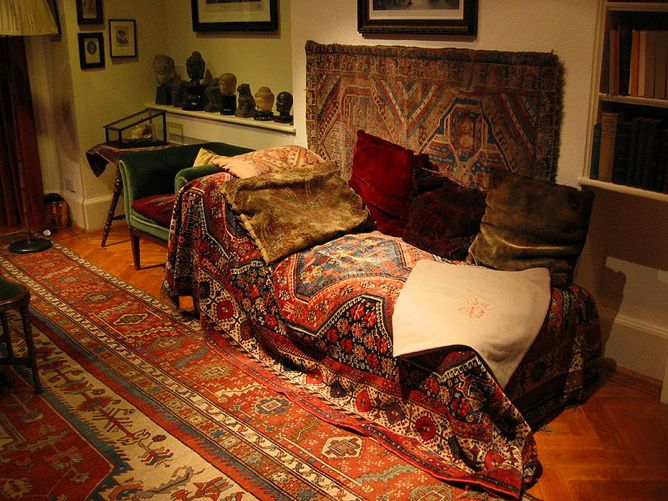
In this regard, Bollas puts me in mind of how Maggie Ross describes the mistaken notions behind modern concepts and practices of "spiritual direction," much of which consists of attempts at "mind control" as she puts it, and the result of which is to reinforce one's narcissism. Silence, for Ross, whose book shows considerable familiarity with psychoanalytic ideas, is the goal, and is hugely valuable in itself--a point that also becomes abundantly clear in reading the psychoanalytic literature about silent patients who nonetheless get better--start with another fascinating English Anglican, the analyst Nina Coltart, for examples of this; see her Slouching Towards Bethlehem.

McCabe doesn't come right out and advocate freely associating during prayer, but he very much leans in that direction. This is something I'll have to think about some more, but it does seem to me a helpful way to conceive of prayer and the problems of being distracted during or bored by prayer, or restlessly wondering about the futility of it all.

Rather than fighting that, McCabe advocates letting your mind wander until you find what you really want to pray about, and then praying about it. Here, again without using the words per se, McCabe seems to me to establish the "fundamental rule" (cf. Freud's "On Beginning the Treatment") of prayer outside the shackles of whatever spiritual superegos may be trying to tell us otherwise. If we let ourselves pray for what we are really concerned about, McCabe says, those prayers not only will almost always be, but in fact should be "the vulgar and rather infantile things you really do want," instead of all the pious and high-minded things we think we should pray about.

If we're distracted during prayer, it's because we're not praying for the right things (he notes those on sinking ships never report distractions during their prayers!), and constraining ourselves to pray for the things our superego tells us to--the "proper and respectable and 'religious'" things. Instead of that, as he drolly puts it, "you could let world peace rest for a while."And while you're at it, let your mind run to those distractions because they "are nearly always your real wants breaking in on your prayer." (Lest we worry that this is an excuse for descending into infantile selfishness, McCabe says that if we are honest in prayer about our desires, the Holy Spirit will invariably lead us deeper, for prayer involves change and growing up.) If psychoanalysis involves, as Bollas argued in his first major book The Shadow of the Object, a certain "ordinary regression to dependence" for a time, does this not also describe how we are in prayer with our Father in heaven as we pray for the things closest to us that matter most to us?

Monday, November 20, 2017

On the Theological Roots of the Russian Revolution and Communism More Generally

We were fortunate last week to bring to Ft. Wayne a fascinating scholar who teaches just an hour south of us at Ball State University: Sergei Zhuk, whose dual doctorates mark him out as a scholar of both American and Soviet/Russian history of the 20th century.

His talk, on the centenary of the Russian Revolution, was a deeply learned and wide-ranging affair. It was especially noteworthy to me that he began with and spent some time on the deep theological roots of the revolution, and of communism in particular. In doing so, he drew on, inter alia, his 2004 book Russia's Lost Reformation: Peasants, Millennialism, and Radical Sects in Southern Russia and Ukraine, 1830-1917 (Woodrow Wilson Centre Press), 480pp.

The theological roots of communism and the revolution are also treated in this new essay by Eugene McCarraher, who is always worth reading. When and if his much-promised and much-delayed book The Enchantments of Mammon: Capitalism and the American Moral Imagination is published I'm quite sure it will be worth reading.
Related Posts Plugin for WordPress, Blogger...